Is North Macedonia Part Of The EU?
No, North Macedonia is not in the EU or Schengen. What that means for visas, currency and travel to Ohrid, with entry rules and planning facts.
Ohrid is a lakeside town in North Macedonia, a country that sits outside the European Union, outside the Schengen Area and outside the eurozone. That single fact shapes almost every practical decision a visitor makes: which visa rule applies, which currency to carry, and what happens at the border on the road in. The Ohrid Travel Guide covers this here because it is the single most common planning question travellers ask before booking, and the answer is often confused with the neighbouring countries that recently joined Schengen. The confusion is understandable. Bulgaria and Romania became full Schengen members, land borders included, on 1 January 2025, which makes the map look more uniform than it is. North Macedonia remains outside every one of those structures, and it uses its own currency, the Macedonian denar (MKD).
No, North Macedonia is not part of the European Union, and it is not a member of the Schengen Area or the eurozone either. The country operates its own visa policy, its own border checks and its own currency, the Macedonian denar. Travellers to Ohrid cross a hard international border on the way in, whatever direction they arrive from, and the entry rules that apply are North Macedonia's rather than the EU's.
The practical consequences are smaller than the phrase "non-EU" suggests, but they are real. There is a passport or ID check at every land border, so buses between Tirana, Skopje and Ohrid stop for control at the frontier. Euros are commonly quoted for tours and transfers, because the denar is pegged to the euro by the National Bank, but euros are not legal tender in the country, so day-to-day spending in Ohrid happens in denar. And the visa question is answered by the Macedonian foreign ministry rather than by any EU rulebook.
For most visitors none of this adds friction. The country is straightforward to enter, the border procedures at the main crossings are routine, and Ohrid itself is a compact town where the practical questions are more likely to be about walking shoes than about treaties. The sections below take the EU question apart into the parts that actually affect a trip.
Is North Macedonia In The Schengen Area Or The Eurozone?
No on both counts. North Macedonia is not a Schengen member and does not use the euro. The Schengen Area counts 29 states, expanded when Bulgaria and Romania became full members, land borders included, on 1 January 2025, and North Macedonia is not among them. The currency in Ohrid is the Macedonian denar, which the National Bank keeps stable against the euro, so conversion is simple even though the euro itself is not legal tender.
The Schengen point matters most for itinerary planning. A traveller combining Ohrid with Albania or Greece passes through external border checks each time, and journey times on the Skopje to Ohrid or Tirana to Ohrid bus routes include a border stop as standard. The eurozone point matters at the till. Prices for bookable tours are often listed in euros or dollars, but a museum ticket in Ohrid is quoted in denar, a taxi fare is agreed in denar, and an ATM dispenses denar. The trick is to treat the euro as a reference number, not as money you can spend.
The distinction also explains a quirk of the region's transport map. Because North Macedonia stayed outside Schengen while its eastern neighbours joined, a trip that crosses from Greece or Bulgaria into North Macedonia re-enters passport control in both directions. Anyone planning a wider Balkan loop through Ohrid and Tirana should budget for that stop rather than assuming free movement the whole way.
What Does Non-EU Status Change For An Ohrid Trip?
Three things change in practice: the entry rule is North Macedonia's own, the money is the denar, and the border is a real checkpoint rather than a line on a map. Visa-free nationals can stay up to 90 days in any 180-day period, UK visitors can stay up to three months without a visa, and euros are quoted widely but only the denar pays for things on the ground.
The visa side is more generous than many travellers expect. Citizens of the United States, the United Kingdom, the EU, Canada and Australia enter visa-free for up to 90 days in any 180-day period, per the Macedonian foreign ministry's entry information. UK guidance adds two details: a UK passport should have an expiry date at least 90 days after the date of arrival, and visitors should be registered with the local police within 48 hours of arriving, which hotels routinely handle for their guests. Anyone holding a valid multiple-entry UK, US or Canadian visa, or a Schengen residence permit, can also enter for up to 15 days under the ministry's rules.
The money side is equally simple once the peg is understood. The National Bank targets a stable denar against the euro, so the rate barely moves, and ATMs are widespread in Ohrid for withdrawing denar directly. Exchange offices handle any leftover euros at the end of a stay. The mistake to avoid is assuming the euro circulates like it does in Montenegro or Kosovo: it does not, and a shop quoted in euros will still settle in denar.
Here is the comparison in one place:
| Question | North Macedonia status | What it means in Ohrid |
|---|---|---|
| EU member? | No | EU rules on roaming, pricing and consumer law do not apply |
| Schengen member? | No, 29 states are, and it is not one of them | Passport or ID check at every border, in both directions |
| Euro currency? | No, the denar (MKD) is legal tender | Withdraw denar; euros are quoted but not spendable as money |
| Visa needed? | Not for most visa-free nationals, up to 90 days in any 180 | Check passport validity before travel |
| Police registration? | Within 48 hours of arrival | Hotels handle it for guests |
How Do You Cross The Border To Reach Ohrid?
Ohrid is reached overland, by bus from Skopje in about three hours or by minibus from Tirana in three to three and a half hours including the border, and every route passes a checkpoint because North Macedonia is not in Schengen. The crossing at Sveti Naum and Tushemisht, about 4 km from the St Naum monastery, is the local link to Albania and is reported to be open around the clock for passenger vehicles and pedestrians.
The Skopje route runs about 170 km by road with several daily departures, and the bus is the standard option since there is no passenger train to Ohrid and no domestic flight. The Tirana route runs roughly five to seven minibuses a day, crossing at Qafe Thane or Kjafasan, with fares commonly in the range of 15 to 20 euros one way as quoted by operators. Flying in is also possible: Ohrid's own airport sits about 10 km from the centre, and direct flights to Ohrid are mostly seasonal and concentrated in the warmer months, which is itself a consequence of a small, non-EU aviation market.
None of these crossings is difficult, but each one adds time that a Schengen itinerary would not. Allow for the stop when booking onward connections, and keep the passport accessible rather than buried in a bag. Travellers combining the two sides of the lake can read more about combining Ohrid and Albania on one trip before committing to a route.
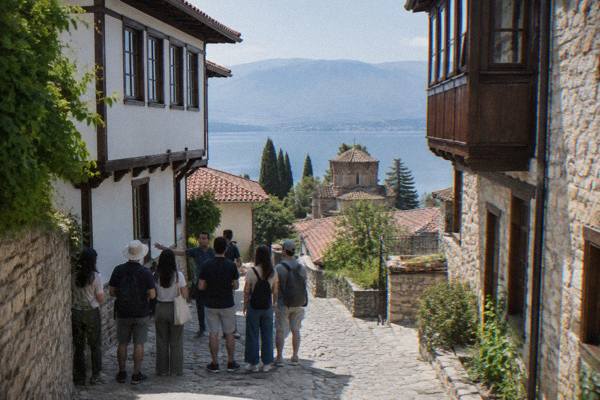
Once in town, the EU question fades quickly. Ohrid is compact and walkable, the old town lanes between the lake and the fortress walls are closed to through traffic, and the practical business of visiting settles into churches, lake water and food. A guided introduction such as the Old Town walk of Ohrid is one way to get the geography straight on the first day, and the same tour can be held with Check availability through the operator's live listing.
Which Currency, Numbers And Rules Apply Day To Day In Ohrid?
The denar is the only legal tender, emergency numbers are North Macedonia's own, ambulance 194, police 192 and roadside assistance 196, and the entry rules above are the full extent of the bureaucracy for a typical stay. Nothing about being outside the EU makes Ohrid harder to visit than a Schengen neighbour; it only means the details differ and are worth knowing before arrival.
The emergency numbers deserve the emphasis because the single European number is the reflex many travellers carry. The UK foreign office's guidance for North Macedonia lists ambulance at 194, police at 192 and roadside assistance at 196, so those are the numbers to save offline. On money, the answer to what currency is used in Ohrid is the denar, with the National Bank holding it steady against the euro, which makes budgeting straightforward for anyone arriving with euro-based expectations.
Two more day-to-day points follow from non-EU status. Card acceptance varies from place to place, so carrying denar in cash covers markets, small churches and lake-side stalls. And because the country is outside the EU's roaming arrangements, a phone plan that works "in Europe" may not work here on the same terms, so checking the roaming terms with your operator before arrival avoids surprises.
Want mobile data sorted before you land? Book a North Macedonia travel eSIM here.
Is The Non-EU Status A Reason To Skip Ohrid?
No. Ohrid's UNESCO-listed old town, its lake setting at about 693 m above sea level and its cluster of Byzantine churches have nothing to do with EU membership, and the extra planning amounts to one border check, one currency and one visa rule that most visa-free nationals clear automatically. The town rewards the small amount of extra preparation many times over.
The lake itself is the draw for many visitors: Lake Ohrid is a freshwater mountain lake inside the UNESCO mixed site "Natural and Cultural Heritage of the Ohrid Region", inscribed in 1979 and 1980 and extended to the Albanian side in 2019. Swimming, boat trips and kayaking are the summer staples, and questions like whether you can swim in Lake Ohrid get a straightforward yes in the warm months. Whether Ohrid is worth visiting is settled quickly too, by the density of churches, the fortress walls above the old town and the lake shore a short walk from everywhere.
For travellers weighing Ohrid against better-known stops, the honest framing is this: the non-EU status is a paperwork footnote, not a barrier. The border is a stamp and a short wait, the denar is stable, and the entry rule for visa-free nationals is among the more generous in the region. Deciding how many days you need in Ohrid is a far more consequential planning question than the treaty status of the country around it.
Common Questions About The EU And Ohrid Travel
Is North Macedonia Part Of The EU?
No. North Macedonia is not a member of the European Union, the Schengen Area or the eurozone, and it applies its own visa rules and currency, the Macedonian denar.
Do I need a visa to visit Ohrid?
Most visa-free nationals, including citizens of the UK, the US, the EU, Canada and Australia, can stay up to 90 days in any 180-day period without a visa. UK visitors can stay up to three months, with a passport expiry date at least 90 days after arrival.
Can I pay with euros in Ohrid?
Euros are commonly quoted for tours and transfers, but the euro is not legal tender in North Macedonia. Day-to-day spending is in Macedonian denar, available from ATMs and exchange offices in Ohrid.
Is North Macedonia in the Schengen Area?
No. Schengen counts 29 member states, and Bulgaria and Romania became full members, including land borders, on 1 January 2025. North Macedonia is outside the area, so there are passport checks at every border crossing.
What are the emergency numbers in Ohrid?
Ambulance is 194, police is 192 and roadside assistance is 196, per the UK foreign office's guidance for North Macedonia. Save them offline before arrival.
Do hotels handle the police registration?
Yes. Visitors should be registered with the local police within 48 hours of arrival, and hotels routinely complete this for their guests, so a normal hotel stay involves no extra steps.