What Currency Is Used In Ohrid?
The Macedonian denar (MKD) is the currency used in Ohrid, North Macedonia. What that means for cash, euros, tour bookings and daily spending around Lake Ohrid.
The currency used in Ohrid is the Macedonian denar, abbreviated MKD, the official currency of North Macedonia. Ohrid is a lake town, not a coastal resort, and money here works differently from neighbouring Greece or the eurozone just across the Galicica ridge: the country is not in the European Union, the euro is not legal tender, and everyday prices in shops, bakeries and museum ticket booths are set in denars. At the same time, tour operators and transfer drivers commonly quote their prices in euros, which surprises visitors who assumed the whole Balkan lakeshore had switched. The Ohrid Travel Guide covers how this split works in practice, what to hold in your wallet and where each currency is actually useful.
The currency used in Ohrid is the Macedonian denar, whose international code is MKD. It is the national currency of North Macedonia, issued by the National Bank, and it is the currency in which local prices, museum tickets, bus fares and shop tills around Ohrid are actually denominated. The euro is not legal tender in the country, although many tour and transfer operators quote their prices in it for convenience.
The denar is the only official money in Ohrid. When a bakery by the Old Bazaar prices its bread, when the museum institute's ticket counter at Robev Family House takes payment, or when a bus runs toward Struga, the figures involved are denar figures. The National Bank of the Republic of North Macedonia issues the currency and manages it, and the country's monetary setup keeps the denar in a stable relationship with the euro, which is why quoted euro prices for tourism services tend to hold steady rather than swing.
Where the confusion starts is tourism. Ohrid's visitor economy is closely tied to travellers arriving overland from euro-using Albania, from Skopje or from farther afield, and operators selling boat cruises, day tours and private transfers routinely advertise in euros. That is a quoting convention, not a change of currency. When payment happens on the spot, it is settled in denars, or through an online booking that handles the conversion before you arrive.
A practical way to hold this in your head: anything local is denominated in denars, anything bookable online is often described in euros or dollars, and the two worlds meet at the moment of payment. Planning pages like the guide to money and the Macedonian denar go deeper on notes, coins and how the currency is managed.
Do You Need Euros Or Denars In Ohrid?
You need denars for day-to-day spending in Ohrid, because local shops, markets, museum ticket counters and public transport price everything in MKD. You do not need euros as walking-around money, though euro figures are commonly quoted for tours and transfers, so knowing the quoted euro price of a booked activity and paying its denar equivalent is normal practice rather than an exception.
Bring some euros or another major currency to exchange or withdraw, then convert enough into denars to cover your days in town. This is not a destination where a second currency substitutes for the first. A bakery, a lakeside café or a ticket booth at the Bay of Bones expects denars, and the cleanest way to be ready for that is to change money on arrival in Ohrid rather than carry a wallet full of euros hoping everywhere will take them.
Euros earn their keep in three specific situations. First, some tour and transfer operators quote in euros, so a quoted euro figure is what you compare when shopping for a St Naum boat trip or a Skopje transfer. Second, prepaid and organised products sold through booking platforms are charged in the platform's own currency before travel, meaning no denars change hands at all for those items. Third, staying near the Albanian border at St Naum makes euros familiar to people on both sides of the crossing, since Albania itself uses the euro-bound lek but welcomes euro-carrying visitors.
What euros do not do is function as legal tender. A price tag in a Struga shop, a taxi meter in Ohrid or a museum admission is a denar transaction, and treating euros as interchangeable money will at best get an improvised conversion and at worst a polite refusal. The broader question of trip costs, from meals to accommodation, is covered in the Ohrid cost and budget guide.
How Do You Pay For Tours And Day Trips In Ohrid?
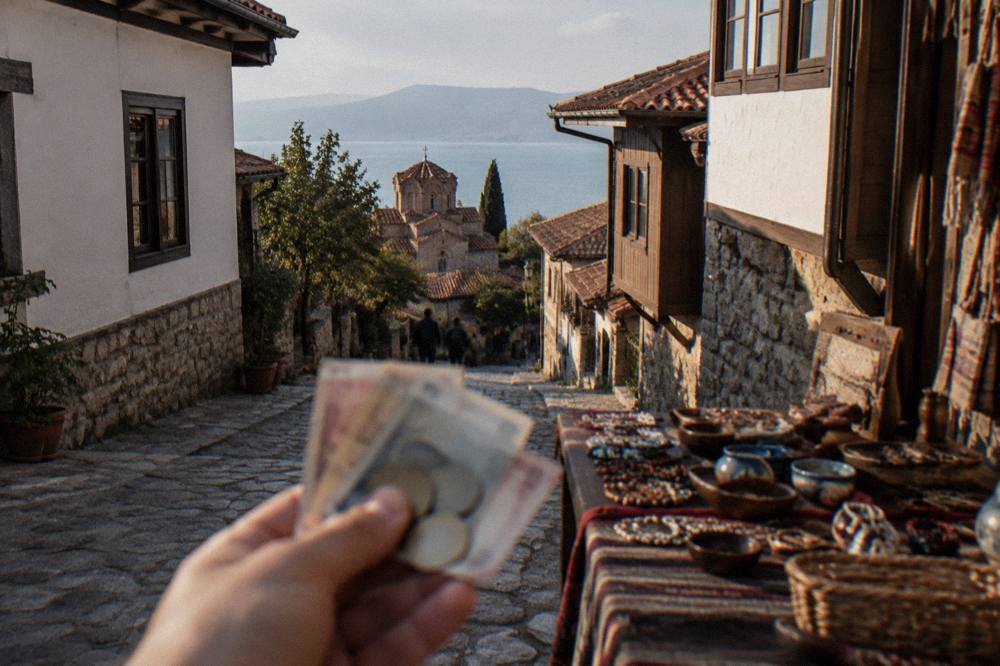
Tours and day trips around Ohrid are most commonly booked online in advance, in which case payment happens through the booking platform in its own currency and no denars are needed at all, while anything paid on the spot, a boat cruise ticket, a guide's fee, a transfer, is settled in denars even when the price was quoted in euros. Both routes are normal.
Booking ahead suits structured days. The boat trips along the lakeshore, the walking tours of the old town and the long day trips that set out from Skopje or Tirana are sold as bookable products, and their prices, ratings and durations appear in the listings themselves rather than being typed into a guide. That is the cleanest option when a departure time or a seat count matters, such as a small-group walk through lanes you would otherwise walk past.
An example is the shared Hidden Gems walk, a small-group route through quieter corners of the old town, which sits alongside the hidden gems walking tour page on this site, with Check availability showing the operator's live listing.
Paying on the spot suits flexible days. A seat on a boat departing the Ohrid harbour front, a taxi from the bus station or an arrangement made with a driver at St Naum is a cash conversation in denars. Get a denar figure before you commit, since a euro quote still needs converting at whatever rate the seller applies, and an agreed number in the local currency removes the ambiguity.
What Do Things Cost In Denars In Ohrid?
Everyday costs in Ohrid are set in Macedonian denars, and the figures that primary sources publish give a fair picture: the museum institute's sites, including Robev Family House and the Museum on Water, list 150 denars for foreign visitors and 120 denars for domestic visitors, while Galicica National Park charges 250 denars per vehicle at its gates. Bookable tours print their own prices on their listings.
The museum institute's own site lists those ticket rates, along with a reduced 60-den rate for children and students, and the same institute runs Robev Family House, the Museum on Water at the Bay of Bones and the Icon Gallery. St Naum monastery's entrance is listed by a cruise operator at 150 MKD per person, and its rowboat rides through the Crn Drim springs at about 5 EUR, one of the few spots where a euro figure is the quoted one.
| What | Where the figure comes from | Amount |
|---|---|---|
| Museum institute sites, foreign adult | The institute's own ticket page | 150 MKD |
| Museum institute sites, domestic adult | The institute's own ticket page | 120 MKD |
| Children and students at museum sites | The institute's own ticket page | 60 MKD |
| Galicica National Park, per vehicle | Park fee schedule | 250 MKD |
| Galicica National Park, entering on foot | Park fee schedule | 100 MKD |
| Full-day boat cruise Ohrid to St Naum, adult | Cruise operator's listing | from 1,200 MKD |
Two caats apply to that table. Galicica's 100 MKD rate applies only to someone entering on foot from the Ohrid-side gate; passengers arriving in a vehicle are covered by the vehicle fee, not a per-person charge. And museum hours follow a seasonal pattern, winter from 1 October to 30 April and summer from 1 May to 30 September, with sites closed on Mondays where their pages say so, so a ticket price is only useful alongside the day of the week you plan to visit.
Why Ohrid Does Not Use The Euro
Ohrid does not use the euro because North Macedonia is not a member of the European Union or the eurozone, and it has not adopted the currency unilaterally. The country's own currency, the denar, remains legal tender everywhere, including the lakeshore, and euro figures seen around Ohrid are quoted prices from tourism operators rather than an official or parallel currency.
This trips up visitors coming from Albania or Greece, where euro-area habits carry over, or from Schengen itineraries where borders barely register. North Macedonia sits outside both the EU and Schengen, which also matters for entry rules: visa-free nationals may stay up to 90 days in any 180-day period, and visitors register with the local police within 48 hours of arrival, something hotels normally handle. Those entry mechanics are laid out in the guide to visas and entry for North Macedonia.
The practical consequence for your wallet is a two-currency trip. Anything you book online before arriving is handled in the booking currency. Anything you buy on the ground, bread, boat seats, bus rides, museum tickets, church candles, is denars. Travellers who assume one currency covers everything end up converting in the least favourable places; travellers who convert sensibly on arrival find the whole old town straightforward.
For wider planning, whether the town adds up to an affordable destination is a separate question with its own answer on the page is Ohrid cheap or expensive.
Common Questions About Money In Ohrid
What Currency Is Used In Ohrid?
The Macedonian denar (MKD). It is the official currency of North Macedonia and the currency in which local prices across Ohrid, from museum tickets to bus fares, are set. Euros are commonly quoted for tours and transfers but are not legal tender in the country.
Can I pay with euros in Ohrid?
Not as legal tender. Some tourism operators quote prices in euros, and a booked product paid online is charged in the platform's currency, but shops, ticket counters and transport in Ohrid are denar transactions. Expect to convert rather than spend euros directly.
Should I exchange money before arriving in Ohrid?
Denars are easiest to obtain in North Macedonia itself, and arrivals by bus or car pass through towns where exchange is straightforward. Bring euros or another major currency to convert, then change enough for your stay rather than relying on any single payment method.
Do museum tickets in Ohrid cost denars or euros?
Denars. The museum institute's own page lists 150 MKD for foreign visitors, 120 MKD for domestic visitors and a reduced rate for children and students at its sites, which include Robev Family House, the Museum on Water and the Icon Gallery.
Is North Macedonia in the EU or the eurozone?
No to both. North Macedonia is outside the European Union, the eurozone and the Schengen area, and it keeps its own currency, the denar, which the National Bank manages in a stable relationship with the euro.
Do tour prices for Ohrid come in dollars, euros or denars?
Bookable products print their prices on their listings, and those listings handle payment in their own currency before you travel. On-the-spot purchases such as boat seats or taxis are paid in denars, sometimes against a euro quote.
The short version: denars for the ground, bookings for the big-ticket days out, and no assumption that either currency replaces the other. Budget your Ohrid days in denars, compare the bookable tours on their listed prices, and the money side of a Lake Ohrid trip takes care of itself.