Tirana From Ohrid: The Border Bus And What To See
Tirana sits about 86 km from Ohrid as the crow flies, across an international border, and the trip is very doable with planning. What follows covers the crossing, the route, and what to see on the other side.
Short answer
Tirana is about 86 km straight-line from Ohrid, across the North Macedonia, Albania border at Qafe Thane or Sveti Naum and Tushemisht. The trip works as a long day trip or an overnight, and bus schedules should be checked before you go.
Tirana is the capital of Albania, and it sits about 86 km from Ohrid in North Macedonia as a straight-line distance, on the far side of an international border. That combination, short distance plus a hard border crossing, is what shapes every Tirana day trip plan from Ohrid. The Ohrid Travel Guide covers this route because travellers ask about it constantly, and because getting it right depends on knowing which crossing to use, what paperwork applies, and how much of the day the journey eats. The basics first: Ohrid is a lakeside town on Lake Ohrid, a freshwater mountain lake at about 693 m above sea level, and Albania begins on the lake's southern and western shores.
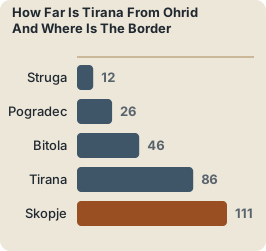
How Far Is Tirana From Ohrid And Where Is The Border?
Tirana lies about 86 km from Ohrid in a straight line, computed from the coordinates of both cities, and the trip between them crosses the international border between North Macedonia and Albania. The two practical road crossings from the Ohrid side are the Qafe Thane crossing on the main Struga route and the small Sveti Naum and Tushemisht crossing at the southern end of Lake Ohrid, both of which put you into Albania heading toward Pogradec and onward to Tirana.
The straight-line figure comes from computed distances, and the road distance is longer because the route bends around the terrain and through the border posts. What matters for planning is not the kilometres but the border itself: North Macedonia is not in the Schengen area, so every crossing is a full passport check in both directions, in both countries. Allow real time for it, in both directions, and build it into any same-day plan.
The Sveti Naum and Tushemisht crossing has a specific feature worth knowing: it is reported as open around the clock for passenger vehicles and pedestrians, and pedestrians can cross it on foot. St Naum monastery sits about 4 km from that border post. The bigger question of which crossing a bus or a shared minibus uses is an operator decision, and schedules, fares and operators for this route should be checked directly before travel, since none of them can be stated as fixed fact here.
For the wider frame, the guide to getting from Ohrid to Tirana covers the route question in question-and-answer form, and the reverse direction guide, Tirana to Ohrid, is the page to read if your trip starts in Albania.
| Destination from Ohrid | Straight-line distance | Country |
|---|---|---|
| Struga | about 12 km | North Macedonia |
| Pogradec | about 26 km | Albania |
| Bitola | about 46 km | North Macedonia |
| Tirana | about 86 km | Albania |
| Skopje | about 111 km | North Macedonia |
Those figures are straight-line distances, computed, and road distances are always longer. They are still the honest way to compare day trips: Pogradec is a short hop compared with Tirana, and that difference decides how much of your day the border and the road consume.
Can You Do Tirana From Ohrid In One Day?
A Tirana day trip from Ohrid is possible but it is a long day, because the roughly 86 km straight-line distance becomes a much longer road journey with a full international border crossing each way, and North Macedonia and Albania are both outside the Schengen area so there is no fast lane. A guided day trip removes the navigation and the border guesswork, and several bookable products run this corridor, though a product that lists Tirana or Durres as its start point departs from there, not from Ohrid.
That last point matters and is often misunderstood. The Tirana-based day tours that visit Ohrid and St Naum, including the one featured below, start in Tirana or Durres and run toward the lake, not the other way. If you are staying in Ohrid, such a product fits a trip where you are based in, or overnighting in, Albania. If you are purely Ohrid-based, the guided options that fit are the ones that start from Ohrid or the ones you drive yourself.
One product on this site's roster covers the corridor directly: it runs from Tirana, Durres and Golem to Ohrid and St Naum. The Check availability link sits beside the site's own tour page, and the operator's live listing carries the current price, duration and meeting arrangements.
There is no passenger rail service into Ohrid at all, so the train is not part of this conversation; the question of a train from Tirana to Ohrid answers the same point from the Albanian side. That leaves road transport, your own car, or a guided product.
A calmer alternative worth naming: rather than a full Tirana day, some travellers split the Albanian side into a Pogradec-and-back trip, which is under half the straight-line distance. The Pogradec day trip guide covers that shorter crossing, using the same Sveti Naum and Tushemisht border post.
What Is The Bus From Ohrid To Tirana Actually Like?
Shared minibuses and coaches do run between the Ohrid, Struga and Tirana corridor, but no timetable, fare, operator list or journey duration for this specific route can be stated as a fixed figure here, because none is published for the current season. The honest planning position is this: services exist, they are seasonal and changeable, and current schedules, prices and departure points should be checked at the Ohrid bus station or with operators directly before you commit a day to them.
Ready to compare coach times and fares for the corridor? Book a bus ticket to Ohrid here.
This is not evasion, it is how this corridor actually behaves. Cross-border services on this route have historically run from Tirana's terminals to Ohrid via the Qafe Thane crossing near Struga, with departures concentrated in the morning, but frequencies and fares shift with the season and with demand. A schedule that was right in August can be wrong in November.
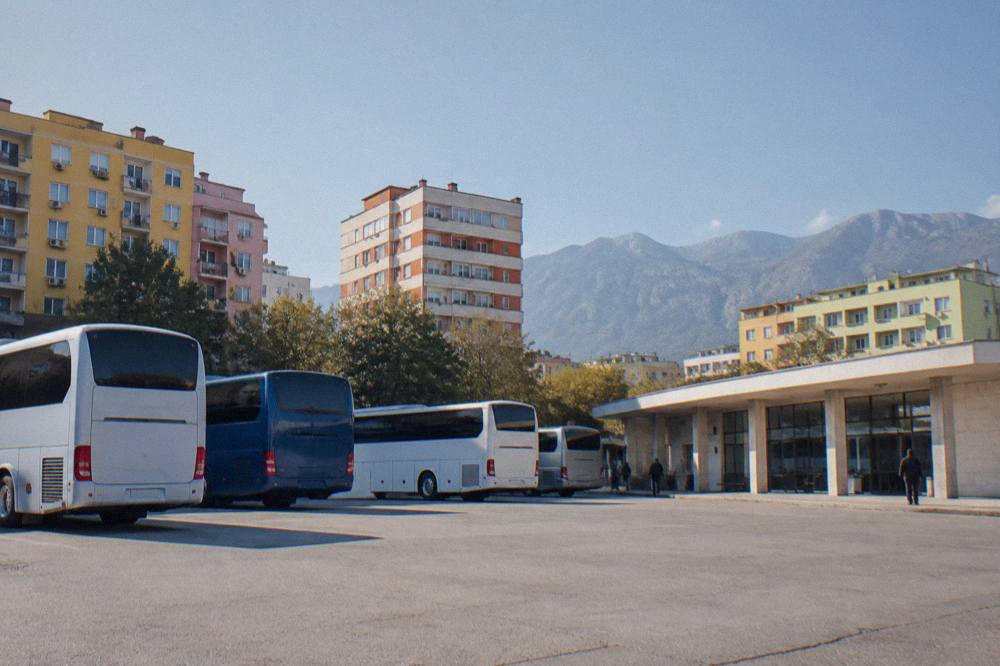
Practical advice that holds regardless of the timetable: buy or confirm your ticket a day ahead in high season, carry your passport on your body rather than in a bag in the hold, and expect to exit the vehicle at the border for passport control. Both countries stamp or scan separately because there is no common border regime between them.
Two site pages help with the mechanics. The Ohrid bus station guide explains where the station sits relative to the old town and what to expect there, and the Skopje to Ohrid guide covers the domestic long-distance side of Ohrid's bus network, including the fare picture on the Skopje route.
Is Driving From Ohrid To Tirana A Better Plan?
Driving yourself from Ohrid to Tirana gives you control of the schedule, and the road route runs via Struga and the Qafe Thane crossing, or via the southern lakeshore and the Sveti Naum and Tushemisht post, both of which are reported as functioning crossings. What you take on is a border in a private vehicle, which means separate checks for the car and its occupants, and green card insurance documentation, which driving guidance for North Macedonia says you should carry.
The road itself is the reason many people drive. The Albanian side of the lake, from the border toward Pogradec and Lin, is a lakeshore drive, and doing it on your own clock rather than a minibus's clock is the main advantage of a hire car. The trade-off is paperwork and patience at the posts: with your own car you clear both states' formalities in the vehicle, and rental conditions for cross-border use vary, so the Ohrid car rental guide is the page to read before deciding, because cross-border permission is a contract question with your rental company, not a rule of the road.
Driving rules in North Macedonia that the guidance confirms: headlights on day and night, tolls paid per section at plazas rather than by vignette, and a green card for international insurance. Those apply on the Macedonian side of the trip. Albania has its own rules and its own toll situation, and the border posts are where the two regimes meet.
A middle option is to drive or ride only as far as the border area and walk: the Sveti Naum and Tushemisht crossing is reported as crossable on foot, with a walk of roughly a kilometre between the two posts, and travellers do use it to reach the Albanian side on foot before arranging onward transport. St Naum sits about 4 km from the crossing, which makes the St Naum day trip guide and the St Naum monastery page natural companions to this route.
What Should You Actually See In Tirana On A Day From Ohrid?
Tirana rewards a focused half-day rather than an attempt at everything, and the sights that anchor a first visit are Skanderbeg Square at the city's centre, the Blloku district, and the National History Museum on the square's north side. This site's coverage does not extend to Tirana's interiors, opening hours or ticket prices, so what follows is a planning frame, distances and layout, rather than a room-by-room walkthrough.
The honest way to plan a short Tirana visit from Ohrid is to accept the clock. The border, in both directions, plus the road on both sides of it, consumes the morning. What remains is a late morning, an afternoon and an early evening, which is enough for the central square area, a walk, and a meal, and not enough for museums plus a cable car plus a suburb.
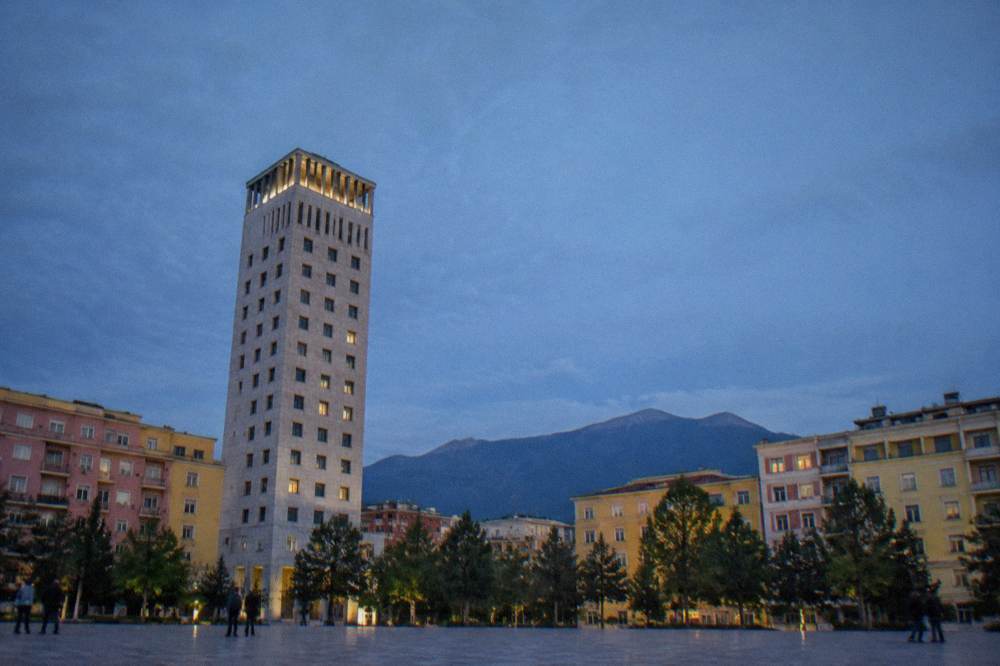
That frame is why the Skanderbeg Square area works: it concentrates the national museum, the mosque, the clock tower and the government buildings within a few minutes' walk of each other, so nothing depends on city transport or on an opening hour you cannot confirm from Ohrid. Blloku, the former restricted quarter that is now the city's cafe district, sits a short walk further, and lunch there is the natural midday stop.
A different way to spend the same effort, for the record, is to skip Tirana and spend the day on the lake itself. Ohrid's own sightseeing products, like the small-group old town walks and the short panoramic cruises, take a couple of hours each and pair well with a border-free day. The picks below show both.
Should You Stop At Pogradec Or St Naum On The Way?
Yes, stop at both, in that order: St Naum first from Ohrid by road or boat, then the short hop across the border, then Pogradec for lunch. That turns a transit day into a sightseeing day. Watch the calendar, though, because museum sites on the shore run a winter schedule from 1 October to 30 April and close on Mondays, so a Monday itinerary finds the doors shut.
The pairing works best as a morning plan: St Naum first, from Ohrid, by road or by boat, then the short hop across the border, then Pogradec for lunch, then Tirana in the afternoon. That ordering turns the transit day into a sightseeing day, which is the strongest argument for driving or taking a guided product rather than a point-to-point minibus.
The details that hold up: St Naum's monastery entrance is listed at 150 MKD per person on a cruise operator's published inclusions page, and a rowboat ride through the Crn Drim springs at about 5 EUR is quoted on the same page. The full-day boat cruise from Ohrid port to St Naum is listed at 7 hours, from 1,200 den for an adult and 600 den for a child, seasonal. Bay of Bones, the Museum on Water at Peshtani, sits on the same southern shoreline route and its museum ticket is 150 MKD for foreign visitors.
| Stop on the southern shore route | What it is | Ticket figure that is published |
|---|---|---|
| Bay of Bones, Peshtani | Museum on Water, lakeside archaeological site | 150 MKD foreign, 120 MKD domestic, 60 MKD children and students |
| St Naum monastery | Monastery at the Crn Drim springs | 150 MKD per person, per a cruise operator's listing |
| Crn Drim springs rowboat | Rowboat ride through the springs | about 5 EUR per boat, per the same listing |
| Ohrid to St Naum full-day cruise | Boat cruise from Ohrid port | from 1,200 den adult, 600 den child, seasonal |
The museum sites at Bay of Bones and the Icon Gallery run a winter schedule from 1 October to 30 April, shorter hours than summer, and close on Mondays; that Monday closure is the single most trip-breaking detail on this shoreline, because a Monday itinerary finds the doors shut. The Pogradec guide and the Struga guide cover the two towns that bracket the corridor's northern end.
What Papers And Money Do You Need For The Ohrid To Tirana Trip?
You need a passport, because both border states run full passport control, and visa-free nationals may stay up to 90 days in any 180-day period in North Macedonia, with the UK rule allowing visits of up to 3 months and a passport expiry date at least 90 days after arrival. The denar, MKD, is North Macedonia's currency and euros are not legal tender there, while Albania uses the lek, so this is a two-currency day and cards should not be assumed everywhere.
The registration rule is easy to miss: UK guidance says visitors register with the local police within 48 hours of arrival in North Macedonia, and hotels do this for their guests, so a hotel stay covers it. On a day trip out and back the question does not arise; on a multi-base trip that starts in Albania and moves to Ohrid, it does, and your Ohrid accommodation handles it.
Emergency numbers for the North Macedonia side: ambulance 194, police 192, roadside assistance 196. Albania has its own numbers, and a day-tripper's practical setup is to have both countries' numbers noted before departure rather than searched for at the roadside.
On money: the denar is de facto pegged to the euro, with the National Bank of the Republic of North Macedonia publishing a middle rate of 1 EUR = 61.6633 MKD on 19 October 2026, and exchange offices and ATMs are widespread in Ohrid. Euros circulate informally in tourist settings at poor rates, so denars for Macedonia and leks for Albania, withdrawn or exchanged in country, is the clean arrangement.
| Item | North Macedonia side | Albania side |
|---|---|---|
| Currency | Macedonian denar, MKD | Albanian lek |
| Border control | Full passport check, non-Schengen | Full passport check, non-Schengen |
| Visa-free stay | Up to 90 days in any 180-day period | Separate Albanian rules; check before travel |
| Police registration | Within 48 hours; hotels do it | Check current Albanian requirements |
| Emergency numbers | Ambulance 194, police 192, roadside 196 | Check Albanian numbers before travel |
When Does The Weather Matter For Tirana From Ohrid?
The crossing itself barely depends on weather, but the lakeshore legs do: modelled ERA5 climate normals for the Ohrid grid, 1991 to 2020, show January averaging a high of 5.0 C and a low of minus 0.8 C with 76.5 mm of rain, while July averages a high of 27.1 C with 34.7 mm of rain, and December carries 92.6 mm of rain. Snow closes the Galicica park road in some winter months, though that ridge route is not the Tirana corridor.
The Tirana route hugs the lake and the valley, so winter rain rather than snow is the realistic disruption, and the border posts operate year-round. The real seasonal effects are on the extras: the boat services to St Naum on the southern shore run roughly May to October and thin out in winter, so a winter version of this trip is a road trip with no boat option.
Summer has its own texture. August averages the highest mean daily high of the year at 27.6 C, per the modelled normals, and August is also the busiest month on the lake. A summer Tirana-and-back day means the border posts at their busiest and the lake at its most crowded, while May, June and September split the difference with highs of 19.5, 24.2 and 22.4 C respectively.
| Month | Mean daily high C | Mean daily low C | Rain mm |
|---|---|---|---|
| January | 5.0 | -0.8 | 76.5 |
| April | 14.6 | 6.3 | 82.4 |
| July | 27.1 | 18.3 | 34.7 |
| August | 27.6 | 19.0 | 32.9 |
| October | 17.4 | 10.3 | 76.0 |
| December | 6.2 | 0.9 | 92.6 |
Those are modelled ERA5 reanalysis values for a grid cell at altitude, not a weather-station record, and they describe the Ohrid end of the route; Tirana's lowland climate runs warmer in summer and milder in winter. For the month-by-month picture of the Ohrid end, the guide to the best time to visit Ohrid is the deeper page.
Tirana From Ohrid Versus The Other Big Day Trips
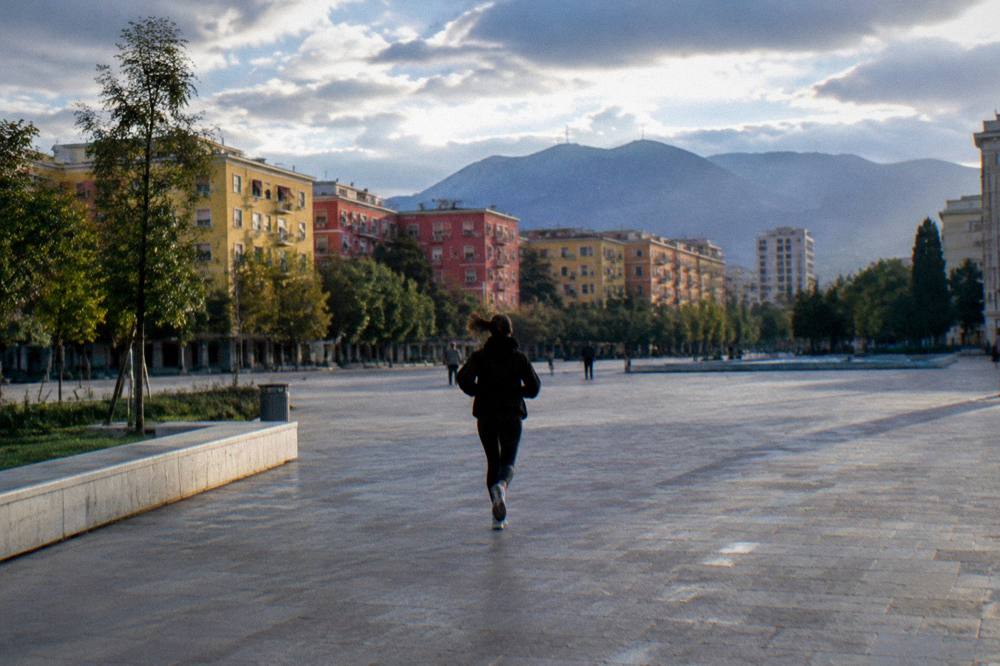
Tirana is the longest of the major day trips from Ohrid at about 86 km straight-line, against about 111 km to Skopje, about 46 km to Bitola, about 26 km to Pogradec and about 12 km to Struga, and it is one of only two of those, with Pogradec, that involves an international border. That makes it the trip where a guided product or a self-drive plan earns its cost most clearly, because the border is the variable you cannot control.
Comparing the options by effort rather than distance: Struga is a local bus ride, Bitola is a half-day each way by road, Skopje is a full day on a long road with the motorway partially built, and Tirana is a full day split between two countries. The Kicevo to Ohrid motorway section, for context, is due to open in stages with full opening expected in the first half of 2027, which affects the Skopje corridor far more than the Albanian one.
The Skopje corridor is covered in depth at the Skopje from Ohrid guide and the Skopje to Ohrid transport guide. For a multi-country plan that chains all three cities, the Skopje, Ohrid and Tirana route itinerary is the page built for exactly that.
If the appeal of Tirana is mainly "another country, one lake away", Pogradec delivers that at a third of the distance, and if the appeal is the big-city energy, Skopje delivers it without a border. Tirana earns its long day when you specifically want Albania's capital, its squares and its cafe districts, and are willing to spend the hours getting there.
Common Questions About Tirana From Ohrid
How far is Tirana from Ohrid?
About 86 km in a straight line, computed from both cities' coordinates. The road distance is longer, and the trip crosses the North Macedonia, Albania border, which adds significant time in both directions.
Is there a bus from Ohrid to Tirana?
Cross-border services have long run on this corridor, but no current timetable, fare or operator list can be stated as fixed here. Check current schedules at the Ohrid bus station or with operators directly before planning the day.
Is there a train from Ohrid to Tirana?
No. There is no passenger rail service into Ohrid at all, so rail is not an option in either direction on this route.
Which border crossing should I use?
The two practical crossings from the Ohrid side are Qafe Thane on the Struga route and Sveti Naum and Tushemisht at the southern end of the lake. The southern post is reported as open around the clock and crossable on foot, and St Naum monastery sits about 4 km from it.
Do I need a visa for a day trip to Albania from Ohrid?
Visa-free nationals may stay up to 90 days in any 180-day period in North Macedonia. Albania sets its own entry rules; check the current Albanian requirements before travel, and carry your passport for both border controls.
Can I visit St Naum and Tirana on the same day?
It is geographically coherent, since St Naum sits about 4 km from the Tushemisht border post on the southern route, but it makes for a very full day. St Naum in the morning, the border crossing, and Pogradec rather than Tirana is the shorter version.
The route from Ohrid to Tirana is a border story as much as a distance story, and planning it well means respecting both: the passport checks in both directions, the two currencies in your pocket, and the schedule checks before you set out. Done that way, a day in Albania's capital, or a softer version built around St Naum and Pogradec, is well within reach from Ohrid.