What To Buy From North Macedonia?
A practical shopping guide to Ohrid in North Macedonia: Ohrid pearls, icons, wine, rakija and crafts, where to find them in the Old Bazaar, and how to pay in denar.
Shopping in Ohrid, the old lake town in North Macedonia, works around a compact set of purchases that are genuinely local rather than imported generic souvenirs. The town's retail heart is the Old Bazaar, a lane of small shops a short walk from the lakefront, and it sits inside a UNESCO World Heritage region whose crafts, church art and food traditions shape what the shops actually sell. This Ohrid Travel Guide page lays out what is worth buying, where in town to find it, and how to handle payment, because the denar, not the euro, is the only legal currency here. For broader context on the town's reputation, see what Ohrid is famous for, and for the money question in detail, what currency is used in Ohrid.
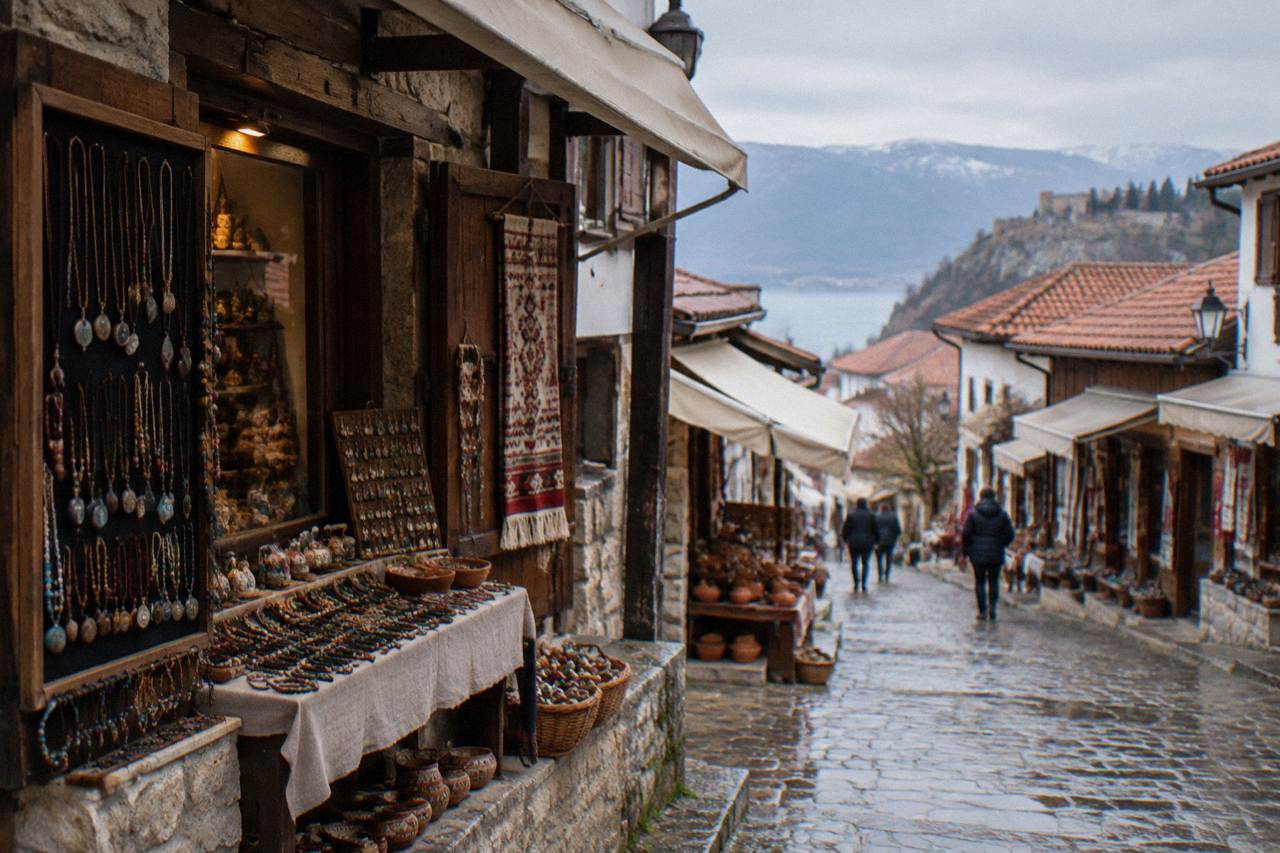
The purchases most rooted in the place are Ohrid pearls made by the town's own workshops, icon reproductions and religious art drawn from a collection of more than 800 Byzantine-style icons, Macedonian red wine and rakija, handmade filigree jewellery, and foodstuffs such as honey and dried herbs sold around the Old Bazaar. The pearl workshops are specific to Ohrid and the icon tradition is tied to the town's churches, which gives both a provenance that mass-produced souvenirs elsewhere in the region lack. Wine and rakija travel well and are sold in sealed bottles. Jewellery and small crafts fit in hand luggage.
The list is short on purpose. Ohrid is a small town of about 51,428 residents in its municipality, per the 2021 census as reported by the State Statistical Office, and its shopping scene reflects that scale: a handful of dedicated workshops, the bazaar lanes, and food shops that serve locals as much as visitors. That is an advantage. The seller of Ohrid pearls or of an icon reproduction is usually connected to the workshop that made it, and questions about materials and origin get straight answers.
Two things to set expectations on. First, the euro is not legal tender in North Macedonia, although prices for tours and transfers are often quoted in it; the denar, pegged in practice to the euro, is what changes hands in shops. Second, North Macedonia is outside the EU, so duty-free allowances and customs limits on what you carry home follow the rules of your own country, and alcohol in particular is worth declaring honestly.
Where To Shop In Ohrid For These Buys
The Old Bazaar is the main shopping district, a street of small shops close to the lakefront in the lower old town, with the Ohrid pearl workshops, icon shops and food sellers clustered in and around it, and the lanes climbing from there toward Samuel's Fortress holding more of the same mix. The bazaar is on foot, like the whole old town, which climbs from the lake at about 693 m above sea level up to the fortress walls. Everything on a shopping list for Ohrid is reachable on a single walking loop through the bazaar, the square and the church quarter.
A practical way to combine the loop with some context is a guided walk or an audio guide. The self-guided Echoes of Antiquity audio tour covers the old town at your own pace and passes the bazaar lanes among its stops, and a small-group old town walking tour does something similar with a live guide. Both work as a first-day orientation: learn the geography, then go back and buy with a sense of what is where.
Opening rhythm matters more here than in a capital city. The town's museum sites, which set the tone for the visitor economy, run a winter schedule from 1 October to 30 April and a summer schedule from 1 May to 30 September, and the museum sites close on Mondays. Shop hours in the bazaar are less formal and vary by season, with the busiest stretch of the visitor year running June to September, August included. In the shoulder months some shops shorten their days, so morning shopping is the safer plan.
Ohrid Pearls, Icons And Church Art From Ohrid
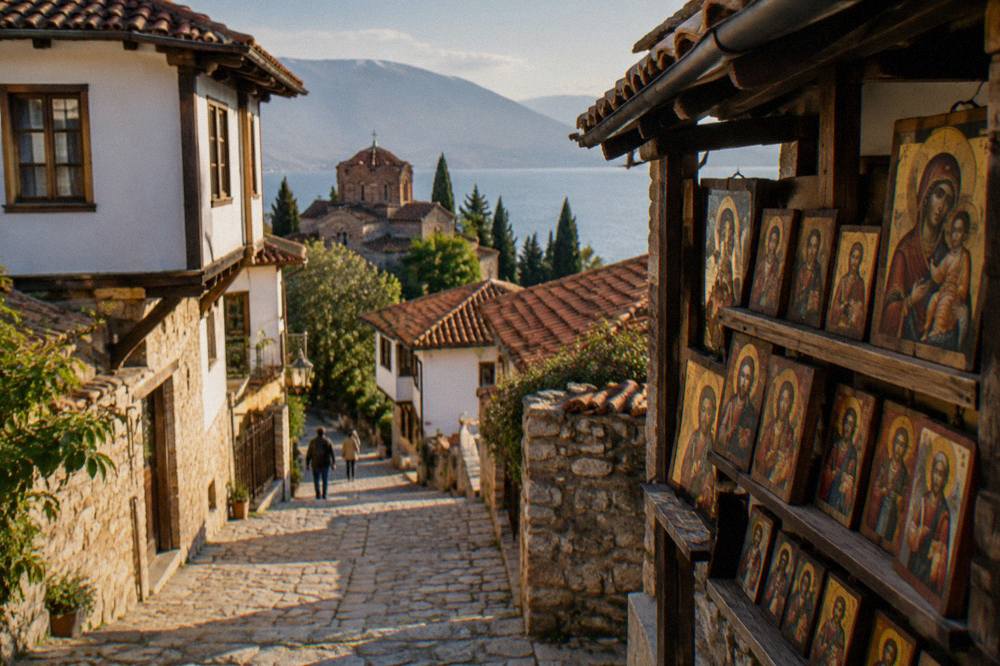
Ohrid pearls are the single most distinctive purchase available in North Macedonia, made locally by a small number of Ohrid workshops from the scales of the fish Platica opaquella, and they are sold with certificates from the workshops that produce them; icon reproductions and religious art are the second, drawn from a tradition UNESCO describes as more than 800 Byzantine-style icons from the 11th to the end of the 14th century. Neither product has a real equivalent elsewhere in the region. The pearls are a Ohrid-specific craft with a documented making process, and the icon tradition belongs to the town's churches, whose collections the reproductions echo.
The pearl story is worth knowing before you buy, because it is the difference between an Ohrid pearl and a generic freshwater pearl. The technique, developed in Ohrid, coats each pearl from an emulsion made of fish scales, giving the characteristic sheen the workshops are known for. Sellers in the established shops explain the process and provide a certificate of origin. Pearls are sold as necklaces, earrings and bracelets, in price tiers that run from simple strands to elaborate sets, and the workshops themselves, several of which have operated for generations, are the most reliable place to buy rather than a stall with no name.
Icon reproductions range from small wooden panels to larger framed works, and the models are real: the Icon Gallery in the Perivleptos complex holds part of the town's collection and charges 150 den for foreign visitors, open summer 09:00 to 17:00 and winter 09:00 to 14:00, closed Mondays, per the museum institute's own pages. A visit to the gallery before buying reproductions puts the craft in context and shows what a serious icon looks like up close. Church art aside, the bazaar's silversmiths sell filigree work in the same Macedonian tradition, and handmade pieces can be found alongside the usual imported stock, so ask which is which. A reputable shop answers that question directly.
Wine, Rakija And Food To Carry Home From Ohrid
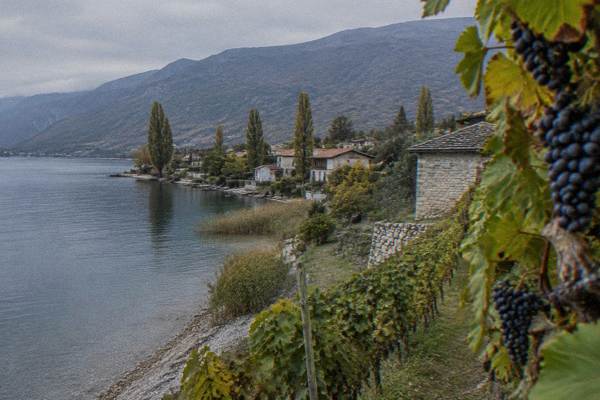
Bottled Macedonian red wine and rakija, the fruit brandy that anchors the country's table, are the most practical food purchases, alongside honey, dried herbs and tea blends from the mountain region, all sold in sealed packaging that survives a journey; Ohrid trout, for all its fame on local plates, is not a souvenir, and the endemic lake fish belongs on a menu rather than in a suitcase. Wine from Macedonian varieties travels well and shops in the old town stock a range from inexpensive table bottles to reserve bottles from named wineries.
Rakija deserves a short explanation for anyone buying it as a gift. It is a clear fruit brandy, most often from grapes, sometimes from other fruit, and it is drunk in small measures rather than mixed. Bottles are sold by volume and by producer, and the better shops let you taste before you commit, which is normal practice rather than a favour. For what the spirit means at the table, the site's page on rakija and Macedonian wine goes into the traditions, and the page on Ohrid restaurants covers how the food side of the culture tastes in situ.
The rule of thumb for food shopping anywhere in North Macedonia is to buy sealed, labelled products from a shop rather than loose goods from a stall if the item is crossing a border. Honey jars, herb packets and wine bottles all pass that test. Customs allowances for alcohol vary by destination country and North Macedonia's non-EU status means nothing here counts as an intra-EU purchase, so check your home allowance before loading up.
A day built around food and drink can also take in the wineries near town. For the cost picture of a whole trip, including meals and shopping money, the page on whether Ohrid is cheap or expensive breaks it down.
How To Pay For Shopping In Ohrid
The denar, MKD, is the only legal currency in North Macedonia, the National Bank's middle rate on 19 October 2026 was 1 EUR = 61.6633 MKD, and the denar is de facto pegged to the euro, so the rate stays stable around 61.5; euros are not legal tender, though some tourist-facing businesses accept them informally at poor rates, and ATMs in Ohrid dispense denars for card withdrawals. For shopping, that means withdrawing or exchanging denars and paying in the local currency rather than offering euros, which invites an unfavourable implicit rate.
The peg makes budgeting simple. Whatever a price is in denars, dividing by about 61.5 gives a euro figure close enough for planning, though the shop's own till works in denars and any conversion you do is your own arithmetic, not a transaction. The National Bank publishes the daily middle rate, and because the currency is managed against the euro, day-to-day movement is minimal, which removes any timing question from exchanging money. The site's page on the denar and money in Ohrid covers this in full.
Card acceptance in individual shops is not something this guide can state as a figure, and prices for specific souvenirs are best checked at the counter, since no published tariff exists for bazaar goods. What the facts do support is a picture of a cash-friendly town with widespread ATMs. Keep smaller denar notes for the bazaar, since small shops handle large notes poorly, and keep receipts for anything valuable such as pearls or icons, which help at customs and with insurance.
| What you buy in Ohrid | Where it comes from | Typical form | How to buy it well |
|---|---|---|---|
| Ohrid pearls | Ohrid workshops, made from an emulsion of fish scales | Necklaces, earrings, bracelets, with certificate | Buy from a named workshop and keep the certificate |
| Icon reproductions | Local ateliers drawing on Ohrid's church tradition | Wooden panels, framed works | Visit the Icon Gallery first to see the originals |
| Filigree silver | Macedonian silversmith tradition | Jewellery and small objects | Ask which pieces are handmade |
| Red wine | Macedonian wineries, several within a day trip of Ohrid | Sealed bottles, from table to reserve | Buy sealed and labelled bottles for travel |
| Rakija | Fruit brandy, usually grape | Sealed bottles by producer | Taste before buying where offered |
| Honey and herbs | Mountain region around Ohrid and Galicica | Jars and packets | Sealed packaging only for border crossings |
The sightseeing that fills the hours between purchases runs on denars too, and the museum institute's own prices are a useful calibration for what things cost here: 150 den for foreign visitors at sites such as the Robev Family House and the Museum on Water, 120 den for domestic visitors, with a reported 60 den child and student rate. A full-day boat cruise from Ohrid port to St Naum with a cruise operator starts at 1,200 den for an adult, and the rowboat ride through the Crn Drim springs at St Naum runs about 5 EUR, per the operator's listing. Those are attraction prices, not shopping prices, but they set the scale of the local economy your souvenir budget sits inside.
Common Questions About Shopping In Ohrid
What To Buy From North Macedonia?
Ohrid pearls from the town's own workshops, icon reproductions rooted in the local church tradition, Macedonian red wine and rakija, filigree silver, and sealed foodstuffs such as honey and dried herbs. The pearls and the icons are the two purchases genuinely specific to Ohrid; the rest are best-in-region rather than unique.
Are Ohrid pearls real pearls?
Ohrid pearls are not cultured pearls from an oyster. They are made in Ohrid from a coating derived from the scales of the fish Platica opaquella, applied layer by layer, and the established workshops sell them with certificates of origin. That making process is what the name refers to, and the site's page on Ohrid pearl workshops covers it in detail.
Can I pay in euros in Ohrid shops?
No, the euro is not legal tender in North Macedonia. Some tourist-facing businesses accept euros informally, but at rates that favour the seller. Withdraw or exchange denars instead; the currency is de facto pegged to the euro at around 61.5 denars per euro, so the value is predictable.
Is shopping in Ohrid expensive?
Ohrid is generally a low-cost destination by European standards, and museum tickets, boat cruises and food are inexpensive relative to western Europe. Souvenir prices vary by craft: filigree and pearls span a wide range depending on the piece. Set a budget in denars and compare two or three shops before buying anything significant.
Where is the best place to buy souvenirs in Ohrid?
The Old Bazaar and the lanes around it hold the densest cluster of shops, including the pearl and icon sellers. The dedicated pearl workshops are the reliable source for pearls, and the shops nearest the main church sights carry the widest icon reproduction stock. Morning hours are the safest bet outside peak summer.
For anyone pairing a purchase list with the rest of a trip plan, the pages on what Ohrid is famous for and how many days you need in Ohrid round out the picture, and the small-group old town walk remains the fastest way to learn the lanes before spending in them, with Check availability on the operator's live listing for the audio version.