Ohrid Restaurants: Lakeside Tables, Kaneo And The Old Town
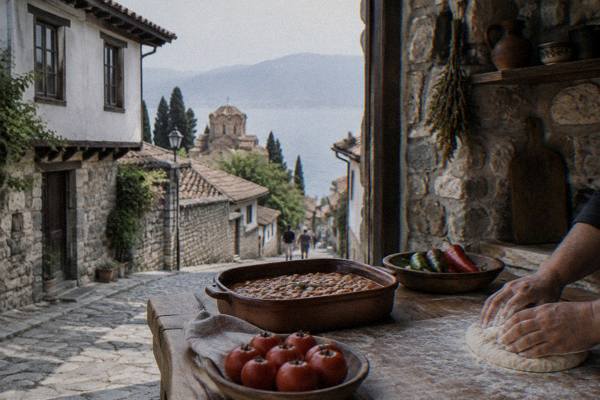
Ohrid, on Lake Ohrid in North Macedonia, is a town where eating out runs from lakeside terraces below the church of St John at Kaneo to the lanes of the Old Town and the stalls of the Old Bazaar.
Short answer
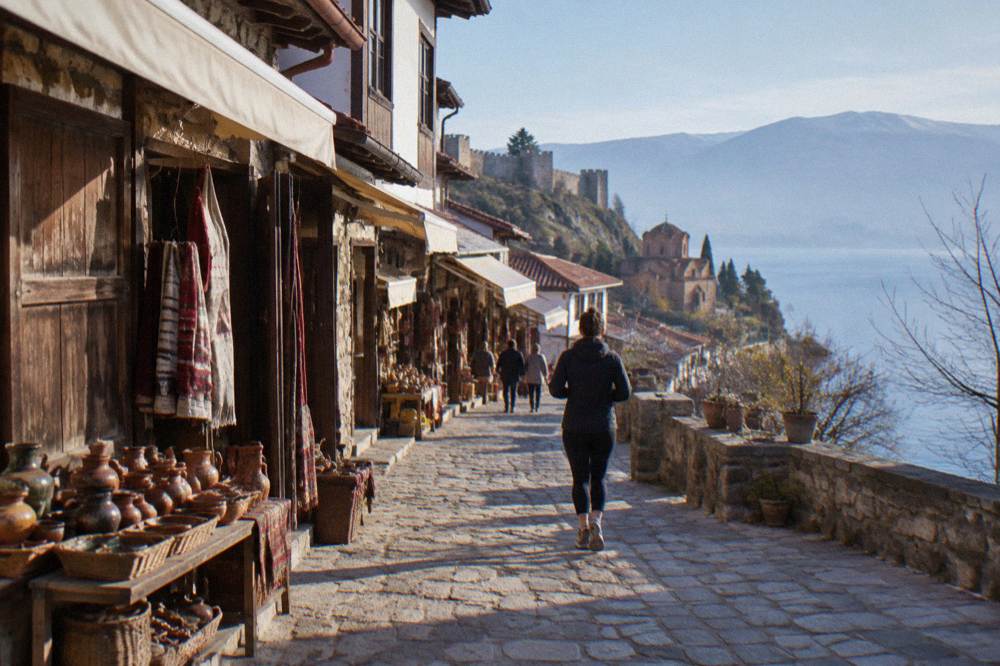
Eating in Ohrid centres on three areas: the terraces of the Kaneo district above the lake, the restaurants tucked into the Old Town lanes, and the cafés along the boardwalk and the Old Bazaar. Macedonian cooking dominates menus, with lake fish, grilled meat, fresh salads and local wine; the dining season runs with the tourist summer, from about May to October.
Ohrid, in North Macedonia, sits on Lake Ohrid, a freshwater mountain lake whose surface sits at about 693 m above sea level, and its restaurant map follows the shape of the town: tables climb the Old Town lanes from the water to Samuel's Fortress, cluster around the Kaneo district where the Church of St John at Kaneo stands above the shore, and line the boardwalk that runs along the lake edge. The Ohrid Travel Guide covers the destination as a whole, and this page deals with one slice of it: where the eating happens, how the seasons shape it, and how the sights, the lake and the day trips slot around a table. The town is part of the UNESCO mixed property "Natural and Cultural Heritage of the Ohrid Region", inscribed in 1979 and 1980 and extended to the Albanian side in 2019, and the dining areas sit inside that same landscape.
Where Are The Main Eating Areas In Ohrid?
Ohrid's restaurant scene divides into four areas: the Kaneo district terraces above the lake below the Church of St John at Kaneo, the lanes of the Old Town running up towards Samuel's Fortress, the boardwalk and city beach along the shore, and the Old Bazaar near the centre, each with a different pace and a different view, and all of them walkable from one another because the town itself is compact.
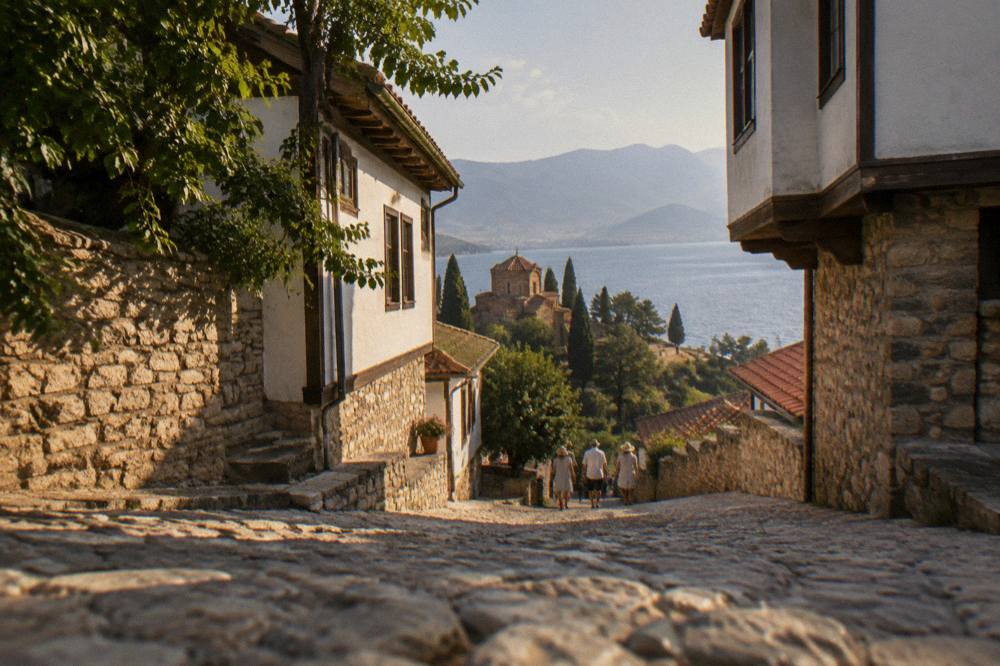
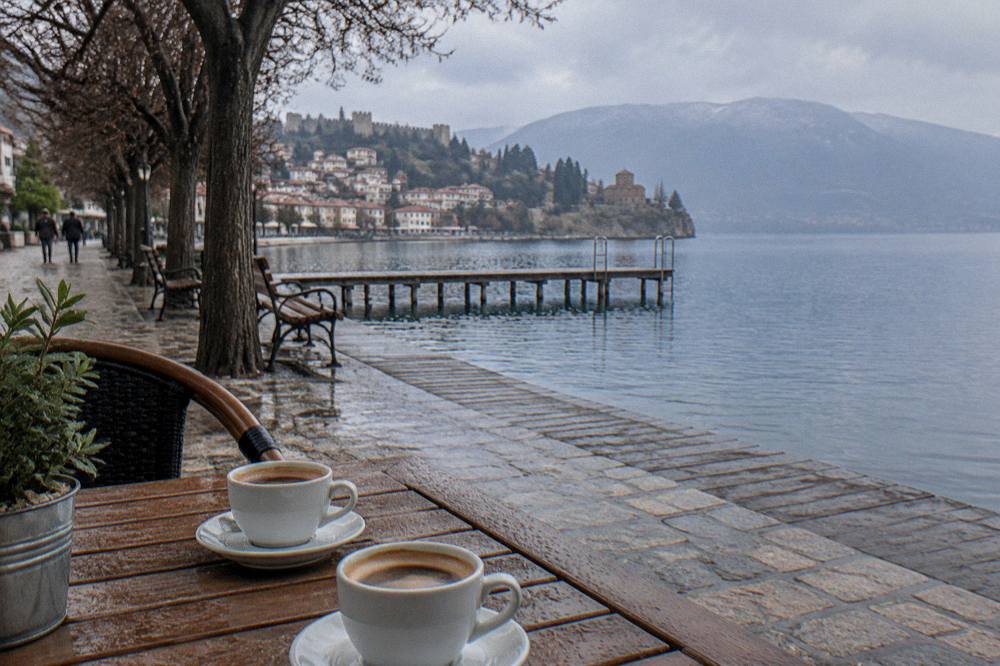
The Old Town is the part that climbs from the water to the fortress, a network of lanes on foot, and its restaurants sit in old stone houses along those lanes. The old town guide covers the district street by street. Below it, the Kaneo district wraps around the bay under the church, and its terraces are the tables people picture when they picture Ohrid: stone, water and a church on the headland. The boardwalk, covered in its own boardwalk guide, is the flat, evening stroll part of town, where cafés and ice cream stands do steady trade. The Old Bazaar is the historic market street, the place for quick, casual food rather than a long sit-down dinner.
Because the whole old core is pedestrian in practice, the usual pattern is a walk that links all four: down through the bazaar, along the boardwalk, up to Kaneo, then back into the Old Town lanes for dinner. None of this needs a car, and in summer 2026 the municipality went further, making streets like Ilindenska, Kosta Abrash and Car Samoil resident-only under a parking regime reported to include clamping for non-residents, which is one more reason to leave the car at the edge of town, a subject the parking guide covers in detail.
What Does A Meal In Ohrid Actually Look Like?
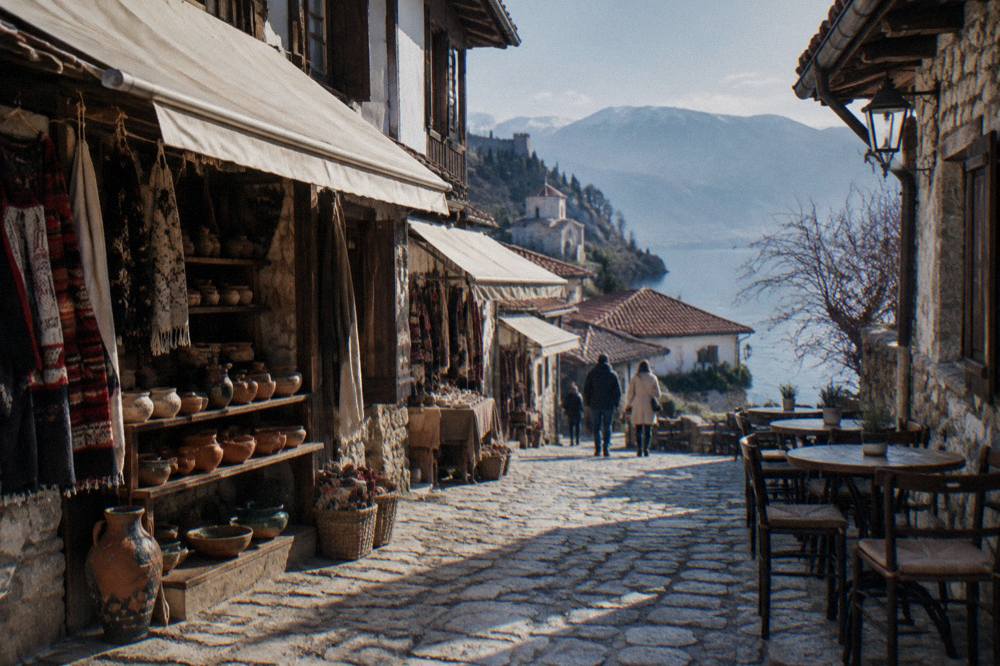
A typical Ohrid meal is Macedonian home cooking: a fresh salad with white cheese, grilled meat or lake fish as the main dish, bread on the table, and local wine or rakija to drink, with tavche gravche, the baked bean pot, as the standard vegetarian anchor and Ohrid trout as the famous local name on menus around the lake shore.
That is the general shape of the cuisine rather than a price list, and this page deliberately prints no dish or drink prices. Menus are seasonal and the tourist strip prices itself differently from the lanes a five minute walk away. What can be said plainly is the structure: eating here is unhurried, salads arrive first, mains follow, and the meal stretches. The classic accompaniments are grilled peppers, ajvar-style pepper spreads, and yoghurt-based sides. Rakija, the fruit brandy, and Macedonian wine sit behind the bar, and both have their own pages on this site: rakija and Macedonian wine and the wider Ohrid food guide.
The two local names worth knowing before you read a menu are Ohrid trout, which carries the lake's name and a protected local identity, and tavche gravche, the baked bean dish that is North Macedonia's national comfort food. The Ohrid trout page covers the fish and its history. The practical reading of an Ohrid menu is simple: lake fish and grilled meat are the centre of gravity, seasonal vegetables carry the starters, and the baking traditions of the region show up in pies and slow-cooked pots.
Which Ohrid Neighbourhood Suits Your Table Best?
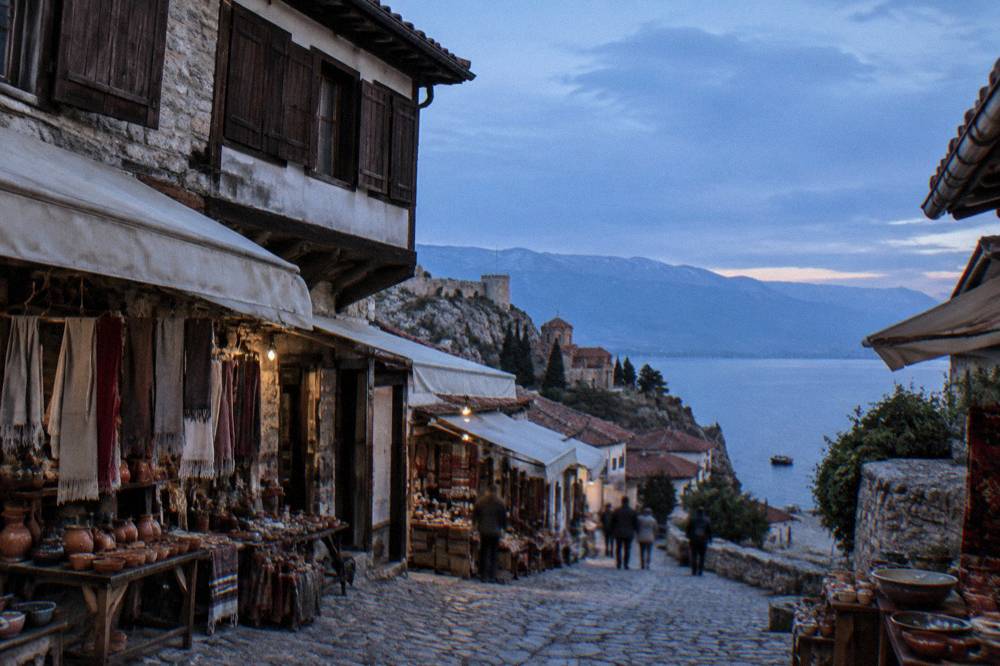
For a view with dinner, the Kaneo district is the pick, because its terraces sit directly above the water below the Church of St John at Kaneo; for atmosphere and choice, the Old Town lanes hold the deepest concentration of restaurants in old stone houses; for a cheap, fast bite, the Old Bazaar; and for an evening stroll with something small, the boardwalk and the city beach.
The Kaneo district is the postcard version. Its area guide and the Church of St John at Kaneo page cover the headland itself; the terraces sit below it, and dinner here means the lake in front of you and the old town walls behind. It is also the area that pairs most naturally with time on the water: a stand-up paddle hour along this stretch of shore is run as a rental with Kaneo and Old Town views, and it ends close to where the dinner tables start. For the wider sweep of options in town, the things to do in Ohrid overview collects them all, or go straight to the water option and Check availability.
The Old Town is the working heart of the dining scene. It holds everything from konoba-style rooms in stone houses to rooftop tables under the fortress walls, and it is where the evening crowd ends up after the day's sightseeing, since the Samuel's Fortress walk and the Ancient Theatre both pour visitors downhill into these lanes at closing time. The bazaar and the boardwalk fill the gaps: breakfast, coffee, and the late evening walk.
How Do The Seasons Change Eating Out In Ohrid?
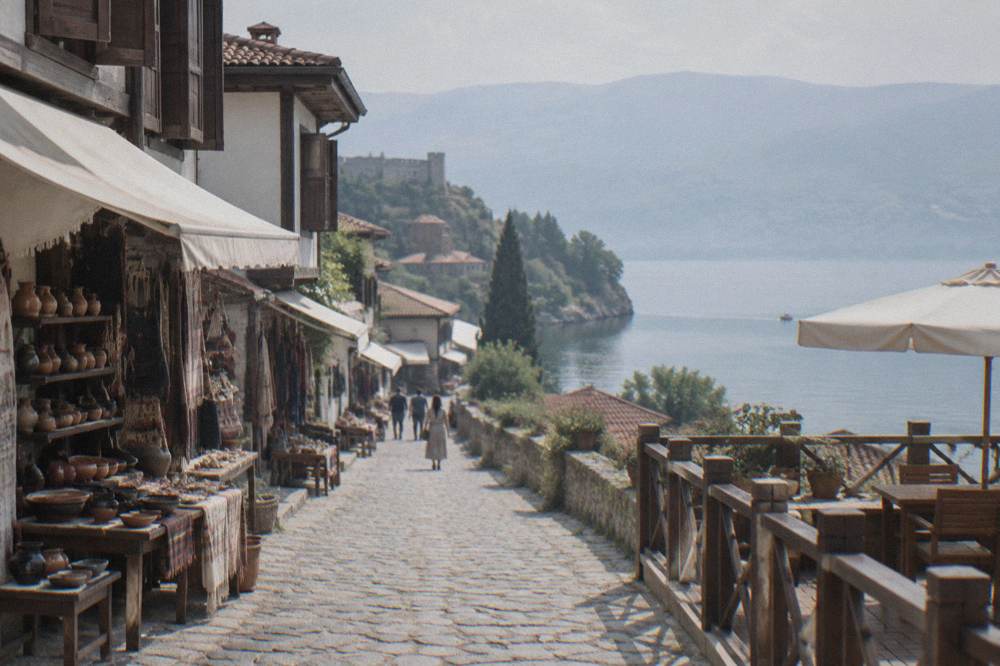
The dining season in Ohrid peaks with the summer, from about June to September, when lakeside terraces run at full tilt and the town is busiest in August, while from November to March the outdoor tables close, the crowd thins and eating moves indoors, so the time of year you visit decides whether dinner is on a terrace above the water or beside a stove in a stone house.
The modelled climate normals for Ohrid, ERA5 reanalysis for 1991 to 2020, explain the pattern. July and August average mean daily highs of 27.1 C and 27.6 C, with mean lows of 18.3 C and 19.0 C, which is terrace weather deep into the evening. December and January average mean daily highs of 6.2 C and 5.0 C, with lows around freezing, and December carries 92.6 mm of rain across the month. The full table:
| Month | Mean High C | Mean Low C | Rain mm |
|---|---|---|---|
| Jan | 5.0 | -0.8 | 76.5 |
| Feb | 6.3 | 0.0 | 74.3 |
| Mar | 10.0 | 2.5 | 80.5 |
| Apr | 14.6 | 6.3 | 82.4 |
| May | 19.5 | 10.8 | 70.8 |
| Jun | 24.2 | 15.2 | 43.1 |
| Jul | 27.1 | 18.3 | 34.7 |
| Aug | 27.6 | 19.0 | 32.9 |
| Sep | 22.4 | 14.9 | 62.4 |
| Oct | 17.4 | 10.3 | 76.0 |
| Nov | 11.5 | 5.3 | 90.4 |
| Dec | 6.2 | 0.9 | 92.6 |
These are modelled reanalysis figures for a grid cell at the centre of Ohrid, not a weather-station record. The shoulder months matter for food travellers: May, June and September combine terrace-friendly highs of 19.5 C, 24.2 C and 22.4 C with lighter rain than spring, and September still carries a swim-capable lake. The lake's own temperature shapes the shoreline mood, and the modelled aggregator values for the surface water look like this, with the October mean of 14.3 C coming from the UHMR multi-year record:
| Month | Modelled Surface Water C |
|---|---|
| Jan | 4.6 |
| Feb | 5.4 |
| Mar | 7.2 |
| Apr | 10.5 |
| Jun | 19.4 |
| Jul | 22.9 |
| Aug | 23.5 |
| Oct | 14.3 (UHMR multi-year mean) |
| Nov | 10.3 |
| Dec | 6.0 |
Swimming and terrace dining share the same season, roughly July to September, when the modelled surface water runs at 22.9 C in July and 23.5 C in August. The best time to visit and Ohrid weather pages carry the month-by-month detail.
What Sights Sit Right Next To The Best Tables?
That ticket structure comes from the NI Institute and Museum Ohrid's own site, and it matters for planning a food-and-sights day because the museum sites run two schedules: a winter one from 1 October to 30 April and a summer one from 1 May to 30 September. The hours differ by site, so the table below keeps them separate rather than blending them:
| Museum Site | Foreign / Domestic Ticket | Winter Hours (1 Oct, 30 Apr) | Summer Hours (1 May, 30 Sep) | Closed |
|---|---|---|---|---|
| Robev Family House | 150 / 120 den | 09:00 to 15:30 | Two shifts, 09:00 to 15:30 and 13:30 to 20:00 | Monday |
| Bay of Bones, Peshtani | 150 / 120 den | 09:00 to 15:30 | 09:00 to 16:30 | Monday |
| Icon Gallery, Perivleptos | 150 / 120 den | 09:00 to 14:00 | 09:00 to 17:00 | Monday |
The practical fit with eating is straightforward. Robev Family House stands on Tsar Samoil street in the middle of the old core, so it slots between a bazaar lunch and an Old Town dinner. The Icon Gallery sits in the Perivleptos complex uphill in the old lanes. The Bay of Bones, the Museum on Water at Gradishte near Peshtani, is a lakeshore excursion, and the Bay of Bones page covers it.
Can A Food Day In Ohrid Pair With Wine And The Lake?
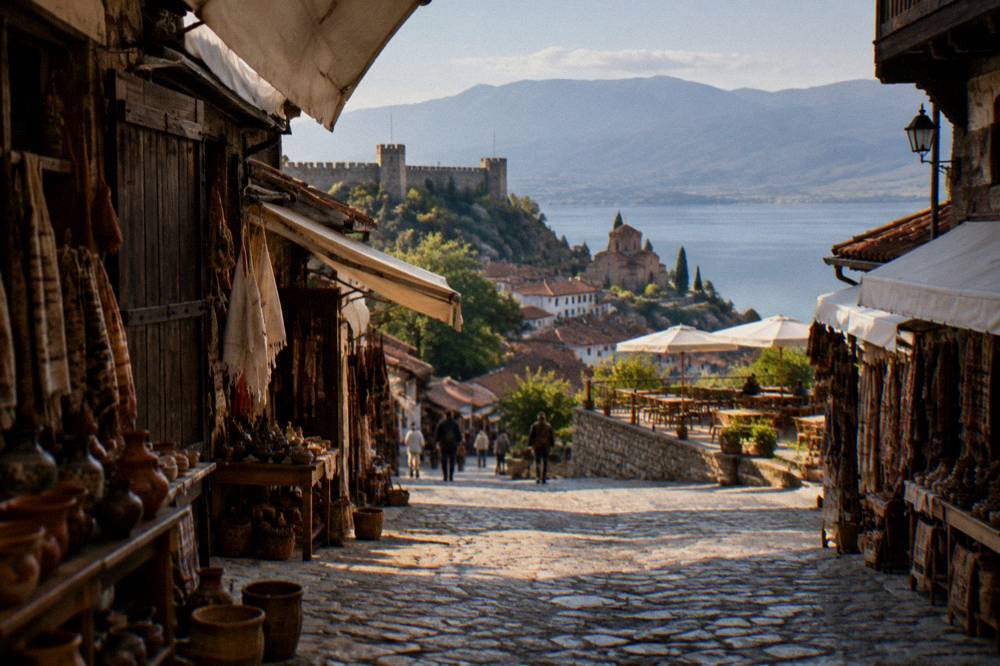
Yes, and the two strongest pairings are a winery tasting in the Ohrid countryside, where monastery winery visits with tastings run as bookable half-day experiences, and an evening on or beside the water, where sunset boat cruises, one running about an hour and a half, and a wine-tasting cruise with wine included both operate from the town port through the season.
Ready to taste the local side of the region's cuisine? Book a wine tasting experience here.
The wine side of the region is covered in the rakija and Macedonian wine guide; the wine page explains what is in the glass. Around the lake, the eating day and the water day are the same day. The Armada full-day cruise from Ohrid port to St Naum runs 7 hours, from 1,200 den for an adult and 600 den for a child, per the operator's own listing, and it stops at shoreline spots along the way, with the St Naum monastery entrance at 150 den per person and a rowboat through the Crn Drim springs at about 5 EUR, both listed by the cruise operator as extras rather than inclusions. The general lake-extras picture:
| Lake Extra | Figure | Source Basis |
|---|---|---|
| Full-day boat cruise Ohrid port to St Naum, adult | from 1,200 den | Operator listing |
| Full-day boat cruise, child | from 600 den | Operator listing |
| St Naum monastery entrance | 150 den per person | Operator listing, not included |
| Rowboat, Crn Drim springs | about 5 EUR | Operator listing, not included |
| Bay of Bones entrance | 150 MKD per person | Operator listing, not included |
The 2026 navigation rules shape the water side of these evenings: a government decision of 2 June 2026 bans jet skis between 1 July and 31 August from 11:00 to 19:00, and bans boats at night from 21:00 to 05:00 over the summer and from 20:00 to 06:00 in September, with a further October limit. Sunset trips work inside those windows, and the Lake Ohrid page carries the detail.
Where Can You Eat Beyond Ohrid On A Day Trip?
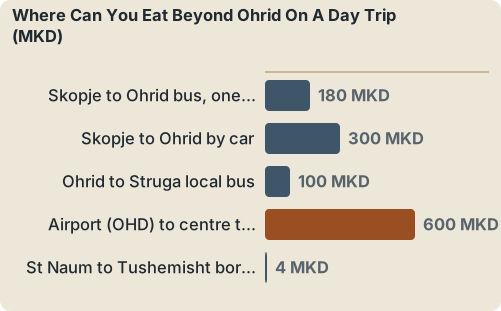
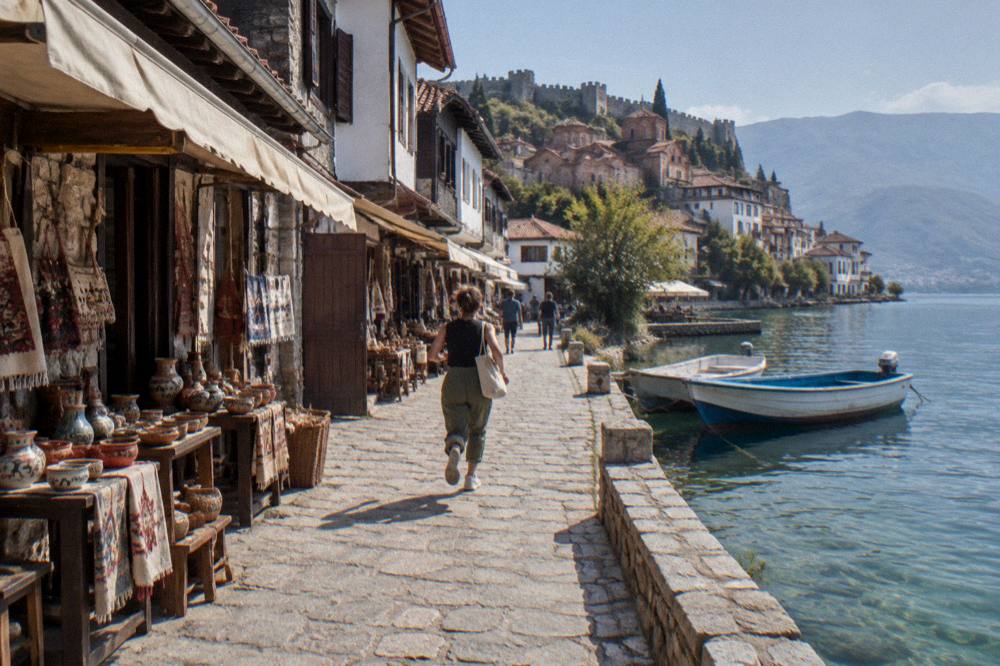
The nearest eating beyond Ohrid happens in Struga, the town at the north end of the lake where the Crn Drim flows out, reached by local bus for roughly 100 to 150 den by older guides' figures, in the shoreline villages like Peshtani and Trpejca on the way to St Naum, and across the border at Pogradec in Albania, with St Naum itself only about 4 km from the Tushemisht crossing.
Struga is the easy one: a short bus hop, its own dining scene at the river mouth, and the Struga Poetry Evenings, whose 65th edition ran 24 to 29 June 2026, as the town's cultural anchor. The Struga from Ohrid and Struga town pages cover it. The southern shore, Trpejca and Ljubanista, and St Naum are covered in their own guides, and St Naum doubles as a border run, with the Tushemisht crossing reported to be open around the clock for passengers and pedestrians. The longer food-and-sights day trips, and the road costs behind them, look like this:
| Route | Figure | Basis |
|---|---|---|
| Skopje to Ohrid bus, one way | 850 to 950 MKD, about 3 hours | Secondary guide, confirmed figures |
| Skopje to Ohrid by car | about 172 km, about 2.5 hours, about 140 MKD tolls | Secondary guide |
| Tirana to Ohrid minibus | about EUR 15 to 20, 3 to 3.5 hours with border | Secondary guide |
| Ohrid to Struga local bus | about 100 to 150 MKD | Older guides, confirm locally |
| Airport (OHD) to centre taxi | about 600 to 800 MKD | Reported figure |
| St Naum to Tushemisht border | about 4 km, taxi quoted 400 den | Traveller report |
For a single-day plan that mixes eating with the essentials, the Ohrid in one day itinerary exists, and how many days in Ohrid answers the length question. If you want the under-visited corners instead of the bazaar and the boardwalk, the hidden gems page lists them.
Which Festivals Give Ohrid A Reason To Book A Table?
The Ohrid Summer Festival anchors the cultural calendar, its 66th edition running from 12 July to 20 August 2026 with the opening gala at the Ancient Theatre, the Balkan Festival of Folk Songs and Dances follows in early July, the Water Festival fills late August with the 25 km swimming marathon from St Naum to Ohrid harbour on 22 August and a separate 33 km SUP marathon around the lake on 26 August, and Struga's poetry festival sits in late June.
These events matter for restaurant planning because they fill the town: the summer festival's opening gala at the Ancient Theatre puts its audience directly in the Old Town's dining lanes afterwards, and the swimming marathon lands its finish at Ohrid's harbour, on the boardwalk. The 2026 calendar:
| Event | 2026 Dates | Anchor Venue |
|---|---|---|
| Struga Poetry Evenings, 65th edition | 24 to 29 June | Struga |
| Balkan Festival of Folk Songs and Dances, 65th edition | 3 to 6 July | Grigor Prlichev cultural centre |
| Ohrid Summer Festival, 66th edition | 12 July to 20 August | Ancient Theatre, St Sophia |
| Ohrid Swimming Marathon, 39th edition | 22 August | St Naum to Ohrid harbour, 25 km |
| SUP marathon around the lake | 26 August | Lake Ohrid, 33 km |
The Ohrid Summer Festival page carries the festival detail, and the nightlife and photography spots pages pick up where the dinner table ends.
How Much Should You Budget Around Eating In Ohrid?
Ohrid sits at the affordable end of European dining by general reputation, but no restaurant, dish or drink price appears in this site's records, so the honest budget frame is the one built from the figures on file: museum tickets at 150 den per site, a full-day lake cruise from 1,200 den, local buses at 100 to 150 den to Struga and 850 to 950 den to Skopje, and the denar itself, pegged in practice to the euro at about 61.5 den per euro.
The currency page explains the money side in full, including why euros are quoted informally everywhere but are not legal tender. The cost and budget guide and the denar and money page hold the practical detail, and the where to stay guide places the dining areas against the accommodation areas, which matters because the Kaneo terraces and the Old Town lanes are an evening walk from almost anywhere in the old core. The National Bank's middle rate on 19 October 2026 was 1 EUR = 61.6633 MKD, and ATMs are widespread for denar withdrawals.
Common Questions About Restaurants In Ohrid
Where should I eat in Ohrid for a lake view?
The Kaneo district terraces sit directly above the water below the Church of St John at Kaneo, and the boardwalk cafés line the shore closer to the centre. Both are covered in the Kaneo district and boardwalk guides on this site.
What food is Ohrid known for?
Ohrid trout carries the lake's name, tavche gravche is the national baked bean dish, and Macedonian menus generally centre on lake fish, grilled meat, fresh salads with white cheese, local wine and rakija. The Ohrid trout and Ohrid food pages cover each in detail.
Is Ohrid expensive for eating out?
No dish or restaurant price appears in this site's records. The working frame is the denar itself, pegged in practice to the euro at about 61.5 den per euro, with museum tickets at 150 den and a full-day lake cruise from 1,200 den as reference points.
When is the best month for terrace dining in Ohrid?
Modelled ERA5 normals for 1991 to 2020 put July and August mean highs at 27.1 C and 27.6 C, with June at 24.2 C and September at 22.4 C, so June through September is the terrace season, with August the busiest month.
Can you combine dinner in Ohrid with a day trip to Struga?
Yes. Struga sits at the north end of the lake, local buses run the route for roughly 100 to 150 den by older guides' figures, and the Struga from Ohrid day-trip guide covers the town, its river mouth and the poetry festival.
Do restaurants in Ohrid take cards?
No sourced figure on card acceptance in Ohrid exists, so carry denar: ATMs are widespread, and euros are not legal tender even where informally accepted.