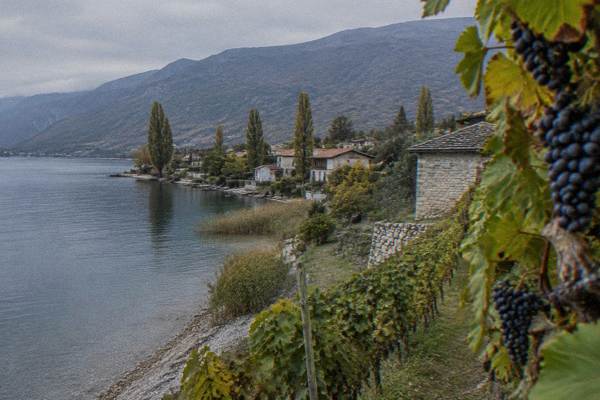
Rakija And Macedonian Wine: What To Drink Around Ohrid
Rakija and Macedonian wine are the two drinks that anchor every table around Ohrid, and both are easy to explore from the old town: this guide covers what each one is, how tastings work, and what to eat alongside them.
Short answer
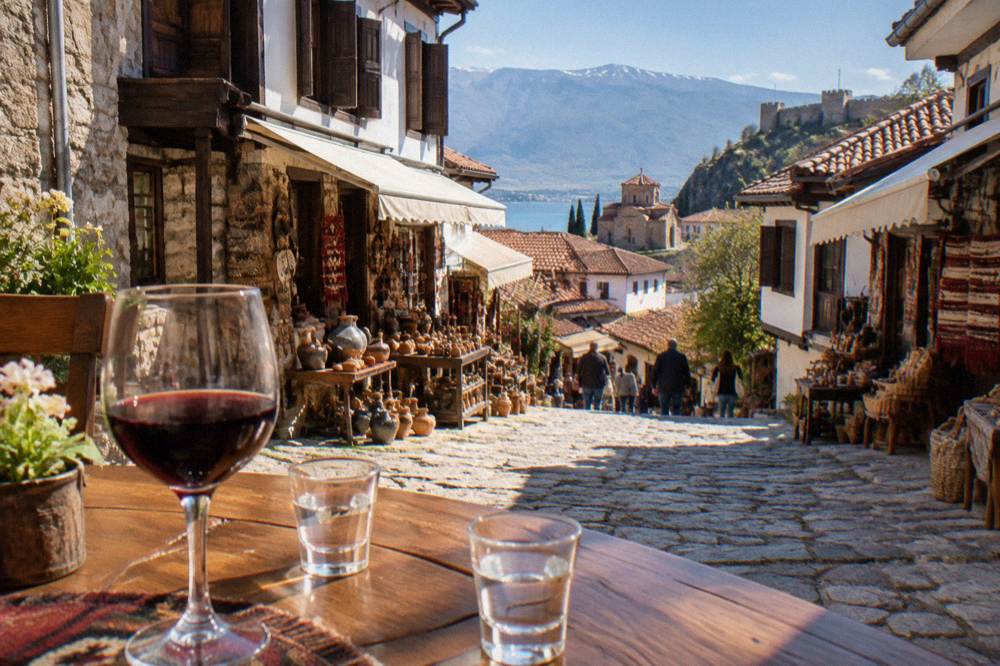
Rakija is a fruit brandy served in small glasses, usually before or with a meal, and Macedonian wine, red and white, is poured by the glass across Ohrid's restaurants and tasting rooms. Several bookable tastings and winery tours run from the town, each with its own character.
Rakija and Macedonian wine are the two drinks that define the table in Ohrid, the old lake town on Lake Ohrid in North Macedonia whose old lanes, Byzantine churches and lakeside quay sit inside a UNESCO mixed heritage site. Rakija, a fruit brandy poured in small glasses, opens meals and marks toasts; Macedonian wine, red and white, fills the rest of the evening. Neither needs a car to explore: tasting rooms, winery tours and cooking experiences all run from the town, and the Ohrid Travel Guide lays out how each of them works, what to drink with what, and how to plan the drinking side of a visit without guessing at prices.
What Is Rakija And How Is It Served In Ohrid?
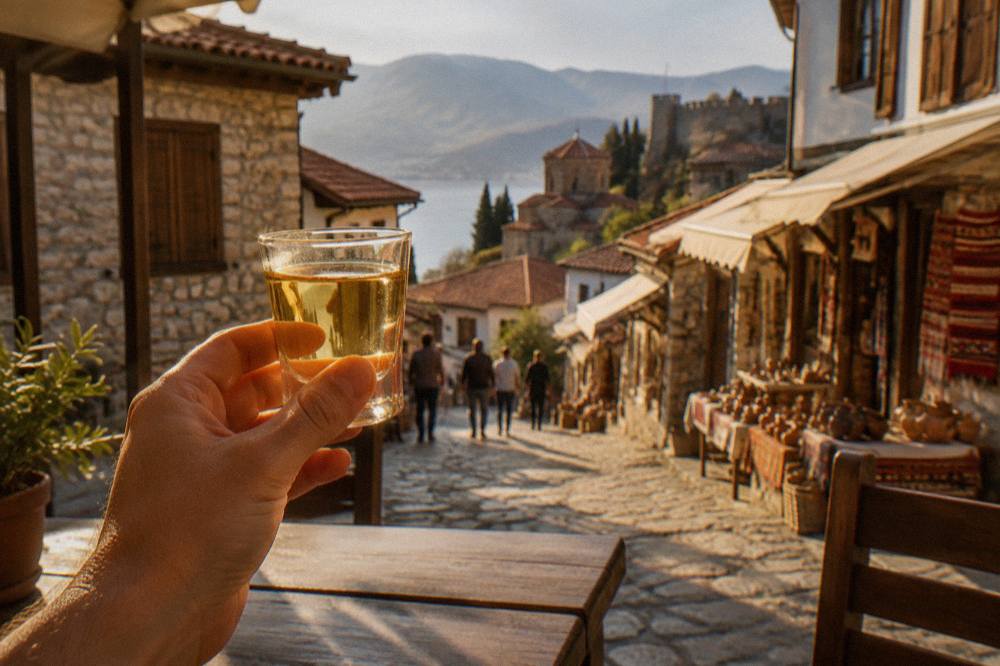
Rakija is a fruit brandy, distilled across the Balkans and poured in North Macedonia as a small, strong drink taken before or alongside a meal, never as a long sipping session. In Ohrid it arrives in tiny glasses, often unordered, as a gesture of welcome at the start of a table, and the same word covers brandies made from different fruits depending on what was in season where they were made.
The drink is a hospitality ritual as much as a beverage. A glass is raised, someone offers a toast, and the glass goes back down empty or nearly so. Refills are common but never obligatory, and pacing yourself across a long Macedonian meal matters more than matching your hosts glass for glass. Because rakija is strong, it is treated as an opener rather than a drink to accompany the whole evening; wine and water carry the rest of the table.
Fruit choice shapes the flavour. Grapes, plums, apricots and other orchard fruits each produce their own style, and households and small producers across North Macedonia make their own. Around Ohrid, what reaches a restaurant table or a tasting room is usually whatever the family or the supplier makes, so asking what the bottle in front of you was made from is a fair question and usually gets a direct answer. Some versions are flavoured or rested with herbs or other fruit after distillation; the plain ones let the base fruit speak.
Two practical notes make the first rakija easier. First, it is drunk at room temperature, not chilled, and the small glass size is the whole point. Second, if a glass appears before you have ordered anything, that is the custom working as intended rather than a billing trick; the basics of Macedonian money and the denar matter more later in the meal, when the bill arrives in MKD.
What Macedonian Wines Should You Try Around Lake Ohrid?
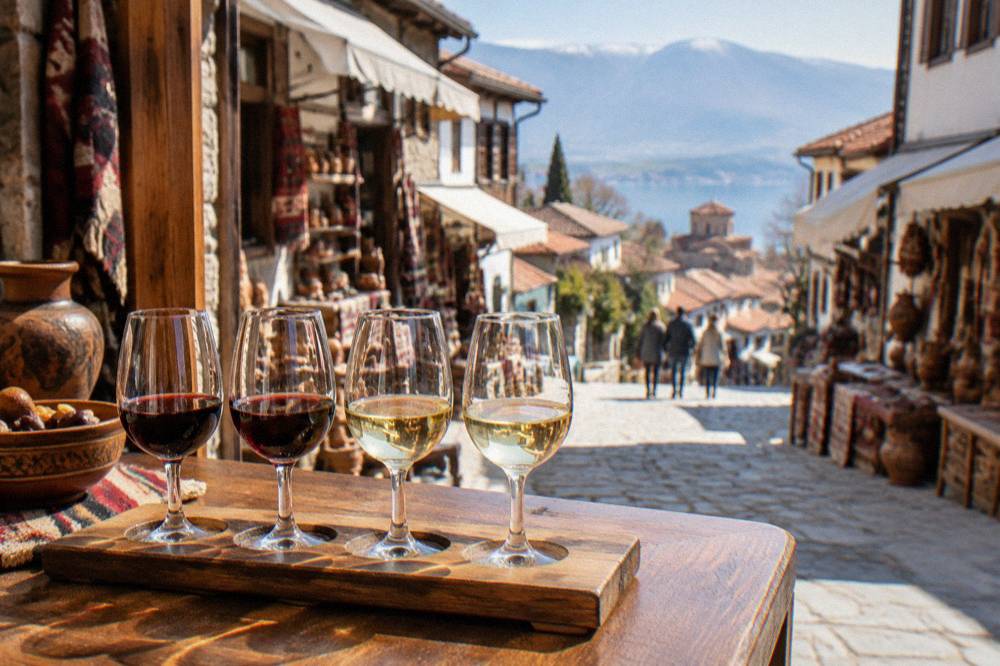
Macedonian wine comes in red, white and rosé, made from both international grapes and varieties that grow mainly in this part of the Balkans, and around Ohrid it is poured by the glass, by the carafe and at organised tastings. A visitor does not need to study labels in advance: the useful move is to taste local pours side by side, which is exactly what a guided tasting or winery visit is built to do.
North Macedonia has a long wine-growing tradition, and the country's vineyards supply both everyday table wine and bottles aimed at export. In Ohrid, the everyday end of that range is what fills most glasses: house reds and whites poured by the carafe at meals, inexpensive, and poured generously. The tasting end is where the local varieties get interesting, because a structured tasting is the easiest way to meet a Macedonian red next to a Macedonian white and understand the difference without committing to full bottles at dinner.
Reds dominate the national conversation, and the country's warm continental summers ripen them fully. Whites and rosés suit the lakeside setting better on a hot afternoon, and the altitude around the Ohrid region, a mountain basin at about 693 m above sea level, keeps evenings cool enough that a white glass on the quay is a comfortable thing. A tasting that includes one of each is the ideal first encounter.
The practical way in is a bookable tasting. The Check availability link goes to a winery tour and tasting experience that runs from Ohrid with transport included; its listing carries the live price, rating and duration. For a broader look at what the site covers on this theme, see the food and wine tours around Ohrid page.
Ready to taste the local wines at a winery? Book a winery tour and tasting here.
What A Wine Experience Around Ohrid Actually Covers
The bookable options differ less in quality than in shape. Some stay in town at a tasting room; others drive out to a winery; one or two wrap the drinks into a full food experience. The table below sets out what each kind involves, without prices, which render from the live listings.
| Experience type | Where it happens | What you get | Best for |
|---|---|---|---|
| Winery tour with tasting | A winery reached by road from Ohrid, transport included | A walk through the winery followed by a seated tasting | First-time visitors who want context with the glass |
| In-town tasting at a winery room | A tasting room in Ohrid itself | A flight of pours with someone explaining each one | Short visits and evenings |
| Private tasting | A booked room, arranged for your group | Pours at your own pace, questions answered directly | Couples and small groups |
| Cooking class with drinks | A kitchen venue in Ohrid | Dishes you prepare, served with Macedonian wine | Visitors who want food first |
| Budget tasting at a local winery | A winery on the edge of town | A shorter flight, informal setting | Travellers watching spending |
Each operator's listing serves as the price source, and product prices, ratings and durations all render from the booking blocks on this page rather than from typed figures.
Where Can You Taste Wine And Rakija In Ohrid?
Tastings in Ohrid happen in three settings: dedicated tasting rooms and winery venues in and around the town, restaurants that pour local wine by the carafe alongside a full menu, and bookable experiences that combine a winery visit, a tasting or a cooking session with the drinks included. Each suits a different kind of evening, and none requires a car if you pick one with transport included.
The in-town tasting room is the simplest option. You sit, you are poured a sequence of glasses, and someone talks you through what each one is. This is the fastest way to learn what Macedonian wine tastes like when it is not competing with food. Winery visits add the production side: the walk past tanks and barrels before the tasting explains why the wine in the glass tastes the way it does. Around Ohrid these run as short guided trips with transport laid on.
Restaurants are the third route and the most relaxed one. Order by the carafe, ask for the house red or white, and the meal becomes the tasting. Rakija often appears at the start of the table in exactly this setting, which is why dinner is a good place to meet both drinks in one evening. The food of Ohrid page, part of the site's wider coverage of the town, goes into what to order alongside.
For a structured version of the same evening, bookable experiences do the arranging for you.
How Much Does A Wine Tasting In Ohrid Cost?
Wine experiences around Ohrid are sold per person through booking listings, and every price on this page renders from those live listings rather than being typed here, because tasting prices change with season and inclusions. What a visitor can plan on is the structure: a short in-town tasting sits at the low end, a winery visit with transport costs more, and a full private evening costs more again, with local costs in restaurants and shops paid in denars.
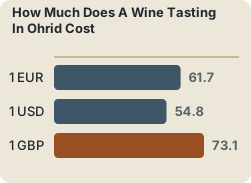
The denar (MKD) is the local currency, and the National Bank pegs it to the euro in practice, which keeps prices predictable for euro-zone visitors. The middle rate on 19 October 2026, from the National Bank's own published list, gives a useful reference:
| Currency | MKD per unit, 19 Oct 2026 middle rate |
|---|---|
| 1 EUR | 61.6633 |
| 1 USD | 54.7972 |
| 1 GBP | 73.0738 |
Euros are quoted widely for tours and transfers but are not legal tender in North Macedonia, so anything bought in a shop or restaurant in Ohrid is paid in denars, cash or card as the venue allows. The full picture, including ATMs and exchange, is on the money and denar guide. For planning the whole budget around the drinking, the Ohrid cost and budget guide is the companion page.
Booking a tasting in advance rather than on the day does two things: it fixes the slot at a known price, and it removes the need to negotiate anything in a second language on the night. Free cancellation terms, where the listing offers them, are shown on the listing itself, so checking the terms before paying is the one step that matters.
What Food Goes With Rakija And Wine In Ohrid?
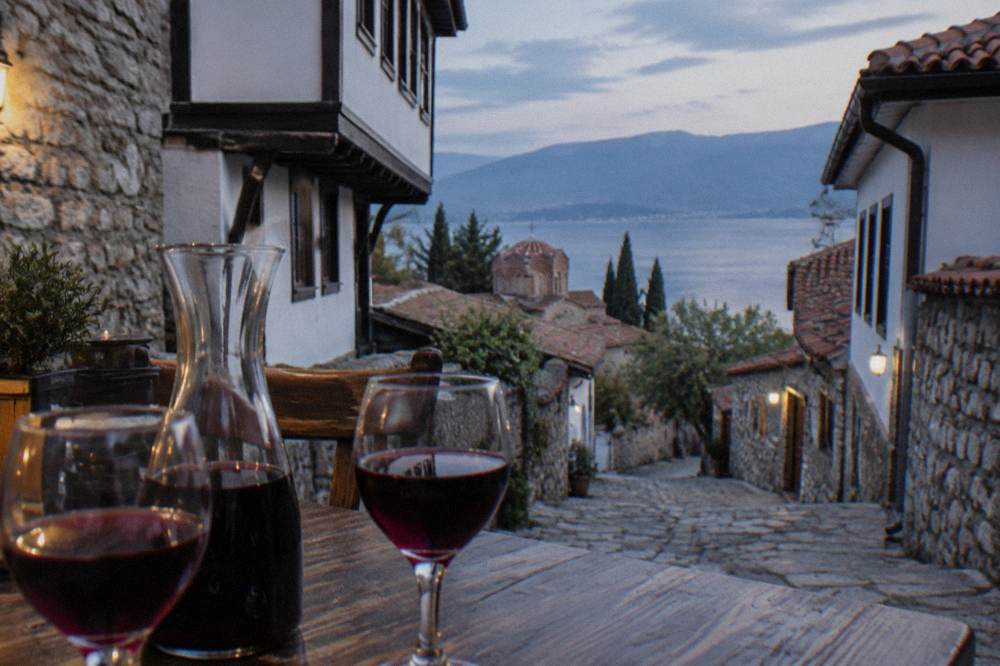
Macedonian meals are built for long tables: a sequence of small cold dishes first, then grills and baked mains, with salad and bread throughout, and the drinks slot into that order, rakija at the opening, wine across the middle, and a small sweet ending. In Ohrid the same structure applies, with the lake adding its own fish tradition to the middle of the meal.
The opening is where rakija belongs. Small plates, salads, cured and pickled things, cheese and bread all appear before any main, and the brandy's strength is matched against those salty, sharp flavours. White wine takes over cleanly from there, and red carries the grilled and baked dishes that follow. This order is not a rule enforced on anyone; it is simply how tables in North Macedonia are laid out, and following it needs no expertise.
The lake's fish tradition is Ohrid's own contribution to the Macedonian table, and the story of Ohrid trout is covered elsewhere on this site in the wider food coverage. Around any fish main, a white pour is the natural pairing; around the grills, a red. A toast with rakija fits either moment, and offering one back is the polite mirror of receiving one.
For visitors who want the whole structure explained while cooking it, a cooking class with the drinks included does exactly that.
A class turns the pairing question into a practical one: you cook the dishes, you pour the glasses that go with them, and you leave knowing which wine to order with which plate for the rest of the trip. The phrase guide for saying hello in Macedonian adds the two or three words that make the same table warmer.
When Is The Best Season For Wine And Rakija Around Ohrid?
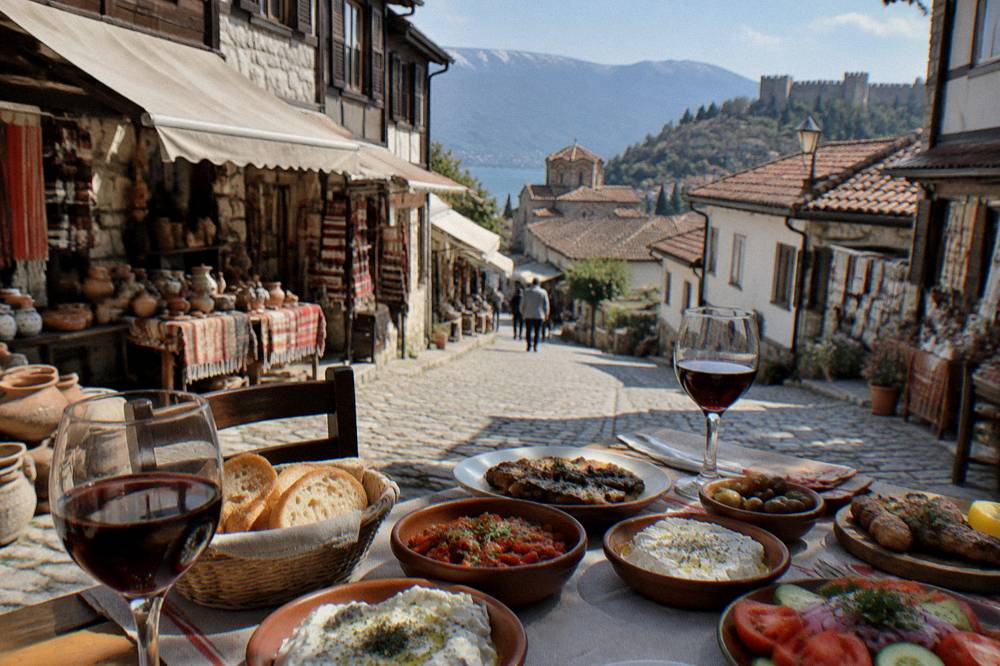
Summer, from June through August, is when Ohrid's terraces and lakeside tables are in full use and every tasting runs at its fullest schedule, with August the busiest month of the year; late spring and early autumn bring milder weather with fewer demands on booking ahead, and winter keeps the indoor tasting rooms open while lake activities pause.
The modelled climate normals for Ohrid, ERA5 reanalysis for 1991-2020, show why the calendar shapes the drinking. Summer highs average 24.2 C in June, 27.1 C in July and 27.6 C in August, with the lowest rain of the year in July and August at 34.7 mm and 32.9 mm. That is terrace weather, and it is also when the town is fullest. The shoulder months trade some warmth for calm: May averages a 19.5 C high with 70.8 mm of rain, September 22.4 C with 62.4 mm.
| Month | Mean daily high C | Mean daily low C | Rain mm |
|---|---|---|---|
| May | 19.5 | 10.8 | 70.8 |
| June | 24.2 | 15.2 | 43.1 |
| July | 27.1 | 18.3 | 34.7 |
| August | 27.6 | 19.0 | 32.9 |
| September | 22.4 | 14.9 | 62.4 |
| October | 17.4 | 10.3 | 76.0 |
The festival calendar also fills the summer. The 66th Ohrid Summer Festival ran 12 July to 20 August 2026, with the opening gala at the Ancient Theatre, and the Ohrid Water Festival followed across late August, including the 25 km swimming marathon from St Naum to Ohrid harbour on 22 August 2026. An evening tasting booked around a festival performance is a classic Ohrid summer combination. The full seasonal picture is on the best time to visit Ohrid page.
Can You Combine A Wine Tasting With Sightseeing Around Ohrid?
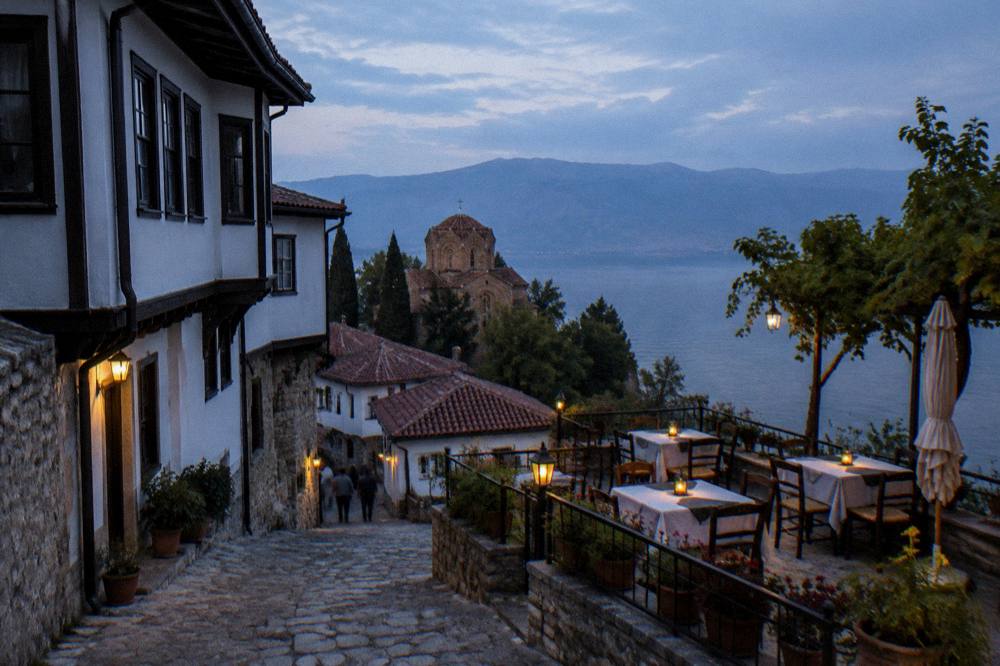
Yes, and the pairing works both directions: a tasting or winery visit slots easily into an afternoon around Ohrid's old town, churches and quay, while the bigger day trips, to St Naum, Galicica National Park or across the lake, can end back in town with an evening of local wine. The one rule is that day trips that start in Tirana or Skopje start there, not in Ohrid.
The compact old town makes the half-day combination simple. The lanes climb from the lake toward Samuel's Fortress, and the National Museum institute's sites, including Robev Family House, keep a summer schedule from 1 May to 30 September and a winter schedule from 1 October to 30 April, closed on Mondays. A morning walk through those, lunch on the quay, and a tasting in the afternoon is a full and unhurried day. Institute tickets are 150 MKD for foreign visitors and 120 MKD for domestic visitors at the listed museum sites.
Day trips run the other way. A trip to the St Naum monastery at the lake's southern end pairs a monastery visit with the Crn Drim springs, where rowboats take visitors through the spring water; the crossing at Sveti Naum to Tushemisht, about 4 km away, is the Albania link. Trips flagged as starting in Tirana or Durres depart from there, and that is worth checking before booking, because the product name does not always make it obvious.
| Day out from the Ohrid region | What it involves | How drinks fit |
|---|---|---|
| St Naum monastery and springs | Monastery, springs rowboats, southern lake shore | Evening back in Ohrid for dinner and wine |
| Bay of Bones and lake cruise | The Museum on Water at Peshtani by boat | Lakeside lunch stop, house pour |
| Galicica National Park | Park roads between Lake Ohrid and Lake Prespa, Magaro peak at 2,254 m | Cold rakija or a white after the altitude |
| Old town walk in Ohrid | Churches, fortress lanes, Old Bazaar, quay | Tasting room in the afternoon |
The park charges 250 MKD per vehicle with no per-passenger fee, and 100 MKD applies only to someone entering on foot from the Ohrid-side gate. How the pieces of a visit fit together day by day is laid out in how many days you need in Ohrid.
What Should You Know Before Drinking In Ohrid?
Drinking in Ohrid needs three practical anchors: the drinking age and licensing rules are the national ones, the currency for everything bought in town is the denar, and North Macedonia is outside the EU and Schengen, so entry rules, registration and phone roaming all work differently from a euro-zone trip. None of it complicates a glass of wine; all of it is worth knowing before the first one.
Registration is handled by hotels: foreign visitors register with the local police within 48 hours of arrival, and a hotel does it as part of check-in. Visa-free nationals may stay up to 90 days in any 180-day period, and UK visitors may stay up to 3 months, with passport expiry at least 90 days after arrival. The details sit on the visa and entry guide.
Safety around alcohol is ordinary-city common sense. Ohrid's lanes are on foot and climb from the lake, so the walk back after an evening is a walk uphill on cobbles in places. The safety guide for Ohrid covers the wider picture, including the emergency numbers: ambulance 194, police 192, roadside assistance 196. Tap water in Ohrid is generally drinkable, a point covered in full at can you drink the water in Ohrid, and alternating water with wine at a long table is standard practice rather than a tourist habit.
Getting to the evening matters too. Ohrid's airport is about 10 km from the centre; a taxi from the airport is reported at about 600 to 800 MKD, and the bus from Skopje, about 170 km away, runs about 3 hours for 850 to 950 MKD one way. From Tirana, minibuses take 3 to 3.5 hours including the border, for about 15 to 20 euros. Those figures belong to their journeys and no others.
Can You Buy Rakija And Macedonian Wine To Take Home From Ohrid?
Yes: bottles of both are sold in Ohrid's shops and around the Old Bazaar, from small domestic producers and larger Macedonian wineries, and they travel well as gifts or souvenirs, with the usual airline liquid rules the only constraint. The choice is between a branded bottle from a shop and a bottle bought where you tasted it, and both routes are easy in town.
Buying where you tasted has one advantage beyond sentiment: the person selling the bottle can tell you what it is, because they poured it an hour earlier. Winery visits usually end at exactly this point, and tasting rooms in town do the same. In the Old Bazaar and the shops around it, branded Macedonian wine and rakija line the shelves, and the price is paid in denars.
For luggage, glass needs padding and the liquid allowance for carry-on applies, so checked luggage is the practical route for more than a bottle or two. Anyone flying from Ohrid's St Paul the Apostle Airport, which handled 263,869 passengers in 2025, 20.0 percent up on 2024, will find it a small terminal where checked bags move quickly. Souvenir ideas beyond the bottle, including the famous Ohrid pearl, sit on the site's shopping and souvenirs coverage under things to do in Ohrid.
How Do You Plan A Wine-Focused Trip To Ohrid?
A wine-focused visit works as two or three evenings in town built around one booked tasting and one long restaurant table, with a winery day trip in the middle and the old town, the quay and a lake outing filling the daylight hours. Book the tasting and the winery visit in advance, leave dinners open, and use the walking city itself as the transport between all of it.
The shape of the trip follows the shape of the town. Ohrid is walkable: the old town climbs from the lake and everything in it is reached on foot, a point the site's getting around Ohrid guide covers in detail. That means a tasting room, a restaurant and a quay-side evening glass are all within the same evening's walk, and no plan needs a car inside town.
The one booking worth making ahead is the structured experience, whether that is the winery tour with tasting and transport, a private tasting or a cooking class with wine. Those have set departures and group sizes. Restaurant tables, by contrast, can be chosen on the day around whatever the old town serves up. For travellers arriving from further away, the Skopje to Ohrid and Tirana to Ohrid routes are both covered on this site, and each lands you close enough to the first glass.
Common Questions About Rakija And Macedonian Wine In Ohrid
What is rakija made from in North Macedonia?
Rakija is a fruit brandy, and the base fruit varies by producer: grapes, plums, apricots and other orchard fruits are all used across the Balkans. Around Ohrid, asking what a specific bottle was made from is the normal way to find out, and the answer is usually given directly.
Do you drink rakija before or with a meal in Ohrid?
Before and at the start: rakija arrives in small glasses as an opener, often with the first cold dishes of a Macedonian table, and wine carries the rest of the meal. The small glass size is the convention, and the toast that opens the glass is part of the ritual.
Can you visit a winery from Ohrid without a car?
Yes. Bookable winery experiences from Ohrid include transport, so the visitor is collected and returned rather than driving. The listing for each product states exactly what is included, and the booking blocks on this page carry the live prices and ratings.
How much does a wine tasting in Ohrid cost?
Tasting prices are set per person by the operators and change with season and inclusions, so this page prints no figure. Every price renders from the live booking listings in the blocks above, which show the current rate, rating and availability at the moment you look.
Is Macedonian wine available by the glass in Ohrid restaurants?
Yes, house reds and whites are poured by the glass and by the carafe across Ohrid's restaurants, alongside the wider Macedonian wine list. Ordering the house pour is the simplest way to drink local at a normal dinner price, paid in denars like everything else in town.
Can you bring Macedonian wine or rakija home in your luggage?
Yes, both travel well as checked luggage with padding, subject to the usual airline liquid rules for carry-on. Bottles are sold in shops around Ohrid and the Old Bazaar, and buying at the tasting room or winery means the seller can tell you exactly what is in the bottle.