Ohrid Vs Skopje: Where To Spend Your Time
Ohrid and Skopje sit about 170 km apart by road in North Macedonia, and they answer different travel questions: Ohrid is a lakeside UNESCO town on Lake Ohrid, Skopje is the capital and the country's transport hub. This guide compares them on facts, distances, costs and tour options.
Short answer
Ohrid is the destination town on Lake Ohrid with the UNESCO World Heritage old town, churches, fortress and beaches; Skopje is the capital and main arrival hub about 170 km away by road. Many travellers fly into Skopje, spend a day or two there, then take the three-hour bus or a tour to Ohrid for the lake and the heritage sites.
Skopje is the capital of North Macedonia and the country's main transport hub; Ohrid is the lakeside town on Lake Ohrid, about 170 km away by road, holding the UNESCO World Heritage old town, the Byzantine churches and the lake shore. Deciding where to spend your time is mostly a question of what the trip is for: the Ohrid Travel Guide side of the comparison is a compact heritage town on the water, while Skopje is where the flights, buses and rails of the country connect. Both can be combined in one trip, and the three-hour bus between them makes that easy.
Where Are Ohrid And Skopje, And How Far Apart?
Ohrid sits on the north-eastern shore of Lake Ohrid at about 693 m above sea level, a freshwater mountain lake inside a UNESCO mixed heritage site, while Skopje lies inland to the north-east, about 111 km away in a straight line and about 170 km by road. The bus between them takes about three hours and costs 850 to 950 denars one way. There is no passenger train to Ohrid and no domestic flight between the two cities.
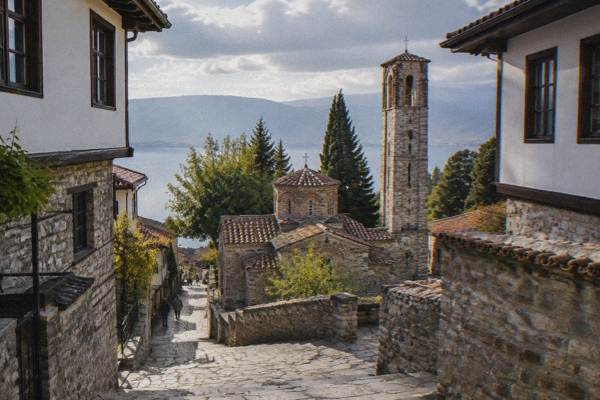
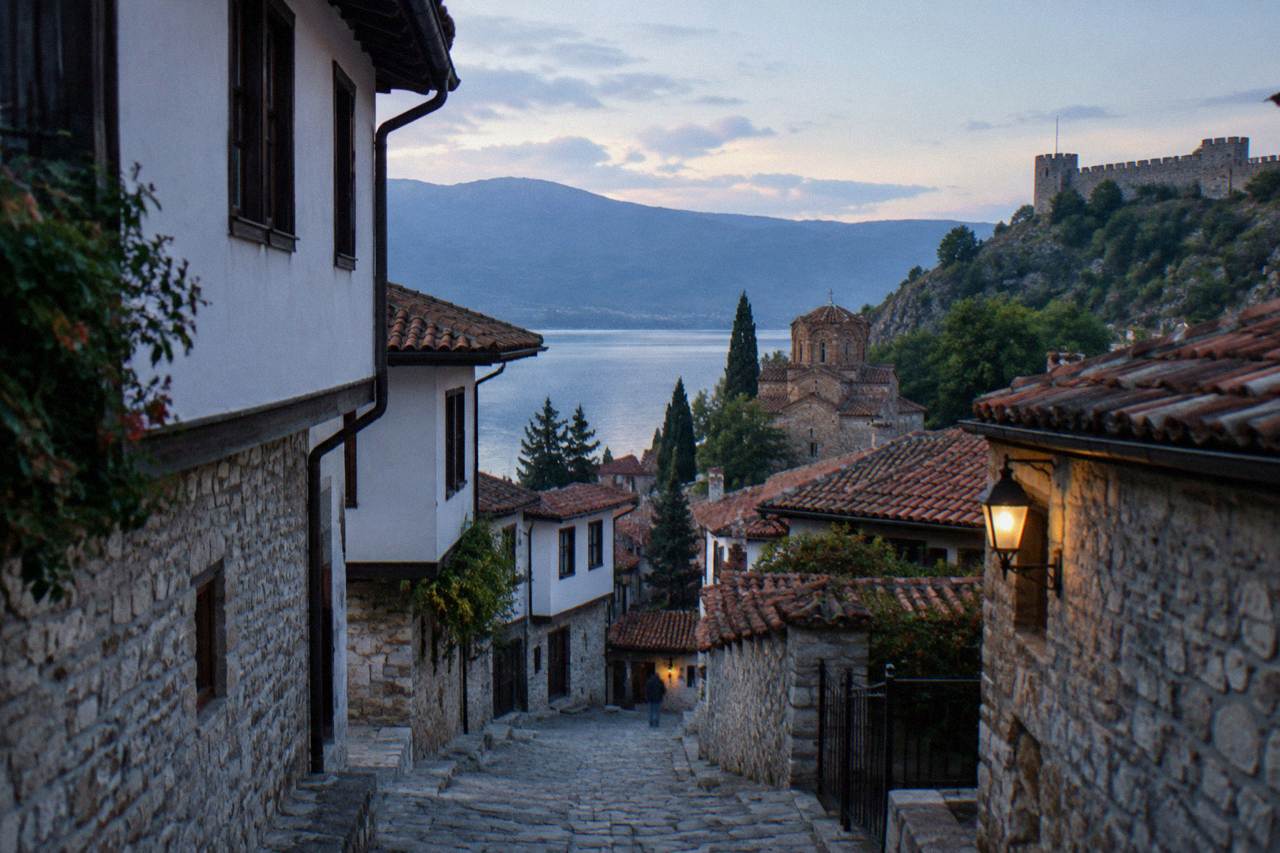
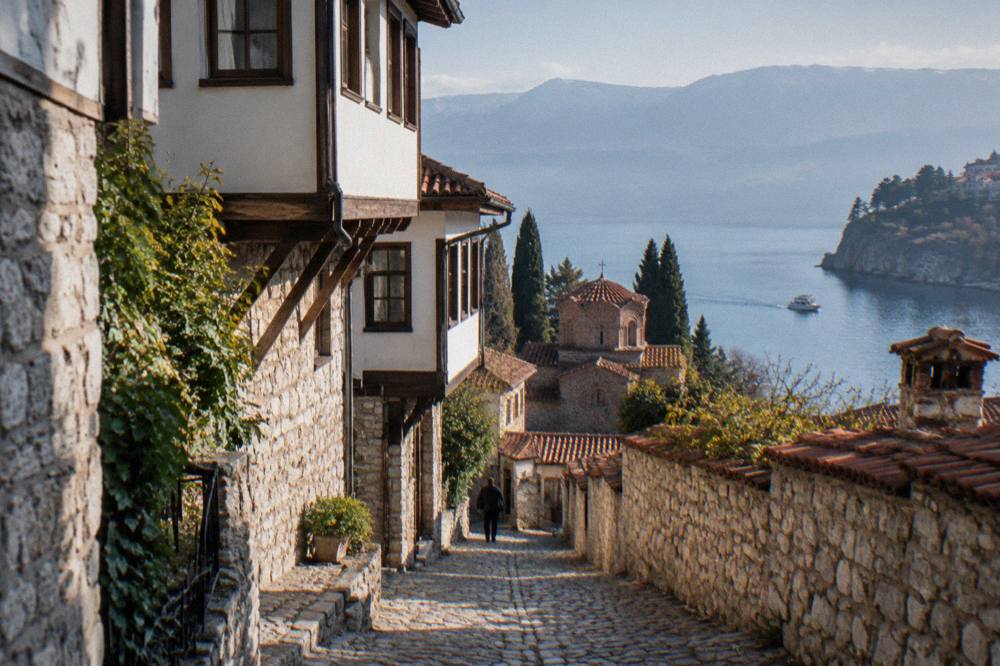
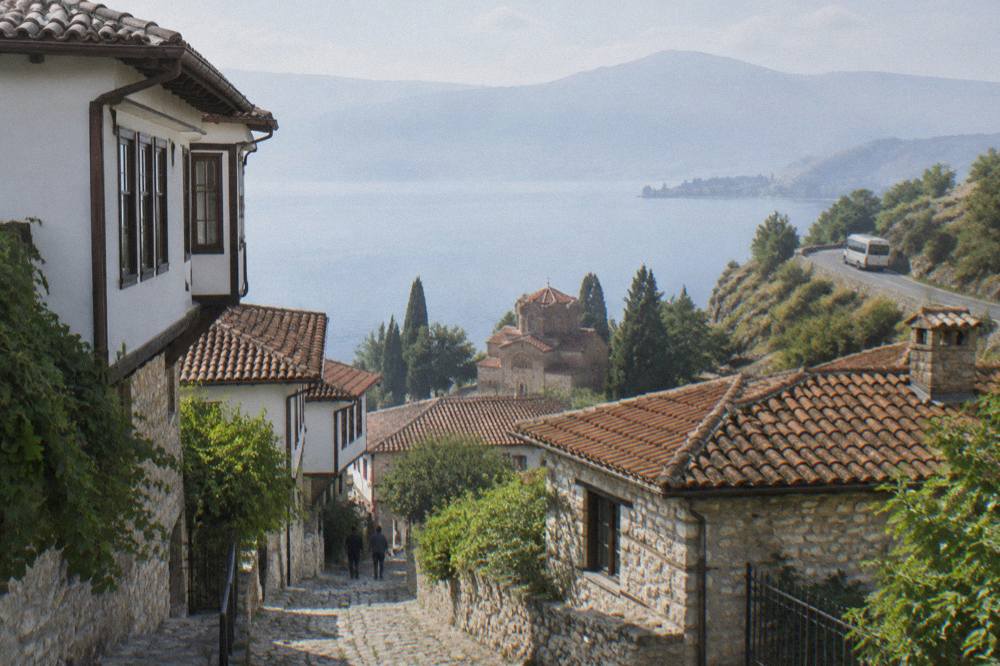
The two cities belong to the same small country but to different worlds of travel. Ohrid is built around the lake: the old town climbs from the shore to Samuel's Fortress, the lanes are on foot, and St Naum, Struga, Galicica National Park and Lake Prespa are all day trips from it. Skopje, by contrast, is a capital and the place where long-distance travel through North Macedonia is organised; the road to Ohrid is one of its busiest corridors.
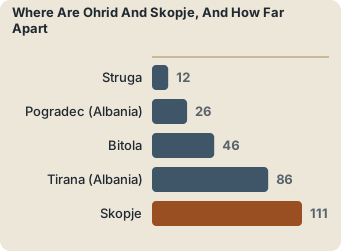
The straight-line distances, computed for this comparison, put the neighbours in proportion: Struga about 12 km from Ohrid, Pogradec in Albania about 26 km, Bitola about 46 km, Tirana about 86 km and Skopje about 111 km. By road the Skopje run is the long one, roughly 170 km with about 140 MKD in motorway tolls for a car, and about two and a half hours of driving. The full guide to that route is at Skopje to Ohrid transport options.
| Place | Straight-line distance from Ohrid | Role in a trip |
|---|---|---|
| Struga | about 12 km | Day trip, lake town on the Crn Drim |
| Pogradec (Albania) | about 26 km | Day trip across the border |
| Bitola | about 46 km | Day trip inland |
| Tirana (Albania) | about 86 km | Day trip or onward transfer |
| Skopje | about 111 km | Capital, main arrival hub, 170 km by road |
What Kind Of City Is Each One, And What Is In Ohrid?
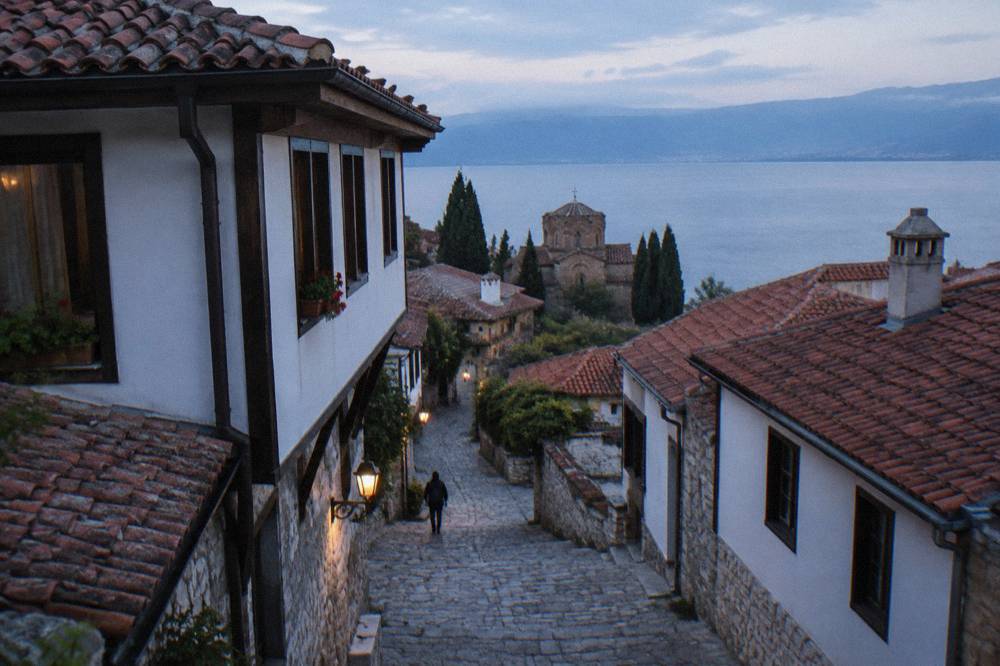
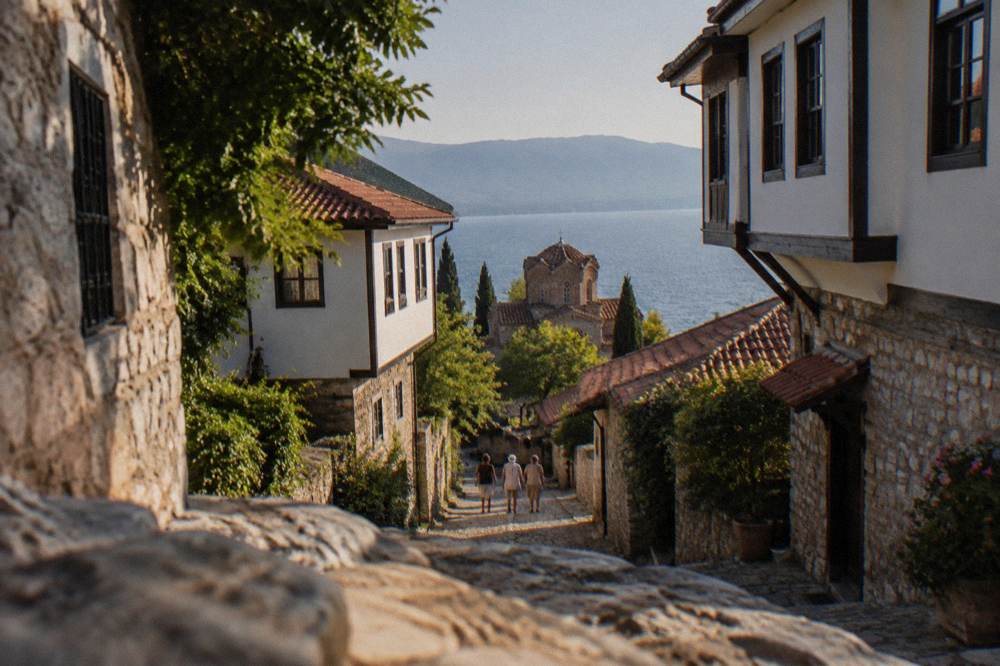
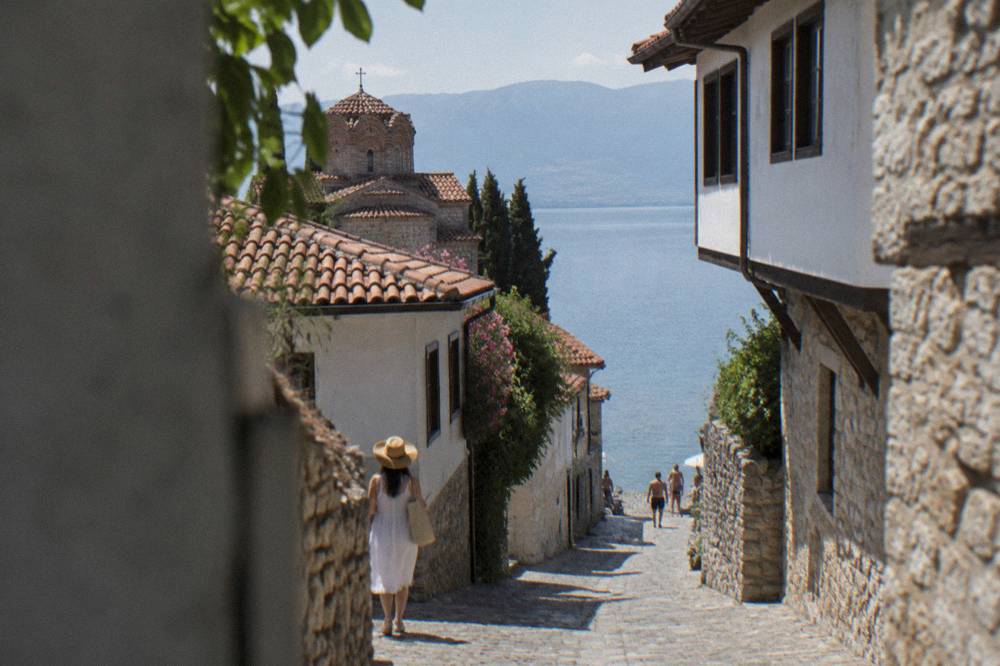
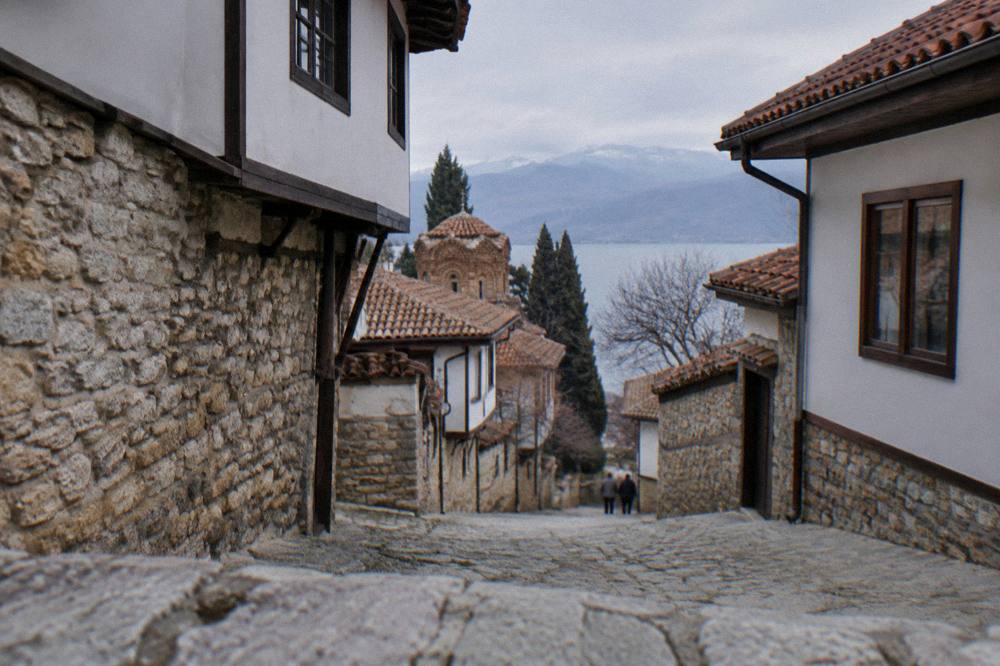
Ohrid is a lake town of about 51,428 people in its municipality, centred on a UNESCO mixed site inscribed in 1979 and 1980 and extended to the Albanian part of the lake in 2019, with Samuel's Fortress, the Church of St John at Kaneo, St Sophia, Plaosnik, the Ancient Theatre and the Old Bazaar inside walking distance of the shore.
Skopje is the capital, and on this page's facts it figures as the transport hub and the starting point of guided day tours to Ohrid rather than as a described sightseeing destination.
The comparison is honest only if it stays on what is documented. Ohrid's own record is deep: the UNESCO listing credits the town with the oldest Slav monastery, St Panteleimon at Plaosnik, and more than 800 Byzantine-style icons from the 11th to the end of the 14th century, and the lake is described by UNESCO as having existed about two to three million years with over 200 endemic species, including 17 endemic fish. That is the substance of the Ohrid side of the scales.
Skopje's side, in this comparison, is practical: it holds the country's main airport, the intercity bus network's centre, and the departure point of the guided day tours that bring travellers to Ohrid when there is no time for an overnight stay. Whether Skopje itself rewards sightseeing days is its own question, treated in Is Skopje worth visiting, and the honest answer for a first-time visitor to North Macedonia with limited days is usually to treat the capital as the gateway and the lake as the destination.
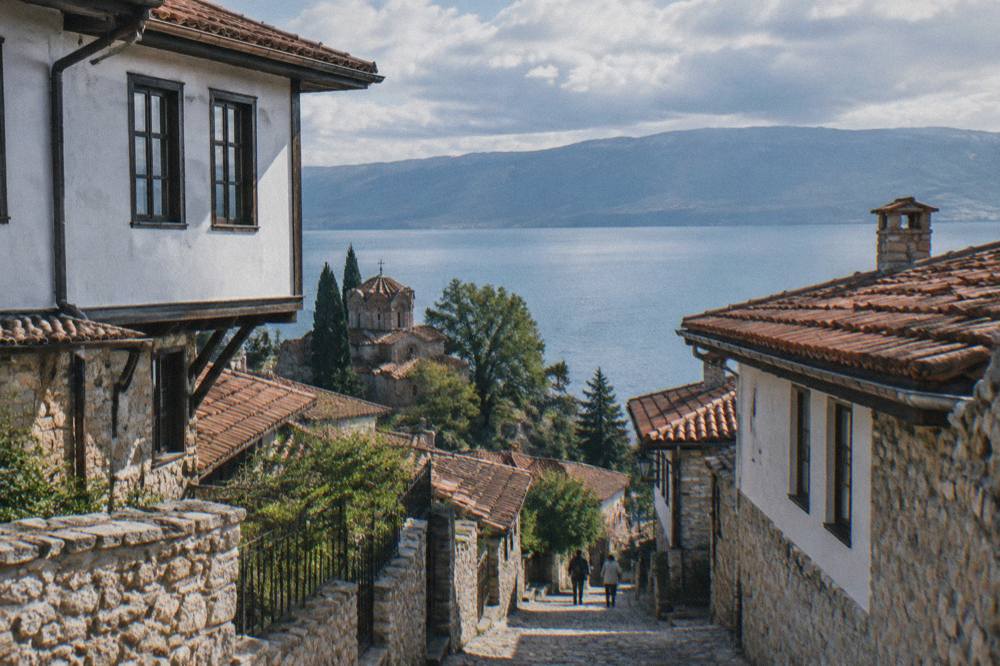
For the Ohrid half of the trip, the sightseeing is dense and walkable, and the question of how long to allow has its own page in How many days in Ohrid. The lake itself, the beaches and the boat trips out of the port are covered in Lake Ohrid and its shore.
How Do You Travel Between Skopje And Ohrid?
The bus is the standard link: intercity coaches run from Skopje's Transport Centre to Ohrid several times a day, take about three hours and cost 850 to 950 MKD one way. Driving takes about two and a half hours over roughly 172 km with about 140 MKD in tolls, a private transfer starts from about EUR 130, and there is no passenger train and no domestic flight.
Several operators, including Galeb and Classic Company, run the Skopje to Ohrid corridor, with departures spread across the day and more of them in summer. The fare range of 850 to 950 MKD is a one-way figure from the transport record, and the arrival point in Ohrid is the bus station east of the centre, a short taxi ride or a walk of about twenty to thirty minutes from the old town. The two costs have their own detailed pages in How much is a bus from Skopje to Ohrid and How much does a taxi cost from Skopje to Ohrid.
The train question deserves a direct answer because it is asked often: there is no passenger rail service to Ohrid at all, so the rail leg that exists on the map of North Macedonia ends far short of the lake. That answer, with the reasoning, is in Is there a train from Skopje to Ohrid. Flying is not an alternative either: there is no domestic flight between the two cities, and Ohrid's own airport, St Paul the Apostle, about 10 km from the centre, serves international seasonal routes rather than a domestic shuttle, as covered in Ohrid Airport routes and transfers.
| Mode | Time | Cost figure | Notes |
|---|---|---|---|
| Intercity bus | about 3 hours | 850 to 950 MKD one way | Several daily departures, more in summer |
| Car | about 2.5 hours | about 140 MKD tolls (plus fuel) | Tolls paid at each plaza, no vignette |
| Private transfer | about 2.5 hours | from about EUR 130 | Quoted as a starting price |
| Train | none | none | No passenger rail to Ohrid |
| Domestic flight | none | none | No domestic flight between the cities |
For travellers landing at Skopje's airport rather than in the city, the onward connection is its own logistics question, handled in Skopje Airport to Ohrid.
Can You See Ohrid From Skopje In One Day?
Yes, and it is a common pattern: guided day tours depart from Skopje and spend the day in Ohrid's old town and at its major sights, with the operator's listing carrying the exact price, duration and itinerary. The trade is simple: a day tour buys the UNESCO core of Ohrid without an overnight stay, while staying in Ohrid buys the lake at dawn, the evening shore and the day trips that a same-day return to Skopje forecloses.
The flagship option on this route is the Ohrid UNESCO Heritage full-day guided tour from Skopje, which exists precisely for travellers whose trip is anchored in the capital. Because it is a product that starts in Skopje, it starts in Skopje: the pickup and the timing belong to the operator's listing, and the day's return lands back in the capital. When the plan allows an overnight instead, the same corridor can be travelled independently by bus and turned into a two- or three-day stay, which is the shape most lake itineraries take. Check availability if the one-day shape fits the trip.
To see Ohrid's sights from the capital in one sweep, book a full-day guided tour here.
The reverse direction also works: Skopje is a day trip from Ohrid by bus or car, which suits travellers who want a look at the capital without moving hotels. That pattern, with what it involves, is laid out in Skopje from Ohrid as a day trip, and the multi-city version that strings Skopje, Ohrid and Tirana together is in the Skopje, Ohrid and Tirana route.
What Do Ohrid's Sights And Museums Cost?
The NI Institute and Museum Ohrid, which runs Robev Family House, the Museum on Water at the Bay of Bones and the Icon Gallery, charges 150 denars for foreign visitors, 120 denars for domestic visitors and 60 denars for children and students, per its own website. The museum sites run a winter schedule from 1 October to 30 April and a summer schedule from 1 May to 30 September, and the listed sites close on Mondays.
These are the figures the comparison actually rests on, because Ohrid's sightseeing is mostly a museum-institute affair and the prices come from the institute itself. The hours differ site by site and belong to each sight's own page, so the fortress, Kaneo, Plaosnik and St Sophia are covered separately, in Samuel's Fortress, St John at Kaneo, Plaosnik and St Sophia. The Ancient Theatre, built at the end of the 3rd or the start of the 2nd century BC and first excavated in 1935, is also an institute site, and its story is in the Ancient Theatre of Ohrid.
| Museum site | Foreign ticket | Domestic ticket | Winter hours (1 Oct to 30 Apr) |
|---|---|---|---|
| Robev Family House | 150 MKD | 120 MKD | 09:00 to 15:30, closed Monday |
| Museum on Water (Bay of Bones) | 150 MKD | 120 MKD | 09:00 to 15:30, closed Monday |
| Icon Gallery (Perivleptos) | 150 MKD | 120 MKD | 09:00 to 14:00, closed Monday |
A day of Ohrid sightseeing therefore budgets in denars, not euros: the currency of North Macedonia is the Macedonian denar, euros are not legal tender though they are commonly quoted for tours and transfers, and the money mechanics are covered in Macedonian denar and money in Ohrid. The wider budget picture, including what a stay tends to involve, is in Ohrid cost and budget.
When Is The Best Time To Visit Each City?
Ohrid's season runs with the lake: peak months are June to September, August is the busiest, and boats to St Naum operate about May to October with a reduced winter schedule, so the best months for lake swimming are July to September, when modelled surface water reaches about 22.9 C in July and 23.5 C in August. Skopje, as a capital visited for its own sights rather than a swim season, does not depend on the lake calendar.
The climate record for Ohrid is modelled ERA5 reanalysis for 1991 to 2020, not a weather-station reading, and it shows the shape of the year plainly: July and August are the warmest months with mean daily highs of 27.1 and 27.6 C, and mean daily lows of 18.3 and 19.0 C, while December and November carry the highest monthly rainfall at 92.6 and 90.4 mm. August has the lowest monthly rain total at 32.9 mm, and July 34.7 mm, so the lake summer is both the warm and the dry end of the year.
| Month | Mean daily high C | Mean daily low C | Rain mm |
|---|---|---|---|
| January | 5.0 | -0.8 | 76.5 |
| March | 10.0 | 2.5 | 80.5 |
| May | 19.5 | 10.8 | 70.8 |
| July | 27.1 | 18.3 | 34.7 |
| August | 27.6 | 19.0 | 32.9 |
| October | 17.4 | 10.3 | 76.0 |
| December | 6.2 | 0.9 | 92.6 |
The water tells its own story. Modelled aggregator values put the lake surface at about 4.6 C in January and about 14.7 C in October, with the October multi-year mean at 14.3 C from the hydrological service's 2001 to 2020 base, so the comfortable swimming window is a summer phenomenon. The month-by-month detail is in Ohrid weather by month and the season question in Best time to visit Ohrid, with the lake-season version at When is the best time to visit Lake Ohrid.
Ohrid in August also carries the festival calendar: the 66th Ohrid Summer Festival opened on 12 July 2026 at the Ancient Theatre and ran to 20 August, and the Ohrid Water Festival from 12 to 30 August 2026 included the 25 km swimming marathon from St Naum to Ohrid harbour on 22 August and the 33 km SUP marathon around the lake on 26 August. Those dates belong to 2026; later editions had not been announced.
Ohrid Or Skopje For A Short Trip?
For a trip of two or three days built around sightseeing and the water, Ohrid is the stronger use of the time: the UNESCO old town, the fortress, the churches, the lake shore and the boat trips are all inside one compact walkable town, and November 2025 alone counted 18,103 guests in Ohrid, of whom 11,686 were foreign. For a trip anchored on flights, connections or business, Skopje is where the country's transport concentrates.
The honest framing is not a beauty contest but a logistics one. Ohrid's visitor flow is foreign-led, with Germany the largest single foreign market in November 2025 at 3,537 guests, followed by Turkey, and the town's infrastructure is oriented to exactly that short-stay visitor. Skopje holds the country's principal airport and the bus network's centre, so the practical itineraries either fly into Skopje and transfer to Ohrid for the stay, or split the trip: days in the capital first, then the lake.
For the Ohrid end of that split, the ready-made plans are in Ohrid in one day, Ohrid in two days and Ohrid in three days, and the full local catalogue is at things to do in Ohrid. Where to sleep while doing them is its own question, answered in Where to stay in Ohrid.
What Tours Run From Each City?
From Skopje, the guided products are day tours to Ohrid and the wider region, including the Ohrid UNESCO Heritage full-day tour and a group tour to the UNESCO city of Ohrid; from Ohrid, the products are lake-based and old-town-based: boat cruises, wine-tasting cruises, walking tours, paragliding, diving and paddling. A product listed as starting in Skopje departs from Skopje, and one listed in Ohrid departs from Ohrid.
The distinction matters more than it sounds. A traveller based in Skopje who books a day tour gets Ohrid's core in a single sweep and returns to the capital; a traveller based in Ohrid can layer the products: a small-group old-town walk on the first morning, a panoramic boat cruise of the old town from the water, a wine-tasting cruise with unlimited wine, or a full-day boat trip to the Bay of Bones and St Naum, which the operator Boat Armada lists at 7 hours from 1,200 denars for an adult and 600 denars for a child.
| Product type | Departs | What it covers |
|---|---|---|
| Ohrid UNESCO day tour | Skopje | Full-day guided tour of Ohrid's heritage sites |
| Group tour to the UNESCO city | Skopje | Full-day group excursion to Ohrid |
| Small-group old-town city tour | Ohrid | Guided walk of the old town |
| Wine-tasting boat cruise | Ohrid | Lake cruise with unlimited wine |
| Full-day boat trip to St Naum and Bay of Bones | Ohrid | 7-hour cruise, adult from 1,200 MKD |
| Paragliding above Ohrid | Ohrid | Tandem flights over the lake |
The activities beyond the tours are the lake's own: swimming from Gradiste, Lagadin, Ljubanista, Potpesh and Labino, and the walking routes of Galicica National Park, which covers 22,750 ha between Lake Ohrid and Lake Prespa with Magaro peak at 2,254 m and charges 250 MKD per vehicle at the gate, or 100 MKD for someone entering on foot from the Ohrid-side gate. Heavy snow can close the park's main road, typically January to March. The park guide is at Galicica National Park.
Can You Combine Ohrid, Skopje And Beyond In One Trip?
Yes, and the corridor makes it straightforward: Skopje to Ohrid is a three-hour bus ride, Ohrid to Tirana is a three to three-and-a-half hour minibus ride across the border at about EUR 15 to 20, and Ohrid also links onward toward Kotor and the Adriatic, so a single trip can run Skopje, Ohrid and Tirana in either direction. The limiting factor is days, not transport.
The Tirana link runs roughly five to seven minibuses a day, crossing at Qafe Thane or Kjafasan, and the border point at Sveti Naum and Tushemisht, open around the clock for passenger vehicles and pedestrians, sits about 4 km from St Naum monastery, putting Pogradec in Albania within a short taxi ride of the lake's southern end. The full three-city plan is laid out in the Skopje, Ohrid and Tirana route, and the westward continuation in Ohrid to Kotor.
Two entry rules shape the multi-country version. North Macedonia is not in the EU or in Schengen, so a Schengen visa does not by itself govern entry the way travellers sometimes assume, and visa-free nationals may stay up to 90 days in any 180-day period. UK visitors may stay up to 3 months, need a passport with an expiry date at least 90 days after arrival, and must register with the local police within 48 hours, which hotels normally handle. The details are in North Macedonia visa and entry.
Safety rarely changes the calculation: the practicalities are covered in Is Ohrid safe, and the US State Department's advisory level for North Macedonia stands at Level 1, Exercise Normal Precautions.
Common Questions About Ohrid Vs Skopje
Is Ohrid better than Skopje?
They serve different purposes. Ohrid holds the UNESCO World Heritage old town, the lake, the churches and the fortress in one walkable town; Skopje is the capital and the country's main transport hub. A trip built around the lake and heritage sites spends its days in Ohrid and uses Skopje as the arrival point.
How far is Ohrid from Skopje?
About 111 km in a straight line and about 170 km by road. The bus takes about three hours and costs 850 to 950 MKD one way; driving takes about two and a half hours with about 140 MKD in tolls. There is no train and no domestic flight.
Can you visit Ohrid as a day trip from Skopje?
Yes. Guided full-day tours depart from Skopje and cover Ohrid's old town and major sights, returning to the capital the same evening. The exact itinerary, duration and price are on the operator's live listing. An overnight stay allows the lake evenings and the day trips that a same-day return does not.
Is Skopje worth visiting on the way to Ohrid?
That question has its own treatment at the Is Skopje worth visiting page on this site. As a practical matter, most itineraries use Skopje as the arrival hub, and many travellers give it a day before taking the three-hour bus to the lake.
Do you need a car to combine Skopje and Ohrid?
No. Intercity buses run several times daily in about three hours for 850 to 950 MKD one way, and guided tours cover the same corridor. A car adds flexibility for Galicica National Park, Lake Prespa and the villages, with about 140 MKD in tolls each way.
Which city is better for swimming and the lake?
Ohrid, by definition of the geography: the lake is the town's shore. Modelled surface water reaches about 22.9 C in July and 23.5 C in August, and the swimming season runs about July to September. Skopje has no lake shore in this comparison.
Where should you stay, Skopje or Ohrid?
If the trip is built around sightseeing, the water and the day trips, stay in Ohrid and use Skopje for arrivals. Ohrid's accommodation options, from the old town to the lakeshore villages, are covered in the Where to stay in Ohrid guide on this site.