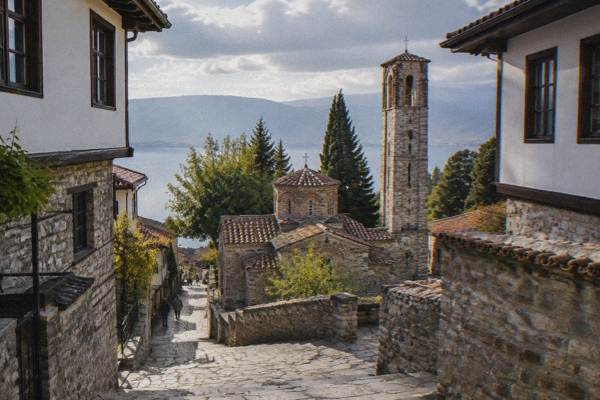
Samuel's Fortress: The Hilltop Walls Above The Old Town
Samuel's Fortress stands on the hill above Ohrid's Old Town, between the lake shore and the ridgeline, and the climb to its walls is the single most rewarding short walk in the city. This guide covers what the fortress is, what the surrounding museum sites cost, and how to fit the hill into a day in Ohrid, North Macedonia.
Short answer
Samuel's Fortress is the walled hilltop above Ohrid's Old Town, reached on foot by steep lanes from the lake shore or the Old Bazaar. The fortress itself has no published ticket price or hours, but the museum-institute sites around it charge 150 den for foreign visitors and 120 den for domestic visitors, and the whole hill, walls, Upper Gate, Plaosnik and the Ancient Theatre, can be walked in a morning.
Samuel's Fortress crowns the hill at the top of Ohrid's Old Town, and everything about a visit is shaped by that single fact of geography. The Old Town climbs from the shore of Lake Ohrid, a freshwater mountain lake sitting at about 693 m above sea level, up steep pedestrian lanes to the walls, and the fortress hill sits inside the UNESCO mixed site "Natural and Cultural Heritage of the Ohrid Region", inscribed in 1979 and 1980. This page, from Ohrid Travel Guide, walks through the fortress itself, what it costs to see the museum sites clustered around it, and how to plan the climb without wasting the middle of your day.
What Is Samuel's Fortress In Ohrid?
Samuel's Fortress is the walled hilltop that stands above Ohrid's Old Town, between the lake shore below and the Galicica slopes above, and it forms the upper anchor of the whole historic core. The fortress area includes the Upper Gate, and the lanes inside the walls run down on foot toward Plaosnik, the Ancient Theatre and the Old Bazaar. No published ticket price or opening hours exist for the fortress itself, so a visit is planned around the sites around it.
The fortress is the reason Ohrid's Old Town looks the way it does. The town was built inside and below these walls, and the street pattern still follows the logic of a fortified hill: the main lanes climb to the gates, and the smaller alleys terrace off them toward the lake. The Upper Gate is part of the fortress area, and passing through it is the classic way to enter the walled upper town from the bazaar side.
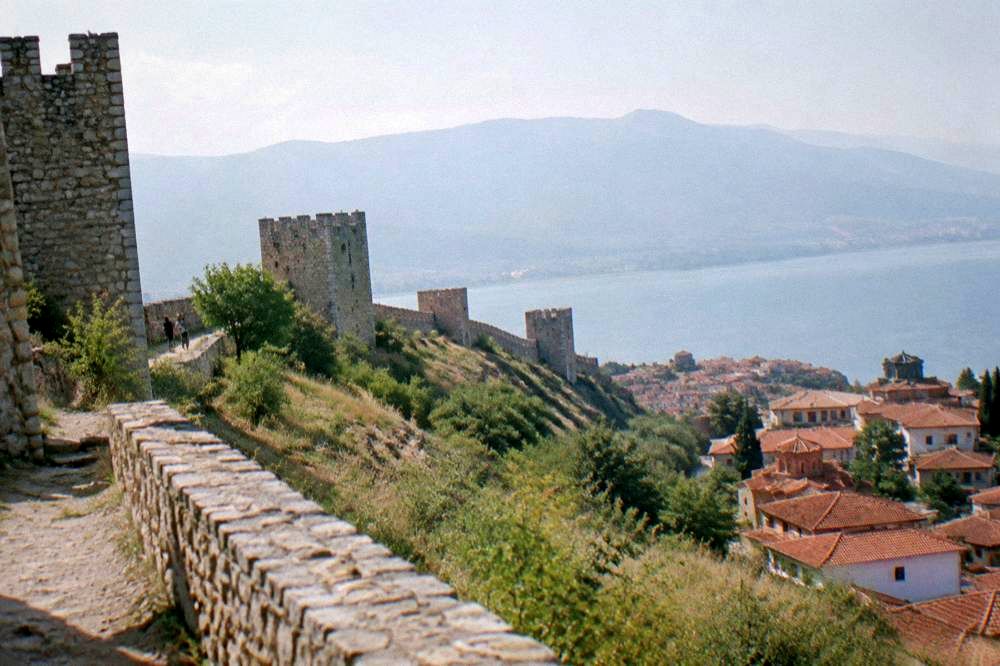
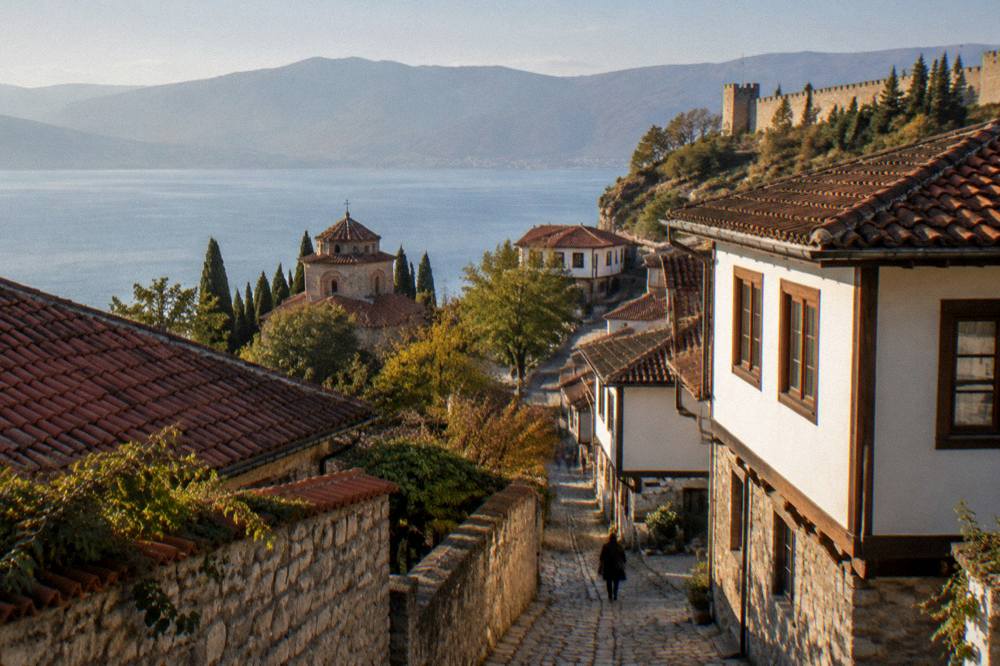
What the fortress gives a visitor is the panorama. From the wall line the whole amphitheatre of Ohrid is visible at once: the red roofs of the Old Town dropping to the shore, the lake stretching south toward St Naum, and the ridge of Galicica National Park, North Macedonia's second national park, founded in 1958, rising on the far side. The lake itself has existed for about two to three million years according to UNESCO's own listing, and holds over 200 endemic species including 17 endemic fish, which is why the heritage listing is a mixed one, cultural and natural together.
The fortress is also a live municipal project. A revitalisation plan reported in the Macedonian press budgets over 11 million denars for a summer stage, illumination and archaeological work on the site, which signals that the hill is being treated as a performance venue as well as a monument: the Ohrid Summer Festival has traditionally used open-air historic venues in the town, with its 66th edition opening on 12 July 2026 at the Ancient Theatre below the fortress.
For context on how the town grew around the walls, see how old Ohrid is, and for the wider setting, the Lake Ohrid guide.
How Do You Get Up To The Fortress Walls In Ohrid?
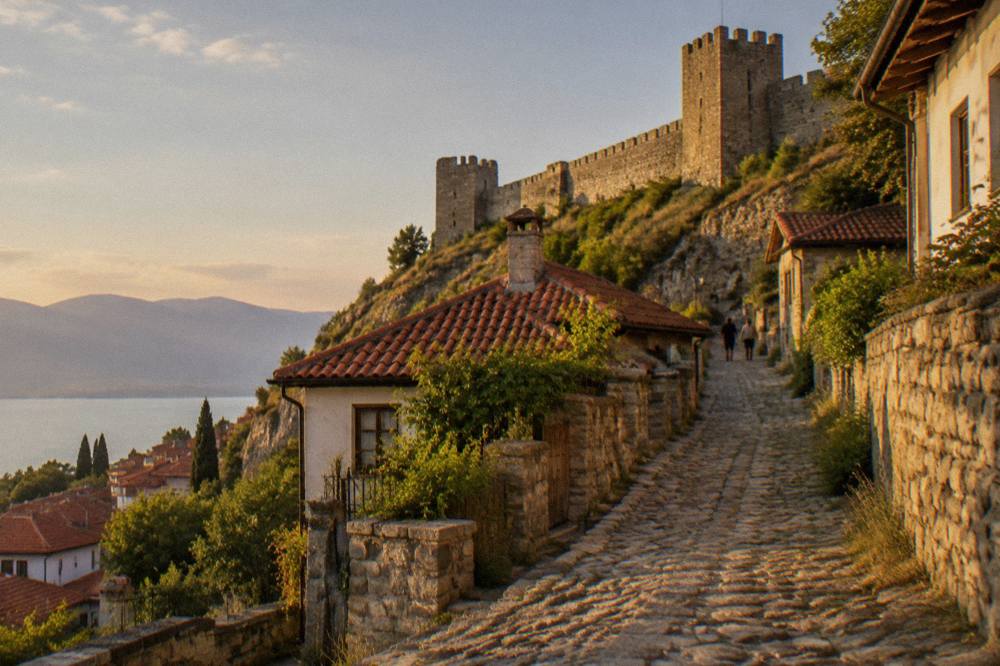
You walk. The Old Town of Ohrid is a pedestrian network of lanes, and every route to Samuel's Fortress climbs from either the lake shore and the boardwalk or the Old Bazaar and the Upper Gate, with the whole ascent on foot in the order of a short, steep city hike. There are no trams or bike share in Ohrid, and the bus station sits east of the centre, so the climb starts wherever you leave the flat ground of the shore.
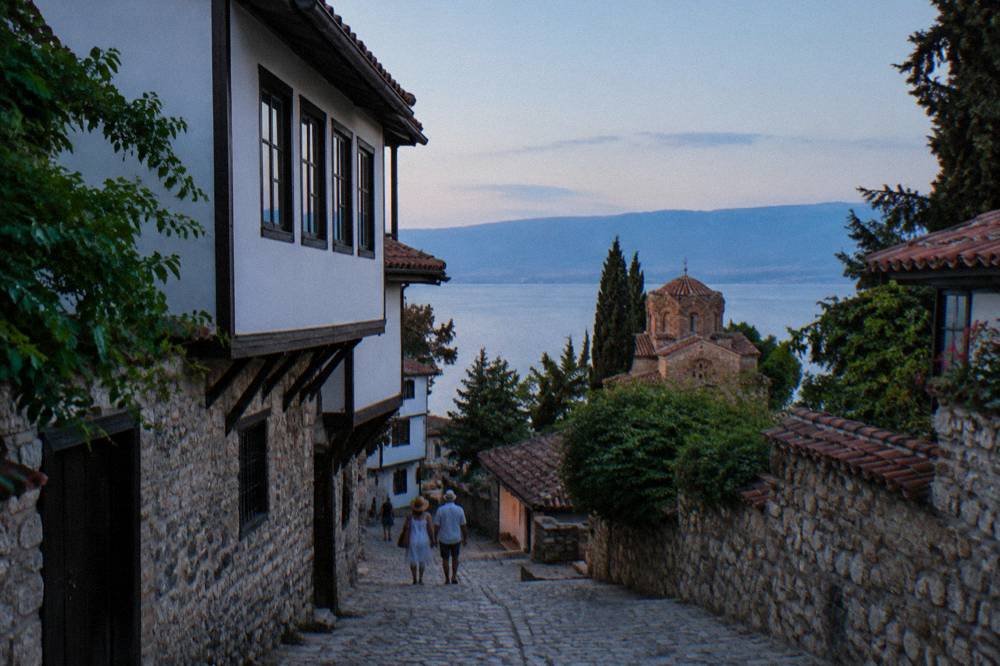
Three practical approaches cover almost every visit. From the shore, the lanes above the Old Bazaar side give the gentlest gradient and pass shops and houses on the way to the Upper Gate. From the western Old Town, around the Church of the Holy Mother of God Perivleptos and the Icon Gallery, the climb is shorter and steeper, and it delivers you near the fortress from the side. From Plaosnik and the Ancient Theatre side, you approach the walls along the ridge with the lake below you the whole way.
Footwear matters more than timing. The lanes are stone, worn and in places stepped, and the climb from the shore to the wall line gains a real amount of height, the old town sits well above the lake, whose level is about 693 m above sea level, and the fortress stands above the town. In summer the modelled ERA5 normals for Ohrid put the July mean daily high at 27.1 C and August at 27.6 C, so the mornings are the comfortable window for the ascent.
If you are driving, plan around the 2026 parking regime: from summer 2026, streets in the old part of Ohrid such as Ilindenska, Kosta Abrash and Car Samoil became resident-only, with clamping reported for non-residents, so a car is best left outside the old core, covered in detail in the Ohrid parking guide. The whole Old Town, fortress included, is covered stop by stop in Ohrid in one day.
What Does It Cost To Visit The Fortress And The Museum Sites Around It In Ohrid?
The fortress walls themselves have no published ticket price or opening hours, so nothing can be stated about what entry costs or when the gates open. The museum-institute sites clustered on and below the fortress hill, Robev Family House, the Museum on Water and the Icon Gallery, charge 150 den for foreign visitors, 120 den for domestic visitors, with a children's and students' rate reported at 60 den, per the institute's own ticket page.
The distinction matters because the hill is not one ticketed attraction but a cluster. The Institute and Museum of Ohrid runs the listed museum sites, and its tickets page gives the 120/150 den rates; the children's and student rate of 60 den is reported only, so confirm it at the desk. The fortress itself is a separate case: its official page lists no fee and no hours, and any specific figure you may have read elsewhere does not come from the site's own publishing.
| Museum-institute site in Ohrid | Foreign adult | Domestic adult | Winter hours (1 Oct to 30 Apr) | Summer hours (from 1 May) | Closed |
|---|---|---|---|---|---|
| Robev Family House, Tsar Samoil St 62 | 150 den | 120 den | 09:00 to 15:30 | Two shifts, 09:00 to 15:30 and 13:30 to 20:00 | Monday |
| Icon Gallery, Perivleptos complex | 150 den | 120 den | 09:00 to 14:00 | 09:00 to 17:00 | Monday |
| Museum on Water (Bay of Bones), Peshtani | 150 den | 120 den | 09:00 to 15:30 | 09:00 to 16:30 | Monday |
The museum institute's own office hours are Monday to Friday 07:30 to 15:30 at Boro Shain St 10, and the institute's site pages carry the per-site schedules shown above. Two reading notes: the English page's "60 days" for children means 60 den, and a summer schedule typo reading "September 31" should be read as 30 September, the season boundary the institute uses.
Plan the money in denar. The Macedonian denar is the local currency, de facto pegged to the euro through the National Bank's exchange-rate targeting, with the middle rate on 19 October 2026 at 61.6633 den to the euro. Euros are commonly quoted for tours and transfers but are not legal tender, so carry denar for museum desks. Budget planning for the whole town is covered in the Ohrid cost and budget guide companion pages and the denar explainer.
What Do You Actually See From The Fortress Hill In Ohrid?
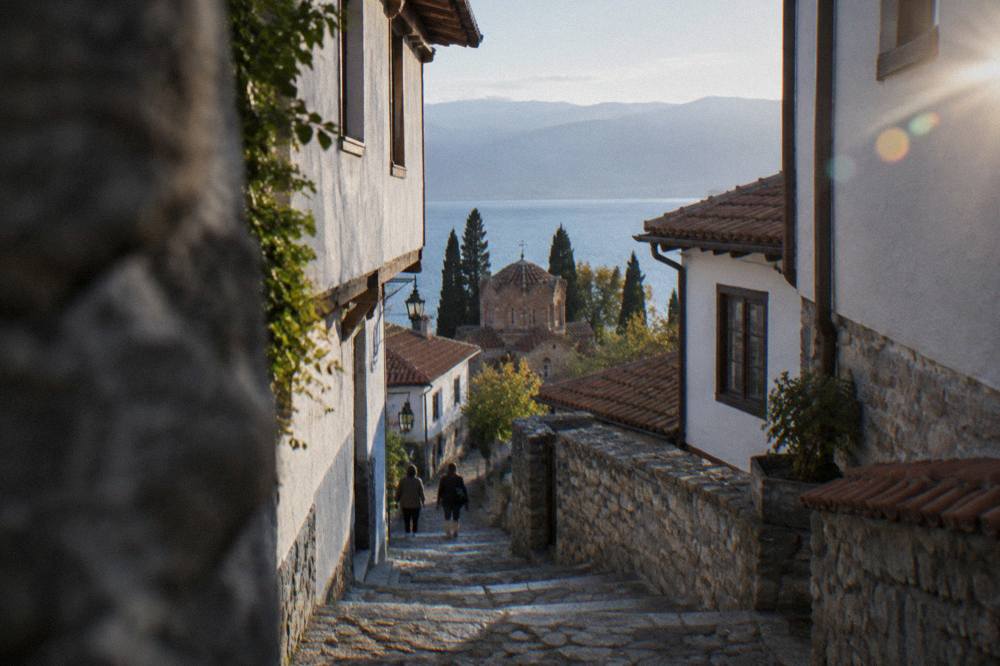
From the wall line of Samuel's Fortress the whole of Ohrid reads at a glance: the Old Town's roofs stepping down to the lake shore, the boardwalk and city beaches along the water, Kaneo and its church on the headland below, and the ridge of Galicica across the bay, with the lake running south toward St Naum and the Albanian border. Every one of these is a named, mapped place in the town, not a distant blur.
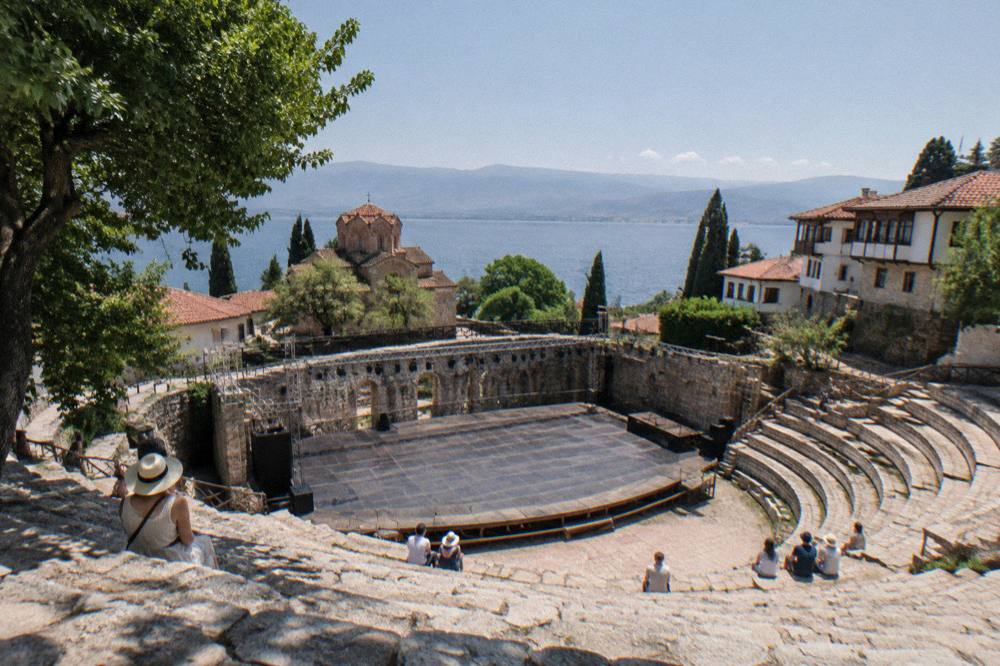
Reading the view downward, in order of distance: first the lanes you climbed, then the plateau of Plaosnik with the Church of St Clement, then the Ancient Theatre cut into the slope below it, then the bowl of the Old Bazaar, and finally the flat shore. The Ancient Theatre was built at the end of the third or start of the second century BC, in the late Hellenistic period, first excavated in 1935, and its capacity rose to 5,000 after the epiteatron was added. The Old Bazaar sits at the bottom of the climb, and Plaosnik holds, per UNESCO's listing, the oldest Slav monastery, that of St Panteleimon.
Reading the view outward: the Kaneo district and the Church of St John at Kaneo sit on their headland west of the descent, the lake fills the southern horizon, and the mountains belong to Galicica National Park, 22,750 hectares between Lake Ohrid and Lake Prespa, with Magaro peak at 2,254 m. The park's own site runs a live camera page, useful for checking conditions before any trip up the ridge.
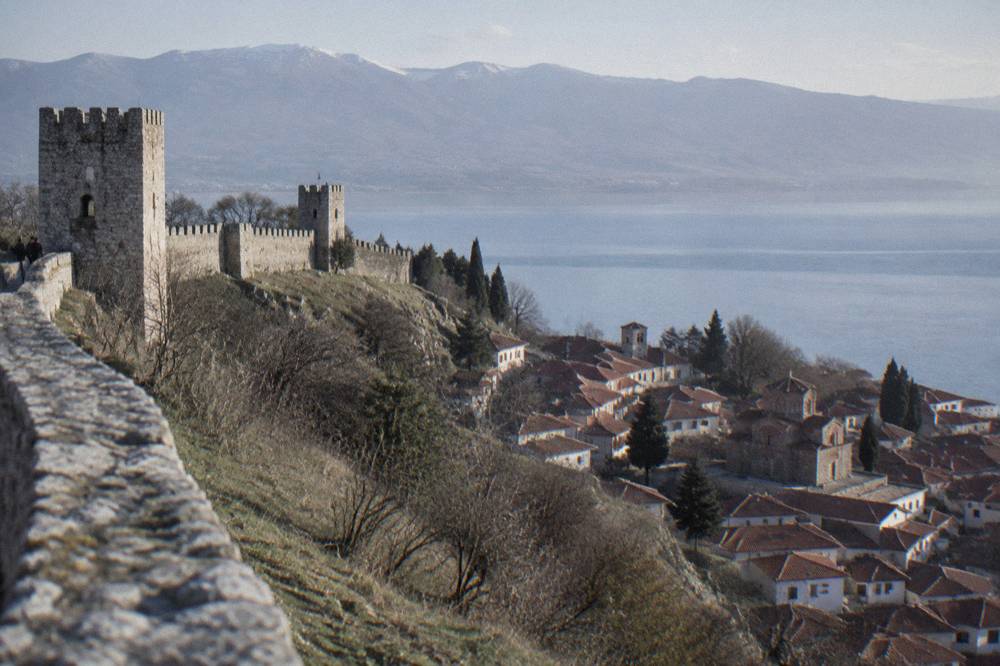
For photographers the hill is the anchor shot of the town, and the Ohrid photography spots guide maps the other angles, including the water-level views that pair with the climb.
How Long Should You Spend On The Fortress Hill In Ohrid?
A focused visit to the fortress hill, meaning the walls and Upper Gate, Plaosnik and the Ancient Theatre, works as a half-day loop of roughly three to four hours at a reading pace, while a full day lets you add the Icon Gallery, the Perivleptos complex, St John at Kaneo on the headland below, and still descend to the shore for the afternoon. The climb itself is the fixed cost; everything after it is modular.
The efficient loop starts from the bazaar side, enters through the Upper Gate, takes the walls and the view, then descends by Plaosnik and the theatre, which lands you back in the lower Old Town within a short walk of the shore. Do that loop before the day heats up: the ERA5 modelled normals put the mean daily high at 24.2 C in June, 27.1 C in July and 27.6 C in August, with mean nightly lows of 15.2 to 19.0 C in the same months, so an early start buys you the cool air and the empty lanes.
Want the descent through the lanes narrated as you go? Book a self-guided audio walk here.
The seasonal arithmetic also matters for what is open. The museum-institute sites run their winter schedule from 1 October to 30 April and their summer schedule from 1 May to 30 September, and they close on Mondays, so a Monday visit to the hill leaves the outdoor walls, lanes and views as the substance of the day. Rain days have their own plan in Ohrid in the rain.
| Month | Modelled mean daily high (C) | Modelled mean nightly low (C) | Modelled rain (mm) | What it means for the fortress climb |
|---|---|---|---|---|
| April | 14.6 | 6.3 | 82.4 | Mild climb, museum sites still on winter hours to 30 Apr |
| May | 19.5 | 10.8 | 70.8 | Summer hours from 1 May, full loop comfortable |
| June | 24.2 | 15.2 | 43.1 | Peak season begins, start early |
| July | 27.1 | 18.3 | 34.7 | Hot climb, mornings only |
| August | 27.6 | 19.0 | 32.9 | Busiest month, earliest start |
| September | 22.4 | 14.9 | 62.4 | Summer hours to 30 Sep, softer light |
| October | 17.4 | 10.3 | 76.0 | Winter hours from 1 Oct, shorter days |
These climate figures are modelled ERA5 reanalysis normals for 1991 to 2020 at the Ohrid grid cell, not a weather-station record, and they describe the averages, not a forecast for any given day.
How Does The Fortress Fit Into A Day Trip To Ohrid?
Samuel's Fortress is the anchor of any Ohrid day trip, because a group arriving from Skopje, Tirana or the coast has a fixed number of daylight hours, and the fortress hill, Plaosnik, the Ancient Theatre, the bazaar and the shore walk compress into one continuous pedestrian route. Tours from Skopje and Tirana are listed as departing from those cities, so Ohrid's fortress becomes the midday centrepiece of their itinerary rather than a departure point.
Day trips from Skopje cover the town by bus or private transfer: the capital is about 170 km away by road, the bus takes about three hours and costs 850 to 950 den one way, and there is no passenger train and no domestic flight between the two. Trips from the Albanian side cross at Qafe Thane or at the Sveti Naum and Tushemisht crossing near the southern shore, which is about 4 km from St Naum itself. The planning pages for each option are Skopje to Ohrid and the border detail in St Naum from Ohrid.
The in-town sequence that works for a day trip is the reverse of the resident's morning: start on the shore, take a boat out for the water-level view of the town and its walls, then climb through the bazaar to the fortress while the light is still workable, and finish at Plaosnik before heading back down. The featured cruise on this page, Ohrid's Old Town panoramic boat cruise with Tito's Residence, covers exactly the first half of that sequence, and live spaces can be checked with Check availability.
What Is Near The Fortress Worth Adding In Ohrid?
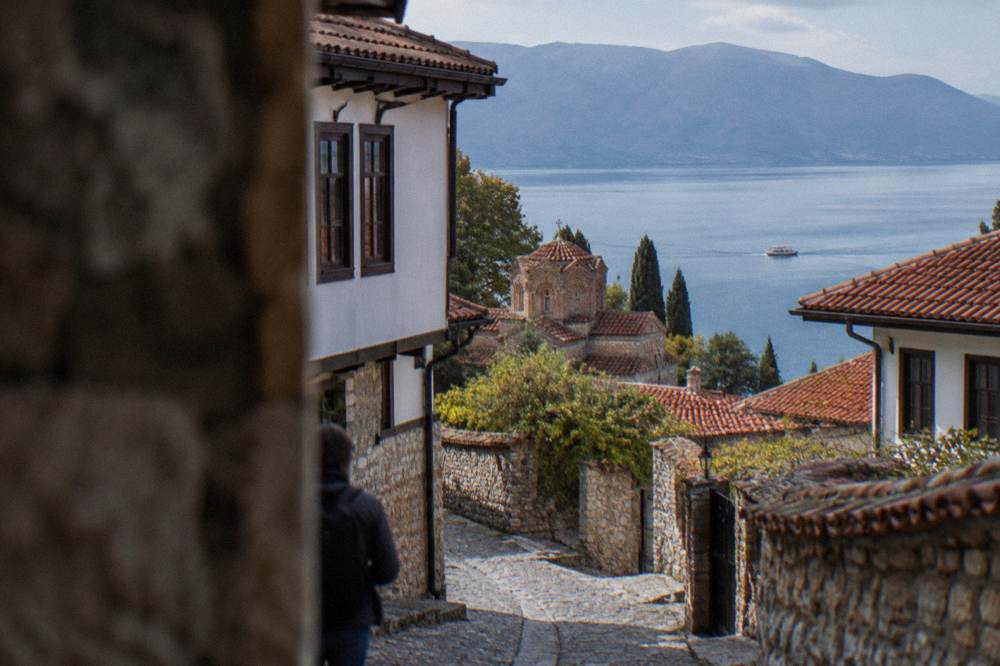
Within ten minutes' walk downhill from the fortress walls sit Plaosnik with the Church of St Clement, the Ancient Theatre, the Perivleptos complex with the Icon Gallery, and the top of the Old Bazaar, four named sights that together make the hill a district rather than a single monument. Further down the slope, St Sophia, the Old Bazaar proper and the shore boardwalk complete the set.
The near neighbours, in walking order from the walls: Plaosnik and its monastic complex; the Ancient Theatre, a performance venue during the Ohrid Summer Festival; the Church of the Holy Mother of God Perivleptos with the Icon Gallery beside it, open 09:00 to 14:00 in winter and 09:00 to 17:00 in summer, closed Mondays; and the Old Bazaar at the foot of the climb. UNESCO's listing credits Ohrid with more than 800 Byzantine-style icons from the 11th to the end of the 14th century, and the Icon Gallery is where a large share of them are kept.
| Sight near the fortress hill | Type | Ticket situation | Closed day |
|---|---|---|---|
| Plaosnik, Church of St Clement | Monastic complex | Fee reported at about 150 den, not on the museum-institute ticket page | Not stated |
| Ancient Theatre | Late Hellenistic theatre, festival venue | No fee or hours published on the institute's page | Not stated |
| Icon Gallery, Perivleptos complex | Museum-institute site | 150 den foreign, 120 den domestic | Monday |
| Robev Family House | Museum-institute site, lower town | 150 den foreign, 120 den domestic | Monday |
| Old Bazaar | Historic market street | Public street | None |
The churches of the lower town, St Sophia and St John at Kaneo, plus the lake-side Bay of Bones museum at Peshtani, are covered in their own pages, and the Old Town area guide stitches the whole slope together street by street.
When Is The Best Time Of Day And Year For The Fortress In Ohrid?
Early morning is the practical answer for the climb, because the modelled ERA5 normals show mean daily highs of 27.1 C in July and 27.6 C in August against mean nightly lows of 18.3 and 19.0 C, a gap of roughly nine degrees that makes the first hours of daylight the humane window. For the year, May, June and September balance open museum sites, workable temperatures and the fullest boat schedules on the lake.
The season's machinery matters as much as the temperature. The museum-institute sites around the hill switch to summer hours on 1 May and back to winter hours on 1 October, closing Mondays year-round. Boats to St Naum and the Bay of Bones run roughly May to October and reduce in winter, so an off-season visit keeps the walls, lanes and views but trims the lake half of the day. Peak season runs June to September, with August the busiest month.
| Season in Ohrid | Fortress climb | Museum sites | Lake boats | Notes |
|---|---|---|---|---|
| Spring (Apr to May) | Mild, some rain (70.8 to 82.4 mm modelled per month) | Winter hours to 30 Apr, summer from 1 May | Services building up from May | Lanes wet after rain |
| Summer (Jun to Aug) | Hot, dry (32.9 to 43.1 mm modelled) | Summer hours, two shifts at Robev House | Full schedules | August busiest; 2026 lake rules limited jet skis and night boating |
| Autumn (Sep to Oct) | Warm to mild (62.4 to 76.0 mm modelled) | Summer hours to 30 Sep, winter from 1 Oct | Reduced from late Sep | Softer light on the walls |
| Winter (Nov to Mar) | Cold, mean lows around or below freezing | Winter hours, closed Mondays | Largely reduced | Snow possible in town and heavier in Galicica |
One dated rule to know if your visit falls in midsummer: under a government decision of 2 June 2026, jet skis were banned on the lake between 1 July and 31 August from 11:00 to 19:00, and boats were restricted at night through the summer and into early October, a swimmer-safety measure rather than a permanent law.
What Events Use The Fortress And The Hill In Ohrid?
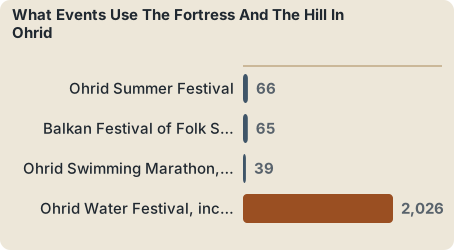
The fortress hill's lower venues carry Ohrid's festival summer: the 66th Ohrid Summer Festival opened on 12 July 2026 at the Ancient Theatre with a gala evening, and ran toward its traditional close on 20 August, while the 65th Balkan Festival of Folk Songs and Dances filled the Grigor Prlichev cultural centre from 3 to 6 July 2026. The fortress itself has a reported revitalisation plan, over 11 million denars for a summer stage and illumination, pointing to a growing performance role.
The festival calendar around the hill, all 2026 dates:
| Event in Ohrid | 2026 edition | Dates | Main venue |
|---|---|---|---|
| Ohrid Summer Festival | 66th | Opened 12 July, traditional close 20 August | Ancient Theatre and St Sophia |
| Balkan Festival of Folk Songs and Dances | 65th | 3 to 6 July | Grigor Prlichev cultural centre |
| Ohrid Swimming Marathon, St Naum to Ohrid harbour, 25 km | 39th | 22 August | Lake, finishing at the city harbour |
| Ohrid Water Festival, including the 33 km SUP marathon around the lake | 2026 | 12 to 30 August, SUP on 26 August | Lake Ohrid |
The SUP marathon around the lake is a separate 33 km event. Dates for the 2027 editions have not been announced. The wider calendar is in what events are happening in Ohrid.
Is The Fortress Climb Suitable For Everyone Visiting Ohrid?
The climb to Samuel's Fortress is a steep, continuous walk on worn stone lanes with no tram, funicular or bike share to shortcut it, so it suits anyone comfortable with an uphill city walk of that kind, and it is hard work for anyone who is not. The reward at the top is the single widest view of Ohrid available on foot, which is why the climb anchors nearly every itinerary despite the gradient.
Practical notes that hold year-round: the lanes are pedestrian, so the climb is traffic-free but stepped and uneven in places; the museum sites on the hill close on Mondays; and emergency numbers in North Macedonia are ambulance 194, police 192 and roadside assistance 196. Tap water in Ohrid is generally reported as drinkable. Visa-free nationals may stay up to 90 days in any 180-day period, UK visitors up to three months with a passport valid at least 90 days after arrival, and hotels handle the police registration within 48 hours.
For the gentler alternatives, the shore-side pages, where to stay in Ohrid and the walking options in free things near the Old Town, keep the flat ground; for the fuller menu of the town, things to do in Ohrid is the root guide.
A morning on the walls pairs naturally with an afternoon that leaves the hill entirely: a winery tasting outside town, or a boat out onto the lake to see the fortress from below, the view the walls were built to command. Visitors coming with more than a day can stretch the sequence across Ohrid in two days or longer.
Common Questions About Samuel's Fortress In Ohrid
The museum-institute sites on and below the hill, Robev Family House, the Icon Gallery and the Museum on Water, charge 150 den for foreign visitors and 120 den for domestic visitors per the institute's ticket page. The full breakdown is in the dedicated answer page on entry to Samuel's Fortress.
The museum sites around it run a winter schedule from 1 October to 30 April and a summer schedule from 1 May to 30 September, and they close on Mondays; per-site hours are listed in the table above.
How do I get to Samuel's Fortress from Ohrid's centre?
On foot, up the pedestrian lanes of the Old Town, either from the shore through the Old Bazaar to the Upper Gate or from the Perivleptos side near the Icon Gallery. There is no tram or public transport up the hill, and from summer 2026 the old-town streets around the climb are resident-only for parking.
Is the climb to the fortress difficult?
It is a short but continuously steep stone walk. The old town stands above the lake, whose level is about 693 m above sea level, and the fortress stands above the town, so allow a steady pace, water and early-morning timing in July and August, when modelled daily highs average 27.1 and 27.6 C.
What can you see from Samuel's Fortress?
The whole bowl of Ohrid: the Old Town roofs, Plaosnik and the Ancient Theatre below the walls, the Kaneo headland, the lake running south toward St Naum, and the Galicica ridge, with Magaro peak at 2,254 m, across the water.
Is Samuel's Fortress part of the UNESCO site?
Yes. The fortress hill sits inside the UNESCO mixed property "Natural and Cultural Heritage of the Ohrid Region", inscribed in 1979 and 1980 and extended to the Albanian part of the lake in 2019. On 24 July 2026 the World Heritage Committee decided not to place the property on the List of World Heritage in Danger.
The walls above Ohrid reward the climb at any hour the lanes are dry, and the hill's cluster of museum sites, theatres and monastic terraces makes a half day feel full without ever leaving the Old Town on foot.