Lake Ohrid: Europe's Oldest Lake And UNESCO Site
Lake Ohrid sits at about 693 m above sea level beside the town of Ohrid in North Macedonia, and the whole region around it is a UNESCO mixed World Heritage site. Here is what that means in practice: the inscription, the boats, the swimming, the weather and the costs in denars.
Short answer
Lake Ohrid is a freshwater mountain lake shared between North Macedonia and Albania, sitting at about 693 m above sea level with the town of Ohrid on its shore. The region around it was inscribed by UNESCO as a mixed natural and cultural property in 1979 and 1980 and extended to the Albanian side in 2019.
Lake Ohrid is a freshwater mountain lake shared between North Macedonia and Albania, and the town of Ohrid sits on its northern shore at about 693 m above sea level. The lake is often described as Europe's oldest lake, and the region around it, the Natural and Cultural Heritage of the Ohrid Region, has been a UNESCO mixed World Heritage property since its natural inscription in 1979 and cultural inscription in 1980, extended to the Albanian part in 2019. This page on the Ohrid Travel Guide lays out what the listing covers, how to get out on the water, where the swimming spots sit and what each part of a lake visit costs in Macedonian denars.
What Is Lake Ohrid And Where Does It Sit?
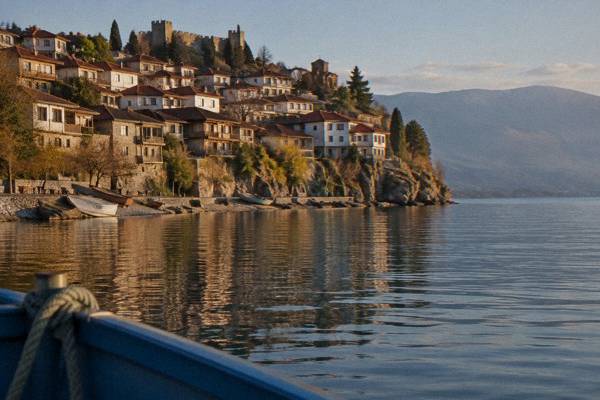
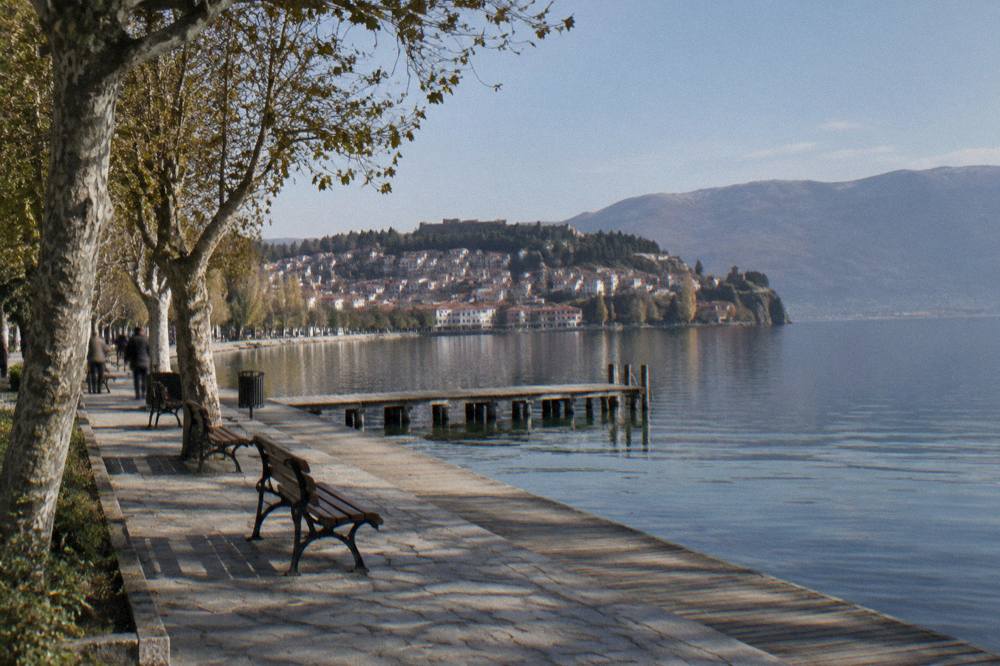
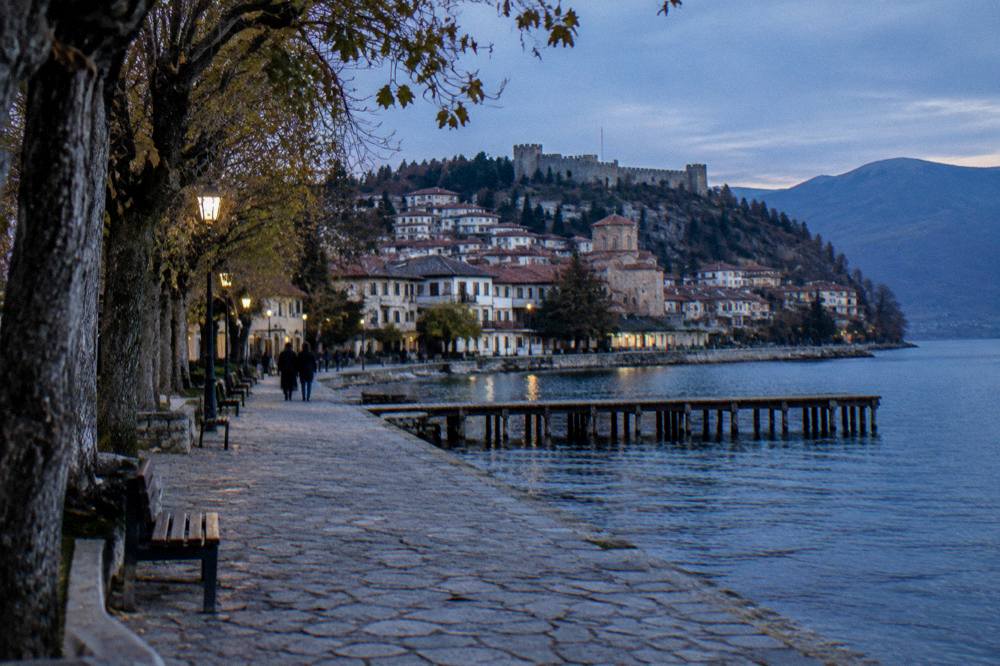
Lake Ohrid is a freshwater mountain lake at about 693 m above sea level, shared between North Macedonia and Albania, with the town of Ohrid on its shore inside the country's southwest corner. The old town climbs from the water toward Samuel's Fortress, and the whole lake region forms one UNESCO property spanning both countries. It is an inland lake, not a sea coast, roughly 170 km by road from Skopje.
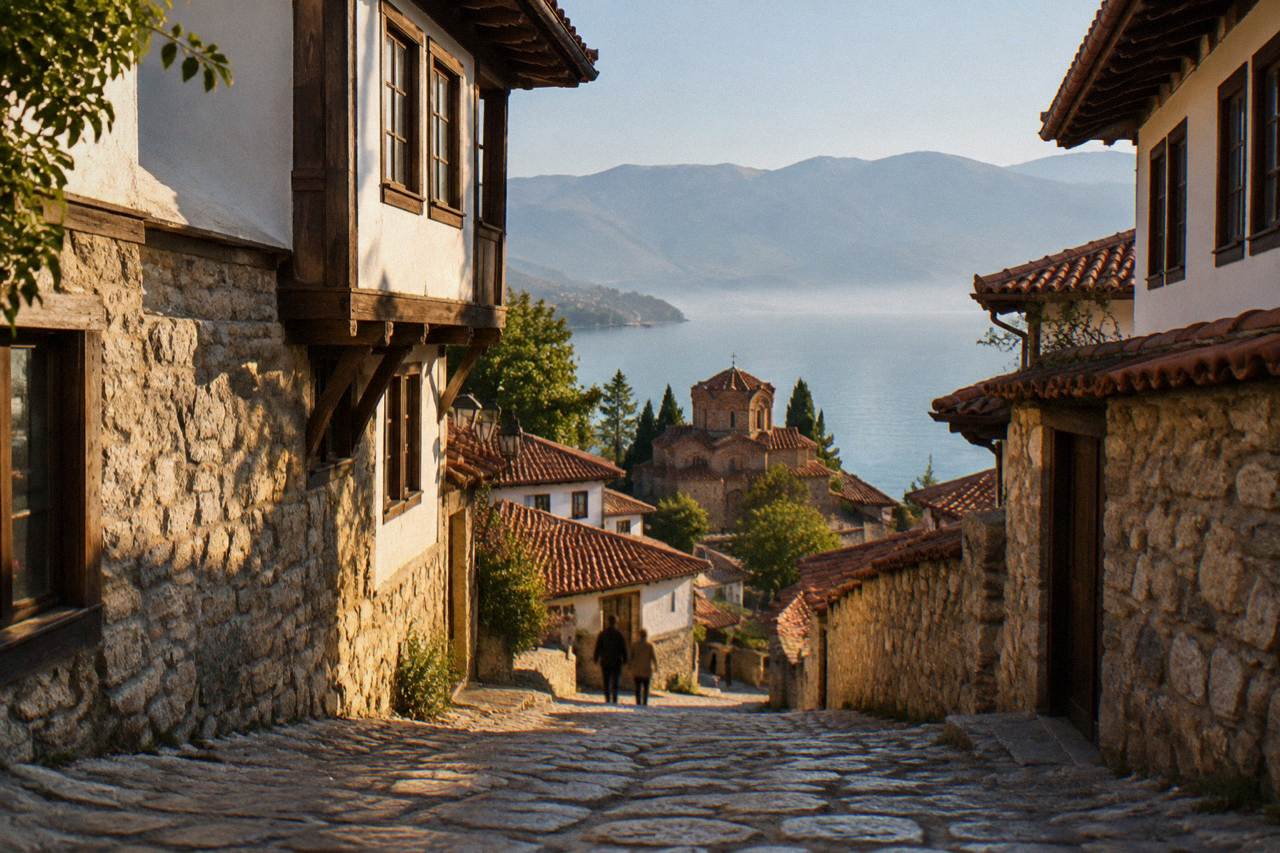
The lake is the single fact that shapes everything about a visit to Ohrid. The old town's lanes climb from the waterfront up to the fortress, and the shoreline running south from town passes the Kaneo district, the village beaches near Peshtani and Lagadin, Trpejca, and finally St Naum at the southern end near the Albanian border. The Crn Drim springs bubble up near St Naum, and the lake drains out through the Black Drim river at Struga on the northwestern corner.
Getting there is straightforward. Ohrid's St Paul the Apostle Airport is about 10 km from the centre. From Skopje, the bus runs about 170 km in around three hours for 850 to 950 MKD one way; there is no passenger train to Ohrid and no domestic flight. From Tirana, minibuses take roughly three to three and a half hours including the border, for about 15 to 20 euros. The getting to Ohrid question is covered in full elsewhere on this site.
Why Is Lake Ohrid A UNESCO World Heritage Site?
The Natural and Cultural Heritage of the Ohrid Region is a UNESCO mixed property of about 94,729 hectares, inscribed in 1979 for its natural values and in 1980 for its cultural ones, and extended to the Albanian part of the lake in 2019. UNESCO's listing notes the oldest Slav monastery, more than 800 Byzantine-style icons from the 11th to 14th centuries, and over 200 endemic species in the lake, including 17 endemic fish.
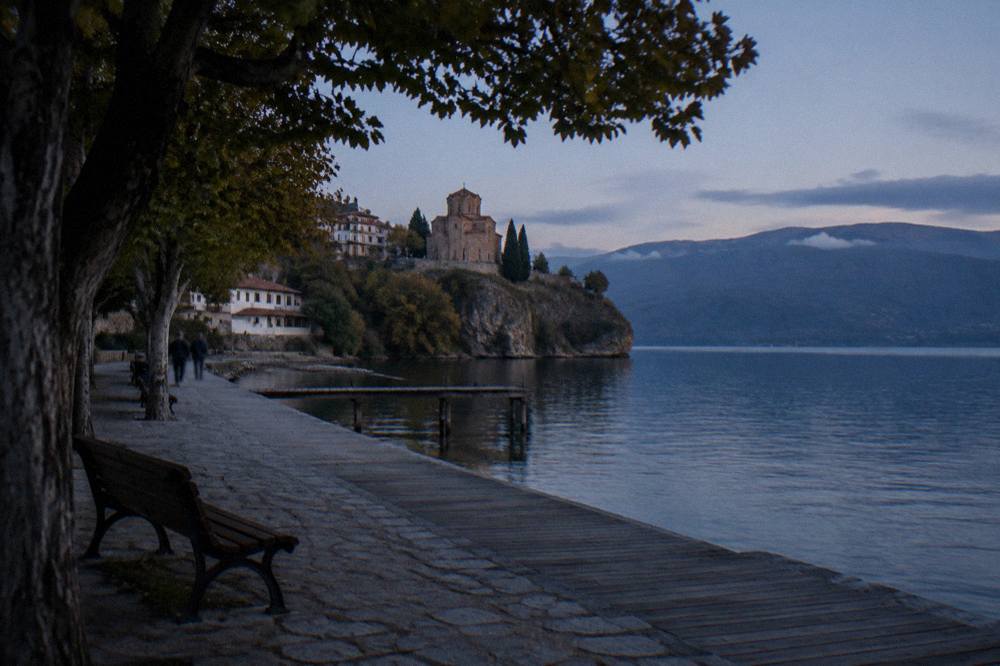
A mixed property is one inscribed for both nature and culture, and Ohrid is one of the small number of places where both halves carry the listing. The cultural side rests on the concentration of Byzantine churches in and around the old town: St Sophia, Plaosnik with the Church of St Clement and Panteleimon, the Church of St John at Kaneo, and the Perivleptos complex with its Icon Gallery. The natural side rests on the lake itself, whose isolated ecosystem supports those endemic species found nowhere else.
The listing is transboundary. Since the 2019 extension the property covers the Albanian shore as well, including the stretch toward Pogradec, which is why the two countries are asked to manage the lake jointly. There is a separate question people often ask about whether the lake is the oldest in Europe, and the oldest lake question has its own page. What the listing itself supports is the biodiversity and the heritage density, and that is the strongest reason the region matters.
For travellers who want the structure handled, a guided day covers the heritage core in one loop.
What Can You See Around Lake Ohrid?
Around Lake Ohrid the main sights are the Byzantine churches and museum sites of Ohrid's old town, Samuel's Fortress above it, the Bay of Bones museum on the water near Peshtani, the monastery and springs at St Naum, and the shoreline villages between them. The museum institute's sites charge 150 den for foreign visitors and 120 den for domestic visitors, with a 60 den rate reported for children and students.
The old town holds the densest cluster. St Sophia and Plaosnik anchor the middle of the climb, the Ancient Theatre, built at the end of the 3rd or start of the 2nd century BC according to the museum institute's own page, sits below Samuel's Fortress, and the Old Bazaar and the Perivleptos complex with the Icon Gallery sit toward the southern lanes. The Bay of Bones, a reconstruction of a prehistoric pile-dwelling settlement on the water at Gradishte near Peshtani, is the lake's most distinctive museum: it runs a winter schedule of 09:00 to 15:30 from 1 October to 30 April, a summer schedule of 09:00 to 16:30 from 1 May to 30 September, and is closed on Mondays.
At the southern end, St Naum monastery sits beside the Crn Drim springs, about 4 km from the Tushemisht border crossing with Albania. A cruise operator's listing puts the monastery entrance at 150 MKD per person and a rowboat ride through the springs at about 5 euros. The monastery has its own page with the St Naum detail linked from the boats guide.
The museum institute's ticket rates apply to its listed sites, including Robev Family House, the Museum on Water at the Bay of Bones and the Icon Gallery.
| Museum institute site | Winter hours (1 Oct to 30 Apr) | Summer hours (from 1 May) | Closed |
|---|---|---|---|
| Robev Family House, Tsar Samoil St 62 | 09:00 to 15:30 | 09:00 to 15:30 and 13:30 to 20:00 | Monday |
| Museum on Water (Bay of Bones), Gradishte | 09:00 to 15:30 | 09:00 to 16:30 | Monday |
| Icon Gallery, Perivleptos complex | 09:00 to 14:00 | 09:00 to 17:00 | Monday |
Tickets: 150 den foreign visitors, 120 den domestic, 60 den reported for children and students, per the museum institute's own site.
How Do You Get Out On Lake Ohrid?
The main way onto Lake Ohrid is a boat: a full-day cruise from Ohrid port down to St Naum with stops along the way runs 7 hours and costs from 1,200 den for an adult and 600 den for a child with one operator, and shorter panoramic cruises of the old town bay and sunset trips also run from the town waterfront. Boats to St Naum generally run from about May to October on a seasonal schedule.
The full-day route is the classic lake day. One operator, Boat Armada, lists a 7-hour cruise from Ohrid port to St Naum from 1,200 den adult and 600 den child, with the Bay of Bones entrance of 150 MKD per person listed as not included. Shorter options concentrate on the old town bay itself, an hour on the water with the fortress and church rooftops above you. The boats and ferries guide holds the detail on operators and schedules.
Two dated 2026 rules changed life on the water. Under a government decision announced by the Ministry of Transport on 2 June 2026, jet skis are banned on the lake from 1 July to 31 August between 11:00 and 19:00, and boats are banned at night from 3 June to 31 August between 21:00 and 05:00, with a further limit running through October 2026. These are swimmer-safety rules for the 2026 season, written here with their date, not permanent law.
If you would rather have the whole day arranged, a private guide service runs a full-day circuit of Ohrid and the lake, and you can Check availability for your dates. The guided alternative pairs the old town walk with a lake loop, which suits a first visit.
Where Can You Swim In Lake Ohrid?
Swimming in Lake Ohrid is a summer activity, with the comfortable season running from about July, when modelled surface temperatures pass 20 C, through September. The named swimming spots along the eastern and southern shore include Gradiste, Lagadin, Ljubanista, Potpesh and Labino, all pebble or mixed shores reached by road or boat from Ohrid, with facilities reduced outside the main season.
Swimming pairs nicely with paddling on the same water. Book a stand-up paddleboarding tour here.
The water warms slowly because the lake sits high. Modelled aggregator values put the surface at about 4.6 C in January, 7.2 C in March, 10.5 C in April, about 14.9 to 18.7 C in May, 22.9 C in July, 23.5 C in August and 14.7 C in October; the UHMR multi-year October mean is 14.3 C. Those are modelled figures, and the swimming guide and the can you swim here question carry the full picture.
| Month | Modelled surface temperature (C) | Swimming |
|---|---|---|
| January | about 4.6 | No |
| March | about 7.2 | No |
| April | about 10.5 | No |
| May | about 14.9 to 18.7 | Marginal |
| July | about 22.9 | Yes |
| August | about 23.5 | Yes |
| October | about 14.7 | Cold |
The shore beaches are pebble and mixed shingle rather than sand. Gradiste sits near Peshtani close to the Bay of Bones, Lagadin and Potpesh line the eastern shore road, Ljubanista lies toward the southern end, and Labino is within reach of Ohrid town itself. Beach facilities run on a seasonal pattern, with bars and equipment reduced or closed from late autumn to spring.
What Is The Weather Like On Lake Ohrid?
On the ERA5 reanalysis normals for Ohrid, 1991 to 2020, mean daily highs run from 5.0 C in January to 27.6 C in August, mean daily lows from -0.8 C in January to 19.0 C in August, and monthly rain runs from 32.9 mm in August to 92.6 mm in December, totalling 816.6 mm across the year. These are modelled normals for the grid cell over Ohrid, not a weather-station record.
The practical shape of the year: summer is warm and comparatively dry, with July and August combining highs above 27 C with the two lowest rain totals, 34.7 mm and 32.9 mm. Winter is cold at night, with lows below freezing in January, and December carries the year's highest monthly rain total at 92.6 mm. November follows at 90.4 mm. The full breakdown lives in the Ohrid weather guide.
| Month | Mean high (C) | Mean low (C) | Rain (mm) |
|---|---|---|---|
| Jan | 5.0 | -0.8 | 76.5 |
| Feb | 6.3 | 0.0 | 74.3 |
| Mar | 10.0 | 2.5 | 80.5 |
| Apr | 14.6 | 6.3 | 82.4 |
| May | 19.5 | 10.8 | 70.8 |
| Jun | 24.2 | 15.2 | 43.1 |
| Jul | 27.1 | 18.3 | 34.7 |
| Aug | 27.6 | 19.0 | 32.9 |
| Sep | 22.4 | 14.9 | 62.4 |
| Oct | 17.4 | 10.3 | 76.0 |
| Nov | 11.5 | 5.3 | 90.4 |
| Dec | 6.2 | 0.9 | 92.6 |
Source: Open-Meteo ERA5 reanalysis, 1991 to 2020, for the grid cell over Ohrid. For timing a visit, the best time question weighs the weather against the season's crowds.
What Day Trips Run From Lake Ohrid?
From Ohrid the established day trips are St Naum and the springs at the lake's southern end, Struga on the Black Drim at the northwestern corner, Galicica National Park across the ridge between Lake Ohrid and Lake Prespa, and cross-border runs to Pogradec in Albania, plus longer routes to Bitola, Skopje and Tirana. Galicica charges 250 MKD per vehicle, with 100 MKD applying only to those entering on foot at the Ohrid-side gate.
Galicica National Park, North Macedonia's second national park, established in 1958, covers 22,750 hectares between the two lakes, with Magaro peak at 2,254 m. The park is open year-round, but heavy snow can close the main road, typically between January and March. Lake Prespa sits about 148 m higher than Lake Ohrid on the far side of the ridge, which is the reason the viewpoint road is worth the drive. The hiking guide covers the trails.
Struga, where the Black Drim drains the lake, is a short hop away, and the Ohrid versus Struga comparison helps decide whether to split a stay. Further afield, the Skopje route can be folded into a five-day plan that also takes in the Albanian shore.
| Day trip | Distance or route | Getting there |
|---|---|---|
| St Naum | Southern end of the lake, about 4 km from the Tushemisht border | Boat from Ohrid port, seasonal, or road |
| Struga | Northwestern corner of the lake | Local bus, fares reported around 100 to 150 MKD |
| Galicica National Park | Ridge between Lake Ohrid and Lake Prespa | Vehicle, 250 MKD park fee |
| Pogradec, Albania | Cross the Tushemisht border by road | Taxi or minibus, border wait up to an hour |
How Much Does A Lake Ohrid Trip Cost?
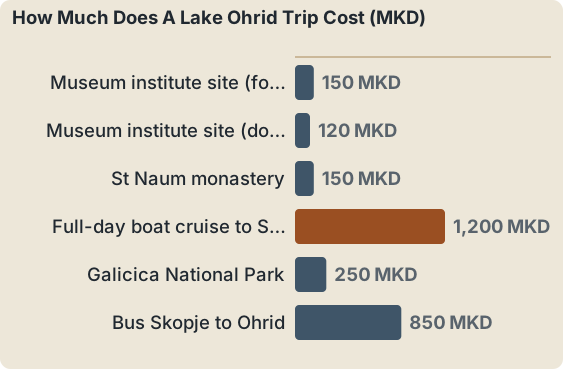
A day around Lake Ohrid costs, in local figures: 150 den to enter each museum institute site as a foreign visitor, 150 MKD at St Naum monastery by the cruise operator's listing, from 1,200 den for the full-day boat cruise, 250 MKD per vehicle to enter Galicica, and 850 to 950 MKD for the bus from Skopje. Tour and transfer prices quoted in euros by operators are not the local currency; the denar is.
North Macedonia is not in the EU, and the currency is the Macedonian denar, which the National Bank keeps stable against the euro. Euros are commonly quoted for tours and transfers but are not legal tender, so expect to pay local costs in denars. The money and denar guide explains the practical side.
| Item | Cost | Notes |
|---|---|---|
| Museum institute site (foreign visitor) | 150 den | Robev House, Museum on Water, Icon Gallery |
| Museum institute site (domestic visitor) | 120 den | Same ticket system |
| St Naum monastery | 150 MKD | Per cruise operator's listing |
| Rowboat at the Crn Drim springs | about 5 EUR | Per cruise operator's listing |
| Full-day boat cruise to St Naum | from 1,200 den adult, 600 den child | 7 hours, one operator |
| Galicica National Park | 250 MKD per vehicle | 100 MKD on foot, Ohrid-side gate |
| Bus Skopje to Ohrid | 850 to 950 MKD | About 3 hours |
For the budget picture as a whole, the cost and budget guide and the is Ohrid cheap or expensive question both break a stay down day by day.
Is It Safe To Visit Lake Ohrid?
Yes, in the sense that the standard advice treats North Macedonia as a normal-precautions destination, and the practical risks around Lake Ohrid are the ordinary ones of water, mountain roads and winter weather rather than anything specific to the region. Emergency numbers are ambulance 194, police 192 and roadside assistance 196, and tap water in Ohrid is generally reported as drinkable.
The safety detail that matters on the lake itself is behavioural: the 2026 navigation limits exist because swimmers and boats share the same water, and the summer beach spots are unsupervised outside whatever seasonal provision runs. On the roads, headlights are required day and night, motorway tolls are paid at each plaza with no vignette, and the Galicica road can close under snow between January and March. The is Ohrid safe guide carries the fuller checklist.
One border fact worth knowing for any route through the neighbourhood: North Macedonia is not in the Schengen area or the EU, so the Tushemisht crossing near St Naum is a real border with passport checks, and waits of up to an hour are quoted for it. Visa-free nationals may stay up to 90 days in any 180-day period, and UK visitors up to 3 months, with hotels handling the police registration within 48 hours of arrival.
How Do You Plan A First Lake Ohrid Visit?
For a first visit, give Ohrid two or three days: one for the old town's churches and the fortress, one for the boat down to the Bay of Bones and St Naum, and a third for either Galicica or the Albanian shore. Base yourself in Ohrid town, use the summer museum hours to your advantage, and check the one day itinerary if time is short.
The sequencing matters because of the Monday closures. All three museum institute sites listed above close on Mondays, so a Monday in Ohrid belongs to the outdoors: the Kaneo district, the shoreline walk, or a day in Galicica. In summer, the two-shift hours at Robev House, which run to 20:00, free the middle of the day for the water. The Ohrid in summer guide works through the peak-season pattern.
Guided options make sense where the logistics stack up: the trio below covers a private full-day circuit from Ohrid, a boat-based lake day, and a group day trip for travellers starting in Skopje, which departs from Skopje and is a lengthy commitment rendered on the listing itself.
Common Questions About Lake Ohrid
Is Lake Ohrid in North Macedonia or Albania?
Both. The lake is shared: the town of Ohrid and the larger part of the shoreline are in North Macedonia, and the western shore, toward Pogradec, is in Albania. The UNESCO property covering the region was extended to the Albanian part in 2019.
Can you swim in Lake Ohrid?
Yes, in summer. Modelled surface temperatures pass 20 C from about July and stay there through August, with September cooling. The named swimming spots include Gradiste, Lagadin, Ljubanista, Potpesh and Labino.
How do you get from Ohrid to St Naum?
By seasonal boat from Ohrid port, a route one operator runs as a 7-hour cruise from 1,200 den for an adult, or by road along the southern shore. St Naum sits about 4 km from the Tushemisht border crossing with Albania.
How much does it cost to visit the Lake Ohrid sights?
The museum institute's sites, including Robev Family House, the Museum on Water at the Bay of Bones and the Icon Gallery, charge 150 den for foreign visitors and 120 den for domestic visitors. St Naum monastery is listed at 150 MKD, and Galicica National Park charges 250 MKD per vehicle.
When is the best time to visit Lake Ohrid?
July and September are the usual answer: modelled highs reach 27.6 C in August with the lowest rain totals of the year, and the water is warmest from July. Boats to St Naum run about May to October, and museum hours extend into evening shifts from 1 May.
Is Lake Ohrid a UNESCO site?
Yes. The Natural and Cultural Heritage of the Ohrid Region is a mixed World Heritage property of about 94,729 hectares, inscribed in 1979 for nature and 1980 for culture, and extended to the Albanian part in 2019.