Is Ohrid Walkable?
Is Ohrid walkable? A practical answer for the old town, the lake shore, the climb to Samuel's Fortress and the distances beyond the centre.
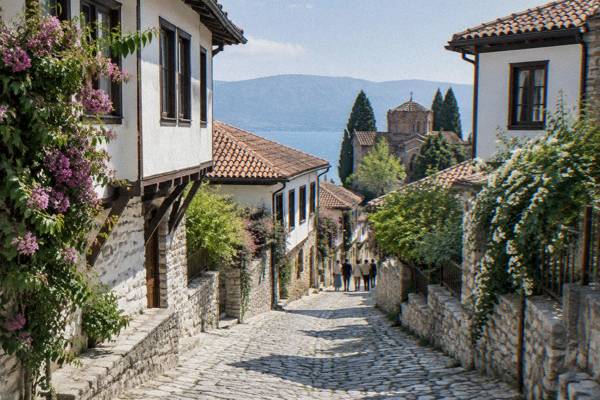
Ohrid, in North Macedonia, is a lake town built around a single idea: everything of interest sits close together on a slope between Lake Ohrid and the ridge above it. The Ohrid Travel Guide covers the town in depth, and the short answer to the walkability question is yes, with one honest qualification. The lanes of the old town are narrow, pedestrian in character and signposted, and the main sights, the Old Bazaar, the Ancient Theatre, the Church of St John at Kaneo and the churches along the shore, connect on foot in a compact loop. The qualification is the terrain: the town climbs from the lake at about 693 m above sea level up to the fortress, so the walking is real walking, with steps and gradients rather than flat promenades.
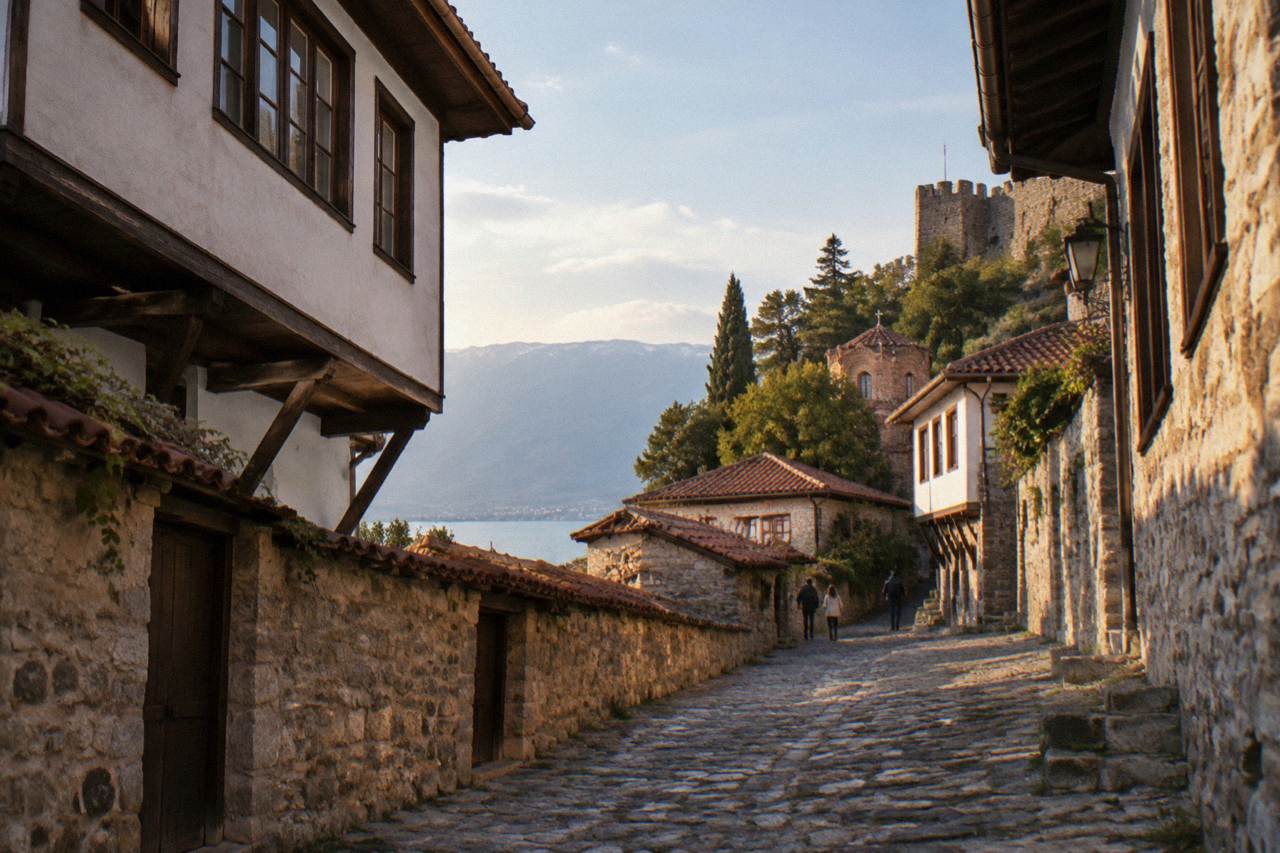
Yes, Ohrid is walkable to a degree that surprises visitors expecting a spread-out resort town. The old town is compact enough that its main sights link on foot in a single loop, its lanes are narrow and pedestrian in character, and the town has no trams, no metro and no bike share to learn. The one thing to plan around is the slope, because the streets rise from the lake shore to Samuel's Fortress, so comfortable shoes matter more than distance.
The geography does the work. Ohrid's old town climbs from the lake to the fortress, and the lanes between are on foot by design rather than by regulation. The Boardwalk along the shore, the Old Bazaar near the centre, the Ancient Theatre and the descent to St John at Kaneo all fall within a walkable band a few hundred metres wide. Nothing in that core requires a vehicle, and in the tightest lanes a vehicle would be a hindrance rather than a help.
What "walkable" does not mean is flat. The drop from the fortress level down to the church at Kaneo is a genuine hill, negotiated on stepped lanes. Visitors who plan a loop that descends to the lake and returns by a different lane, rather than going up and down the same street twice, tend to find the gradient manageable. The old town guide breaks the lanes and stairs down street by street.
A second honest qualification: the walkability is concentrated in the old town and the immediate shore. Ohrid municipality had a population of 51,428 at the 2021 census, and the town spreads beyond the heritage core along the lake toward neighborhoods like Lagadin and Peshtani. Those stretches exist, but they are excursions, not the reason the town centre feels closed to cars and open to feet.
How Compact Is The Ohrid Old Town On Foot?
The old town core of Ohrid is small enough that its headline sights sit within a few minutes' walk of one another, strung along the slope between the lake shore and Samuel's Fortress. The Boardwalk, the Old Bazaar, the Ancient Theatre, Plaosnik and the descent to St John at Kaneo form one continuous walking route, and the lanes between them are pedestrian in character with steps on the steeper sections.
The shape of the town encourages a natural loop. Arrive at the shore, walk the Boardwalk, climb through the Old Bazaar toward the fortress walls, then descend past the Ancient Theatre and Plaosnik to the church at Kaneo at the water's edge. That loop is the standard first day in Ohrid and it is entirely a walking itinerary. The one day itinerary sequences it hour by hour.
Two details make the loop easier. First, the museum sites that charge admission, Robev Family House, the Icon Gallery and the Bay of Bones, all follow the same schedule pattern: a winter schedule from 1 October to 30 April, a summer schedule from 1 May to 30 September, and a closed day on Monday, per the museum institute's own pages. Second, the churches with interior access close for a midday break in the off season, so a walker building a loop around opening times should front-load the interiors and leave the shore and viewpoints for the gaps.
The old town's compactness also has a parking consequence worth knowing. From summer 2026, a resident-only parking regime applies on old-town streets including Ilindenska, Kosta Abrash and Car Samoil, with clamping reported for non-residents, so a car is not just unnecessary inside the core, it is actively inconvenient. Arriving on foot, by taxi to the edge, or by one of the day-trip transfers that set down outside the old lanes is the simpler plan.
What Are The Steepest Walks In Ohrid?
The steepest walking in Ohrid is on the stepped lanes that link the fortress level to the lake shore, above all the descent from the plateau near Plaosnik down to the Church of St John at Kaneo, and the climb from the shore back up toward the Old Bazaar. These are short, measured in minutes rather than hours, but they are genuine gradients with steps, and anyone with limited mobility should treat them as the demanding end of the town's walking.
A walker with average fitness will manage all of them. The point is sequencing. Going down to Kaneo first and climbing back later, or splitting the fortress and the church into different parts of the day, spreads the effort. The Kaneo district guide describes the approach lanes, and the Samuel's Fortress guide covers the upper end of the climb.
The rest of the town is gentler than its reputation suggests. The Boardwalk is level, running along the water, and the streets around the Old Bazaar rise on a moderate grade rather than stairs. It is the two vertical connectors, fortress to theatre and theatre to Kaneo, that concentrate the effort. No evidence points to any of these lanes being closed to walkers; they are the town's ordinary streets.
Can You Walk Everywhere In Ohrid Without A Car?
Within the old town and the immediate shore, yes, no car is needed and none is useful, since the lanes are on foot and the 2026 resident-only parking regime keeps non-resident cars off the old streets. Beyond that core, the answer changes: the lakeside settlements east of town such as Lagadin, Peshtani and Trpejca, the Bay of Bones at Gradishte and St Naum at the far end of the lake are separate places reached by boat, bus or a day trip, not by a stroll.
The distinction matters because Ohrid is really a chain of lakeshore places, and the walkable part is the historic head of that chain. A visitor staying in the old town can walk to every church, the fortress, the bazaar and the city beach. To reach the Bay of Bones, the Museum on Water at Peshtani, a full-day boat cruise from Ohrid port toward St Naum runs from 1,200 den for an adult and 600 den for a child, per the operator Armada's own listing. That cruise is the walking-friendly alternative to driving the shore road.
For the town's practical walking questions, the basics are stable: the town has no trams and no metro, taxis exist for the edges, and the getting around guide covers the options. The is Ohrid worth visiting question and the how many days do you need in Ohrid answer both assume the town is seen on foot, because that is how the geography works.
Is Ohrid Walkable For Older Visitors And Families?
Ohrid is walkable for older visitors and for families with school-age children, because the core distances are short, the Boardwalk is level and the sights reward a slow pace. The caveat is the stepped connectors between the fortress level and the lake, which are the one part of town where a stroller, a wheelchair or tired legs meet real obstacles, and where planning a taxi for the uphill return is the sensible fallback.
The museum sites inside the core help by keeping short, defined visiting circuits: Robev Family House on Tsar Samoil street, the Icon Gallery in the Perivleptos complex and the Ancient Theatre each take in a single stop rather than a long trek. The Ohrid with kids and accessibility guides treat the gradient question in detail, including which stretches have alternatives.
For families, the practical shape of a walking day is the same loop adults use, with the beach and the Boardwalk as the reward at the bottom. For older visitors, the same loop works in reverse, descending first while legs are fresh. The one number to remember is not a distance but a level: everything between the shore and the fortress lies within a couple of hundred vertical metres, which sounds modest until it is repeated three times in a day. Once is enough.
Do You Need A Walking Tour To Get Around Ohrid?
No, a walking tour is not needed to get around Ohrid, because the old town is compact, its lanes connect logically and its headline sights are findable without a guide. What a walking tour adds is interpretation rather than navigation: the churches, the fortress walls and the Ancient Theatre reward context, and a small-group walk such as the shared Hidden Gems tour covers the quieter lanes that a first-time visitor walking alone tends to miss.
The trade-off is time against depth. A walker with a good guide page and a free afternoon will reach every major sight unaided. A shared walk compresses that into a structured route with a local voice, which suits a first day or a short stay. For that option the shared Hidden Gems walk is the natural pick, and Check availability covers current departures on the operator's live listing.
Curious what a guide could add to those lanes? Book a small-group city tour here.
Beyond the town, the calculus changes. The semi-private Ohrid and Struga tour from Tirana and the wine tasting cruise on the lake are products for the parts of the region that walking cannot reach, which is exactly why they pair well with a car-free stay in the old town.
How Walkable Is Ohrid Compared With Struga And Skopje?
Ohrid is the most walkable of the three by a clear margin, because its sights are packed into one sloping core with no need for transit, while Struga is a smaller, flatter lakeside town around the Black Drim and Skopje is a capital city about 170 km away whose sights spread across districts that reward transport. A visitor comparing the three for a car-free trip should base in Ohrid and treat the others as excursions.
The comparison in numbers:
| Place | Walkable core | Terrain | Car needed for sights? |
|---|---|---|---|
| Ohrid old town | Fortress, bazaar, churches, theatre and Kaneo in one loop | Sloped, stepped connectors | No |
| Struga | Small centre on the Black Drim and the lake shore | Flat | No for the centre |
| Skopje | Sights spread across a capital about 170 km from Ohrid | Mixed, river-crossed city | Helps |
Getting between them is a separate question from walking inside them. Buses link Skopje and Ohrid in about three hours for 850 to 950 den one way, per schedule listings, and there is no passenger train to Ohrid at all, so the Skopje to Ohrid and train answers settle the standard route. The Ohrid versus Struga comparison goes deeper for stays split between the two lake towns.
What Should You Wear For Walking In Ohrid?
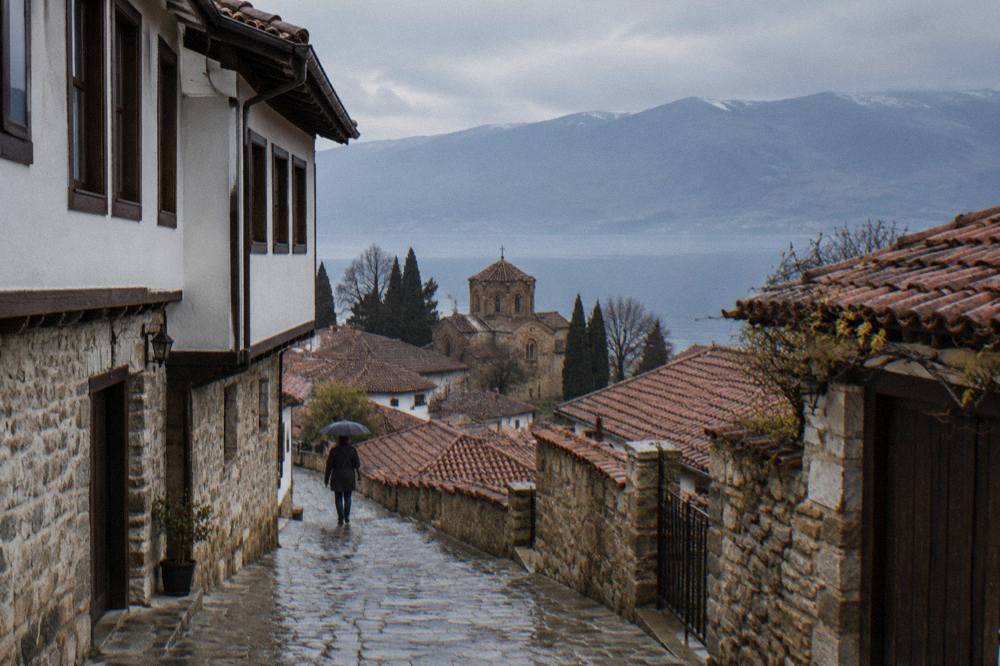
Pack for slopes and sun, not distances: closed shoes with grip for the stepped lanes, especially the descent to St John at Kaneo, and shade for the middle of the day, because the modelled ERA5 climate normals for 1991 to 2020 put July's mean daily high at 27.1 C and August's at 27.6 C, with the warm afternoons running through a summer that also brings the year's lowest rainfall, 32.9 mm in August.
The same normals frame the rest of the year for walkers. January averages a mean daily high of 5.0 C and a mean daily low of minus 0.8 C, and snow reaches the town in winter, with heavier snow on Galicica above it. November and December carry the year's highest monthly rain totals, 90.4 mm and 92.6 mm respectively, so the wet-season walker wants a light rain layer, while the summer walker wants water and a hat more than an extra layer. The weather by month guide carries the full table.
| Month | Mean daily high (C) | Mean daily low (C) | Rain (mm) | Walking note |
|---|---|---|---|---|
| January | 5.0 | -0.8 | 76.5 | Cold lanes, possible snow |
| April | 14.6 | 6.3 | 82.4 | Mild, showers possible |
| July | 27.1 | 18.3 | 34.7 | Heat, climb early |
| August | 27.6 | 19.0 | 32.9 | Heat, lake stops |
| October | 17.4 | 10.3 | 76.0 | Mild, wet spells |
| December | 6.2 | 0.9 | 92.6 | Rain, short days |
Figures are modelled ERA5 reanalysis normals for 1991 to 2020, not a weather-station record, and they describe the town's grid cell rather than a single street. As planning ranges they are reliable: summer mornings are the window for the fortress climb, and winter afternoons suit the level Boardwalk and the museums, which keep their winter hours from 1 October to 30 April.
Common Questions About Walking In Ohrid
Is Ohrid Walkable?
Yes. The old town is compact, its lanes are pedestrian in character and its headline sights link on foot in one loop, with the honest caveat that the town slopes from the lake up to the fortress, so the walking involves steps and gradients rather than flat ground.
Is the old town of Ohrid car-free?
The old town's lanes are on foot by design, and from summer 2026 a resident-only parking regime applies on old-town streets including Ilindenska, Kosta Abrash and Car Samoil, with clamping reported for non-resident vehicles, which makes a car unnecessary and inconvenient inside the core.
Can you walk from Ohrid town to St John at Kaneo?
Yes, on foot via the stepped lanes that descend from the plateau near Plaosnik, a route the town's geography is built around. The descent is short but genuinely steep, so the return climb is the part to plan around.
Can you walk from Ohrid to St Naum or the Bay of Bones?
No. Those sit at the far end of the lake, reached by boat, bus or a day trip. A full-day boat cruise from Ohrid port toward St Naum is listed from 1,200 den per adult, per the operator's own page, and the Bay of Bones charges 150 den for foreign visitors on the museum institute's ticket.
Is Ohrid hilly or flat?
Hilly in the core, flat on the shore. The Boardwalk along the water is level, while the connectors between the fortress level and the lake, above all the Kaneo descent, carry the town's real gradients on stepped lanes.
Do you need good shoes for Ohrid?
Yes. The lanes between the Old Bazaar, the Ancient Theatre and St John at Kaneo include stone steps and pitched cobbles, and comfortable shoes with grip matter more than any distance figure on a town this compact.
Ohrid rewards the walker more than almost any town of its size in the region, and the slope that defines it is the same slope that keeps it walkable.