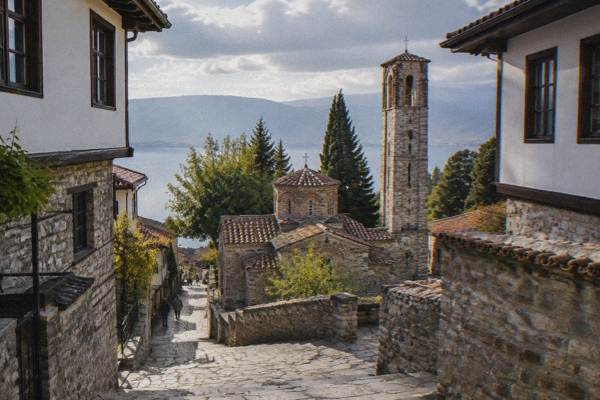
Ohrid Old Town: Where The Streets Climb To The Fortress
The Ohrid Old Town is a hillside of stone lanes between Lake Ohrid and the walls of Samuel's Fortress, holding Byzantine churches, museum houses and the Old Bazaar. This guide lays out the geography, the sights with their ticket prices and hours, and how to plan the climb.
Short answer
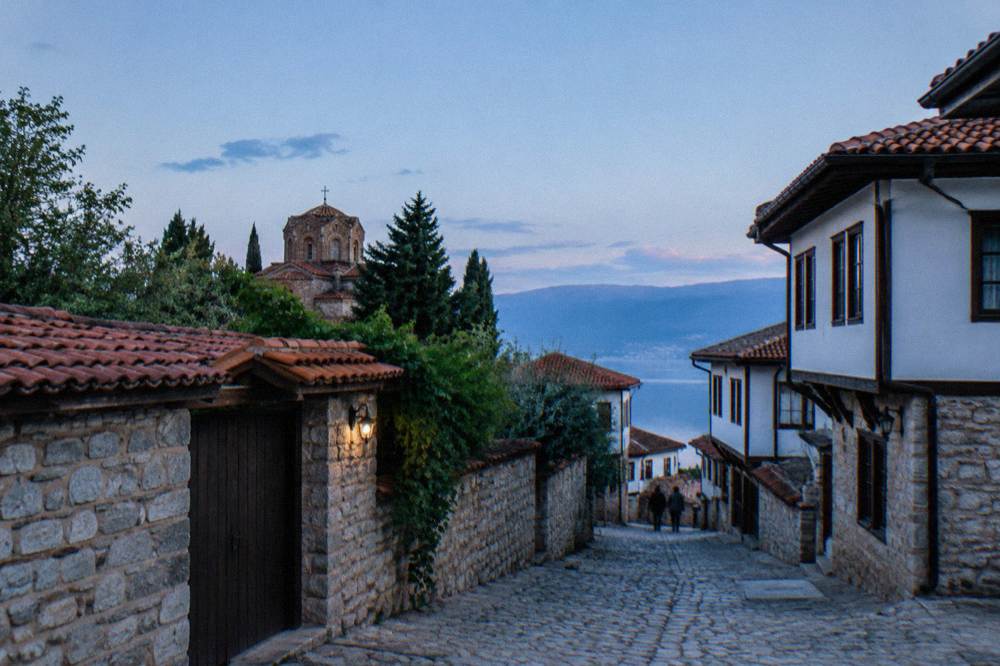
The Ohrid Old Town climbs from the lake shore and the Old Bazaar up to Samuel's Fortress, with the Ancient Theatre, Plaosnik, St Sophia and the Church of St John at Kaneo along the way. Museum sites charge 150 den for foreign visitors and close on Mondays from October to April.
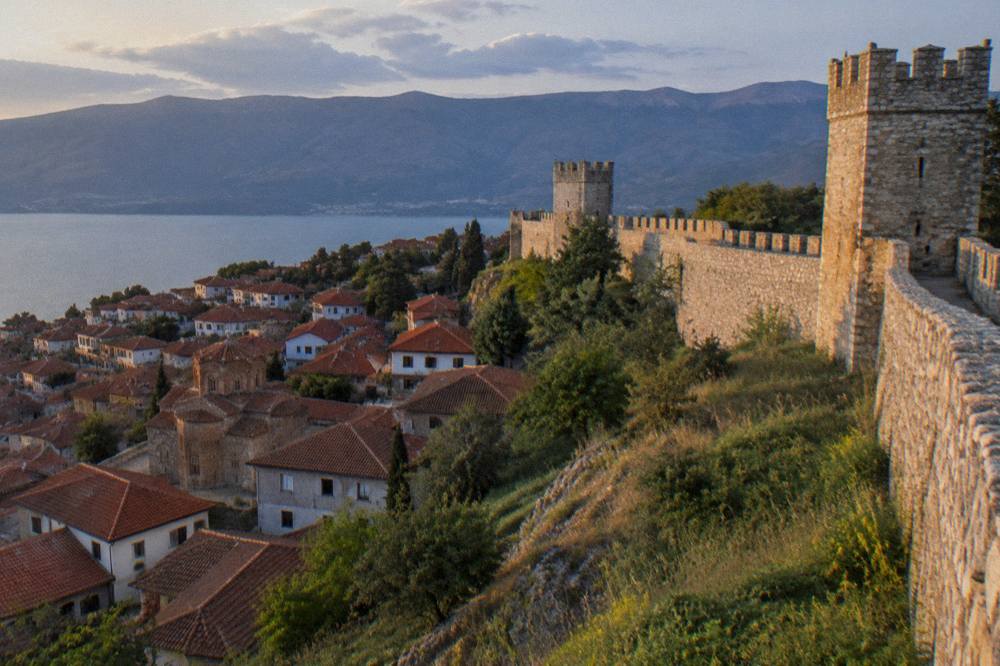
The Ohrid Old Town occupies the hillside between the shore of Lake Ohrid and the walls of Samuel's Fortress in Ohrid, North Macedonia, a lakeside town on a freshwater mountain lake whose water level sits at about 693 m above sea level. The whole area sits inside the UNESCO mixed site "Natural and Cultural Heritage of the Ohrid Region", inscribed in 1979 and 1980 and extended to the Albanian side of the lake in 2019. The streets are on foot: they climb from the port and the Old Bazaar past church terraces to the fortress walls above, and this Ohrid Travel Guide page walks that route from bottom to top, with the ticket prices, hours and dates that the museums and the listings themselves publish.
What Is The Ohrid Old Town?
The Ohrid Old Town is the historic core of Ohrid, a UNESCO-listed hillside quarter of stone lanes that runs from the lake shore and the Old Bazaar up to the walls of Samuel's Fortress, containing St Sophia, Plaosnik, the Ancient Theatre and the Church of St John at Kaneo among its sights. It is a district you cover entirely on foot, and its shape is set by geography: the old town climbs from the water to the fortress, and every lane between the two belongs to the same protected heritage area. The lake below is about two to three million years old by UNESCO's own description, with over 200 endemic species including 17 endemic fish, which is why the listing is a mixed natural and cultural property rather than a purely architectural one.
The quarter's weight of churches is the reason Ohrid carries the UNESCO inscription at all. UNESCO's listing text records that Ohrid holds the oldest Slav monastery, St Panteleimon at Plaosnik, and more than 800 Byzantine-style icons from the 11th to the end of the 14th century, many of them displayed in the Icon Gallery at the Perivleptos complex. That density of ecclesiastical art, packed into a walkable hillside, is what separates the old town from a generic lakeside resort.
Practically, the district breaks into three bands. The lowest band holds the port, the promenade and the Old Bazaar, described in detail on the Old Bazaar attraction page. The middle band carries the bulk of the churches and museum houses. The top band is the fortress hill, covered on the Samuel's Fortress page, where the walls crown the hill above the lake. A full introduction to the town's layout, including the districts beyond the old core, sits on the Ohrid neighborhoods overview.
How Do The Streets Of The Ohrid Old Town Climb To Samuel's Fortress?
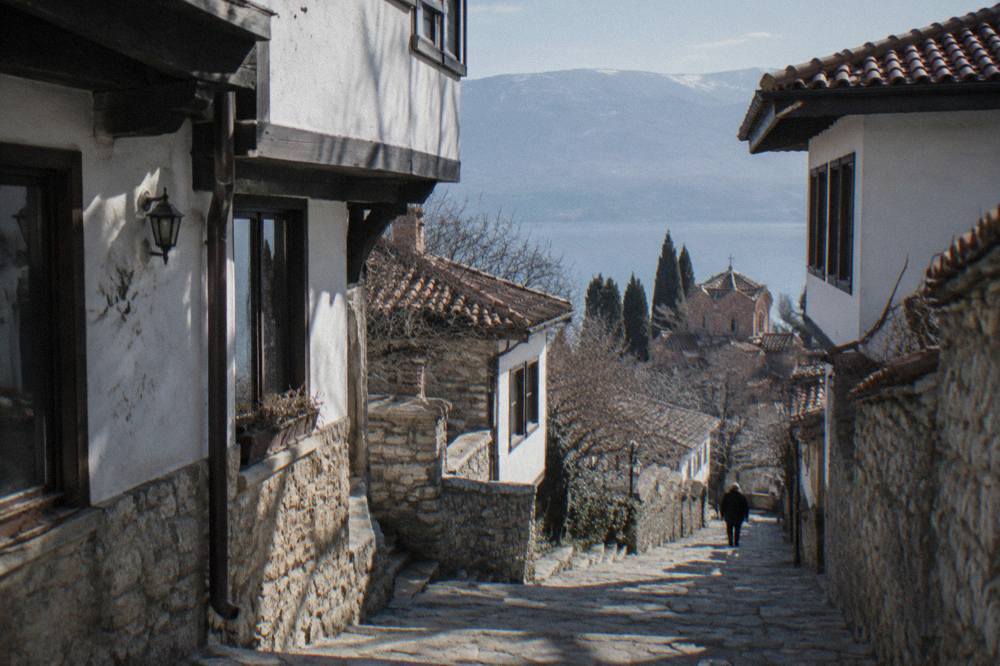
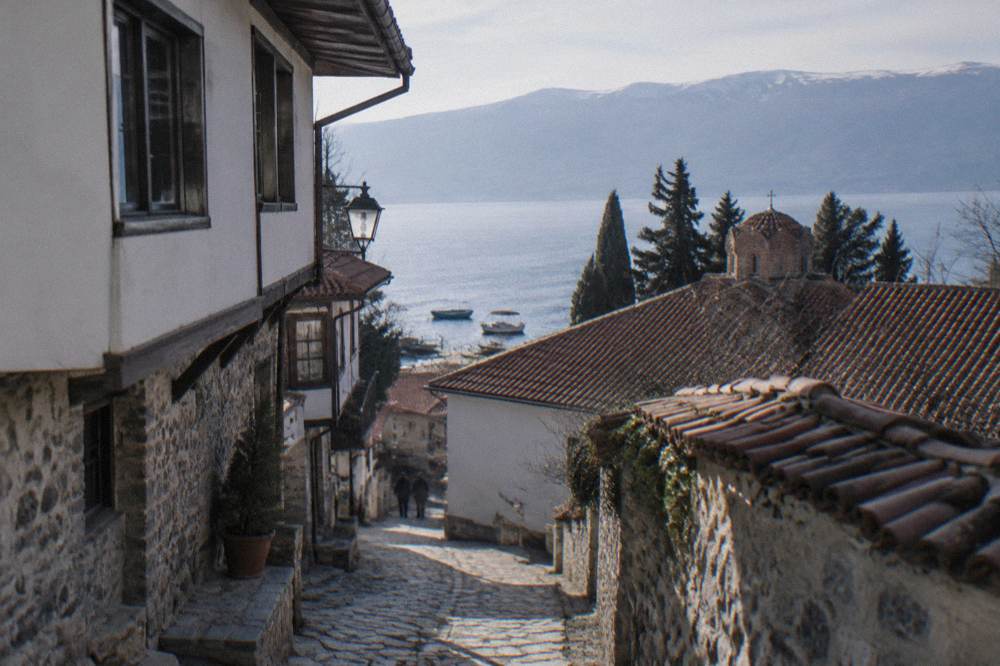
The climb runs from the lake shore at the bottom to the fortress walls at the top, a continuous ascent through stone lanes past St Sophia, the Ancient Theatre and Plaosnik, with the fortress hill as the highest point of the old town and views back down over the rooftops to the water. There is no transport inside the quarter: Ohrid has no trams and no bike share, and the lanes are narrow, stepped in places and closed to through traffic in parts. The walk is the attraction.
The route rewards a particular order. Start at the port and the lower town, where the Old Bazaar and the museum houses sit on the flattest ground. The middle section then rises through the church belt: St Sophia stands on the flat, the Ancient Theatre sits partway up, and Plaosnik and the Church of St John at Kaneo sit on the terraces below the fortress. The final stretch brings you to the fortress gate at the top of the hill. Walking down instead is equally workable, and the descent to Kaneo and the water is the one most photographers take, since the Ohrid photography spots guide details the church-above-the-water compositions the district is known for.
One 2026 change affects anyone arriving by car. From summer 2026 the municipality introduced a resident-only parking regime on old-town streets including Ilindenska, Kosta Abrash and Car Samoil, free for residents with a valid sticker, with clamping reported for non-residents. The practical answer is to park outside the old core; the Ohrid parking guide covers the options, and the getting to Ohrid guide covers arrival by bus and air. Ohrid's St Paul the Apostle Airport is about 10 km from the centre, and the bus station sits east of the centre.
For anyone who prefers the climb with a guide, the small-group city tour of the old town is this site's featured walk for the district, and its own tour page, the small-group Old Town walk, sets out what the route covers. The free tip-based walks described on the free walking tour page are the budget alternative for the same lanes.
What Are The Main Sights Inside The Ohrid Old Town?
The main sights inside the Ohrid Old Town are Samuel's Fortress at the top, Plaosnik and the Ancient Theatre on the middle terraces, St Sophia and the Robev Family House on the flat, the Icon Gallery at the Perivleptos complex, and the Church of St John at Kaneo at the water's edge, with the museum sites charging 150 den for foreign visitors, 120 den for domestic visitors and 60 den for children and students. Those three museum rates come from the Institute and Museum of Ohrid's own ticket page and apply to its listed sites: the Robev Family House, the Icon Gallery and the Bay of Bones museum on Water at Peshtani, which is a short trip down the lake rather than inside the quarter itself. Museum sites run a winter schedule from 1 October to 30 April and a summer schedule from 1 May to 30 September, and the museum houses close on Mondays.
The hours differ by site, and the differences matter when you plan the climb. The museum institute's own pages give the following:
| Site | Winter hours (1 Oct to 30 Apr) | Summer hours (1 May to 30 Sep) | Closed | Ticket (foreign / domestic) |
|---|---|---|---|---|
| Robev Family House, Tsar Samoil St 62 | 09:00 to 15:30 | Two shifts, 09:00 to 15:30 and 13:30 to 20:00 | Monday | 150 / 120 den |
| Icon Gallery, Perivleptos complex | 09:00 to 14:00 | 09:00 to 17:00 | Monday | 150 / 120 den |
| Bay of Bones, Museum on Water, Peshtani | 09:00 to 15:30 | 09:00 to 16:30 | Monday | 150 / 120 den |
The Ancient Theatre is a separate case. The museum institute's page records that it was built at the end of the 3rd or start of the 2nd century BC, in late Hellenism, first excavated in 1935, and that its capacity rose to 5,000 after the epiteatron was added. It remains a performance venue: the 66th Ohrid Summer Festival opened there on 12 July 2026 with a gala evening, and the festival traditionally runs to 20 August, so in summer the theatre does double duty as a monument and a stage. The Ancient Theatre page covers it in detail.
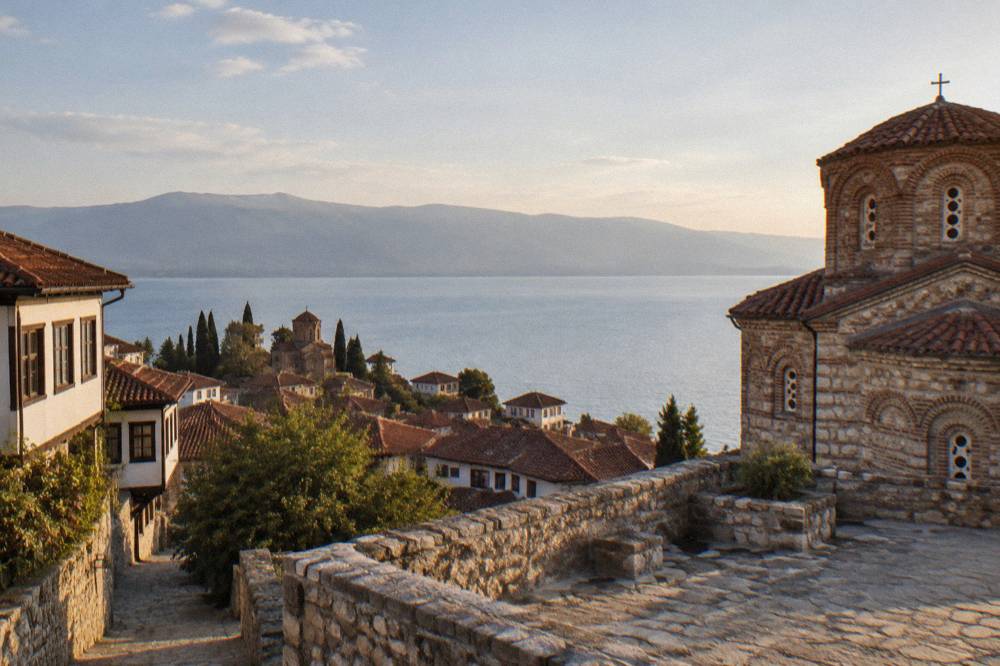
The churches are the heart of the quarter. St Sophia, Plaosnik and the Church of St John at Kaneo each sit on the standard sightseeing route, and each has its own page: St Sophia, Plaosnik and St John at Kaneo. The Kaneo district around the church, a separate neighbourhood of the old town on the shore below the fortress, has its own area guide. Samuel's Fortress itself has a municipal revitalisation plan with a summer stage and illumination budgeted at over 11 million denars, but the fortress publishes no ticket price or hours of its own, so treat any figure you see elsewhere with caution and check the fortress page for what is actually on record.
How Do You Spend A Day Walking The Ohrid Old Town?
A full day covers the old town bottom to top: the Old Bazaar and the Robev Family House in the morning, the climb past St Sophia and the Ancient Theatre to Plaosnik at midday, the fortress walls in the early afternoon, and the descent to the Church of St John at Kaneo and the shore to finish, with a boat cruise from the port as the standard end to the circuit. That order works with the museums' Monday closure and their afternoon hours, and it front-loads the climbing while legs are fresh. The one-day itinerary on this site, Ohrid in one day, follows essentially this sequence with timings.
The single-day walker should know what to skip. The Bay of Bones and the St Naum monastery are lake trips, not old-town sights: the museum on Water sits at Gradishte near Peshtani, and St Naum is at the far southern end of the lake near the Albanian border, about 4 km from the Tushemisht crossing. Both belong to the Bay of Bones page and the St Naum tour guide rather than to a walking day. A full-day boat cruise from Ohrid port to St Naum with Boat Armada runs 7 hours, from 1,200 den for an adult and 600 den for a child, and includes the Bay of Bones stop, with the museum's 150 den entrance paid separately.
For the afternoon on the water inside the town itself, the old town panoramic boat tour leaves from the port and shows the quarter from the lake, which is the angle the climb never gives you. It is one of the three products this page features, and Check availability on the featured small-group walk if you want the morning climb guided before you take to the water. The Ohrid boat tour guide compares the cruises, from the short panoramics to the full-day St Naum runs.
Want to see the old town from the water? Book a panoramic boat tour here.
| Part of the day | Where | Detail |
|---|---|---|
| Morning | Old Bazaar, Robev Family House | Museum house, two-shift summer hours from 1 May, closed Monday |
| Late morning | St Sophia, Ancient Theatre | Theatre built end of 3rd or start of 2nd century BC, capacity 5,000 |
| Midday | Plaosnik | Site of the oldest Slav monastery, St Panteleimon, per UNESCO |
| Late afternoon | Kaneo and the shore | Church of St John at Kaneo above the water, port cruises below |
Where Do You Eat And Shop In The Ohrid Old Town?
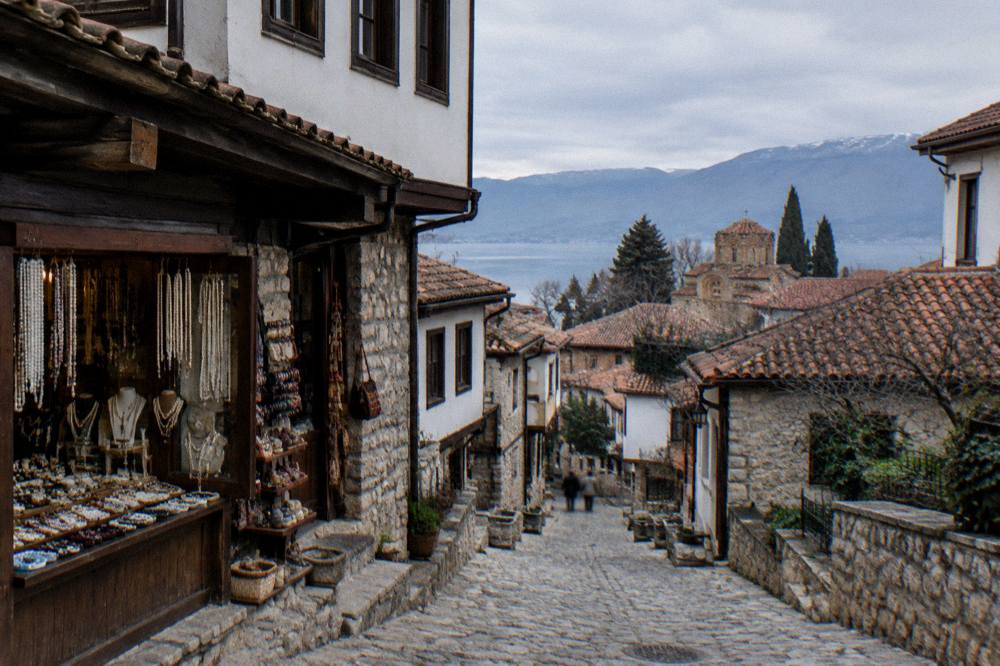
Eating and shopping in the Ohrid Old Town centre on the Old Bazaar and the lanes between it and the port, where the town's restaurants, the pearl workshops, the paper museum and the souvenir shops sit, with the bazaar at the bottom of the hill forming the commercial heart of the quarter. The Ohrid pearl, made by hand in family workshops rather than harvested from the lake, is the signature local product, and the Ohrid souvenirs and shopping guide explains what it is and how to tell the workshop product from the import. The workshops and the paper museum, which demonstrates handmade paper in the old town, are covered on their own pearl workshops and paper museum pages.
Food in the old town is Macedonian cooking with the lake at the centre of it. Ohrid trout is the historic local dish, though the lake's trout fishery is regulated and farmed trout is now the standard offering; the Ohrid trout page explains the distinction. Tavche gravche, the baked-bean dish that is North Macedonia's national food, and rakija with Macedonian wine round out the standard menu, each covered on this site's food pages. For where to eat, the Ohrid restaurants guide lists the old-town options by street, and the Macedonian food overview covers the dishes you will see on every menu.
A food-and-wine pairing works well here because the old town is compact. The monastery winery tour with tasting, one of the district's popular evening options, sits in this site's food and wine tour section, alongside the S&S Winery tasting and the private tasting experiences. None of these requires leaving the town, which matters if you have walked the hill all day and want dinner within five minutes of your room.
When Is The Best Time To Walk The Ohrid Old Town?
The best time to walk the Ohrid Old Town is between late spring and early autumn: June averages a 24.2 C daily high against 43.1 mm of rain, July 27.1 C against 34.7 mm, and August 27.6 C against 32.9 mm, with the climb most comfortable in the shoulder months of May and September when highs sit at 19.5 C and 22.4 C. These are modelled ERA5 reanalysis climate normals for the 1991 to 2020 period at the Ohrid grid cell, not a weather-station record, and they describe the air, not the lake. For swimming, the modelled lake surface temperature averages 22.9 C in July and 23.5 C in August, with the swimming season running from July, so summer combines the walk with a swim off the town's beaches.
| Month | Mean daily high C | Mean daily low C | Rain mm |
|---|---|---|---|
| Jan | 5.0 | -0.8 | 76.5 |
| Feb | 6.3 | 0.0 | 74.3 |
| Mar | 10.0 | 2.5 | 80.5 |
| Apr | 14.6 | 6.3 | 82.4 |
| May | 19.5 | 10.8 | 70.8 |
| Jun | 24.2 | 15.2 | 43.1 |
| Jul | 27.1 | 18.3 | 34.7 |
| Aug | 27.6 | 19.0 | 32.9 |
| Sep | 22.4 | 14.9 | 62.4 |
| Oct | 17.4 | 10.3 | 76.0 |
| Nov | 11.5 | 5.3 | 90.4 |
| Dec | 6.2 | 0.9 | 92.6 |
The season shapes what is open. The summer festival fills July and August, with the 66th edition running 12 July to 20 August 2026 across venues including the Ancient Theatre, and the Balkan Festival of Folk Songs and Dances ran 3 to 6 July 2026 at the Grigor Prlichev cultural centre. The 2027 dates of the major festivals have not been announced. Outside summer the museum sites drop to their winter hours from 1 October and boats to St Naum reduce or stop, roughly a May-to-October season for the lake cruises. The best time to visit Ohrid guide and the season pages for spring, summer, autumn and winter break the year down month by month, and the Ohrid weather page carries the full table.
August deserves a flag. It is the busiest month of the Ohrid year, the peak of a June-to-September season, and the lake's 2026 navigation rules responded to exactly that: a government decision of 2 June 2026 banned jet skis between 1 July and 31 August from 11:00 to 19:00 and restricted boats at night through the summer, in the interest of swimmer safety. The old town itself absorbs crowds across its lanes better than a single attraction does, but book rooms early for August.
What Practical Things Should You Know Before Visiting The Ohrid Old Town?
The practical essentials for the Ohrid Old Town are: the currency is the Macedonian denar with euros quoted informally but not legal tender, visa-free nationals may stay up to 90 days in any 180-day period, North Macedonia is outside the EU and Schengen, hotels register you with the police within 48 hours, and the emergency numbers are ambulance 194, police 192 and roadside assistance 196. None of this is onerous. The denar is de facto pegged to the euro through the National Bank's exchange-rate targeting, ATMs are widespread, and museum tickets are priced in denar: pay the 150 den foreign rate at the desk rather than converting in your head.
Entry rules in one line: visitors from visa-free countries may stay up to 90 days in any 180-day period, and UK visitors may stay up to 3 months with a passport valid at least 90 days after arrival. Holders of a valid multiple-entry UK, US or Canadian visa or a Schengen residence permit may enter for up to 15 days. Bulgaria and Romania have been full Schengen members since 1 January 2025, but North Macedonia itself is not in Schengen, so border checks apply on every crossing. The visa and entry guide carries the full detail.
| Practical item | What applies |
|---|---|
| Currency | Macedonian denar (MKD); euros quoted informally, not legal tender |
| Museum ticket | 150 den foreign, 120 den domestic, 60 den children and students |
| Museum schedule | Winter 1 Oct to 30 Apr, summer 1 May to 30 Sep, museum sites closed Monday |
| Visa-free stay | Up to 90 days in any 180-day period; UK up to 3 months |
| Police registration | Within 48 hours of arrival; hotels do it for guests |
| Emergency numbers | Ambulance 194, police 192, roadside assistance 196 |
| Old-town parking | Resident-only streets from summer 2026, clamping for non-residents |
Getting there is covered across this site: Skopje to Ohrid is about 170 km by road, roughly 3 hours by bus, with no passenger train and no domestic flight; Tirana to Ohrid runs roughly 5 to 7 minibuses a day over 3 to 3.5 hours including the border. The Kicevo to Ohrid motorway is still under construction, with the full opening reported for the first half of 2027, so the road journey keeps its current length for now. Once in town, everything in the old town is walkable, and the is Ohrid walkable question answers itself the moment you stand at the port and look up.
How Does The Ohrid Old Town Fit Into A Longer Trip?
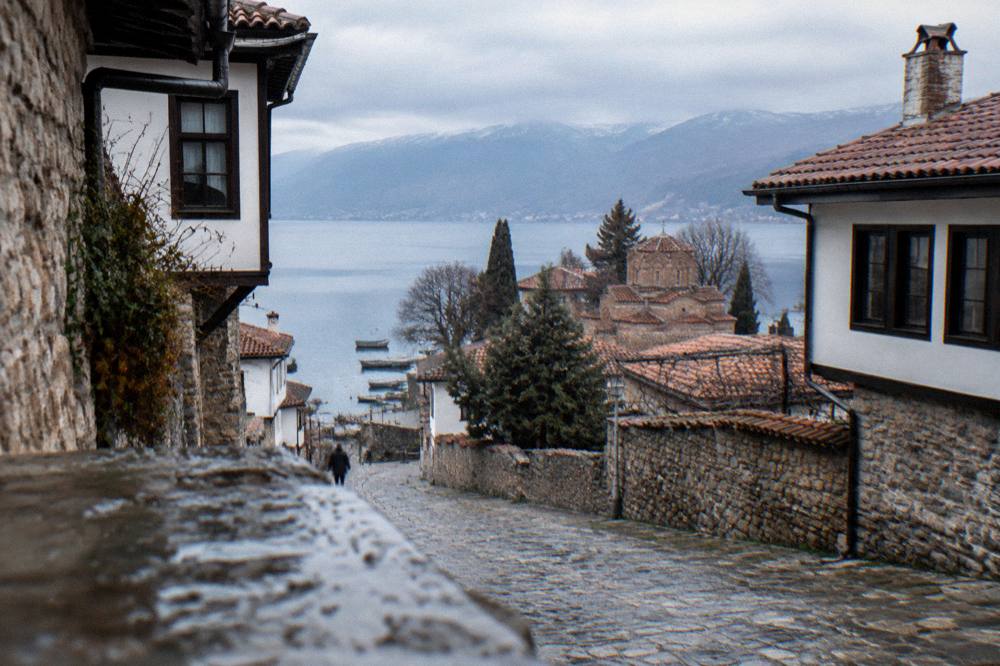
The Ohrid Old Town works as the fixed base of a longer trip: one day for the quarter itself, a second for the lake sights such as the Bay of Bones and St Naum, a third for Galicica National Park or the far shore, and further days for Struga, Vevcani or cross-border trips, with the itineraries on this site scaling from one day to five. The sequence matters less than the geography: the old town is the hub, and everything else is a spoke. The Bay of Bones at Peshtani and the eastern-shore villages of Trpejca and Ljubanista sit along the lake road, covered on the Trpejca and Ljubanista and Lagadin and Peshtani pages, while Struga at the lake's outflow and the Sveti Stefan and eastern shore area fill a further day each.
The two-day and three-day versions are the most common plans, and the how many days in Ohrid question gets a direct answer on this site. Travellers combining countries should note that the St Naum monastery sits only about 4 km from the Tushemisht border crossing into Albania, with the crossing open around the clock per the border listing, which makes an Ohrid-and-Pogradec combination straightforward; the Pogradec from Ohrid page covers it. The Skopje, Ohrid, Tirana route guide assembles the full three-capital circuit.
For travellers arriving from Tirana, the semi-private tour of Ohrid and Struga from Tirana is the pick that fits this pattern, since it pairs the old town with the lake's second town in a single day from the Albanian capital. The things to do in Ohrid hub lists everything across the destination, and the Ohrid hidden gems itinerary covers the corners of the old town that the standard climb skips.
Common Questions About The Ohrid Old Town
Is the Ohrid Old Town walkable?
Entirely. The quarter is a hillside of narrow stone lanes between the shore and Samuel's Fortress, closed to through traffic in parts, and everything from the Old Bazaar to the fortress gate is covered on foot.
How much do the museum sites in the Ohrid Old Town cost?
The Institute and Museum of Ohrid charges 150 den for foreign visitors, 120 den for domestic visitors and 60 den for children and students at its listed sites, including the Robev Family House and the Icon Gallery.
Are the Ohrid museums open on Mondays?
The museum institute's houses close on Mondays. They run winter hours from 1 October to 30 April and summer hours from 1 May to 30 September.
Can you drive into the Ohrid Old Town?
From summer 2026 streets including Ilindenska, Kosta Abrash and Car Samoil are reserved for residents with a valid sticker, and non-resident cars risk clamping. Park outside the old core and walk in.
What is at the top of the Ohrid Old Town?
Samuel's Fortress crowns the hill above the lake, with the fortress walls at the top of the climb and Plaosnik and the Ancient Theatre on the terraces below.
How long does the walk through the Ohrid Old Town take?
The climb from the port to the fortress and back down via Kaneo fills most of a day at museum pace, and the one-day Ohrid itinerary on this site follows exactly that circuit with timings.
The old town is Ohrid in miniature: a climb, a lake, a fortress and eight hundred years of church art packed into one hillside, and every lane in it leads either up to the walls or down to the water.