Is There A Train From Tirana To Ohrid?
No passenger train runs from Tirana to Ohrid. This guide explains the road route, the border crossing and the best ways to reach Ohrid from Albania.
Travellers planning a two-city Balkan itinerary often assume a rail link exists between the Albanian capital and North Macedonia's lake town, because the two look close on a map. Tirana sits about 86 km in a straight line from Ohrid, a lakeside town in North Macedonia on the shore of Lake Ohrid, a freshwater mountain lake at about 693 m above sea level. The assumption of a train is reasonable and, as this Ohrid Travel Guide page sets out, wrong. No passenger rail service reaches Ohrid at all, from any direction, and the journey is made by road.
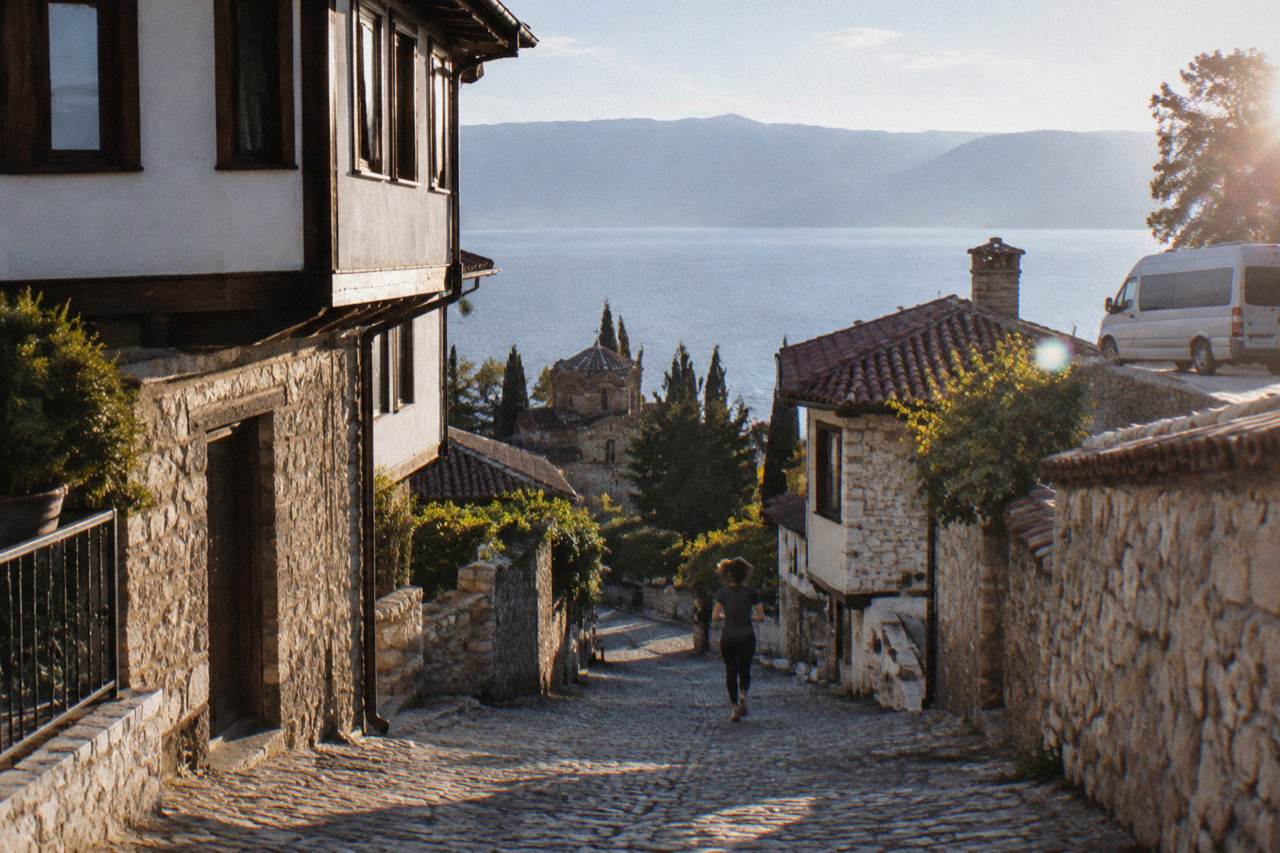
No, there is no passenger train from Tirana to Ohrid, and no passenger rail service reaches Ohrid from anywhere at all. Ohrid has no operating railway station, and no schedule, operator or rail fare for this route exists to look up. The crossing between Albania and North Macedonia on this route is made entirely by road, by bus, minibus, private transfer or a hired car.
That is not a temporary interruption or an engineering works situation. The absence is structural. Tirana's own rail network is limited, and North Macedonia's passenger network does not extend to Ohrid; the nearest rail connection people sometimes mention, Kicevo, has no confirmed passenger service to Ohrid in 2026. Anyone who searches for a Tirana to Ohrid train timetable will not find one, because there is no line to run one on.
The practical consequence is simple: the itinerary still works, it just works on wheels. Road travel between the two cities is well established, with buses and shared minibuses running the route, plus private transfers and self-drive options. The border between the two countries is a real international frontier, since North Macedonia is not in the European Union and not in Schengen, so passports are checked somewhere in the middle of the drive.
For travellers coming at Ohrid from the other direction, the same answer applies. There is no train from Skopje either, and the question is covered in detail on the page is there a train from Skopje to Ohrid.
How Do You Travel From Tirana To Ohrid Without A Train?
The route runs by road, most commonly by intercity bus or shared minibus from Tirana, crossing the Albania to North Macedonia border and continuing to Ohrid, usually with Struga on the way. Multi-stop road journeys of this kind between Tirana and Ohrid are well travelled, and the full route, its crossing points and its onward connections are documented in this site's Tirana to Ohrid route guide.
Buses and shared minibuses are the workhorses of this corridor. Reported schedules describe several departures a day in each direction in season, running from Tirana's bus terminals and crossing the frontier on the western side of Lake Ohrid before reaching Struga, the Macedonian town at the lake's outflow, and then Ohrid itself. Because timetables, fares and operators on this route change seasonally and no current schedule is published in a single official place, the working rule is to check current departures with the terminal or the operator before committing to a day. The full corridor is laid out on the Tirana to Ohrid route page.
Driving the route yourself is the other common choice. North Macedonia requires headlights on day and night, tolls on its motorway sections are paid at each plaza rather than through a vignette, and drivers should carry a green card for international insurance. The border itself functions as a normal passenger crossing; the St Naum and Tushemisht crossing on the southern shore of the lake is reported to be open around the clock for passenger vehicles and pedestrians.
For travellers who would rather not manage any of this alone, guided road products exist that start in Tirana and bring the whole corridor into one itinerary. The St Naum Day Trip from Tirana covers Ohrid and the St Naum monastery on a single day tour that departs from Tirana or Durres, and it can be checked at the operator's live listing: Check availability.
What Does The Albania To North Macedonia Border Crossing Involve?
The drive from Tirana to Ohrid crosses one international border, since Albania and North Macedonia are separate countries outside the Schengen area, and passport checks happen on the road between the two. The main crossing on this corridor sits west of Lake Ohrid, and the St Naum and Tushemisht crossing at the lake's southern end is reported to operate 24 hours a day for passenger vehicles and pedestrians.
The southern crossing has a feature that surprises many visitors: it can be crossed on foot. The St Naum monastery area sits about 4 km from the Tushemisht border post on the Albanian side, a gap a taxi covers in roughly ten minutes, and pedestrians can walk the stretch between the two posts. From the Albanian side, Pogradec, the lakeside Albanian town, lies roughly 26 km in a straight line from Ohrid, close enough that Ohrid and Albania are genuinely combinable in a single trip, a pairing discussed on the page how do I get from Ohrid to Tirana.
Two rule-based facts matter for the crossing. First, visa policy: many nationalities, including British, American, Canadian and Australian citizens, enter North Macedonia visa-free for up to 90 days in any 180-day period, and UK visitors can stay up to three months without a visa provided the passport is valid for at least 90 days after arrival. Second, registration: visitors staying in accommodation are registered with the local police within 48 hours of arrival, and hotels do this automatically for their guests.
| Border fact | What applies |
|---|---|
| Crossing on the lake's south shore | St Naum (North Macedonia) and Tushemisht (Albania), reported open 24/7 |
| Distance from St Naum to the border post | About 4 km, roughly 10 minutes by taxi |
| Pedestrian crossing | Possible on foot between the two posts |
| Passport rule for UK visitors | Expiry at least 90 days after arrival, stay up to 3 months visa-free |
| Police registration | Within 48 hours, handled by the hotel |
Allow time at the frontier. Peak summer weekends lengthen queues at Balkan land borders, and a crossing that takes minutes at midday can take much longer in the evening. Nothing about the wait is verifiable in advance, so the honest advice is to build slack into any same-day plan, especially one that ends with a boat departure or a festival evening in Ohrid.
Why Does The Route Work So Well Without A Train?
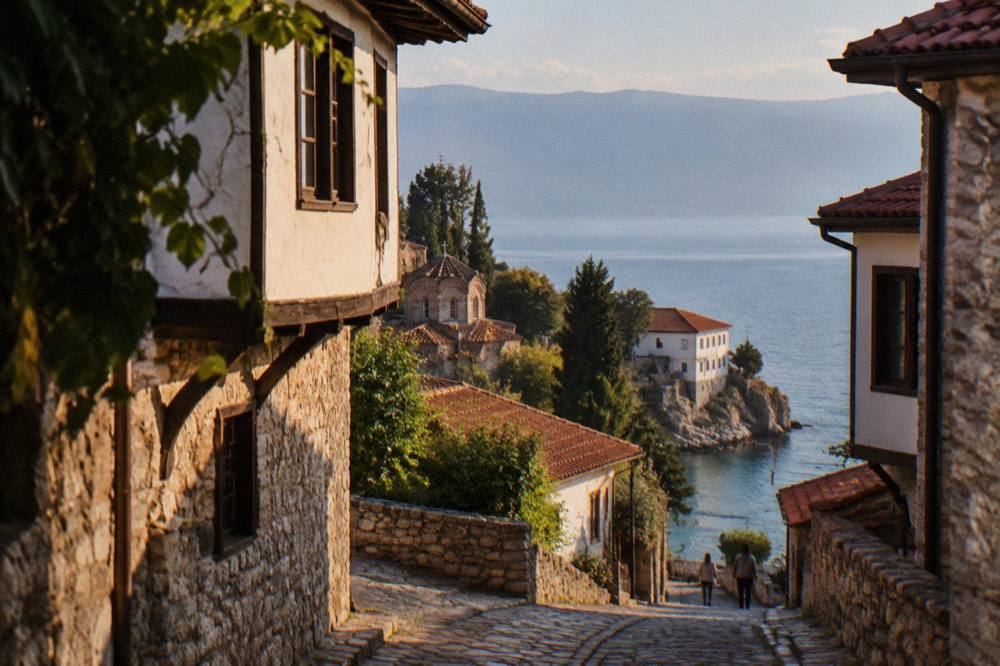
Because the two cities are close, about 86 km apart in a straight line, and everything a traveller wants sits along one road corridor: the Albanian shore, the border, the southern Macedonian shore with St Naum and the Bay of Bones, then Struga and Ohrid. A train would save little on a route this short, and the road already links every stop that matters on both sides of the lake.
The corridor is unusually dense with sights for its length. On the Macedonian side the road north from the border passes St Naum, the monastery at the Crn Drim springs where rowboats take visitors through the spring pools, and Peshtani, next to the Bay of Bones, the museum on water built as a prehistoric pile dwelling. Struga follows, where the Black Drim leaves the lake, and then the road rounds into Ohrid itself. In practical terms, a bus or a car is not a compromise on this route, it is the sightseeing.
The distances involved stay modest all the way. Straight-line distances computed for this destination put Struga about 12 km from Ohrid, Pogradec about 26 km, and Skopje, the capital, about 111 km. Nothing in the region demands a high-speed link.
| Place | Straight-line distance from Ohrid |
|---|---|
| Struga | About 12 km |
| Pogradec (Albania) | About 26 km |
| Bitola | About 46 km |
| Tirana (Albania) | About 86 km |
| Skopje | About 111 km |
What Can You Do In Ohrid Once You Arrive By Road?
Ohrid rewards arrival with a compact old town of Byzantine churches, a fortress and a lakefront, all walkable on foot, with the Church of St John at Kaneo above the water, St Sophia, Plaosnik and Samuel's Fortress as the anchors. The town is the centre of a UNESCO mixed World Heritage site inscribed in 1979 and 1980, covering both the cultural heritage and the lake itself.
The old town climbs from the lake shore up to the fortress, and its lanes are pedestrian in character, so a visit is mostly a walking proposition rather than a driving one. The museum institute's sites, including the Robev Family House, the Icon Gallery at the Perivleptos complex and the Bay of Bones at Peshtani, run a winter schedule from 1 October to 30 April and a summer schedule from 1 May to 30 September, with Mondays closed at the sites where the institute's own pages state that. The lake itself is the other half of the visit: boat cruises run from the port, including a full-day cruise toward St Naum offered by local operators, and the evening options include a short sunset cruise on the water.
Summer adds a festival layer. The 66th Ohrid Summer Festival opened on 12 July 2026 at the Ancient Theatre, a late Hellenistic site whose capacity, per the museum institute's own page, rose to about 5,000 after its upper seating was added. The Swimming Marathon, a 25 km race from St Naum to Ohrid harbour, and a separate 33 km stand-up paddle marathon around the lake both formed part of the Ohrid Water Festival in August 2026.
Travellers fitting Ohrid into a wider loop often pair it with the Albanian capital in one itinerary, a route combination laid out on the Skopje Ohrid Tirana route page. The reverse day trip, taking in Tirana from an Ohrid base, is covered separately on the Tirana from Ohrid day trip page.
Is A Guided Day Tour A Sensible Alternative To The Bus?
Yes, for anyone based in or passing through Tirana who wants Ohrid and St Naum without managing buses, borders and boat schedules alone, a guided road day tour is the low-friction option. The tours that cover this corridor depart from Tirana or Durres, not from Ohrid, and they bundle the border drive, the monastery stop and time in the old town into one booked itinerary.
The roster for this corridor includes several road products that start in Tirana, among them the St Naum Day Trip from Tirana, a semi-private option that adds Struga, and longer group trips that link Ohrid, the lake and St Naum. The choice between them comes down to group size and how much of the shore you want included; the shared options keep the price down, while the semi-private and private versions buy flexibility at the border and at each stop.
For a small-group day that adds Struga to Ohrid, book a semi-private tour here.
Once in Ohrid, the switch to local products is easy. Short boat cruises, walking tours of the old town and a half-day city tour all run from the town itself, so a one-day arrival by road can still end with an evening on the water or a guided walk through the lanes above the port.
Common Questions About Travel From Tirana To Ohrid
Is There A Train From Tirana To Ohrid?
No. No passenger train runs between Tirana and Ohrid, and no passenger rail service reaches Ohrid from anywhere. The journey is made by road, by bus, minibus, private transfer or hired car, crossing the Albania to North Macedonia border on the way.
How long does the Tirana to Ohrid journey take by road?
No current timetable or journey duration is published for this route, and times vary with the border and the season. Check current schedules with the Tirana terminal or the operator before planning a same-day connection.
Which border crossing is used between Tirana and Ohrid?
The corridor crosses the Albania to North Macedonia frontier west of Lake Ohrid. The St Naum and Tushemisht crossing at the lake's southern end is reported to be open 24 hours a day for passenger vehicles and pedestrians, and St Naum sits about 4 km from the border post.
Do I need a visa to cross into North Macedonia from Albania?
Many nationalities, including UK, US, Canadian and Australian citizens, enter visa-free for up to 90 days in any 180-day period. UK passports must be valid for at least 90 days after arrival. Hotels register guests with the local police within 48 hours.
Can I visit Ohrid and Albania in one trip?
Yes. Tirana lies about 86 km in a straight line from Ohrid, Pogradec on the Albanian shore about 26 km, and the St Naum to Tushemisht crossing can even be made on foot, so a two-country lakeside itinerary is practical by road.
Is there a train from anywhere to Ohrid?
No passenger rail service reaches Ohrid. The same applies from Skopje, which is about 111 km away by straight line and is reached by bus or car in practice.