Tirana To Ohrid: Bus, Car And The Border At Qafë Thanë
Tirana sits about 86 km from Ohrid as the crow flies, across an international border between Albania and North Macedonia. This guide sets out the two realistic ways to make the crossing, by road through Qafë Thanë or around the lake via Sveti Naum, and what changes once you are on the Macedonian side.
Short answer
There is no train and no flight between Tirana and Ohrid. Travellers go by road: a shared minibus from Tirana crossing at Qafë Thanë near Struga, or a private car, either by the same route or around the southern shore via the Sveti Naum and Tushemisht crossing. The day trip to Ohrid is covered end to end by several guided products that start in Tirana, so no local driving is required.
Tirana and Ohrid sit barely 86 km apart on the map, yet the journey between them crosses an international border between Albania and North Macedonia, a country that is in neither the EU nor Schengen. That single fact shapes everything about the route: documents are checked, the currency changes from the lek to the Macedonian denar, and the last stretch of road drops toward a lake that lies about 693 m above sea level. This Ohrid Travel Guide page sets out the two realistic ways to travel, by shared minibus through Qafë Thanë or by car around the southern shore, and what to do with a day in Ohrid once the border is behind you. For the reverse direction, the Tirana from Ohrid day trip page covers the itinerary the other way round, and the broader Skopje Ohrid Tirana route strings all three cities into one trip.
How Do You Get From Tirana To Ohrid?
The only practical ways from Tirana to Ohrid are by road: a shared minibus or private transfer across the Qafë Thanë border near Struga, or a self-drive car using that same crossing or the small Sveti Naum and Tushemisht crossing at the southern end of the lake. There is no passenger train on any part of this route and no flight between the two cities. The whole plan rests on choosing a crossing and timing the border.
Two doors lead into North Macedonia from this side. The first, Qafë Thanë (Qafe Thane on the Macedonian side, also written Kjafasan in older sources), is the main crossing for traffic heading to Struga and Ohrid from Tirana, and it is the one shared minibuses use. The second, Sveti Naum on the Macedonian side and Tushemisht on the Albanian side, sits at the southern tip of the lake, about 4 km from the St Naum monastery. It is a small, quiet crossing that suits a car or a taxi on a round-the-lake route, and it is listed as open around the clock for passenger vehicles and pedestrians, though schedules and opening arrangements should be confirmed before relying on a night crossing.
The shared minibus, known locally as a furgon, is the standard budget option. Several run daily from Tirana, mostly from the south and regional terminal, and they cross at Qafë Thanë before continuing to Struga and Ohrid. Fares, departure times and journey durations change with the season and the operator, so check current schedules at the terminal or with the operator before you travel; nothing on this route runs to a fixed published timetable that stays true year-round. Booking platforms also sell seats on shared and private transfers on the same corridor, which spares the terminal legwork.
Comparing coach times and fares for the cross-border trip? Book a bus ticket to Ohrid here.
What Is The Border At Qafë Thanë Like?
Qafë Thanë is a land border crossing between Albania and North Macedonia on the road corridor between Tirana, Struga and Ohrid, used by the shared minibuses and by nearly all car traffic from the Albanian capital. North Macedonia is outside the EU and outside Schengen, so every traveller shows a passport or ID card to two sets of officers, one leaving Albania and one entering North Macedonia, and waits in the vehicle queue at each post.
The paperwork is straightforward for most visitors. Visa-free nationals may stay up to 90 days in any 180-day period, a rule the Macedonian foreign ministry states plainly. UK guidance adds two conditions for British visitors: stays of up to three months without a visa, and registration with the local police within 48 hours of arrival, a formality hotels complete for their guests. Passport validity for UK travellers means an expiry date at least 90 days after the date of arrival. Border wait times are not fixed or published in any reliable form, so build slack into any same-day plan rather than trusting a number.
The do I need a visa for North Macedonia question is covered in full on its own page, and the money question changes the moment you cross: Albania uses the lek, North Macedonia uses the denar (MKD), pegged in practice to the euro, with the euro itself widely quoted for tours and transfers but not legal tender. The Macedonian denar and money guide covers notes, exchange and card use in detail.
| Border item | What applies |
|---|---|
| Crossing on the Tirana to Struga and Ohrid corridor | Qafë Thanë (Qafe Thane / Kjafasan) |
| Crossing at the southern lake tip | Sveti Naum (MK) and Tushemisht (AL) |
| Sveti Naum crossing to Tushemisht distance | About 4 km from the St Naum monastery |
| Stays for visa-free nationals | Up to 90 days in any 180-day period |
| UK visitors | Up to 3 months, passport expiry at least 90 days after arrival |
| Police registration | Within 48 hours; hotels do it for guests |
| EU and Schengen status of North Macedonia | In neither |
Is Driving From Tirana To Ohrid Better Than The Bus?
Driving from Tirana to Ohrid means one border stop, full control of the schedule and the option of the scenic southern route through Pogradec and the Sveti Naum crossing, at the cost of handling Albanian and Macedonian roads and border queues yourself. The minibus is cheaper and simpler, but it fixes your route through Qafë Thanë and Struga and gives no room to stop at the lake viewpoints or the monastery on the way.
The self-drive case rests on the southern loop. The monastery there, beside the Crn Drim springs, has its own entry fee of 150 MKD and a rowboat ride through the springs for about 5 EUR, per a cruise operator's published list. From Sveti Naum the Macedonian shore road runs north past the villages of the eastern shore straight into Ohrid. A local blog puts a taxi from St Naum to the border at about 400 den and advises allowing up to an hour for the formalities.
Driving rules on the Macedonian side are specific: headlights on day and night, a green card for insurance, and tolls paid per motorway section at plazas, with no vignette system. The Ohrid car rental guide covers picking up a vehicle on the Macedonian side, which avoids taking a rental across the border at all, since many Albanian rentals are not insured for it. One dated rule matters in Ohrid itself: from summer 2026, old-town streets such as Ilindenska, Kosta Abrash and Car Samoil fall under a resident-only parking regime, with clamping for non-residents, so a car is best left outside the old lanes.
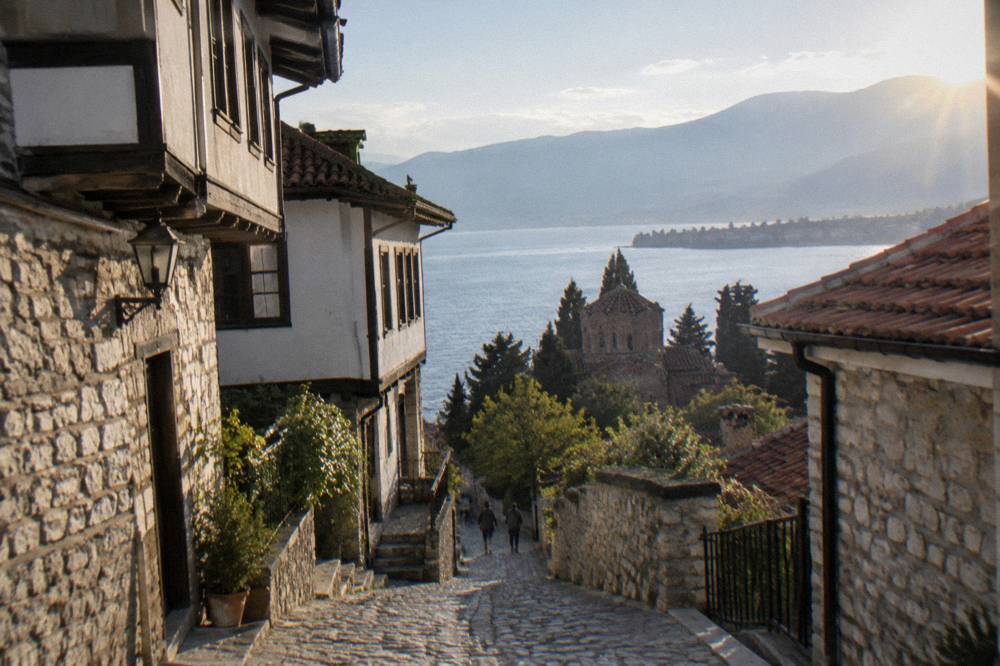
For anyone who would rather not drive or negotiate a terminal, guided products that start in Tirana and Durres cover the whole corridor: the crossing, the drive and a day in Ohrid. The picks above include a private full-day option, a sunset cruise on the lake and a small-group walk of the old town, three ways to spend the Ohrid hours of the trip without planning a single local connection.
Can You Do Tirana To Ohrid As A Day Trip?
Yes, Ohrid works as a day trip from Tirana, and it is the single most common way Albanian-coast visitors see the town: a guided tour that starts in Tirana or Durres crosses at Qafë Thanë, spends the day on the old town, the churches and the lake shore, and returns the same evening. Several bookable products run exactly this shape, and all of them start in Albania, not in Ohrid.
The roster on this site lists multiple Tirana departures covering Ohrid and the St Naum monastery, plus variants from Durres and from the Golem coast, and a semi-private version that adds Struga. The trade-off is time. A same-day return spends the drive and two border formalities inside one day, so the in-town hours are real but not endless; travellers who want the evening lake light, the restaurants and a swim usually prefer at least one overnight. The how many days in Ohrid page lays out what one, two and three days each buy you.
If the day trip appeals, the pairing to know about is St Naum. The monastery sits at the southern end of the lake, reached from Ohrid by road or by boat from the port, and the St Naum from Ohrid page covers it in full. Many Tirana day tours include it precisely because it lies on the southern route home toward the Sveti Naum and Tushemisht crossing, folding two sights into one border-to-border loop. For the reverse plan, the how do I get from Ohrid to Tirana answer covers the same corridor from the other side.
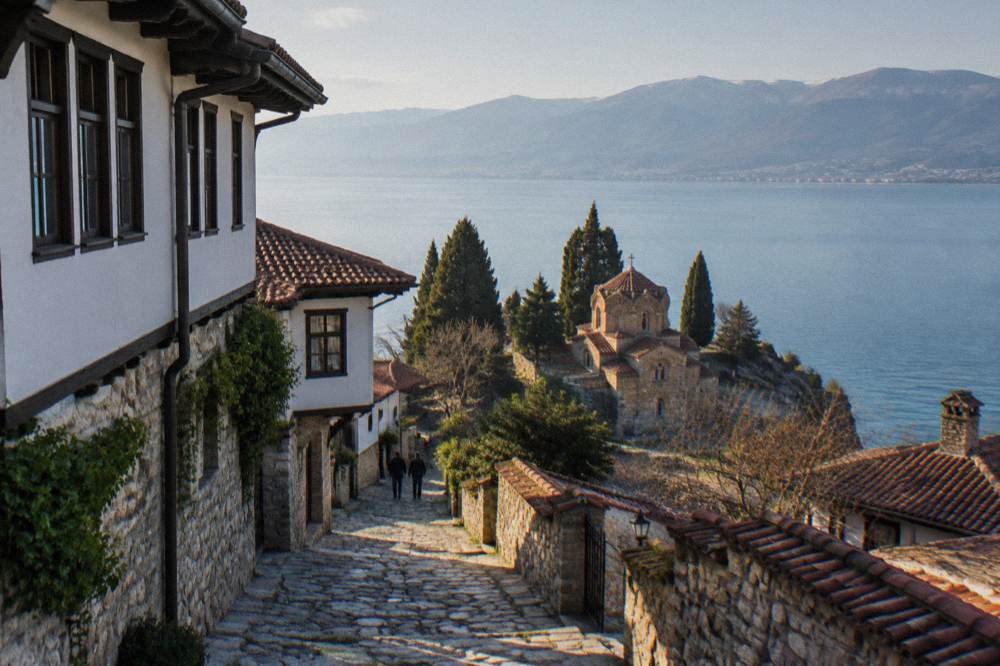
What Changes When You Cross Into North Macedonia?
Three things change at the border: the currency becomes the Macedonian denar, with the euro quoted for tours and transfers but not legal tender; entry rules become those of a non-EU, non-Schengen state with the 90-in-180 visa-free rule; and emergency and practical numbers switch to the Macedonian set, ambulance 194, police 192, roadside assistance 196. None of the EU-style conveniences, from Schengen free movement to the euro, apply.
Money is the everyday version of this. The denar is managed against the euro by the national bank, and the middle rate on 19 October 2026 was 1 EUR to 61.6633 MKD. ATMs are the normal way to get denars, and exchange offices handle cash conversion; paying in euro notes informally fetches poor rates, so change properly rather than at the counter. Local costs, museum tickets, boat fares and park fees are quoted in MKD, and the museum institute's own price list, 150 den for foreign adults and 120 den for domestic visitors at its sites, shows why: rounding into euro loses you money at every ticket window.
Practical details worth carrying: tap water in Ohrid is generally drinkable, English is spoken in tourism settings, and the town is compact and walkable once you arrive, with the old lanes closed to through traffic. The getting around Ohrid page covers local buses, taxis and boats, and the is Ohrid safe page covers the safety picture, which the US State Department places at its lowest advisory level, Exercise Normal Precautions, in guidance reported for 2025.
| Item | Albania side | North Macedonia side |
|---|---|---|
| Currency | Albanian lek | Macedonian denar (MKD) |
| Euro status | Not legal tender | Not legal tender, widely quoted |
| EU membership | Candidate country | Not a member |
| Schengen | Not a member | Not a member |
| Emergency numbers | Local set | Ambulance 194, police 192, roadside 196 |
| Visa-free stay | Check per nationality | Up to 90 days in any 180-day period |
How Far Is Ohrid From Tirana And The Other Big Cities?
Tirana lies about 86 km from Ohrid in a straight line, the closest of the major capitals to the town, with Skopje about 111 km, Bitola about 46 km, Pogradec in Albania about 26 km and Struga about 12 km away on the same measure. Road distances run longer than these figures, since the route bends around the lake and the mountains, and no reliable door-to-door driving time for the Tirana corridor is published as a fixed figure.
The table below uses straight-line kilometres, the only measurement that is stable across sources. Use it for scale, not for planning a pickup time: road distance, border queues and season all stretch the real figure. What the numbers do show is how tightly Ohrid sits against its neighbours, close enough to Struga that the two towns share a bus corridor, and close enough to Pogradec that a single small crossing separates them.
| Place | Straight-line distance from Ohrid | Country |
|---|---|---|
| Struga | About 12 km | North Macedonia |
| Pogradec | About 26 km | Albania |
| Bitola | About 46 km | North Macedonia |
| Tirana | About 86 km | Albania |
| Skopje | About 111 km | North Macedonia |
For context on the northern corridor, Skopje to Ohrid by road is about 170 km, with intercity buses, private transfers and no passenger rail, a route the Skopje to Ohrid page covers in detail. The is there a train from Tirana to Ohrid answer settles the rail question for this corridor too: no passenger service reaches Ohrid from any direction, so road or nothing.
What Should You Do With Your First Day In Ohrid?
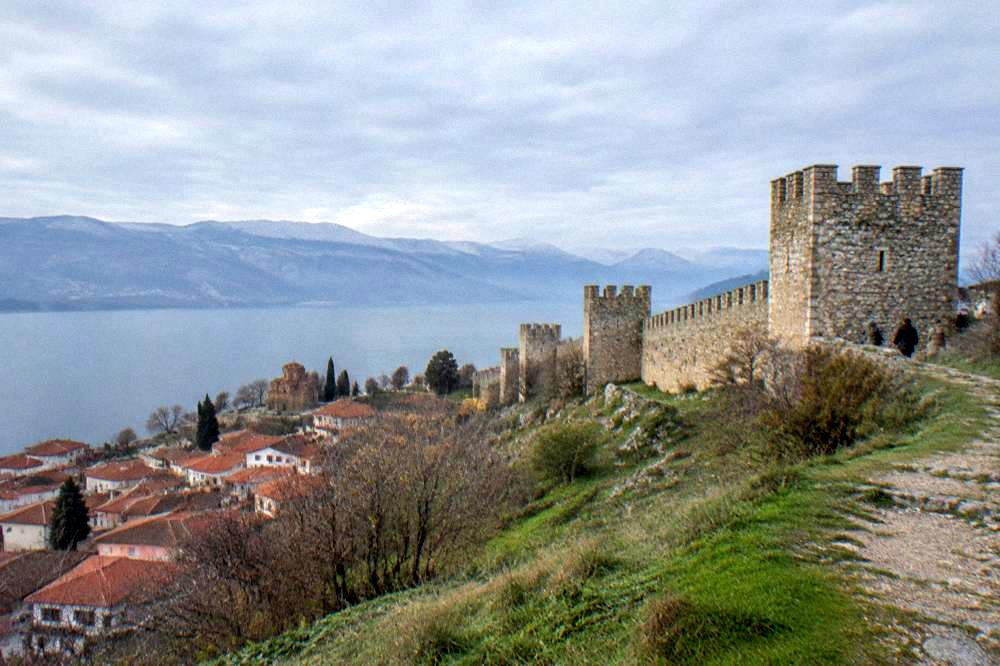
A first day in Ohrid belongs to the old town on foot: the lanes climbing from the lake to Samuel's Fortress, the Church of St John at Kaneo above the water, the Ancient Theatre, St Sophia, Plaosnik and the Old Bazaar, with the museum institute's sites, Robev Family House, the Icon Gallery and the Bay of Bones on its ticket list at 150 den for foreign adults and 120 den for domestic visitors.
The museum buildings keep seasons. Robev Family House runs a winter schedule from 1 October to 30 April, 09:00 to 15:30, and a summer two-shift schedule from 1 May, closing Mondays either way. The Icon Gallery keeps winter hours of 09:00 to 14:00 and summer hours to 17:00, also closed Monday, and the Museum on Water at the Bay of Bones, out at Gradiste near Peshtani, runs 09:00 to 16:30 in summer and 09:00 to 15:30 in winter, again closed Monday.
For a fuller plan, the things to do in Ohrid page is the site's master list, and the itinerary pages, Ohrid in one day, in two days and in three days, sequence the same sights by length of stay. A small-group guided walk of the old town is a good first-morning move for Tirana day-trippers especially, since it compresses the orientation into a couple of hours.
What Is The Best Time Of Year For The Tirana To Ohrid Trip?
The lake season runs about June to September, with July and August the busiest months, water at its most swimmable and every boat, beach bar and lakeside facility open; May, June and September bring milder air and thinner crowds on the same roads; and winter, November to March, trades the boats and beaches for low season quiet, short museum hours and a real chance of snow on the Galicica road.
The modelled ERA5 reanalysis normals for 1991 to 2020 for the Ohrid grid cell put July at a mean daily high of 27.1 C and August at 27.6 C, against January's 5.0 C high and minus 0.8 C low. Rain tells the same story from the other side: December averages 92.6 mm and November 90.4 mm, while August averages 32.9 mm and July 34.7 mm. Lake surface temperature follows: modelled aggregator values put August around 23.5 C and the swimming season from July, while January sits near 4.6 C and October around 14.7 C, with the UHMR multi-year October mean at 14.3 C. The full picture, month by month, is on the Ohrid weather and best time to visit Ohrid style pages, and the season-by-season breakdowns of the Ohrid weather by month table.
The dated caveat for high summer is on the water, not the road. A government decision of 2 June 2026 restricted lake navigation: jet skis are banned from 1 July to 31 August between 11:00 and 19:00, and boats are banned at night, 21:00 to 05:00, from early June through August, with further limits into September and October. A sunset cruise in August therefore runs closer to the shore and earlier than the same cruise in June, something to weigh when picking a boat trip.
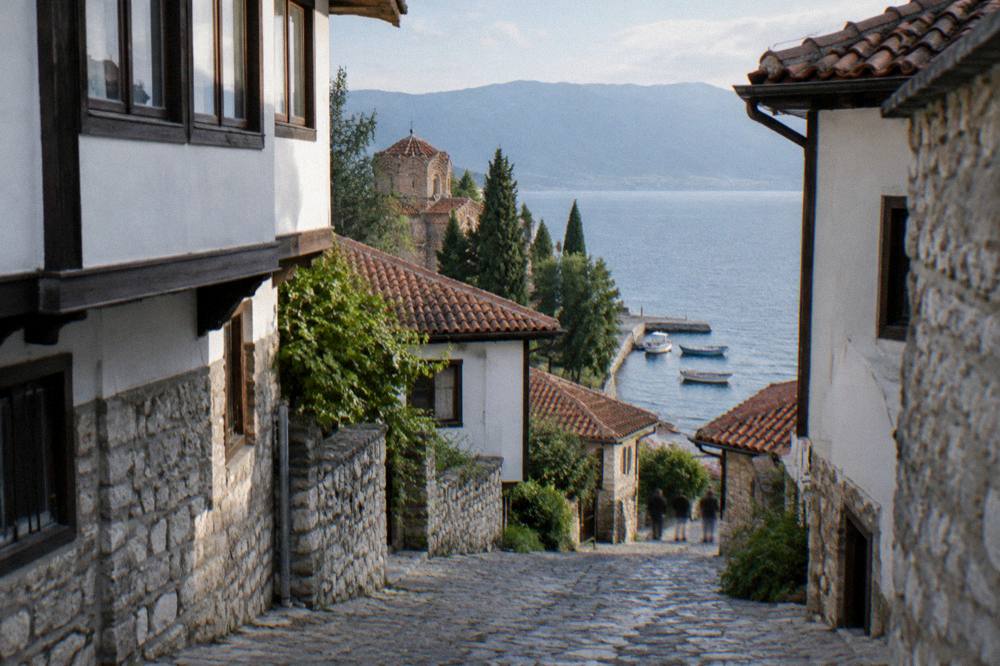
How Much Does The Tirana To Ohrid Trip Cost?
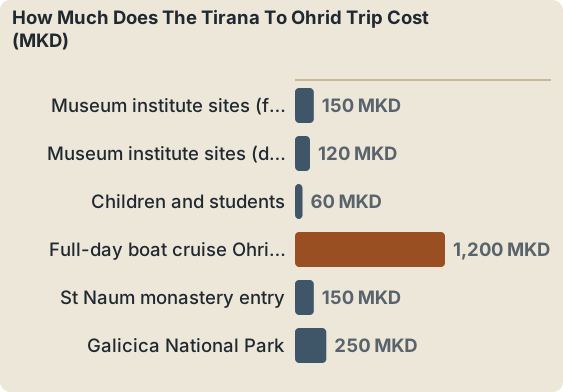
Crossing costs split into three parts: transport from Tirana, which varies by mode and operator and should be checked against current schedules and listings; border and entry costs, which are nil for visa-free nationals beyond any insurance or green card for a car; and in-town costs, which are low by European standards, 150 MKD museum entries, a full-day boat cruise to St Naum from 1,200 den adult and 600 den child, and 250 MKD per vehicle to enter Galicica National Park.
The fixed local figures are the ones worth memorising, because they barely move. The museum institute's ticket list prices its sites at 150 den foreign, 120 den domestic and 60 den for children and students. The Boat Armada full-day cruise from Ohrid port to St Naum runs 7 hours from 1,200 den for an adult and 600 den for a child. Galicica National Park charges 250 MKD per vehicle with no per-passenger fee, or 100 MKD only for someone entering on foot from the Ohrid-side gate. The St Naum monastery entry is 150 MKD per person, with the springs rowboat at about 5 EUR, per the cruise operator's list. Product prices for guided tours and transfers, which are quoted in foreign currency by the operators, render from the listings themselves rather than from a fixed local tariff.
| Cost item | Figure | Basis |
|---|---|---|
| Museum institute sites (foreign adult) | 150 MKD | Institute ticket list |
| Museum institute sites (domestic adult) | 120 MKD | Institute ticket list |
| Children and students | 60 MKD | Institute ticket list |
| Full-day boat cruise Ohrid port to St Naum | From 1,200 den adult, 600 den child | Operator's published list |
| St Naum monastery entry | 150 MKD | Cruise operator's list |
| Springs rowboat at St Naum | About 5 EUR | Cruise operator's list |
| Galicica National Park | 250 MKD per vehicle, 100 MKD on foot | Park guide |
Accommodation, restaurant and nightlife budgets are covered separately on the Ohrid cost and budget page, and the currency mechanics on the Macedonian denar and money page. The one rule to carry across the border: denars come from ATMs and exchange offices, not from hoping a euro note will be accepted at the museum door.
Which Route Should You Choose: Qafë Thanë Or Sveti Naum?
Choose Qafë Thanë if you are on a shared minibus, a transfer or any guided day tour from Tirana, since it is the corridor those services use toward Struga and Ohrid; choose Sveti Naum and Tushemisht if you are driving yourself or hiring a car and want the lake-shore route through Pogradec, the monastery and the eastern-shore villages, folding two of the region's sights into the drive itself.
The case for the southern route, in practice, is that it turns transit into itinerary. From Pogradec the shore road north passes Tushemisht, crosses about 4 km from St Naum, and then runs the whole Macedonian east shore toward Ohrid, the same water you would otherwise see only from the town quay. The case for Qafë Thanë is simplicity and speed: the minibuses know it, the road is the main corridor, and it drops you at Struga, about 12 km from Ohrid, from where local connections or a short taxi ride finish the journey.
Common Questions About Travel From Tirana To Ohrid
Is there a bus from Tirana to Ohrid?
Shared minibuses (furgons) run daily from Tirana, mostly from the south and regional terminal, crossing at Qafë Thanë and continuing to Struga and Ohrid. Fares, times and frequencies change with season and operator, so check current schedules at the terminal or with the operator before travelling.
How long does the trip from Tirana to Ohrid take?
Tirana is about 86 km from Ohrid in a straight line, but the road route is longer and includes two border checks, one leaving Albania and one entering North Macedonia. No reliable fixed door-to-door time is published, so treat any figure as an estimate and build slack into same-day plans.
Which border crossing is used between Tirana and Ohrid?
Shared minibuses and most traffic use Qafë Thanë (Qafe Thane / Kjafasan), the main corridor toward Struga and Ohrid. Drivers can instead take the southern route through Pogradec to the Sveti Naum and Tushemisht crossing, about 4 km from the St Naum monastery, reported as open around the clock for passenger vehicles and pedestrians.
Do I need a visa to enter North Macedonia from Albania?
Visa-free nationals may stay up to 90 days in any 180-day period. UK visitors may stay up to 3 months, must hold a passport valid at least 90 days beyond arrival, and must register with local police within 48 hours, which hotels do for guests.
What currency do I need in Ohrid?
The Macedonian denar (MKD). Euros are commonly quoted for tours and transfers but are not legal tender; the middle rate on 19 October 2026 was 1 EUR to 61.6633 MKD. Use ATMs or exchange offices rather than paying in euro notes.
Can you visit Ohrid and Albania in one trip?
Yes. The distance is short, the crossings are open to passenger traffic, and the Skopje Ohrid Tirana route is a established three-city itinerary. Several day tours from Tirana and Durres cover Ohrid and the St Naum monastery in a single day, starting in Albania.
What Should You Book Before Crossing From Tirana To Ohrid?
Book two things in advance and leave the rest loose: your transport across the border, whether a minibus seat, a transfer or a guided day tour that starts in Tirana, and any timed activity in Ohrid you would hate to miss, above all a boat trip or a guided walk, since boats run seasonally and the good walking hours fill first. Museum entries, taxis and food need no advance booking at all.
The reason is the border, not the town. Ohrid itself is manageable on arrival: tickets are bought at the door, the old town is walked, and the quays fill with boats in season. What cannot be improvised is the shape of the day around two sets of border officers and a fixed return time, which is exactly the problem a pre-booked product solves. The private full-day tour below starts in Tirana and Durres, covers the crossing and the drive, and pairs naturally with a sunset cruise or an old-town walk booked for the same evening or the following day. For anyone staying longer, the itinerary pages do the sequencing work for you.
Check availability for the private Tirana day tour on the operator's live listing, where the current price, dates and pickup options are shown before you commit, with cancellation terms stated on the listing page.