North Macedonia Visa And Entry Rules For Ohrid Trips
Ohrid sits in North Macedonia, a country outside the EU and outside Schengen, so the entry rules differ from those of neighbouring Greece and of Bulgaria or Romania. This guide sets out what the foreign ministry and UK travel advice actually say about visas, passports, stay limits, police registration and the borders that serve the lake.
Short answer
Citizens of the US, UK, EU, Canada and Australia can enter North Macedonia visa-free for up to 90 days in any 180-day period, and UK guidance says visitors register with the local police within 48 hours, something hotels do for their guests.
Ohrid is a lakeside town in North Macedonia, on a freshwater mountain lake whose surface sits at about 693 m above sea level, and the country that hosts it is outside the EU and outside the Schengen area. That single fact shapes every entry question on this page: the visa rules are national, the border is a hard external frontier, and the stay clock runs on a 90-in-180 calculation rather than on Schengen rules. The Ohrid Travel Guide lays out what the Ministry of Foreign Affairs and UK travel advice actually publish, from the visa-free list to the police-registration requirement, and then covers the practical side, which border crossings and which transport routes serve the lake. The short version for most readers: if you hold a US, UK, EU, Canadian or Australian passport, you do not need a visa, you may stay up to 90 days in any 180-day period, and your hotel registers you with the police.
Do You Need A Visa To Visit Ohrid?
No visa is needed for most short visits to Ohrid: the Ministry of Foreign Affairs states that visa-free foreigners may stay a total of not more than 90 days in any 180-day period, which covers citizens of the United States, the United Kingdom, EU member states, Canada and Australia. Holders of a valid multiple-entry UK, US or Canadian visa, or a Schengen residence permit, may enter for up to 15 days.
The foreign ministry's entry-information page is the reference that matters here, and its numbers are the ones border officers work from. The 90-day allowance is not a fresh 90 days on every visit: it is a rolling window, so a long stay followed by a quick exit and re-entry does not restart the clock. Anyone planning to stay longer, to work or to study needs a different category of permission, and that is a consulate conversation rather than a border-counter one.
For travellers building a lake-and-capital itinerary, the practical point is that the allowance is generous. A week in Ohrid with day trips to Struga, Galicica National Park and Lake Prespa barely dents it. The answers page on visas for North Macedonia covers the same rule in short form, and the guide to how many days to spend in Ohrid helps size the trip inside the limit.
| Traveller category | Entry rule | Source of the rule |
|---|---|---|
| US, UK, EU, Canada, Australia citizens | Visa-free, up to 90 days in any 180-day period | Ministry of Foreign Affairs |
| Holders of a valid multiple-entry UK, US or Canadian visa | Up to 15 days | Ministry of Foreign Affairs |
| Holders of a Schengen residence permit | Up to 15 days | Ministry of Foreign Affairs |
| UK citizens | Visit up to 3 months without a visa | UK foreign travel advice |
| Anyone planning work or study | Consular permission needed before travel | Ministry of Foreign Affairs |
How Long Can You Stay In North Macedonia Visa-Free?
Visa-free stays run to a maximum of 90 days within any 180-day period, counted as a rolling window rather than per calendar year or per entry, according to the Ministry of Foreign Affairs. UK guidance frames its own rule as a visit of up to 3 months without a visa, and the two figures describe the same practical ceiling for a tourist trip to Ohrid and the lake.
The arithmetic is the part worth doing before a long trip. Count backwards 180 days from any given day and add up every day spent in North Macedonia inside that window; the total must not exceed 90. Two back-to-back months in Ohrid, a hop over the border to Albania, and a return for another month would need exactly that kind of check, because the earlier days still sit inside the window.
A stay of that length also invites the registration question, covered below, and it makes the seasonal picture relevant. The modelled ERA5 climate normals for Ohrid, 1991 to 2020, put July's mean daily high at 27.1 C and January's mean daily low at -0.8 C, with December bringing 92.6 mm of rain and August 32.9 mm. The best time to visit Ohrid and the month-by-month weather guide turn those figures into planning advice.
What Passport Rules Apply To Ohrid Trips?
UK travel advice states that a passport's expiry date must be at least 90 days after the date you arrive in North Macedonia, and UK visitors may stay up to 3 months without a visa; the same advice notes that visitors must register with the local police within 48 hours of arrival, a task hotels routinely handle for their guests. The foreign ministry's own page governs the general visa-free rule.
The 90-days-after-arrival requirement is the one that catches people out, because it is stricter than the "valid for your stay" habit many travellers bring from elsewhere in Europe. Check the expiry date against your arrival date, not your return date. Nothing further about document format, issue age or blank pages appears in the published guidance this page reports, so nothing further is claimed here.
Registration is the second obligation. Arriving visitors must register with the local police within 48 hours, and a hotel does it as part of check-in, which is why the whole thing usually happens without any thought. Someone staying in a private apartment should ask the host to register them, since the duty sits with the person providing accommodation. Keep the registration slip; it is the document that shows lawful stay if it is ever queried at the border on the way out.
| Requirement | Rule | Who publishes it |
|---|---|---|
| Passport validity | Expiry at least 90 days after arrival date | UK foreign travel advice |
| Visa-free stay (UK citizens) | Up to 3 months | UK foreign travel advice |
| Police registration | Within 48 hours of arrival; hotels do it for guests | UK foreign travel advice |
| Visa-free stay (general) | Up to 90 days in any 180-day period | Ministry of Foreign Affairs |
Is North Macedonia In The EU Or Schengen?
North Macedonia is in neither the EU nor the Schengen area, so the Schengen 90-day clock and EU free-movement rules do not apply; Bulgaria and Romania became full Schengen members, land borders included, on 1 January 2025, bringing the Schengen states to 29, but North Macedonia remains outside with its own national visa policy and its own border checks.
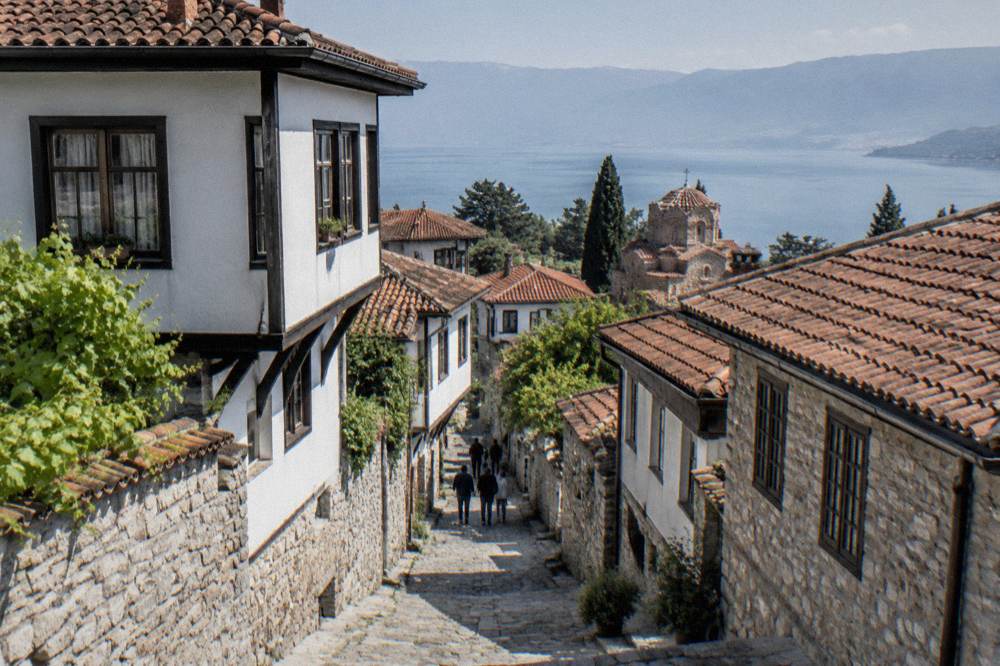
The distinction matters in two directions. Coming from a Schengen country, you still pass a full passport check on entry, so carry the passport, not just a national ID card habit. Heading on from Ohrid to Albania, you cross another external frontier entirely, since Albania is also outside the EU. Time spent in Ohrid does not consume Schengen days, and time in Greece or Bulgaria before arrival does not consume North Macedonia days: the two clocks are separate.
The currency follows the same logic. The Macedonian denar (MKD) is the local money, and the National Bank's middle rate on 19 October 2026 was 1 EUR to 61.6633 MKD. Euros are not legal tender, though they are informally accepted in tourist areas on unfavourable terms, and bookable tours and transfers are commonly quoted in euros. The denar and money guide covers exchange, ATMs and card use in practice.
| Question | Answer |
|---|---|
| Is North Macedonia in the EU? | No |
| Is North Macedonia in Schengen? | No |
| Does a Schengen visa cover it? | Not as a visa substitute; a Schengen residence permit allows up to 15 days |
| Which neighbours joined Schengen on 1 January 2025? | Bulgaria and Romania, land borders included |
| Is the euro legal tender in Ohrid? | No; the denar (MKD) is |
Which Borders And Crossings Serve Ohrid?
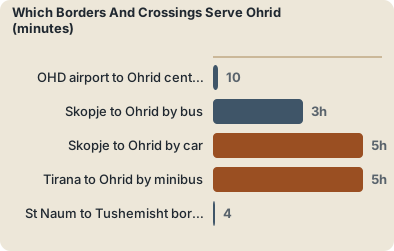
Ohrid is reached through three practical gateways: Ohrid St Paul the Apostle Airport about 10 km from the centre, the road from Skopje about 170 km away with buses taking around 3 hours, and minibus links from Tirana taking 3 to 3.5 hours across the Qafe Thane or Kjafasan border; the Sveti Naum and Tushemisht crossing near the Albanian border at St Naum is about 4 km from the monastery and is listed as open around the clock.
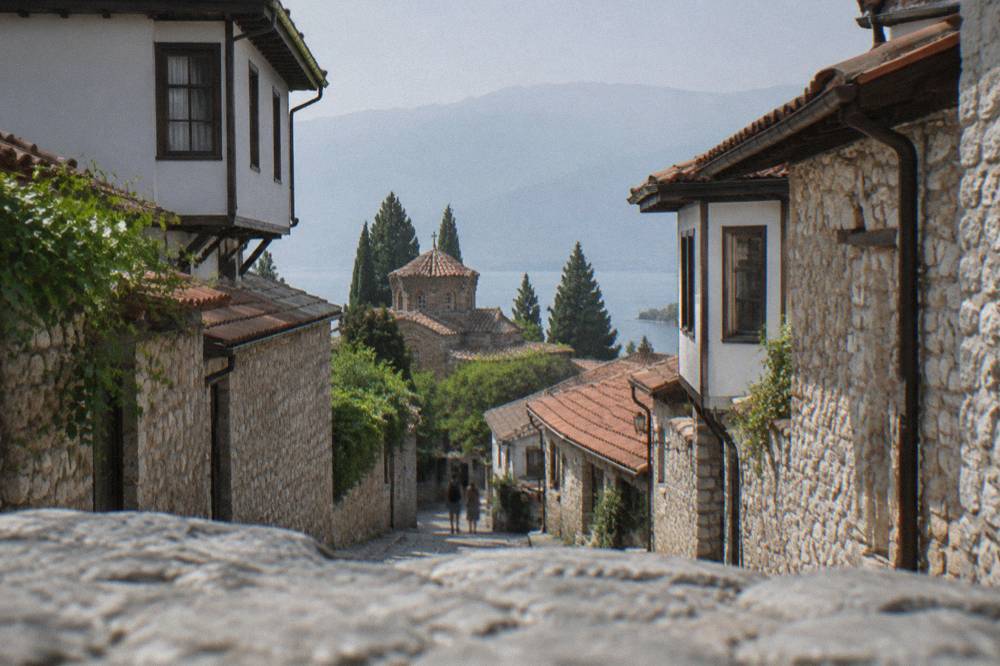
The airport route is the simplest on paper. OHD sits about 10 km west of the centre off the E65, and the airport's own passenger guide notes there is no regular public shuttle, so the arrival choice is a taxi or an arranged transfer. Wizz Air dominates the schedule, and TAV, the operator, announced new 2026 routes including Wroclaw and Katowice alongside the return of Budapest; a Wizz base with a stationed aircraft was reported in August 2026 as expected. The Ohrid Airport guide lists what to expect on arrival.
Flying in through Ohrid's own airport. Book a flight to Ohrid here.
From Skopje, intercity buses run several times daily at roughly 850 to 950 MKD one way, with the Skopje to Ohrid and bus station pages covering operators and arrival practicalities. From Tirana, shared minibuses make the run in 3 to 3.5 hours including the border, for about EUR 15 to 20, and the Tirana to Ohrid guide details terminals and crossing points. Travellers combining both legs should look at the wider how to get to Ohrid overview.
One local quirk is worth knowing: at the southern end of the lake, the Sveti Naum and Tushemisht crossing sits about 4 km from St Naum monastery, roughly a 10-minute drive, and pedestrians can walk between the posts. Allow up to an hour for the border at busy times, and remember that a day trip into Albania and back uses two full crossings of an external frontier. Every crossing means a passport stamp or entry record in each direction, so keep the passport accessible rather than buried in hold luggage on a minibus.
| Route | Distance or time | Fare where published |
|---|---|---|
| OHD airport to Ohrid centre | About 10 km | Taxi reported around 600 to 800 MKD |
| Skopje to Ohrid by bus | About 3 hours, about 170 km | 850 to 950 MKD one way |
| Skopje to Ohrid by car | About 2.5 hours | Tolls about 140 MKD |
| Tirana to Ohrid by minibus | 3 to 3.5 hours with border | About EUR 15 to 20 |
| St Naum to Tushemisht border | About 4 km | Taxi quoted 400 den |
What Should You Know About Driving Into Ohrid?
Driving into North Macedonia means headlights on day and night, a green card for insurance, and tolls paid at each plaza rather than through a vignette, with about 140 MKD in tolls on the Skopje to Ohrid motorway sections; from summer 2026, old-town streets including Ilindenska, Kosta Abrash and Car Samoil became resident-only under a new parking regime, with clamping reported for non-residents.
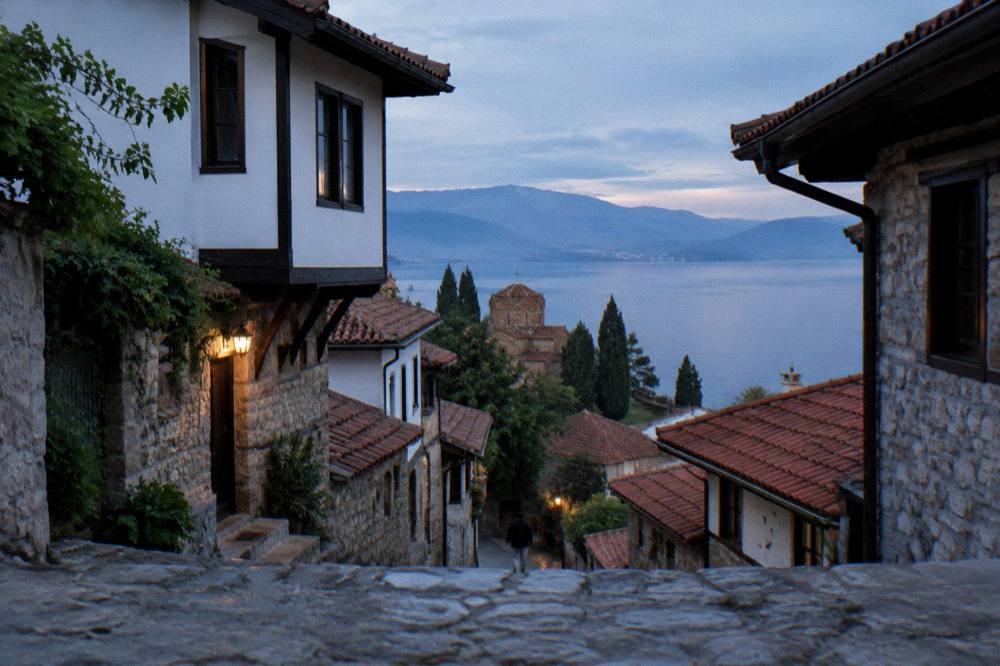
The toll system is straightforward cash-and-card at barriers, so no sticker or electronic tag needs arranging in advance. The Kicevo to Ohrid motorway remained under construction into 2026, with the full opening reported for the first half of 2027, meaning part of the western approach still runs on the old road. The car rental guide covers picking up a vehicle locally.
The 2026 parking regime is the change most likely to affect a visitor with a car. Old-town streets designated resident-only are off-limits without a resident sticker, so park outside the old core and walk in; the lanes climb from the lake toward the fortress on foot anyway. Border formalities for a private car also mean the green card and vehicle documents get checked, not just passports, so have the registration paper and insurance certificate to hand before reaching the booth.
How Safe Is Entry And Arrival In Ohrid?
The US State Department carries North Macedonia at Level 1, Exercise Normal Precautions, and UK travel advice publishes standard guidance with no Ohrid-specific warning; the emergency numbers to save before arrival are ambulance 194, police 192 and roadside assistance 196, per the UK government's help page.
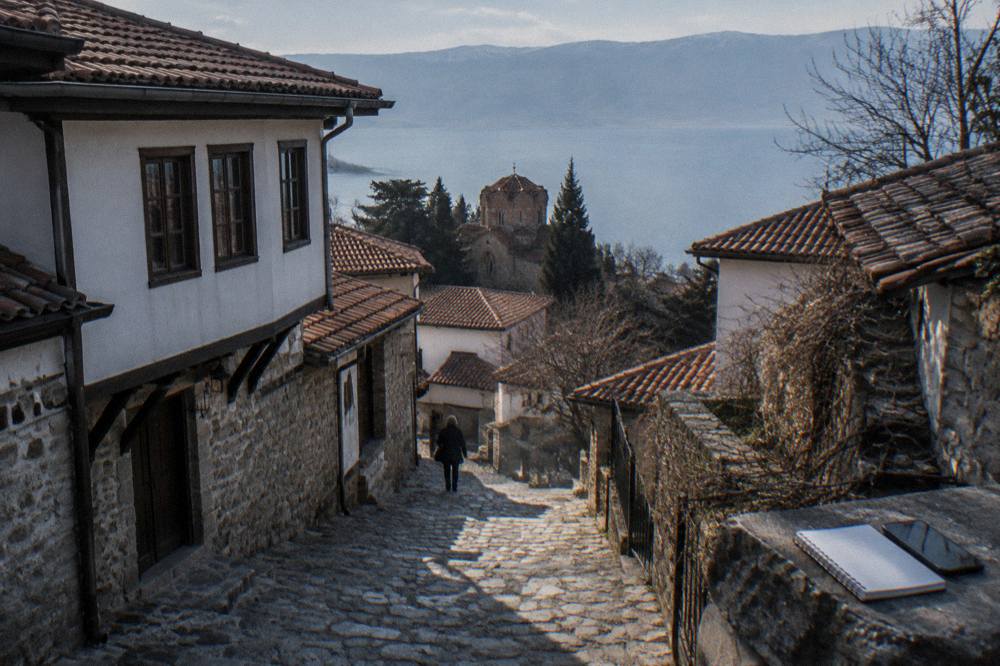
A Level 1 advisory is the lowest rung on the State Department's scale, and nothing in the published guidance singles out the Ohrid region for concern. The practical reading for an arriving visitor is ordinary city caution rather than specific precautions. The is Ohrid safe guide covers neighbourhoods, nightlife and solo travel in detail.
Keep the three numbers in the table below; roadside assistance 196 is the one drivers most often need and least often remember.
| Service | Number |
|---|---|
| Ambulance | 194 |
| Police | 192 |
| Roadside assistance | 196 |
What Can You Do In Ohrid On A Visa-Free Stay?
A visa-free stay comfortably covers the full Ohrid repertoire: the museum-institute sites (Robev Family House, the Museum on Water at the Bay of Bones, the Icon Gallery), the churches of St John at Kaneo, St Sophia and Plaosnik, boat trips on the lake toward St Naum, and day trips into Galicica National Park or across to Albania, all inside the 90-day window and mostly inside a single week.
Museum tickets run at 150 den for foreign visitors, 120 den domestic, with a reported 60-den rate for children and students, and the institute's sites run a winter schedule from 1 October to 30 April and a summer schedule from 1 May to 30 September, closing on Mondays. The things to do in Ohrid page is the full catalogue.
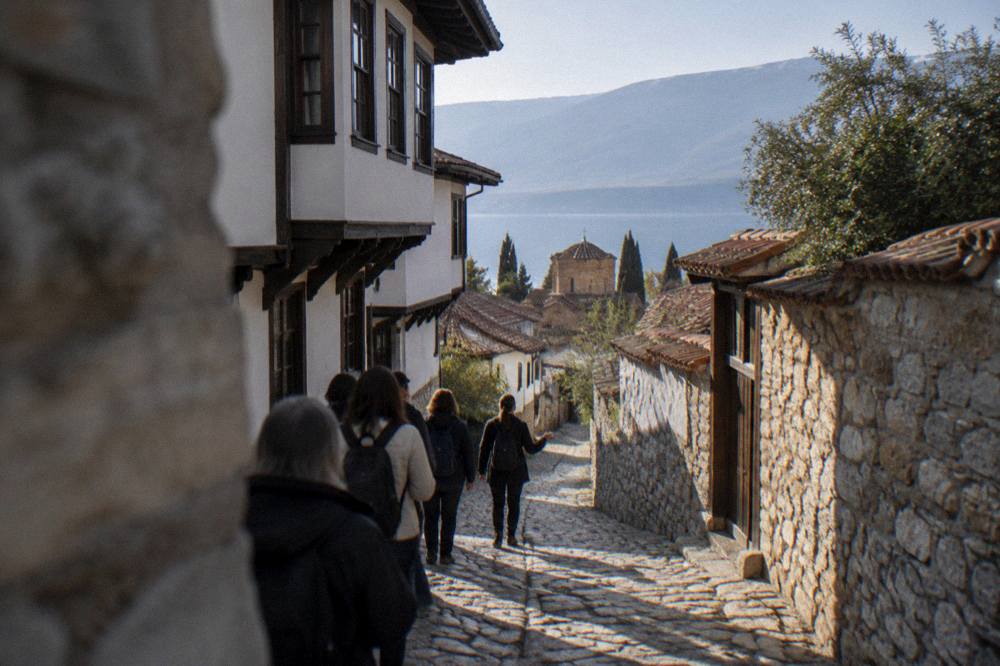
For a first orientation, a shared small-group walk through the hidden corners of the old town pairs well with the monastery sites; the Discover Ohrid's Hidden Gems shared walk is a low-cost way to get the town's layout on day one, and Check availability takes a minute. Visitors arriving from Tirana can fold the whole lake into one border-crossing itinerary, and the day-trip overview ranks the options by direction. On the water, the Lake Ohrid boats and ferries page tracks the seasonal services, which run about May to October in reduced form outside the peak.
Budget sets the length of a stay as much as the visa rule does. The cost and budget guide prices a day in Ohrid across spending styles, from museum tickets in denars to restaurant meals, and pairs with the where to stay page for accommodation areas. Note that North Macedonia's accommodation scene prices rooms in denars and euros side by side, and nobody at the border asks about funds; the published guidance this page reports sets no proof-of-funds requirement.
Common Questions About North Macedonia Visa And Entry For Ohrid
Do I need a visa to visit Ohrid?
Citizens of the US, UK, EU, Canada and Australia do not need a visa for stays of up to 90 days in any 180-day period, per the Ministry of Foreign Affairs. Holders of a valid multiple-entry UK, US or Canadian visa or a Schengen residence permit may enter for up to 15 days.
Is North Macedonia in the Schengen area?
No. North Macedonia is outside both the EU and Schengen and runs its own border checks and visa policy. Bulgaria and Romania became full Schengen members on 1 January 2025, but that does not extend to North Macedonia.
How long can UK citizens stay in Ohrid?
UK travel advice says UK visitors may stay up to 3 months without a visa, with a passport expiry date at least 90 days after arrival. The general visa-free rule is 90 days in any 180-day period.
Do I need to register with the police in Ohrid?
Yes, within 48 hours of arrival. Hotels do it for their guests automatically; if you stay in private accommodation, ask your host to register you and keep the slip.
Can I use euros in Ohrid?
The denar (MKD) is the local currency and the euro is not legal tender, though euros are quoted for tours and transfers and are informally accepted in tourist areas on unfavourable terms. ATMs dispense denars.
Can I visit Albania from Ohrid on the same trip?
Yes. The Sveti Naum and Tushemisht crossing sits about 4 km from St Naum monastery, is listed as open around the clock, and can be crossed on foot as well as by car; allow up to an hour at the border at busy times.