How Much Does A Trip To Ohrid Cost?
Ohrid prices its sights in Macedonian denars, its tours mostly in euros, and its transport somewhere between the two. Here is what the published figures actually say.
Short answer
Museum sites in Ohrid charge 150 MKD for foreign visitors and 120 MKD for domestic visitors, the Galicica National Park vehicle fee is 250 MKD, and the Skopje to Ohrid bus runs 850 to 950 MKD one way, so a day of sightseeing costs a fraction of a Western European city.
Ohrid, a lakeside town in North Macedonia on a freshwater mountain lake sitting at about 693 m above sea level, prices itself in Macedonian denars (MKD), a currency pegged in practice to the euro. The Ohrid Travel Guide collects what the published sources actually state: museum tickets in denar, a national park fee charged per vehicle, buses quoted at fixed fares, and bookable tours whose prices come from their live listings. Nothing here is converted or estimated; where a figure is reported by a secondary source rather than an official page, the wording says so.
How Much Do The Museum Sites In Ohrid Cost?
The NI Institute and Museum Ohrid charges 150 MKD for foreign visitors and 120 MKD for domestic visitors at its listed sites, including Robev Family House, the Museum on Water at the Bay of Bones and the Icon Gallery, with a 60 MKD rate reported for children and students, according to the institute's own ticket pages. The same three-figure tariff applies across the institute's network, so one ticket line covers several of the town's main indoor sights. The institute's office at Boro Shain St 10 keeps weekday hours of 07:30 to 15:30 for ticketing questions. Reported figures for individual churches, around 150 MKD each for St John at Kaneo, St Sophia and Plaosnik, come from a secondary calculator site rather than an official page, so treat those as a planning guide and confirm on the spot.
The opening schedules matter as much as the price, because the institute runs a winter and a summer pattern and every listed site closes on Mondays. Robev Family House on Tsar Samoil St keeps 09:00 to 15:30 from 1 October to 30 April, then two summer shifts from 1 May, 09:00 to 15:30 and 13:30 to 20:00. The Museum on Water at Gradishte near Peshtani shifts from 09:00 to 15:30 in winter to 09:00 to 16:30 in summer. The Icon Gallery in the Perivleptos complex runs 09:00 to 14:00 in winter and 09:00 to 17:00 in summer. A Monday arrival therefore meets closed doors at all three.
| Museum site | Location | Foreign ticket | Domestic ticket | Winter hours (1 Oct to 30 Apr) | Closed |
|---|---|---|---|---|---|
| Robev Family House | Tsar Samoil St 62 | 150 MKD | 120 MKD | 09:00 to 15:30 | Monday |
| Museum on Water (Bay of Bones) | Gradishte, Peshtani | 150 MKD | 120 MKD | 09:00 to 15:30 | Monday |
| Icon Gallery | Klimentov Univerzitet St bb | 150 MKD | 120 MKD | 09:00 to 14:00 | Monday |
| St Naum monastery (reported by cruise operator) | South shore of the lake | 150 MKD | 150 MKD | seasonal | varies |
For context on what sits where, the old town walking guide and the Bay of Bones guide cover the two clusters of ticketed sights, and the Icon Gallery page details the Perivleptos complex.
How Much Does Getting To Ohrid Cost?
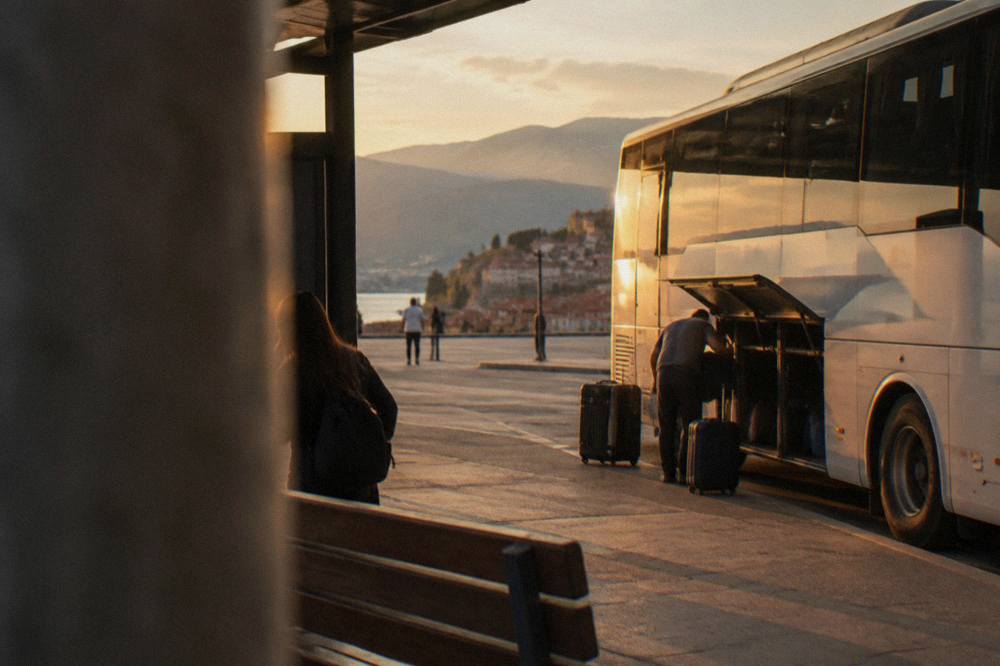
The Skopje to Ohrid bus costs 850 to 950 MKD one way for a journey of about 3 hours over roughly 170 km, while minibuses from Tirana run about 15 to 20 euros for a 3 to 3.5 hour trip including the border, and a private transfer from Skopje starts at around 130 euros, per secondary transport guides for the route. There is no passenger train to Ohrid and no domestic flight, so the road is the only line in. Driving the Skopje route costs about 140 MKD in tolls at the plazas, paid per section with no vignette. The airport sits about 10 km from the centre, and reported taxi fares for that run land between 600 and 800 MKD, or about 12 euros, a figure to agree before the ride rather than after.
The budget picture is straightforward: bus from Skopje for the price of a museum ticket and a half, minibus from Tirana for a similar order of magnitude, and the transfer or the taxi only when a group shares it. The Skopje to Ohrid guide and the Tirana to Ohrid guide break down operators and departure patterns, and the Ohrid bus station page covers where you arrive.
| Route | Mode | Fare (one way) | Journey time | Source tier |
|---|---|---|---|---|
| Skopje to Ohrid | Intercity bus | 850 to 950 MKD | about 3 h | V (secondary) |
| Skopje to Ohrid | Car (tolls only) | about 140 MKD | about 2.5 h | V (secondary) |
| Skopje to Ohrid | Private transfer | from about EUR 130 | about 2.5 h | V (secondary) |
| Tirana to Ohrid | Minibus / furgon | about EUR 15 to 20 | 3 to 3.5 h | V (secondary) |
| Ohrid airport to centre | Taxi (reported) | 600 to 800 MKD / about EUR 12 | about 10 to 15 min | R |
| Ohrid to Struga | Local bus | 100 to 150 MKD | short hop | R (older guides) |
Around town, the lanes of the old town are on foot and the town is compact, which keeps local transport spending near zero for most of a stay. The getting around guide covers the rest.
What Do Boat Trips On Lake Ohrid Cost?
A full-day cruise from Ohrid port to St Naum with Boat Armada costs from 1,200 MKD per adult and 600 MKD per child, and the same operator's page lists the St Naum monastery entrance at 150 MKD and a rowboat ride through the Crn Drim springs at about 5 euros, which are among the few lake prices published by an operator rather than a forum. Those figures sit beside a cruise that runs about 7 hours with stops, giving a rare fully itemised day on the water. Season matters: boats to St Naum generally run about May to October with a reduced winter schedule, so the lake's cheapest and priciest experiences are both summer products.
The Lake Ohrid boats and ferries guide covers the public and cruise options in full.
How Much Does Galicica National Park Cost?
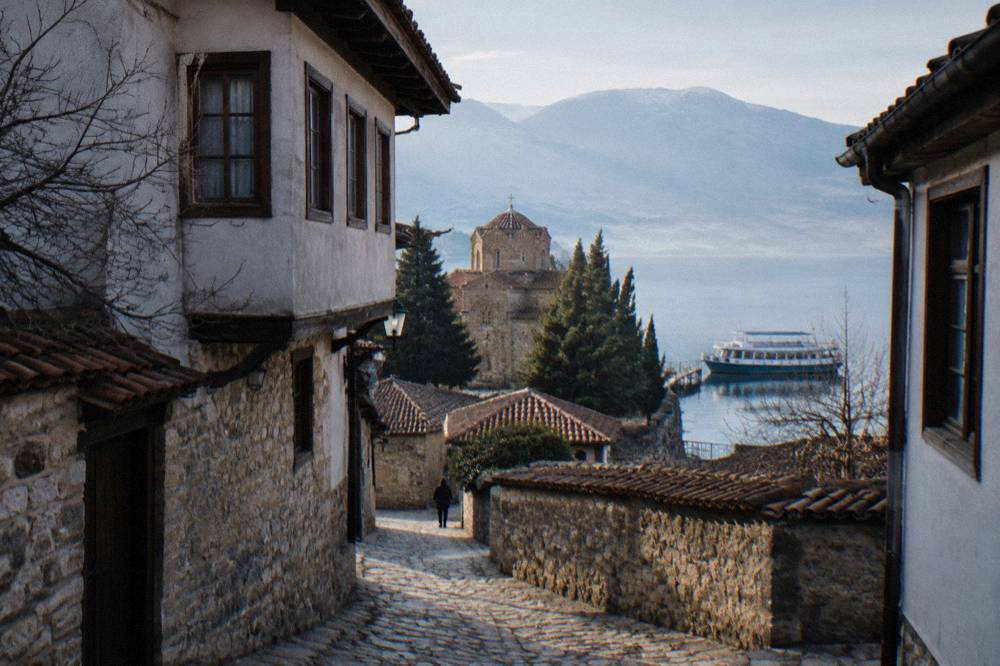
Galicica National Park charges 250 MKD per vehicle with no per-passenger fee, and 100 MKD applies only to someone entering on foot through the Ohrid-side gate, a distinction worth getting right because a car of four pays the vehicle fee once, per a detailed secondary guide to the park. The park, North Macedonia's second national park, established 1958, spans 22,750 ha between Lake Ohrid and Lake Prespa with the Magaro peak at 2,254 m, and it stays open year-round, though heavy snow can close the main road typically from January to March. The official park site runs a live camera page, which is the practical way to check conditions before paying for a drive up.
The fee buys the ridge road and the trailheads, and the Galicica National Park guide maps the routes, while the Lake Prespa day trip page covers the far side of the ridge. A vehicle fee shared across a car of travellers makes this one of the cheaper big-landscape experiences in the region.
What Does Food And Drink Cost To Plan For?
Restaurant prices in Ohrid are not published in any official source, so this page prints no plate or pint figure; the honest budget anchors are the town's market and self-catering rhythm, the price of bookable food experiences rendered live from their listings, and the general pattern that the denar keeps local costs in a different league from euro-zone cities. Any specific restaurant price on another page is an estimate, not a sourced figure. What is sourced: the cooking class and cave-church village cuisine products below carry their own live prices, and the Ohrid food guide and restaurants page describe what to order rather than what to pay. The budget-conscious plan is a market breakfast, a bakery stop, and one proper evening meal, with a booked tasting or class as the splurge.
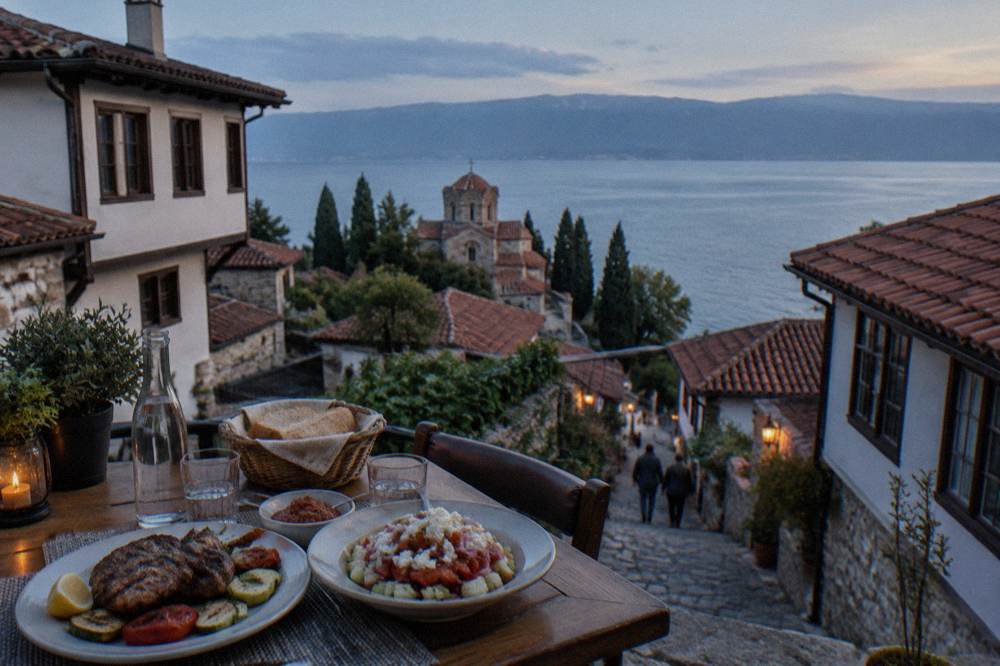
Wine is a separate line. Monastery winery tastings around Ohrid are established products with consistent review bases, and the rakija and Macedonian wine guide explains what is in the glass. Tasting fees, like restaurant prices, are checked on the spot: the room states them, so confirm the amount when you book.
How Does The Season Change What You Spend?
August carries modelled daily highs of 27.6 C with the month's lowest rainfall at 32.9 mm against a July mean high of 27.1 C, while January sits at a mean low of -0.8 C with 76.5 mm of rain, and the paid extras shrink in the cold months because boats to St Naum reduce to a winter schedule and beach facilities close, per ERA5 reanalysis normals for 1991 to 2020 and seasonal reporting. The same modelled normals put December at 92.6 mm of rain and a 6.2 C mean high. The cost curve follows: summer carries full-price boats, active beaches and the Ohrid Summer Festival, which opened its 66th edition on 12 July 2026 at the Ancient Theatre, while winter concentrates spending on museum sites, which run their shorter 1 October to 30 April hours.
Money itself behaves the same all year: the denar is de facto pegged to the euro, with the National Bank's middle rate on 19 October 2026 at 1 EUR to 61.6633 MKD, and euros are not legal tender, accepted only informally at poor rates. The Macedonian denar and money guide covers cash and exchange practice, and the best time to visit guide weighs season against price.
| Month | Mean daily high C | Mean daily low C | Rain mm |
|---|---|---|---|
| Jan | 5.0 | -0.8 | 76.5 |
| Feb | 6.3 | 0.0 | 74.3 |
| Mar | 10.0 | 2.5 | 80.5 |
| Apr | 14.6 | 6.3 | 82.4 |
| May | 19.5 | 10.8 | 70.8 |
| Jun | 24.2 | 15.2 | 43.1 |
| Jul | 27.1 | 18.3 | 34.7 |
| Aug | 27.6 | 19.0 | 32.9 |
| Sep | 22.4 | 14.9 | 62.4 |
| Oct | 17.4 | 10.3 | 76.0 |
| Nov | 11.5 | 5.3 | 90.4 |
| Dec | 6.2 | 0.9 | 92.6 |
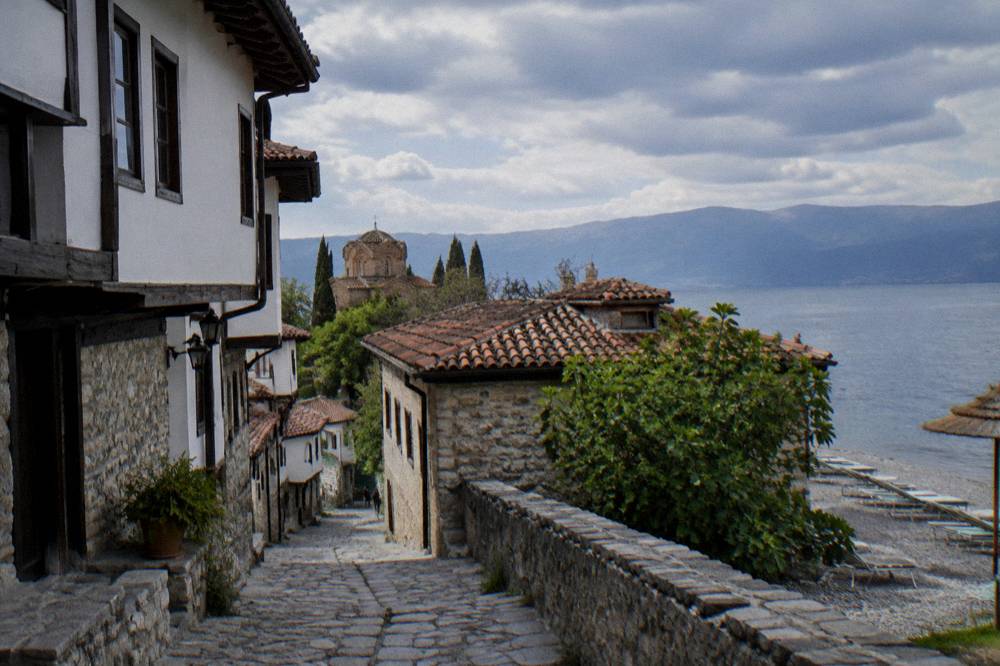
Swimming is also a seasonal cost question, in comfort rather than money: modelled lake surface temperatures run from 4.6 C in January to 23.5 C in August, with the swimming season generally from July. The swimming in Lake Ohrid guide covers where.
What Does A Day Of Free Sightseeing In Ohrid Look Like?
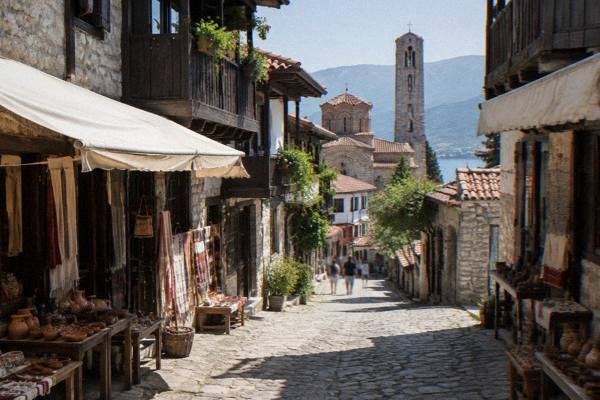
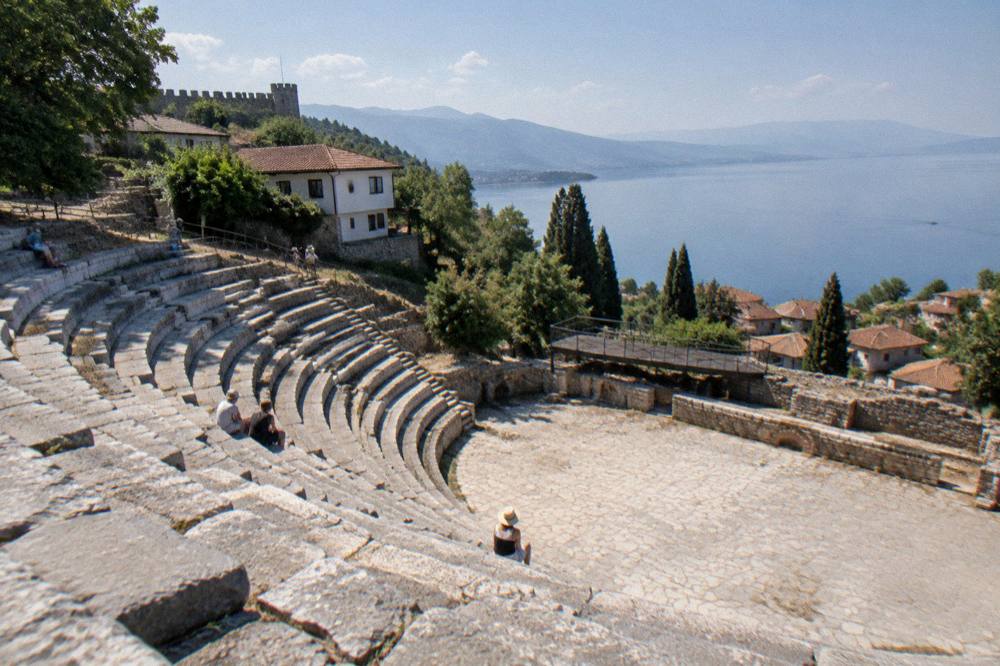
The Old Bazaar, the lanes of the old town and the lake shore cost nothing to walk, and the UNESCO listing that covers the whole region, inscribed 1979 and 1980 and extended to the Albanian part in 2019, is itself free to experience, so a zero-ticket day is entirely realistic when the museum sites are closed on Mondays anyway. The theatre, built at the end of the 3rd or start of the 2nd century BC with first excavations in 1935 and a capacity that rose to 5,000 after the epiteatron was added, stands open to daylight visits, per the museum institute's own page on the site. The Ancient Theatre guide, the Old Bazaar page and the boardwalk guide lay out a full walking loop. A paid walk adds structure and commentary, and the operator's live listing carries the current price:
a good plan is to walk the free loop first, then decide whether a guided version adds value; for the walking option this page features, Check availability.
What Should A Realistic Daily Budget Look Like?
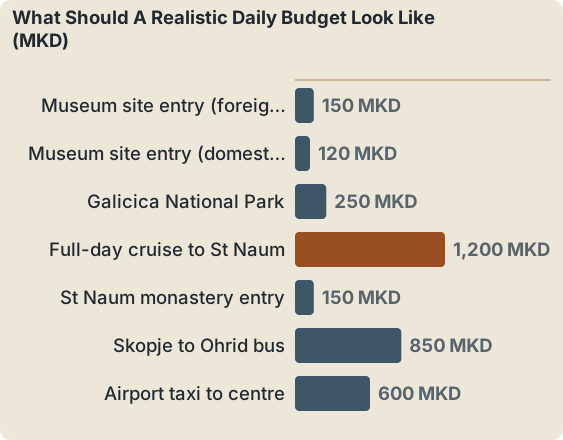
A realistic Ohrid day builds from three sourced anchors: 150 MKD per museum site, 250 MKD per vehicle for Galicica, and either an 850 to 950 MKD intercity bus arrival or a from-1,200 MKD full-day cruise if the water calls, with accommodation, restaurant meals and shopping left as personal lines because no published, official nightly rate or menu price exists in the sources this site reports. The table below assembles only the figures the sources attach to specific services in Ohrid. It deliberately excludes hotel rates, taxi fares inside town beyond the reported airport range, and food prices, because none of those carry a figure from an official or operator page.
| Budget line | Figure | Unit | Source tier |
|---|---|---|---|
| Museum site entry (foreign adult) | 150 MKD | per site | V |
| Museum site entry (domestic adult) | 120 MKD | per site | V |
| Galicica National Park | 250 MKD | per vehicle | V (secondary) |
| Full-day cruise to St Naum | from 1,200 MKD adult / 600 MKD child | per person | V (operator) |
| St Naum monastery entry | 150 MKD | per person | V (secondary, operator list) |
| Crn Drim springs rowboat | about EUR 5 | per boat | V (secondary) |
| Skopje to Ohrid bus | 850 to 950 MKD | one way | V (secondary) |
| Tirana to Ohrid minibus | about EUR 15 to 20 | one way | V (secondary) |
| Airport taxi to centre | 600 to 800 MKD | one way | R |
Three spending profiles fall out of that table. A low-budget day: one museum site, the free theatre and bazaar, self-catered food, under 200 MKD of admissions plus whatever the market costs. A mid day: two museum sites plus a shorter boat product or the monastery run, admissions and cruises totalling a few thousand denars. A high day: the full-day cruise with the monastery and springs extras, or a booked tasting or class, all priced on live listings. Add the Ohrid cost of paid tours for the full product roster.
Where Do Travellers Overspend Or Get Caught Out?
Three dated 2026 rules catch visitors off guard: a resident-only parking regime on old-town streets including Ilindenska, Kosta Abrash and Car Samoil from summer 2026 with clamping for non-residents, lake navigation limits under a 2 June 2026 government decision banning jet skis from 11:00 to 19:00 in July and August and night boating in set windows through September, and the fact that the 2027 Kicevo to Ohrid motorway completion means road works and diversions persist on the approach. None of these is a fee, but each one can cost money or a booking: a clamped car, a boat tour that cannot run its planned evening route, or a slower drive. The Ohrid parking guide details the rules.
Two further catches are smaller. The museum week closes on Mondays, so a Monday-heavy itinerary buys closed doors, not tickets. And Samuel's Fortress has its own access situation covered on the Samuel's Fortress page, where a municipal revitalisation plan budgeted at over 11 million denars signals works ahead; do not assume any particular ticket or hours for it without checking there. For the wider region, the can you visit Ohrid and Albania in one trip answer covers the border-crossing logistics at St Naum and Tushemisht, which sits about 4 km from the monastery.
Common Questions About Ohrid Trip Costs
How much does a trip to Ohrid cost?
A sourced baseline: museum sites at 150 MKD foreign entry, the Skopje bus at 850 to 950 MKD, a Galicica vehicle fee of 250 MKD and a from-1,200 MKD full-day cruise, with accommodation and meals as personal lines because no official rates are published for them.
Is Ohrid cheap compared with euro-zone cities?
The denar is de facto pegged to the euro at about 61.5 MKD per euro, but local ticket prices, 150 MKD for a major museum site, sit well below typical euro-zone admission levels. Tours are quoted in euros or dollars by operators, so a booked-heavy itinerary costs more than a self-guided one.
Do I need cash in Ohrid?
The denar (MKD) is the local currency and euros are not legal tender, though some tourist businesses accept them informally at poor rates. This page states no card-acceptance or ATM figure because no sourced one exists; carry denars for tickets and small purchases.
What does the boat to St Naum cost?
Boat Armada's own page lists a full-day cruise from Ohrid port from 1,200 MKD per adult and 600 MKD per child, plus a 150 MKD monastery entry and a springs rowboat at about 5 euros.
Are the Ohrid museums open every day?
No. Robev Family House, the Museum on Water and the Icon Gallery all close on Mondays, and they run shorter winter hours from 1 October to 30 April, per the museum institute's own site pages.
What is free in Ohrid?
The Old Bazaar, the old town lanes and the lake shore cost nothing, and the whole region sits inside a UNESCO mixed heritage site, inscribed 1979 and 1980, that is free to experience.