Is Ohrid Good For Families?
Is Ohrid good for families? A practical answer on sights, swimming, costs, safety and the best months for a family trip to Ohrid in North Macedonia.
Ohrid, on the shore of Lake Ohrid in North Macedonia, is a compact old town where the main family activities, a fortress, Byzantine churches, a lakeside promenade and boat departures, sit within walking distance of one another. The lake sits at about 693 m above sea level, the town is part of a UNESCO mixed heritage site, and the whole place is small enough that a family does not need a car for the core visit. This Ohrid Travel Guide answer page lays out what a family trip here actually involves: what the sights charge, when the lake is warm enough to swim, how safe the town is, and which bookable products fit a family day. For the wider picture, start with is Ohrid worth visiting.
Yes, Ohrid suits families well, provided everyone can manage hills and cobbled lanes: the old town is compact and walkable, the museum sites charge children and students a reduced 60 den rate, the lake warms up for swimming from July, and the town sits inside a UNESCO heritage site with a fortress, boat rides and beaches all close together. The caveats are real but manageable. North Macedonia is not in the EU or Schengen, the currency is the denar, and the swimming season is concentrated in the summer months. Families visiting outside summer will find the boat schedule reduced and the lake cold.
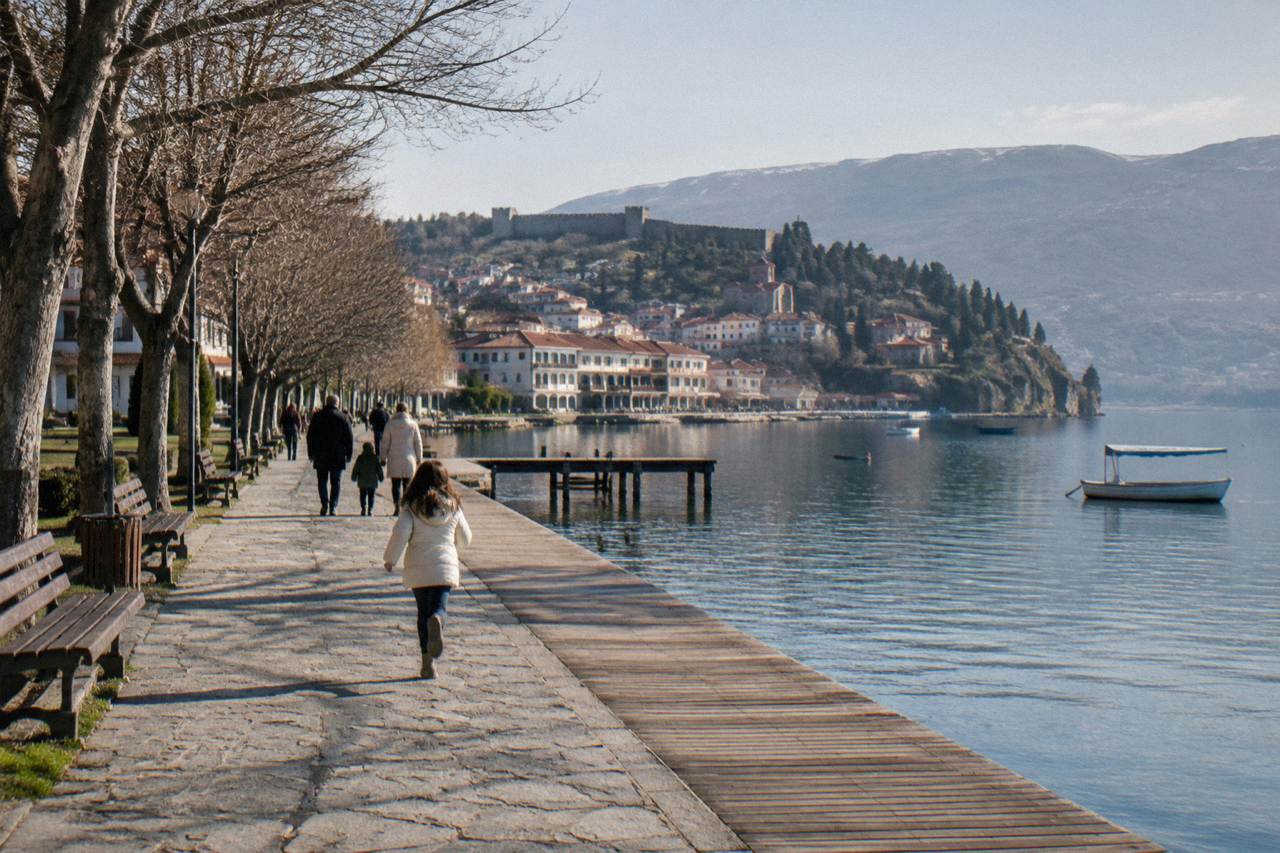
The town's basic shape helps. The old town climbs from the lake up to Samuel's Fortress, and the lanes between are on foot. That means short walking distances between sights, but also inclines and uneven surfaces in places, so comfortable shoes matter more than in a flat city. There is no tram system and no bike share; everything is either walking, a taxi or a boat.
Practical safety is straightforward. The US State Department advisory for North Macedonia stands at Level 1, Exercise Normal Precautions, and emergency numbers are ambulance 194, police 192 and roadside assistance 196. Tap water in Ohrid is generally reported as drinkable, a point covered in more detail in can you drink the water in Ohrid.
What Can Families Do In Ohrid With Kids?
The core family day in Ohrid combines the museum sites, the lakefront and a boat: the museum institute's sites (Robev Family House, the Bay of Bones and the Icon Gallery) charge 150 den for foreign adults and 60 den for children and students, a full-day boat cruise to St Naum runs from 1,200 den per adult and 600 den per child, and the lakefront promenade itself is free to walk. Those three figures define a family day out better than any list of attractions, because they show the price ceiling is low by European standards.
The museum institute's own pages give the exact terms. Robev Family House runs a winter schedule from 1 October to 30 April, 09:00 to 15:30, closed Mondays, and a summer schedule with two shifts from 1 May. The Bay of Bones, the Museum on Water at Gradishte near Peshtani, is 09:00 to 16:30 in summer, also closed Monday. The Icon Gallery at the Perivleptos complex keeps its own hours. Mondays are the day to plan around: the museum sites close, so that is the day for the boat, the beaches or the fortress hill.
A guided walk is the easiest way to give children the stories behind the walls. The small-group old town walk is a short, low-commitment introduction to the old town, and the operator's live listing carries the current price and departure details, Check availability if a guided first hour appeals.
Boats are the other family anchor. The full-day cruise from Ohrid port to St Naum takes in the Bay of Bones and the monastery at the Crn Drim springs, and shorter panoramic cruises of the old town run from the port area. Note that the day trip listed above starting in Tirana departs from Tirana, Durres or Golem in Albania, not from Ohrid, so it belongs in a family plan only if Albania is your base.
For a fuller rundown of the town's sights, see what Ohrid is famous for.
How Easy Is It To Get Around Ohrid With Children?
Ohrid is a walking town: the old town is hilly and cobbled in parts, there are no trams or bike share, taxis handle the airport run of about 10 km, and the 2026 resident-only parking regime on old-town streets such as Ilindenska, Kosta Abrash and Car Samoil means a hire car is more hindrance than help for the core visit. Families staying inside the old town can reach the fortress, the churches, the port and the promenade on foot, with a taxi or boat for anything beyond.
The airport is the main transfer. Ohrid St Paul the Apostle Airport sits about 10 km west of the centre, with access via the E65, per the airport's own guide page. There is no regular public shuttle bus; taxis are the standard option. Getting to Ohrid from elsewhere in the region is covered in how many days you need in Ohrid and the transfer answers on this site.
Distances inside town are short but vertical. The climb from the lake up to Samuel's Fortress is the steepest part of a visit, and the old lanes are stepped and cobbled in stretches. Plan the fortress for a cooler part of the day in summer, using the modelled normals below as a guide.
What Does A Family Trip To Ohrid Cost?
A family day in Ohrid is inexpensive by European standards: the museum sites charge 60 den for children and students against 150 den for foreign adults, the full-day boat to St Naum costs from 1,200 den per adult and 600 den per child, and Galicica National Park charges a flat 250 den per vehicle rather than a per-person fee, so a family of four can see the main sights and take the long boat for well under a typical Western European city day. The currency is the Macedonian denar; euros are quoted for some tours and transfers but are not legal tender, and the denar is de facto pegged to the euro.
| Item | Adult (foreign) | Child / student | Source basis |
|---|---|---|---|
| Museum institute sites (Robev Family House, Bay of Bones, Icon Gallery) | 150 MKD | 60 MKD | Institute ticket page |
| Full-day boat cruise Ohrid to St Naum | from 1,200 MKD | 600 MKD | Cruise operator listing |
| St Naum monastery entrance | 150 MKD | per operator listing | Cruise operator inclusions |
| Galicica National Park, by car | 250 MKD per vehicle | no per-passenger fee | Park guide |
| Rowboat at the Crn Drim springs | about 5 EUR per boat | same boat | Cruise operator listing |
For the cost picture beyond activities, is Ohrid cheap or expensive covers the wider budget.
When Should A Family Visit Ohrid?
July and August are the family months if swimming is the goal: modelled lake surface temperatures run about 22.9 C in July and 23.5 C in August, the swimming season generally runs July to September, and the 66th Ohrid Summer Festival ran 12 July to 20 August 2026 with the opening gala at the Ancient Theatre; June and September trade some warmth for thinner crowds and 24.2 C and 22.4 C mean daily highs. The catch with August is that it is the busiest month of the year, with full beaches and full accommodation.
The climate figures below are modelled ERA5 reanalysis normals for 1991 to 2020, not a station record, so treat them as planning ranges. Outside summer, the boats to St Naum reduce their schedule, beach facilities wind down, and the lake drops to modelled values around 10.3 C in November and 6.0 C in December.
| Month | Mean daily high | Mean daily low | Rain | Modelled lake surface |
|---|---|---|---|---|
| May | 19.5 C | 10.8 C | 70.8 mm | 14.9 to 18.7 C |
| Jun | 24.2 C | 15.2 C | 43.1 mm | 19.4 to 22.5 C |
| Jul | 27.1 C | 18.3 C | 34.7 mm | 22.9 C |
| Aug | 27.6 C | 19.0 C | 32.9 mm | 23.5 C |
| Sep | 22.4 C | 14.9 C | 62.4 mm | 19.7 to 25.0 C |
| Oct | 17.4 C | 10.3 C | 76.0 mm | 14.7 C |
Two further summer notes carry their dates. The 2026 bathing water tests, per the Institute of Public Health as reported, classed the lake Class I physico-chemically except Grashnica beach, and most microbiological samples came back Excellent. And the 2026 government navigation limits, set on 2 June 2026, banned jet skis in daytime hours through July and August and restricted night boating, both framed for swimmer safety. For timing decisions beyond the water, when is the best time to visit Lake Ohrid goes deeper.
Is Ohrid Safe And Practical For A Family?
Ohrid is a low-risk family destination on the official record: the US State Department advisory for North Macedonia is Level 1, Exercise Normal Precautions, the 2026 lake bathing tests were largely Excellent, tap water is generally reported drinkable, and visa-free nationals stay up to 90 days in any 180-day period, with hotels handling the police registration that is due within 48 hours of arrival. Those are the facts a family actually needs before booking; the detail sits in this site's dedicated answers.
Entry rules have two family-relevant edges. North Macedonia is not in Schengen or the EU, so EU rules on roaming and entry do not carry over. And UK passports must be valid for at least 90 days after the date of arrival, with UK visitors allowed up to three months without a visa. The full rules, including the 15-day allowance for holders of certain visas, are in do you need a visa for North Macedonia and is Ohrid safe for tourists.
On the water, swimming questions are answered in is it possible to swim in Lake Ohrid, and where to base the family is covered in where to stay in Ohrid.
Common Questions About Family Travel To Ohrid
Is Ohrid Good For Families?
Yes. The old town is compact and walkable, museum sites charge a reduced 60 den rate for children and students, the lake is swimmable from July, and the town's advisory level and bathing water record are both favourable. The trade-offs are summer crowds in August, reduced boat schedules outside the main season, and hilly, cobbled lanes.
Is Ohrid walkable with children?
The core old town is entirely walkable, with the fortress, churches, port and promenade close together. The streets climb from the lake and are cobbled in parts, so the walk up to Samuel's Fortress is the steepest stretch. There are no trams or bike share; anything farther out is a taxi or a boat.
What do Ohrid's sights cost for a family?
Museum institute sites such as Robev Family House, the Bay of Bones and the Icon Gallery charge 150 den for foreign adults, 120 den for domestic visitors and 60 den for children and students. The full-day boat to St Naum runs from 1,200 den per adult and 600 den per child. Galicica National Park charges 250 den per vehicle.
When can children swim in Lake Ohrid?
The swimming season generally runs July to September. Modelled lake surface temperatures are about 22.9 C in July, 23.5 C in August and 19.7 to 25.0 C in September, against 14.7 C in October. The 2026 bathing tests were largely rated Excellent, with Grashnica beach the exception on physico-chemical class.
Are Ohrid's museums open every day?
No. The museum institute sites close on Mondays. Robev Family House runs 09:00 to 15:30 in winter (1 October to 30 April) with longer summer shifts from 1 May, and the Bay of Bones runs 09:00 to 16:30 in summer. Plan Mondays for the boat, the beach or the fortress hill.
Is the tap water safe for children in Ohrid?
Tap water from the municipal supply in Ohrid is generally reported as drinkable. Lake water itself is not recommended untreated. This site covers the question in full in its dedicated water answer.