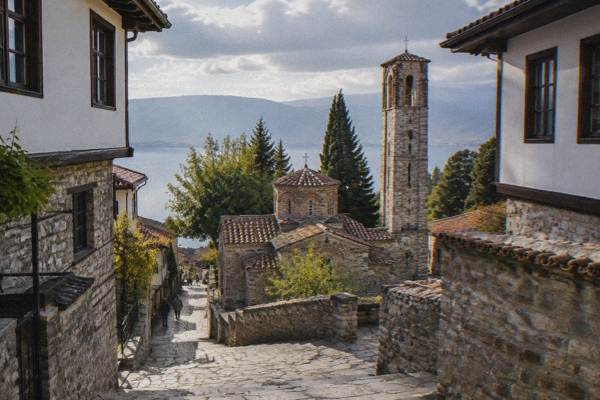
Is Ohrid Worth Visiting?
A direct answer to whether Ohrid is worth visiting: what the UNESCO-listed lake town offers, what sights and tickets cost, when to go, and who it suits.
Ohrid sits on Lake Ohrid, a freshwater mountain lake at about 693 m above sea level in North Macedonia, and the town together with its region carries UNESCO's mixed natural and cultural listing, inscribed in 1979 and 1980. The Ohrid Travel Guide exists because the question of whether the town deserves a trip comes up often, and the honest answer sits in verifiable details: a lake the UNESCO listing describes as having existed about two to three million years, a museum network with printed ticket prices in denars, a summer festival with fixed dates, and an old town built for walking. None of this requires marketing language to make the case.
What Makes Ohrid Worth The Trip?
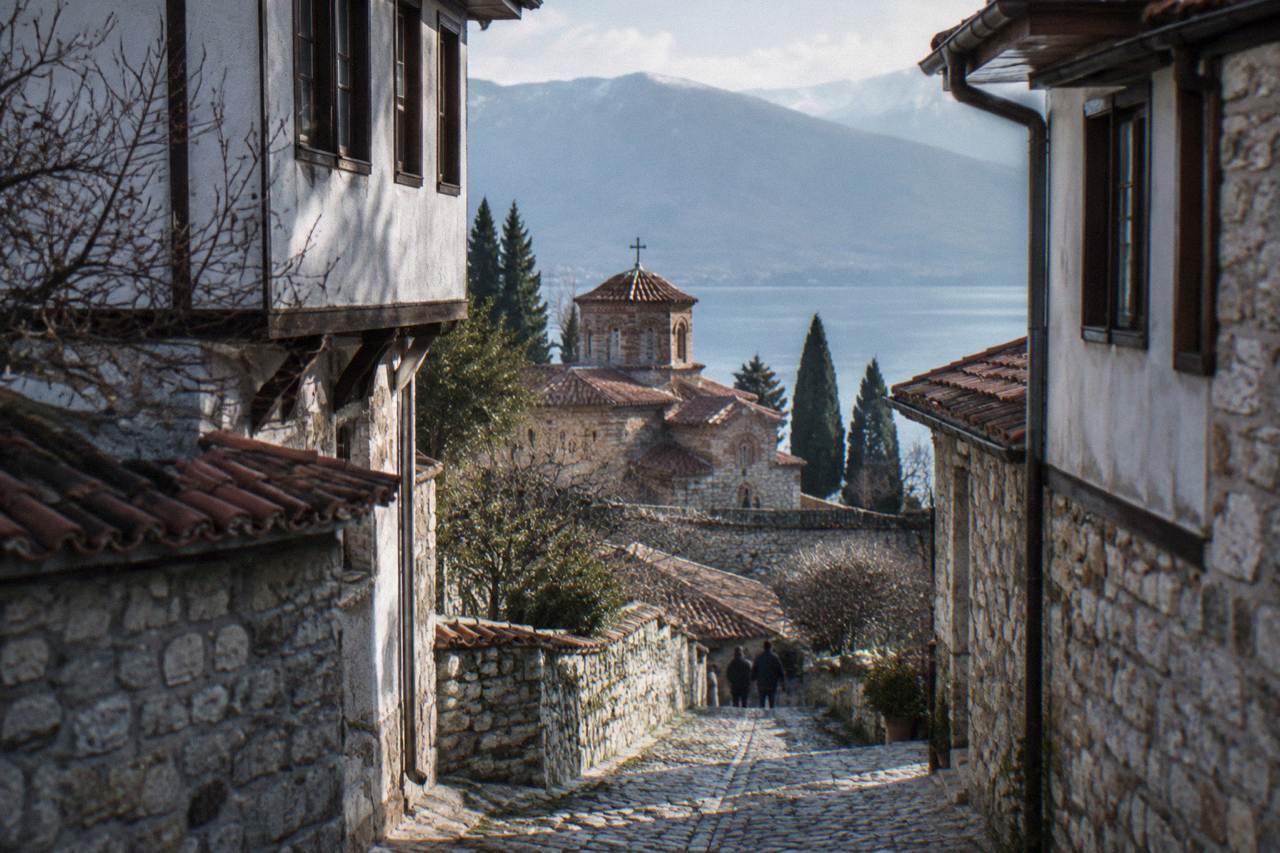
Ohrid earns its reputation through density: a compact old town of Byzantine churches and stone lanes, a lake the UNESCO listing describes as about two to three million years old with over 200 endemic species including 17 endemic fish, and a landscape where the Galicica ridge separates the lake from Lake Prespa at a higher level. The UNESCO property covers about 94,729 hectares and was extended to the Albanian side of the lake in 2019, which means the designation protects scenery on both shores, not just the Macedonian town.
The listing itself records specific heritage claims that are hard to match elsewhere: Ohrid holds the oldest Slav monastery, St Panteleimon at Plaosnik, and more than 800 Byzantine-style icons from the 11th to the end of the 14th century, many displayed at the Icon Gallery. The Ancient Theatre, built at the end of the 3rd or start of the 2nd century BC in the late Hellenistic period, still hosts the opening gala of the Ohrid Summer Festival, which opened its 66th edition on 12 July 2026 at that venue. That combination, ancient stage, active festival, living monastic tradition on one hillside, is what the primary sources actually describe.
The lake is the second half of the argument. UNESCO's citation treats the water body as a natural phenomenon of the same rank as the architecture, and the hydrological record keeps it in the news: the UHMR gauge has held the level at about 693 m, only 5 cm above the agreed minimum, which is why the World Heritage Committee reviewed the region's condition at its 48th session in July 2026 and decided not to place it on the Danger List, asking instead for a joint report by 1 February 2029. For a traveller, that means the place is intact but watched, and visiting it supports the case for keeping it so.
Is Ohrid Worth Visiting?
For anyone interested in Orthodox heritage, lake swimming, hiking or low-cost Balkan travel, Ohrid is worth visiting: entry to the museum institute's sites costs 150 den for foreign visitors, a full-day boat cruise to St Naum starts at 1,200 den per adult, and the town's sights sit within walking distance of each other on lanes closed to through traffic. The value question answers itself in denars, because the headline experiences carry printed local prices rather than premium ones.
The sightseeing core works on foot. The old town climbs from the lake to Samuel's Fortress and the Upper Gate, the Old Bazaar sits near the bottom, and the Church of St John at Kaneo stands at the water's edge below the fortress slope. The museum institute runs Robev Family House, the Bay of Bones museum on water near Peshtani, and the Icon Gallery in the Perivleptos complex, all on one ticket system. A first visit naturally splits into a walking day for the churches and fortress lanes, and a water day for the lake.
How long to stay depends on pace, and the how many days you need in Ohrid question has its own detailed answer, but the short version is that the town rewards two full days minimum: one for the old town and one for the water. If that sounds like your kind of place, the selections below cover the three most common first-visit formats, a guided old-town walk, an organized arrival from Skopje, and a panoramic lake cruise.
Planning to stay those two full days? Book a hotel in Ohrid here.
What Does Sightseeing In Ohrid Cost?
The NI Institute and Museum Ohrid charges 150 den for foreign adults, 120 den for domestic visitors and a reported 60 den for children and students at its sites, which include Robev Family House, the Museum on Water at the Bay of Bones and the Icon Gallery, with every site closed on Mondays. Those printed rates come from the institute's own website and apply across its network, so a museum day in Ohrid costs less than a single coffee in many Western European capitals.
| Museum site | Winter hours (1 Oct to 30 Apr) | Summer hours (from 1 May) | Closed |
|---|---|---|---|
| Robev Family House | 09:00 to 15:30 | 09:00 to 15:30 and 13:30 to 20:00 | Monday |
| Museum on Water (Bay of Bones, Peshtani) | 09:00 to 15:30 | 09:00 to 16:30 | Monday |
| Icon Gallery (Perivleptos complex) | 09:00 to 14:00 | 09:00 to 17:00 | Monday |
Beyond the museum network, other costs are documented in the local record. Galicica National Park charges 250 den per vehicle, with no per-passenger fee, and 100 den only for those entering on foot from the Ohrid-side gate. The monastery at St Naum lists entrance at 150 MKD per person, and a rowboat ride through the Crn Drim springs there costs about 5 EUR. A full-day boat cruise from Ohrid port to St Naum with Boat Armada runs 7 hours and starts at 1,200 den per adult and 600 den per child. The question of whether Ohrid is cheap or expensive has a fuller breakdown, but the pattern is consistent: local prices in denars, with tour products quoted in euros or dollars by their operators.
One planning note the museum pages make easy to miss: the winter and summer schedules change on 1 October and 1 May, and Monday closures apply across the institute's sites year-round. Anyone arriving on a Monday should plan the boat, the fortress lanes or a Galicica drive instead of the museum interiors.
When Is The Best Time To Visit Ohrid?
Modelled ERA5 climate normals for 1991 to 2020 put August's mean daily high at 27.6 C and January's mean daily low at -0.8 C, with December's 92.6 mm of rain the highest monthly total in the table and August's 32.9 mm the lowest, so the practical choice is between warm dry summers for swimming and cooler months for walking the heritage sites. Those figures are reanalysis values for a grid cell at 701 m, not a station record, and they describe a mountain-lake climate rather than a Mediterranean one.
| Month | Mean daily high | Mean daily low | Rain |
|---|---|---|---|
| Jan | 5.0 C | -0.8 C | 76.5 mm |
| Apr | 14.6 C | 6.3 C | 82.4 mm |
| Jul | 27.1 C | 18.3 C | 34.7 mm |
| Aug | 27.6 C | 19.0 C | 32.9 mm |
| Oct | 17.4 C | 10.3 C | 76.0 mm |
| Nov | 11.5 C | 5.3 C | 90.4 mm |
The festival calendar anchors the summer. The 66th Ohrid Summer Festival ran 12 July to 20 August 2026, the 65th Balkan Festival of Folk Songs and Dances ran 3 to 6 July, and the Ohrid Water Festival filled 12 to 30 August with lake events including the 25 km swimming marathon from St Naum to Ohrid harbour on 22 August and a separate 33 km SUP marathon around the lake. The fuller seasonal picture, including month-by-month water temperatures, sits in the best time to visit Lake Ohrid guide.
Should You Visit Ohrid In Winter?
Winter in Ohrid means modelled daily highs around 5.0 C in January and 6.2 C in December, museum sites on their shorter 09:00 to 15:30 schedule, and a town whose summer water traffic drops away, which suits travellers who want the churches and lanes without the August crowds around the harbour. Snow reaches the town in winter, and Galicica at higher elevation takes heavier snow that can close the park's main road, typically January to March.
The trade-offs are concrete. Boats to St Naum generally run about May to October and reduce or stop outside that window, though the road to St Naum stays open, so a winter visit reaches the monastery by car or bus rather than by water. The Vevcani Carnival, held 13 to 14 January by tradition for the Julian New Year, gives the winter calendar its distinctive event, and Orthodox Christmas falls on 7 January with the Vodici cross-throwing in the lake on 19 January. Anyone weighing a cold-season trip can read the dedicated is Ohrid worth visiting in winter discussion for detail.
Can You Swim In Lake Ohrid?
Yes, and the modelled surface temperatures support swimming from July: aggregators put July at about 22.9 C and August at about 23.5 C at Ohrid, with the UHMR's multi-year October mean at 14.3 C marking the end of the comfortable season. The 2026 bathing tests by the Institute of Public Health rated the water Class I physico-chemically at nearly all sampled points, with most microbiological samples excellent and one exception at Grashnica beach, rated Class III.
That official testing record matters more than any postcard claim, because it is what tells a swimmer the water is monitored rather than merely scenic. Beaches along the eastern and southern shore, including Gradiste, Lagadin, Ljubanista, Potpesh and Labino, are the established swimming spots, and the lake's protected status means the swimming is the same water body UNESCO cites for its endemic species. The can you swim in Lake Ohrid page carries the full breakdown by month and beach.
Practical rules from 2026 shape the summer water experience. A government decision of 2 June 2026 banned jet skis on the lake between 1 July and 31 August from 11:00 to 19:00 and restricted boating at night through the summer and into autumn, measures aimed at swimmer safety. For visitors these limits mostly mean calmer water in the middle of the day at the height of summer, and they are dated rules, not permanent law.
How Do You Get To Ohrid And Get Around?
Ohrid's St Paul the Apostle Airport sits about 10 km from the centre on the E65, and it handled 263,869 passengers in 2025, up 20.0 percent on 2024, while the road from Skopje covers about 170 km in roughly 3 hours by bus at 850 to 950 den one way, with no passenger train to Ohrid at all. Those are the three arrival facts that frame every trip, and each is documented by the transport record rather than by guesswork.
The airport's growth is real but not a record: 2025 traffic remained 0.7 percent below 2023 and 16.8 percent below 2019, and the route map leans seasonal, with Wizz Air expected to station an aircraft at Ohrid, as reported in August 2026, which would add routes and early departures. From Skopje, buses run several times daily, and the journeys and fares are covered in detail in the Skopje to Ohrid pages. From Albania, minibuses from Tirana take 3 to 3.5 hours including the border.
Once in town, the place is walkable by design: the old town is a network of lanes on foot between the lake and the fortress, and there are no trams or bike-share systems to learn. Taxis handle the airport run and the short hop to the bus station, and the emergency numbers are ambulance 194, police 192 and roadside assistance 196. North Macedonia is outside the EU and Schengen, the denar is the currency, and visa-free nationals can stay up to 90 days in any 180-day period, facts that all bear on how smoothly a visit runs.
Who Should Skip Ohrid?
Travelers bored by a two-millennium theatre, an icon gallery or a spring-fed lake should skip Ohrid, since what rules the town out, where it does, is a mismatch of expectations, and those visitors will find the days long. For everyone else the calculation favours going, and neither the August crowd question nor safety concerns rule the town out, with the US State Department's Level 1 advisory, Exercise Normal Precautions, as the reference point.
The August crowd question has its own answer page, and is Ohrid safe for tourists addresses the other common hesitation, where the US State Department's Level 1 advisory, Exercise Normal Precautions, is the reference point. Neither concern rules the town out. What rules it out, where it does, is a mismatch of expectations: anyone bored by a two-millennium theatre, an icon gallery or a spring-fed lake will find the days long.
For everyone else the calculation favours going. The what is Ohrid famous for rundown lists the claims in full, and the things to do in Ohrid page maps them onto itineraries. If a guided start appeals, the half-day city tour covers the old town's core with a guide who can place each church in its century, and you can Check availability alongside the Old Town walking tour itinerary.
Common Questions About Visiting Ohrid
Is Ohrid Worth Visiting?
Yes, for heritage, lake swimming and hiking at low local prices: the UNESCO mixed listing, museum tickets at 150 den for foreign visitors and a walkable old town make the case, and the full argument is laid out above.
How Many Days Do You Need In Ohrid?
Two full days as a minimum: one for the old town's churches, fortress lanes and museums, and one for the lake, either the boat cruise to St Naum or a beach on the eastern shore.
Is Ohrid Expensive?
Local costs are in denars and are low by Western European standards: museum entry at 150 den, Galicica's vehicle fee at 250 den and a full-day boat cruise from 1,200 den per adult are the printed reference points.
Can You Swim In Lake Ohrid?
Yes. Modelled surface temperatures reach about 22.9 C in July and 23.5 C in August, and 2026 bathing tests rated the water Class I physico-chemically at nearly all sampled points.
When Is The Ohrid Summer Festival?
The 66th edition ran 12 July to 20 August 2026, opening with a gala at the Ancient Theatre.