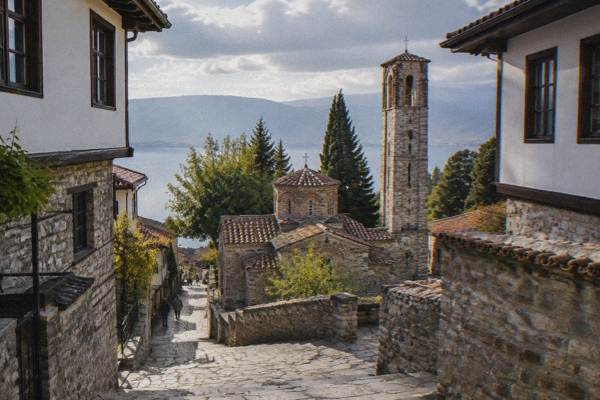
What Are The Most Beautiful Towns In North Macedonia?
The most beautiful towns in North Macedonia, from Ohrid's UNESCO old town on Lake Ohrid to Struga, Bitola, Skopje and the village of Vevcani, with practical facts on how to reach each one.
North Macedonia is a small, landlocked country in the southern Balkans, and its most beautiful towns sit on lakeshores, mountain ridges and old Roman roads. Ohrid, on Lake Ohrid at about 693 m above sea level, is the town the world knows: a UNESCO mixed World Heritage site of Byzantine churches, a fortress hill and an Old Bazaar, described in full across this Ohrid Travel Guide. But the country has other towns worth the bus fare, according to what the sources actually say, from Struga at the point where the Black Drim leaves the lake, to Bitola, Skopje and the village of Vevcani. For a deeper look at the headline town itself, see is Ohrid worth visiting.
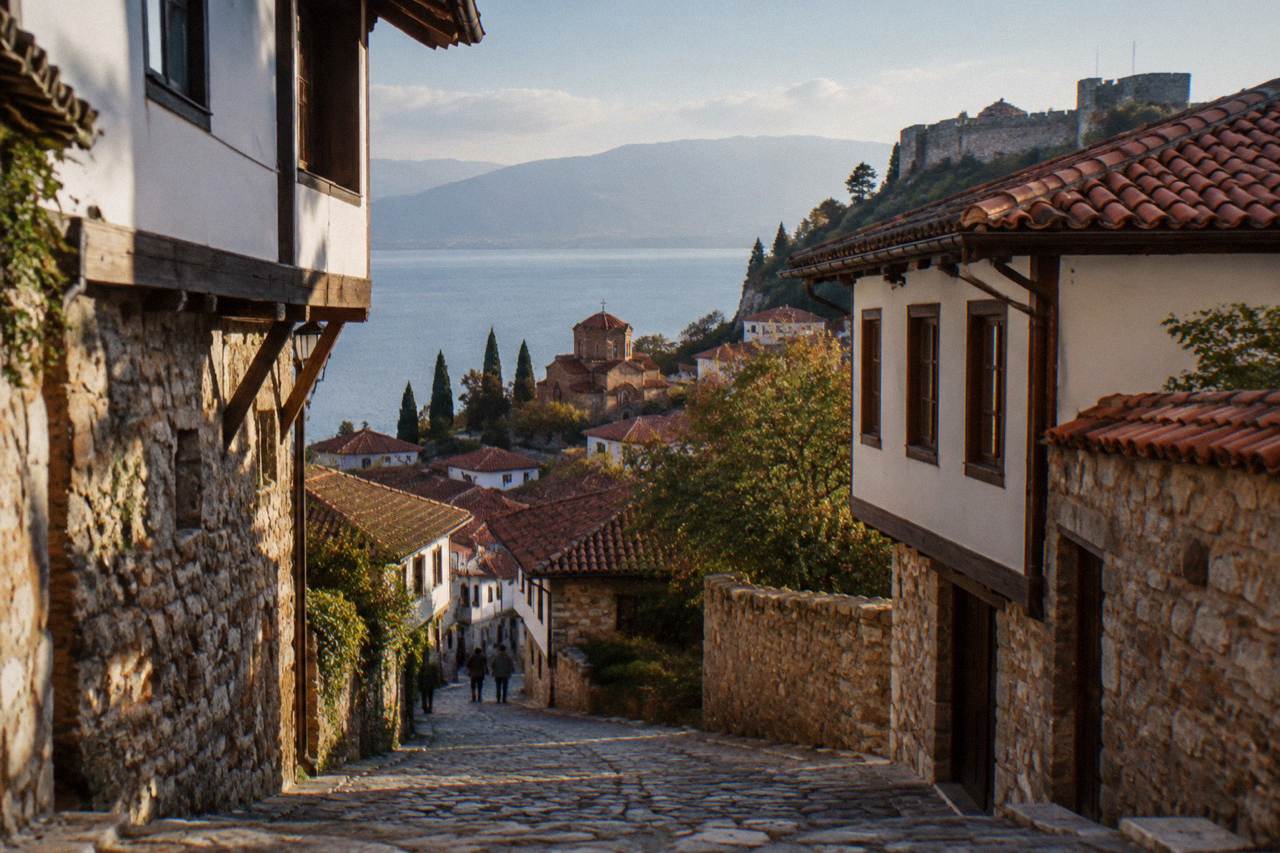
The most beautiful towns in North Macedonia are Ohrid, Struga, Bitola, Skopje and the village of Vevcani, in roughly that order for a first-time visitor. Ohrid is the only UNESCO World Heritage town, Struga sits where the Black Drim flows out of Lake Ohrid, Bitola and Skopje are the two biggest towns after each other, and Vevcani holds a January carnival that draws visitors into the hills above Lake Ohrid.
That is a shortlist, not a ranking written in stone, and the reasons are practical as much as aesthetic. Ohrid, Struga and Vevcani sit within a short bus ride of one another in the southwest, around the lake, so they combine naturally into one trip. Skopje and Bitola lie further east along the road towards Greece, roughly 170 km from Ohrid by road in Skopje's case, and each asks for a day of its own. The rest of this page takes the towns one at a time, with the figures that help you plan the order.
Why Does Ohrid Lead Every List Of Beautiful Towns In North Macedonia?
Ohrid leads because it is the country's only town inside a UNESCO World Heritage site, the Natural and Cultural Heritage of the Ohrid Region, inscribed in 1979 and 1980 and extended to the Albanian side of the lake in 2019. UNESCO credits the town with the oldest Slav monastery, at Plaosnik, and with a collection of more than 800 Byzantine-style icons from the 11th to the 14th century, set on a freshwater mountain lake that has existed for about two to three million years.
No other town in the country can match that single paragraph, and the layer underneath it is walkable. The old town climbs from the lake to Samuel's Fortress, with the lanes on foot, and the sights along the climb include St Sophia, the Church of St John at Kaneo, Plaosnik, the Ancient Theatre and the Old Bazaar. The Ancient Theatre was built at the end of the 3rd or the start of the 2nd century BC, in the late Hellenistic period, with first excavations in 1935 and a capacity that rose to 5,000 after the epiteatron was added, per the museum institute's own page. The lake itself carries over 200 endemic species, including 17 endemic fish, according to UNESCO's listing.
The museum institute's ticket covers several of the key sites, and the hours are printed by season. A small-group guided walk is the easiest way to absorb the old town in one pass: the Check availability link shows the operator's live listing, and there is more on the town's signature sights in what Ohrid is famous for.
| Museum institute site | Winter hours (1 Oct to 30 Apr) | Summer hours | Closed |
|---|---|---|---|
| Robev Family House, Tsar Samoil St 62 | 09:00 to 15:30 | Two shifts, 09:00 to 15:30 and 13:30 to 20:00 | Monday |
| Bay of Bones / Museum on Water, Peshtani | 09:00 to 15:30 | 09:00 to 16:30 (1 May to 30 Sep) | Monday |
| Icon Gallery, Perivleptos complex | 09:00 to 14:00 | 09:00 to 17:00 | Monday |
Tickets for those museum institute sites are 120 den for domestic visitors and 150 den for foreign visitors, with a reported 60-den rate for children and students, per the institute's own ticket page. The town's wider story, from how long to stay to which neighbourhood to sleep in, is covered in how many days you need in Ohrid and where to stay in Ohrid.
What Makes Struga One Of The Most Beautiful Towns In North Macedonia?
Struga, at the northern end of Lake Ohrid where the Black Drim flows out of the lake, is the second lake town and the natural companion to Ohrid, about a short local bus ride away on a line that runs multiple times a day. Its international claim is literary: the Struga Poetry Evenings, one of the world's long-running poetry festivals, held its 65th edition from 24 to 29 June 2026 with about 70 poets under the theme "Where Poetry Lives", as reported by the national news agency.
That June date matters for planning, because the festival does not run in late August: the 65th edition moved to the last week of June 2026, one day longer than before, and the 2027 dates have not been announced. Outside festival week, Struga is a quieter lakeside town that pairs with Ohrid rather than competing with it, and the local bus between the two towns is a regular service. A semi-private day tour from Tirana that includes both Ohrid and Struga exists for visitors basing themselves in Albania, and the boat and cruise options on the lake are covered in the site's lake boats guide. For the town-by-town contrast, see [is Ohrid better than Struga] in the site's guide section.
Are Skopje And Bitola Among The Most Beautiful Towns In North Macedonia?
Skopje and Bitola are the country's two largest towns after each other, and both are reached from Ohrid as day trips or stopovers: Skopje is about 170 km by road, roughly 3 hours by bus for 850 to 950 den one way, with buses running several times a day from operators such as Galeb and Classic Company, and Bitola sits on the same road east towards Greece.
Skopje is the capital and the country's transport hub, so many visitors meet it first whether or not it tops an aesthetic list. The practical facts for the run between the two towns are settled: there is no passenger train to Ohrid and no domestic flight, the car journey is about 2.5 hours with about 140 MKD in motorway tolls, and a private transfer runs from about EUR 130, per the transport sources the site reports. The question of whether Skopje is worth visiting on its own merits has its own answer page, and the same holds for whether Bitola is worth visiting.
Bitola's draw is different in kind: an old town on the Roman road through the south of the country, within reach of the region's ancient sites. Facts about Bitola's interiors are thin, so this page says little about them and leaves the detail to the dedicated page. What is certain is the logistics: both towns lie along the Skopje road, so a single eastbound itinerary can carry Ohrid, Bitola and Skopje in one line.
Is Vevcani One Of The Most Beautiful Towns In North Macedonia?
Vevcani, a mountain village above the western shore of Lake Ohrid, belongs on this list less for monuments than for its carnival: held traditionally on 13 and 14 January, the eve and first day of the old Julian New Year, an annual tradition that visitors time their trips around, per the carnival listings that report it. The village sits in the hills above Struga, close enough to combine with a lake itinerary.
The carnival date is the fixed point. The 2027 edition is expected in mid-January on the same pattern, though the exact confirmation follows prior years. What can be said is geographic: Vevcani is a village rather than a town, and it rounds out a southwest cluster of Ohrid, Struga and the lake shore that a visitor can cover from a single base in Ohrid.
How Do You Reach These Beautiful North Macedonian Towns From Ohrid?
The lake towns are local bus rides from Ohrid, Struga costing roughly 100 to 150 den one way on reported older fares, while Skopje is about 170 km by road at roughly 3 hours by bus or 2.5 by car, Bitola lies along the same eastern road, and Vevcani sits above Struga, reached by road from the lake shore. Tirana, in Albania, is a separate country and a border crossing, with minibuses taking 3 to 3.5 hours including the border for about EUR 15 to 20.
The table below gathers the journeys a visitor actually plans from an Ohrid base, with the figures the transport sources give for each exact route.
| Journey | Distance or duration | Cost (as reported) | Notes |
|---|---|---|---|
| Ohrid to Struga | Local bus, multiple daily | About 100 to 150 MKD one way | Operators include Galeb and Classic Company |
| Ohrid to Skopje | About 170 km; bus about 3 h, car about 2.5 h | Bus 850 to 950 MKD; car tolls about 140 MKD | No passenger train, no domestic flight |
| Ohrid to Tirana (Albania) | 3 to 3.5 h including border | About EUR 15 to 20 | Roughly 5 to 7 minibuses a day, crossing at Qafe Thane / Kjafasan |
| St Naum to Albanian border (Tushemisht) | About 4 km, about 10 min drive | Taxi quoted 400 den | Allow up to an hour at the border |
Two planning notes follow from the geography. First, North Macedonia is outside the EU and outside Schengen, so every trip to Tirana or Pogradec is an international border crossing with passport checks; visa-free visitors may stay up to 90 days in any 180-day period, and UK guidance says visitors register with the local police within 48 hours of arrival, which hotels do for their guests. Second, the money changes at the border: the currency in North Macedonia is the denar, and the euro is not legal tender, a subject covered in full at what currency is used in Ohrid.
When Is The Best Time To See The Most Beautiful Towns In North Macedonia?
The modelled climate normals for Ohrid, from the ERA5 reanalysis for 1991 to 2020, show July averaging a mean daily high of 27.1 C and August 27.6 C with only 34.7 and 32.9 mm of rain, June to September forming the warm stretch around the lake, while December brings 92.6 mm of rain and January a mean daily low of -0.8 C, which is the season for Vevcani's mid-January carnival.
Summer is when the lake towns are in full swing: the Ohrid Summer Festival ran its 66th edition from 12 July to 20 August 2026, opening with a gala at the Ancient Theatre, and the Balkan Festival of Folk Songs and Dances held its 65th edition from 3 to 6 July 2026. The swimming season on Lake Ohrid runs from about July, with modelled August surface temperatures around 23.5 C. The trade-off is crowds and heat; the shoulder months of May (19.5 C mean high) and September (22.4 C, 62.4 mm of rain) sit between the extremes, and the question of when to visit Lake Ohrid has its own page. Boat services on the lake run about May to October with a reduced winter schedule, per the reports the site carries.
Common Questions About Beautiful Towns In North Macedonia
What are the most beautiful towns in North Macedonia?
Ohrid, Struga, Bitola, Skopje and the village of Vevcani. Ohrid is the only UNESCO World Heritage town and the natural first stop; Struga sits where the Black Drim leaves Lake Ohrid; Bitola and Skopje are the largest towns; Vevcani is known for its 13 to 14 January carnival.
Is Ohrid the most beautiful town in North Macedonia?
Ohrid is the town with the strongest claim: it lies inside the UNESCO Natural and Cultural Heritage of the Ohrid Region, with the oldest Slav monastery at Plaosnik, more than 800 Byzantine-style icons and an old town that climbs from the lake to Samuel's Fortress.
How far is Ohrid from Skopje?
About 170 km by road. The bus takes about 3 hours and costs 850 to 950 MKD one way; the car journey is about 2.5 hours with about 140 MKD in tolls. There is no passenger train and no domestic flight.
Can you visit Struga from Ohrid?
Yes, on a local bus that runs multiple times a day between the two lake towns, on reported fares of about 100 to 150 MKD one way. Struga also hosts the Struga Poetry Evenings, whose 65th edition ran 24 to 29 June 2026.
Is Vevcani worth visiting?
Vevcani is worth timing a trip around if the mid-January carnival appeals: it is held on 13 and 14 January, the eve and first day of the old Julian New Year, per the carnival listings. The village sits in the hills above Struga.
Do you need a visa for North Macedonia?
Visa-free nationals may stay up to 90 days in any 180-day period. UK visitors may stay up to 3 months, and guidance says visitors register with the local police within 48 hours of arrival, which hotels handle for guests.
Taken together, the shortlist holds: Ohrid for the UNESCO old town and the lake, Struga for poetry and the Drim, Bitola and Skopje on the eastern road, Vevcani for a January carnival in the hills, and every one of them reachable from a base on the Lake Ohrid shore.
Ready to base yourself in Ohrid and explore them all? Book a hotel in Ohrid here.