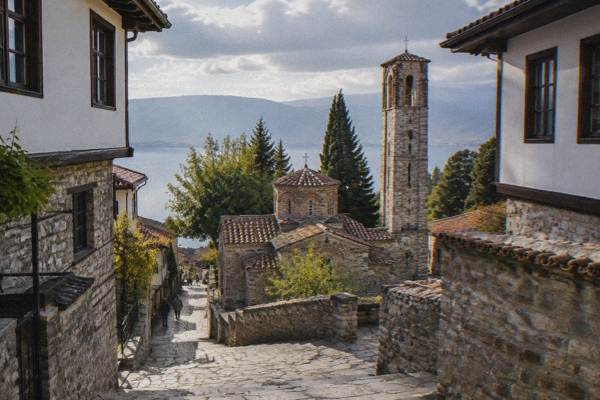
Is Ohrid Worth Visiting In Winter?
A source-based answer to whether Ohrid, on Lake Ohrid in North Macedonia, rewards a winter visit: modelled climate figures, museum winter hours, winter water temperatures and what actually runs.
Ohrid, the lakeside town in North Macedonia on the shore of Lake Ohrid, is a summer place by reputation: swimming from July, boat trips to St Naum, full terraces along the quay. The Ohrid Travel Guide record shows a second, quieter season that fewer guides write about, one where the lake sits at about 693 m above sea level under a pale sky and the old-town lanes empty out between the museum sites. Winter here runs roughly December through February, and it is a real season with real trade-offs: modelled temperatures from the ERA5 reanalysis put January daytime highs at about 5.0 C, and the main museum sites switch to a shortened winter schedule. None of that makes the town closed. It makes it different, and for some travellers, that is the argument for going.
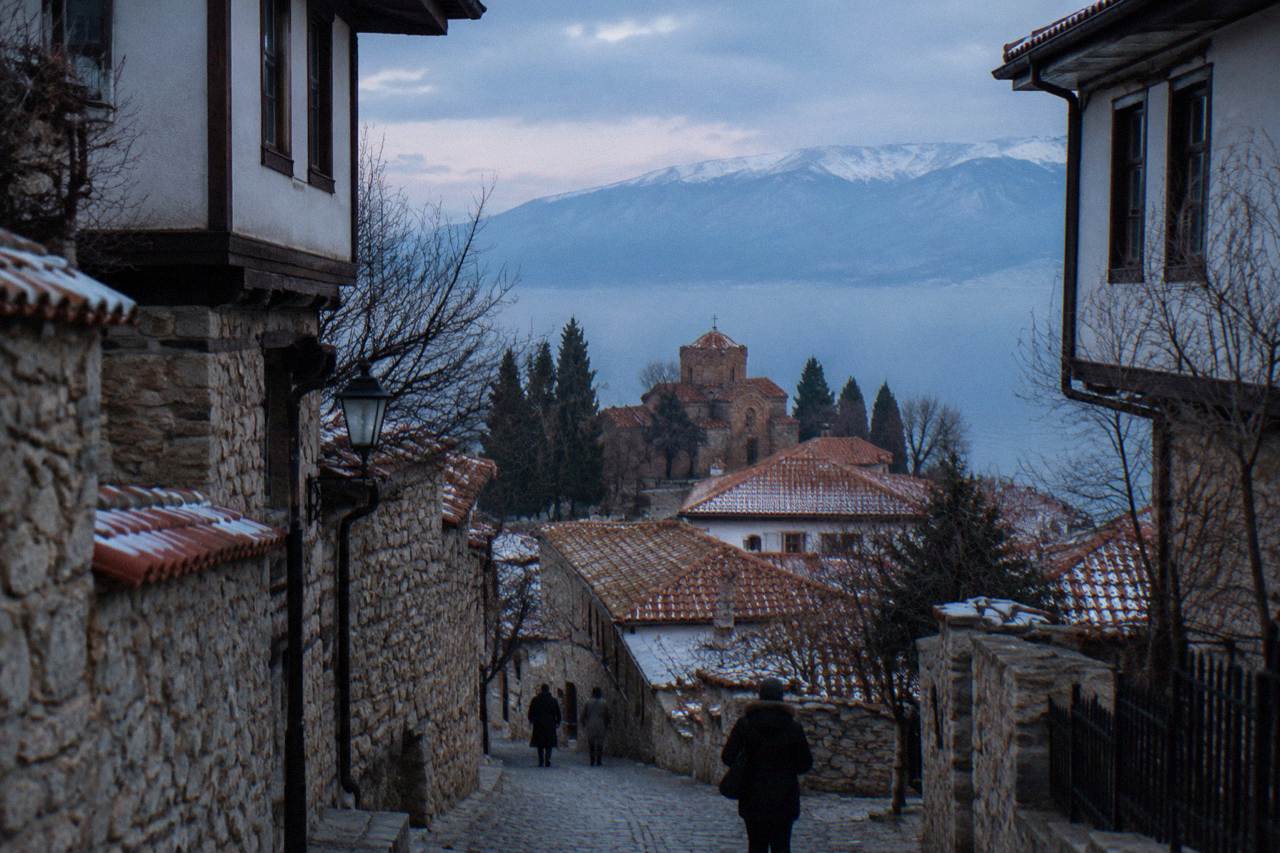
What Is Winter In Ohrid Actually Like?
Winter in Ohrid is cold, quiet and damp rather than snowbound, with modelled January highs of about 5.0 C and lows of about -0.8 C, December rain of about 92.6 mm and November rain of about 90.4 mm, on ERA5 reanalysis normals for 1991 to 2020 at the old-town grid point, which is a modelled figure and not a weather-station record.
Those numbers come from the ERA5 reanalysis, 1991-2020, computed for the grid cell over the old town at 701 m. The continental climate with a lake influence means the lake moderates the extremes a little: December's mean daily high is about 6.2 C and February's about 6.3 C, while the mean daily lows hover around zero, 0.9 C in December and 0.0 C in February. Snow does occur in Ohrid in winter, and Galicica National Park, the ridge between Lake Ohrid and Lake Prespa, gets heavier snow that can close the main park road, typically between January and March.
The other half of the picture is daylight use. Winter days are short, and the modelled figures say nothing about sunshine hours, so plan around the clock rather than around a forecast. The lake itself stays far too cold for swimming: modelled aggregator values put the surface at about 6.0 C in December, about 4.6 C in January and about 5.4 C in February, against the UHMR multi-year October mean of 14.3 C. Nobody swims in that, and the swimming season on the modelled figures starts around July.
| Month | Mean daily high C | Mean daily low C | Rain mm | Modelled lake surface C |
|---|---|---|---|---|
| December | 6.2 | 0.9 | 92.6 | about 6.0 |
| January | 5.0 | -0.8 | 76.5 | about 4.6 |
| February | 6.3 | 0.0 | 74.3 | about 5.4 |
Air temperatures are ERA5 modelled normals, 1991-2020; water temperatures are modelled aggregator values, not station readings.
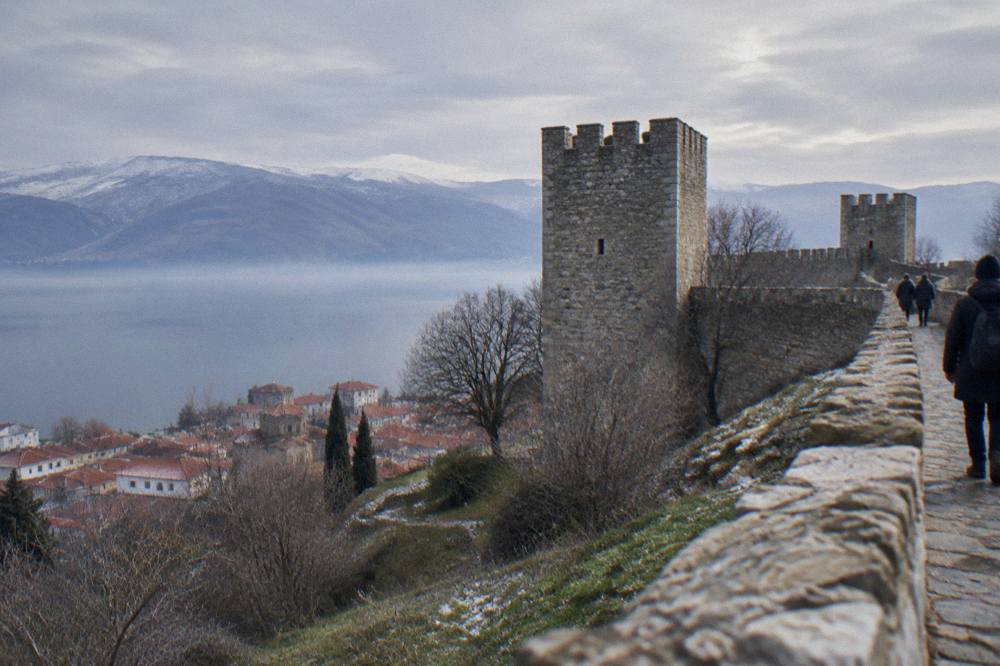
Is Ohrid Worth Visiting In Winter?
Ohrid is worth visiting in winter if you want the churches, the museum sites, the old-town lanes and the lake views without the summer crowds, and it is a poor choice if you want swimming, boat trips to St Naum or long warm evenings, because the modelled lake temperature sits near 5 C, boats to St Naum run a reduced winter schedule, and the museum sites close by mid-afternoon on a winter timetable.
The honest split is between what the town is and what the lake does. What the town is: a UNESCO mixed heritage site, the "Natural and Cultural Heritage of the Ohrid Region", inscribed in 1979 and 1980 and extended to the Albanian part in 2019, with more than 800 Byzantine-style icons from the 11th to the end of the 14th century held in the region, and an old town that climbs on foot from the shore to the fortress. None of that closes in December. The Church of St John at Kaneo stands over the lake in January exactly as in July.
What the lake does: it gets cold, and the summer economy around it shrinks. Boat trips to St Naum and the Bay of Bones, which typically run about May to October, are limited or unavailable outside the main season, though road access to St Naum remains possible. Peak season runs June to September with August the busiest month; the November 2025 figures for Ohrid municipality recorded 18,103 guests, against a summer machine built for far more. If your mental image of Ohrid involves a swim stop, winter will not deliver it. If it involves a quiet walk between Byzantine churches with a museum ticket in your pocket, it will.
A guided walk earns its keep in winter precisely because the days are short. The Ohrid Half-Day City Tour covers the old town's core in one pass, useful when daylight runs out by late afternoon and you do not want to spend it orienting yourself, and Check availability for winter dates before assuming the summer schedule holds.
What Is Open In Ohrid In Winter?
The museum institute's sites stay open in winter on a shortened schedule from 1 October to 30 April, with Robev Family House and the Bay of Bones running 09:00 to 15:30 and the Icon Gallery 09:00 to 14:00, all closed on Mondays, at tickets of 150 MKD for foreign visitors and 120 MKD for domestic visitors, per the museum institute's own site.
That is the structural fact of an Ohrid winter: the sights run, but on a tighter clock. Robev Family House on Tsar Samoil Street shifts to 09:00 to 15:30 in winter and switches to two summer shifts from 1 May. The Bay of Bones, the Museum on Water at Gradishte near Peshtani, keeps 09:00 to 15:30 in winter and 09:00 to 16:30 in summer, closed Monday year-round. The Icon Gallery in the Perivleptos complex has the shortest winter day of the three, 09:00 to 14:00. The reported child and student rate is 60 MKD. Plan Mondays around the Old Bazaar, the lanes and the lake shore rather than the museum sites.
| Site | Winter hours (1 Oct to 30 Apr) | Closed | Ticket (foreign / domestic) |
|---|---|---|---|
| Robev Family House | 09:00 to 15:30 | Monday | 150 / 120 MKD |
| Bay of Bones, Museum on Water | 09:00 to 15:30 | Monday | 150 / 120 MKD |
| Icon Gallery, Perivleptos | 09:00 to 14:00 | Monday | 150 / 120 MKD |
One winter constant worth knowing: the Ohrid Summer Festival is a July-to-August institution, opening its 66th edition on 12 July 2026 at the Ancient Theatre, so winter visitors should not expect it. On the calendar side, Orthodox Christmas falls on 7 January and Epiphany, Vodici, with its cross-throwing into the lake, on 19 January, and the Vevcani Carnival is traditionally held on 13 to 14 January in the hills above Struga.
How Cold Is The Lake, Really?
Modelled lake surface temperatures in Ohrid winter bottom out at about 4.6 C in January, with about 6.0 C in December and about 5.4 C in February, against a UHMR multi-year October mean of 14.3 C, so winter swimming in Lake Ohrid is not a realistic plan and the swimming season on the modelled figures does not start until around July.
Those winter water values are modelled aggregator figures, not gauge readings, and the October mean of 14.3 C is the UHMR figure on a 2001-2020 base. Even that October water is brisk. The practical consequence is what surrounds the water rather than the water itself: the beach bars and summer facilities on the shores at Gradiste, Lagadin, Ljubanista, Potpesh and Labino reduce or close outside the main season, and the boats thin out with them.
The lake's water quality is a separate question with a current answer. The 2026 bathing-water testing, reported in May and June, met standards at most points, Class I physico-chemically, with most microbiological samples rated Excellent, though Grashnica beach was rated Class III. Winter visitors are not swimming anyway, but it is a reasonable question to ask of any water, and the swimming in Lake Ohrid answer covers the season in more detail.
What To Do In Ohrid In Winter
A winter day in Ohrid divides into the old town on foot, the museum sites on their 09:00 schedules, the lake shore and the boardwalk, and indoor stops such as the cooking classes and winery tastings that run year-round, with day trips to Struga, Vevcani or the Albanian side of the lake filling the rest.
The old town is the anchor. It climbs from the lake to the fortress on lanes that are entirely pedestrian, and the compact set of sights, the Ancient Theatre, Plaosnik, St John at Kaneo, the Old Bazaar and the Perivleptos and Icon Gallery complex, sits within walking distance of each other. The Ancient Theatre, built at the end of the 3rd or start of the 2nd century BC in the late Hellenistic period according to the museum institute, is an open monument whose festival role belongs to summer; in winter it is simply there, part of the walk. The what Ohrid is famous for page sets out the full sight list, and the is Ohrid worth visiting page weighs the town against other Balkan stops.
Food fills the short afternoons well. The cooking classes and the monastery winery tours on the roster are indoor, weather-proof products, and a guided old-town walk paired with one of them is a workable winter formula. Struga, at the north end of the lake where the Crn Drim drains it, is a short bus ride on the local line, and the Vevcani springs village above it is the base for the January carnival. Across the border, Pogradec in Albania is reached via the St Naum and Tushemisht crossing, which is about 4 km from the St Naum monastery itself.
The boat trip in that list is a summer product at heart; treat it as a reason to come back after May, or check the operator's live listing for any winter departures. The winter guide to Ohrid carries a fuller day-by-day plan for the coolest months.
How Do You Get To Ohrid In Winter?
Ohrid is reachable in winter by bus from Skopje in about 3 hours for 850 to 950 MKD one way, by minibus from Tirana in 3 to 3.5 hours for about EUR 15 to 20, or by air into Ohrid St Paul the Apostle Airport, which is about 10 km from the centre, though the flight schedule is seasonal and summer-focused and winter options are thinner.
There is no passenger train to Ohrid from anywhere, and no domestic flight, so road or the airport are the choices. The Skopje bus runs several times daily on operators such as Galeb and Classic Company, arriving at the Ohrid bus station east of the centre. Driving from Skopje covers about 170 km in about 2.5 hours plus about 140 MKD in tolls, with headlights required day and night; snow on the Galicica stretches and the Kicevo-Ohrid road is the winter variable, and the Kicevo-Ohrid motorway's full opening is expected in the first half of 2027, so parts of that route remain ordinary road for now. The Skopje to Ohrid and Tirana to Ohrid answers carry the fare and operator detail.
Common Questions About Ohrid In Winter
Is Ohrid Worth Visiting In Winter?
Yes, for churches, museums, the old town and lake views without crowds; no, for swimming or boat trips, since modelled lake temperatures sit near 5 C and the St Naum boats reduce to a winter schedule.
Is Ohrid Too Cold In Winter?
Modelled ERA5 normals, 1991-2020, put January highs at about 5.0 C and lows at about -0.8 C, with December and February highs about 6 C. That is cold and damp, not extreme, and snow does fall in town.
Are The Ohrid Museums Open In Winter?
Yes, on a winter schedule from 1 October to 30 April: Robev Family House and the Bay of Bones 09:00 to 15:30, the Icon Gallery 09:00 to 14:00, all closed Monday, with tickets at 150 MKD foreign and 120 MKD domestic.
Can You Swim In Lake Ohrid In Winter?
No. Modelled surface temperatures are about 6.0 C in December, 4.6 C in January and 5.4 C in February, and the swimming season on the modelled figures starts around July.
Do The Boats To St Naum Run In Winter?
Boat trips to St Naum and the Bay of Bones typically run about May to October and are limited or unavailable outside that window, though the road to St Naum stays open and the monastery is about 4 km from the Tushemisht border crossing.
Does Anything Happen In Ohrid In Winter?
Orthodox Christmas is on 7 January, Epiphany with the cross-throwing into the lake on 19 January, and the Vevcani Carnival is traditionally held on 13 to 14 January in the village above Struga. The Ohrid Summer Festival itself is a July and August event.