How To Get To Ohrid: Flights, Buses And Borders
Ohrid sits on Lake Ohrid in North Macedonia, reached by a small lakeside airport, road links from Skopje and Tirana, and a walkable border crossing at Sveti Naum. This guide lays out each route with what is confirmed and what needs checking before travel.

Short answer
Ohrid is served by Ohrid St Paul the Apostle Airport (OHD), about 10 km from the centre, mainly by Wizz Air routes. Overland, Skopje is about 170 km away by road with intercity buses, and minibuses run from Tirana across the Qafe Thane border. There is no passenger train to Ohrid. Visa-free stays run up to 90 days in any 180-day period.
Ohrid is a lakeside town in North Macedonia on the shore of Lake Ohrid, a freshwater mountain lake whose surface sits at about 693 m above sea level, and every route into it is either through the air or over mountain roads. The town has a small airport of its own, Ohrid St Paul the Apostle Airport (OHD), about 10 km from the centre, and otherwise depends on road links from Skopje, Tirana and the wider region. There is no passenger rail line into Ohrid and no sea port, because this is an inland lake basin ringed by mountains, not a coast. This Ohrid Travel Guide page walks through each arrival route in turn: the flight options, the transfer from the airport, the road corridors from Skopje and from Albania, the border crossings, and the documents and rules that apply at the frontier. Where a schedule, fare or frequency changes seasonally, the advice is to check current timetables before committing to a plan, because Ohrid's transport offer expands sharply in summer and contracts in winter.
Where Is Ohrid And What Routes Lead There?
Ohrid lies in the southwest corner of North Macedonia on the north-eastern shore of Lake Ohrid, at about 693 m above sea level, close to the Albanian border and with Galicica National Park rising between the lake and Lake Prespa. The practical consequence for travel is that almost every arrival funnels through four channels: a seasonal flight into OHD, a road approach from Skopje about 170 km to the east, a road approach from Tirana across the Albanian border, or arrival across the lake border area at Sveti Naum near the southern end of the lake.

The geography shapes the seasons as much as the routes. The airport's flight schedule is largely summer-focused, with winter operations much thinner, and boat services on the lake itself run roughly May to October and reduce outside that window. Anyone travelling between November and April should expect fewer flight connections and should confirm road conditions, since heavy snow can close the main road through Galicica National Park, typically between January and March. The where is Ohrid guide covers the town's position and setting in more detail, and the Lake Ohrid guide explains the body of water every route ultimately arrives at.
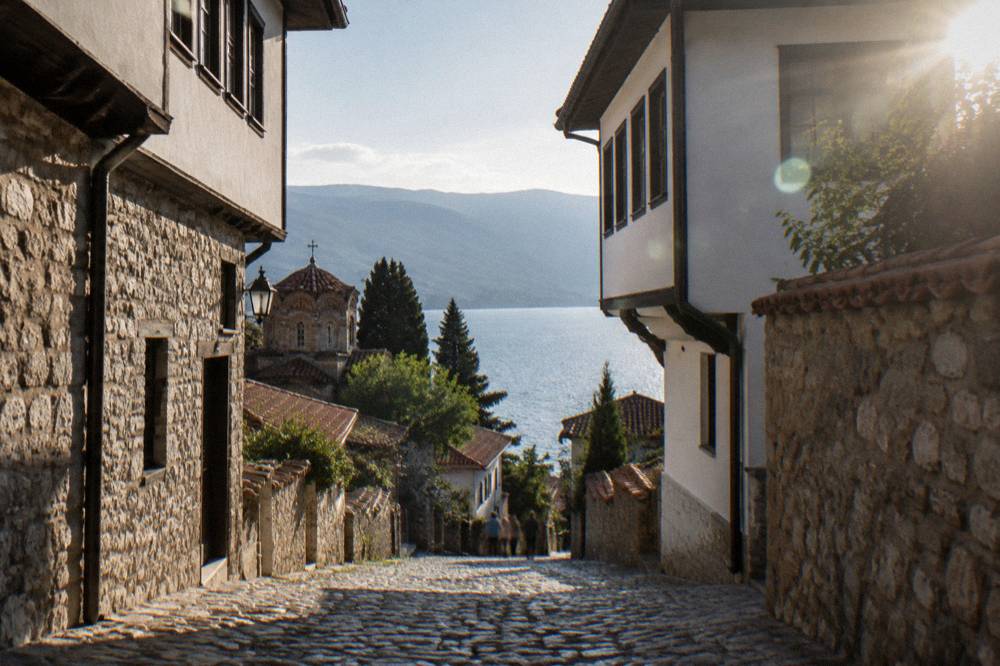
A quick summary of the four main approaches:
| Route | Entry point | Distance or key fact | What to check before travel |
|---|---|---|---|
| Flight to OHD | Ohrid St Paul the Apostle Airport | Airport about 10 km from the centre | Seasonal schedule, winter route cuts |
| From Skopje | Road via the A2 corridor | About 170 km by road | Current bus timetables, motorway works near Kicevo |
| From Tirana | Qafe Thane / Kjafasan border | Minibus services cross here | Departure days, border wait |
| From Albania via the lake | Sveti Naum / Tushemisht crossing | St Naum is about 4 km from the border | Opening status, walking the crossing on foot |
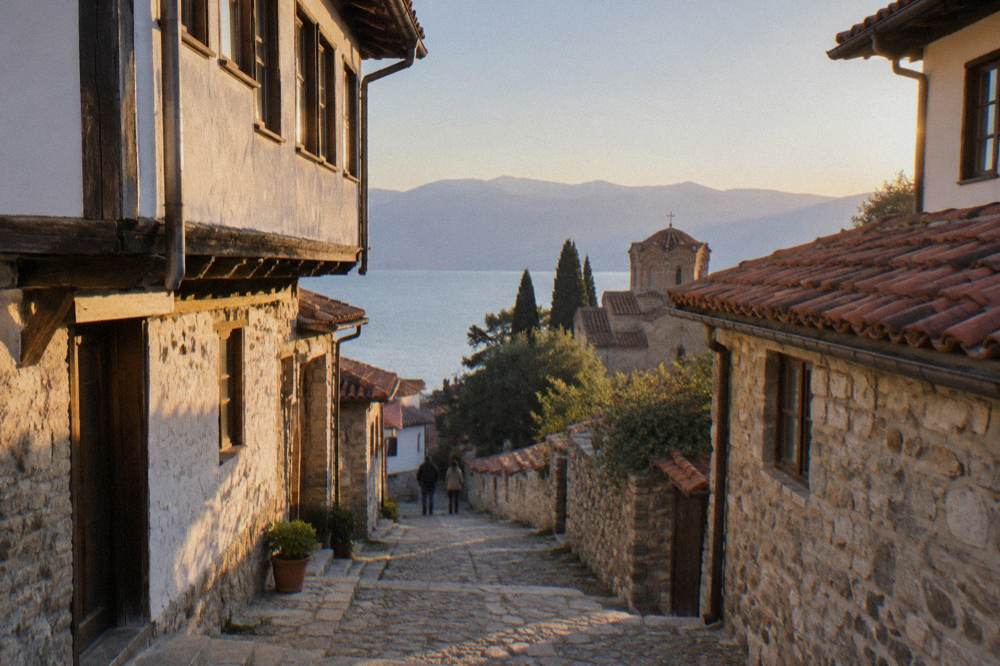
Flying Into Ohrid: What Lands At St Paul The Apostle Airport?
Ohrid St Paul the Apostle Airport (OHD), operated by TAV Macedonia, sits about 10 km from the town centre and is served primarily by Wizz Air, whose 2026 expansion added routes including Naples, Wroclaw and Milan across the Skopje and Ohrid airports, with Katowice and Budapest also returning. The airport handles a modest passenger volume, 263,869 passengers in 2025, which was 20.0 percent up on 2024 though still below the 2023 and 2019 figures, so it is a small seasonal operation rather than a busy hub.
The route network leans heavily on leisure traffic from Central and Western Europe, and it thins out sharply outside summer. TAV has also announced investment in terminal reconstruction and expansion to raise capacity, and in August 2026 the Deputy Prime Minister indicated Wizz Air is expected to base an aircraft at Ohrid, which would enable new routes and early departures. None of that is a promise of a specific winter connection, so anyone flying outside the June to September window should confirm what actually operates on the date of travel. The Ohrid airport guide goes deeper, and the answer page on direct flights to Ohrid addresses the route question directly.
For travellers who cannot find a workable flight into OHD, the standard alternative is flying into Skopje International Airport and continuing to Ohrid by road, a corridor covered below. Others combine the two countries, flying into Tirana and crossing into North Macedonia overland, which is described in the Albania section further down.
How Do You Get From Ohrid Airport To The Town Centre?
The airport lies about 10 km from the centre of Ohrid with access via the E65 road, and there is no regular public shuttle bus, so the practical options are a taxi, a pre-arranged private transfer, or a rental vehicle collected in town, with the short drive taking only a matter of minutes at that distance. TAV's airport page confirms the distance and the road link, and it confirms the absence of a scheduled public shuttle, which is the single most useful thing to know before landing.
Because no published official taxi tariff appears on the airport's own site, the standard advice applies: agree the price before getting in, or have a transfer booked in advance, ideally one whose terms are clear before departure. The road from the airport runs along the lakeshore side of the plateau, and at 10 km the journey is short regardless of mode. For anyone planning to use the town as a base without a car, the getting around overview on the root page and the Ohrid taxis guide set out the local picture, while the car rental guide covers hiring in the town itself.
Practical arrival notes worth knowing before you land:
| Item | Situation at OHD | Practical takeaway |
|---|---|---|
| Distance to centre | About 10 km via the E65 | Short hop, no long transfer |
| Public shuttle | No regular scheduled shuttle | Plan a taxi or pre-booked transfer |
| Published taxi tariff | Not published on the airport site | Agree the fare before the ride |
| Flight season | Largely summer-focused | Check winter schedules carefully |
| Terminal works | TAV reconstruction and expansion announced | Allow a little flexibility on arrival logistics |
How Do You Travel From Skopje To Ohrid By Bus Or Car?
Skopje is about 170 km from Ohrid by road, intercity buses run the corridor with more departures in summer, and there is no passenger train and no domestic flight between the two cities, so the road is the only public option and current schedules should always be checked before travel. The bus journey is the standard route for visitors arriving at Skopje's airport or exploring the capital first, and tickets are bought at Skopje's bus station or from the operators' own channels.
Ready to sort your seat for that road route? Book a bus ticket to Ohrid here.
The road route has been in flux for years because of the Kicevo to Ohrid motorway (A2) construction, which has run since about 2014. As of mid-2026 roughly 37 km of the roughly 57 km route was operational, the Izvor to Vrbjani section with the Preseka tunnel was expected to open in the coming months, and full opening was targeted for the first half of 2027. That means parts of the drive remain on the older road, and journey conditions change as sections open. Driving rules in North Macedonia require headlights on day and night, a green card for insurance, and tolls paid per section at plazas rather than through a vignette. The Skopje to Ohrid guide covers the corridor end to end.

For visitors who prefer not to manage the transfer themselves, a guided group option exists that starts in Skopje and spends a full day in Ohrid covering the UNESCO heritage sites, with the group tour from Skopje described on its own page, and Check availability for the date in mind. The bus station guide explains where buses terminate on the Ohrid side.
How Do You Get To Ohrid From Tirana And Albania?
Minibuses and shared transfers run from Tirana to Ohrid, roughly five to seven a day in season, crossing at the Qafe Thane / Kjafasan border near Struga, with the crossing itself usually adding time and the whole trip best planned with a buffer for border formalities. Services generally depart from Tirana's south or regional terminal, and the route enters North Macedonia on the Struga side of the lake, from where Ohrid is a short onward hop.
The border at Qafe Thane is the main vehicle crossing on this corridor, and it is where nearly every bus and minibus from Albania passes. Wait times at any Balkan land border fluctuate with the season and the hour, and North Macedonia is not in the Schengen area, so passport checks apply in full on both sides even though Bulgaria and Romania became full Schengen members on 1 January 2025. The Tirana to Ohrid guide covers the corridor, and visitors pairing the two countries can also read about combining Ohrid and Albania in one trip on the root planning page.
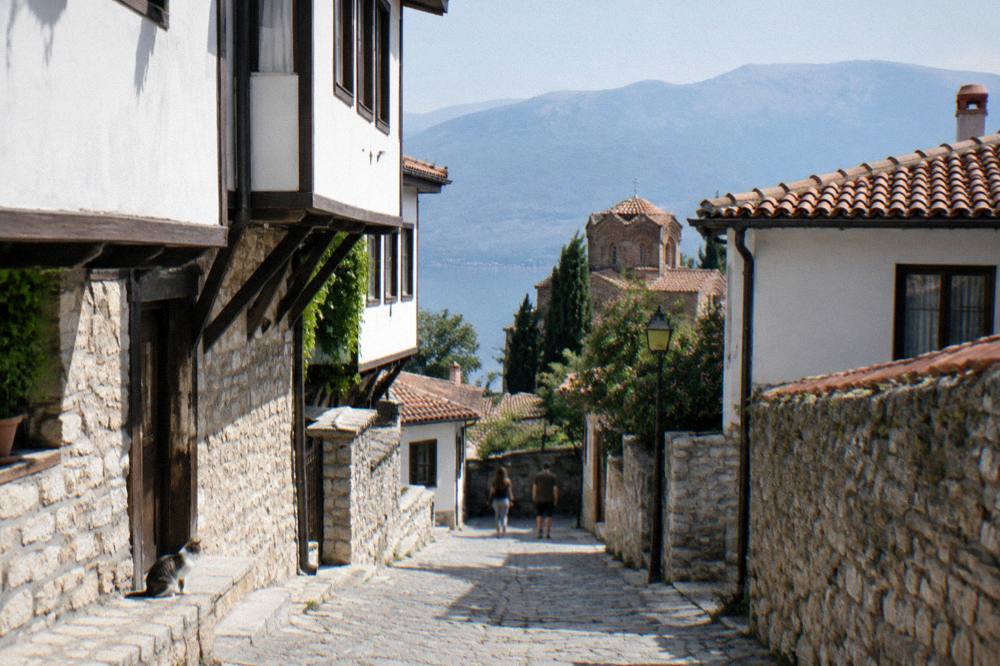
A second, quieter option exists at the southern end of the lake, described in the next section, and day trips in the other direction, from Ohrid into Albania, are covered by the Pogradec day trip guide listing on the root page.
What About The Sveti Naum And Tushemisht Border Crossing?
The Sveti Naum / Tushemisht crossing at the southern end of Lake Ohrid lies about 4 km from St Naum monastery, is reported to operate around the clock for passenger vehicles and pedestrians, and can be crossed on foot, with a walk of roughly a kilometre through no-man's-land between the two posts. It is the natural crossing for anyone combining St Naum with the Albanian lakeside around Tushemisht and Pogradec.
The pedestrian crossing is the detail that surprises people: it is a documented, commonly used route on foot, and it turns St Naum into a two-country outing, since the monastery sits only about 4 km from the border, a drive of roughly ten minutes by local taxi. Budget up to an hour for border formalities at busier times. Travellers planning this should carry their passport even for a short walk across, because it is a full international frontier. The St Naum from Ohrid guide covers reaching the monastery from the town itself.
Is There A Train To Ohrid?
No passenger rail service reaches Ohrid, and no operational passenger line into the town is confirmed for 2026, so rail has no place in an Ohrid travel plan and the realistic public-transport arrivals are the flight, the bus from Skopje and the minibus from Tirana. The railway network of North Macedonia does not extend to the lake, and the nearest rail connection is not a practical substitute for a bus.
This matters for itinerary planning because multi-country rail routings that look plausible on a map of Europe terminate well short of the lake. Anyone stringing together Skopje, Tirana and Ohrid by public transport is stringing together buses and minibuses, with border crossings on foot or in the vehicle. The answer pages on trains from Skopje to Ohrid and from Tirana cover the rail question in detail, and both come back to the same conclusion: the road is the route.

What Documents And Entry Rules Apply At The Border?
North Macedonia is outside the EU and outside Schengen, visa-free nationals may stay up to 90 days in any 180-day period, and UK visitors may stay up to 3 months, with registration with the local police within 48 hours of arrival required, a formality hotels normally complete for their guests. Holders of valid multiple-entry UK, US or Canadian visas or Schengen residence permits may enter for up to 15 days under the foreign ministry's published rules.
Because it is a non-Schengen frontier, every entry into North Macedonia involves a passport check, and the country's rules stand apart from the EU's systems. UK guidance adds a passport condition specific to British visitors: the passport's expiry date should be at least 90 days after the date of arrival. Registration with the police within 48 hours is a legal requirement, but a hotel stay discharges it automatically, so independent travellers in private accommodation are the ones who need to handle it themselves. The visa and entry guide carries the full detail, and the safety picture is summarised in is Ohrid safe.
| Entry item | Rule |
|---|---|
| EU membership | North Macedonia is not in the EU |
| Schengen | Not a member; full passport checks apply |
| Visa-free stay | Up to 90 days in any 180-day period for visa-free nationals |
| UK visitors | Up to 3 months; passport expiry at least 90 days after arrival |
| Police registration | Within 48 hours; hotels do it for guests |
| Holders of UK, US, Canadian visas or Schengen residence | Up to 15 days |
| Emergency numbers | Ambulance 194, police 192, roadside assistance 196 |
Money follows the same non-EU logic: the currency is the Macedonian denar (MKD), euros are commonly quoted for tours and transfers but are not legal tender, and the denar and money guide explains how to handle it on arrival.
When Is The Best Time Of Year To Arrange Travel To Ohrid?
The flight schedule and the lake services both peak between June and September, July and August are the busiest months on the ERA5 1991-2020 modelled normals with mean daily highs of 27.1 C and 27.6 C, and travel outside that window means fewer connections, thinner boat schedules and possible snow on the Galicica road between January and March. The same normals put January's mean daily high at 5.0 C with 76.5 mm of rain, and December at 6.2 C with 92.6 mm, so winter arrival is a different kind of trip.

The modelled monthly picture from the ERA5 reanalysis for the Ohrid grid cell, 1991 to 2020:
| Month | Mean daily high C | Mean daily low C | Rain mm |
|---|---|---|---|
| Jan | 5.0 | -0.8 | 76.5 |
| Feb | 6.3 | 0.0 | 74.3 |
| Mar | 10.0 | 2.5 | 80.5 |
| Apr | 14.6 | 6.3 | 82.4 |
| May | 19.5 | 10.8 | 70.8 |
| Jun | 24.2 | 15.2 | 43.1 |
| Jul | 27.1 | 18.3 | 34.7 |
| Aug | 27.6 | 19.0 | 32.9 |
| Sep | 22.4 | 14.9 | 62.4 |
| Oct | 17.4 | 10.3 | 76.0 |
| Nov | 11.5 | 5.3 | 90.4 |
| Dec | 6.2 | 0.9 | 92.6 |
Timing interacts with the route. The airport's summer-heavy schedule means a June or July flight is easier to find than a January one; the swimming marathon and the Ohrid Summer Festival crowd August; and the modelled lake surface temperature, from an aggregator rather than a station, runs about 4.6 C in January against about 23.5 C in August. The best time to visit guide and the month-by-month weather guide help match a travel window to a purpose, and the how many days in Ohrid page helps size the stay once the route is fixed.
Once arrived, the practical follow-ups are where to sleep, covered in where to stay in Ohrid, and what the trip costs, covered in the cost and budget guide. The arrival itself, whichever corridor it uses, ends at the same place: a stone old town climbing from a mountain lake, with the fortress above and the water below.
Common Questions About Getting To Ohrid
Does Ohrid have an airport?
Yes. Ohrid St Paul the Apostle Airport (OHD) is about 10 km from the town centre and is served mainly by Wizz Air, with a schedule that is largely summer-focused and much thinner in winter.
How far is Ohrid from Skopje?
Skopje is about 170 km from Ohrid by road, served by intercity buses rather than by rail, since no passenger train runs to Ohrid.
Is there a train from Skopje or Tirana to Ohrid?
No passenger rail service reaches Ohrid. The realistic public-transport arrivals are the flight into OHD, the bus from Skopje and the minibus from Tirana across the Qafe Thane border.
Is North Macedonia in the EU or Schengen?
No to both. Full passport checks apply at the border, visa-free nationals may stay up to 90 days in any 180-day period, and UK visitors may stay up to 3 months with passport expiry at least 90 days after arrival.
Can you cross into Albania from St Naum?
Yes. The Sveti Naum / Tushemisht crossing lies about 4 km from St Naum monastery, is reported to operate around the clock, and can be crossed on foot, with roughly a kilometre on foot between the two border posts.
What currency should I arrange before arriving in Ohrid?
The local currency is the Macedonian denar (MKD). Euros are commonly quoted for tours and transfers but are not legal tender, so denars are needed for local costs on the ground.