Taxis In Ohrid: Fares, Apps And Airport Rides
Ohrid is a compact lakeside town where the Old Town lanes are on foot, motorised transport means licensed taxis and intercity buses, and the airport sits about 10 km from the centre.
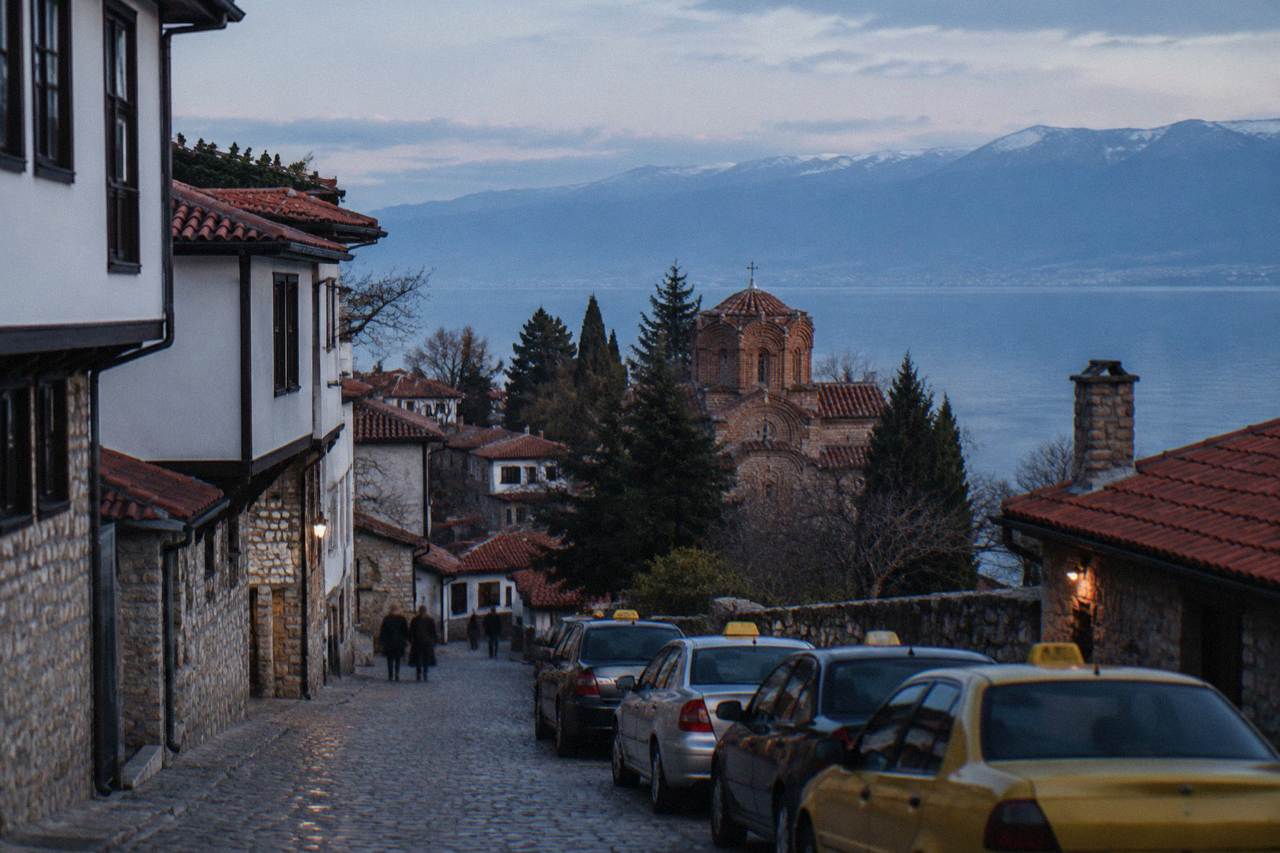
Short answer
Ohrid has no trams, no metro and no bike share, and the Old Town is walked rather than driven. Licensed taxis are the motorised fallback, intercity buses link the town with Skopje, Struga and Tirana, and seasonal lake boats run along the shore. The airport is about 10 km out with no regular public shuttle, so a taxi, a pre-booked transfer or a rental car covers the last stretch.
Ohrid, on the shore of Lake Ohrid in North Macedonia, is a town built for legs before wheels. The old town climbs from the lake to Samuel's Fortress and the lanes are on foot; there are no trams, no metro and no bike share anywhere in the town. What that leaves for motorised travel is licensed taxis, intercity and local buses, seasonal lake boats and your own two feet, and this Ohrid Travel Guide page sets out how each of those pieces fits together, from the airport ride in to the parking rules that reshaped the old-town streets in 2026.
Are There Uber And Ride-Hailing Apps In Ohrid?
Ohrid's transport picture is built around walking, licensed taxis and buses rather than app-based ride hailing, and no ride-hailing service is part of the town's official transport setup. The old town is compact and pedestrian, there are no trams, no metro and no bike share, and the motorised options that do exist are conventional: metered or negotiated taxis, intercity coaches and seasonal boats on the lake.
In practice this means planning around the phone less than in a large city. A taxi in Ohrid is hailed on the street, called by phone or taken from a rank, and the fare conversation happens with a human being rather than an app screen. The common advice, repeated across guides to the town, is to agree the price in advance or ask the driver to use the meter where one is fitted, because many cabs are metered but not all fares start there.
None of this makes the town hard to navigate. The distance from the lakefront to the top of the old town is short and steep rather than long, and the destinations visitors actually cross town for, the Old Bazaar, St Sophia, the Church of St John at Kaneo and the boardwalk along the shore, sit within an easy walk of one another. The one-day Ohrid itinerary covers them on foot by design.
For anything beyond walking range, the pattern that works is simple: taxis for short hops and airport runs, buses for Skopje, Struga and Tirana, and booked tours or boats for St Naum and the southern shore. Each of those has its own section below.
How Do Taxi Rides In Ohrid Work In Practice?
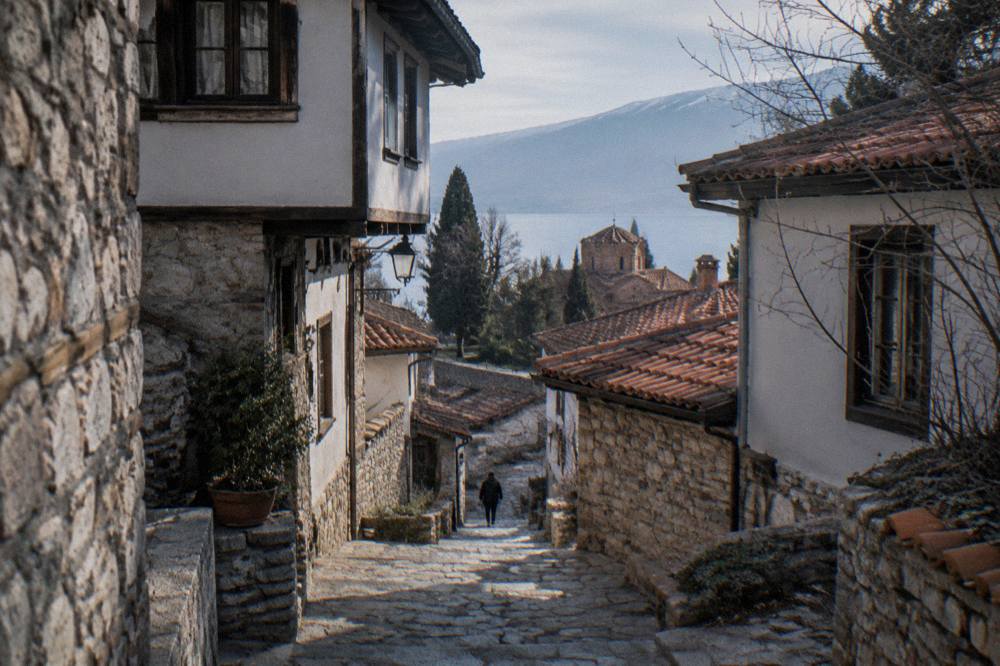
A taxi ride in Ohrid starts with a licensed cab, usually a yellow or black vehicle, and the fare is either metered or agreed with the driver before the car moves, with agreeing the price in advance the standard advice for visitors. Rides are short because the town is small, ranks and phone calls replace app hails, and cash in denars is the default way to pay.
The mechanics are straightforward. Licensed taxis operate across the town, and though no single official roster of companies is published. What is consistent is the advice: confirm the price before the ride begins, or check that the meter is running, and treat the agreed figure as the figure you pay.
A few practical habits carry the whole system:
- Agree the destination and the price before getting in, or ask for the meter.
- Carry denars for the fare, since the euro is not legal tender in North Macedonia.
- For hotel and guesthouse staff, asking the desk to call a known cab firm is a normal request.
- For the airport and early departures, arrange the pickup the day before rather than hailing on the morning.
The currency point matters more here than in eurozone destinations. Prices across North Macedonia are set in Macedonian denars, and while euros are sometimes informally accepted in tourist areas, the exchange terms are poor; the guide to the denar and money in Ohrid covers how to handle this properly.
How Do You Get From Ohrid Airport To The Town?
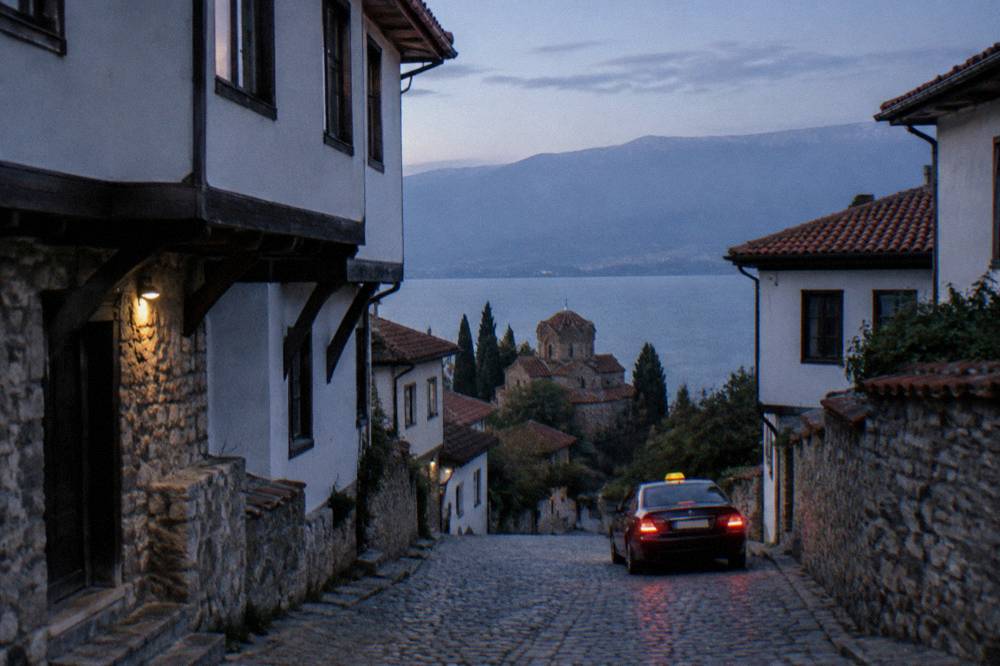
Ohrid St Paul the Apostle Airport sits about 10 km from the centre of Ohrid, reached by the E65 road, and the airport's own passenger guide lists no regular public shuttle bus between the terminal and the town, so the transfer is a taxi, a pre-booked private transfer or a rental car picked up independently. The drive is short, on the order of ten to fifteen minutes by road.
Rather not negotiate a taxi after landing? Book an airport transfer here.
The airport is small and seasonal, with a route list concentrated on summer flying, and its ground-transport reality follows from that. With no scheduled public bus, the options divide into three. A taxi from the terminal is the default. A pre-booked transfer or tour pickup suits arrivals outside standard hours. And a rental car, arranged separately, suits visitors planning day trips to Galicica National Park, Lake Prespa or the Albanian side of the lake; the Ohrid car rental guide works through that choice.
The same logic applies in reverse for departures: a taxi booked the evening before a morning flight is the low-stress option, and the Ohrid airport guide covers the terminal side of the trip in detail.
| Route | Distance | What the airport's own guide says |
|---|---|---|
| OHD airport to Ohrid centre | About 10 km | Access by road via the E65; no regular public shuttle listed |
| OHD airport to Struga | Short onward run west along the lake | Taxi or pre-booked transfer; no scheduled airport bus |
| Skopje (SKP) airport to Ohrid | About 170 km onward by road | Intercity bus from Skopje city, or private transfer |
For anyone landing at Skopje instead, the standard route is a bus or transfer into Skopje followed by the Skopje to Ohrid connection, which the linked guide covers with its own timings, and the Skopje airport to Ohrid page handles that landing specifically.
Can You Get Around Ohrid Without A Taxi At All?
Yes, and many visitors effectively do, because the old town is compact, the lakefront walks link the main sights, and the only journeys that genuinely need wheels are the airport run, the intercity legs to Skopje, Struga or Tirana, and the longer southern-shore trips toward St Naum, each of which has a bus, boat or booked-tour alternative to a private cab.
Inside the town the answer is walking. The old town's lanes are stepped and narrow, built for pedestrians, and the climb from the lake to the fortress is a walk measured in minutes. The guide to how many days to spend in Ohrid is built entirely on foot-traffic assumptions.
Between towns, buses do the work. Local services link Ohrid and Struga along the north shore of the lake with multiple daily departures, and the Struga guide and the Ohrid bus station page cover the practical side of those runs. North to Skopje, intercity coaches run several times daily, more often in summer; east to Tirana, minibuses cross the border with a journey that includes the crossing itself.
On the water, seasonal boats connect Ohrid with destinations along the lake, running roughly May to October and thinning outside that window, and the lake boats and ferries guide covers what runs when. A boat is not a commute, but for the southern shore it replaces a long drive with the lake itself.
| Journey | Taxi? | Alternatives that exist |
|---|---|---|
| Inside the old town | Rarely needed | Walking; lanes are stepped and car-hostile |
| Ohrid to Struga | Possible | Local bus, multiple daily departures |
| Ohrid to Skopje | Long and costly | Intercity coach, several daily, more in summer |
| Ohrid to Tirana | Long, cross-border | Minibus or shared transfer via the border |
| Ohrid to St Naum | Possible by road | Seasonal boat, roughly May to October, or a booked tour |
| Airport to centre | Standard choice | Pre-booked transfer or rental car |
What Should Drivers Know About Parking And Road Rules In Ohrid?
Drivers in Ohrid face a resident-only parking regime on the old-town streets introduced from summer 2026, covering streets such as Ilindenska, Kosta Abrash and Car Samoil, free for residents with a valid sticker and closed to non-residents, with clamping reported for violations, so visitors driving in should plan to park outside the old core and walk in.
The 2026 change is the one to know. Reported by local news as taking effect around July 2026, the regime reserves those old-town streets for residents displaying a valid sticker, and non-resident cars risk the clamp. The practical answer is a car park or accommodation parking outside the restricted streets, then the town on foot; the Ohrid parking guide goes deeper on where to leave a car.
The driving rules themselves are national rather than local. Headlights are required day and night across North Macedonia, a green card or equivalent international insurance should be carried, and motorway tolls are paid per section at plazas rather than through a vignette. The practical entry and visa guide covers the border side of a driving arrival.
One road project shapes the Skopje drive: the Kicevo to Ohrid motorway remains under construction, with the full opening reported as targeted for the first half of 2027, so part of the route is still conventional road. The how to get to Ohrid guide lays out the whole approach.
| Rule or change | What applies | Since when |
|---|---|---|
| Old-town resident parking | Resident-only with sticker on Ilindenska, Kosta Abrash, Car Samoil; clamping reported | From summer 2026 |
| Headlights | Required day and night nationwide | Standing national rule |
| Insurance | Green card or equivalent carried by foreign drivers | Standing national rule |
| Motorway tolls | Paid per section at plazas; no vignette system | Standing national rule |
| Kicevo to Ohrid motorway | Under construction; full opening reported as targeted for first half of 2027 | Status as reported in 2026 |
Do Taxis And Boats Serve St Naum And The Southern Shore?
The southern shore around St Naum is served by road and by water: seasonal boats run from Ohrid along the lake roughly May to October with a reduced winter schedule, road access to St Naum remains possible year-round, and the St Naum monastery sits about 4 km from the Tushemisht border crossing into Albania, close enough that a taxi or tour vehicle can combine the monastery with a border-village stop in one outing.
The boat option is the one that changes with the calendar. Cruises from Ohrid toward St Naum, typically calling at points such as the Bay of Bones, are a summer product; outside roughly May to October they thin out or stop, while the road south keeps working. A full-day cruise product run by an operator on the port lists a seven-hour round trip from Ohrid to St Naum, and the operator's page notes that the monastery's own entrance is paid separately and a rowboat at the Crn Drim springs is an optional extra.
The water itself is regulated in 2026. A government decision of 2 June 2026, announced by the Ministry of Transport, bans jet skis on the lake between 1 July and 31 August from 11:00 to 19:00, and restricts boat traffic at night through the summer and into October, with limits running 21:00 to 05:00 in June to August and 20:00 to 06:00 in September, plus a further October limit. Swimmer safety is the stated purpose. For visitors this means daytime boat trips and evening swims rather than night excursions on the water.
| Way to reach the southern shore | Season | Notes from the sources |
|---|---|---|
| Full-day boat cruise from Ohrid port | Roughly May to October | Operator lists a seven-hour round trip toward St Naum |
| Road to St Naum | Year-round | Boat schedule shrinks in winter; the road does not |
| St Naum to Tushemisht border | About 4 km by road | Reported as roughly a ten-minute drive |
| Rowboats at the Crn Drim springs | In season | Optional extra listed by a cruise operator |
The St Naum guide covers the monastery itself, and the swimming in Lake Ohrid page covers the water side of the same shore.
What Can You Book Instead Of A Taxi For Day Trips?
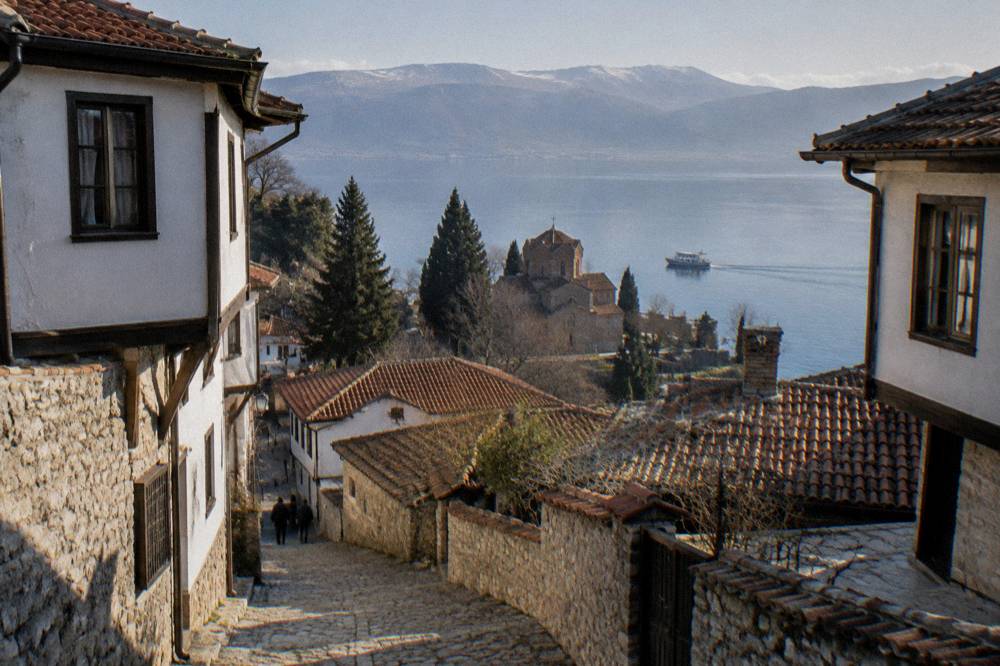
For the journeys where a taxi would be expensive or awkward, the practical substitute is a booked tour or transfer: a semi-private day trip from Tirana covers Ohrid and Struga with transport included, small-group walking tours cover the old town, panoramic boat tours cover the shoreline, and each of these removes the fare negotiation, the parking question and the border paperwork from the visitor's side of the day.
The semi-private option deserves the headline for anyone starting from Tirana. It pairs Ohrid with Struga in one day, which a taxi day-hire would struggle to match on convenience, and the operator's live listing carries full pricing and cancellation terms: Check availability. It starts in Tirana, and a product that starts in Tirana departs from Tirana, a distinction the Tirana to Ohrid guide explains from the other direction.
Within the town, guided walks replace nothing motorised, because nothing motorised is needed, but they replace the guidebook. A shared-group hidden-gems walk costs little more than a couple of short taxi rides and covers lanes and viewpoints a first-time visitor would not find alone, and a self-guided audio tour covers the same ground at whatever pace suits.
For the lake, the panoramic boat products serve the shoreline from the water, which is the view the town is famous for, and the Ohrid boat tour guide compares them properly.
When Is A Taxi In Ohrid Actually The Right Choice?
A taxi earns its fare in Ohrid in four situations: the airport run at awkward hours, the bus station leg with luggage, early-morning or late-evening departures when nothing else is running, and the St Naum or border-side excursion where a group is large enough that one car beats several booked seats. Outside those cases, feet, buses, boats and booked tours cover nearly everything a visitor tries to do.
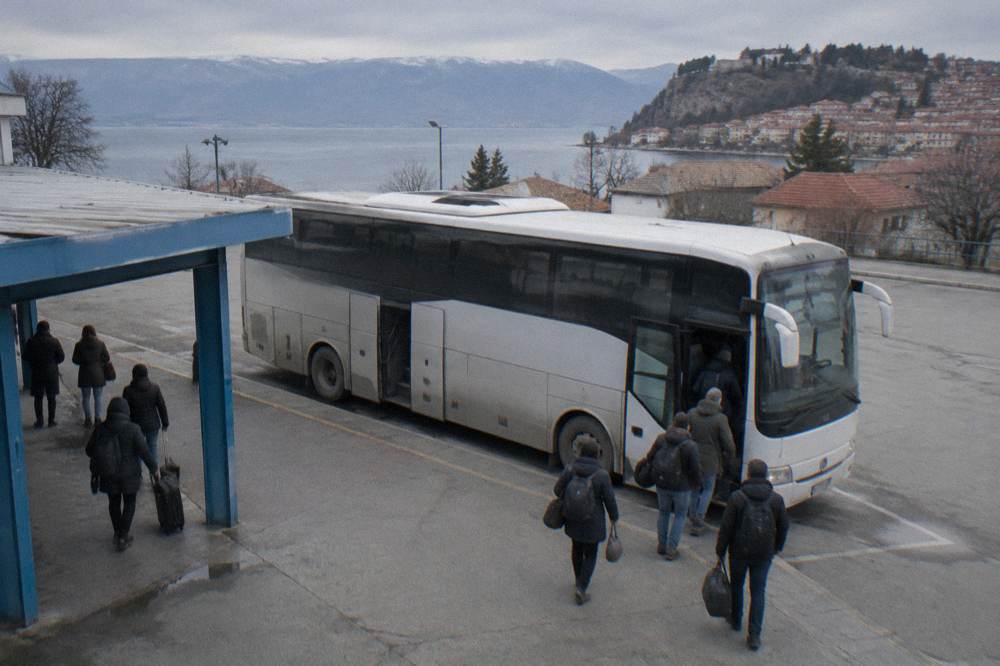
The luggage case is the classic one. The Ohrid bus station sits east of the centre, and a visitor arriving from Skopje or Tirana with bags faces a walk, a wait or a cab; a short station-to-accommodation ride is the exact trip taxis exist for. The same applies in reverse for departures, and doubly so for the airport, where no scheduled public shuttle runs and early flights make a pre-booked cab the reliable answer.
The group case is arithmetic rather than comfort. A party of four heading to St Naum, or crossing to Pogradec on the Albanian side, may find one negotiated car simpler than four tour seats, provided the border documents are in order; the Tushemisht crossing sits about 4 km from St Naum and is reported as open around the clock, with a walk of roughly a kilometre possible between the posts for pedestrians. UK visitors should note the passport rule: expiry at least 90 days after arrival, and stays of up to three months without a visa.
Everything else in the town rewards walking. The where to stay in Ohrid guide is written around that walkability, and the safety guide addresses the street-level questions visitors usually ask before choosing to walk at night.
How Does The Season Change Transport In Ohrid?
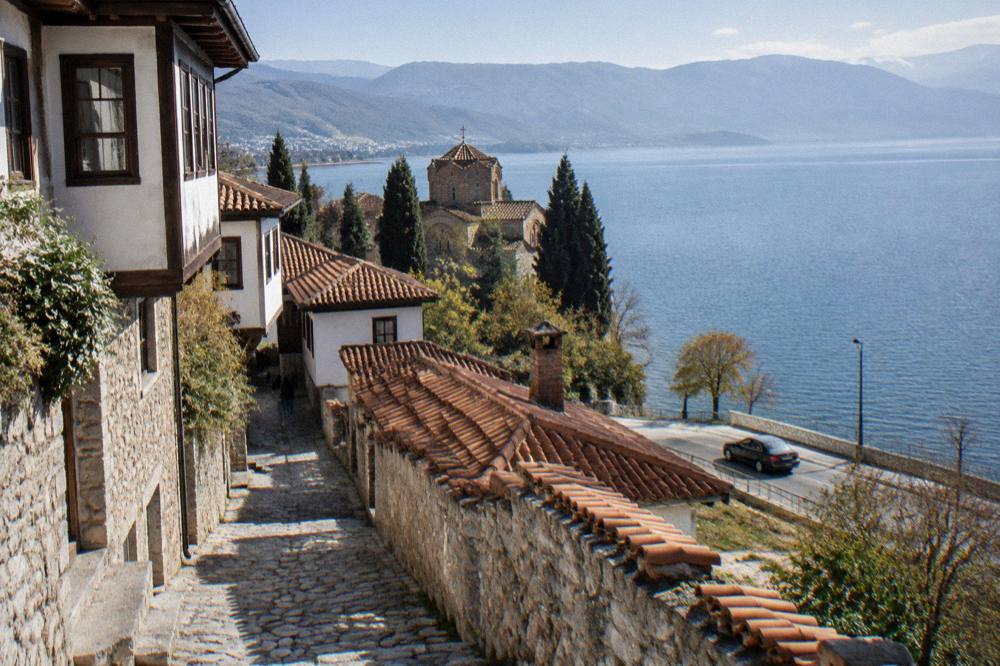
Transport in Ohrid contracts in winter and expands in summer: boat services toward St Naum and the southern shore run roughly May to October and reduce outside that window, intercity buses run more departures in the summer months, the airport's route list is summer-weighted, and snow can close the main road through Galicica National Park, typically between January and March, which matters for any winter plan that crosses the mountain rather than the lakeshore.
The lake is the clearest seasonal marker. Boats are a warm-month product; when they stop, the southern shore is a road destination. The road itself past Galicica is a separate question, because the park's main route is reported as open year-round but subject to snow closures in the depth of winter, and the Galicica National Park guide treats that as a live winter consideration rather than a footnote.
The town's own rhythm matters less for transport than for crowds. August is the reported high point of the season, with busy beaches and full accommodation, and November 2025 provides a concrete off-peak data point from the State Statistical Office via local reporting: 18,103 guests in the municipality that month, 6,417 domestic and 11,686 foreign, so the low season is real but far from empty. Weather-wise, the modelled ERA5 reanalysis for the 1991-2020 period puts January mean daily highs at 5.0 C and July at 27.1 C, a spread that shapes both what you wear walking and how much you want to stand at a boat pier.
| Season factor | Summer (Jun to Aug) | Winter (Nov to Mar) |
|---|---|---|
| Boats to St Naum | Running, roughly May to October | Reduced or stopped |
| Galicica main road | Open | Snow closures possible, typically Jan to Mar |
| Intercity bus frequency | More departures | Fewer departures |
| Airport routes | Summer-weighted schedule | Thinner schedule |
| Town walks | Warm, July mean high 27.1 C (modelled) | Cold, January mean high 5.0 C (modelled) |
The best time to visit Ohrid guide and the month-by-month weather page carry the full seasonal picture for anyone weighing a shoulder-season trip, when transport runs but crowds do not.
What Budget Should You Plan For Getting Around Ohrid?
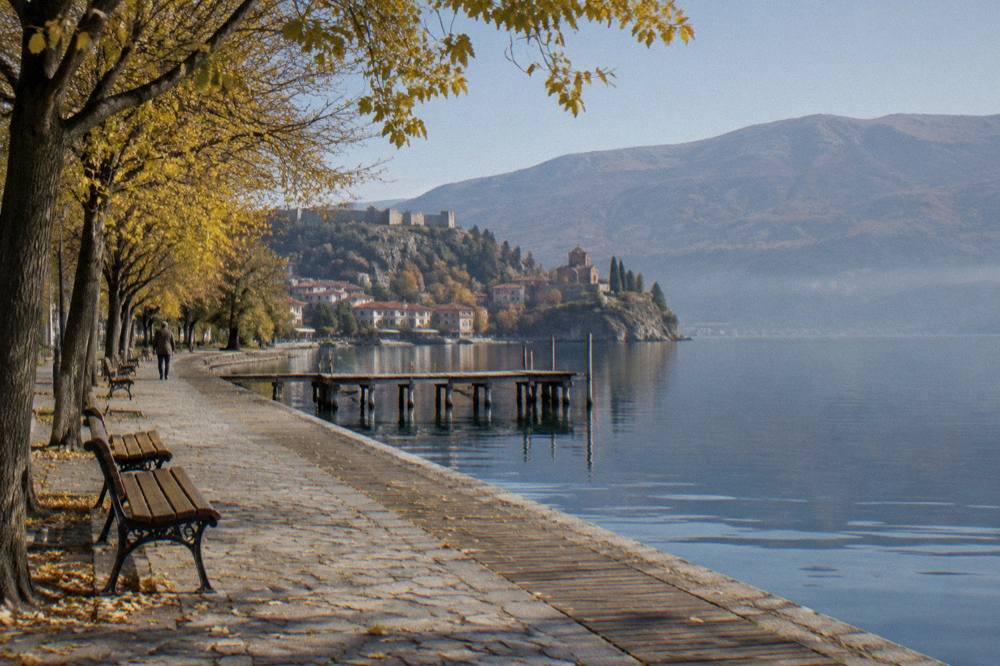
Getting around Ohrid is a small line in a trip budget, because the town itself is walked, the paid legs are few, and the only costs that add up are the intercity journeys and any booked day trips: plan for taxi rides agreed in advance and paid in denars, bus tickets bought at the station or from the driver, boat tickets in season, and tour prices exactly as the operator's live listing prints them, never converted or estimated in advance.
The discipline that keeps this cheap is refusing to guess. Taxi and transfer fares are agreed with the driver or the operator, not budgeted from a chart, because no official fare table for Ohrid taxis is published. Bus and boat fares are paid at the point of travel. Tour and transfer prices come from the listing at the moment of booking, and every price on this page's tour blocks renders from the operator's live data rather than from a typed figure.
What a visitor can plan is the shape of the spending. Inside the town, effectively nothing. One airport leg each way. Possibly one bus-station leg with luggage. Then the big items: intercity buses, a boat day if the season allows, and one or two booked day trips if Tirana, Skopje or the Struga side is on the itinerary. The Ohrid cost and budget guide puts transport in its place alongside rooms, food and museum tickets.
Two small habits protect the budget. First, denars: the euro is not legal tender, and informal euro acceptance works at poor rates, so withdrawals and payments in the local currency keep every fare honest. Second, the day-before booking: a taxi arranged the evening before an early flight costs the conversation and removes the morning risk, which is the cheapest insurance in transport.
Common Questions About Taxis In Ohrid
Are there Uber and ride-hailing apps in Ohrid?
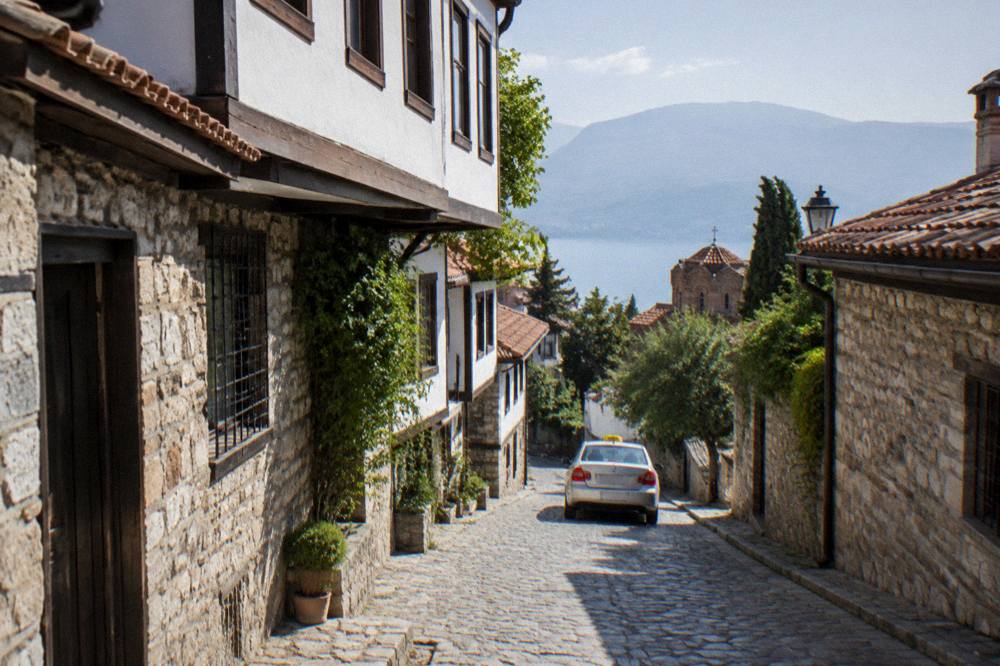
No ride-hailing service is part of Ohrid's official transport setup. The town runs on walking, licensed taxis hailed or called by phone, buses and seasonal boats, and fares are agreed with the driver or run on a meter rather than set by an app.
How do I get from Ohrid airport to the town?
Ohrid St Paul the Apostle Airport is about 10 km from the centre, reached by the E65 road, and the airport's own passenger guide lists no regular public shuttle. A taxi, a pre-booked transfer or a rental car covers the roughly ten-to-fifteen-minute drive.
Do I need a taxi inside Ohrid?
Rarely. The old town is compact, stepped and pedestrian, and the main sights sit within walking range of one another. Taxis matter mainly for luggage legs from the bus station and for early or late departures.
How should I pay for a taxi in Ohrid?
In Macedonian denars, the local currency. The euro is not legal tender in North Macedonia, and where it is informally accepted the terms are poor, so withdraw denars and use them for fares agreed before the ride.
Can I drive into the Ohrid old town?
From summer 2026, streets including Ilindenska, Kosta Abrash and Car Samoil are reserved for residents with a valid sticker, with clamping reported for non-resident vehicles, so park outside the old core and continue on foot.
Can a taxi or tour reach St Naum and Albania?
St Naum is reachable by road year-round and by seasonal boat roughly May to October, and the Tushemisht border crossing into Albania sits about 4 km away, reported as open around the clock, with the walk between posts possible for pedestrians.