Parking In Ohrid: Old Town, Lakefront And Garages
Ohrid's Old Town streets are largely closed to visitor parking under a resident-only regime introduced in 2026, so the practical plan is to park outside the old core and explore the lanes, churches and lakefront on foot.
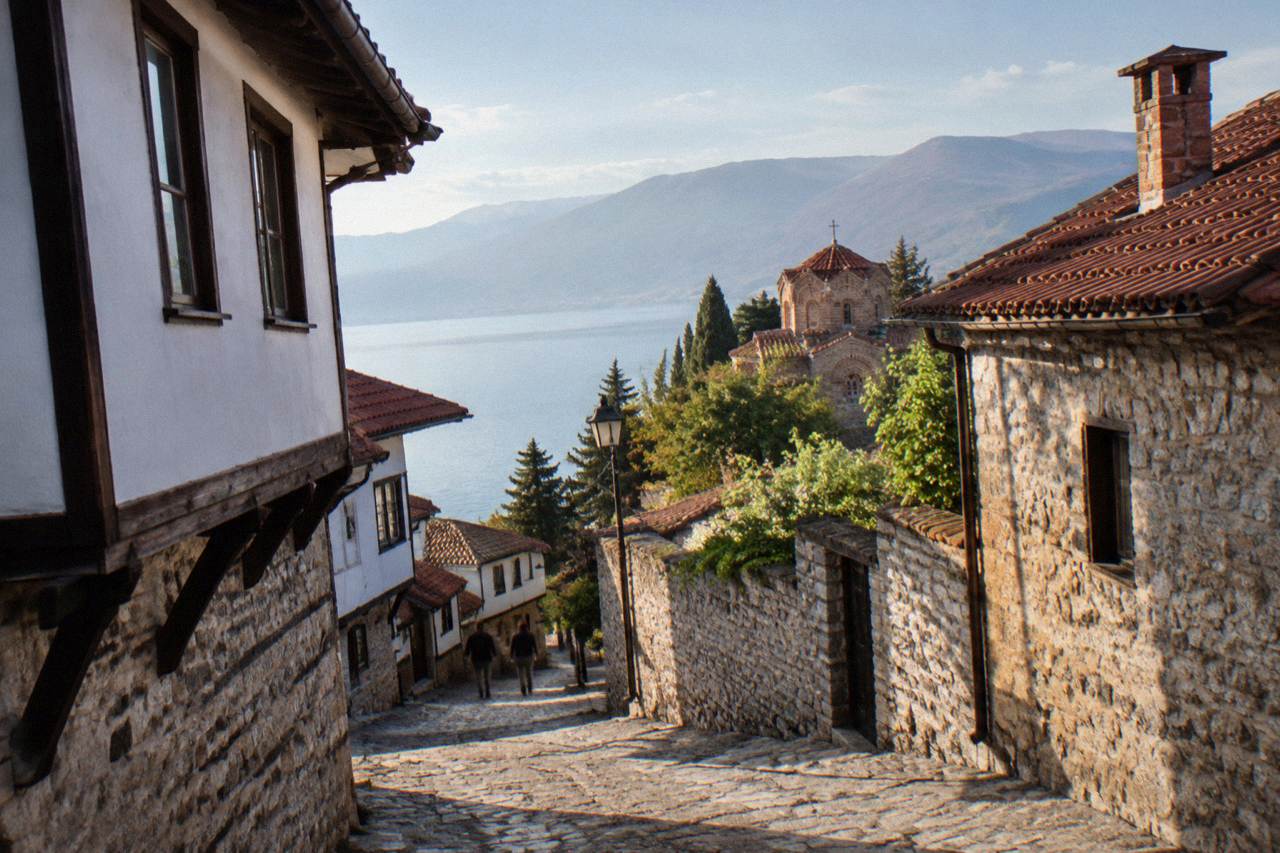
Short answer
Visitor parking is restricted on the Old Town streets of Ilindenska, Kosta Abrash and Car Samoil, which became resident-only from summer 2026 with clamping for non-residents. Ohrid is compact and best explored on foot, and many visitors arrive by bus from Skopje or via Ohrid Airport 10 km away.
Ohrid sits on the shore of Lake Ohrid, a freshwater mountain lake whose surface sits at about 693 m above sea level, and its Old Town climbs from the water up narrow stone lanes toward Samuel's Fortress. Those lanes are the reason parking in Ohrid needs a little planning: from summer 2026 several Old Town streets became resident-only under a municipal regime, with clamping reported for non-residents who ignore it. This Ohrid Travel Guide page sets out what that means in practice, how to arrive without a car at all, and what to do once you have left one behind.
Where Can You Park When Visiting The Old Town In Ohrid?
The practical answer is to park outside the Old Town core and walk in, because the narrow streets inside it are not built for visitor traffic and, from summer 2026, a resident-only parking regime applies on several of them. Under that regime, reported by local media, the streets Ilindenska, Kosta Abrash and Car Samoil in the old part of Ohrid are reserved for residents holding a valid sticker, and non-resident vehicles risk being clamped. The change was introduced around July 2026, so treat it as the current rule of thumb rather than a permanent law, and check locally on arrival.
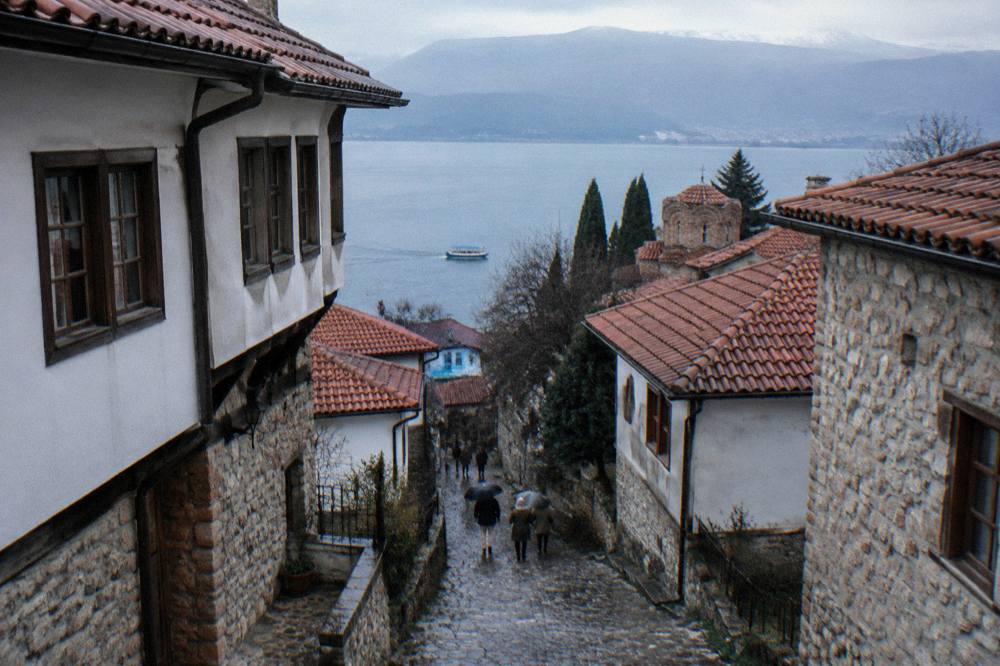
The geography explains the policy. The Old Town runs downhill from the fortress to the lake and the Old Bazaar, and the streets between are narrow, stone-paved and shared with pedestrians for most of the day. Anyone staying inside the old core should confirm with the accommodation where a car can be left, since the answer differs street by street. Visitors basing themselves elsewhere can look at the where to stay in Ohrid guide for districts with easier vehicle access.
What you should not expect is a priced, published tariff for Old Town parking. Where a figure matters, such as the Galicica National Park vehicle fee on a day trip, it appears further down with its source attached. For the streets themselves, the resident-only rule is the fact that matters.
Why Is Ohrid Best Explored On Foot Rather Than By Car?
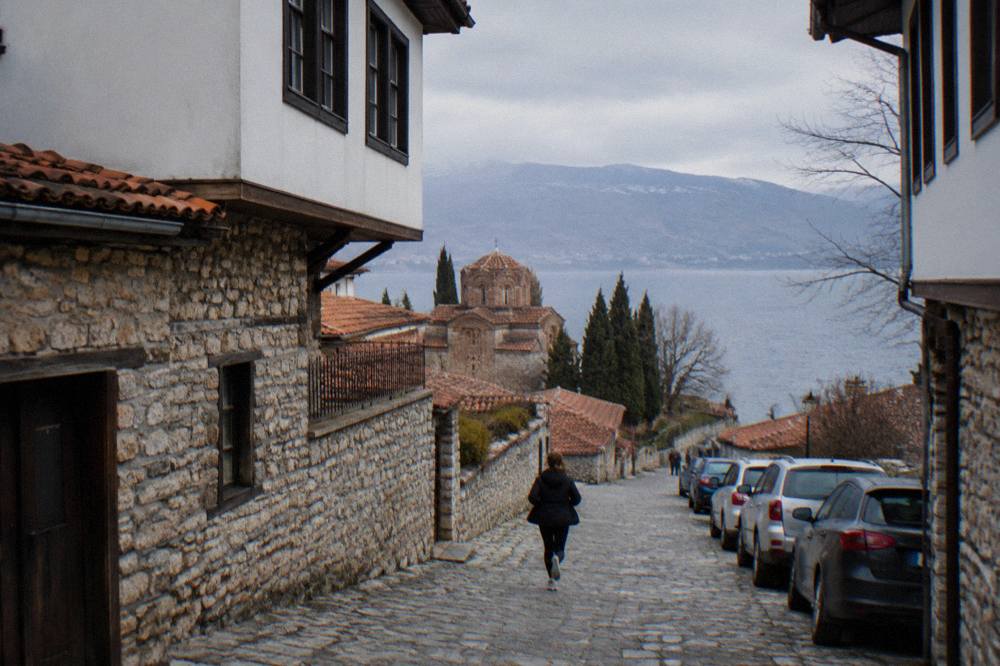
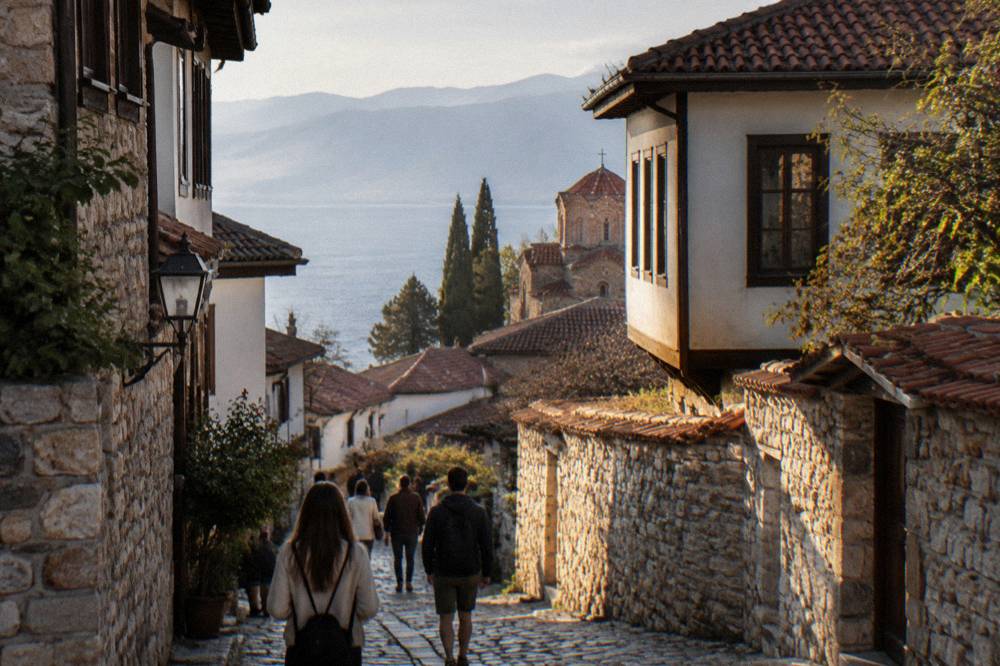
Once the car is parked, Ohrid rewards walking more than driving, because the sights that define the town, the fortress, the churches, the Ancient Theatre and the Old Bazaar, are linked by lanes that were laid out long before cars and sit within a compact hillside area. The town has no trams and no bike share, and the lakeside boardwalk connects the port area to the swimming spots on foot. A sensible plan is a parking spot outside the old core plus a day on foot, following something like the one day in Ohrid route.
The hill is the thing to plan around. The Old Town climbs from the lake to the fortress, so the walk up is steady and the walk down is easy, and the lanes in between hold the Old Town churches and workshops that a car would only separate you from. The boardwalk along the lake keeps to flat ground where the streets do not.
A guided walk is one way to cover the ground with someone who knows which lane leads where, and the roster includes a small-group Old Town walking tour among its options. The touring picks below show what that looks like in practice, alongside boat and food experiences that also start from the town centre.
Do You Even Need A Car In Ohrid?
Many visitors do not bring a car at all: Ohrid is reachable by intercity bus from Skopje in about 3 hours over roughly 170 km, by minibus from Tirana in about 3 to 3.5 hours including the border, and by air through Ohrid St Paul the Apostle Airport, which sits about 10 km from the town centre. Within the town everything of first importance is walkable, and the main excursions, St Naum, Struga, Galicica and the lake itself, are covered by tours, boats and local buses rather than requiring your own wheels.
That said, a car earns its keep for a lake circuit or a week of day trips, and the decision usually comes down to itinerary length rather than town parking. The short-stay maths favours arriving without one; a longer stay around Lake Ohrid and its villages can justify it.
| Route to Ohrid | Distance or duration | Fare or cost figure | Note |
|---|---|---|---|
| Skopje to Ohrid intercity bus | About 170 km, about 3 hours | 850 to 950 MKD one way | Multiple daily departures, more in summer |
| Tirana to Ohrid minibus (furgon) | About 3 to 3.5 hours including the border | About EUR 15 to 20 one way | Roughly 5 to 7 departures a day, crossing at Qafe Thane / Kjafasan |
| Ohrid Airport (OHD) to the centre | About 10 km via the E65 | Airport taxi reported at about 600 to 800 MKD | No regular public shuttle bus |
| Skopje to Ohrid by car | About 172 km, about 2.5 hours | About 140 MKD in tolls at plazas | Tolls paid per section, no vignette |
Arriving by air changes the picture least of all: the airport lies west of the centre on the E65, a short drive in, and the Ohrid Airport guide covers the airlines and seasonal routes. There is no passenger train to Ohrid from anywhere, and no domestic flight from Skopje, so the table above is effectively the full set of options.
What Should You Know About Driving To Ohrid?
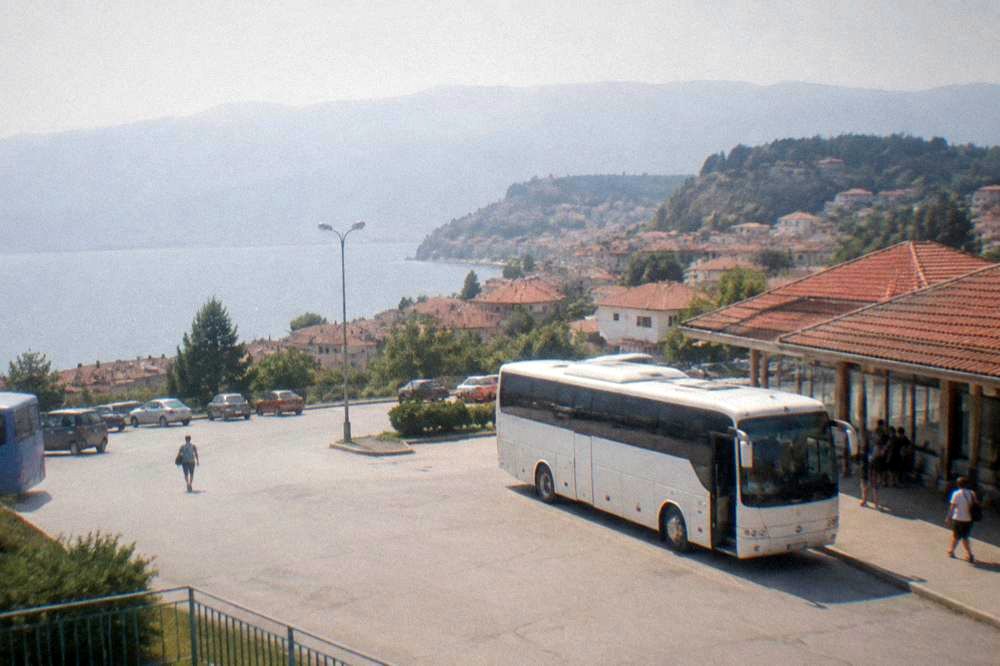
North Macedonia drives on the right, requires headlights on day and night, and asks foreign drivers to carry a green card for insurance, with motorway tolls paid at each plaza rather than through a vignette, so the practical advice is to confirm the current driving rules with your rental company before setting off. The main road project to know about is the Kicevo to Ohrid motorway: it remains under construction, with the Izvor to Vrbjani section of about 10 km due to open in the coming months and full opening expected in the first half of 2027.
Until that motorway is finished, the last stretch into Ohrid is ordinary road, and in winter the wider region can see snow: the ERA5 reanalysis normals for Ohrid put the January mean daily low at about -0.8 C and December's at about 0.9 C. None of this is difficult driving, but it argues for daylight arrivals between November and March.
Inside the town, everything said about the resident-only streets applies, and the honest summary of garage and lot pricing is that no figure is offered here. What can be said is structural: the old core is small, the newer parts of town around it carry the everyday traffic, and hotels outside the Old Town generally have their own arrangements. Confirm parking at the point of booking, in writing, and the question is solved before you arrive.
How Does The Season Change Parking And Crowds In Ohrid?
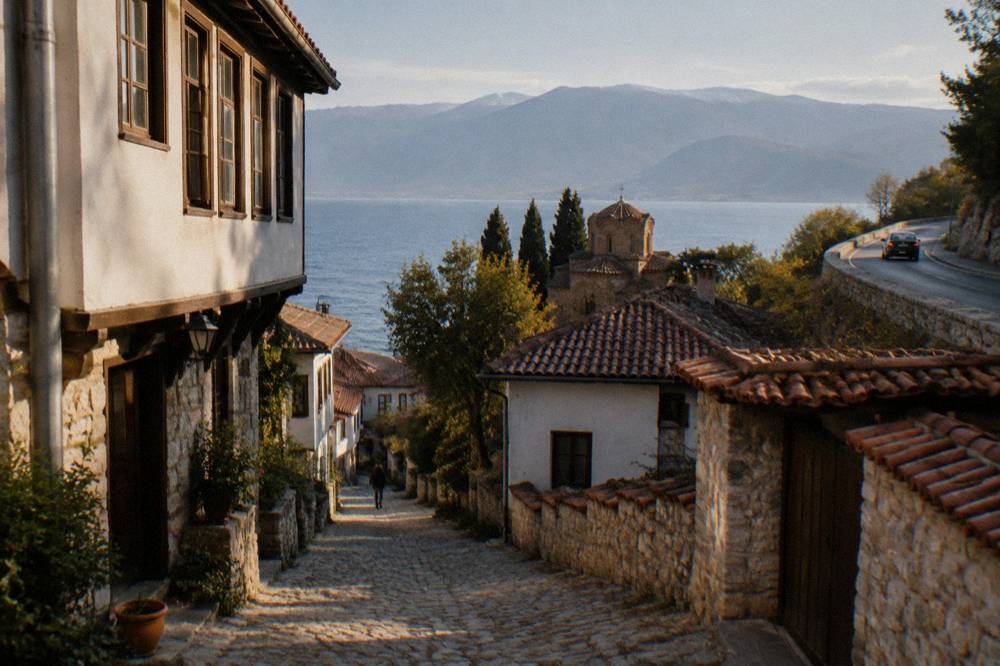
The high season runs roughly June to September with August the busiest month, museum sites switch to a winter schedule on 1 October that runs to 30 April with shorter hours and a Monday closure, and lake boats to St Naum operate about May to October with a reduced winter service, so the time of year shapes both how tight parking feels and what is reachable once you have parked. A shoulder-month visit, May or late September, trades the fullest boat schedule for thinner traffic on the streets.
The museum hours are worth knowing because they anchor a walking day. The Institute and Museum Ohrid runs its listed sites, including Robev Family House, the Museum on Water at the Bay of Bones and the Icon Gallery, on the two schedules below, and each closes on Mondays.
| Museum site | Winter hours (1 Oct to 30 Apr) | Summer hours (from 1 May) | Closed |
|---|---|---|---|
| Robev Family House | 09:00 to 15:30 | Two shifts, 09:00 to 15:30 and 13:30 to 20:00 | Monday |
| Museum on Water, Bay of Bones, Peshtani | 09:00 to 15:30 | 09:00 to 16:30 | Monday |
| Icon Gallery, Perivleptos complex | 09:00 to 14:00 | 09:00 to 17:00 | Monday |
The modelled climate normals tell the same story from the weather side. These are ERA5 reanalysis values for 1991 to 2020 at Ohrid, not a weather-station record, and they show why July and August dominate the calendar: those months combine the highest mean daily highs, 27.1 C and 27.6 C, with the lowest monthly rainfall, 34.7 mm and 32.9 mm.
| Month | Mean daily high | Mean daily low | Rain |
|---|---|---|---|
| Jan | 5.0 C | -0.8 C | 76.5 mm |
| Feb | 6.3 C | 0.0 C | 74.3 mm |
| Mar | 10.0 C | 2.5 C | 80.5 mm |
| Apr | 14.6 C | 6.3 C | 82.4 mm |
| May | 19.5 C | 10.8 C | 70.8 mm |
| Jun | 24.2 C | 15.2 C | 43.1 mm |
| Jul | 27.1 C | 18.3 C | 34.7 mm |
| Aug | 27.6 C | 19.0 C | 32.9 mm |
| Sep | 22.4 C | 14.9 C | 62.4 mm |
| Oct | 17.4 C | 10.3 C | 76.0 mm |
| Nov | 11.5 C | 5.3 C | 90.4 mm |
| Dec | 6.2 C | 0.9 C | 92.6 mm |
The Ohrid weather page expands on this month by month, and the best time to visit Ohrid page weighs the seasons against the festival calendar. For winter arrivals, the Ohrid in winter guide covers what keeps running when the boats thin out.
What Can You Do Around Ohrid Without Moving The Car?
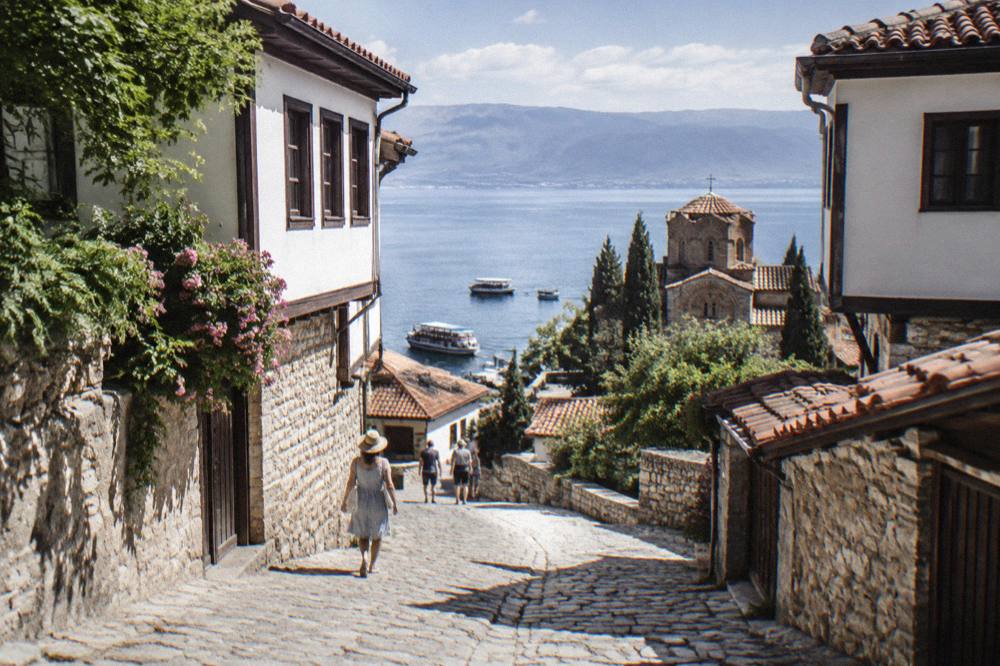
Once the car is parked, the town's core experiences all start within walking distance of the port and the Old Town: guided walking tours of the lanes and churches, panoramic boat cruises from the harbour, and cooking classes that put you in a kitchen rather than behind a wheel. The lake is the town's second street, so to speak, and the waterfront connects the departure points on foot. The things to do in Ohrid round-up maps the full set, from Samuel's Fortress down to the water.
The Old Town walking tour is the natural companion to a car-free day, since it covers the hill, the fortress approach and the church quarter in one loop; you can Check availability on the operator's live listing. The panoramic boat cruise and Tito's Residence trip adds the view of the town from the water, and the cooking classes slot into an evening or a rainy afternoon.
For a lake day without driving, the full-day boat cruise from Ohrid port to St Naum, run by operator Boat Armada, covers about 7 hours with stops including the Bay of Bones, from 1,200 den per adult and 600 den per child. St Naum monastery itself charges 150 MKD entrance per person, and the rowboat through the Crn Drim springs near the monastery costs about 5 EUR, both figures from the cruise operator's own listing.
| Car-free activity from Ohrid | Key figure | Source basis |
|---|---|---|
| Full-day boat cruise, Ohrid port to St Naum | 7 hours, from 1,200 den adult, 600 den child | Boat Armada listing |
| St Naum monastery entrance | 150 MKD per person | Cruise operator's listing |
| Rowboat at the Crn Drim springs | About 5 EUR per boat | Cruise operator's listing |
| Museum institute sites (Robev House, Bay of Bones, Icon Gallery) | 150 MKD foreign, 120 MKD domestic, 60 MKD children and students | Institute ticket page |
Evenings work the same way. The lanes between the Old Bazaar and the port hold the restaurants, and the Ohrid restaurants guide walks that ground on foot, exactly as the nightlife itineraries do. Nobody drives to dinner in the old core, and after the 2026 parking regime, nobody should try.
What Rules Apply On The Lake And At Galicica In 2026?
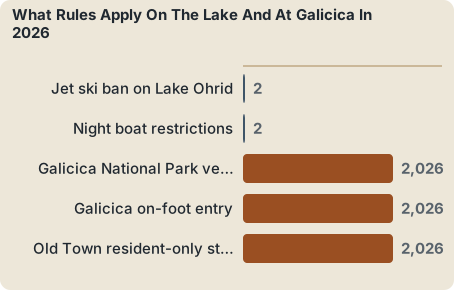
Two dated 2026 rules matter around the water: a government decision of 2 June 2026 bans jet skis on the lake from 1 July to 31 August between 11:00 and 19:00 and restricts boats at night through the summer and into October, and Galicica National Park charges 250 MKD per vehicle with no per-passenger fee, or 100 MKD for someone entering on foot from the Ohrid-side gate. Both are written with their dates because rules like these change, and a visitor should treat them as the 2026 position rather than a permanent regime.
The lake rules exist for swimmer safety, and they sit alongside the navigation detail that the night-boat limits run 21:00 to 05:00 from 3 June to 31 August and 20:00 to 06:00 through September, with a further October limit in the same decision. For anyone planning an evening cruise, that is the frame to check against.
Galicica is the second national park in North Macedonia, proclaimed in 1958, covering 22,750 ha between Lake Ohrid and Lake Prespa, with Magaro peak at 2,254 m. It is open year-round, but heavy snow can close the main road, typically between January and March, which matters for a winter drive across to Lake Prespa country. The park's official site runs a live camera page, useful for a same-day check of conditions.
| 2026 rule or fee | Detail | Date basis |
|---|---|---|
| Jet ski ban on Lake Ohrid | 1 Jul to 31 Aug, 11:00 to 19:00 | Government decision, 2 Jun 2026 |
| Night boat restrictions | 3 Jun to 31 Aug 21:00 to 05:00; 1 to 30 Sep 20:00 to 06:00; further October limit | Government decision, 2 Jun 2026 |
| Galicica National Park vehicle fee | 250 MKD per vehicle, no per-passenger charge | 2026 reported figures |
| Galicica on-foot entry | 100 MKD, Ohrid-side gate | 2026 reported figures |
| Old Town resident-only streets | Ilindenska, Kosta Abrash, Car Samoil; clamping reported for non-residents | From summer 2026 |
Which Practical Numbers Should You Keep Handy In Ohrid?
The numbers worth saving are the emergency lines, ambulance 194, police 192 and roadside assistance 196, plus the currency fact that North Macedonia uses the denar (MKD), which trades around 61.5 to the euro under a de facto peg, and the entry fact that the country is neither in the EU nor in Schengen. Euros are commonly quoted for tours and transfers but are not legal tender, so small local costs, museum tickets and park fees are paid in denars. The denar and money page covers exchange and cards in detail.
Registration is one rule drivers and non-drivers share: visa-free visitors register with the local police within 48 hours of arrival, and a hotel normally does it for you. Visa-free stays run up to 90 days in any 180-day period for most visa-free nationals, and UK visitors can stay up to 3 months with a passport valid at least 90 days after arrival. The visa and entry page carries the full detail.
| Practical item | Figure or rule |
|---|---|
| Ambulance | 194 |
| Police | 192 |
| Roadside assistance | 196 |
| Currency | Macedonian denar (MKD), de facto peg near 61.5 to the euro |
| EU / Schengen status | North Macedonia is in neither |
| Police registration | Within 48 hours of arrival, normally handled by the hotel |
| Visa-free stay | Up to 90 days in any 180-day period |
Safety-wise, Ohrid is an ordinary Balkan lakeside town, and the is Ohrid safe page addresses the question directly. The parking question is less about crime than about geometry and the 2026 street regime: a hill town with resident-only lanes at its centre is simply easier on foot, and every figure in this page points the same way.
Common Questions About Parking In Ohrid
Can you park inside Ohrid's Old Town?
The Old Town streets are not open to general visitor parking, and from summer 2026 the streets Ilindenska, Kosta Abrash and Car Samoil are resident-only, with clamping reported for non-residents. Park outside the old core and walk in.
Where should you stay in Ohrid if you are bringing a car?
Accommodation outside the Old Town core generally has its own parking arrangements, while stays inside the old lanes need a written confirmation from the host about where a car can be left. The where to stay in Ohrid guide breaks the districts down.
Do you need a car in Ohrid at all?
Most first visits do not. The town centre is walkable, intercity buses reach Ohrid from Skopje in about 3 hours, minibuses run from Tirana in about 3 to 3.5 hours, and the airport is about 10 km out, so a car mainly pays off for a week of independent day trips.
Is there a train to Ohrid?
No. There is no passenger rail service to Ohrid, and no domestic flight from Skopje, so the bus, the road or the airport are the options.
Does it cost anything to drive into Galicica National Park?
Yes, Galicica charges 250 MKD per vehicle with no per-passenger fee in 2026, and 100 MKD applies only to someone entering on foot from the Ohrid-side gate. Heavy snow can close the main park road, typically January to March.
When is parking in Ohrid hardest?
In August, the busiest month of a June-to-September high season. Shoulder months such as May and late September bring thinner traffic on the streets while the boat season, which runs roughly May to October, is still running.