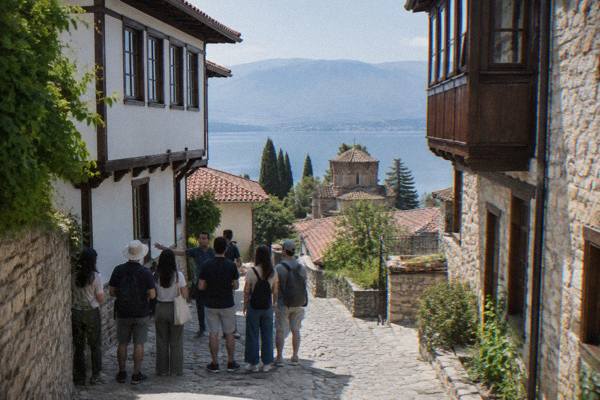
Ohrid Neighborhoods: Where To Spend Your Time
Ohrid in North Macedonia splits naturally into a walled Old Town on the hill, a lakeshore strip with the boardwalk and city beach, the Kaneo district under its clifftop church, and a string of shoreline villages to the south and east. This page maps each area, what it costs to enter the sights inside it, and how the districts fit together on foot and by boat.
Short answer
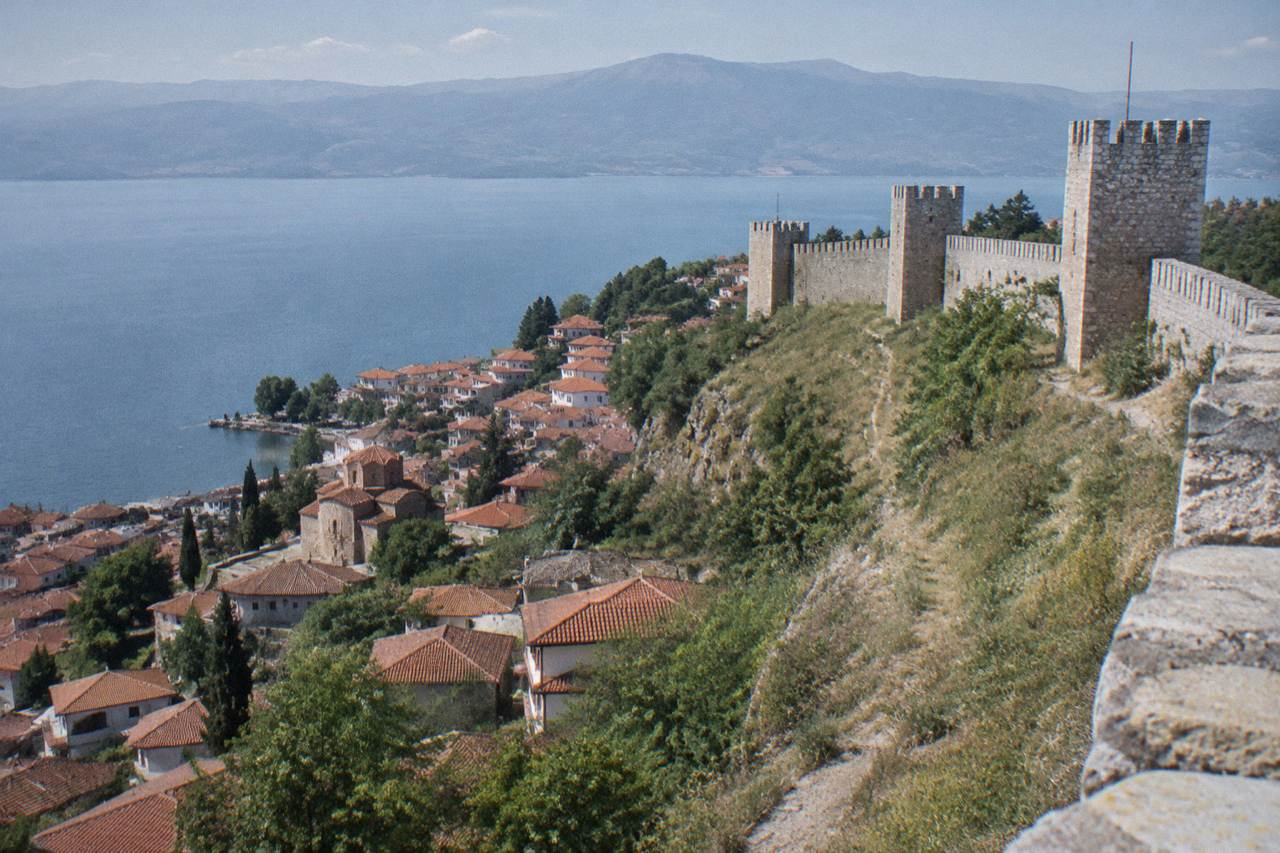
The Old Town and the Kaneo district hold nearly all the headline sights and are covered on foot; the lakeshore around the boardwalk is the flat, café-lined base; the villages of Peshtani, Trpejca and Ljubanista sit along and beyond the southern shore; and Struga is a separate town on Lake Ohrid's outflow, reached by bus.
Ohrid is a lake town in North Macedonia, built around a hill of churches between Samuel's Fortress and the shore of Lake Ohrid, a freshwater mountain lake sitting at about 693 m above sea level inside a UNESCO mixed World Heritage site. The town does not have formally gazetted boroughs the way a capital does, but it does have clearly distinct areas, and knowing them decides where you sleep, what you climb to and how much walking you do in a day. This Ohrid Travel Guide page lays out each area, the sights inside it and the published entry prices, so you can plan a stay around the districts rather than around a list of attractions scattered blindly across the map.
What Are The Main Areas Of Ohrid?
Ohrid divides into five practical areas: the Old Town on the hill between the fortress and the lake, the Kaneo district on the western cliff below the Church of St John at Kaneo, the flat lakeshore strip around the boardwalk and city beach, the southern and eastern shore villages of Peshtani, Trpejca and Ljubanista, and the separate town of Struga at the lake's outflow, about 100 to 150 MKD away by local bus.
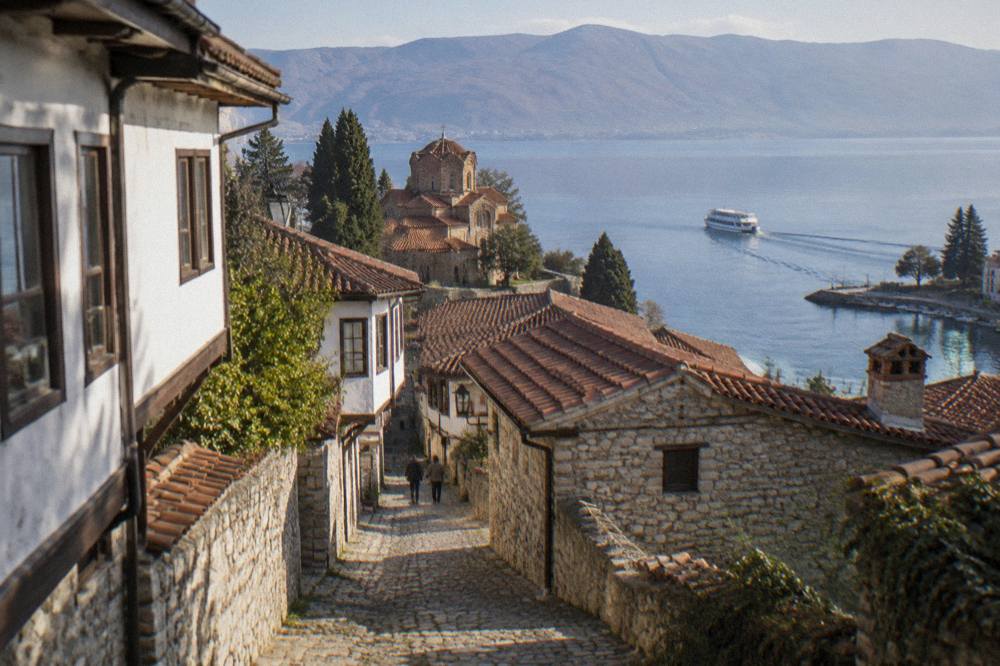
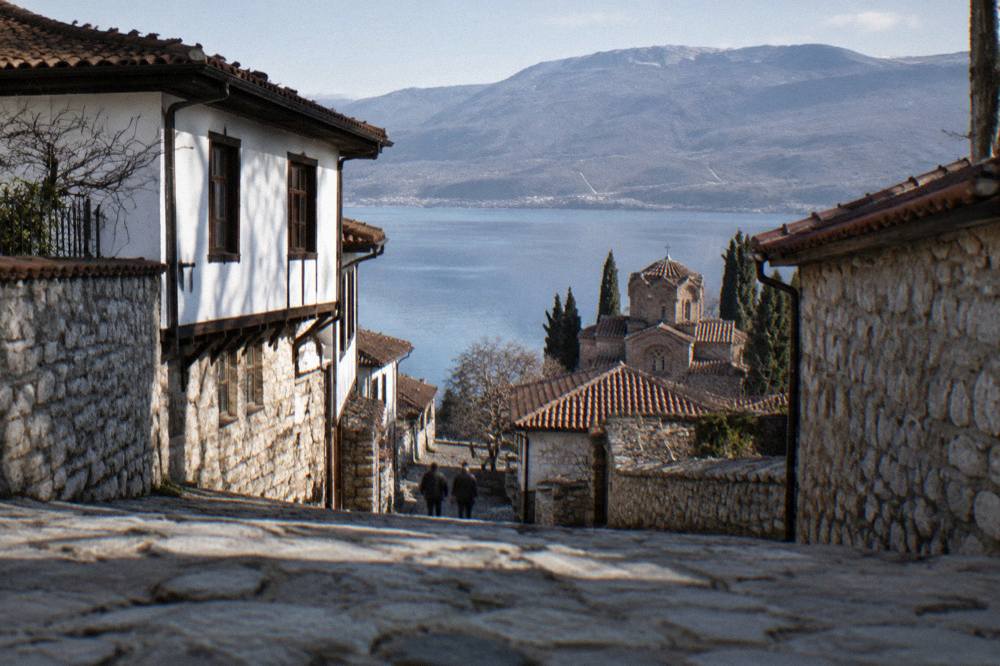
Each area has a different character and a different job. The Old Town carries the history: the Ancient Theatre, Plaosnik, St Sophia, the Old Bazaar and the Upper Gate, all connected by lanes that climb from the water to the fortress. Kaneo is the postcard district, a cluster of streets dropping to a small harbour under the church on the cliff. The lakeshore strip is where the boardwalk, the port and the flat evening stroll live. The shore villages are quieter, water-facing and boat-oriented. Struga is its own municipality on the Crn Drim, worth a look and covered in full on the Struga town guide.
The table below is the short version of the whole page.
| Area | Core sights | Ground | Best for |
|---|---|---|---|
| Old Town | Ancient Theatre, Plaosnik, St Sophia, Old Bazaar, Samuel's Fortress, Robev Family House | Steep lanes, on foot only | First visit, churches, museums |
| Kaneo district | Church of St John at Kaneo, small harbour | Steep descent to the water | The classic lake view, swimming below the church |
| Lakeshore strip | Ohrid boardwalk, port, city beach | Flat | Evening walks, boat departures, easy access |
| Southern shore (Peshtani) | Bay of Bones / Museum on Water, Gradiste beach | Road and boat access | Museum on Water, beach day |
| Eastern shore (Trpejca, Ljubanista) | Beaches, quiet water | Road and boat access | Quieter swimming, boat stops |
| Struga | Crn Drim outflow, Poetry Evenings venue town | Flat, separate town | A half-day side trip |
A one-day visit will realistically cover the Old Town, Kaneo and the lakeshore on foot, which is exactly the shape of the Ohrid in one day itinerary. Anything longer opens the shore villages, the eastern shore and Struga.
What Is The Old Town Of Ohrid Like?
The Old Town is the whole reason Ohrid is a UNESCO site: a compact hill of Byzantine churches, the Ancient Theatre, the Old Bazaar and the fortress hill, threaded by lanes that run on foot from the port up to the fortress walls, with the museum institute's sites priced at 150 MKD for foreign visitors, 120 MKD domestic and 60 MKD for children and students.
The institute behind most of the ticketed sites is the NI Institute and Museum Ohrid, whose tickets page lists those three rates for its listed sites, including Robev Family House, the Icon Gallery and the Museum on Water at the Bay of Bones. Its office hours are Monday to Friday 07:30 to 15:30 at Boro Shain St 10. The sites themselves run two seasonal schedules: winter from 1 October to 30 April, summer from 1 May to 30 September, and the individual sites close on Mondays.
| Museum site | Winter hours (1 Oct to 30 Apr) | Summer hours (1 May to 30 Sep) | Closed |
|---|---|---|---|
| Robev Family House, Tsar Samoil St 62 | 09:00 to 15:30 | Two shifts: 09:00 to 15:30 and 13:30 to 20:00 | Monday |
| Icon Gallery, Perivleptos complex | 09:00 to 14:00 | 09:00 to 17:00 | Monday |
| Museum on Water (Bay of Bones), Peshtani | 09:00 to 15:30 | 09:00 to 16:30 | Monday |
The Ancient Theatre, built at the end of the third or start of the second century BC in the late Hellenistic period and first excavated in 1935, sits mid-slope; its capacity rose to 5,000 after the epiteatron was added, and it still serves as an open festival stage, hosting the opening gala of the 66th Ohrid Summer Festival on 12 July 2026. Separate guides cover the Ancient Theatre, St Sophia, Plaosnik and Samuel's Fortress in detail.
The fortress itself has a municipal revitalisation plan, reported in 2026, that adds a summer stage and illumination on a budget of 11 million denars. A 2026 change that touches the Old Town directly is a resident-only parking regime introduced on streets including Ilindenska, Kosta Abrash and Car Samoil from summer 2026, with clamping reported for non-residents: arriving by car and parking on the old lanes is no longer a plan, the bus station and paid lots outside the old core are.
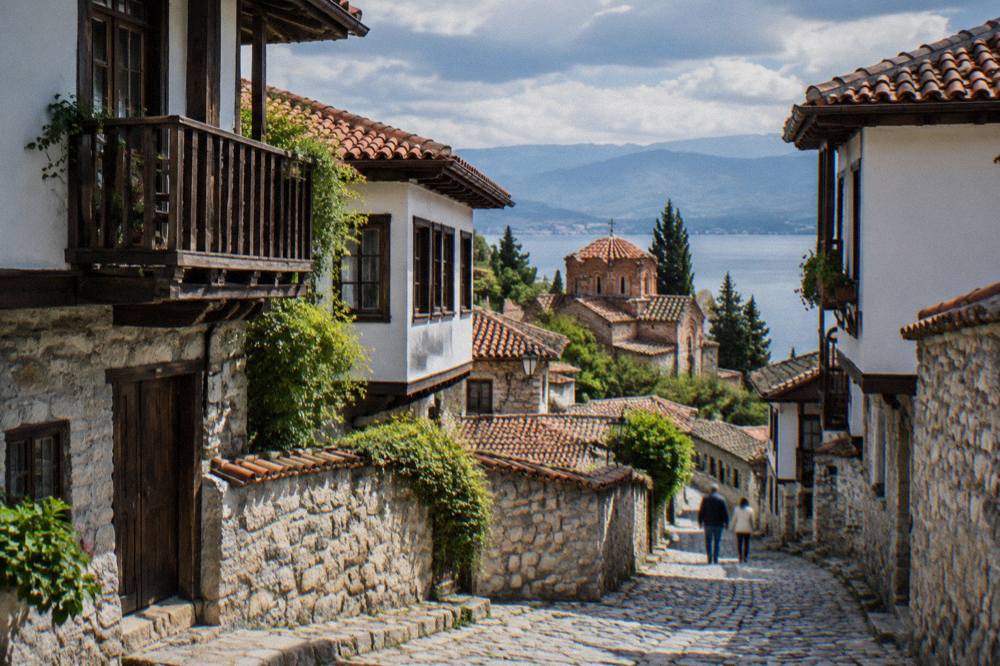
The lanes themselves are the district's infrastructure. The old town climbs from the lake to the fortress and the lanes are on foot, so where you sleep inside it decides how much climbing a day contains: a port-side room gives flat evenings, a room under the fortress gives the view and the stairs. The full district picture is on the Old Town area guide.
Where you sleep inside the old lanes shapes each day. Book a hotel in Ohrid here.
What Defines The Kaneo District?
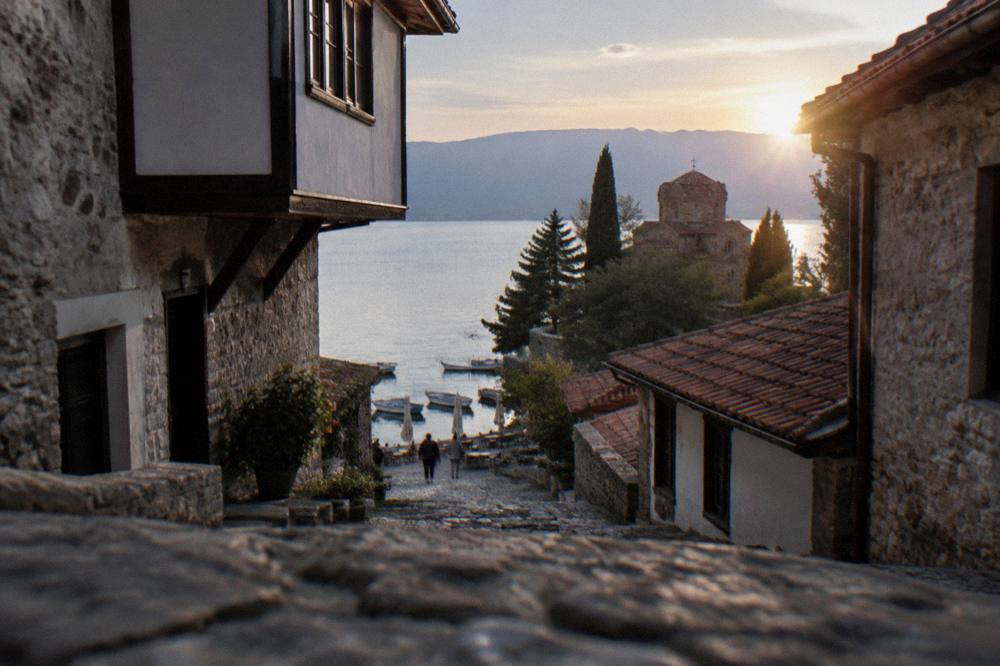
Kaneo is the small district on Ohrid's western cliff below the Church of St John at Kaneo, a stack of lanes dropping toward a tiny harbour and swimming rocks, reported by secondary sources as charging about 150 MKD for church entry with the exterior viewpoint free, and it is the single most photographed corner of the town.
The district around it is small enough to be walked in under an hour: the descent from the Old Town, the church terrace above the water, the harbour below and the climb back up toward the Upper Gate end of the fortress plateau.
Kaneo doubles as a swimming spot, with rocks and small platforms at the foot of the cliff, and as a sunset viewpoint. Two practical notes shape a visit. First, the climb back up from the harbour is steep and unshaded in the afternoon. Second, since the summer of 2026, jet skis are banned on the lake between 1 July and 31 August from 11:00 to 19:00, and boats are restricted at night between 3 June and 31 August from 21:00 to 05:00, under a government decision of 2 June 2026 aimed at swimmer safety, which affects how busy the water directly below the church is during the day.
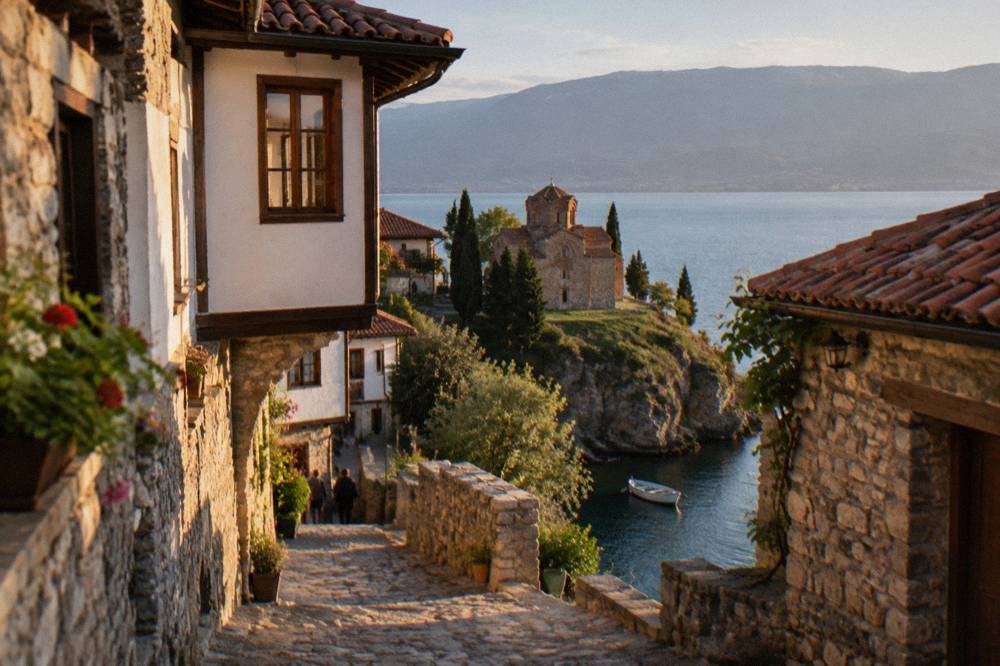
The district pairs naturally with the Old Town in a single morning: down through the lanes to the church, along the water, then up to the fortress plateau while the air is still cool. The district's own page, the Kaneo district guide, goes deeper on the church and the harbour.
What Is The Lakeshore Strip Around The Boardwalk?
The lakeshore strip is Ohrid's flat zone: the port, the Ohrid boardwalk, the city beach and lido, and the line of cafés and boat departure points between them, all reachable without climbing, which is why it serves as the town's default evening promenade and the practical base for anyone who wants the sights without the stairs.
The boardwalk page covers the waterfront itself. What matters for neighborhood planning is that this strip is where the lake traffic happens: the full-day boat cruise run by operator Boat Armada from Ohrid port to St Naum takes 7 hours and costs from 1,200 den for an adult and 600 den for a child, with stops including the Bay of Bones. That cruise is also the easiest way to connect the lakeshore strip with the southern shore villages in one move, and it ties the districts together without any driving.
The port end of the strip is also where tour transport concentrates, including guided old town walks, and the operator's live listing for the small-group Old Town walk is bookable at Check availability.
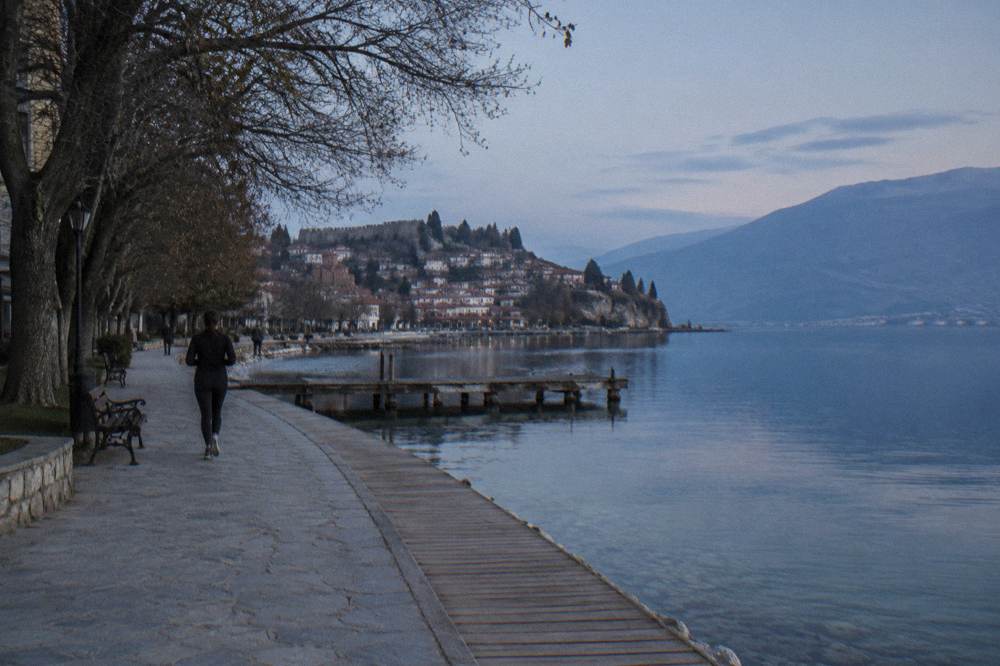
The swimming here is town swimming. The 2026 bathing water tests, run by the Institute of Public Health in May and June, rated most Ohrid sampling points physico-chemically Class I and microbiologically Excellent or Good, with Grashnica beach the exception at Class III, so the city beach and lido zone tested well this season while Grashnica did not.
What Are The Southern Shore Villages: Peshtani, Trpejca And Ljubanista?
The southern and eastern shore villages are separate small settlements strung along the lake road: Peshtani is home to the Bay of Bones, where the Museum on Water charges 150 MKD for foreign visitors and runs 09:00 to 16:30 in summer, closed Mondays, while Trpejca and Ljubanista further east are water-and-beach villages reached by road or by the boat cruise.
The Bay of Bones is the anchor sight of this shore: a reconstructed pile-dwelling settlement on the water at Gradishte near Peshtani, on the museum institute's ticket system at the same 150/120/60 MKD rates as the town museums. The operator Armada's own cruise page independently lists the Bay of Bones entrance at 150 MKD per person as an item not included in its boat fare, which matches the institute's rate.
The villages each have their own page: Lagadin and Peshtani and Trpejca and Ljubanista. What unites them as a planning zone is the water. Modelled surface temperatures for Lake Ohrid, from aggregator data rather than a station record, show the lake at about 4.6 C in January, 22.9 C in July and 23.5 C in August, with the UHMR multi-year October mean at 14.3 C: in plain terms, the swimming season around these villages runs from about July, which is exactly when the beaches here come into their own.
| Month | Modelled lake surface temp (C) | Old Town mean high (C) | Rain (mm) |
|---|---|---|---|
| January | 4.6 | 5.0 | 76.5 |
| April | 10.5 | 14.6 | 82.4 |
| July | 22.9 | 27.1 | 34.7 |
| August | 23.5 | 27.6 | 32.9 |
| October | 14.7 | 17.4 | 76.0 |
The air-temperature columns are ERA5 reanalysis climate normals, 1991 to 2020, for the grid cell over Ohrid, not a station record. November averages 90 mm of rain and December 92.6 mm, while August comes in at 32.9 mm, which is why the shore villages feel like a summer district rather than a year-round one: boats to St Naum run about May to October with a reduced winter schedule.
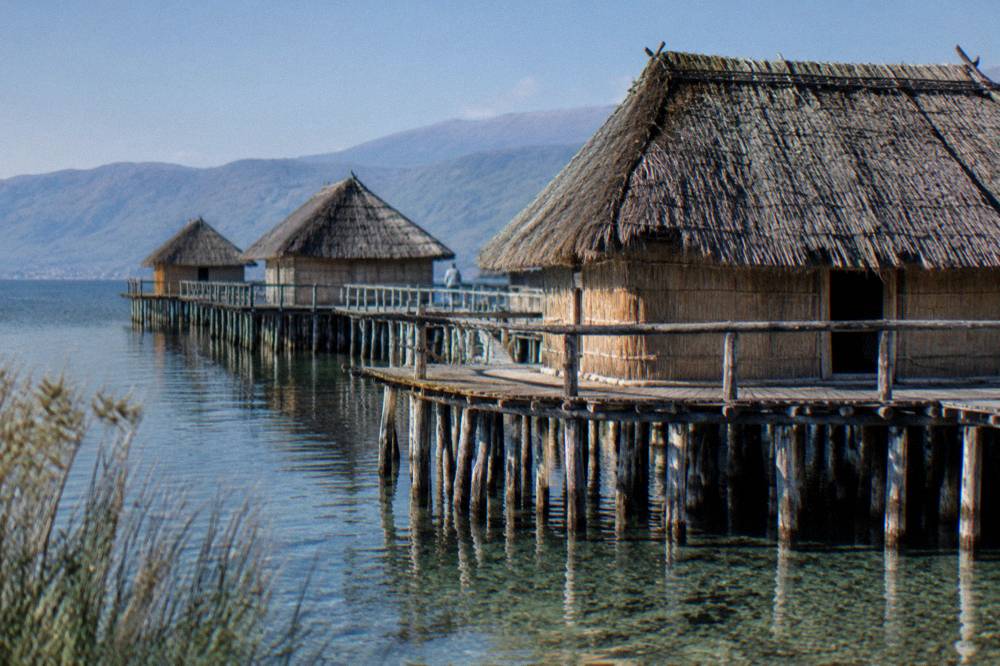
Village time is also where the cave churches and cuisine tours point, covering ground that the town-center districts never touch, and the eastern shore road continues toward St Naum at the southern end of the lake, where the monastery entrance is listed by the cruise operator at 150 MKD and a rowboat through the Crn Drim springs at about 5 EUR.
Is Struga A Neighborhood Of Ohrid?
No: Struga is a separate town on the Crn Drim, the outflow of Lake Ohrid, about 15 km up the shore and linked to Ohrid by local buses reported at 100 to 150 MKD one way, and it is a side trip from Ohrid rather than a district of it, best known as the venue town of the Struga Poetry Evenings, whose 65th edition ran 24 to 29 June 2026.
The two towns are regularly confused because they share the lake and the bus corridor, but they are separate municipalities. Struga's own page, the Struga town guide, covers the differences in full. The Poetry Evenings moved in 2026 from their traditional late-August slot to 24 to 29 June, with about 70 poets and the theme 'Where Poetry Lives', one day longer than before.
For neighborhood purposes, Struga answers a different question: it is flat, it sits on running water where Ohrid sits on still water, and it makes an easy half-day by bus. The border context matters too: the main Tirana to Ohrid minibus route crosses at Qafe Thane near Struga, with roughly 5 to 7 furgons a day from Tirana at about EUR 15 to 20, 3 to 3.5 hours including the border.
Where Should You Base Yourself Among The Ohrid Neighborhoods?
Base in the lakeshore strip for flat access, boat departures and evening life; base inside the Old Town for atmosphere and proximity to the churches at the cost of stairs and, since summer 2026, resident-only parking on the old lanes; base in Kaneo for the view; and base in the shore villages only if swimming and quiet are the point of the trip, accepting that dinner and the evening promenade then mean a bus or a boat back to town.
The table below is the honest trade-off summary, using only figures the sources publish.
| Base | Entry cost to its key sight | Getting to the Old Town | Trade-off |
|---|---|---|---|
| Lakeshore strip / boardwalk | Port, boardwalk, city beach: no ticket | Flat walk into the Old Town lanes | Least atmospheric, most convenient |
| Old Town | Institute sites 150 MKD foreign / 120 MKD domestic | You are in it | Stairs, and street parking reserved for residents since summer 2026 |
| Kaneo district | St John at Kaneo: about 150 MKD (secondary source) | Short steep climb | View premium, climb cost |
| Peshtani | Museum on Water 150 MKD foreign / 120 MKD domestic | Road or boat | Boat-dependent days out of season |
| Struga | Separate town, own sights | 100 to 150 MKD by bus | A side trip, not an Ohrid base |
Timing shapes the choice as much as geography. The best time to visit Ohrid question, and its lake-specific version when is the best time to visit Lake Ohrid, both point the same way: the peak runs June to September with August the high point, boats run about May to October, and the museum sites drop to their shorter winter hours from 1 October. An August stay in the shore villages and a November stay there are two different trips entirely.
How Do The Ohrid Neighborhoods Connect Without A Car?
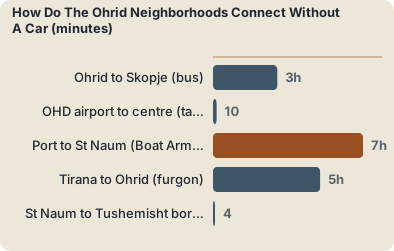
Ohrid's districts connect on foot within town, by boat along the shore in the May to October season, and by bus along the lake road, with the two facts that matter being that the Old Town lanes are walking-only and that no passenger train reaches Ohrid at all: the practical spine is the port for boats, the bus station at Vele Markov for regional buses, and the lakeshore strip as the flat connector between them.
The bus station sits east of the center, about 20 to 30 minutes on foot from the Old Town or a short taxi ride, with town taxis reported from about 150 to 200 MKD for the hop. Regional connections from there: Skopje is about 170 km away, roughly 3 hours by bus at 850 to 950 MKD, while the airport, Ohrid St Paul the Apostle (OHD), is about 10 km from the centre on the E65 with an airport taxi reported at 600 to 800 MKD. Getting to Ohrid from the capital or the airport is covered in the wider things to do in Ohrid planning pages.
| Connection | Distance / time | Fare as published |
|---|---|---|
| Ohrid to Struga (local bus) | Short lake-road hop | 100 to 150 MKD (older guides, confirm) |
| Ohrid to Skopje (bus) | About 170 km, about 3 h | 850 to 950 MKD |
| OHD airport to centre (taxi) | About 10 km | 600 to 800 MKD reported |
| Port to St Naum (Boat Armada day cruise) | 7 hours round trip | From 1,200 den adult, 600 den child |
| Tirana to Ohrid (furgon) | 3 to 3.5 h via Qafe Thane | About EUR 15 to 20 |
| St Naum to Tushemisht border | About 4 km, about 10 min | Taxi quoted 400 den |
The boat line in that table deserves emphasis for neighborhood planning: the 7-hour cruise from the port calls at the Bay of Bones, which is the single link that stitches the lakeshore strip to Peshtani and the southern shore without a car, and the same operator's page lists the St Naum monastery entrance and the springs rowboat as separate items.
What Does Each Ohrid Area Add On A Second Or Third Day?
The first day belongs to the Old Town and Kaneo, the second to the lake itself, with the Bay of Bones cruise, the shore villages and Galicica National Park filling it, and the third to the wider region, with Struga, the Albanian side of the lake and the Skopje or Tirana corridors as the realistic picks, each of them a day trip outward from Ohrid rather than a neighborhood inside it.
Galicica, North Macedonia's second national park, designated in 1958, spans 22,750 ha between Lake Ohrid and Lake Prespa with Magaro peak at 2,254 m, and it levies 250 MKD per vehicle with no per-passenger fee, or 100 MKD only for someone entering on foot from the Ohrid-side gate; its main road can close under snow, typically January to March. Lake Prespa itself sits about 148 m higher than Lake Ohrid across the Galicica ridge, per the UHMR gauges of 19 October 2026. The longer itineraries, Ohrid in two days style planning and the cross-country Ohrid to Kotor route, all assume this same second-and-third-day split.
The UNESCO framing holds the whole map together: the Natural and Cultural Heritage of the Ohrid region, inscribed 1979 and 1980 and extended to the Albanian part in 2019, covers about 94,729 ha, and the World Heritage listing records the oldest Slav monastery at Plaosnik's St Panteleimon, more than 800 Byzantine-style icons from the 11th to the end of the 14th century, a lake that has existed about two to three million years, and over 200 endemic species including 17 endemic fish. On 24 July 2026 the World Heritage Committee decided not to inscribe the property on the List of World Heritage in Danger, asking instead for a joint report by 1 February 2029.
Common Questions About Ohrid Neighborhoods
What are the main neighborhoods of Ohrid?
The practical areas are the Old Town on the hill, the Kaneo district on the western cliff, the flat lakeshore strip around the boardwalk and port, the southern and eastern shore villages of Peshtani, Trpejca and Ljubanista, and the separate town of Struga on the lake's outflow.
Is the Ohrid Old Town walkable?
Yes, and it is walkable only: the lanes climb from the lake to the fortress on foot, a resident-only parking regime has applied to several old-town streets since summer 2026, and buses and taxis serve the edges rather than the lanes themselves.
How much do the Old Town museum sites cost in Ohrid?
The museum institute lists its sites, including Robev Family House and the Icon Gallery, at 150 MKD for foreign visitors, 120 MKD for domestic visitors and 60 MKD for children and students, with sites closed on Mondays and on winter hours from 1 October to 30 April.
What is the Kaneo district known for?
Kaneo is known for the Church of St John at Kaneo on its cliff above the lake, its small harbour and the swimming rocks below the church; the church entry is reported at about 150 MKD by secondary sources, and the fortress plateau connects above it.
Should I stay in Ohrid town or in the shore villages?
Stay in town for walkable access to the Old Town, Kaneo and the boardwalk, and in Peshtani, Trpejca or Ljubanista if swimming and quiet come first, bearing in mind that boats run about May to October and the villages are road-dependent outside that season.
Is Struga part of Ohrid?
No, Struga is a separate town and municipality on the Crn Drim at Lake Ohrid's outflow, linked to Ohrid by local buses reported at 100 to 150 MKD, and best known for hosting the Struga Poetry Evenings, whose 65th edition ran 24 to 29 June 2026.