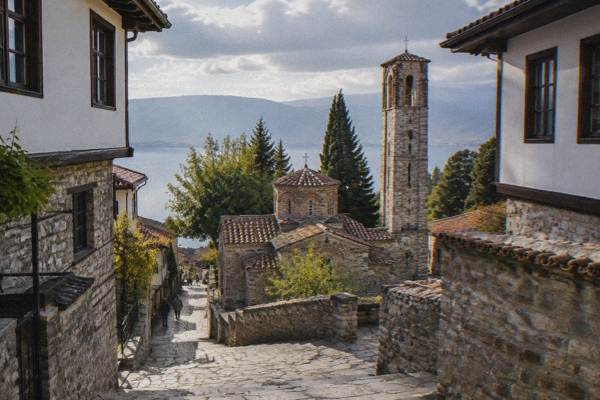
Best Time To Visit Ohrid: Month By Month
The best time to visit Ohrid depends on what you want from Lake Ohrid: July and August bring the modelled warmest water and the festival season, June and September bring thinner crowds with warm air, and May to October is the boat season.
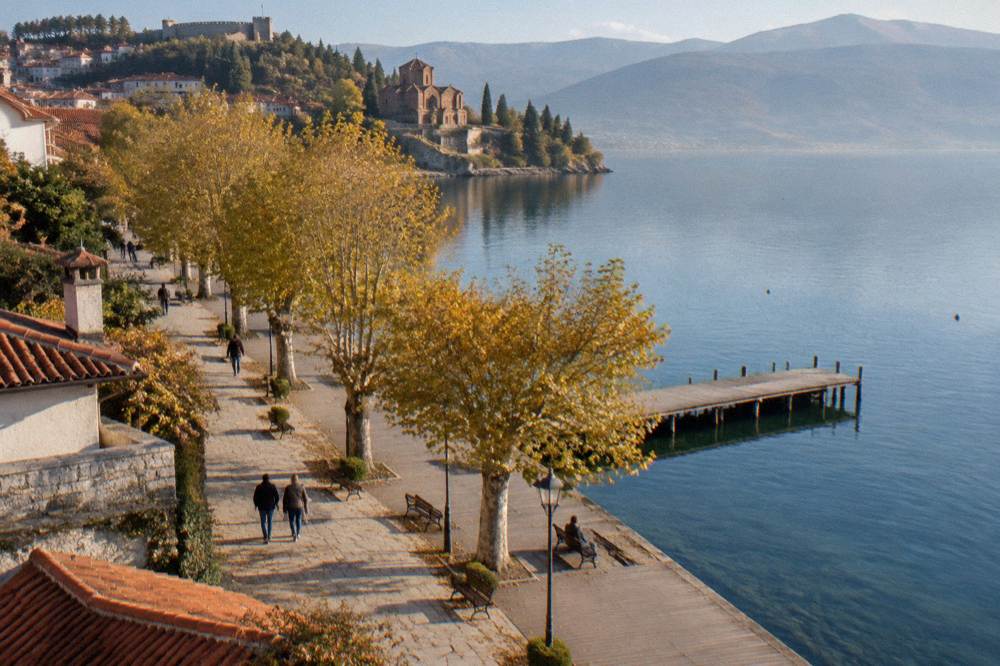
Short answer
July and August are the core of Ohrid's peak season, with modelled August highs of 27.6 C, lake water around 23.5 C and the Ohrid Summer Festival running 12 July to 20 August. June and September are the shoulder alternatives, and May to October is the window for boat trips to St Naum.
Ohrid is a lakeside town in North Macedonia on the shore of Lake Ohrid, a freshwater mountain lake sitting at about 693 m above sea level, inside the UNESCO mixed site "Natural and Cultural Heritage of the Ohrid Region". Choosing when to go matters more here than in most Balkan destinations, because the lake sets the rhythm: swimming, boats and festivals crowd into a short summer, the museums shift between two fixed schedules, and winter belongs to snow on Galicica National Park rather than the waterfront. This Ohrid Travel Guide page works through the year month by month, using modelled climate normals, dated festival reports and the museum institute's own published schedules rather than vague seasonal impressions. For a broader look at what the town offers in every season, the root page on things to do in Ohrid covers the sights that run year round.
What Is The Best Time To Visit Ohrid?
The best time to visit Ohrid is July and August if swimming and festivals are the priority, or June and September for warm weather with fewer of August's pressures: modelled August normals reach 27.6 C daytime highs, lake water runs about 23.5 C, and the Ohrid Summer Festival runs 12 July to 20 August, while the boat season to St Naum is reported to run about May to October.
The trade-offs are real and they follow the calendar closely. August is the high point of a June to September peak season, with busy beaches and full accommodations reported by guide sources, and two government decisions dated 2026 now shape that peak: a daytime jet ski ban and night boating limits on the lake, and a resident-only parking regime on old-town streets. September keeps modelled daytime highs of 22.4 C and drops the rain only slightly to 62.4 mm, while November jumps to 90.4 mm of modelled rain, so the shoulder window closes fairly fast. A practical first decision is how many of the lake activities matter to your dates; the guide on how many days to spend in Ohrid helps frame that against the season you pick.
How Does Ohrid Weather Run Month By Month?
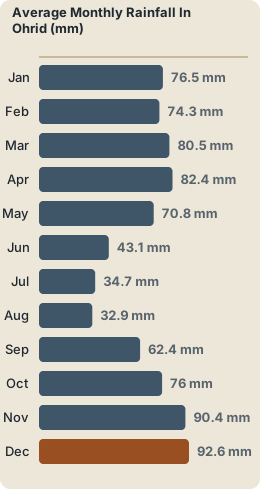
Ohrid's modelled climate normals, ERA5 reanalysis for 1991 to 2020 at the old-town grid point, run from a January mean daily high of 5.0 C and low of minus 0.8 C to an August high of 27.6 C and low of 19.0 C, with modelled rain ranging from 32.9 mm in August up to 92.6 mm in December, a continental pattern with a lake influence rather than a station record.
These are modelled figures, not readings from a weather station, so treat each number as an "about" and check a forecast before packing. The shape of the year is what matters for planning: a cold but not severe winter, a fast spring warm-up from April onward, a dry and warm core from June through August, and a wet late autumn. December carries the highest modelled monthly rain total at 92.6 mm and August the lowest at 32.9 mm. The full monthly breakdown, with far more detail on each month, sits on the Ohrid weather by month page.
| Month | Mean High C | Mean Low C | Rain MM |
|---|---|---|---|
| Jan | 5.0 | -0.8 | 76.5 |
| Feb | 6.3 | 0.0 | 74.3 |
| Mar | 10.0 | 2.5 | 80.5 |
| Apr | 14.6 | 6.3 | 82.4 |
| May | 19.5 | 10.8 | 70.8 |
| Jun | 24.2 | 15.2 | 43.1 |
| Jul | 27.1 | 18.3 | 34.7 |
| Aug | 27.6 | 19.0 | 32.9 |
| Sep | 22.4 | 14.9 | 62.4 |
| Oct | 17.4 | 10.3 | 76.0 |
| Nov | 11.5 | 5.3 | 90.4 |
| Dec | 6.2 | 0.9 | 92.6 |
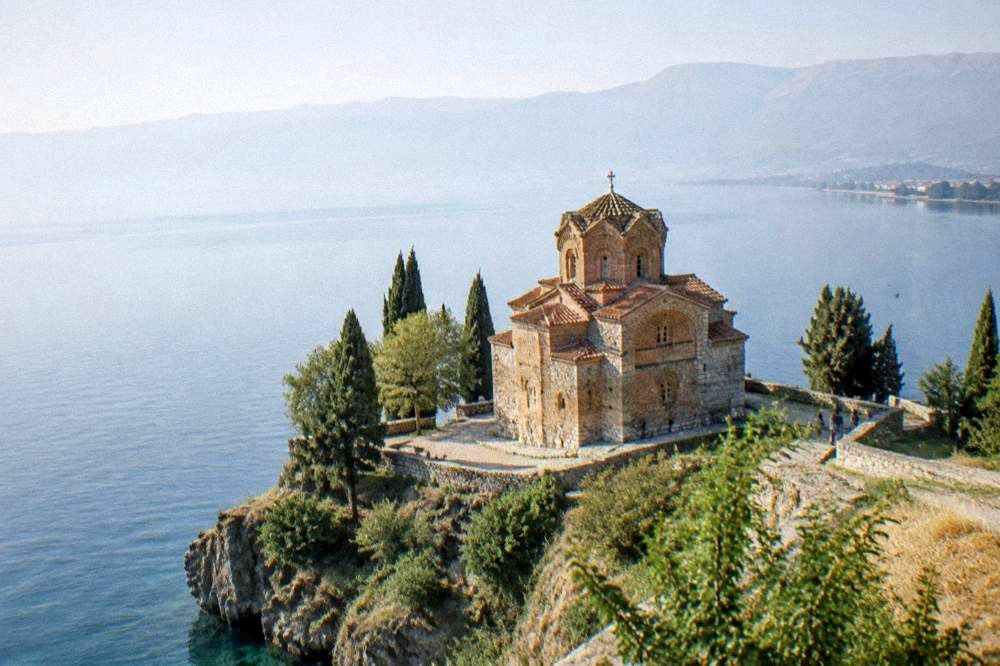
Spring deserves more attention than it usually gets. April's modelled high of 14.6 C is still jacket weather, but May jumps to 19.5 C with 70.8 mm of rain spread across the month, and the museum summer schedule opens on 1 May with longer hours at every institute site. Autumn works in reverse: October holds a modelled 17.4 C high, but the modelled rain climbs back to 76.0 mm and the museums revert to the winter schedule on 1 October. Snow does fall in Ohrid in winter, and Galicica National Park, which rises to Magaro peak at 2,254 m between Lake Ohrid and Lake Prespa, gets heavy snow that can close the main park road, typically January to March.
When Is Lake Ohrid Warm Enough For Swimming?
On modelled aggregator figures, Lake Ohrid's surface temperature climbs from about 10.5 C in April to about 14.9 C in May, reaches about 22.9 C in July and about 23.5 C in August, and falls back through about 19.7 C in September to about 14.7 C in October, so the comfortable swimming season starts around July, and the UHMR multi-year October mean is 14.3 C.
That is a slow-warming, deep mountain lake, not a shallow sea, and the numbers show it. A May visit with 20 C air can still mean lake water in the mid-teens; anyone whose holiday centres on swimming should aim at July through September. The 2026 bathing tests reported by the Institute of Public Health rated the water Class I physico-chemically at most measured points, with most microbiological samples rated Excellent, though Grashnica beach was rated Class III and some individual points scored lower, so check the current-season results rather than assuming every spot is identical. More on the water itself is on the Lake Ohrid page, and the specific question is answered in full at when is the best time to visit Lake Ohrid.
| Month | Modelled Surface Temp C |
|---|---|
| Jan | 4.6 |
| Feb | 5.4 |
| Mar | 7.2 |
| Apr | 10.5 |
| May | 14.9 |
| Jun | 19.4 |
| Jul | 22.9 |
| Aug | 23.5 |
| Sep | 19.7 |
| Oct | 14.7 |
| Nov | 10.3 |
| Dec | 6.0 |
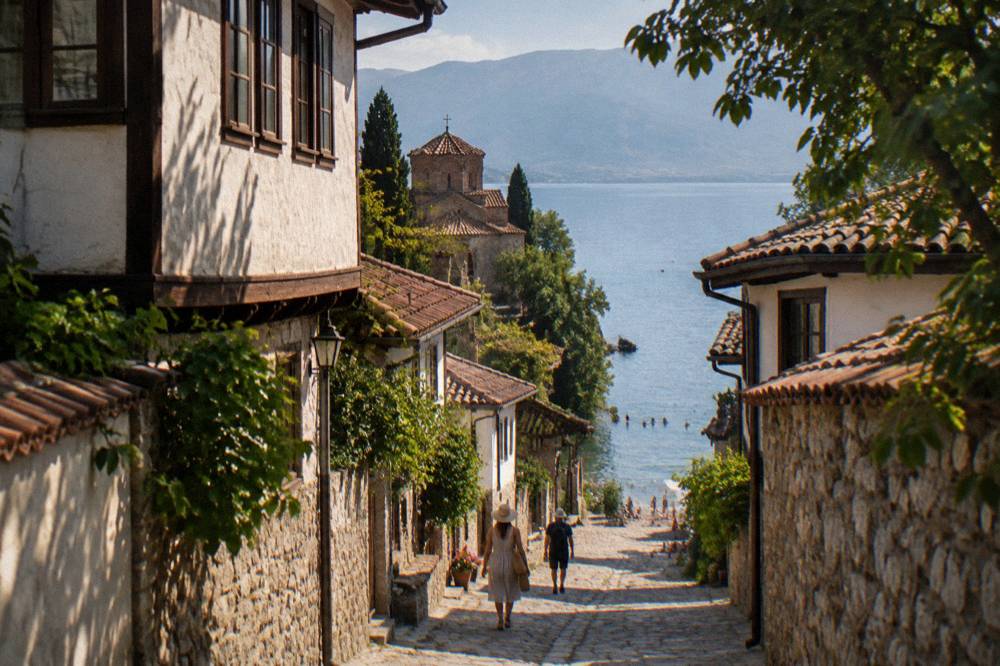
Water activities cluster hard into the warm months. Boat trips from the port to St Naum, including full-day cruises calling at the Bay of Bones, are reported to run about May to October with reduced winter service, and the 2026 government navigation decision adds dated limits inside that window: jet skis banned between 11:00 and 19:00 from 1 July to 31 August, and night boating banned from 21:00 to 05:00 through 31 August with further limits into September and October. A sunset cruise in June or early September sits outside the daytime jet ski window entirely and the water is still swimmable on the modelled figures.
What Festivals Fill The Ohrid Summer?
The Ohrid Summer Festival's 66th edition ran 12 July to 20 August 2026, opening with a gala at the Ancient Theatre, the Balkan Festival of Folk Songs and Dances ran 3 to 6 July 2026, and the Ohrid Water Festival ran 12 to 30 August 2026 including the 25 km St Naum to Ohrid swimming marathon on 22 August, so mid-July to late August packs the calendar tightly.
These are dated 2026 editions, and the 2027 dates had not been announced when these reports were published, so treat them as the pattern rather than a booking calendar. The Ancient Theatre, a late-Hellenistic structure whose capacity rose to 5,000 after the epiteatron was added, is one of the festival's traditional venues, and St Sophia hosts concerts during the festival season by the same tradition. Struga, the town at the lake's outflow, moves its own marker earlier in the summer: the 65th Struga Poetry Evenings ran 24 to 29 June 2026 with about 70 poets, a shift from the festival's traditional late-August slot.
| Event | 2026 Dates | Notes |
|---|---|---|
| Vevcani Carnival | 13 to 14 January | Julian New Year tradition, village of Vevcani |
| Struga Poetry Evenings, 65th | 24 to 29 June | About 70 poets, theme "Where Poetry Lives" |
| Balkan Festival of Folk Songs and Dances, 65th | 3 to 6 July | Opened 3 July at the Grigor Prlichev centre |
| Ohrid Summer Festival, 66th | 12 July to 20 August | Opening gala at the Ancient Theatre |
| Ohrid Water Festival | 12 to 30 August | Includes 33 km SUP marathon on 26 August |
| Ohrid Swimming Marathon, 39th | 22 August | 25 km Klime Savin route, St Naum to Ohrid harbour |
Anyone planning around the festival core should book accommodation early: August is reported as the high point of a June to September peak, and Ohrid's November 2025 figures, 18,103 guests and 33,149 overnight stays in a single off-season month with Germany the largest foreign market, hint at how much busier the summer months run. A private full-day tour of Ohrid and the lake, which covers the town and shoreline highlights in one guided day, can be locked in ahead of the festival weeks: Check availability.
Anyone planning around the festival core should sort accommodation for their dates. Book a hotel in Ohrid here.

What Changes In Ohrid Between The Museum Seasons?
Every museum institute site in Ohrid, including the Robev Family House, the Bay of Bones and the Icon Gallery, runs a summer schedule from 1 May to 30 September and a winter schedule from 1 October to 30 April, with each site closed on Mondays in both seasons, and tickets are 120 den domestic and 150 den foreign, so 1 May and 1 October are the two real switch dates for sightseeing.
The hours differ by site, which matters when you are planning days rather than seasons. The Robev Family House keeps 09:00 to 15:30 in winter and runs two summer shifts, 09:00 to 15:30 and 13:30 to 20:00, from 1 May. The Bay of Bones, the Museum on Water at Gradishte near Peshtani, runs 09:00 to 15:30 in winter and 09:00 to 16:30 in summer. The Icon Gallery in the Perivleptos complex has the shortest hours of the three, 09:00 to 14:00 in winter and 09:00 to 17:00 in summer. A Monday visit, in any month, meets closed doors at all three. The Ohrid cost and budget page folds these tickets into a wider spending picture, and money and the denar covers paying for them.
| Site | Winter, 1 Oct To 30 Apr | Summer, 1 May To 30 Sep | Closed |
|---|---|---|---|
| Robev Family House | 09:00-15:30 | 09:00-15:30 and 13:30-20:00 | Monday |
| Bay of Bones, Museum on Water | 09:00-15:30 | 09:00-16:30 | Monday |
| Icon Gallery, Perivleptos | 09:00-14:00 | 09:00-17:00 | Monday |
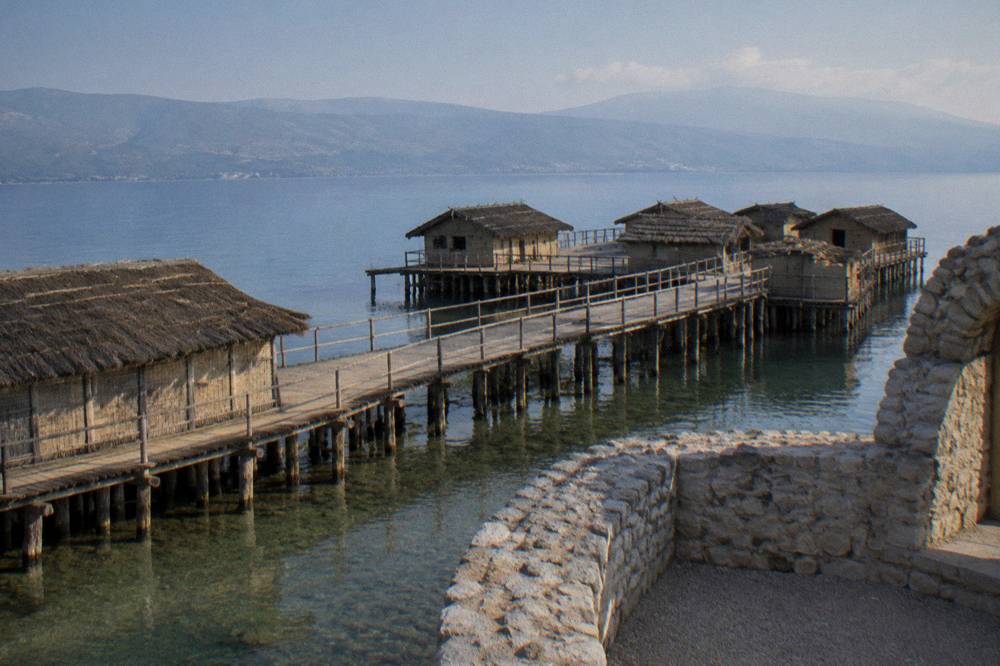
The two schedule dates line up neatly with the seasons that suit different travellers. A 1 May arrival gets the longer hours, the start of the boat season and a modelled 19.5 C high, before the July and August peak. A 1 October arrival keeps the 17.4 C modelled high and the autumn light, but the museums revert to winter hours, the boats thin out, and the first week of October can still deliver a full lake cruise before the season fades. Between those dates, the summer schedule gives evening access to the Robev Family House that winter visitors do not get.
What Is August In Ohrid Actually Like?
August in Ohrid pairs the year's modelled warmest air, 27.6 C highs and 19.0 C lows, and warmest water at about 23.5 C with the densest calendar and the busiest reported crowds, since August is the high point of a June to September peak season, and 2026 added a daytime jet ski ban, night boating limits and a resident-only parking regime on old-town streets such as Ilindenska and Car Samoil.
The practical effects are worth knowing before you commit. The parking regime, in force from summer 2026, reserves named old-town streets for residents holding a valid sticker, with clamping reported for non-residents, so a summer car needs a base outside those streets. The lake rules are dated 2026 and written for swimmer safety, which tells you what August shorelines are like: the water festival's swimming marathon on 22 August, 25 km from St Naum to the city harbour with 16 swimmers in the 39th edition, closes the month's sporting arc.
None of this makes August a month to avoid. It makes August a month to book ahead, park outside the old town, and lean into what only August offers: peak water temperature, the festival's closing weeks, and the fullest boat schedules of the year. Travellers who want the lake lifestyle without the peak's pressures should read the Ohrid weather overview and weigh June, when the modelled high is 24.2 C and the rain total drops to 43.1 mm, or September, at 22.4 C.
Is Ohrid Worth Visiting In Spring Or Autumn?
Spring and autumn are the strongest shoulder seasons: May brings a modelled 19.5 C high, the 1 May start of summer museum hours and the start of the boat season, while September holds a modelled 22.4 C high with about 19.7 C lake water, and October still reaches 17.4 C before the 1 October switch to winter museum hours and the modelled 90.4 mm November rain arrives.
Spring has one quiet advantage the summer months cannot match: the town is fully open, with the summer museum schedule and the boats running, while the peak crowds have not yet arrived, and the modelled rain in May, 70.8 mm, is close to the annual average rather than above it. April is the gamble month, 14.6 C modelled highs and 82.4 mm of rain, better for walking the old town and the fortress path than for the water. The hike across Galicica between the two lakes is a spring and early-summer proposition before the heat, and the park's road can still hold snow early in the year, typically January to March.
Autumn's case is the light and the water. September's lake at about 19.7 C is still swimmable for many people, the boat trips run through October on the reported schedule, and the festival calendar has emptied out. October cools to a 17.4 C modelled high with 76.0 mm of rain, and from 1 October every museum site trims its hours, so late September is the sweet spot where everything is still on the summer schedule. The trade route pages help if the shoulder season is part of a longer loop: Tirana to Ohrid and Skopje to Ohrid both cover year-round transport.
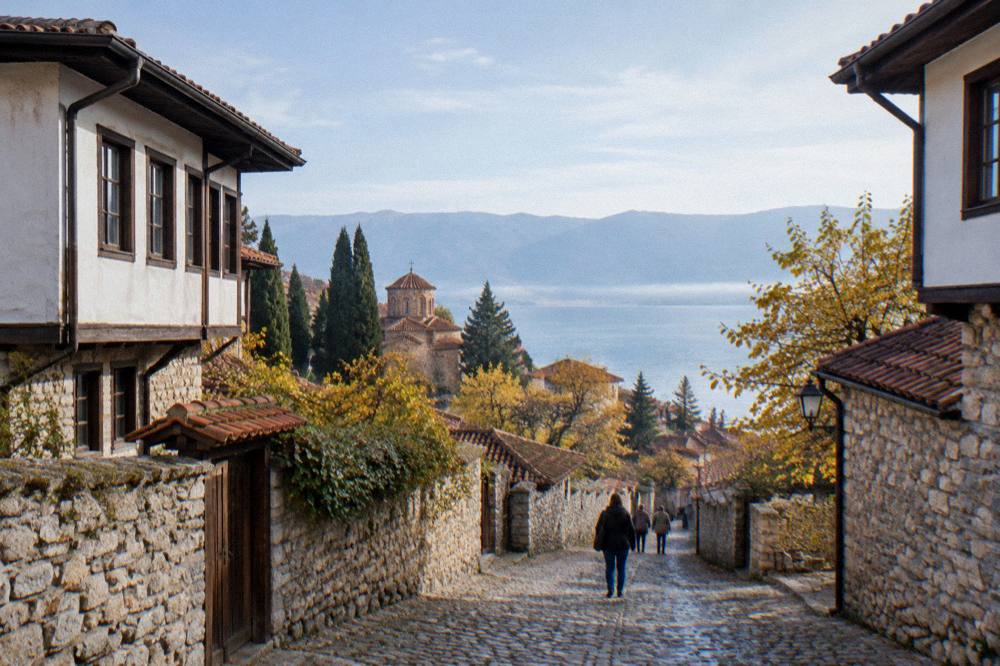
A private full-day best-of tour works well in either shoulder month for a simple reason: the itinerary is not fighting the August crowds, and the longer summer daylight lets a single guided day cover the old-town churches, the fortress hill and a stretch of the shoreline without rushing. The cave churches, villages and cuisine excursion runs on the same logic, reaching inland sites that stay pleasant in May or September heat but can be punishing at August's peak.
What Is Winter In Ohrid Like?
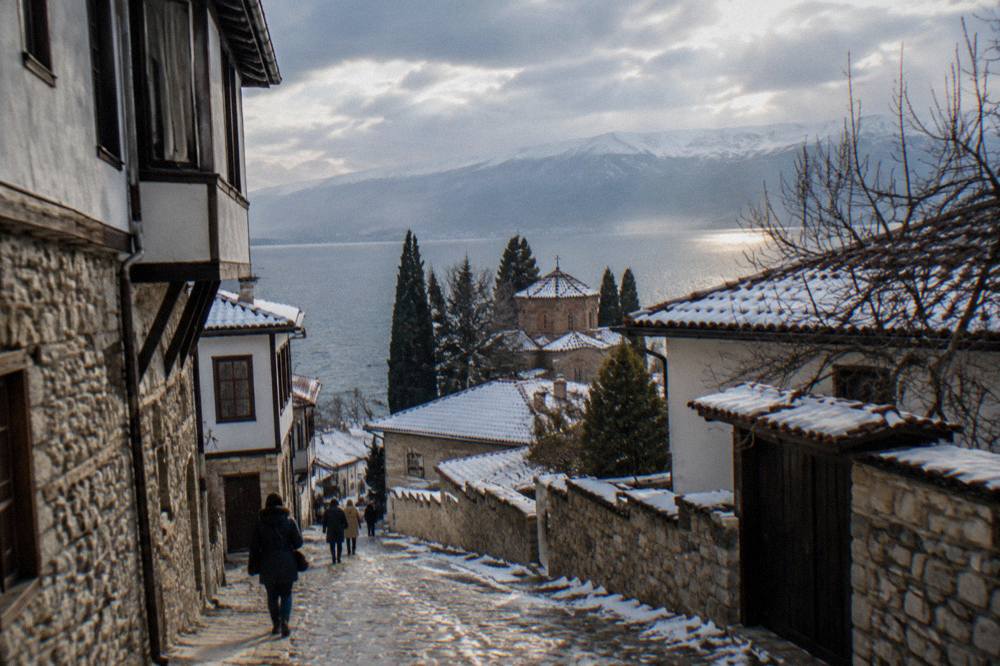
Winter in Ohrid runs cool and quiet rather than closed: modelled January normals are 5.0 C highs and minus 0.8 C lows with 76.5 mm of rain, the lake surface sits at about 4.6 C, museums are on the winter schedule with Monday closures, and the calendar's anchors are Orthodox Christmas on 7 January, Epiphany cross-throwing on 19 January and the Vevcani Carnival on 13 to 14 January.
Winter is the season for the town rather than the lake. The old-town lanes, the churches and the fortress hill cost nothing to walk, and the museums run their 1 October to 30 April hours, short at the Icon Gallery, which opens only 09:00 to 14:00. Snow reaches the town in some winters and sits heavily on Galicica, where the main road can close, typically January to March, so a winter hire car heading for the Prespa viewpoint is a plan to check before driving. Off-season Ohrid still registers serious visitor flows: November 2025 counted 18,103 guests, 11,686 of them foreign, so the town does not shut down the way small seaside resorts do.
The food and wine calendar arguably improves in the cold months. Heavier Macedonian dishes and winery tastings are indoor pleasures, and the winter season is when a monastery winery visit or a cooking class carries the day rather than competing with the beach. Practical winter notes, from the denar to safety, sit on the currency page and the safety page.
Which Month Should You Pick For Your Trip To Ohrid?
Pick July or August for swimming at about 23.5 C modelled water and the festival core, June for 24.2 C modelled highs and thinner crowds, September for 22.4 C air with swimmable water and the summer museum schedule until 30 September, May for the 1 May opening of long museum hours and the boat season, and October or the winter months for a quiet, low-cost town visit on winter museum hours.
The month you choose should follow the single activity that matters most. If it is the lake at its warmest, the window is July to early September and nothing else matches it. If it is photography and walking, May, June and September each offer modelled highs between 19.5 C and 24.2 C. If it is festivals, the mid-July to late-August stretch is non-negotiable. And if it is price and calm, the November to March stretch delivers a functioning town, winter museum hours and the Vevcani Carnival in January, with the airport's seasonal flight schedule at its thinnest, which the Ohrid airport page details.
| If You Want | Best Months | Why |
|---|---|---|
| Warm swimming water | July to early September | Modelled surface about 22.9 C in July, 23.5 C in August |
| Festivals | Mid-July to late August | Summer Festival 12 Jul to 20 Aug 2026, Water Festival into 30 Aug |
| Long sightseeing days | May to September | Summer museum schedule 1 May to 30 Sep, evening hours at Robev House |
| Fewer crowds, warm air | June, September | Modelled highs 24.2 C and 22.4 C outside the August peak |
| Lowest costs and calm | November to March | Off-season rates, winter museum hours, carnival in January |
| Boats to St Naum | About May to October | Reported operating window, reduced in winter |
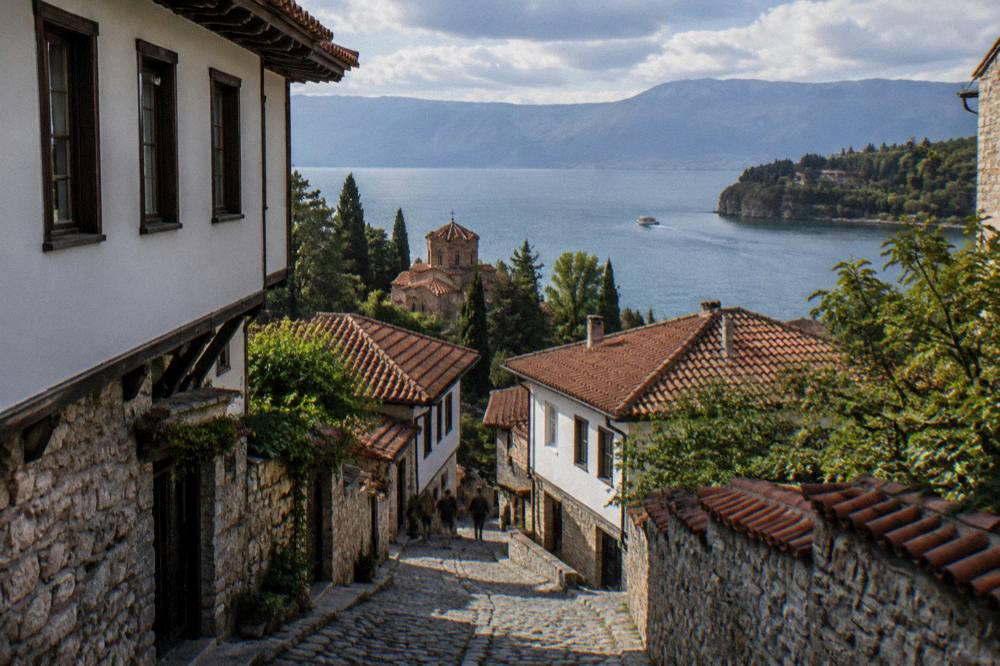
One planning note ties the whole year together: the lake level sits at about 693 m above sea level, and the 2026 readings kept it just above its agreed minimum, so the waterfront experience has been stable through the seasons described here. Whatever month you settle on, the deciding factors are the modelled water temperature for swimming, the two museum schedule dates for sightseeing, and the festival calendar for atmosphere, and every one of those is knowable before you book.
Common Questions About The Best Time To Visit Ohrid
What Is The Best Month To Visit Ohrid?
June and September are the strongest all-round months: modelled highs of 24.2 C and 22.4 C, the summer museum schedule in force from 1 May to 30 September, and the boat season running. July and August suit swimmers and festival-goers, with the Ohrid Summer Festival running 12 July to 20 August in its 2026 edition.
Is August Too Crowded In Ohrid?
August is the reported high point of a June to September peak season, with busy beaches and full accommodations. The 2026 season also brought a daytime jet ski ban, night boating limits and a resident-only parking regime on old-town streets, so book ahead and plan to park outside the restricted streets.
Can You Swim In Lake Ohrid Outside Summer?
Comfortable swimming starts around July on the modelled figures: the lake surface runs about 22.9 C in July, 23.5 C in August and 19.7 C in September, then falls to about 14.7 C in October. May, at about 14.9 C modelled, is cold for most swimmers.
When Do Ohrid's Museums Change Their Opening Hours?
The museum institute sites switch on fixed dates: the summer schedule runs 1 May to 30 September with longer hours, and the winter schedule runs 1 October to 30 April. All the listed institute sites, including the Robev Family House, the Bay of Bones and the Icon Gallery, are closed on Mondays in both seasons.
Is Ohrid Worth Visiting In Winter?
Yes, for a quiet town visit: modelled January highs of 5.0 C, winter museum hours, walkable old-town lanes, and the Vevcani Carnival on 13 to 14 January plus Orthodox Christmas on 7 January. The lake at about 4.6 C is for looking at, not swimming in, and snow can close the Galicica road, typically January to March.
What Is The Rainiest Part Of The Year In Ohrid?
On the modelled 1991 to 2020 normals, December carries 92.6 mm of rain and November 90.4 mm, while August carries 32.9 mm and July 34.7 mm. These are ERA5 reanalysis figures for the old-town grid point, not station readings, so read them as about-right averages.