Getting Around Ohrid: On Foot, By Bike, Bus Or Boat
Ohrid is a compact lake town where the Old Town lanes are on foot, boats leave from the port for St Naum, and a car only helps for the wider region. Here is how each way of moving actually works.
Short answer
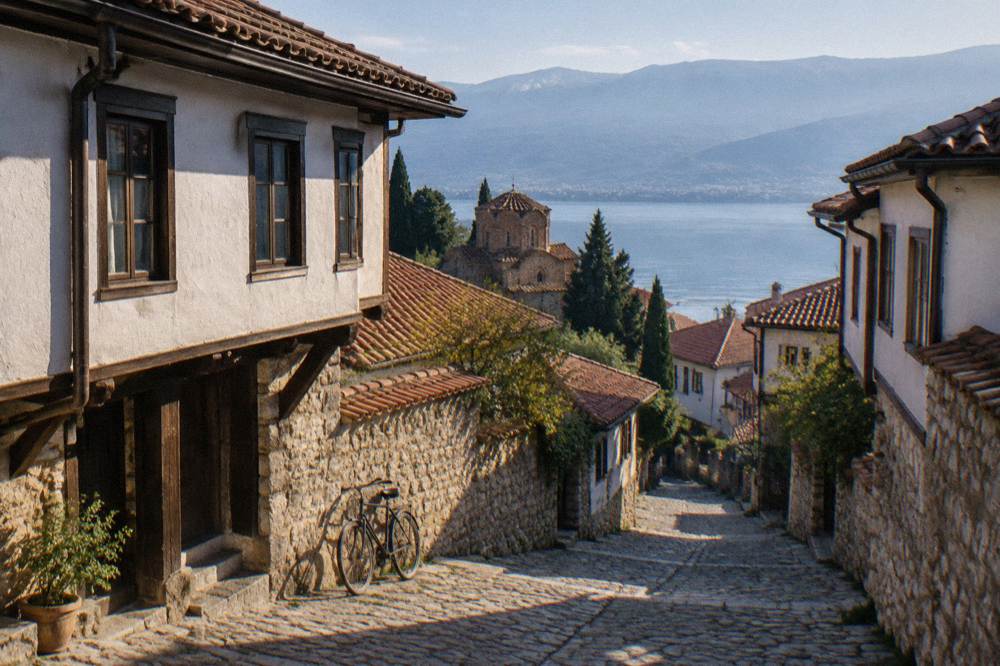
Ohrid is small enough that the Old Town, the lakeshore and the main sights are all walkable, with no trams and no metro. Boats run from the port along the lake, local transport connects Ohrid with Struga, and a car matters mainly for Galicica National Park, Lake Prespa and cross-border day trips. Parking in the old-town streets became resident-only from summer 2026.
Ohrid sits on the shore of Lake Ohrid in North Macedonia, a freshwater mountain lake at about 693 m above sea level, and the shape of the town decides how you move through it. The old centre climbs from the port up to Samuel's Fortress in a network of lanes that belong to pedestrians, the lake itself is a working transport corridor with cruise boats heading south to St Naum, and everything beyond the water, Galicica National Park, Lake Prespa, Struga, Skopje and Tirana, is a road or boat question. This guide on Ohrid Travel Guide walks through each mode in turn: feet, boats, buses, bikes and cars, with the 2026 rules that changed some of them.
How Walkable Is Ohrid Old Town?
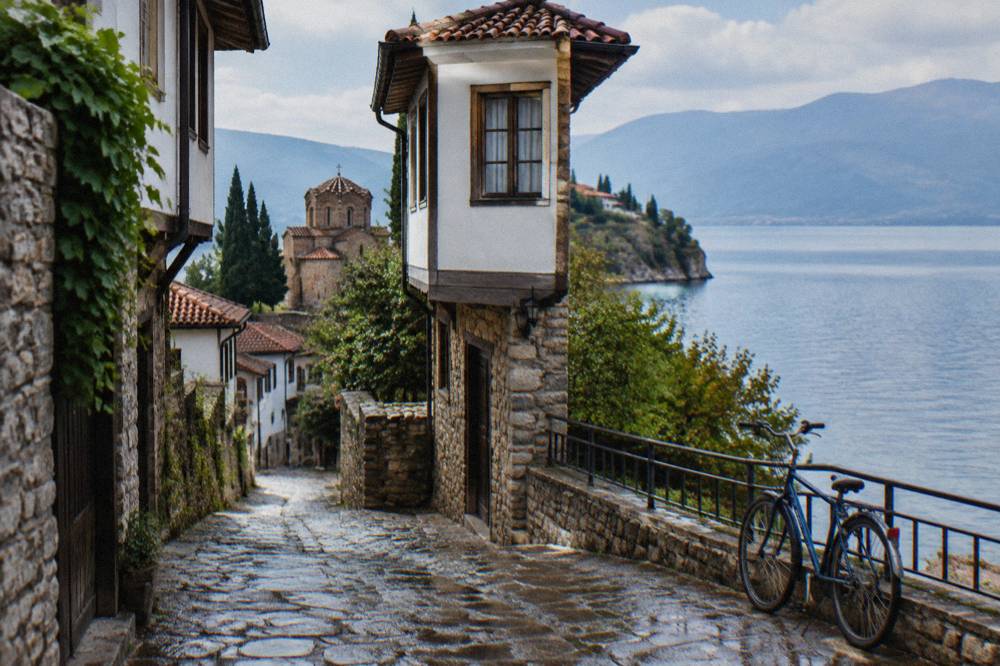
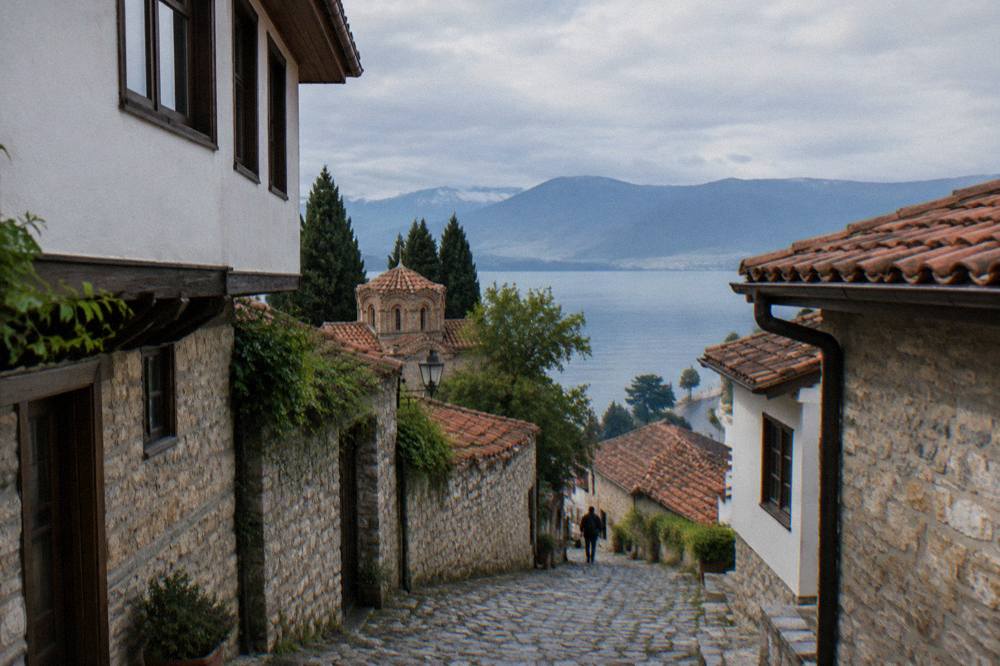
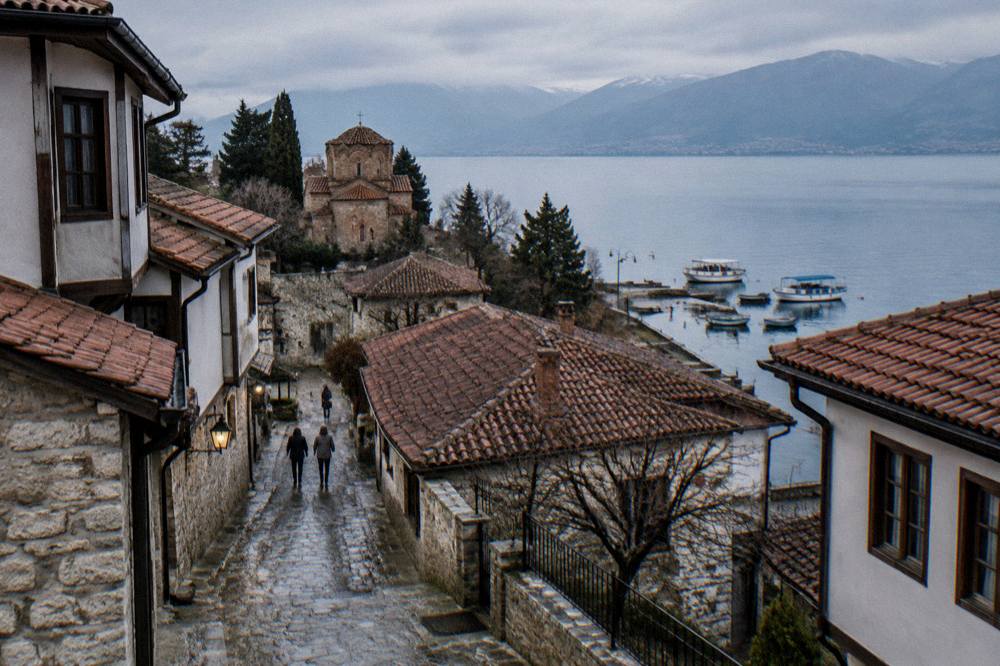
Ohrid Old Town is fully walkable and walking is the normal way to see it: the lanes climb on foot from the lake shore to Samuel's Fortress and the Upper Gate, there are no trams, no metro and no bike share, and the main concentrations of sights, churches, the Ancient Theatre, the Old Bazaar and the boardwalk, sit close enough together that a visitor covers them on foot without needing any other mode inside the town itself.
That compactness is the single most useful transport fact about Ohrid. The old town occupies the slope between the port and the fortress, and the streets narrowing into stairways and footpaths is a property of the terrain, not a planning quirk. The Church of St John at Kaneo, Plaosnik, the Ancient Theatre and the Old Bazaar are all part of the same climb, so a day of sightseeing is a day of walking, with the lakeshore boardwalk as the flat counterweight at the bottom.
What that means practically: shoes matter more than tickets. The gradient from the water to the fortress walls is real, and anyone planning to move between the shore and the upper gates will do it on stepped lanes. In summer the modelled ERA5 climate normals put the July and August mean daily highs at 27.1 C and 27.6 C, so the walking day reshapes around the cooler mornings and evenings. For the full picture of sights strung along that walk, the root page on things to do in Ohrid lists them in one place.
Pedestrian movement also defines the 2026 parking reality on those same streets, covered further down: from summer 2026, streets including Ilindenska, Kosta Abrash and Car Samoil in the old part of town became reserved for residents with a valid sticker, with clamping reported for non-residents. In other words, walking is not just the pleasant option in the old town, it is increasingly the only option on those streets.

Do You Need A Car In Ohrid?
A car is useful for the region around Ohrid rather than for the town itself: it helps with Galicica National Park, Lake Prespa, the Albanian side of the lake and independent border trips, while inside Ohrid the walkable core, the resident-only parking regime from summer 2026 and the boat alternative mean a car adds friction for anything within the town, including St Naum, which boats reach directly from the port.
The honest split is town versus region. Inside Ohrid, a car earns its keep mainly for accommodation logistics and for reaching villages along the shore such as Lagadin, Peshtani and Trpejca. Beyond the town it becomes genuinely valuable: Galicica National Park, which lies between Lake Ohrid and Lake Prespa, charges a 250 MKD eco-fee per vehicle with no per-passenger fee, and 100 MKD applies only to someone entering the park on foot from the Ohrid-side gate, so a car splits that cost across its occupants. The park is open year-round, but heavy snow can close the main road, typically between January and March.
Driving rules in North Macedonia add a few requirements: headlights must be on day and night, a green card is needed for international insurance, and motorway tolls are paid per section at plazas, with no vignette system. The road from Skopje is about 170 km. A significant change is coming on that corridor: the Kicevo to Ohrid motorway section remained under construction through 2026, with the Izvor to Vrbjani stretch due to open in the coming months and full opening expected in the first half of 2027.
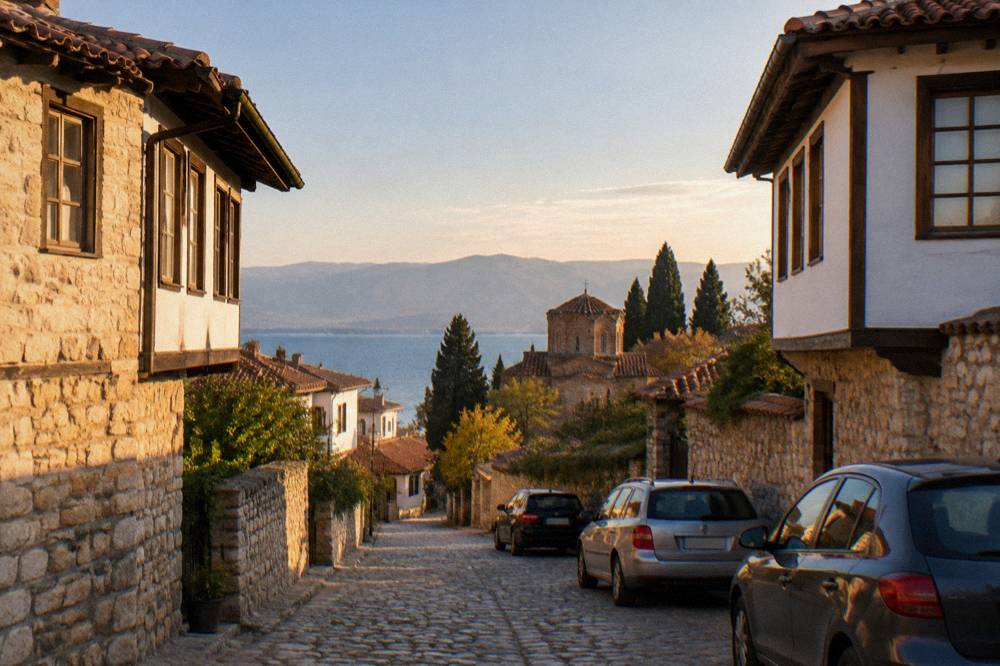
The 2026 parking regime deserves its own paragraph for anyone driving in. Under the new municipal rules, reported from summer 2026, the streets of the old part of town, including Ilindenska, Kosta Abrash and Car Samoil, are reserved exclusively for residents holding a valid sticker, free for them and closed to non-residents, with wheel clamps reported for violators. Visitors arriving by car should plan on parking outside the old core and walking in, which pairs well with the town's walkability anyway. Details on arriving by road are in the guide to the Skopje to Ohrid route, and for the Albanian approach, getting from Tirana to Ohrid.
For travellers who would rather leave the driving entirely aside, the alternative is simple: the boats, covered below, connect the port with the southern shore, and organised day trips cover the road destinations. A tour that starts in Skopje is a Skopje departure, and one that starts in Tirana leaves from Tirana, so the base city decides which product fits.
What Bus Options Exist Around Ohrid?
Local bus services connect Ohrid with Struga and nearby shore settlements using operators such as Galeb and Classic Company running multiple daily departures, while intercity buses from Skopje arrive at the Ohrid bus station east of the centre, but no published timetable, fare or frequency exists for any local route, so the practical rule is to check current schedules at the station or with the operator before planning a journey around a specific departure.
What can be stated with confidence is the structure, not the times. Ohrid has no rail link of any kind: no passenger train serves the town, so buses and the road carry everything the lake does not. The bus station sits east of the centre, which puts arriving passengers a walk or a short taxi ride from the old town. Guides to the Ohrid bus station and to bus costs from Skopje to Ohrid cover the arrival side in detail.
Inside Ohrid itself there is no tram, no metro and no local bus network of the kind a big city has; the town's size makes it unnecessary. The buses that matter are the ones that leave it: the Ohrid to Struga connection, the run up to Skopje, and seasonal services tied to the summer. Frequencies rise in summer and drop outside it, which is the pattern across the whole region's transport, from flights into Ohrid airport to the lake boats.
The right planning posture is to treat published schedules as perishable. Summer 2026 brought new Wizz Air routes into Ohrid airport and an announced intention to base an aircraft there, and each such change shifts demand on the road links too. Checking schedules on the day, or the day before, is the only reliable method.
Getting Around Lake Ohrid By Boat
Boats are Ohrid's most distinctive form of transport: cruise boats leave Ohrid port for the southern lake, a full-day cruise to St Naum with Boat Armada runs seven hours and costs from 1,200 den per adult and 600 den per child, boats typically operate about May to October with a reduced winter schedule, and short panoramic cruises of the Old Town run from the port as bookable products.
The lake is a real corridor, not just scenery. The full-day cruise from Ohrid port down to St Naum is the classic: it passes the Bay of Bones at Peshtani and the shoreline villages, and at St Naum the monastery entrance is 150 MKD per person and a rowboat through the Crn Drim springs costs about 5 EUR, both figures from the cruise operator's own listing. A deeper look at those options sits on the page for the Bay of Bones and St Naum boat trip and in the guide to St Naum day trips from Ohrid.
The season matters more on the water than on the road. Boat trips on the lake typically run about May to October and drop to a reduced or unavailable winter schedule, while road access to St Naum stays possible year-round. The 2026 navigation rules also reshaped the summer lake: under a government decision of 2 June 2026, jet skis were banned between 1 July and 31 August from 11:00 to 19:00, and boats were banned at night between 3 June and 31 August from 21:00 to 05:00, with a further October limit, all for swimmer safety.
Short on-water options round out the picture. Beyond the big south-lake cruise, panoramic cruises of the Old Town run from the port, and one pairs the circuit with a wine tasting served on board: the Check availability link goes to the operator's live listing for that cruise. For people who want to be on the water under their own power, the paddleboarding tour with landmarks and photos covers the calm-water side.
For the short circuit past the old town frontage, book a panoramic boat tour here.
Can You Cycle Around Ohrid?
Cycling around Ohrid works as a leisure activity rather than a transport system: no bike-share scheme operates in the town, no rental price or route length is stated in the sources, and the cycling offer is the road along the lake shore and into the hills as a day trip, with e-bike and guided rides existing only as bookable products whose details render from their listings rather than from any published local network.
What the sources do support is the shape of a ride. A lake circuit or shoreline ride is the natural route, and the region's terrain, a lake at about 693 m ringed by mountains including the Galicica ridge, means flat riding hugs the shore while anything inland climbs quickly. The dedicated page on cycling around Lake Ohrid collects what is known about the route as a day trip.
Two cautions follow from the rules above rather than from any marketing. First, no firm rental price or bike-lane claim exists for Ohrid, so any budget or route planning should come from a shop or listing on the spot. Second, the old-town lanes that make walking so good, stepped, narrow and pedestrian-heavy, are precisely the lanes that make riding through the old core unattractive; the ride starts where the town ends, along the shore road.
What Are The Taxis Like In Ohrid?
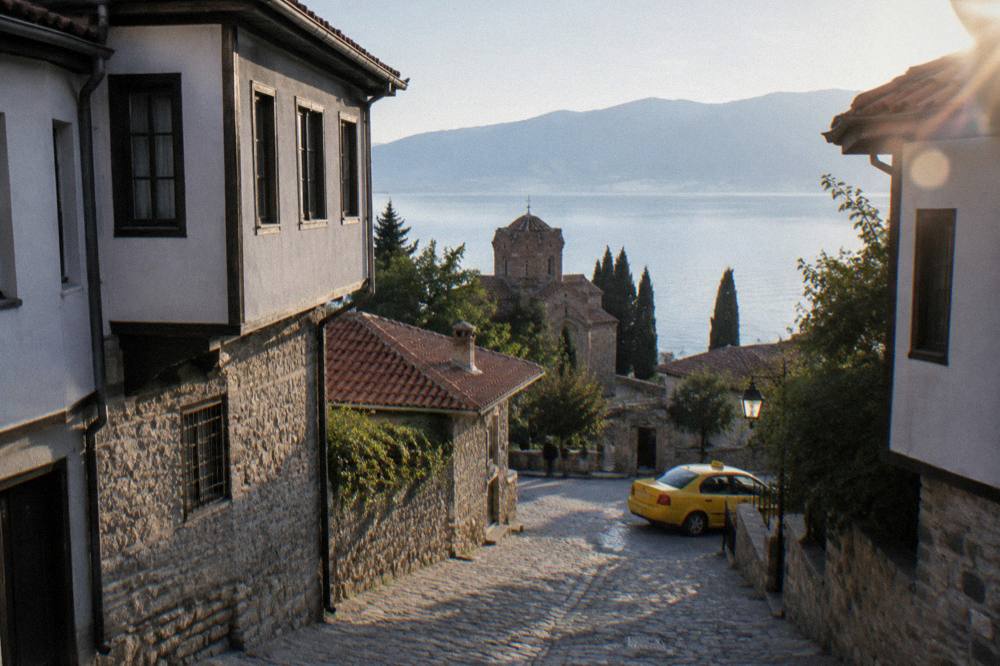
Taxis in Ohrid are licensed cars, often yellow and black, frequently metered but with the standing advice to agree the price before setting off, and no official fare table exists for any journey inside the town: no local bus routes, no fare tables and no taxi tariffs can be stated as fact, so the working method is a named price at the start of the ride and denars for payment.
The airport run is the one transfer people most often want to price. Ohrid St Paul the Apostle Airport sits about 10 km west of the centre, reached via the E65, and reported taxi costs for that run fall around 600 to 800 MKD, with no official published fare on the airport's own site. There is no regular public shuttle bus between the airport and the town, so the arrival choice is a taxi, a pre-booked transfer or an organised pickup.
Inside town, the same rule of agreement applies. Short rides are cheap by wider European standards, and the meter-versus-agreed-price question is resolved the same way every local guide resolves it: settle the number before the car moves. Payment is in denars; the euro is not legal tender in North Macedonia even though tour prices are commonly quoted in it, a distinction the guide to the denar and money in Ohrid unpacks.
One thing Ohrid does not have, and does not need: a ride-hail scene of the kind that replaces taxis elsewhere. The town is small, the taxi supply is adequate to it, and the walkability covered at the top of this page removes the need for a ride-hail app.
How Do You Get Out Of Ohrid For The Day?
Day trips from Ohrid divide by direction: boats and the shore road reach St Naum, the Bay of Bones and the villages south of town, the road over Galicica reaches Lake Prespa, Struga sits a short hop west at the lake's outflow, and Skopje, Bitola, Tirana and Pogradec in Albania are full-day road trips, each with organised tours available where the border or the distance makes independent travel slow.
The near ring first. St Naum, at the southern end of the lake, is reachable by boat in season or by road year-round, and the monastery sits about 4 km from the Tushemisht border crossing into Albania, a crossing reported open around the clock for passenger vehicles and pedestrians. Struga, where the Black Drim leaves the lake, is covered on the Struga from Ohrid page. Galicica's ridge road between the two lakes is the one dramatic drive in the set, snow permitting.
The far ring is road country. Skopje is about 170 km away by road and is covered on the Skopje day trip page; Tirana and the Albanian side, including Pogradec and Lin, sit on the Tirana from Ohrid and Pogradec pages. For hikers, the park's trails are catalogued in the guide to hiking around Ohrid, where the Two Lakes trail over the Galicica ridge is the standout crossing between the two lakes on foot.
Choosing between independent travel and an organised day trip comes down to the border and the boat season. The Albanian crossings are straightforward but add time, boat departures thin out outside summer, and the motorway completion in 2027 will eventually shorten the Skopje run. Until then, a booked day trip trades flexibility for a fixed schedule, and the picks below show the range.
What Opening Hours Shape A Day Of Moving Around Ohrid?
The museum institute's sites set the rhythm of a sightseeing day in Ohrid: from 1 May to 30 September they run summer hours and from 1 October to 30 April winter hours, the Robev Family House, the Bay of Bones and the Icon Gallery are all closed on Mondays, and each site's hours differ enough that the table below, from the museum institute's own pages, is worth checking before a walking or boat day is planned around them.
| Museum site | Winter hours (1 Oct to 30 Apr) | Summer hours (from 1 May) | Closed |
|---|---|---|---|
| Robev Family House, Tsar Samoil St 62 | 09:00 to 15:30 | Two shifts, 09:00 to 15:30 and 13:30 to 20:00 | Monday |
| Bay of Bones (Museum on Water), Peshtani | 09:00 to 15:30 | 09:00 to 16:30 (1 May to 30 Sep) | Monday |
| Icon Gallery, Perivleptos complex | 09:00 to 14:00 | 09:00 to 17:00 | Monday |
The ticket side is uniform across the institute's sites: 150 den for foreign visitors, 120 den for domestic visitors, with a children's and students' rate reported at 60 den, per the museum institute's own ticket page. A boat day down the lake that stops at the Bay of Bones therefore pairs a 150 MKD cruise-stop entrance with the cruise fare itself, which is why the full-day boat product is often the tidier way to combine the two.
Two planning notes follow. First, the Monday closure pattern means a Sunday-to-Friday trip loses nothing, while a Monday-centred stay shifts the day toward the outdoors: the boardwalk, the fortress slopes and the lake itself. Second, the winter shortening of hours across the museum sites, and the winter reduction of the boat schedule, make the May-to-October window the full-fat version of an Ohrid visit, a timing question explored in the guide to the best time to visit Ohrid.
How Does The Weather Affect Getting Around Ohrid?
The modelled ERA5 climate normals for 1991 to 2020 show Ohrid with mean daily highs of 27.1 C in July and 27.6 C in August against 5.0 C in January, rain running from about 33 mm in August to about 93 mm in December, which means summer movement is shaped by heat on the climbs and winter movement by rain, reduced boat schedules and possible snow closures on the Galicica road between January and March.
| Month | Mean daily high C | Mean daily low C | Rain mm |
|---|---|---|---|
| Jan | 5.0 | -0.8 | 76.5 |
| Feb | 6.3 | 0.0 | 74.3 |
| Mar | 10.0 | 2.5 | 80.5 |
| Apr | 14.6 | 6.3 | 82.4 |
| May | 19.5 | 10.8 | 70.8 |
| Jun | 24.2 | 15.2 | 43.1 |
| Jul | 27.1 | 18.3 | 34.7 |
| Aug | 27.6 | 19.0 | 32.9 |
| Sep | 22.4 | 14.9 | 62.4 |
| Oct | 17.4 | 10.3 | 76.0 |
| Nov | 11.5 | 5.3 | 90.4 |
| Dec | 6.2 | 0.9 | 92.6 |
These are modelled reanalysis values for the grid cell over Ohrid, not a weather-station record, so they describe the climate's shape rather than any single day. The transport consequences are concrete anyway: December averages 92.6 mm of rain and November 90.4 mm, months when the boat schedule is already thin, and the January mean low of -0.8 C pairs with snow at Galicica's higher elevations, where the park road can close, typically January to March.
The lake's own temperature sets the swim-and-paddle season, and it is modelled data here too: aggregator values put the July surface at about 22.9 C and August at about 23.5 C, against a UHMR multi-year October mean of 14.3 C, with the swimming season running from about July. Anyone planning a transport day around a swim stop should read the fuller breakdowns in the guides to Ohrid weather and to how many days to spend in Ohrid.
What Does Moving Around Ohrid Cost?
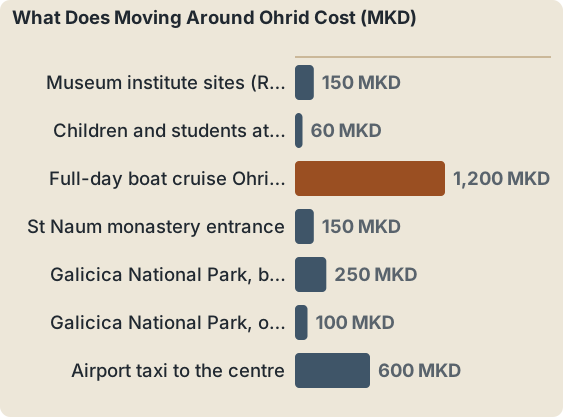
Daily movement costs in Ohrid are low and mostly denar-denominated: the museum sites charge 150 den for foreign visitors, the full-day Boat Armada cruise to St Naum starts at 1,200 den per adult, Galicica charges 250 MKD per vehicle, and the airport taxi run is reported around 600 to 800 MKD, while bus fares, taxi tariffs and rental prices carry no verifiable figures and should be confirmed on the spot.
| Cost item | Figure | Basis |
|---|---|---|
| Museum institute sites (Robev House, Bay of Bones, Icon Gallery) | 150 MKD foreign, 120 MKD domestic | Museum institute ticket page |
| Children and students at museum sites | 60 MKD (reported) | Museum institute page |
| Full-day boat cruise Ohrid to St Naum (Boat Armada) | From 1,200 MKD adult, 600 MKD child | Cruise operator listing |
| St Naum monastery entrance | 150 MKD | Cruise operator listing |
| Rowboat at the Crn Drim springs | About 5 EUR | Cruise operator listing |
| Galicica National Park, by vehicle | 250 MKD per vehicle, no per-passenger fee | Park guide |
| Galicica National Park, on foot | 100 MKD, Ohrid-side gate | Park guide |
| Airport taxi to the centre | About 600 to 800 MKD (reported) | Secondary sources |
Bookable tours and activities are a separate pricing world: their prices, ratings and durations render from the product listings themselves and are not typed into prose, and the euro prices commonly quoted for tours sit alongside, not instead of, the denar economy of tickets, boats and taxis. For the fuller budget picture, including how a stay adds up, see the guide to Ohrid costs and budget.
Safety sits quietly underneath all of this: the US State Department's travel advisory for North Macedonia stands at Level 1, Exercise Normal Precautions, and the practical transport cautions in Ohrid are terrain and weather rather than crime, points expanded in the guide to safety in Ohrid.
The short version of this whole page: walk the town, boat the lake, bus to Struga, drive only for the park and the borders, and let the 2026 parking and navigation rules, not habit, decide where the car stays. Before the closing questions, one last set of picks spanning the three ways of moving covered here, water, road and paddle.
Common Questions About Getting Around Ohrid
Is Ohrid walkable without a car?
Yes. The Old Town, the port, the boardwalk and the main church sites form one continuous walkable area on the slope between the lake and Samuel's Fortress, with no trams or metro. A car only helps for Galicica, Lake Prespa and cross-border trips, and from summer 2026 the old-town streets are resident-only parking anyway.
Can you get around Lake Ohrid by boat?
Boats run from Ohrid port, including the full-day cruise to St Naum with stops along the southern shore, from 1,200 den per adult with Boat Armada. The season typically runs about May to October with a reduced winter schedule, and 2026 brought daytime jet-ski bans and night boating restrictions for swimmer safety.
Is there public transport inside Ohrid?
Not of the big-city kind. There are no trams, no metro and no local bus network inside the town; the buses that matter are the local services to Struga and the intercity routes to Skopje and beyond, arriving at the bus station east of the centre. Check current schedules before planning around any specific departure.
Can I cycle in Ohrid?
Cycling works as a leisure activity, mainly along the lakeshore road and into the hills, but no bike-share scheme, rental price or route length is verifiable for the town. Guided and e-bike rides exist as bookable products, and the steep, stepped lanes of the Old Town itself are best on foot.
How do I get from Ohrid airport to the town?
Ohrid St Paul the Apostle Airport is about 10 km west of the centre on the E65. There is no regular public shuttle; a taxi is reported at around 600 to 800 MKD, and pre-booked transfers and tour pickups are the alternatives. Agree the taxi price before setting off.
Do I need a car for St Naum?
No. In the boat season, roughly May to October, cruise boats run from Ohrid port to St Naum directly. By road the site is reachable year-round, and it sits about 4 km from the Tushemisht border crossing into Albania if you are continuing to Pogradec.