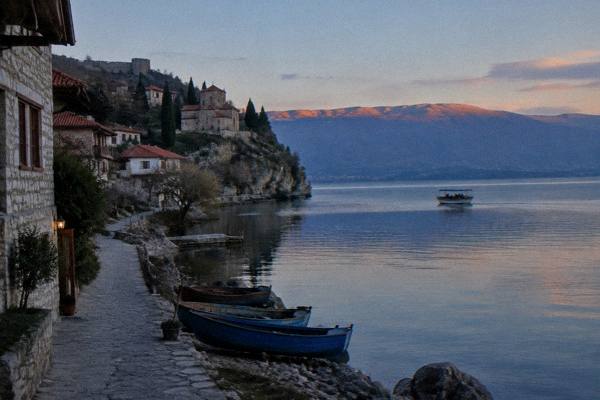
Ohrid At Night: Lakefront Bars, Lit Churches And Late Dinners
Evenings in Ohrid run along the lakefront: lit church walls above the water, boats that stop at a set hour in summer, museum sites that stay open into the second shift, and festival nights in the Ancient Theatre.
Short answer
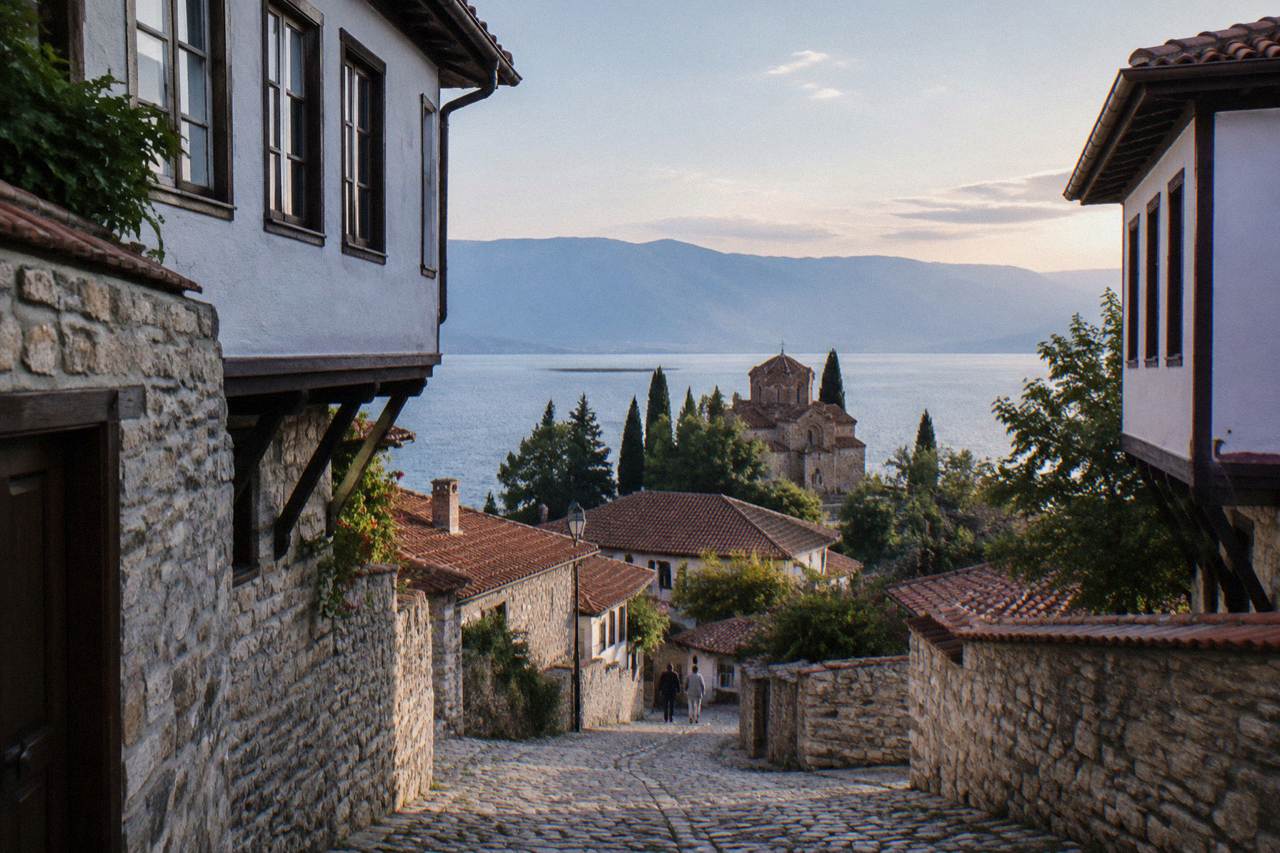
Ohrid's evening runs along the lakefront: the boardwalk and old-town lanes on foot, lit church facades above the shore, museum sites open to 20:00 on the summer second shift, festival performances in July and August, and a lake that goes quiet on the water after 21:00 under the 2026 night-boating rules.
Evening in Ohrid settles over a freshwater mountain lake at about 693 m above sea level, in North Macedonia, not over any sea. The town's night shapes are drawn by its churches and fortress walls above the shore, by a lakeside walking line that carries the whole evening crowd, and by a calendar in which the biggest nights of the year sit inside the Ohrid Summer Festival. The Ohrid Travel Guide lays out the evening hours that are actually printed somewhere: museum second shifts, 2026 boat limits, festival dates and the weather numbers behind a lakefront night. For the daytime half of the plan, start with things to do in Ohrid.
What Is Ohrid Like After Dark?
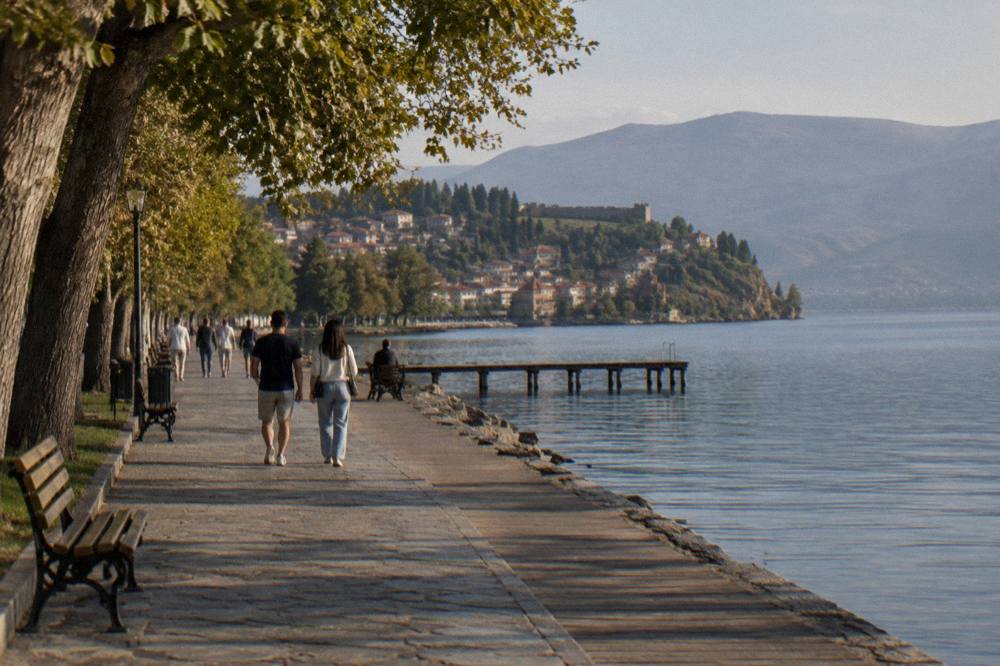
After dark Ohrid becomes a walking town built around one line: the lakefront from the port towards the old town, with the lanes above it climbing towards Samuel's Fortress and the churches lit along the ridge. There is no tram, no river and no seafront, and the whole evening economy of the old town sits within walking distance of the shore, so the night is spent on foot, on the water before the boating cutoff, or at a table overlooking the lake.
The layout does the work. The old town climbs from the lake to the fortress, and its lanes are pedestrian in practice, which pushes restaurants, bars and cafe tables towards the shore and the squares rather than along any road. The boardwalk, covered in detail at the Ohrid boardwalk guide, is the spine of the evening: it connects the port area with the swimming spots and the viewpoints below the old town.
The season matters more here than in a coastal resort. Boats to St Naum run roughly May to October and reduce in winter, museum sites shift to a shorter winter schedule from 1 October, and the festival programme that fills July and August evenings simply does not exist in November. A winter evening is a different product: quieter water, earlier darkness, and the lit facades as the main event, a version of the town covered in Ohrid in winter.
What does not change is the setting. The UNESCO inscription covers the Natural and Cultural Heritage of the Ohrid Region as a mixed property, inscribed 1979 and 1980 and extended to the Albanian part in 2019, and the lake itself has existed about two to three million years per UNESCO's own listing. At night that backdrop is the product: dark water, lit stone, and a town small enough that the whole evening circuit is walkable.
Which Ohrid Sights Stay Open Into The Evening?
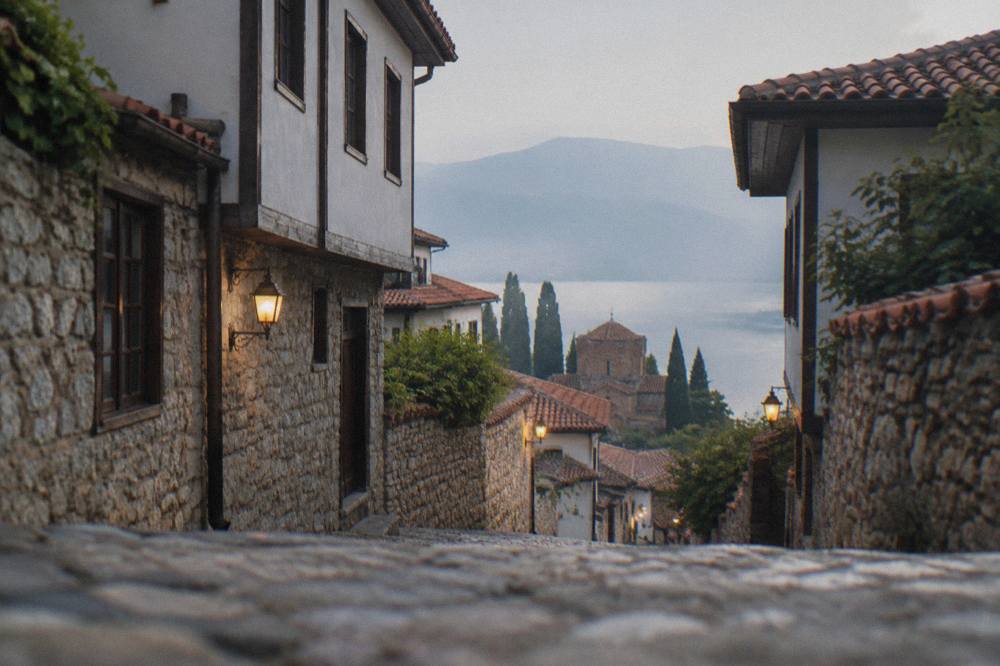
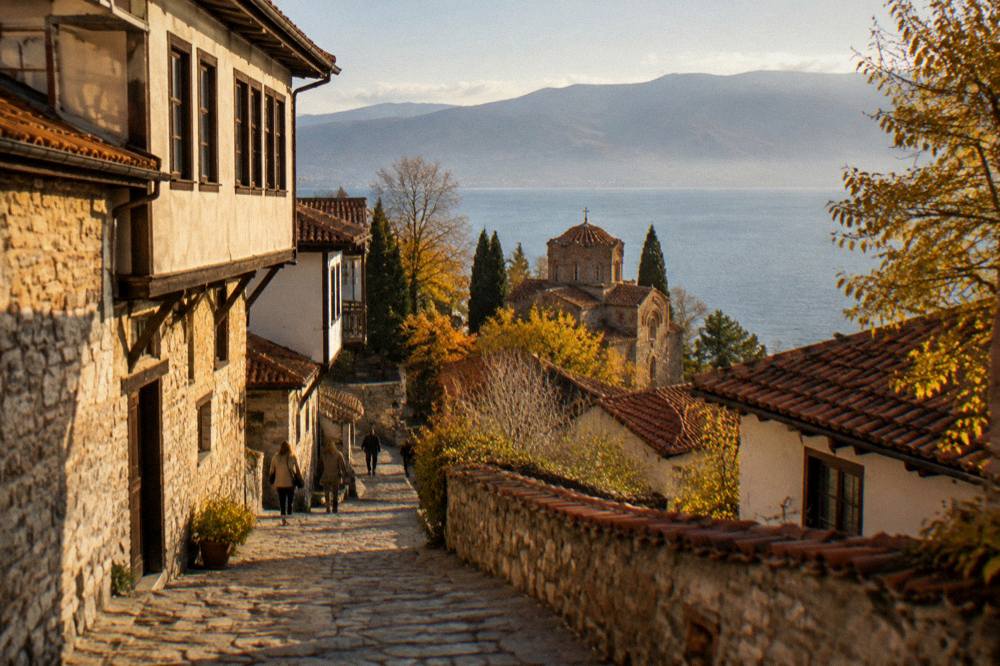
Only the museum institute's sites publish evening hours, and only in summer: Robev Family House runs a second shift to 20:00, the Bay of Bones stays open to 16:30, and the Icon Gallery to 17:00, all on the summer schedule from 1 May to 30 September, and all closed Monday, per the museum institute's own site pages. The churches publish no evening hours, so a lit facade, not an open door, is the evening experience at Kaneo, St Sophia and Plaosnik.
The summer second shift is the practical fact. From 1 May, Robev Family House on Tsar Samoil Street lists two shifts, 09:00 to 15:30 and 13:30 to 20:00, closed Monday. That late shift is the one genuinely evening-capable sight in town, and it sits in the middle of the old town's evening circuit rather than at its edge. Tickets for the institute's sites are 120 den domestic and 150 den foreign, with a reported child and student rate of 60 den.
The rest of the institute's roster closes earlier even in summer, as the table shows. The winter schedule, 1 October to 30 April, ends everything by mid-afternoon, which is why an October evening in Ohrid is a walk, a dinner and a boat-free shoreline rather than a sightseeing round.
| Museum site | Summer hours (1 May to 30 Sep) | Winter hours (1 Oct to 30 Apr) | Closed |
|---|---|---|---|
| Robev Family House | 09:00 to 15:30 and 13:30 to 20:00 | 09:00 to 15:30 | Monday |
| Bay of Bones (Museum on Water), Peshtani | 09:00 to 16:30 | 09:00 to 15:30 | Monday |
| Icon Gallery (Perivleptos complex) | 09:00 to 17:00 | 09:00 to 14:00 | Monday |
| Institute office (Boro Shain St 10) | Mon to Fri 07:30 to 15:30 | Mon to Fri 07:30 to 15:30 | weekends |
The churches are a different category. What the evening reliably offers is the exterior: the positions of these churches above the water are what the lit evening skyline is made of, and the Ohrid churches guide covers the daytime visiting side. How many churches the town actually has is its own question, answered at how many churches are in Ohrid.
The Ancient Theatre belongs to the festival evening rather than the daily one. The theatre, first excavated in 1935, saw its capacity rise to 5,000 after the epiteatron was added, per the museum institute's page, and it is the venue the Ohrid Summer Festival uses for its opening gala. On a festival night the ancient seating is full; the rest of the year the site simply sits inside the old town's walking circuit.
Can You Take A Boat Out At Night On Lake Ohrid?
In 2026, mostly no: a government transport decision of 2 June 2026 bans boats from the lake at night from 3 June to 31 August between 21:00 and 05:00, and from 1 to 30 September between 20:00 and 06:00, with a further October limit, and jet skis are banned altogether from 1 July to 31 August between 11:00 and 19:00. Night boating is closed by rule in high summer, not by custom.
That decision, published by the Ministry of Transport, is the single most important fact for anyone planning an evening on the water. The night bans are dated 2026 rules written for swimmer safety, and this site reports them as exactly that: a 2026 measure, not a permanent law of the lake. The practical shape of an Ohrid evening on the water is therefore a sunset or early-evening departure that is back at the port before the cutoff, not a cruise under darkness.
The sunset window itself is generous in summer. What the evening air does is in the modelled numbers: ERA5 reanalysis for the Ohrid grid cell, 1991 to 2020, puts the mean daily low in July at 18.3 C and in August at 19.0 C, so a July or August evening on the water sits in the high teens more often than not, with mean monthly rain of 34.7 mm in July and 32.9 mm in August.
| 2026 lake rule | Dates | Hours | Effect on an evening plan |
|---|---|---|---|
| Boats banned at night | 3 Jun to 31 Aug | 21:00 to 05:00 | Sunset trips must dock before 21:00 |
| Boats banned at night | 1 to 30 Sep | 20:00 to 05:00 | September evenings end on the water even earlier |
| Further October limit | October 2026 | per the decision | Late-season departures sit in the afternoon |
| Jet skis banned | 1 Jul to 31 Aug | 11:00 to 19:00 | Daytime rule; no jet-ski evenings exist at all |
The water itself, for anyone weighing a swim before dinner, carries modelled surface temperatures of about 22.9 C in July and 23.5 C in August per aggregator data, against the UHMR multi-year October mean of 14.3 C for the lake. Swimming season is generally reported as July to September. The lake's evening appeal does not depend on getting in: the shore between the port and the town beaches is the evening promenade, and the swimming in Lake Ohrid pages cover the daytime water side.
A cruise that fits this window exists on the roster: a sunset cruise on the lake runs in the early evening, and the operator's live listing carries the current departure details. Between the port, the old town from the water and the ridge above, time on the lake in the early evening is the closest thing Ohrid has to a signature night out.
Where Does The Ohrid Summer Festival Hold Its Evening Shows?
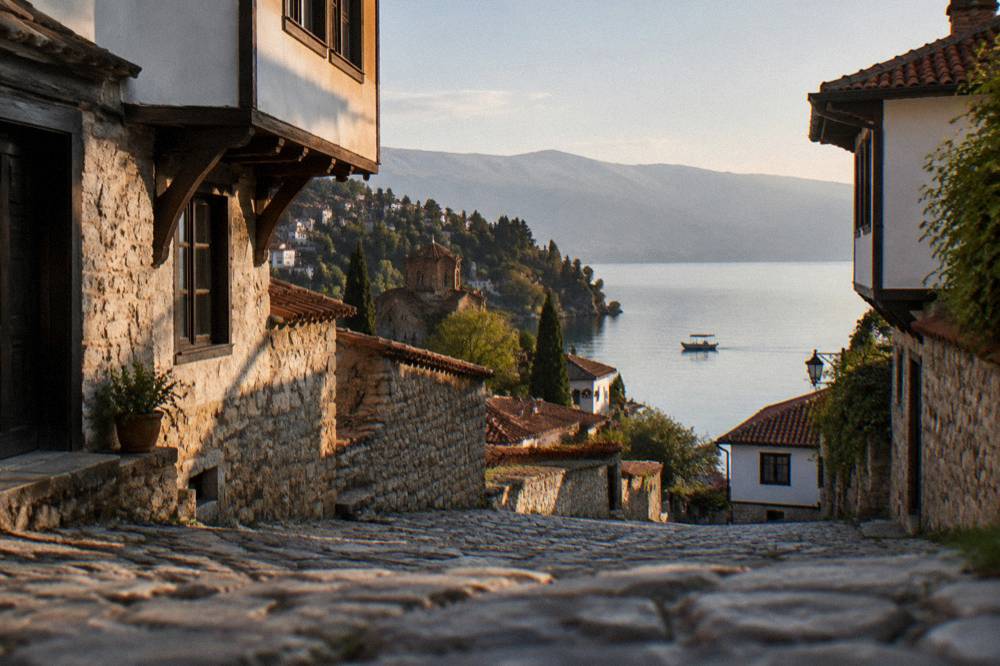
Evening shows at the Ohrid Summer Festival take place at the Ancient Theatre, an ancient stone theatre above the town, and at St Sophia, the traditional second main venue. Both venues sit inside the evening walking circuit, so a festival night needs no transport beyond shoes. The opening gala on 12 July 2026, featuring Ermonela Jaho and Charles Castronovo, showed the setting: full seating and opera voices carrying over the lake basin.
The opening gala on 12 July 2026, with Ermonela Jaho and Charles Castronovo, is the printed fact that shows what an Ohrid festival night looks like: an ancient stone theatre above the town, full seating, and opera voices carrying over the lake basin. St Sophia's role as a concert venue is the tradition the sources describe. Both venues sit inside the evening walking circuit, so a festival night needs no transport beyond shoes.
The festival sits inside a dense summer cultural block, which is why late July and August feel like the town's night season. The dates below are the 2026 editions, all from primary or directly reported sources; treat any 2027 version as unannounced.
| Event, 2026 edition | Dates | Reported detail |
|---|---|---|
| 65th Struga Poetry Evenings (Struga) | 24 to 29 Jun | theme 'Where Poetry Lives', about 70 poets |
| 65th Balkan Festival of Folk Songs and Dances | 3 to 6 Jul | Grigor Prlichev cultural centre, closed by Croatia's Lado |
| 66th Ohrid Summer Festival | 12 Jul to 20 Aug | opening gala at the Ancient Theatre |
| Ohrid Swimming Marathon, St Naum to Ohrid harbour | 22 Aug | 25 km route, 16 swimmers |
| SUP marathon around the lake | 26 Aug | 33 km, part of the Ohrid Water Festival (12 to 30 Aug) |
The marathon's finish at the city harbour is an evening-adjacent spectacle in the Water Festival's August block, and the Ohrid Summer Festival guide covers the rest of the after-dark calendar.
For couples planning a trip around one of these weeks, the festival block is the strongest reason to date the visit: Ohrid for couples pairs the evening programme with the daytime lake circuit.
What Does A Sunset Cruise On Lake Ohrid Cover?
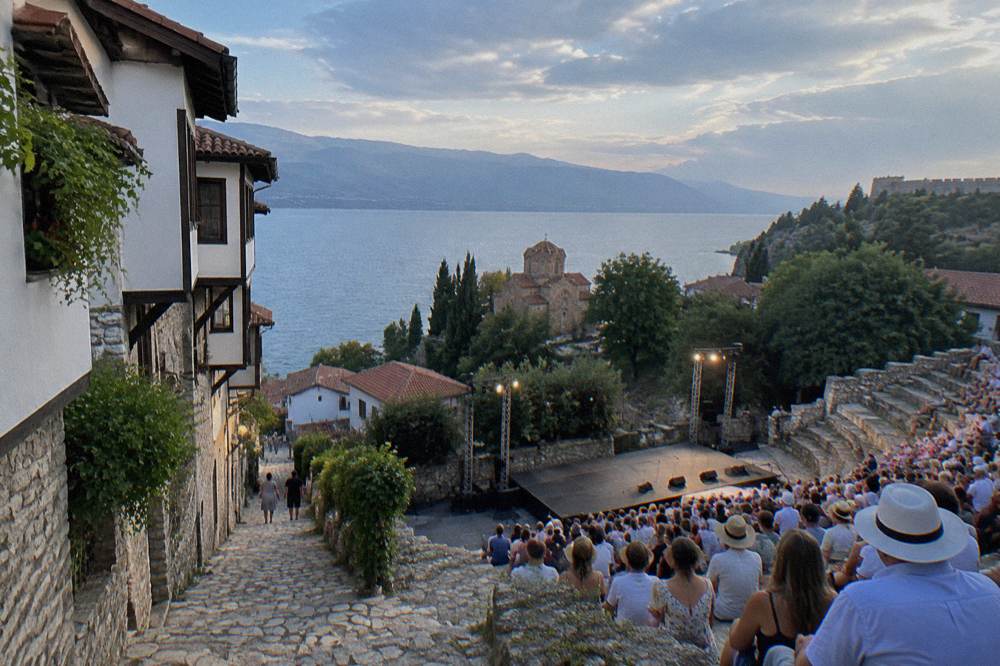
A sunset cruise is the one evening product on the water that fits inside the 2026 rules: the roster's 1.5-hour sunset trip departs in the early evening and returns before the 21:00 summer cutoff, while the panoramic old-town cruises, one of them combining the shore with Tito's Residence, run about an hour from the port area. All of them are daytime-or-dusk products; no listed cruise runs after dark in high summer.
The distinction matters when reading any listing. A sunset departure, a one-hour panoramic circuit and a wine-tasting cruise with unlimited wine are all early-evening products on this lake, because the 2 June 2026 decision closes the water at night. The wine cruise, an hour on the lake with wine flowing, is the most dinner-adjacent of the three, sitting somewhere between a boat ride and an aperitif on water.
Fancy a glass of local wine on the water before dinner? Book a wine tasting cruise here.
What every one of these trips shows is the town's vertical evening profile: the port, the shore line, the churches above it and the fortress at the top. The lake's own numbers frame the comfort: modelled surface temperatures of about 19.4 to 22.5 C in June and 22.9 to 24.4 C in July, cooling to about 14.7 C by October. An evening on the water in shirt sleeves is a June-to-September reality, and an October one wants a layer.
How Late Do Dinners Run And What Should An Evening Table Include?
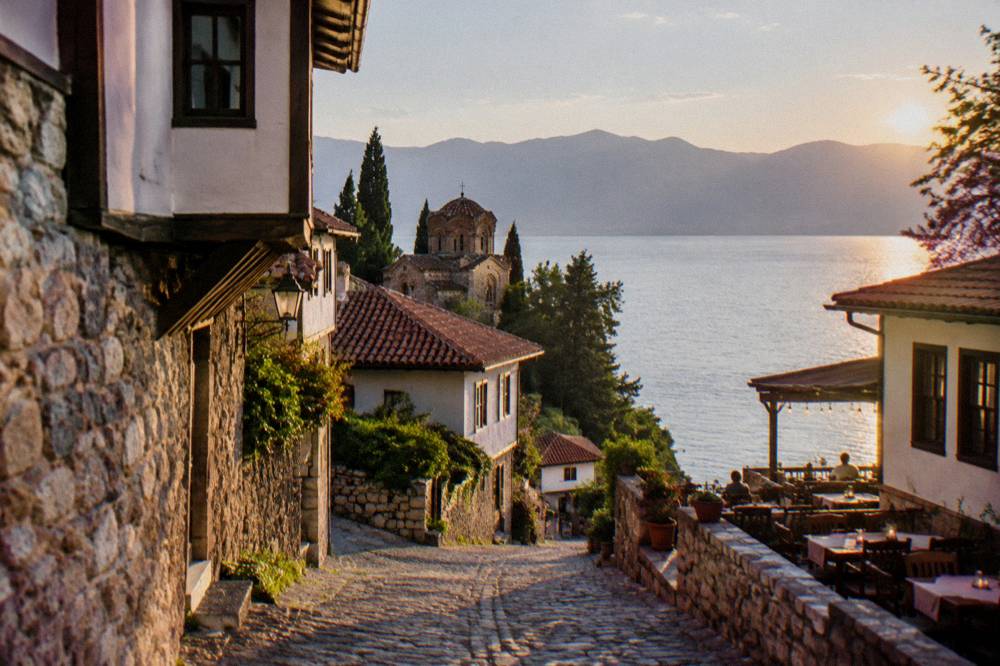
Ohrid's late-dinner culture is a lakefront one: tables along the shore and in the old-town lanes, with local wine and the lake's own food traditions on the menu, and the practical limit on the evening is the walk home up the old-town lanes rather than any published closing hour, since no restaurant hours appear in the usable record. Plan the table for the shore, the walk for after it, and the museum second shift or a sunset boat before it.
The food itself is well documented even where the hours are not. Ohrid trout is the lake's famous dish, tavche gravche the national baked-bean standard, and rakija and Macedonian wine the evening pours; each has its own page in this site's food section. A tasting room rather than a restaurant is another evening shape: several winery experiences on the roster run in the late afternoon and early evening, including a winery tour with transport and a private tasting format.
One product on this page's roster goes further afield: a food-and-villages tour covering cave churches, villages and cuisine gives an evening-heavy day a daytime anchor, and Check availability for its current schedule. It is a daytime product by design, which is exactly why it pairs with a night-focused itinerary: the cave churches and village kitchens fill the hours before the lakefront takes over.
The evening table's other half is money mechanics. The denar is the currency, the National Bank's middle rate on 19 October 2026 was 1 EUR to 61.6633 MKD, and euros are not legal tender even where they are informally accepted at poor rates, so a late dinner bill arrives in denar. The full currency picture, including ATM practice, sits at Macedonian denar and money.
| Evening building block | Detail | Where it fits |
|---|---|---|
| Museum second shift | Robev House to 20:00, summer only | Before dinner, old town |
| Sunset cruise | Early-evening departure, back before 21:00 | Before or instead of a first drink |
| Wine tasting | Winery experiences in the late afternoon | Bridges daylight and dinner |
| Festival night | Ancient Theatre and St Sophia, 12 Jul to 20 Aug 2026 | Replaces the whole evening plan |
| Boardwalk walk | Shoreline from the port towards the beaches | After dinner, on foot |
Is Ohrid Safe To Walk Around At Night?
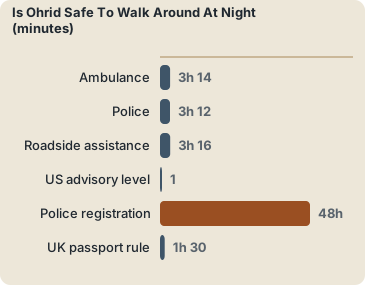
The safety picture is a normal-precautions one: the US State Department's advisory for North Macedonia stands at Level 1, Exercise Normal Precautions, and the UK's FCDO publishes standard rather than heightened advice, while the practical night-time considerations in Ohrid are physical, cobbled lanes climbing from the lake and dark shoreline stretches, not crime statistics, which no usable source provides for the town at night.
The numbers worth carrying are short. Ambulance is 194, police is 192 and roadside assistance is 196, per the FCDO's help page. Tap water in Ohrid is generally reported as drinkable from the municipal supply. Registration with the local police within 48 hours of arrival is the legal formality, and hotels handle it; the UK rule is a passport expiry date at least 90 days after arrival, with visits up to three months without a visa.
One 2026 change touches evening driving specifically. From summer 2026, streets in the old town including Ilindenska, Kosta Abrash and Car Samoil run a resident-only parking regime, free for residents with a valid sticker, with clamping for non-residents, as reported. Anyone planning to drive to a dinner inside the old town rather than walk should read the Ohrid parking guide first.
| Night practical | The printed fact |
|---|---|
| Ambulance | 194 |
| Police | 192 |
| Roadside assistance | 196 |
| US advisory level | Level 1, Exercise Normal Precautions |
| Police registration | Within 48 hours of arrival; hotels do it |
| UK passport rule | Expiry at least 90 days after arrival |
What Is The Weather Like On An Ohrid Evening?
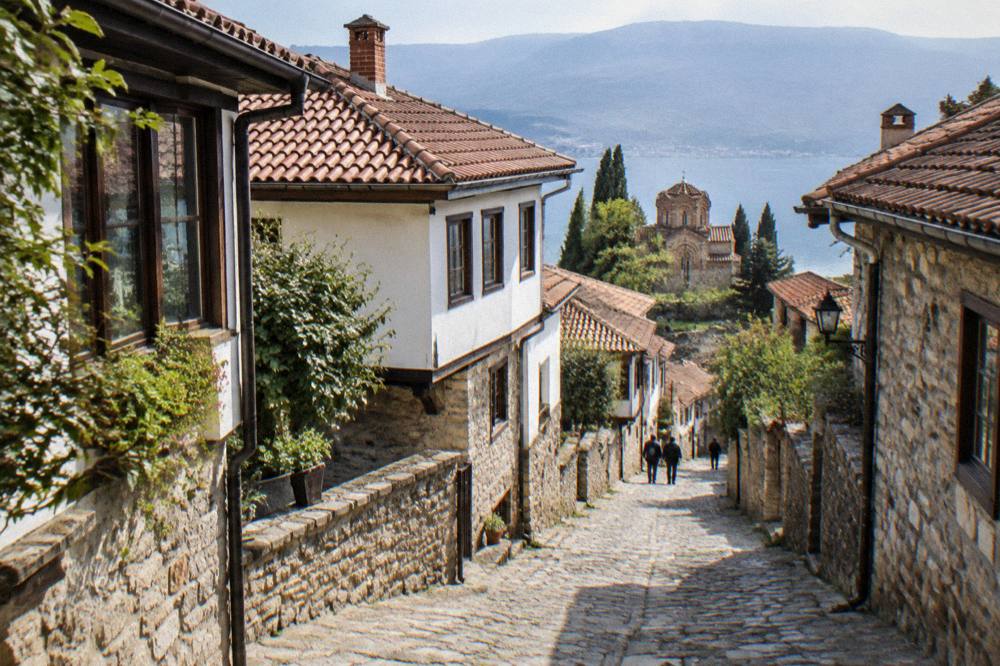
By modelled ERA5 reanalysis for the Ohrid grid cell, 1991 to 2020, summer evenings are mild and dry: July averages a mean daily high of 27.1 C and a low of 18.3 C with 34.7 mm of rain across the month, and August a high of 27.6 C and a low of 19.0 C with 32.9 mm of rain, while September cools to a 22.4 C high and 14.9 C low.
July and August are the natural lakefront-evening months; October is a jacket month after dark.
These are modelled normals, not a station record, and they describe the air, not the water. Read together with the modelled lake surface temperatures, they set the calendar for the whole evening economy: from June the water is swimmable and the air stays warm past sunset, and by November, with a mean high of 11.5 C and 90.4 mm of rain, the evening moves indoors and the boats are gone.
| Month | Mean high C | Mean low C | Rain mm | Modelled lake surface C |
|---|---|---|---|---|
| May | 19.5 | 10.8 | 70.8 | about 14.9 to 18.7 |
| Jun | 24.2 | 15.2 | 43.1 | about 19.4 to 22.5 |
| Jul | 27.1 | 18.3 | 34.7 | about 22.9 |
| Aug | 27.6 | 19.0 | 32.9 | about 23.5 |
| Sep | 22.4 | 14.9 | 62.4 | about 19.7 |
| Oct | 17.4 | 10.3 | 76.0 | about 14.7 |
The evening planner's reading of that table is simple. July and August combine the warmest nights with the lowest rainfall and the festival programme, which is why they are also the busiest months. September trades the festival for a quieter shore and an earlier boat cutoff. May and October are shoulder evenings: pleasant at dinner, cool on the water.
How Do You Build A Full Evening Itinerary Around Ohrid's Night?
A complete Ohrid evening stacks four layers in order: the Robev House second shift until 20:00 in summer, a sunset cruise or a shore walk in the last light, a late dinner on the lakefront, and on festival nights the Ancient Theatre instead of the first two, with everything held together on foot because the old town has no transport of its own. The daytime half of the plan belongs to the one-day and two-day itineraries.
The sequencing is forced by the hours. The museum's second shift ends at 20:00, the boats must be ashore by 21:00 in July and August, and the festival curtain is the theatre's own schedule. A visitor who tries to do all of it in one night runs out of evening; a visitor who picks one water element, one table and one walk has the town's night exactly as it works.
Longer stays spread the layers. Ohrid in three days and Ohrid in five days let a festival night, a cruise night and a quiet dinner night sit side by side, and families will find the walking-and-water structure suits children in summer, as laid out in Ohrid with kids. On a wet evening the plan inverts: Ohrid in the rain moves the weight indoors, and the lit facades do the rest. The one-day and two-day plans sit at Ohrid in one day and Ohrid in two days.
The guided options slot into the same logic. A half-day city tour late in the afternoon ends where the evening begins, and a winery tasting is the bridge between the sightseeing day and the dinner night. The block below carries the current details for the three that pair best with an evening-focused plan.
Common Questions About Ohrid At Night
Can you go boating at night on Lake Ohrid?
No, not in the 2026 season: a government decision of 2 June 2026 bans boats from the lake between 21:00 and 05:00 from 3 June to 31 August, and between 20:00 and 05:00 in September, with a further October limit. Sunset cruises that dock before the cutoff are the evening option on the water.
Is Ohrid's old town safe to walk at night?
The advisory level for North Macedonia is Level 1, Exercise Normal Precautions, and no night-specific crime figure exists in the usable record. The practical considerations are physical: cobbled lanes climbing from the lake and unlit stretches of shoreline. Police is 192 and ambulance is 194.
Are Ohrid's churches open in the evening?
No published evening hours exist for St John at Kaneo, St Sophia or Plaosnik in any usable source. The museum institute's sites are the ones with printed summer hours, and only Robev Family House runs to 20:00, on the summer second shift from 1 May to 30 September, closed Monday.
When does the Ohrid Summer Festival hold its evening performances?
The 66th edition ran 12 July to 20 August 2026, opening with a gala at the Ancient Theatre, with St Sophia the traditional second venue. The 2027 dates had not been announced, so check the programme before dating a trip to the festival.
Is it warm enough to sit outside at night in Ohrid?
In July and August, yes by the modelled ERA5 normals, 1991 to 2020, which put the mean daily low at 18.3 C and 19.0 C respectively with monthly rain of 34.7 and 32.9 mm. September's mean low is 14.9 C, and October's is 10.3 C, so the outdoor season narrows from autumn onwards.
Can you pay in euros for a late dinner in Ohrid?
Euros are not legal tender in North Macedonia; the currency is the denar, with the National Bank's 19 October 2026 middle rate at 1 EUR to 61.6633 MKD. Euros are sometimes informally accepted at poor rates, but a dinner bill is properly settled in denar.