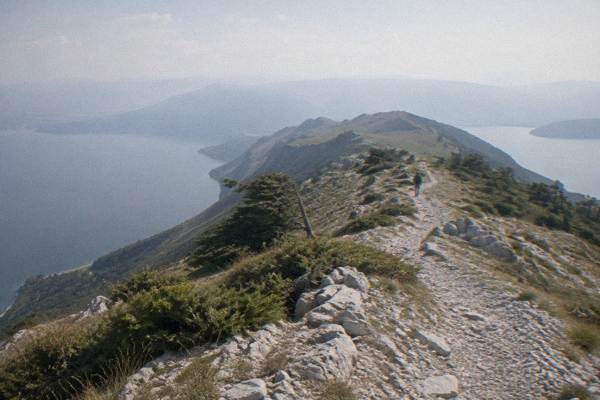
Three Days In Ohrid: Adding Galičica And Struga
Three days is the point at which Ohrid stops being a weekend church crawl and becomes a region: day one for the old town, day two up into Galičica National Park to Lake Prespa, day three down to Struga on the Black Drim.
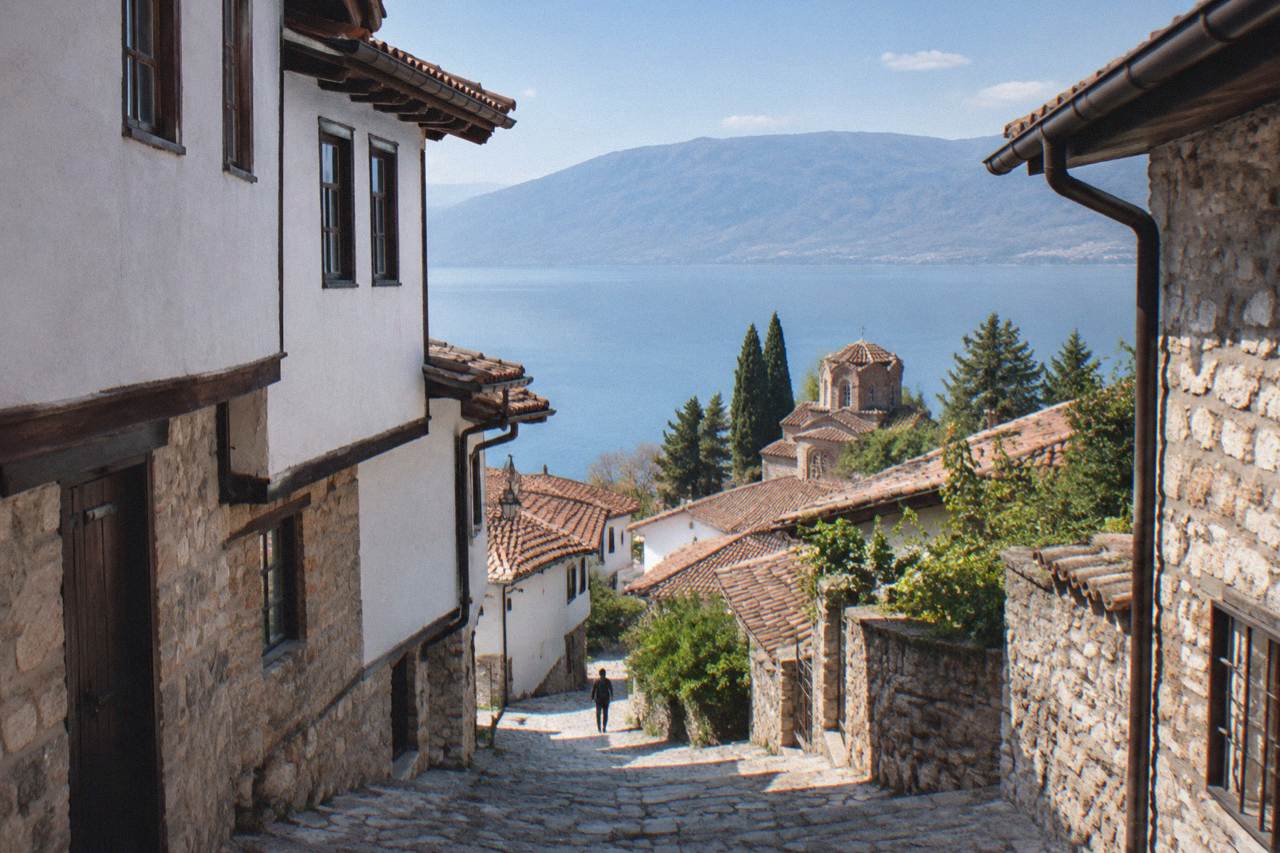
Short answer
Day one covers the old town on foot, Samuel's Fortress, Plaošnik, St John at Kaneo and a lakefront evening. Day two climbs Galičica National Park, 250 MKD per vehicle, to the Prespa viewpoint. Day three pairs Struga, about 12 km away, with the Crn Drim springs at St Naum, where entry is listed at 150 MKD and a springs rowboat at about 5 EUR.
Three days is the point at which Ohrid stops being a weekend church crawl and becomes a region: day one for the old town, day two up into Galičica National Park to Lake Prespa, day three down to Struga on the Black Drim. This Ohrid Travel Guide page lays out each day around figures the primary listings actually publish, from the museum institute's 150 MKD foreign ticket to the park's 250 MKD per-vehicle fee. Ohrid sits on Lake Ohrid in North Macedonia, an inland lake at about 693 m above sea level, and nothing in this plan requires the sea, a river or a tram, because the town has none of them.
Why Three Days In Ohrid Is The Right Length
Three days splits Ohrid cleanly into town, mountain and river: one day for the old town lanes and the lakefront churches, one for Galičica National Park and the Prespa viewpoint, and one for Struga and the St Naum springs, and each of those three days needs a full day because the museum sites close on Mondays and the park road can hold snow between January and March.
The shorter plans on this site, two days in Ohrid and the single-day plan at one day in Ohrid, cover the town itself well. What they cannot absorb is the mountain. Galičica is North Macedonia's second national park, proclaimed in 1958, with 22,750 hectares between Lake Ohrid and Lake Prespa and Magaro peak at 2,254 m, and the park is open year-round although heavy snow can close the main road, typically between January and March. That is the single strongest argument for the third day: it converts Ohrid from a town trip into a two-lake trip, since Lake Prespa's Nakolec gauge reads 841.36 m, about 148 m above Lake Ohrid, directly across the Galičica ridge.
The UNESCO inscription is the other argument. The "Natural and Cultural Heritage of the Ohrid Region" is a mixed property of about 94,729 hectares, inscribed in 1979 for its natural values and 1980 for its cultural ones, and extended to the Albanian side of the lake in 2019. UNESCO's own listing credits Ohrid with the oldest Slav monastery, St Panteleimon at Plaošnik, and more than 800 Byzantine-style icons from the 11th to the end of the 14th century, and puts the lake's age at about two to three million years with over 200 endemic species, including 17 endemic fish. Three days is enough to see both halves of that inscription, the cultural in the town and the natural on the water and the ridge.
Day One: The Old Town, The Fortress Ridge And The Lakefront
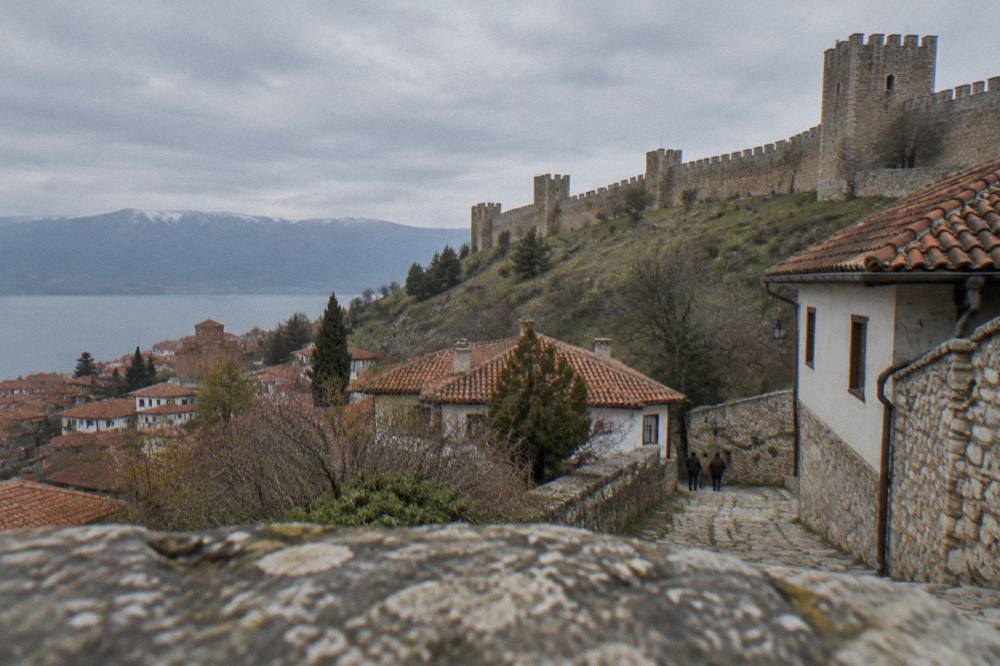
The fortress itself is the one stop on this day where no ticket or hours should be assumed: the official page lists none, and the site's real 2026 news is a municipal revitalisation plan with a summer stage and illumination, budgeted at over 11 million denars. Descend from the ridge to Plaošnik, where UNESCO places the oldest Slav monastery, St Panteleimon, and on to the Ancient Theatre, which the museum institute dates to the end of the 3rd or start of the 2nd century BC, first excavated in 1935, with a capacity that rose to 5,000 after the epiteatron was added. It is also the opening venue of the Ohrid Summer Festival: the 66th edition opened there on 12 July 2026.
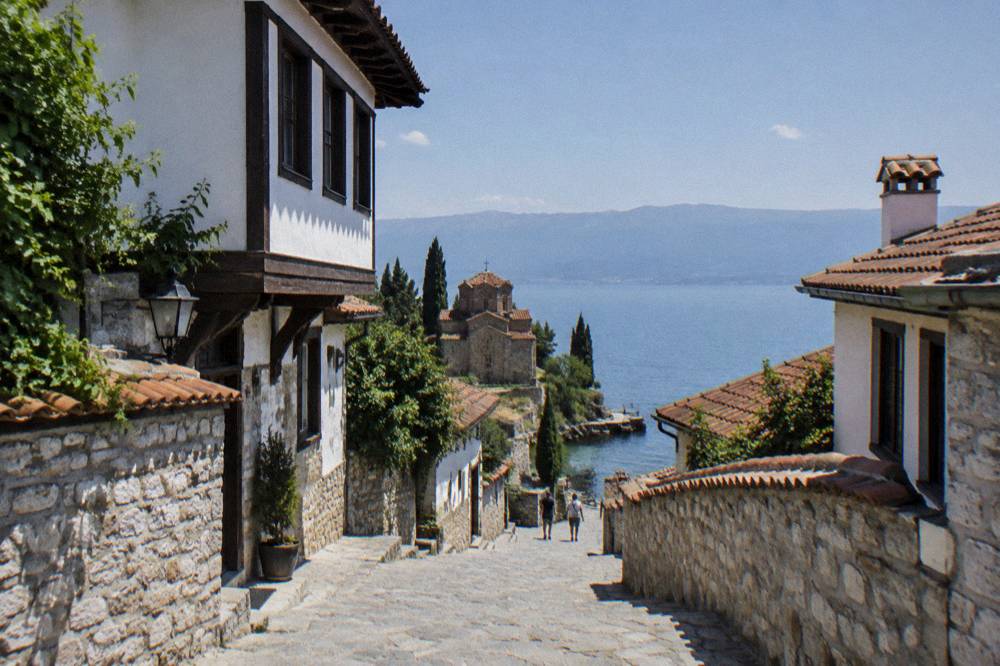
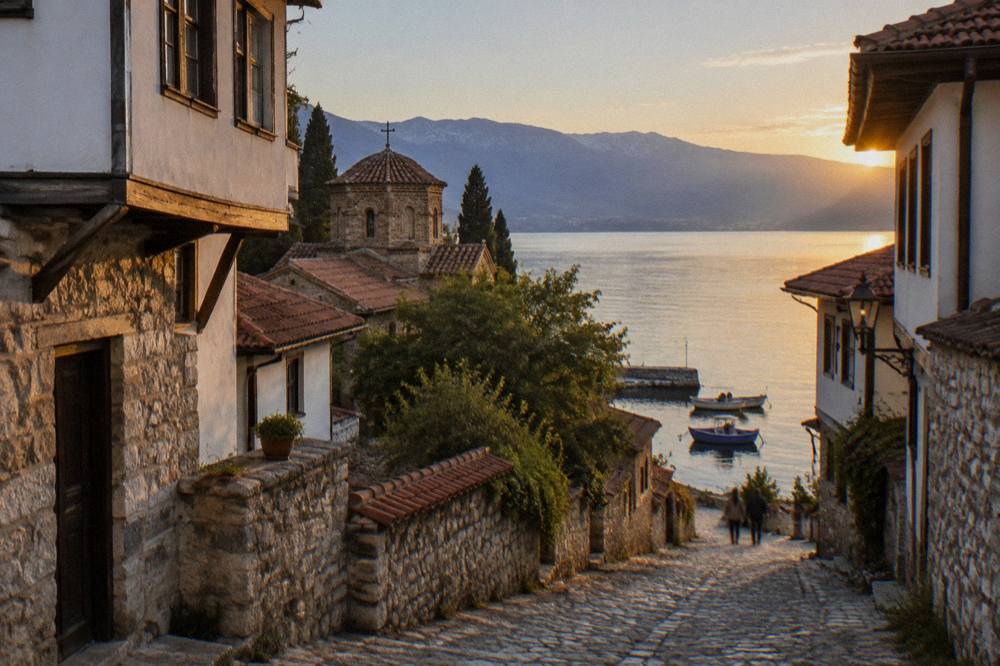
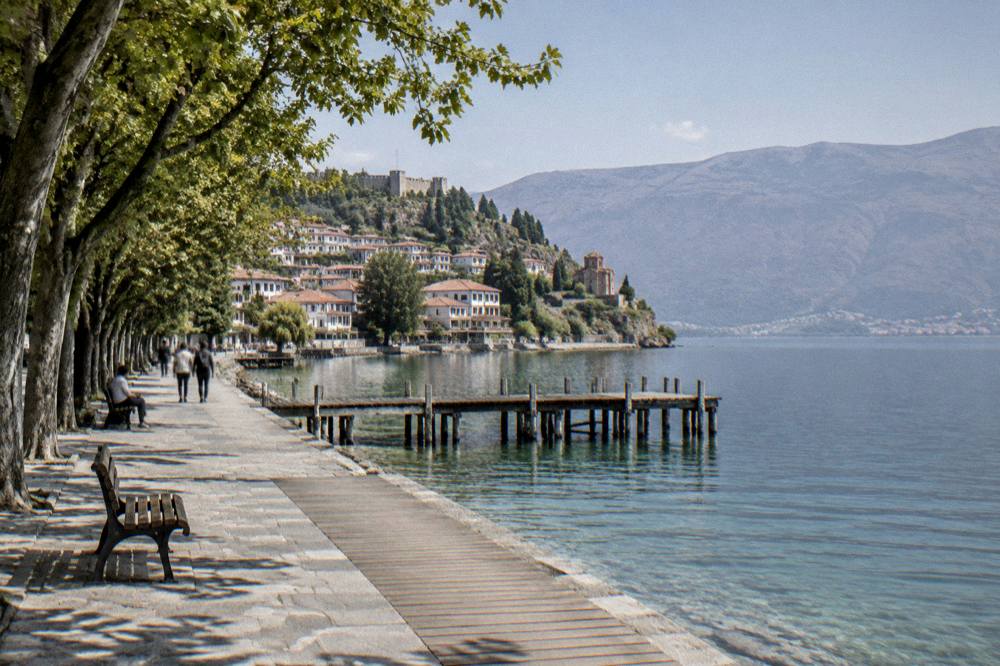
The lakefront end of the day belongs to St John at Kaneo and the boardwalk. The church entry is reported at about 150 MKD, a secondary figure rather than an official one, so confirm at the door. The covered museum sites on this route, Robev Family House, the Icon Gallery at the Perivleptos complex, carry the institute's own printed prices and hours, tabulated below, and the Perivleptos and Icon Gallery guide covers that complex in detail.
| Museum institute site | Foreign (MKD) | Domestic (MKD) | Children and students (MKD) |
|---|---|---|---|
| Robev Family House | 150 | 120 | 60 |
| Museum on Water (Bay of Bones) | 150 | 120 | 60 |
| Icon Gallery (Perivleptos) | 150 | 120 | 60 |
| Museum institute site | Winter hours (1 Oct to 30 Apr) | Summer hours (from 1 May) | Closed |
|---|---|---|---|
| Robev Family House | 09:00 to 15:30 | 09:00 to 15:30 and 13:30 to 20:00 | Monday |
| Museum on Water (Bay of Bones) | 09:00 to 15:30 | 09:00 to 16:30 | Monday |
| Icon Gallery | 09:00 to 14:00 | 09:00 to 17:00 | Monday |
In the evening the lake is the entertainment. A panoramic old-town cruise runs from the port along the town front, and the longer option, Boat Armada's full-day cruise to St Naum with a Bay of Bones stop, costs from 1,200 den adult and 600 den child, a figure worth holding for day three. The full detail on the waterfront is in the Ohrid boat tour guide.
The evening walk itself needs no ticket. The old town climbs from the lake to the fortress and the lanes are on foot, and the Ohrid at night itinerary picks up where this day ends.
Day Two: Galičica National Park And The Prespa Viewpoint
Day two leaves the town for Galičica National Park, paying 250 MKD per vehicle at the gate with no per-passenger charge, crossing the ridge between Lake Ohrid and Lake Prespa on a road that is open year-round but can be closed by heavy snow, typically January to March, with the Prespa shoreline sitting about 148 m higher than Lake Ohrid, at a gauge level of 841.36 m.
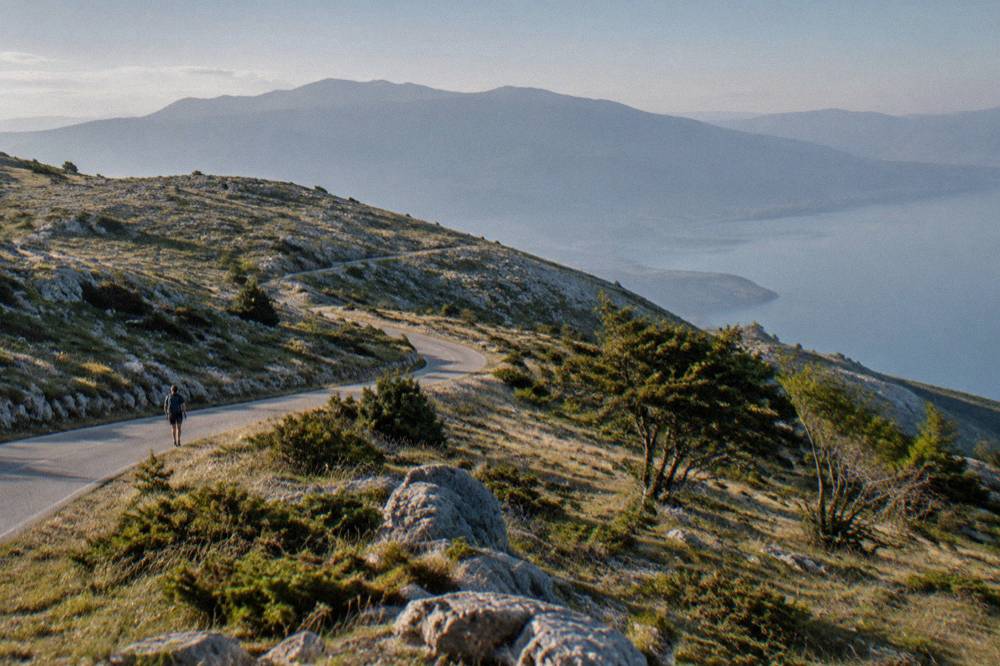
The fee structure is the detail that catches people out. The 250 MKD is per vehicle; the 100 MKD rate applies only to someone entering on foot from the Ohrid-side gate, never to car passengers. The park's official site runs a live camera page, which is the practical way to check the ridge conditions before setting out, and the Galičica National Park day trip page collects the access detail. From the ridge the two-lake geometry is the whole point: Lake Prespa on one side, Lake Ohrid about 148 m below on the other, and the reasons behind Prespa's falling levels are covered in the Lake Prespa day trip page.
The park also carries the hiking weight of the region, and the Ohrid hiking guide maps the marked trails, including the two-lakes route across the ridge. The jeep and ATV products in the roster cover Galičica for anyone who would rather not walk the elevation. Weather planning for this day should use the modelled normals, not memory: the ERA5 reanalysis for the Ohrid grid cell, 1991 to 2020, gives the monthly picture below.
| Month | Mean daily high (C) | Mean daily low (C) | Rain (mm) |
|---|---|---|---|
| May | 19.5 | 10.8 | 70.8 |
| June | 24.2 | 15.2 | 43.1 |
| July | 27.1 | 18.3 | 34.7 |
| August | 27.6 | 19.0 | 32.9 |
| September | 22.4 | 14.9 | 62.4 |
| October | 17.4 | 10.3 | 76.0 |
Those are modelled ERA5 reanalysis values for a grid cell at 701 m, not a station record, and they describe the town level, not the ridge, which runs far higher. August has the highest mean daily high in the table at 27.6 C and January the lowest mean daily low at -0.8 C, with December carrying 92.6 mm of rain against August's 32.9 mm. For a month-by-month decision the Ohrid weather page holds the full table.
If the ridge is closed by snow, or the day turns wet, the substitution is indoor: the Ohrid in the rain plan leans on exactly the museum sites tabulated on day one, all reachable on foot in the old town.
Day Three: Struga, The Black Drim And St Naum
Day three goes west: Struga sits about 12 km from Ohrid on the Black Drim, the river that drains Lake Ohrid northward, and the day pairs the town with St Naum monastery at the Crn Drim springs on the south shore, where the listed entrance is 150 MKD per person and a rowboat through the springs runs at about 5 EUR, with the Albanian border crossing at Tushemisht about 4 km away.
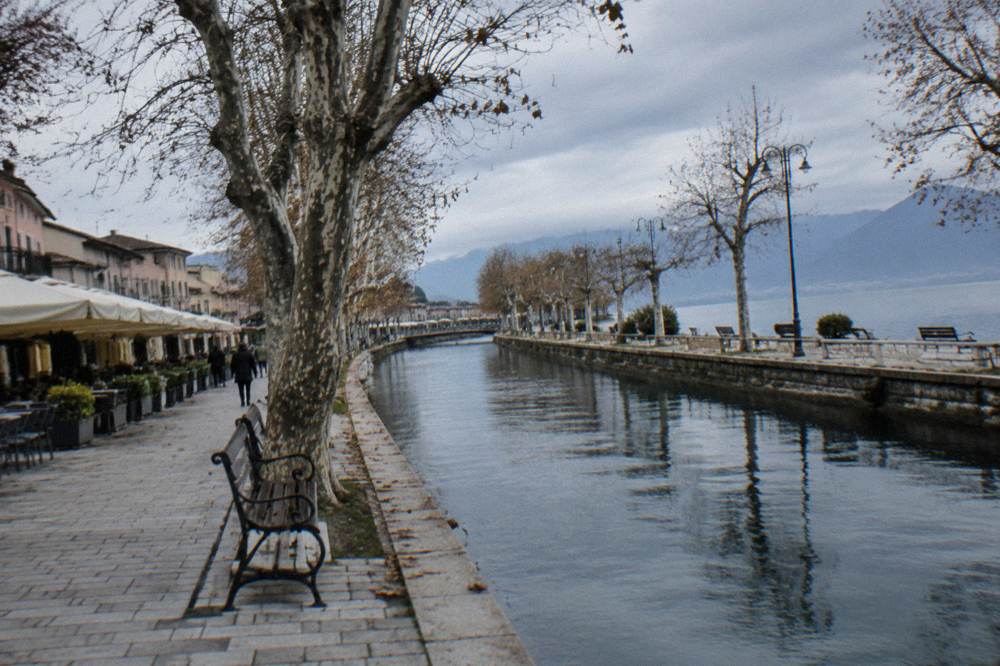
Struga is where Lake Ohrid empties. The Black Drim leaves the lake here, and the town is the home of the Struga Poetry Evenings, whose 65th edition ran 24 to 29 June 2026 under the theme "Where Poetry Lives", with about 70 poets taking part. That edition ran in June rather than its traditional late-August slot, so check the festival's own channels before planning a visit around it. The Struga town guide and the Struga from Ohrid page carry the town detail, and the Ohrid vs Struga comparison answers the obvious question.
St Naum is the anchor of the afternoon. The monastery sits by the Crn Drim springs, and the cruise operator's listing gives the entrance as 150 MKD per person and the springs rowboat at about 5 EUR per boat. The full-day boat option from Ohrid port, from 1,200 den adult and 600 den child, stops at the Bay of Bones on the way, and the St Naum tour from Ohrid page covers both road and boat access. Boats to St Naum generally run about May to October with a reduced winter schedule, so from late autumn the road is the reliable route.
For anyone who would rather not assemble the Struga and St Naum logistics alone, the semi-private tour of Ohrid and Struga from Tirana covers both towns in one booked day, and the related listing is at Semi-Private Tour of North Macedonia: Ohrid & Struga. It starts in Tirana, not Ohrid, so it suits a trip that begins or ends in Albania: Check availability.
The distances are short, which is why the third day works. The straight-line figures from the places data put the whole region within a morning's drive.
| Destination from Ohrid | Straight-line distance |
|---|---|
| Struga | about 12 km |
| Pogradec (Albania) | about 26 km |
| Bitola | about 46 km |
| Tirana (Albania) | about 86 km |
| Skopje | about 111 km |
What Three Days In Ohrid Costs At The Desk
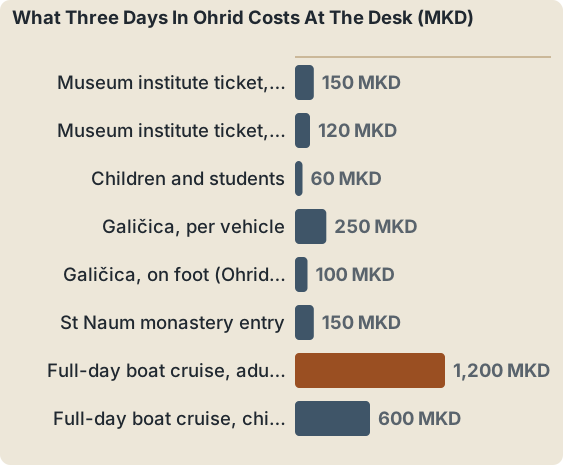
The fixed published costs of this itinerary are the museum institute tickets at 150 MKD foreign and 120 MKD domestic per site with children and students at 60 MKD, the Galičica gate at 250 MKD per vehicle or 100 MKD on foot, St Naum entry at 150 MKD and a springs rowboat at about 5 EUR, plus the full-day boat cruise from 1,200 den adult and 600 den child, in denars, at 61.6633 MKD per euro on 19 October 2026.
That adds up to a modest desk total for two people with a car, on the order of a few thousand denars across the three days, before food and bed. The currency rule matters at every desk: North Macedonia is not in the EU and not in Schengen, the denar is the only legal tender, and euros quoted informally in tourist settings change hands at poor rates. ATMs are the reliable route to denars. The denar and money guide covers this in full, and the Ohrid cost and budget page does the arithmetic for longer stays.
| Item | Published figure | Source type |
|---|---|---|
| Museum institute ticket, foreign | 150 MKD | institute's own site |
| Museum institute ticket, domestic | 120 MKD | institute's own site |
| Children and students | 60 MKD | institute's own site |
| Galičica, per vehicle | 250 MKD | park reporting |
| Galičica, on foot (Ohrid gate) | 100 MKD | park reporting |
| St Naum monastery entry | 150 MKD | cruise operator's listing |
| Springs rowboat at St Naum | about 5 EUR | cruise operator's listing |
| Full-day boat cruise, adult | from 1,200 den | operator's own listing |
| Full-day boat cruise, child | from 600 den | operator's own listing |
Two caveats keep the table honest. The reported about-150 MKD entries at St John at Kaneo, St Sophia and Plaošnik are secondary figures, not official ones, so treat them as approximate and confirm at the door. And Samuel's Fortress stands entirely outside this table because it publishes no price or hours, so nothing is assumed for it here.
How The Three Days Change With The Season
The plan is stable from late spring to early autumn, with modelled lake surface temperatures rising from about 14.9 C in May to about 23.5 C in August and the swimming season running from July, while the winter version drops the boat legs, runs on the museum winter hours of 09:00 to 15:30 or 14:00, and risks Galičica snow closures between January and March, so the mountain day should sit early in an autumn visit and late in a spring one.
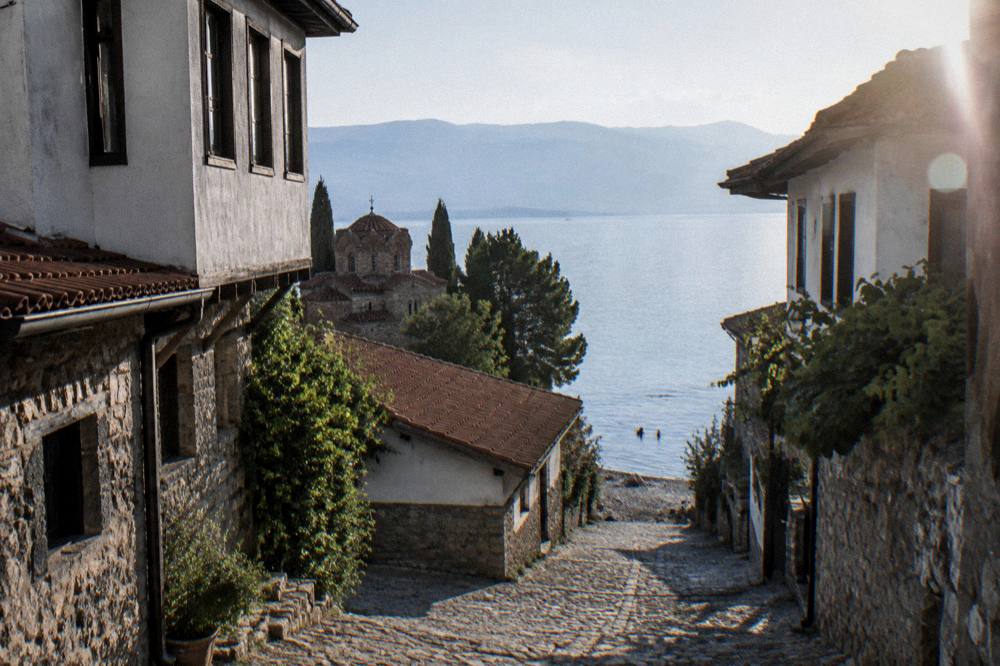
The water figures are modelled aggregator values, with one official anchor: the UHMR multi-year October mean for the lake is 14.3 C on a 2001 to 2020 base. The 2026 bathing tests by the Institute of Public Health found Class I physico-chemical quality across the measured points except Grashnica beach at Class III, with most microbiological samples rated excellent, which is the closest thing to a clean bill the lake publishes. The swimming in Lake Ohrid page carries the detail.
| Month | Modelled lake surface temperature (C) |
|---|---|
| April | about 10.5 |
| May | about 14.9 |
| June | about 19.4 |
| July | about 22.9 |
| August | about 23.5 |
| September | about 19.7 |
| October | about 14.7 |
The festival calendar is the summer wildcard. The 66th Ohrid Summer Festival ran 12 July to 20 August 2026 with its opening gala at the Ancient Theatre, the 65th Balkan Festival of Folk Songs and Dances ran 3 to 6 July 2026, and the Ohrid Water Festival ran 12 to 30 August 2026, including the 25 km swimming marathon from St Naum to Ohrid harbour on 22 August and a separate 33 km SUP marathon around the lake on 26 August. The 2027 dates for the major festivals had not been announced, so a 2027 trip should be planned around the seasons, not the calendar. The Ohrid in summer page has the full summer picture, and the winter variant of this same plan is Ohrid in winter.
Practical Rules For The Three-Day Route
Three rules carry real weight: the museum sites close on Mondays, so days one and any rainy substitute need a Tuesday-to-Sunday slot; visitors register with the local police within 48 hours of arrival, which the hotel does; and the 2026 resident-only parking regime bars non-residents from old-town streets such as Ilindenska, Kosta Abrash and Car Samoil, with clamping reported, so a car belongs in a car park outside the old lanes.
The lake itself carries dated 2026 rules. Under a government decision of 2 June 2026, jet skis are banned between 1 July and 31 August from 11:00 to 19:00, and boats are banned at night from 21:00 to 05:00 between 3 June and 31 August, with a 20:00 to 06:00 limit through September and a further October restriction. None of that touches a scheduled cruise, but it closes the door on improvised late-evening water plans.
The emergency numbers, per the FCDO's own page, are ambulance 194, police 192 and roadside assistance 196. Entry is straightforward for visa-free nationals, up to 90 days in any 180-day period, with UK visitors allowed up to three months on a passport valid at least 90 days beyond arrival. The full detail sits in the North Macedonia visa and entry and is Ohrid safe pages, and the Ohrid travel tips page collects the rest.
For anyone extending beyond three days, the how many days in Ohrid question is answered in depth on its own page, and the five days in Ohrid plan adds Bitola, Pogradec and a free day to this same skeleton. Families should read Ohrid with kids before committing to the Galičica day, and couples the Ohrid for couples plan.
Common Questions About Three Days In Ohrid
Is three days in Ohrid enough?
Three days covers the old town, Galičica National Park with the Prespa viewpoint, and Struga with St Naum, which is the full UNESCO region in miniature. The how many days in Ohrid page compares shorter and longer plans.
What day trips can I add to a three-day Ohrid itinerary?
Struga about 12 km, Pogradec about 26 km, Bitola about 46 km, Tirana about 86 km and Skopje about 111 km, all straight-line, plus Galičica and Lake Prespa directly from town. The day trips from Ohrid guide lists them all.
Do the Ohrid museum sites close on Mondays?
Yes. Robev Family House, the Museum on Water at the Bay of Bones and the Icon Gallery all close on Mondays, in both the winter schedule from 1 October to 30 April and the summer schedule from 1 May.
How much does the Galičica National Park entry cost?
The park charges 250 MKD per vehicle with no per-passenger fee. The 100 MKD rate applies only to someone entering on foot from the Ohrid-side gate.
Can I swim in Lake Ohrid on a three-day visit?
Yes, in the warm months. The modelled surface temperature reaches about 22.9 C in July and 23.5 C in August, and the 2026 bathing tests found Class I physico-chemical quality at the measured points except Grashnica beach.
Is the drive to Struga and St Naum difficult?
No. Struga is about 12 km from Ohrid and the St Naum monastery sits on the south shore, about 4 km from the Albanian border crossing at Tushemisht, which is reported open around the clock for passenger vehicles and pedestrians.