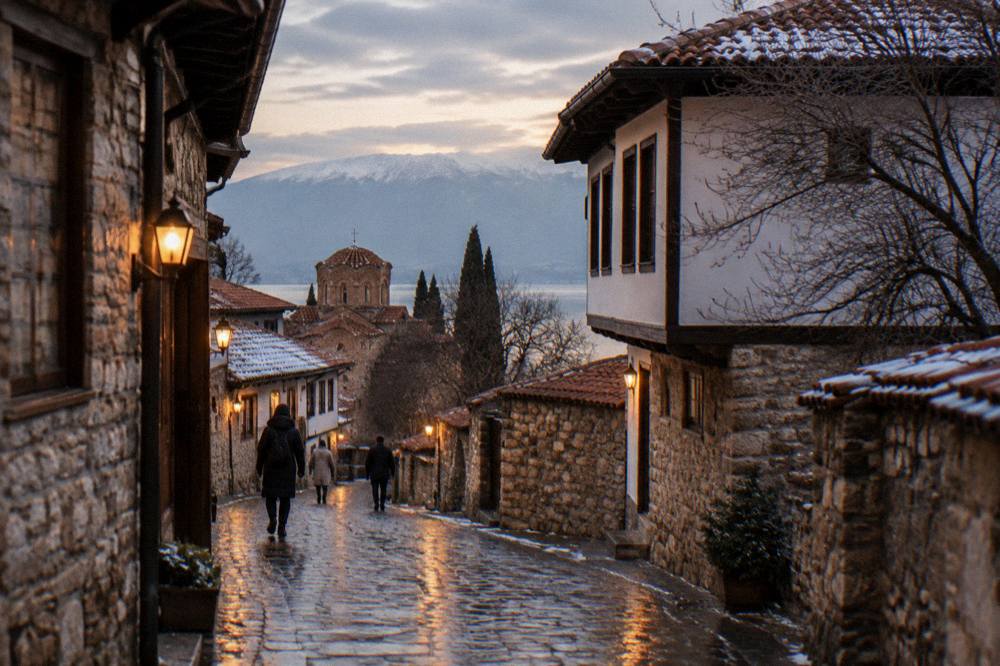
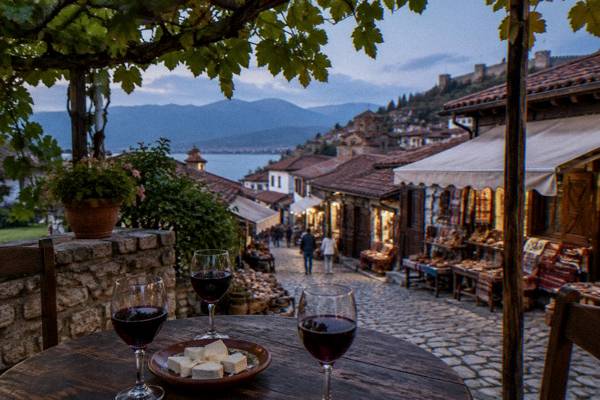
Ohrid In Winter: Frost, Fog And Empty Lakefront
Ohrid in winter is quiet, cold and largely open: the museum sites run reduced hours, the lake drops to modelled temperatures near five degrees, and the old town empties between fog banks.
Short answer
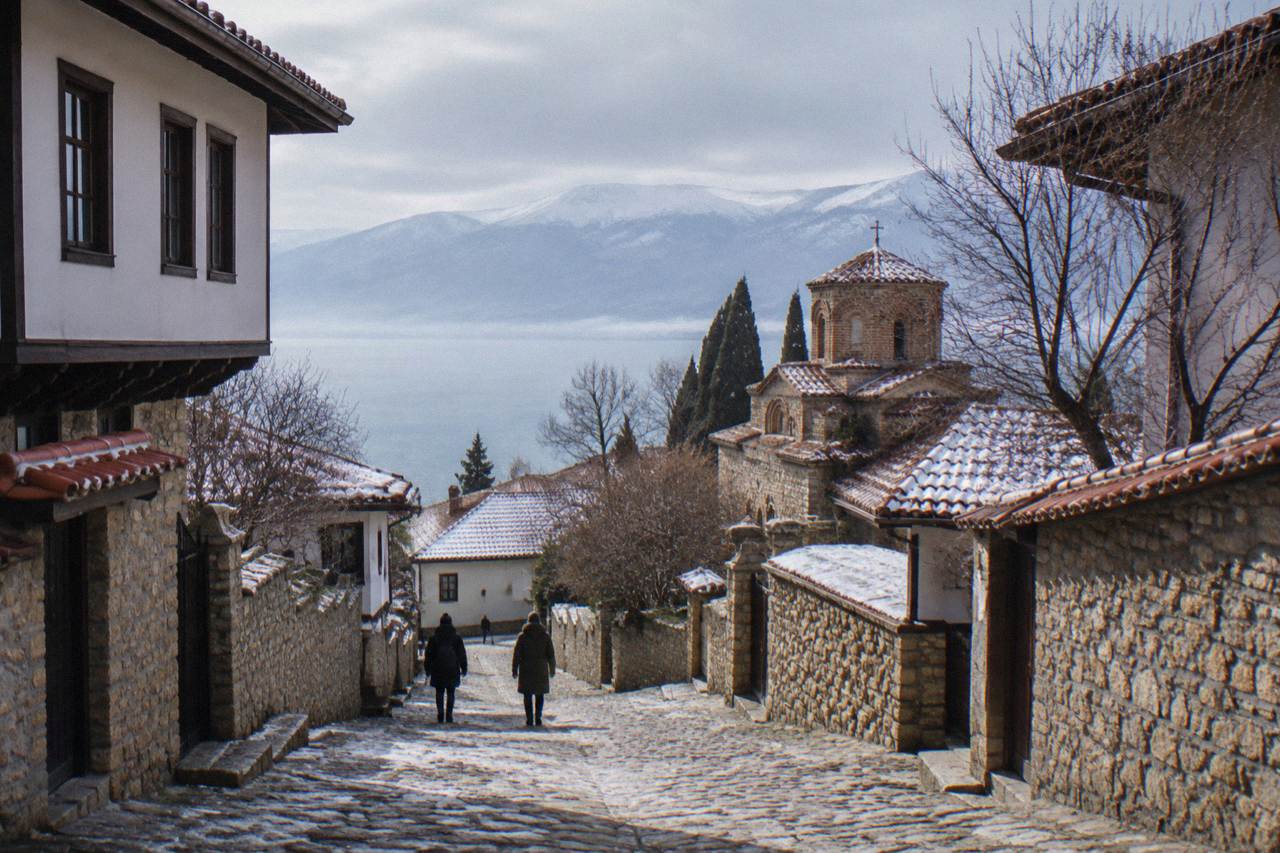
Winter in Ohrid runs the museum sites on a 1 October to 30 April schedule, brings modelled January highs near five degrees, and leaves the old town quiet on weekdays, with Christmas on 7 January and the carnival at Vevcani in mid-January as the season's anchors.
Ohrid, the old lake town of North Macedonia, changes character completely once the summer boats stop running and the lakeside promenade empties. The lanes between the Old Bazaar and the fortress stay walkable, the museum institute keeps its sites open on a reduced winter schedule, and the fog that rolls off the lake at about 693 m above sea level gives the stone streets a stillness that July never allows. This page on the Ohrid Travel Guide lays out winter from the modelled climate figures to the 7 January Christmas, sight by sight, so a December or January trip can be planned on real numbers rather than summer assumptions. For the broader seasonal picture, the companion page on the best time to visit Ohrid compares all four seasons.
How Cold Does Ohrid Get In Winter?
Modelled climate normals put January in Ohrid at about 5.0 C for the mean daily high and about -0.8 C for the mean daily low, with 76.5 mm of rain across the month, figures computed from the ERA5 reanalysis for the 1991 to 2020 period, not from a weather-station record. December averages about 6.2 C high and 0.9 C low with 92.6 mm of precipitation, February about 6.3 C and 0.0 C with 74.3 mm. Snow reaches the town in winter precipitation, and Galicica National Park, whose Magaro peak stands at 2,254 m, takes heavier snow that can close the main park road, typically between January and March.
| Month | Mean daily high | Mean daily low | Precipitation |
|---|---|---|---|
| December | 6.2 C | 0.9 C | 92.6 mm |
| January | 5.0 C | -0.8 C | 76.5 mm |
| February | 6.3 C | 0.0 C | 74.3 mm |
| March | 10.0 C | 2.5 C | 80.5 mm |
These are modelled normals, so treat them as planning ranges: a given January week can sit well above or below them. The practical reading is that Ohrid winters are damp rather than arctic, with frosty nights and daytime temperatures that usually climb above freezing. Layered clothing, a waterproof layer and shoes with grip for the stone lanes cover what the table implies. Month-by-month detail, including the shoulder seasons either side of winter, sits on the Ohrid weather page.
One more reading of the table helps with dates. March is the month that changes fastest: the mean daily high jumps about four degrees over February, and precipitation stays high at 80.5 mm, so a late-winter visit in March trades cold for mud on the unpaved lanes. February, by contrast, is the month with the lowest night figure in the set at 0.0 C, right on the freezing line, which is where the frost on the paving stones comes from. The lake moderates the town's nights relative to the surrounding hills, but the effect has limits at 693 m of altitude in a continental winter.
Which Sights Stay Open In Ohrid In Winter?
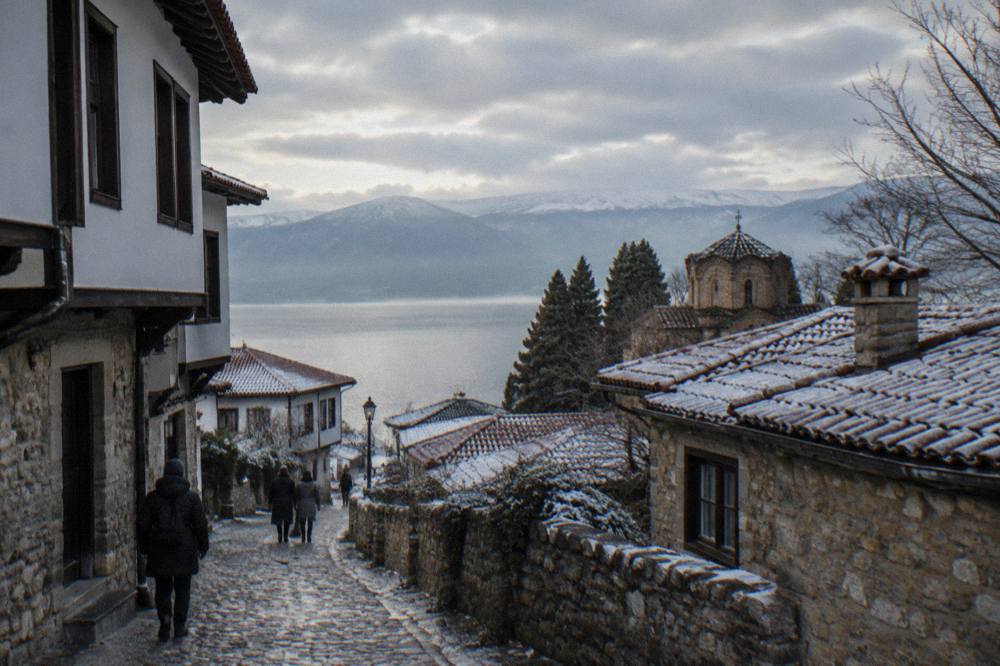
The museum institute sites in Ohrid, including Robev Family House, the Museum on Water at Peshtani and the Icon Gallery, run a winter schedule from 1 October to 30 April, keep tickets at 150 MKD for foreign visitors and 120 MKD for domestic visitors, and close on Mondays. Robev Family House opens 09:00 to 15:30 in winter; the Bay of Bones, the Museum on Water, does the same; the Icon Gallery runs 09:00 to 14:00 in winter. The child and student rate of 60 MKD is reported, not confirmed on the ticket page itself.
| Museum site | Winter hours (1 Oct to 30 Apr) | Closed |
|---|---|---|
| Robev Family House | 09:00 to 15:30 | Monday |
| Museum on Water (Bay of Bones, Peshtani) | 09:00 to 15:30 | Monday |
| Icon Gallery (Perivleptos complex) | 09:00 to 14:00 | Monday |
The institute's own pages carry these hours, and the Monday closure is the detail that shapes a winter itinerary most: a Monday arrival leaves the outdoor sights, the lanes, the Ohrid boardwalk and the churches' exteriors as the day's material. Deep-dive pages on Samuel's Fortress, Plaosnik and the Ancient Theatre cover those monuments individually. A short winter day rewards a plan: the museum sites by early afternoon, then daylight on the lakefront before the fog settles back in.
Note the asymmetry inside the table too: the Icon Gallery closes three and a half hours earlier in winter than its own summer hours, while Robev Family House and the Museum on Water keep the same 09:00 to 15:30 window all year and simply drop the second summer shift. If the Icon Gallery matters to a visit, it belongs in the morning, not the afternoon. The gallery sits in the Perivleptos complex, whose church is covered on the Church of the Holy Mother of God Perivleptos page, and the gallery's own collection is detailed on the Icon Gallery Ohrid page.
Winter also suits the town's indoor craft stops. The pages on Ohrid pearl workshops and the Ohrid paper museum describe both, and neither depends on warm weather.
Can You Do The Old Town On Foot On A Short Winter Day?
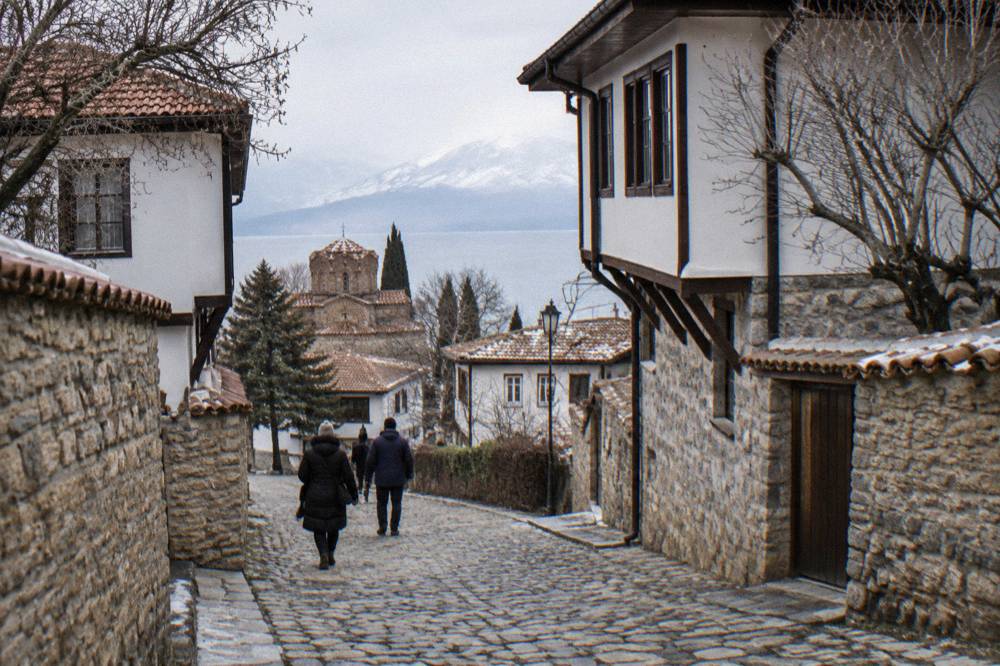
Yes, and winter is arguably when the old town works best on foot: the lanes from the Old Bazaar up to the fortress are pedestrian in character, the compact distance between St Sophia, Plaosnik and the Church of St John at Kaneo fits inside a December afternoon's daylight, and an audio walk priced in euros covers the same streets without depending on opening hours. The self-guided Echoes of Antiquity audio tour runs on your own schedule, which matters when Monday closures or early dusk cut a day short; Check availability if that format suits your trip. A guided alternative is described on the Ohrid walking tour page, and the free-walk option on the free walking tour Ohrid page.
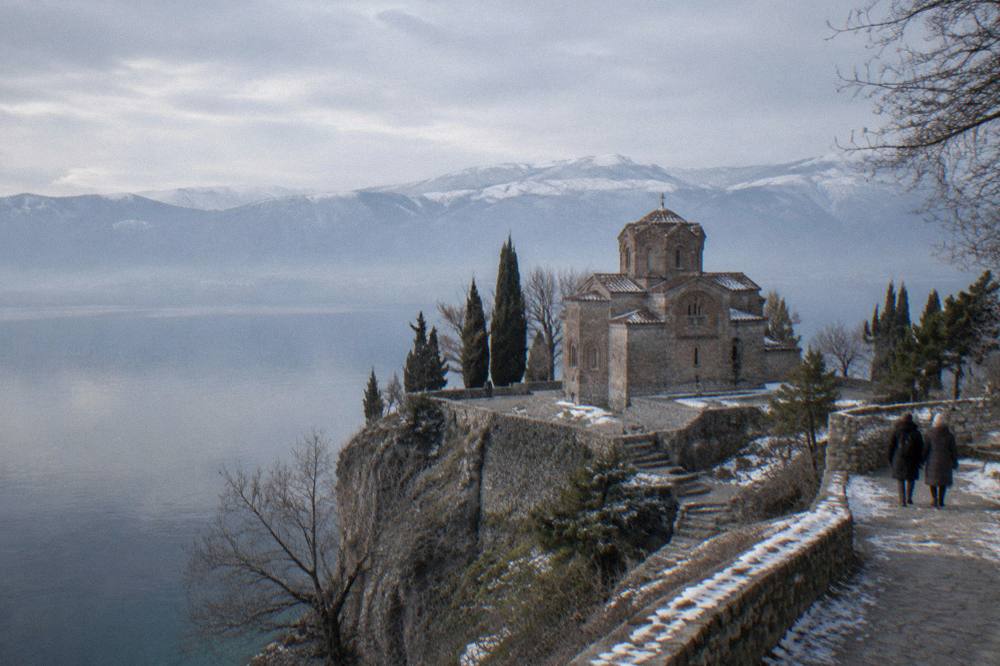
The geography does half the work. Ohrid climbs from the lake to the fortress, so a sensible winter loop starts low, at St Sophia or the Old Bazaar, and ascends while the legs are fresh, descending past Plaosnik toward Kaneo as the afternoon ends. Kaneo's own page, St John at Kaneo, covers the church; in winter the exterior and the water below it are the draw, reached in daylight if you set out by early afternoon.
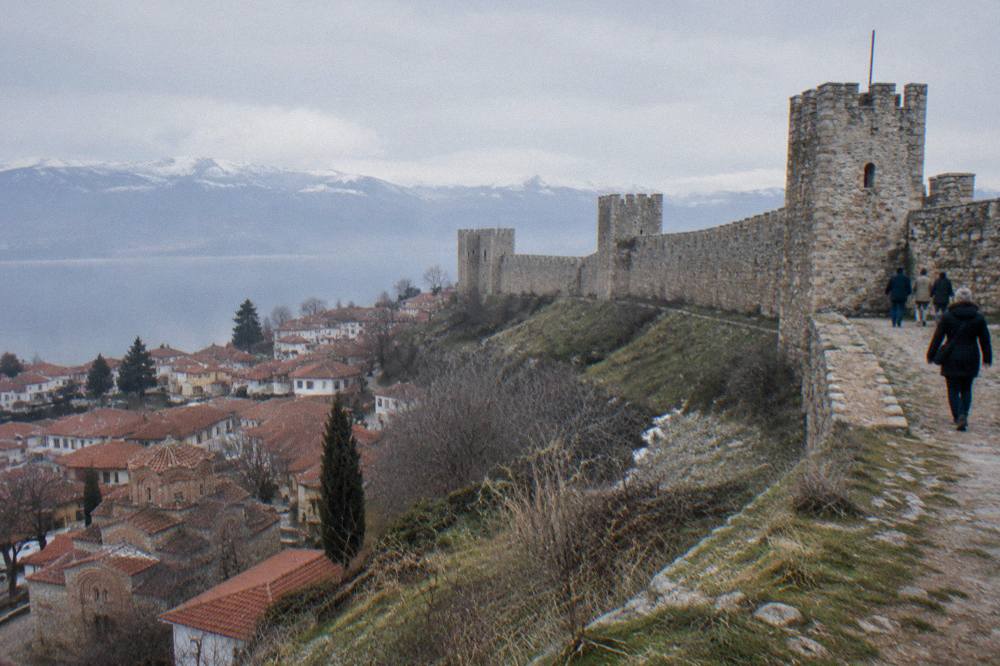
Two practical notes finish the walking picture. The ascent to the fortress is the steepest stretch of the old town, and in frost the paving stones hold the cold longest, so the grippy shoes from the packing section earn their place on that climb specifically. The Old Bazaar page covers the low end of the loop, and the old town and Kaneo district pages map the districts the loop passes through, useful for anyone choosing where to stay within walking distance of everything.
Is Lake Ohrid Too Cold For Swimming In Winter?
On modelled figures, yes: Lake Ohrid's surface temperature averages about 4.6 C in January, about 5.4 C in February and about 6.0 C in December, against about 22.9 C in July, and the multi-year October mean from the national hydrometeorological service stands at 14.3 C, so the swimming season is a July-to-September affair. The monthly figures below are modelled aggregator values, not gauge readings, and the October mean is the one official multi-year figure, so treat them as orientation rather than a forecast for any given week.
| Month | Modelled lake surface temperature |
|---|---|
| December | about 6.0 C |
| January | about 4.6 C |
| February | about 5.4 C |
| March | about 7.2 C |
| July (for comparison) | about 22.9 C |
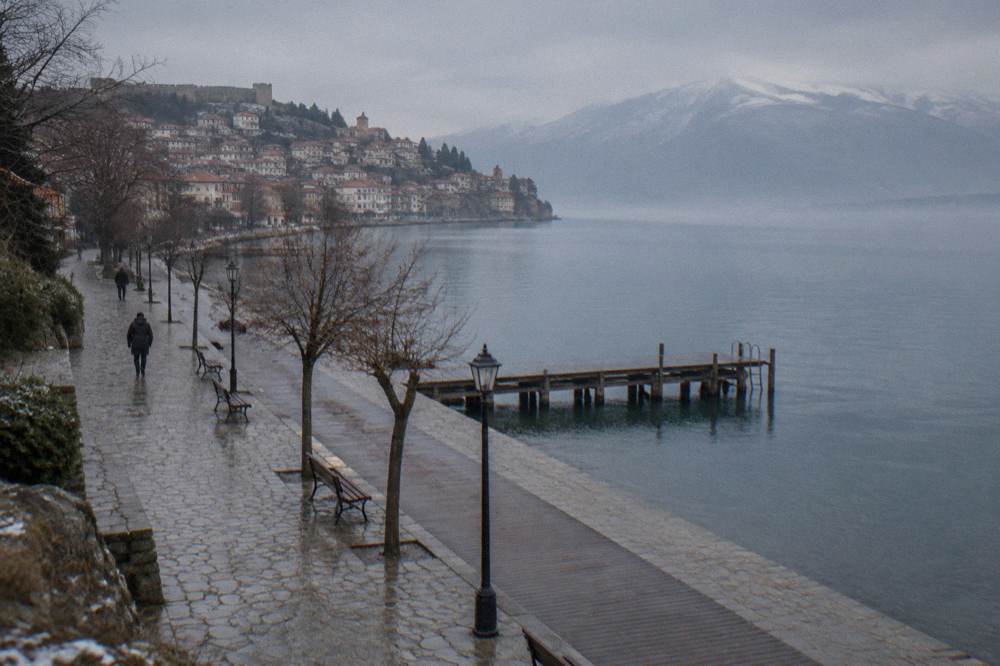
What the cold lake leaves instead is the shoreline itself. The swimming in Lake Ohrid page covers the summer season; in winter the same beaches, Gradiste, Lagadin, Ljubanista, Potpesh and Labino, become empty walking ground, and the city beach and lido page describes the closest one to town. Boats to St Naum run roughly May to October on a reduced seasonal schedule, so the lake in winter is something to walk beside, not ride across. The Lake Ohrid page covers the lake itself, a freshwater mountain lake shared with Albania, whose Crn Drim springs rise near St Naum.
The temperature column also explains the winter fog. A lake surface near five degrees keeps exchanging heat and moisture with air that can be several degrees colder on still nights, and that exchange is what produces the fog banks that drift over the lakefront on winter mornings. They usually thin once the day warms past mid-morning, which is one more argument for starting the day's walk late and using the early hours for the indoor sights instead.
What Events Fill The Ohrid Winter Calendar?
Ohrid's winter calendar centers on four events: St Clement of Ohrid Day on 8 December, Orthodox Christmas on 7 January, the Vevcani Carnival in nearby Vevcani village on 13 to 14 January around the old New Year, and Epiphany on 19 January, when the cross is thrown into Lake Ohrid from the town side. Three of these fall within a single January fortnight, so a week built around the second week of January catches them all.
| Winter event | Date |
|---|---|
| St Clement of Ohrid Day | 8 December |
| Orthodox Christmas | 7 January |
| Vevcani Carnival (Vevcani village) | traditionally 13 to 14 January |
| Epiphany, Vodici, cross throwing in Lake Ohrid | 19 January |
Vevcani is a separate village reached on a day trip, covered on the Vevcani page; the carnival there is the region's best-known winter event and is staged over the two days around the old New Year. In Ohrid itself, Epiphany puts the lake at the centre of a public observance, with the cross thrown from the town side. Beyond these, winter weekdays are simply quiet, which is the point: the Ohrid at night itinerary reads differently in January, when the restaurants along the lakefront thin out but keep serving.
The calendar's shape rewards a January visit over a December one if events are the priority. December offers St Clement Day on the 8th and the run-up to Christmas, but the three event days that follow, Christmas, the carnival and Epiphany, all fall within a single January fortnight, so a week built around the second week of January catches all three. Anyone planning around those dates should also read the Struga town page, since Struga's own Christmas and New Year observances sit a short bus ride away on the lake's north shore.
How Do You Get To Ohrid In Winter?
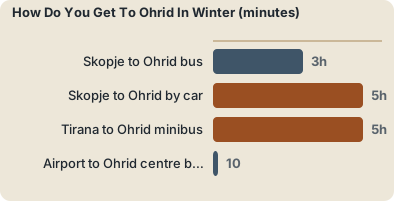
The practical winter routes are the bus from Skopje, about 170 km by road in roughly three hours for 850 to 950 MKD one way, the minibus from Tirana taking three to three and a half hours including the border for about 15 to 20 EUR, and flights into Ohrid's own airport, St Paul the Apostle, about 10 km from the centre, whose schedule is heavily seasonal. There is no passenger train to Ohrid and no domestic flight from Skopje, so the bus or the road are the options from the capital.
| Route | Time | Cost |
|---|---|---|
| Skopje to Ohrid bus | about 3 hours | 850 to 950 MKD |
| Skopje to Ohrid by car | about 2.5 hours | about 140 MKD in tolls |
| Tirana to Ohrid minibus | 3 to 3.5 hours | about 15 to 20 EUR |
| Airport to Ohrid centre by taxi | 10 km, about 10 to 15 minutes | about 600 to 800 MKD |
Two winter caveats sit on these numbers. First, Galicica's higher road sections can close under snow between January and March, which matters for Prespa and Galicica day trips rather than the Skopje route. Second, the Kicevo to Ohrid motorway section remains under construction, with the full opening expected in the first half of 2027, so the final stretch of the drive from Skopje is not yet motorway end to end. The pages on how to get to Ohrid, Skopje to Ohrid, Tirana to Ohrid and Ohrid airport carry the detail.
Winter-specific planning means checking frequency as much as routes. Bus departures between Skopje and Ohrid run multiple times daily, with more in summer than off-season, so an early-morning departure on a winter Sunday is worth confirming against the day's actual timetable rather than assuming the summer pattern. Arrivals from Tirana also thin outside the main season. The Ohrid bus station page covers where buses arrive, and anyone renting a vehicle should read Ohrid car rental first, keeping in mind the driving rules that apply year-round: headlights on day and night, a green card for insurance, and tolls paid per section at plazas with no vignette system.
Where Do You Stay And Eat In Ohrid In Winter?
Ohrid's accommodation runs year-round at lower winter occupancy, with the practical planning points being the denar as the local currency, the museum sites' Monday closure for scheduling, and a resident-only parking regime on old-town streets including Ilindenska, Kosta Abrash and Car Samoil introduced in summer 2026, which makes a car in the old town a liability in any season. No reliable nightly hotel rate can be quoted here, so budget instead from the Ohrid cost and budget page's framework and the neighbourhood breakdowns on where to stay in Ohrid.
A warm base makes the short winter days easier. Book a hotel in Ohrid here.
Parking deserves its own sentence: the 2026 regime restricts those streets to residents holding a valid sticker, with clamping reported for non-residents, so the Ohrid parking page is worth reading before booking anything drivable. Food-wise, winter is the season for the cooked dishes rather than the lakeside grills: the Ohrid food page and the entries on tavche gravche and rakija and Macedonian wine cover what the cold months' kitchens actually serve. A cooking class or a winery visit also works as a short-winter-day activity, and the Ohrid food and wine tour page collects those options.
Where you stay shapes the winter experience more than the summer one, because evenings indoors start earlier. A place within the old town's walking loop puts the restaurants and the lakefront inside a few minutes' walk, which matters when the alternative is a cold taxi wait on the edge of town; the Ohrid restaurants page lists where the kitchens are. Budget travellers have their own page on Ohrid hostels and budget stays, and the neighbourhood-by-neighbourhood guide on Ohrid neighborhoods covers which districts sit closest to the winter action, meaning the part of town where restaurants stay open through the off-season.
What Should You Pack And Know For An Ohrid Winter?
Pack for damp cold around freezing at night and mid-single digits by day: layers, a waterproof, grippy shoes for the stone lanes, and denars, because the Macedonian denar is the currency, euros are not legal tender though informally accepted at poor rates, and the National Bank's middle rate on 19 October 2026 stood at 61.6633 MKD to the euro. Emergency numbers are ambulance 194, police 192 and roadside assistance 196.
The money detail matters more in winter than in summer, simply because fewer informal tourist-facing services are running: ATMs are the reliable route for denars, and the Macedonian denar and money page covers cards, exchange and the peg. On entry rules, North Macedonia is not in the EU or in Schengen; visa-free nationals may stay up to 90 days in any 180-day period, UK visitors up to three months with a passport valid at least 90 days after arrival, and registration with the local police within 48 hours is handled by hotels. The North Macedonia visa and entry page carries the full picture, and the is Ohrid safe page the safety one, where the US advisory level stands at Level 1, Exercise Normal Precautions.
A few additions complete the winter kit list beyond the basics. A hat and gloves cover the wind off the lake, which blows cold across the open lakefront even on afternoons that feel mild in the sheltered lanes. A power bank helps on short days spent mostly outdoors. Tap water in Ohrid is generally drinkable per the reporting on the municipal supply, and the question has its own page on whether you can drink the water in Ohrid. Travellers with mobility or other access needs will find the terrain notes on the Ohrid accessibility page relevant in any season, and the winter frost makes them more so.
Is Ohrid Worth The Winter Trip?
On the evidence this page assembles, yes for travellers who want the heritage without the crowds: the UNESCO-listed old town's lanes, fortress walls and lakefront are all free to walk, the museum institute's sites stay open five days a week through the winter schedule at 150 MKD foreign admission, and the modelled climate, about 5 C January highs, is mild by continental winter standards. The trade-offs are equally concrete: no swimming, a reduced boat season, Monday museum closures and short daylight hours that cap each day at one or two planned sights.
The honest comparison is with the high season, where August brings the busiest crowds and the full festival programme. Travellers weighing that trade-off can read is Ohrid worth visiting in winter directly, or start from things to do in Ohrid and filter by season. For a first visit structured around the short days, how many days in Ohrid gives the answer, and the winter answer is one day longer than the summer one, because the pace is slower.
Winter day trips deserve their own sentence in that verdict. Galicica National Park stays open year-round on paper, but the snow risk on its road between January and March makes it a weather-dependent outing, covered on the Galicica National Park page, and the park charges 250 MKD per vehicle with no per-passenger fee, or 100 MKD for someone entering on foot from the Ohrid-side gate. Struga, reached by a local bus, makes an easy cold-weather half day, and the Struga from Ohrid page covers it. The Bay of Bones at Peshtani keeps its winter hours listed above, so a winter visit pairs naturally with the eastern-shore villages described on the Lagadin and Peshtani page.
Common Questions About Ohrid In Winter
Is Ohrid worth visiting in winter?
Yes, if quiet is the goal: the museum sites stay open on the winter schedule, the old town and lakefront are free to walk, and Orthodox Christmas on 7 January and the Vevcani Carnival on 13 and 14 January give the season its anchors. Expect modelled January highs near 5 C, Monday museum closures and no swimming.
How cold is Ohrid in December and January?
Modelled ERA5 normals for 1991 to 2020 put December at about 6.2 C by day and 0.9 C at night, and January at about 5.0 C by day and -0.8 C at night, with 92.6 mm and 76.5 mm of precipitation respectively. These are modelled figures, not station readings.
Are the Ohrid museums open in winter?
The museum institute sites run a winter schedule from 1 October to 30 April: Robev Family House and the Museum on Water open 09:00 to 15:30, the Icon Gallery 09:00 to 14:00, all closed Monday. Tickets are 150 MKD foreign and 120 MKD domestic.
Can you swim in Lake Ohrid in winter?
No: modelled surface temperatures run about 4.6 C in January, 5.4 C in February and 6.0 C in December. The swimming season runs roughly July to September, when modelled surface values sit above 20 C.
Does it snow in Ohrid in winter?
Winter precipitation in Ohrid includes snow, and the modelled normals show 76.5 mm of precipitation in January. Heavier snow falls on Galicica National Park, where the main road can close typically between January and March.
What happens in Ohrid in January?
Orthodox Christmas falls on 7 January, the Vodici cross-throwing observance on Lake Ohrid on 19 January, and the Vevcani Carnival, in the village of Vevcani reached as a day trip, traditionally runs 13 and 14 January.
The last word belongs to daylight. A winter Ohrid day runs from a frosty morning on the lakefront to fog rolling back in by late afternoon, and everything on this page, the 09:00 museum openings, the walking loops, the January events, fits inside that window. Plan for two sights a day, denars in pocket, waterproof in the bag, and the empty lakefront does the rest.