Two Days In Ohrid: Landmarks Then St Naum
Two days splits Ohrid cleanly: one day for the old-town landmarks inside the UNESCO site, one day for the lake's southern shore at St Naum and the Bay of Bones.
Short answer
Day one covers the old-town landmarks on foot, Samuel's Fortress to the Ancient Theatre, the Old Bazaar, Robev House and the Icon Gallery, all inside the UNESCO site. Day two goes south to St Naum monastery at the Crn Drim springs and the Bay of Bones museum on the water, by boat from Ohrid port or by road. Museum tickets are 150 den for foreign visitors, and the full-day boat cruise to St Naum starts at 1,200 den.
Ohrid, a lakeside town in North Macedonia on a freshwater mountain lake sitting at about 693 m above sea level, rewards exactly the split this itinerary uses: the first day on the landmarks stacked inside the old town, the second day on the lake's southern shore at St Naum. The town sits inside the UNESCO mixed site "Natural and Cultural Heritage of the Ohrid Region", inscribed in 1979 and 1980 and extended to the Albanian part of the lake in 2019, so almost everything on day one is walking distance from everything else. This Ohrid Travel Guide layout keeps the climbing, the museum hours and the Monday closures on the first day and leaves the second day for water, monastery and springs. For the full menu of options across a longer stay, start with things to do in Ohrid.
Why Does Two Days Work So Well In Ohrid?
Two days works because Ohrid's landmarks compress into one walkable hillside and its single long excursion, the monastery of St Naum on the southern shore, swallows a second day comfortably; the old town lanes run on foot between the fortress, Plaosnik, the Ancient Theatre, the Old Bazaar, Robev House and the Icon Gallery, while St Naum sits about 4 km from the Albanian border at Tushemisht and is reached either by boat from Ohrid port or by road.
The logic is geographic before it is anything else. The old town climbs from the lake to the fortress, and everything on day one sits on that slope or at its foot. The second day runs south along the lake shore: the Bay of Bones museum on the water at Gradiste near Peshtani, then the monastery at the Crn Drim springs. UNESCO's own listing credits Ohrid with the oldest Slav monastery, St Panteleimon at Plaosnik, and more than 800 Byzantine-style icons from the 11th to the end of the 14th century, which is why the museum stops on day one are not filler. The lake itself has existed about two to three million years and carries over 200 endemic species, including 17 endemic fish.
One scheduling rule shapes the whole plan: the museum institute's sites are closed on Mondays, and they run a winter schedule from 1 October to 30 April and a summer schedule from 1 May to 30 September. If day one falls on a Monday, swap the two days.
Here is the shape of the two days before the detail:
| Day | Morning | Afternoon | Evening |
|---|---|---|---|
| One | Samuel's Fortress, Plaosnik, Ancient Theatre | Old Bazaar, Robev House, Icon Gallery, St John at Kaneo | Sunset from the Kaneo district, dinner in the old town |
| Two | Road or boat south, Bay of Bones at Peshtani | St Naum monastery, Crn Drim springs, rowboat ride | Return to Ohrid port, final lake-side walk |
What Does Day One Morning In Ohrid Look Like?
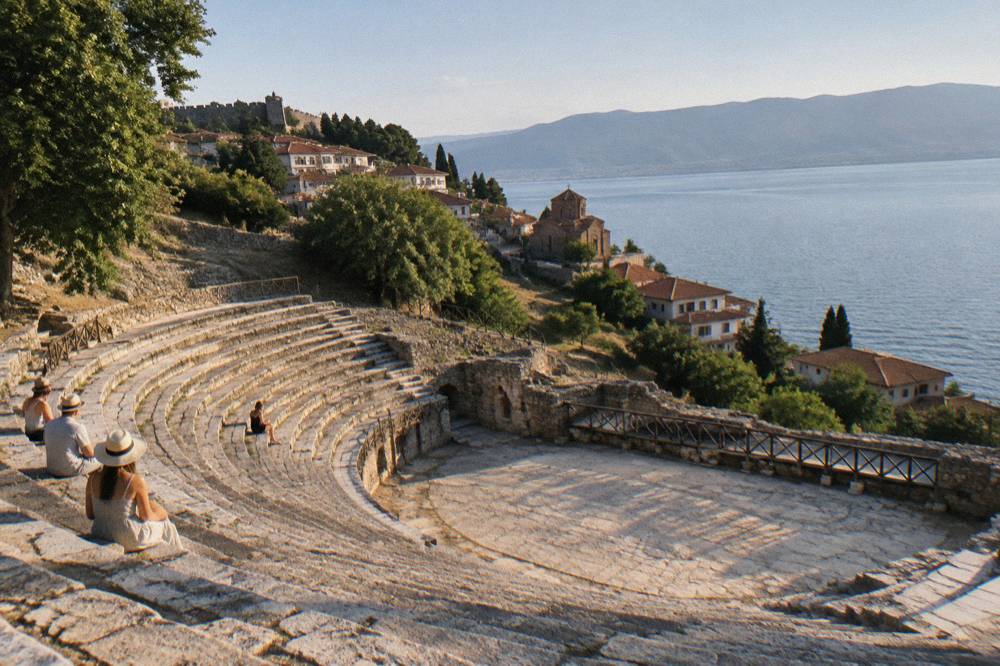
Day one morning climbs from the old town's upper end: Samuel's Fortress first while legs are fresh, then down through Plaosnik, the site of the oldest Slav monastery, St Panteleimon, to the Ancient Theatre, a late Hellenistic structure first excavated in 1935 whose capacity rose to 5,000 after the epiteatron was added, and all of it inside a few hundred metres of walking on the hillside.
To cover that morning climb with a guide, book an old town walking tour here.
Start at the top. Samuel's Fortress anchors the upper town, and the municipality has budgeted more than 11 million denars for a revitalisation plan that adds a summer stage and illumination to the site. The fortress interior is the wide, open part of the morning; there are no published ticket or hour figures to plan around, so treat the stop as open-ended and keep the morning loose.
Below the fortress, Plaosnik carries the excavated foundations of St Panteleimon, the monastery UNESCO's listing names as the oldest Slav monastery. The Plaosnik guide covers the site in depth. From there the ground falls to the Ancient Theatre, built at the end of the 3rd or the start of the 2nd century BC in the period of late Hellenism, and today a performance space used during the Ohrid Summer Festival. The theatre needs no ticket plan: the museum institute's page for it lists none.
Two practical notes shape the morning. First, the old-town streets Ilindenska, Kosta Abrash and Car Samoil run a resident-only parking regime from summer 2026, with clamping reported for non-residents, so the morning works best with no car at all. Second, the whole climb is on foot lanes; comfortable shoes matter more than timing.
If a guide adds value, a small-group walk covers this exact ground:
What Does Day One Afternoon In Ohrid Add?
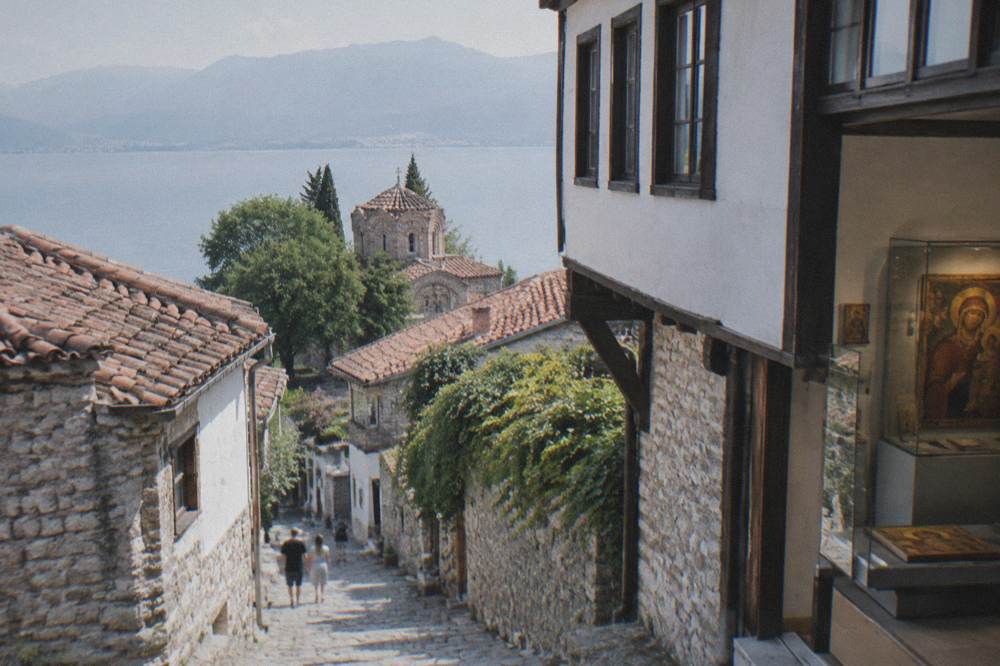
Day one afternoon moves downhill and indoors: the Old Bazaar lanes, then three museum institute stops with one shared price, Robev Family House on Tsar Samoil Street, the Icon Gallery in the Perivleptos complex with its summer hours running 09:00 to 17:00, and the Church of the Holy Mother of God Perivleptos itself, finishing at St John at Kaneo above the lake for the light.
The museum institute's ticket prices apply across its listed sites: 120 den for domestic visitors, 150 den for foreign visitors, and 60 den reported for children and students. Robev Family House runs 09:00 to 15:30 in winter (1 October to 30 April) and in two shifts in summer from 1 May, 09:00 to 15:30 and 13:30 to 20:00, closed Monday. The Icon Gallery, on Klimentov Univerzitet Street in the Perivleptos complex, runs 09:00 to 14:00 in winter and 09:00 to 17:00 in summer, also closed Monday. The Icon Gallery and Perivleptos pages carry the detail.
| Museum institute site | Winter hours (1 Oct to 30 Apr) | Summer hours (1 May to 30 Sep) | Closed |
|---|---|---|---|
| Robev Family House, Tsar Samoil St 62 | 09:00 to 15:30 | 09:00 to 15:30 and 13:30 to 20:00 | Monday |
| Icon Gallery, Perivleptos complex | 09:00 to 14:00 | 09:00 to 17:00 | Monday |
| Bay of Bones / Museum on Water, Gradishte | 09:00 to 15:30 | 09:00 to 16:30 | Monday |
Tickets across these sites: 120 den domestic, 150 den foreign, children and students 60 den as reported.
End the afternoon at St John at Kaneo. The small church above the lake is the town's most photographed building, and the St John at Kaneo guide covers it; its interior fee is reported at about 150 MKD, with the exterior views free. Evening options continue in the Ohrid at night itinerary.
Should Day Two Go To St Naum By Boat Or By Road?
Day two should go to St Naum by boat if the calendar and the season allow, because the full-day cruise from Ohrid port with Boat Armada runs 7 hours from 1,200 den per adult and 600 den per child and stops at the Bay of Bones on the way, while the road option is the answer outside the roughly May to October boat season or when Monday closures or weather push against the water plan.
The boat is the two-birds option. The published Armada cruise covers the port-to-St Naum run with shore stops, and the operator's own list prices the day at 1,200 den for adults and 600 den for children. Cruise departures thin out or stop outside the main season, generally about May to October, so check the operator's live listing before committing a day to it. The St Naum tour page and the how to get from Ohrid to St Naum answer cover the fuller picture.
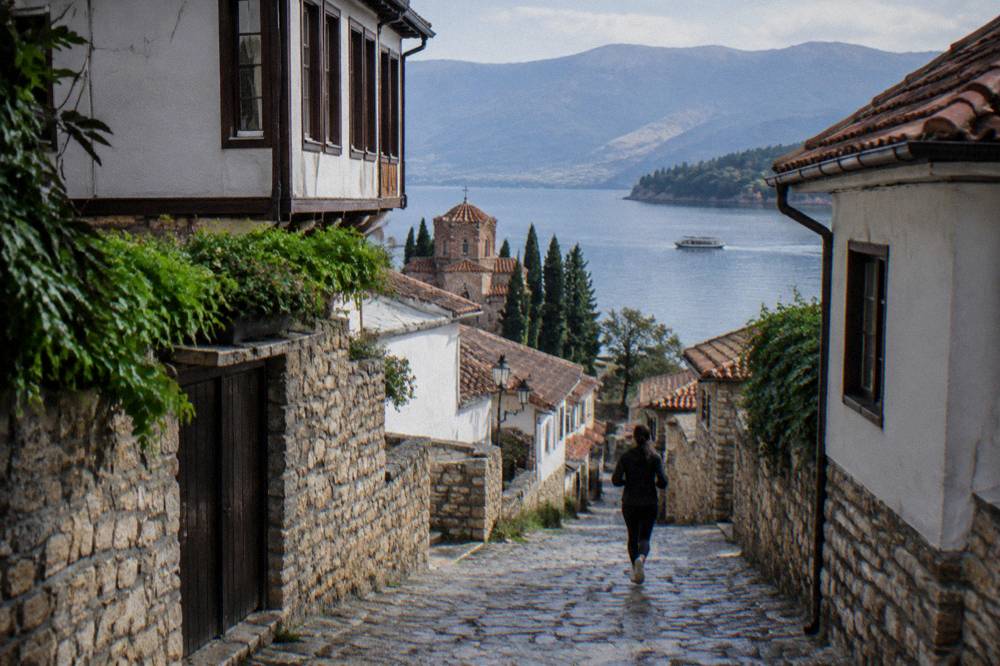
The road runs the same southern shore past Peshtani and Trpejca. It is the reliable option: it does not depend on the boat calendar, and it lets you set your own time at each stop. The trade is that you lose the lake approach to the monastery and the slow water crossing.
| Route to St Naum | Figures that are printed | Notes |
|---|---|---|
| Boat cruise from Ohrid port (Boat Armada) | 7 hours, from 1,200 den adult, 600 den child | Seasonal, roughly May to October, stops at Bay of Bones |
| Road south from Ohrid | St Naum sits about 4 km from the Tushemisht border crossing | Road access possible year-round; a taxi to the border was quoted at 400 den |
| Rowboat at the Crn Drim springs | About 5 EUR per boat | Short rides at the springs below the monastery |
Either way, the monastery's own entrance is listed at 150 MKD per person on the cruise operator's site.
What Are The Stops On The Road To St Naum?
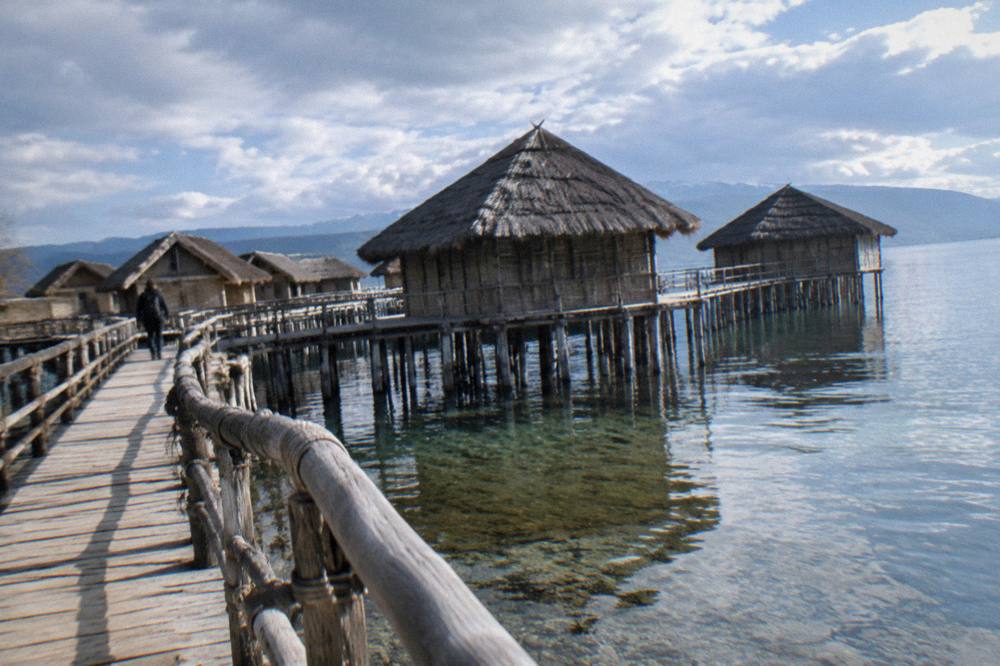
The southern shore run makes two real stops before the monastery: the Bay of Bones, the Museum on Water at Gradishte near Peshtani, a reconstructed pile-dwelling settlement on the lake with summer hours 09:00 to 16:30 and a 150 den foreign entrance, and the village shore at Trpejca and Ljubanista further south, before the road ends at St Naum and the Crn Drim springs.
The Bay of Bones is the first stop and the one with firm hours. The Museum on Water runs 09:00 to 15:30 in winter and 09:00 to 16:30 in summer from 1 May to 30 September, closed Monday, on the museum institute's ticket prices of 120 den domestic and 150 den foreign. The Bay of Bones guide covers what the museum holds. If day two falls on a Monday, flip the itinerary again or keep the stop to the exterior boardwalk view.
Further south, the shore villages sit along the same road. The Trpejca and Ljubanista area guide covers the beaches and village stops. Galicica National Park, North Macedonia's second national park, proclaimed in 1958, with 22,750 hectares between Lake Ohrid and Lake Prespa and Magaro peak at 2,254 m, rises to the east of this road; entering the park by vehicle costs 250 MKD per vehicle, with 100 MKD applying only to someone entering on foot from the Ohrid-side gate. Snow can close the park's main road, typically January to March.
The monastery at the end of the road gives the day its centrepiece. St Naum sits at the Crn Drim springs, and the rowboats at the springs run short rides at about 5 EUR per boat. The St Naum monastery guide and the is St Naum worth visiting answer carry the detail, and the St Naum day trip page frames the excursion.
What Does Two Days In Ohrid Cost?
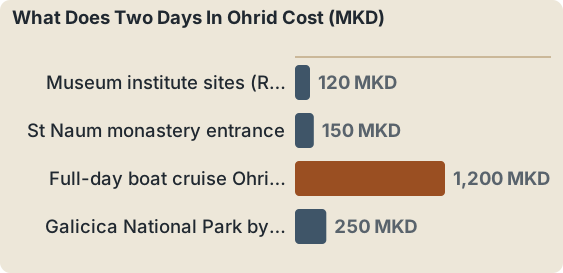
Two days in Ohrid costs very little in tickets and local transport when it is planned around the printed figures: the museum institute sites at 150 den each for foreign visitors, the St Naum monastery entrance at 150 MKD, the Bay of Bones at the same institute rate, the boat cruise to St Naum from 1,200 den, and the springs rowboat at about 5 EUR, with guided products priced separately through their live listings.
The pattern is simple: local costs are in denars, and the big variable is the boat. Here is what can be stated with figures:
| Item | Figure | Notes |
|---|---|---|
| Museum institute sites (Robev House, Icon Gallery, Bay of Bones) | 120 den domestic, 150 den foreign | Children and students 60 den, reported |
| St Naum monastery entrance | 150 MKD per person | Listed on the cruise operator's site |
| Full-day boat cruise Ohrid port to St Naum | From 1,200 den adult, 600 den child | 7 hours, Boat Armada |
| Rowboat at the Crn Drim springs | About 5 EUR per boat | Short rides at the springs |
| Galicica National Park by vehicle | 250 MKD per vehicle | 100 MKD only on foot from the Ohrid-side gate |
Currency matters here. The denar (MKD) is the local currency, and euros are not legal tender even though they are commonly quoted for tours and transfers; a local cost stays in denars as printed. The cost and budget guide carries the fuller picture, including what can and cannot be stated about accommodation and food prices.
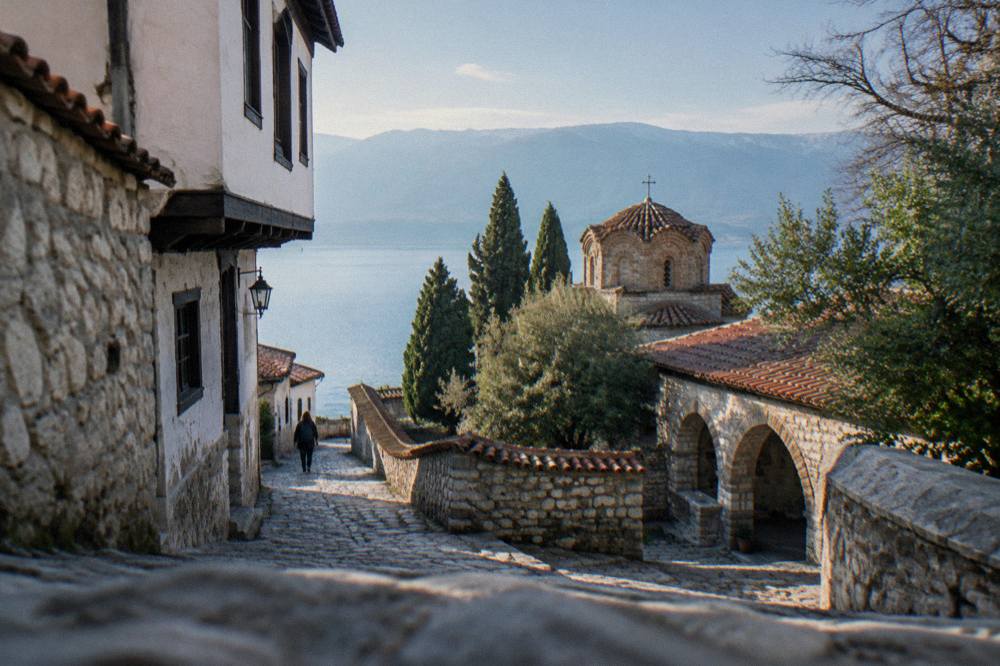
Guided products wrap several of these stops into one seat. This trip from Tirana covers the whole southern-shore plan, and the operator's live listing carries the current price:
What If You Are Coming From Tirana Or Skopje?
If the two days start from Tirana or Skopje, the arithmetic changes: the Tirana run covers about 86 km straight-line to Ohrid with minibus connections taking 3 to 3.5 hours across the border, while Skopje sits about 170 km by road with buses running around 3 hours at 850 to 950 den, so a same-day arrival eats the first morning and an organised day trip becomes the efficient way to see St Naum.
The Tirana connection runs roughly 5 to 7 minibuses a day at about EUR 15 to 20 one way, crossing at Qafe Thane, mostly from Tirana's south and regional terminal. From Skopje, operators including Galeb and Classic Company run multiple daily departures, and a private transfer starts from about EUR 130. There is no passenger train to Ohrid from anywhere. The Skopje to Ohrid route page carries the connections in full.
For travellers based in Tirana, the St Naum day tour starts in Tirana and Durres and is very much a Tirana departure, not an Ohrid one; say so plainly when planning. The same logic applies to the private day tour of Ohrid from Tirana and Durres. Both products exist because the border crossing at Sveti Naum / Tushemisht, about 4 km from the monastery, keeps the Albanian side close at hand; the question of how many days to spend in Ohrid deserves its own planning pass.
If the schedule is tight, the inline link below goes straight to the live listing:
For a booked seat on the southern-shore day from Tirana, Check availability.
What If The Weather Or A Monday Breaks The Plan?
If a Monday or bad weather breaks the plan, the fixes are mechanical: swap the two days so the museum closures fall on the road day, run the indoor museum stops in whatever order the hours allow, and keep St John at Kaneo and the lakeside walk for the clear hours, since the modelled ERA5 normals for Ohrid put August's mean daily high at 27.6 C and January's at 5.0 C with 76.5 mm of rain.
The Monday rule bites hardest in the pattern where day one is the museum day. The Old Bazaar lanes, the fortress hillside and the lakeside walk all run regardless of the day of the week, and the theatre needs no ticket plan, so a Monday old-town day loses only the interiors. The Ohrid in the rain itinerary exists for exactly this.
| Modelled month (ERA5 normals, 1991-2020) | Mean daily high | Mean daily low | Rain mm |
|---|---|---|---|
| January | 5.0 C | -0.8 C | 76.5 |
| April | 14.6 C | 6.3 C | 82.4 |
| July | 27.1 C | 18.3 C | 34.7 |
| August | 27.6 C | 19.0 C | 32.9 |
| October | 17.4 C | 10.3 C | 76.0 |
| December | 6.2 C | 0.9 C | 92.6 |
Those climate figures are modelled ERA5 reanalysis values, not a station record. The lake's surface tells its own seasonal story: modelled aggregator values put the water at about 4.6 C in January and about 23.5 C in August, with the UHMR multi-year October mean at 14.3 C, so the swimming and boating calendar leans hard on summer. The 2026 bathing tests found the water Class I physico-chemically except Grashnica beach, with most microbiological samples rated excellent.
How Do Two Days Compare With One, Three Or Five?
Two days is the minimum that fits both the old-town landmarks and St Naum without rushing, one day forces a choice between the hillside and the southern shore, and three to five days add Struga about 12 km away, Galicica's park roads, Lake Prespa across the ridge at a gauge about 148 m above Lake Ohrid, or the longer runs to Bitola about 46 km and Skopje about 111 km away.
The one-day version cuts day two entirely or compresses it into a boat turnaround, and the Ohrid in one day itinerary shows what that sacrifice looks like. The Ohrid in three days page spends the spare day well, and Ohrid in five days reaches the park and the Prespa side. The how many days in Ohrid guide takes the question in full.
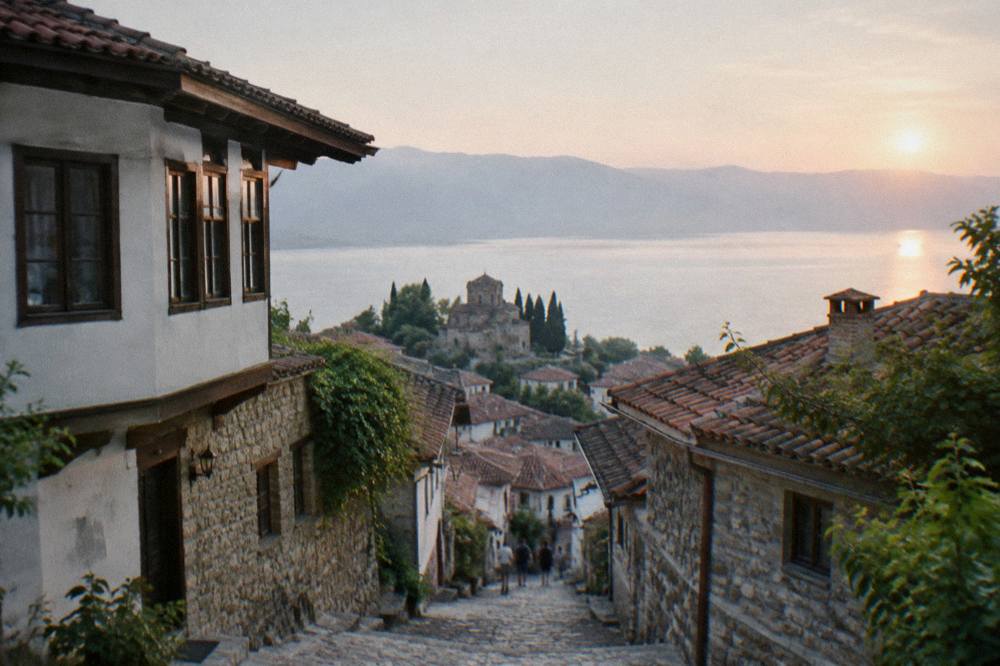
For families the two-day skeleton holds, with the boat cruise and the Bay of Bones as the child-friendly anchors; the Ohrid with kids itinerary adapts it. Couples get the same spine with more Kaneo time, per the Ohrid for couples page, and a spare day opens the Ohrid free day options.
Whichever length you choose, the guided products below cover both halves of this itinerary in a single booked seat:
Common Questions About Two Days In Ohrid
Is Two Days In Ohrid Enough?
Two days is enough for the old-town landmarks and the St Naum excursion: day one covers the fortress, Plaosnik, the Ancient Theatre, the Old Bazaar, Robev House and the Icon Gallery on foot, and day two covers the Bay of Bones and St Naum by boat or road. A third day is what unlocks Struga, Galicica and Lake Prespa.
What Is Closed On Mondays In Ohrid?
The museum institute sites close on Mondays: Robev Family House, the Icon Gallery in the Perivleptos complex, and the Bay of Bones museum on the water. Samuel's Fortress publishes no hours, and the Old Bazaar lanes, the fortress hillside and the lakeside walk run on any day.
Can You Visit St Naum And The Bay Of Bones In One Day?
Yes, and the full-day boat cruise from Ohrid port is built for it: Boat Armada's published run is 7 hours from 1,200 den per adult and 600 den per child, with shore stops along the southern shore. By road, the two stops sit on the same southbound route past Peshtani.
How Much Do The Ohrid Museum Tickets Cost?
The museum institute's sites, including Robev Family House, the Icon Gallery and the Museum on Water at the Bay of Bones, charge 120 den for domestic visitors and 150 den for foreign visitors, with children and students reported at 60 den.
Do You Need A Car For Two Days In Ohrid?
No. Day one is entirely on foot in the old town, and day two works by boat from Ohrid port or by an organised day trip. A car adds flexibility for Galicica National Park, which charges 250 MKD per vehicle, but old-town streets run a resident-only parking regime from summer 2026.
What Month Is Best For This Two-Day Ohrid Itinerary?
July and August bring the modelled mean highs of 27.1 and 27.6 C and the lake's warmest modelled surface water, about 22.9 and 23.5 C, plus the Ohrid Summer Festival running 12 July to 20 August in 2026. May, June and September keep the boat season with cooler walking weather; from about October the boat calendar thins and winter museum hours apply.
Two days in Ohrid, one on the landmarks and one on St Naum and the southern shore, is the itinerary the town's geography was already suggesting; book the boat or the tour seat for day two, keep day one off a Monday, and the rest is walking.