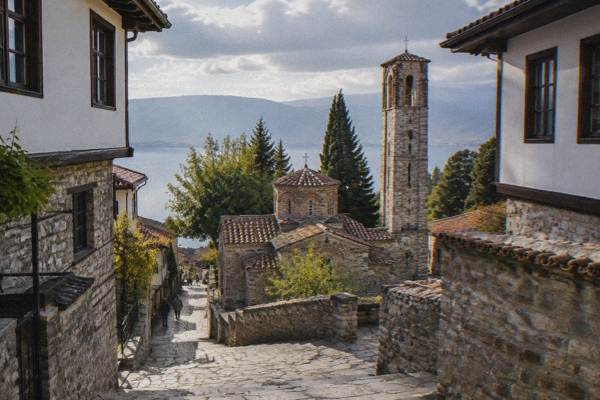
Ohrid Icon Gallery: Medieval Icons Under One Roof
The Icon Gallery sits inside the Perivleptos complex in Ohrid's old town and holds the museum institute's collection of Byzantine-style icons, part of a UNESCO-inscribed heritage region on Lake Ohrid.
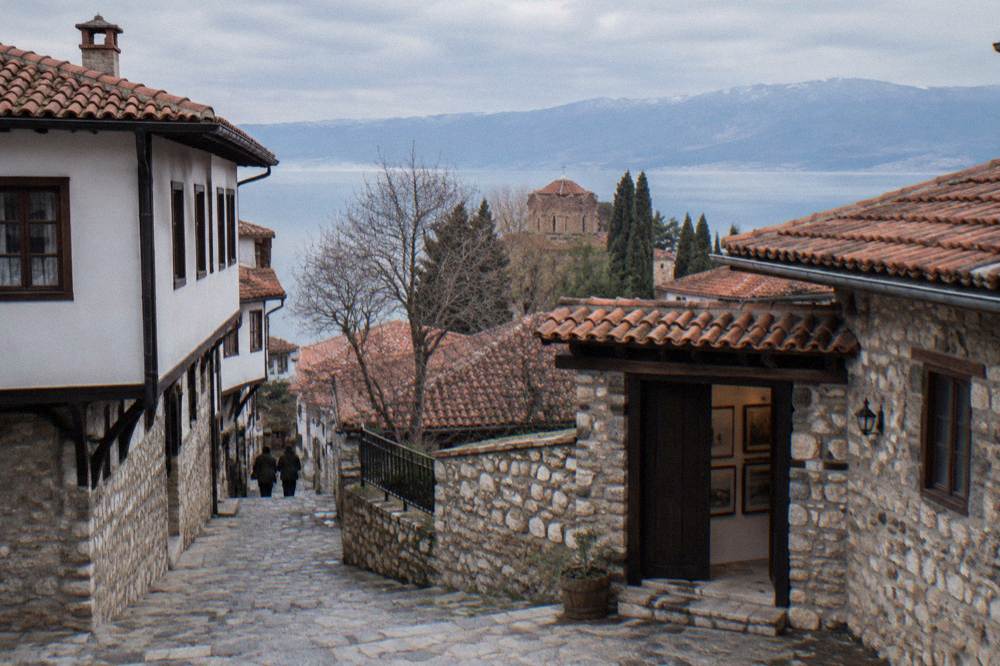
Short answer
The Icon Gallery in Ohrid, North Macedonia, is part of the NI Institute and Museum Ohrid and stands in the Perivleptos complex in the old town, inside the UNESCO Natural and Cultural Heritage of the Ohrid Region, which was inscribed in 1979 and 1980 and extended to the Albanian part in 2019.
The Icon Gallery in Ohrid, a lake town in North Macedonia at about 693 m above sea level on Lake Ohrid, belongs to the NI Institute and Museum Ohrid and stands within the Perivleptos complex in the old town. UNESCO lists the wider region as the mixed property "Natural and Cultural Heritage of the Ohrid Region", inscribed in 1979 for its natural values and 1980 for its cultural ones, and extended to the Albanian part of the lake in 2019. Within that listing, UNESCO records that Ohrid holds more than 800 Byzantine-style icons dating from the 11th to the end of the 14th century, a collection the Ohrid Travel Guide treats as the single strongest reason to climb into the upper old town beyond the churches themselves. The guide below explains what the gallery is, how to reach it, and how to fold it into a day built around things to do in Ohrid.
What Is The Ohrid Icon Gallery?
The Icon Gallery in Ohrid is the icon collection of the NI Institute and Museum Ohrid, housed in the Perivleptos complex, the Church of the Holy Mother of God Perivleptos, in the old town, and it forms part of the cultural layer of the UNESCO Natural and Cultural Heritage of the Ohrid Region, a mixed property inscribed in 1979 and 1980 and extended in 2019.
The gallery is one of several sites run by the museum institute, alongside the Robev Family House in the centre and the Museum on Water at the Bay of Bones near Peshtani. The institute's own pages place the gallery at Klimentov Univerzitet Street in the upper old town, inside the same complex as the church. UNESCO's listing for the Ohrid region records that the town holds more than 800 Byzantine-style icons from the 11th to the end of the 14th century, and describes Ohrid's monastery tradition, including St Panteleimon at Plaosnik, as the oldest Slav monastery. Those two strands, the painted board and the monastic setting, are what the gallery brings together under one roof.
Unlike the lakeside churches, which stand as working monuments along the shore, the gallery exists to display rather than to serve liturgically. That distinction shapes a visit: the point here is the collection and the building that holds it, not a service or a viewing platform. The complex sits high in the old town, on the climb between the lake and the fortress ridge, which places it naturally on a walking route rather than a drive.
Where Is The Icon Gallery In Ohrid And How Do You Reach It?
The Icon Gallery stands on Klimentov Univerzitet Street in Ohrid's old town, inside the Perivleptos complex, reached on foot via the lanes that climb from the lake shore toward Samuel's Fortress; the old town is a pedestrian district of lanes and steps, and there is no tram, river boat or metro in Ohrid, a town on a lake rather than the sea.
Ohrid's geography makes the approach simple in principle: the old town rises from the lake, and the Perivleptos complex sits on the upper slope. Visitors arriving by bus reach the station east of the centre and continue on foot or by taxi; visitors arriving at Ohrid St Paul the Apostle Airport, about 10 km away via the E65, reach the town by taxi or pre-arranged transfer. Within the old town, everything is walked. A summer 2026 resident-only parking regime, as reported, closed streets including Ilindenska, Kosta Abrash and Car Samoil to non-resident parking, with clamping for violators, which strengthens the case for arriving on foot from lodging inside or at the edge of the old town.
The natural walking route links the gallery with the neighbouring sights of the upper town. From the lake shore the lanes climb past the Old Bazaar toward the fortress ridge; the Perivleptos complex sits on that climb, close to the Ancient Theatre and below the walls of Samuel's Fortress. An old town orientation walk is the standard way to absorb the sequence, and the gallery gives the climb a purpose beyond the views.
| Approach | Detail | Source tier |
|---|---|---|
| Ohrid Airport (OHD) to the centre | About 10 km via the E65; taxi fares reported around 600 to 800 MKD, or about EUR 12 | V for distance, R for fare |
| Skopje to Ohrid by bus | About 170 km, around 3 hours, 850 to 950 MKD one way | V (secondary) |
| Skopje to Ohrid by car | About 172 km, around 2.5 hours, plus about 140 MKD in motorway tolls | V (secondary) |
| Tirana to Ohrid by minibus | Roughly 5 to 7 departures a day, 3 to 3.5 hours including the border, about EUR 15 to 20 | V (secondary) |
| Within the old town | Lanes and steps on foot; resident-only parking on several old-town streets from summer 2026 | V / R |
A private day tour is the other common route to the upper old town for visitors short of time or staying in another city. The Full-Day Private Best of Ohrid and Lake Ohrid Tour covers the town and the lake in one guided sweep, and it can be booked at Check availability.
What Collections Does The Ohrid Icon Gallery Hold?
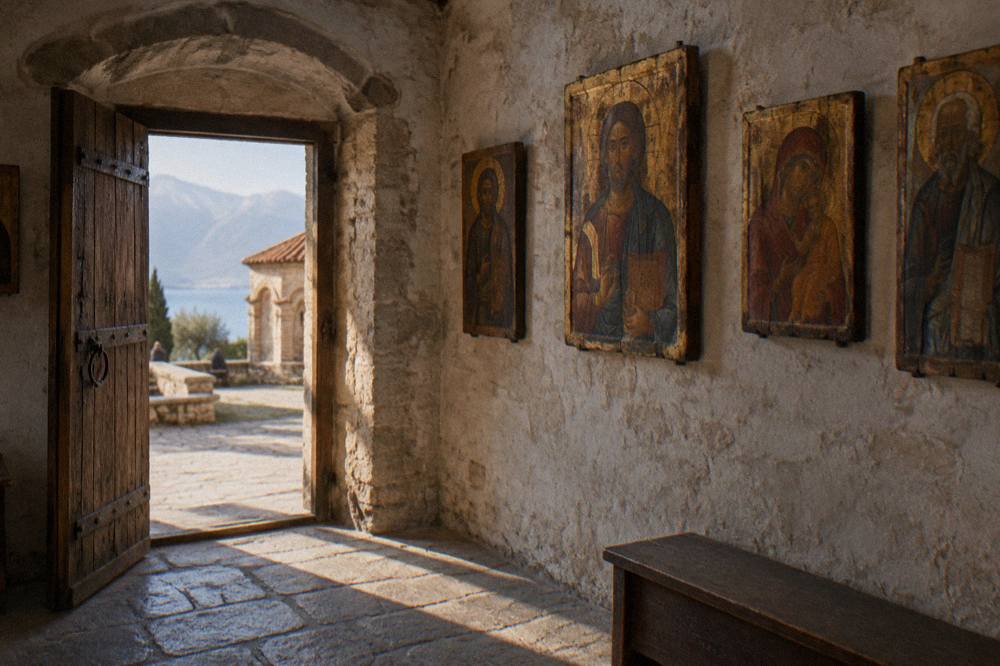
The gallery displays icons from Ohrid's Byzantine tradition, and UNESCO's listing for the Ohrid region records the town's holding as more than 800 Byzantine-style icons from the 11th to the end of the 14th century; the icons are attributed to the Ohrid painting school, and the collection is managed by the NI Institute and Museum Ohrid as part of the museum network that also includes Robev House and the Museum on Water.
The UNESCO citation is the anchor fact for any description of the collection. It places Ohrid's icons across four centuries of production and ties them to a town whose monasteries, above all St Panteleimon at Plaosnik, anchor the Slav monastic tradition the listing recognises. The icons themselves, painted wooden panels, are the medium through which Ohrid's church tradition was carried, and the gallery's role is to hold and show them rather than to keep them in dispersed liturgical use.
What the gallery does not offer is equally worth stating plainly, because the surrounding churches fill that gap. St Sophia, Plaosnik and St John at Kaneo stand as monuments in their own right, and the pages for St Sophia Church, Plaosnik and St John at Kaneo cover them individually. The gallery complements them: where the churches hold their frescoes in place, the gallery gathers painted panels under one roof, with the institute's curatorial structure behind them.
The Perivleptos setting matters to the visit as much as the icons. The complex is described in the site's own listing as the Church of the Holy Mother of God Perivleptos, and the fuller story of the building and its surroundings is on the Perivleptos page. Sensitive detail beyond that, fresco dates, workshop attributions, room-by-room layout, is not licensed for this page, and a visitor wanting depth beyond the collection outline will find it on the panels' own labels and in the institute's materials on site.
How Does The Icon Gallery Fit Into A Day In Ohrid?
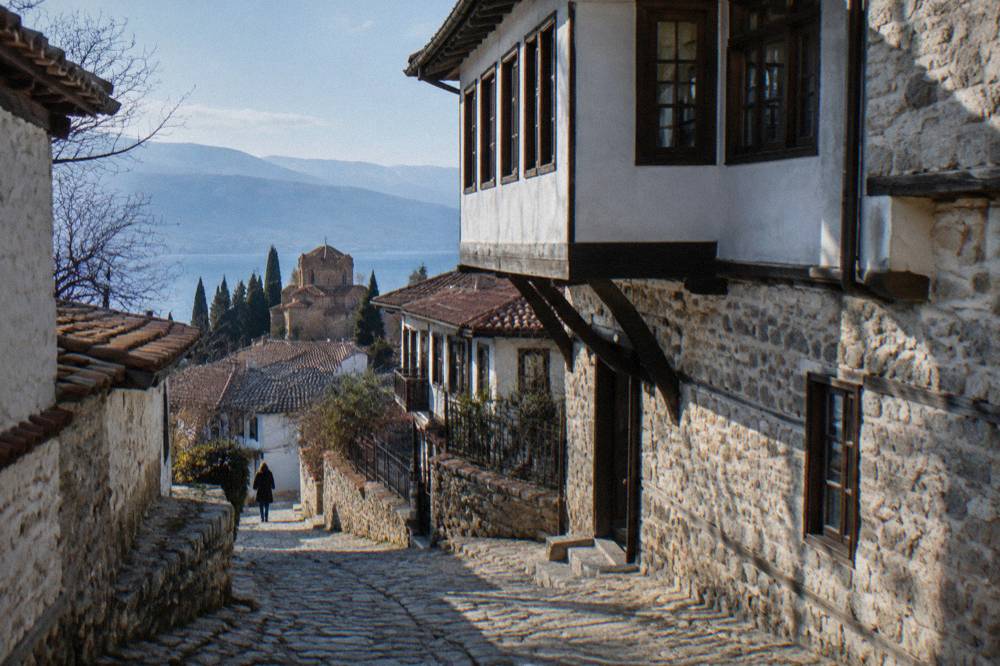
The gallery slots most naturally into the middle of an old-town day: start on the lake shore, climb through the Old Bazaar and the Ancient Theatre to the Perivleptos complex, continue to Samuel's Fortress, and descend past Plaosnik toward St John at Kaneo at the water's edge; that sequence is the spine of a one-day Ohrid itinerary and keeps the steepest climbs grouped together.
The order is not arbitrary. The old town's lanes run uphill from the shore, and grouping the upper sights, the gallery, the fortress ridge and the Ancient Theatre, into one climb avoids repeating the ascent. The Ancient Theatre, excavated from 1935 and built at the end of the 3rd or start of the 2nd century BC in the late Hellenistic period, with a capacity that rose to 5,000 after the epiteatron was added, sits on the route, and it doubles as the opening venue of the Ohrid Summer Festival. The fortress above carries a reported municipal revitalisation plan, budgeted at over 11 million denars, that would add a summer stage and illumination.
Afternoon belongs to the water. A descent past Plaosnik reaches the lake, where the boardwalk runs along the shore and boat trips leave for the Bay of Bones and St Naum. The site's one-day Ohrid itinerary lays out the full sequence with timings, and visitors with two or three days can split the old town and the lake into separate halves.
| Stop on the climb | Detail | Tier |
|---|---|---|
| Old Bazaar | Historic bazaar quarter in the old town | V (subject) |
| Ancient Theatre | Built end of 3rd or start of 2nd century BC; excavations from 1935; capacity rose to 5,000 with the epiteatron | V |
| Perivleptos / Icon Gallery | Museum institute site on Klimentov Univerzitet Street; UNESCO records 800+ Byzantine-style icons for Ohrid, 11th to end of 14th century | V |
| Samuel's Fortress | Reported revitalisation plan, summer stage and illumination, budget over 11 million denars | V (headline) |
| Plaosnik | Site of St Panteleimon, described by UNESCO as the oldest Slav monastery | V |
A guided version of the same day suits visitors who want the collection placed in context rather than simply found. The small-group option below covers the old town on foot.
Prefer the old town explained as you go? Book a guided old town walk here.
What Other Sights Sit Near The Icon Gallery In Ohrid?
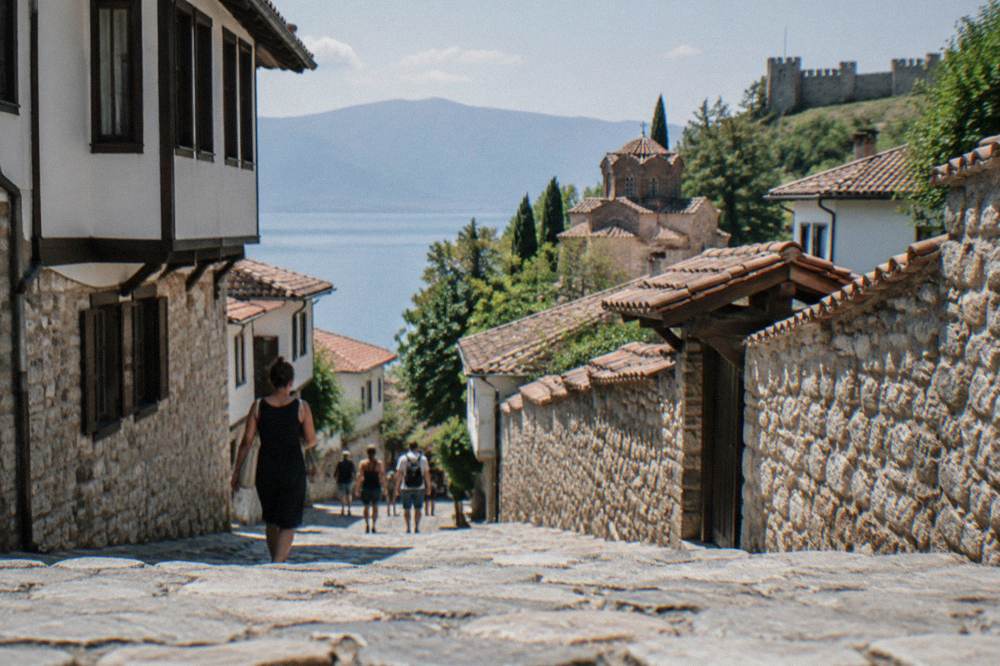
Within a short walk of the gallery stand the Ancient Theatre, Samuel's Fortress, Plaosnik, St Sophia and the descent to St John at Kaneo, together with the Old Bazaar below and the lake shore at the bottom of the climb; farther afield the same day can reach the Bay of Bones at Peshtani, St Naum monastery near the Albanian border, Struga, and the viewpoints of Galicica National Park, all of them day-trip scale rather than neighbourhood stops.
The immediate cluster needs no transport. Each of the neighbouring sights has its own page on this site: Samuel's Fortress, Ancient Theatre, Plaosnik and St Sophia Church. The old-town cluster also holds the pearl workshops and the paper museum, both closer to the bazaar end of the climb.
The wider lake region works differently. The Bay of Bones, the museum on water at Gradishte near Peshtani, and St Naum monastery at the Crn Drim springs sit down the shore, reached by boat in season or by road. Galicica National Park, North Macedonia's second national park, proclaimed in 1958, spans 22,750 ha between Lake Ohrid and Lake Prespa with Magaro peak at 2,254 m, and its road can close under snow, typically January to March. A Lake Prespa day trip crosses that ridge; the UHMR gauge at Nakolec read Lake Prespa at 841.36 m on one October 2026 bulletin, about 148 m above Lake Ohrid.
Crossing into Albania from St Naum is also straightforward: the St Naum to Tushemisht border is about 4 km away, a drive of roughly 10 minutes, with a taxi fare quoted at 400 den and a walk of about a kilometre between the posts for pedestrians. The site's page on visiting Ohrid and Albania in one trip covers the combinations.
When Is The Best Time To Visit The Icon Gallery In Ohrid?
The gallery is an indoor stop that works in any month, so the season question is really about the climb and the lake around it: ERA5 reanalysis normals for 1991-2020 put July and August at mean daily highs of 27.1 and 27.6 C with rain of 34.7 and 32.9 mm, while January averages a high of 5.0 C and a low of -0.8 C with 76.5 mm of rain, and the peak visitor season runs June to September with August the busiest.
Those figures are modelled climate normals from ERA5 reanalysis for a grid cell over Ohrid, not a station record, and they describe the town generally rather than a gallery-specific microclimate. What they imply for planning is simple. Summer combines the warmest weather with the fullest calendar: the 66th Ohrid Summer Festival opened on 12 July 2026 at the Ancient Theatre and ran by tradition to 20 August, and the Ohrid Water Festival followed from 12 to 30 August, including the 25 km swimming marathon from St Naum to Ohrid harbour on 22 August and the separate 33 km SUP marathon around the lake on 26 August. Shoulder months trade some of that for cooler climbs.
| Month | Mean daily high C | Mean daily low C | Rain mm |
|---|---|---|---|
| Jan | 5.0 | -0.8 | 76.5 |
| Feb | 6.3 | 0.0 | 74.3 |
| Mar | 10.0 | 2.5 | 80.5 |
| Apr | 14.6 | 6.3 | 82.4 |
| May | 19.5 | 10.8 | 70.8 |
| Jun | 24.2 | 15.2 | 43.1 |
| Jul | 27.1 | 18.3 | 34.7 |
| Aug | 27.6 | 19.0 | 32.9 |
| Sep | 22.4 | 14.9 | 62.4 |
| Oct | 17.4 | 10.3 | 76.0 |
| Nov | 11.5 | 5.3 | 90.4 |
| Dec | 6.2 | 0.9 | 92.6 |
Source for the table: ERA5 reanalysis climate normals, 1991-2020, for the grid cell over Ohrid. December carries 92.6 mm of rain and January 76.5 mm; August carries 32.9 mm and July 34.7 mm. Summer also governs the lake: modelled surface temperatures put July at about 22.9 C and August at about 23.5 C, with October at about 14.7 C, matching the UHMR multi-year October mean of 14.3 C, and the swimming season runs from July.
| Month | Modelled lake surface temperature (C) |
|---|---|
| Jan | 4.6 |
| Feb | 5.4 |
| Mar | 7.2 |
| Apr | 10.5 |
| May | 14.9 |
| Jun | 19.4 |
| Jul | 22.9 |
| Aug | 23.5 |
| Sep | 19.7 |
| Oct | 14.7 |
| Nov | 10.3 |
| Dec | 6.0 |
Boat service down the lake, reported to run about May to October with a reduced winter schedule, is the other seasonal constraint: a winter visit pairs the gallery and the old town comfortably but leaves the St Naum boat out.
What Practical Facts Should You Know Before Visiting Ohrid?
North Macedonia is not in the EU or Schengen, and the currency is the Macedonian denar: visa-free nationals may stay up to 90 days in any 180-day period, UK visitors up to 3 months, visitors register with the local police within 48 hours of arrival, which hotels normally handle, and the emergency numbers are ambulance 194, police 192 and roadside assistance 196.
The denar is de facto pegged to the euro through the National Bank's exchange-rate targeting, with the middle rate on 19 October 2026 at 1 EUR = 61.6633 MKD. Euros are not legal tender, though they are sometimes accepted informally in tourist areas at poor rates, and ATMs are widely available for denar withdrawals. Tour and transfer prices are commonly quoted in euros, but local costs on the ground are in denars.
Entry rules are straightforward for most visitors. Holders of a valid multiple-entry UK, US or Canadian visa or a Schengen residence permit may enter for up to 15 days. UK passports must be valid for at least 90 days after the date of arrival. North Macedonia sits outside both the EU and Schengen, so EU roaming rules and Schengen border systems do not apply; Bulgaria and Romania, by contrast, became full Schengen members, land borders included, on 1 January 2025.
| Practical fact | Detail | Tier |
|---|---|---|
| Currency | Macedonian denar; 1 EUR = 61.6633 MKD at the 19 Oct 2026 middle rate; pegged to the euro | V / R |
| Visa-free stay | Up to 90 days in any 180-day period; UK visitors up to 3 months | V |
| Police registration | Within 48 hours of arrival; hotels normally do it | V |
| Emergency numbers | Ambulance 194, police 192, roadside assistance 196 | V |
| EU / Schengen status | North Macedonia is in neither | V |
| Tap water | Generally drinkable in Ohrid | R (weak) |
For the visit itself, sensible logistics follow the terrain: shoes that grip stone steps, water for the climb in summer, and a morning start in July and August, when the ERA5 normals put the mean daily high above 27 C. The old town's lanes carry the whole route; nothing between the shore and the fortress requires a vehicle.
Which Guided Tours Pair Well With The Icon Gallery In Ohrid?
Guided products that pair well with a gallery visit are old-town walking tours, which cover the Perivleptos complex and the neighbouring churches on foot, full-day private tours that combine the old town with the lake shore, and boat cruises that finish a sightseeing day on the water; visitors starting from Skopje or Tirana can reach the same ground on full-day day trips that depart from those cities, not from Ohrid.
The pairing logic is geographic. The gallery sits mid-climb in the old town, so a walking tour that includes the upper town reaches it naturally; a private full-day tour adds the lake shore and the viewpoints; a cruise turns the afternoon into rest. The picks below are the site's featured trio for this page, and each has its own tour page with the full description, live pricing and reviews rendered from the operator's listing.
One caution repeats from elsewhere on this site: a product labelled "from Skopje" or "from Tirana" starts in that city. Travellers already in Ohrid should pick an Ohrid-departure product; travellers combining the gallery with a stay in the capital can let the day trip do the driving.
Common Questions About The Ohrid Icon Gallery
What is the Ohrid Icon Gallery?
It is the icon collection of the NI Institute and Museum Ohrid, housed in the Perivleptos complex on Klimentov Univerzitet Street in the old town. UNESCO's listing for the Ohrid region records the town's holding as more than 800 Byzantine-style icons from the 11th to the end of the 14th century.
Where is the Icon Gallery in Ohrid located?
In the Church of the Holy Mother of God Perivleptos complex in the upper old town, on the climb between the Old Bazaar and Samuel's Fortress. The old town is pedestrian, so the gallery is reached on foot.
How long should I spend at the Icon Gallery in Ohrid?
Plan it as one stop inside a half-day old-town walk that also takes in the Ancient Theatre, Samuel's Fortress and Plaosnik. The site's one-day Ohrid itinerary places it mid-climb on the standard route.
Is the Ohrid Icon Gallery part of the UNESCO site?
Yes, in the sense that it sits inside the Natural and Cultural Heritage of the Ohrid Region, the UNESCO mixed property inscribed in 1979 and 1980 and extended to the Albanian part in 2019. On 24 July 2026 the World Heritage Committee decided not to place the property on the List of World Heritage in Danger.
Can I visit the Icon Gallery and St Naum monastery on the same day?
Yes. The gallery belongs to the old-town morning, and St Naum sits at the southern end of the lake, reached by road or by seasonal boat, reported to run about May to October. The border crossing at Tushemisht is about 4 km from St Naum.
Do tours of Ohrid include the Icon Gallery area?
Old-town walking tours cover the Perivleptos complex and its surroundings, and private full-day tours combine the old town with the lake shore. Check the tour's own listing for its exact route before booking.