Trpejca And Ljubanista: Beach Villages Toward St Naum
Trpejca and Ljubanista sit on the eastern shore of Lake Ohrid, downstream of Ohrid town on the road and boat routes toward the St Naum monastery. This guide covers what each village offers, how to reach them, swimming conditions by month, and how they fit into a wider Ohrid itinerary.
Short answer
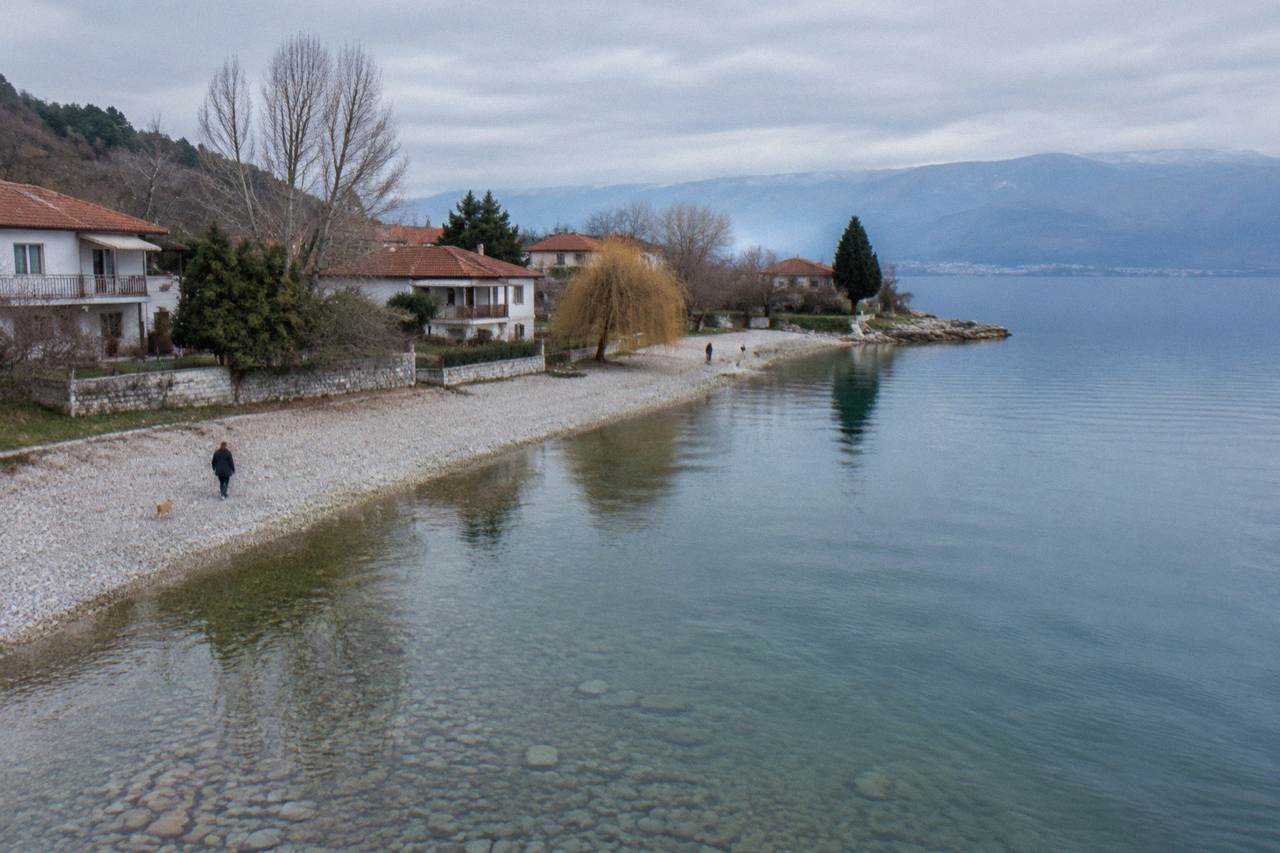
Trpejca and Ljubanista are two beach villages on Lake Ohrid's eastern shore in North Macedonia, reached from Ohrid by road or by the seasonal boat trips that stop here on the way to St Naum. Trpejca appears on full-day boat cruise routes as a swim and food stop, and Ljubaništa is listed among the lake's popular swimming beaches.
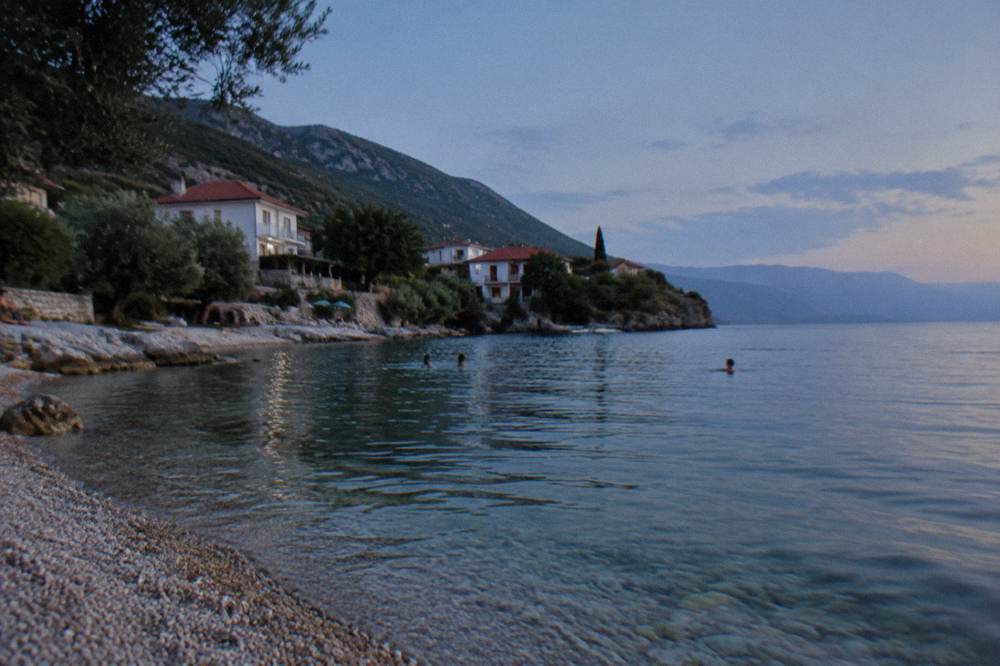
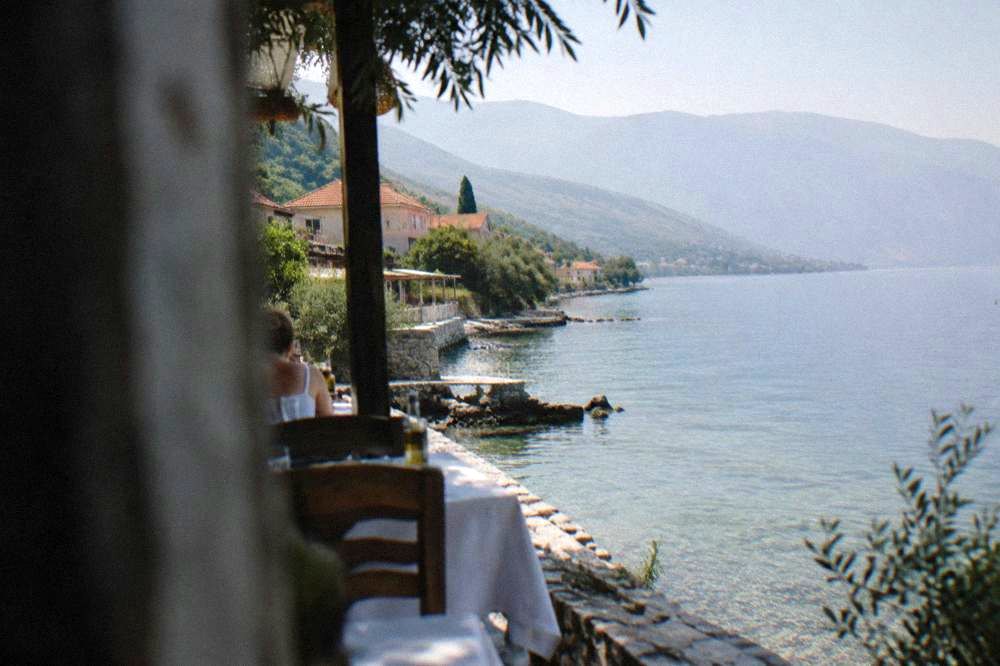
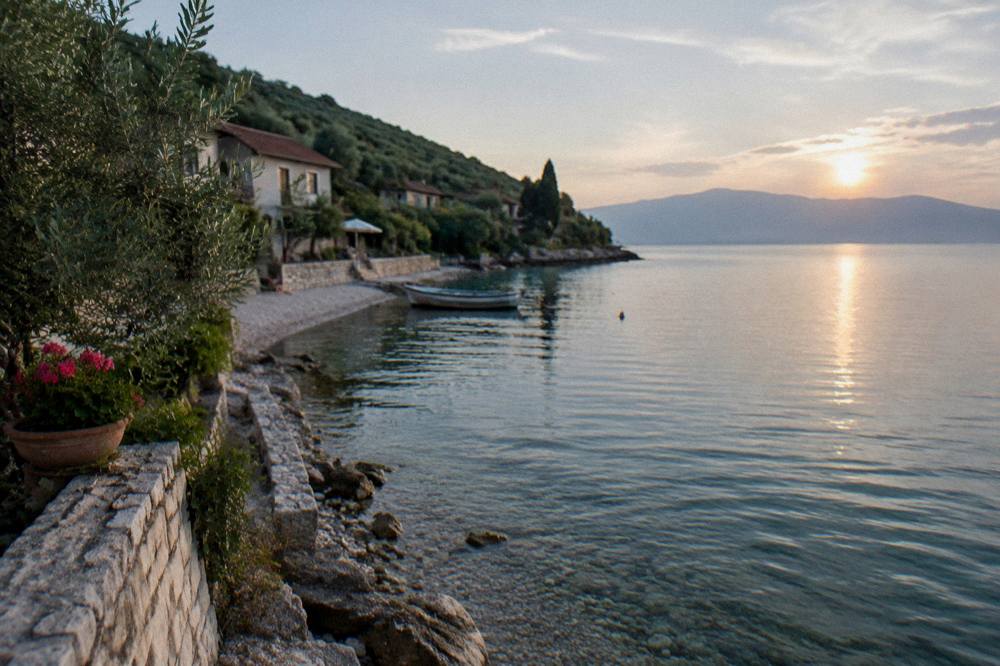
Trpejca and Ljubanista are the two beach villages on the eastern shore of Lake Ohrid in North Macedonia, strung along the coast between Ohrid town and the St Naum monastery at the southern end of the lake. The Ohrid Travel Guide covers them together because they are typically met the same way: from the deck of a boat, or on the lakeside road that runs toward St Naum and the Albanian border. Trpejca appears by name on the route of the full-day boat cruise from Ohrid port, which stops at the Bay of Bones, Trpejca and Zaum on its way to St Naum, and Ljubaništa is listed among Lake Ohrid's popular swimming beaches in the lake's beach guides. Neither is a town. Both are small settlements whose whole economy is the lake in summer.
What follows is a planning guide: what each village actually is, how the boat and road routes work, when the water is warm enough to swim, and how a visit fits with the bigger sights on this side of the lake, from the Bay of Bones museum to St Naum monastery.
Where Are Trpejca And Ljubanista On Lake Ohrid?
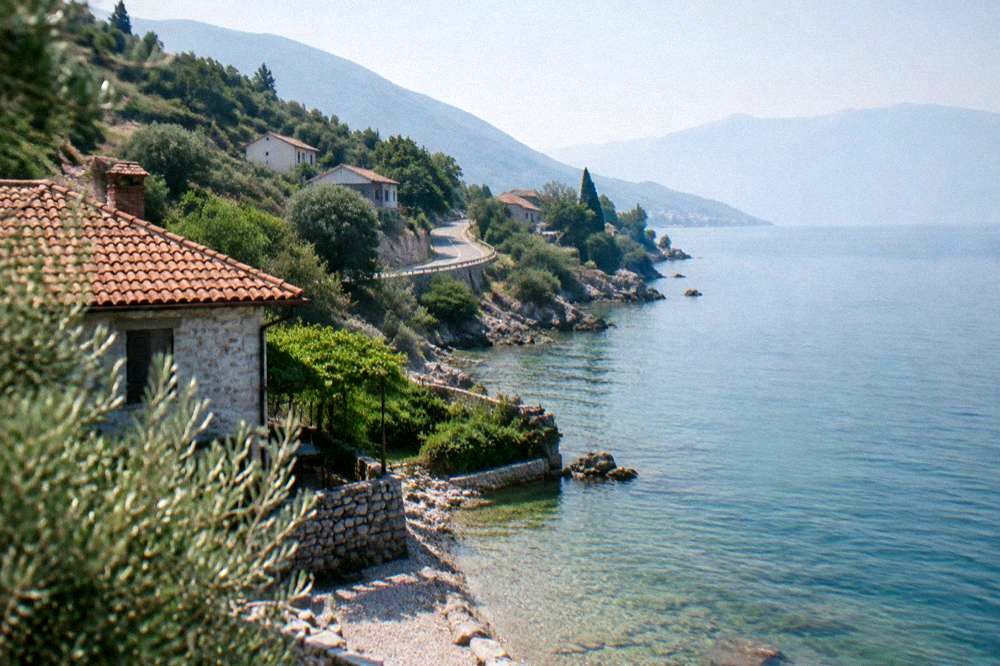
Trpejca and Ljubanista sit on the eastern shore of Lake Ohrid, south of Ohrid town and north of the St Naum monastery, inside the UNESCO inscribed Natural and Cultural Heritage of the Ohrid Region. The lake itself sits at about 693 m above sea level, and the ridge of Galicica National Park, which runs between Lake Ohrid and Lake Prespa, forms the backdrop to this whole stretch of coast.
The UNESCO property, inscribed in 1979 for its natural values and 1980 for its cultural ones and extended to the Albanian part of the lake in 2019, covers roughly 94,729 hectares, and the eastern-shore villages fall inside it. That matters for what the coast looks like: this is not a built-up resort strip. Galicica, North Macedonia's second national park, founded in 1958, covers 22,750 hectares between the two lakes, with Magaro peak at 2,254 m, and its western edge runs down toward the water that Trpejca and Ljubanista sit beside.
For orientation, the straight-line distances in the site's places data put Struga about 12 km from Ohrid on the opposite, northern end of the lake, Pogradec in Albania about 26 km, and Tirana about 86 km. The eastern shore runs the other way, south from Ohrid past Peshtani and the Bay of Bones toward Trpejca, Ljubanista and finally St Naum. The eastern shore guide covers the full run of it, and the neighbouring Peshtani and Lagadin area sits immediately north.
What Can You Actually Do In Trpejca And Ljubanista?
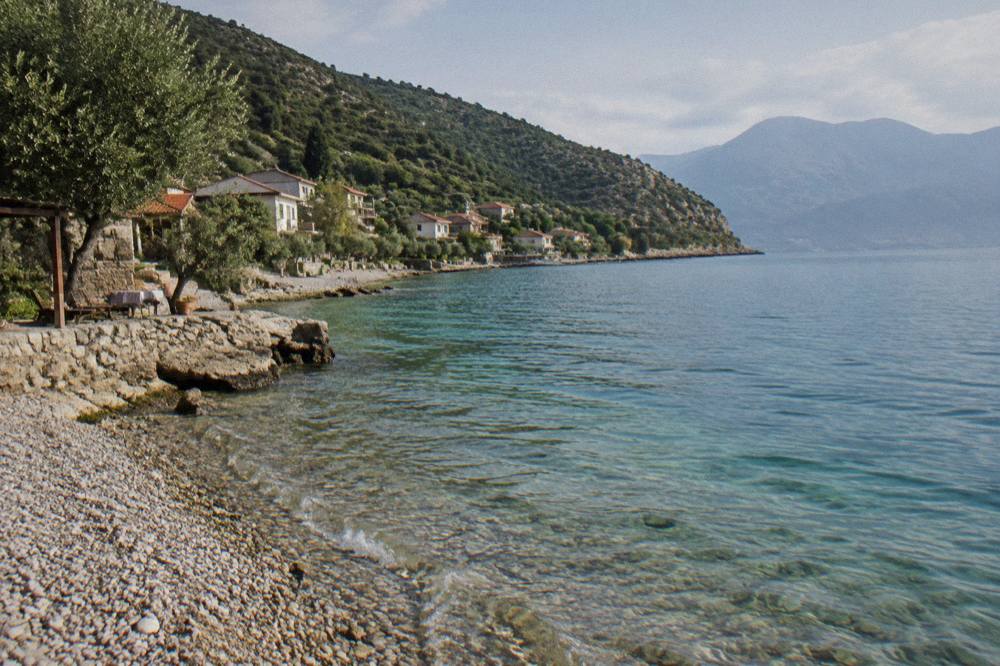
The short answer is lake life: swimming off pebble beaches, eating lakeside in the villages, and using them as staging points for boat trips to Zaum, the Bay of Bones and St Naum. Trpejca is a named stop on the full-day boat cruise from Ohrid port to St Naum, and Ljubaništa is listed in the lake's beach guides among the popular swimming spots, together with Gradiste, Lagadin, Potpesh and Labino.
The beach guides for Lake Ohrid list Ljubaništa among the popular swimming beaches, describing pebble and mixed shores with clear water, and the same guides note that beach facilities in general are reduced or closed outside the main season. That last point matters more than any single beach description: the villages run on a summer rhythm, roughly May to October, the same window in which the boats to St Naum operate, with a reduced winter schedule after that.
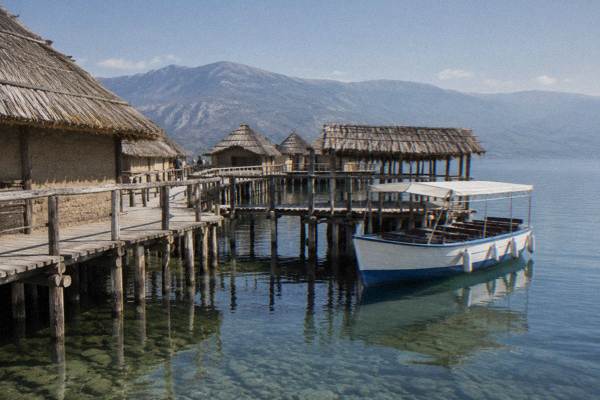
The most concrete thing anchored to this coast is the boat route. One operator, Boat Armada, runs a full-day cruise from Ohrid port to St Naum lasting about 7 hours, with stops at the Bay of Bones, Trpejca and Zaum, priced from 1,200 den per adult and 600 den per child, and listing the Bay of Bones entrance at 150 MKD per person as not included. The Bay of Bones, or Museum on Water, at Gradishte near Peshtani, keeps winter hours of 09:00 to 15:30 from 1 October to 30 April and summer hours of 09:00 to 16:30 from 1 May to 30 September, closed Mondays, with museum-institute tickets at 120 den domestic, 150 den foreign and 60 den for children and students.
For travellers basing themselves in Ohrid town, several bookable products cover this stretch of water, from short sunset runs to full-day cruises that combine the Bay of Bones, St Naum and a swim stop.
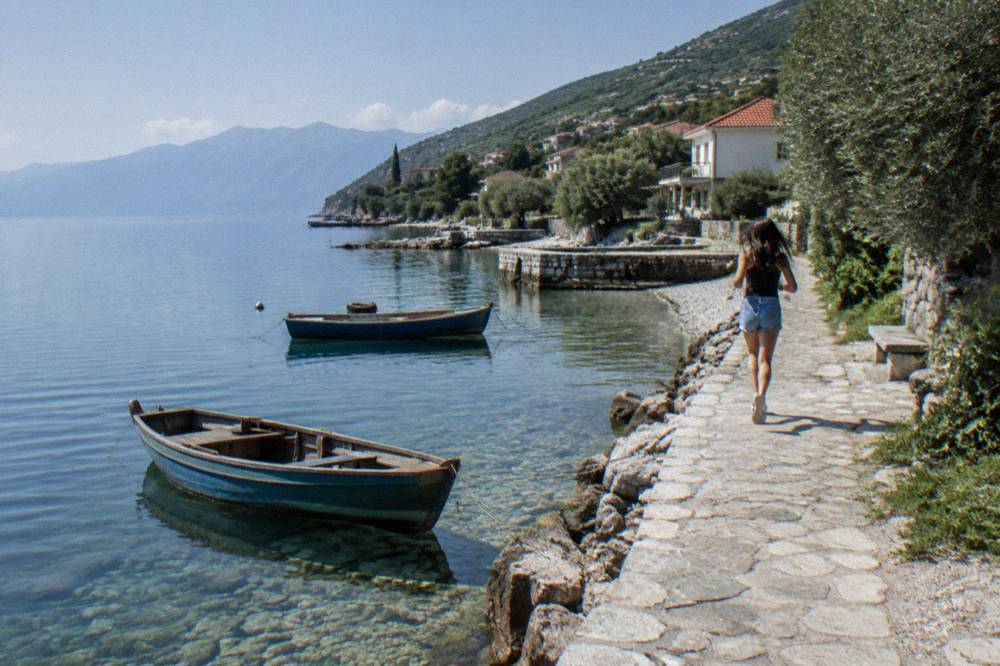
The guided boat products differ in shape. One runs a full circuit taking in the Bay of Bones, St Naum and a swim stop; another pairs a shorter cruise with wine tasting on board; and the day trip from Tirana covers the Ohrid and St Naum side of the lake from an Albanian start point, which matters for anyone combining the two countries in one trip. The question of which departure a product uses is settled on its own listing, and a trip flagged as starting in Tirana starts there.
How Do You Get From Ohrid To Trpejca And Ljubanista?
There are two practical routes from Ohrid town: the lakeside road that runs south along the eastern shore toward St Naum, and the seasonal boats from Ohrid port, which run roughly May to October with stops that include Trpejca on the full-day cruise. The St Naum monastery end of the road sits about 4 km from the Albanian border crossing at Tushemisht, which puts the whole eastern shore within reach of a two-country day.
By road, the eastern shore is the continuation of the route that passes Peshtani and the Bay of Bones before reaching Trpejca, Ljubanista and St Naum. Drivers should know two dated 2026 rules that touch this coast. First, the Government's transport decision of 2 June 2026 set lake navigation limits: jet skis are banned from 1 July to 31 August between 11:00 and 19:00, and boats are banned at night, from 21:00 to 05:00 between 3 June and 31 August and from 20:00 to 06:00 in September, with a further October limit, all for swimmer safety. Second, a resident-only parking regime took effect on old-town streets in Ohrid from summer 2026, on Ilindenska, Kosta Abrash and Car Samoil, with clamping for non-residents, which affects parking in Ohrid itself rather than in the villages.
By boat, the Armada full-day cruise from Ohrid port is the documented scheduled option, about 7 hours, from 1,200 den adult and 600 den child, with Trpejca a named stop. Local rowboats at the St Naum springs run at about 5 EUR per boat, per the cruise operator's own listing. The general pattern, per the season guides, is that boats to St Naum run about May to October with a reduced winter schedule.
The table below pulls together the access options with the figures the sources actually give.
| Option | Route | Figure given in sources | Season |
|---|---|---|---|
| Full-day boat cruise (Boat Armada) | Ohrid port to St Naum, stops at Bay of Bones, Trpejca, Zaum | From 1,200 den adult, 600 den child, about 7 hours | Roughly May to October, reduced in winter |
| Bay of Bones entrance | Gradishte, Peshtani, on the cruise route | 150 MKD per person | Winter 09:00-15:30, summer 09:00-16:30, closed Monday |
| Rowboat at St Naum springs | Crn Drim springs at the monastery | About 5 EUR per boat | Seasonal |
| Road | Ohrid town south along the eastern shore | St Naum to Tushemisht border about 4 km | Year-round |
For the St Naum end of the day, the St Naum from Ohrid day-trip guide and the answer page on how to get from Ohrid to St Naum carry the detail. Travellers coming the other way, from Tirana, can book the guided day trip that covers Ohrid and St Naum in one booked day, and check availability through the operator's live listing: Check availability.
When Is The Water Warm Enough To Swim At Trpejca And Ljubanista?
The modelled lake surface data puts comfortable swimming from July onward: July averages about 22.9 C, August about 23.5 C and September about 19.7 C on the aggregator series, with the swimming season generally running July to September. June averages about 19.4 to 22.5 C depending on the dataset, and by October the modelled average drops to about 14.7 C, with the UHMR multi-year October mean at 14.3 C for 2001 to 2020.
For planning, that translates to a simple rule: a trip built around swimming in Trpejca or Ljubaništa belongs to July, August or early September, and a June trip is a coin-toss on warmth, while October is for walking and boating more than bathing.
| Month | Modelled surface temperature (C) | Swim? |
|---|---|---|
| Jan | 4.6 | No |
| Feb | 5.4 | No |
| Mar | 7.2 | No |
| Apr | 10.5 | No |
| May | 14.9 to 18.7 by dataset | Hardy swimmers only |
| Jun | 19.4 to 22.5 by dataset | Possible |
| Jul | 22.9 | Yes |
| Aug | 23.5 | Yes |
| Sep | 19.7 | Yes, cooling |
| Oct | 14.7 (UHMR mean 14.3) | No |
| Nov | 10.3 | No |
| Dec | 6.0 | No |
Water quality in 2026 has a documented picture too: the Institute of Public Health's May-June testing found Class I physico-chemical quality across the lake's bathing points except Grashnica beach, which rated Class III, and most microbiological samples rated Excellent, though the same reporting flagged ongoing wastewater collector problems on parts of the shoreline, including the stretch from St Naum to Radozda. The answer page on whether the water in Lake Ohrid is clean goes deeper on that.
What Is The Weather Like On The Eastern Shore Through The Year?
The modelled ERA5 climate normals for the Ohrid grid cell, 1991 to 2020, give July a mean daily high of 27.1 C and August 27.6 C, with August the month of lowest rainfall at 32.9 mm and December the highest at 92.6 mm. Spring shoulder months sit at 14.6 C in April and 19.5 C in May, and winter lows dip below freezing, with a January mean minimum of -0.8 C.
These are reanalysis values for the grid cell at 701 m covering Ohrid, not a station record, and they apply to the whole town-and-lake basin, the eastern shore included. The pattern they describe matches the season rhythm of the villages: warm, dry summers that carry the whole beach economy, wet late-autumn months, November at 90.4 mm and December at 92.6 mm, and winters cold enough for snow in Ohrid and heavier snow on Galicica, where the main park road can close typically between January and March. Everything else covered here is indexed on Ohrid Travel Guide.
| Month | Mean high (C) | Mean low (C) | Rain (mm) |
|---|---|---|---|
| Jan | 5.0 | -0.8 | 76.5 |
| Feb | 6.3 | 0.0 | 74.3 |
| Mar | 10.0 | 2.5 | 80.5 |
| Apr | 14.6 | 6.3 | 82.4 |
| May | 19.5 | 10.8 | 70.8 |
| Jun | 24.2 | 15.2 | 43.1 |
| Jul | 27.1 | 18.3 | 34.7 |
| Aug | 27.6 | 19.0 | 32.9 |
| Sep | 22.4 | 14.9 | 62.4 |
| Oct | 17.4 | 10.3 | 76.0 |
| Nov | 11.5 | 5.3 | 90.4 |
| Dec | 6.2 | 0.9 | 92.6 |
The practical reading for this page: June to September is the season that matches both the air and the water, and August is the documented high point of the lake's summer, the month the Swimming Marathon finishes at Ohrid harbour. Outside that window the villages quieten, boats reduce, and the eastern shore becomes a scenic drive or a long walk rather than a beach base.
Where Do Trpejca And Ljubanista Fit In An Ohrid Itinerary?
They fit as the southern leg of a lake day: pair them with the Bay of Bones on the way down, St Naum at the end of the road, and the boat back to Ohrid port, and you have the shape of the classic full-day eastern-shore circuit. Most first-time visitors meet them this way rather than staying overnight, and the two-day Ohrid itinerary typically gives this coast one of its two days.
The logic is geography. Leaving Ohrid's old town, with its churches, Samuel's Fortress and the Old Bazaar, the road south passes Peshtani and the Bay of Bones, reaches Trpejca and Ljubanista, and ends at St Naum, where the monastery sits by the Crn Drim springs and the Albanian border is about 4 km away at Tushemisht. The monastery's own entrance, per the cruise operator's listing, is 150 MKD per person. A boat from Ohrid port replicates the same line on water, which is why the full-day cruise route reads like a checklist of this coast.
For itinerary building, the two-day Ohrid plan allocates the lake's southern shore its own day, and the boat tour overview compares the water options. Visitors with more time often add the Galicica side: the park is open year-round and charges 250 MKD per vehicle with no per-passenger fee, or 100 MKD for someone entering on foot at the Ohrid-side gate, figures that matter if the eastern-shore day turns into a ridge crossing toward Lake Prespa, whose gauge sits about 148 m above Lake Ohrid across the Galicica ridge.
Should You Stay In The Villages Or Visit From Ohrid?
Visiting from Ohrid town is the documented pattern: the town holds the accommodation stock, the November 2025 count recorded 18,103 guests in the Ohrid area in a single off-season month, and the villages function as day destinations served by boats and the coast road. Staying out on the eastern shore trades walkable sightseeing for proximity to the water, a trade that only pays off in the swimming months when beach facilities are open.
The guest figures from the State Statistical Office, 18,103 guests and 33,149 overnight stays in the Ohrid area in November 2025, with Germany the largest foreign market at 3,537 guests, describe the town-centred pattern even in the off-season. The beach guides note that beach bars and facilities reduce or close in winter across the lake's beaches, Ljubaništa included, so an overnight stay in the villages outside summer is a quiet proposition with limited services.
For most plans, basing in Ohrid and answering the stay question with the where to stay in Ohrid guide is the stronger play, with the villages as a day leg. The exceptions are summer weeks built entirely around swimming, and trips that pair the eastern shore with an early start for St Naum or a crossing into Albania at Tushemisht, which the crossing listings report as open 24/7 for passenger vehicles and pedestrians.
Planning to base yourself in Ohrid for the lake days? Book a hotel here.
What Should You Know About St Naum At The End Of The Road?
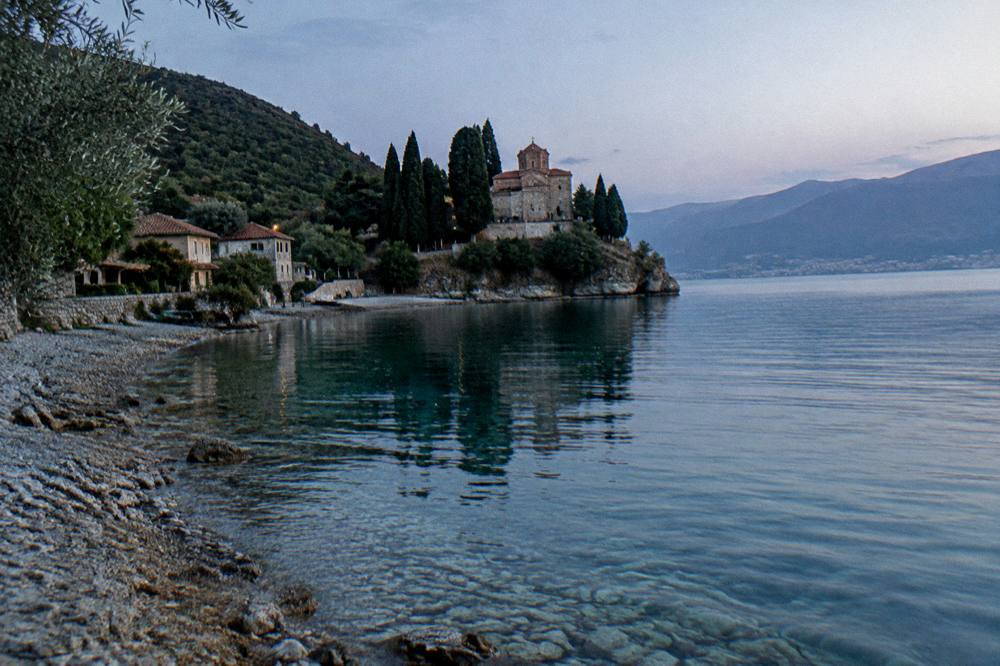
St Naum is the monastery complex at the southern end of Lake Ohrid, about 4 km from the Albanian border crossing at Tushemisht, with a documented entrance of 150 MKD per person and rowboat rides through the Crn Drim springs at about 5 EUR per boat, per the cruise operator's listing. It is the terminus of both the coast road and the full-day boat route that stops at Trpejca on the way.
The monastery is the anchor sight of this whole shore, and the villages exist in its orbit. The St Naum monastery guide covers the complex itself, and the answer page on whether St Naum monastery is worth visiting tackles the judgement call. For this page's purposes, what matters is sequencing: a day that reaches Trpejca and Ljubanista has, by definition, either passed or planned for St Naum, and the boat option stitches all of it together in one ticket.
The dated 2026 navigation rules shape a St Naum boat day: the June transport decision bans boats from the water at night through the summer, 21:00 to 05:00 in July and August and 20:00 to 06:00 in September, and bans jet skis in daytime peak hours in July and August. Cruises therefore run as daylight operations, which is how the roughly 7-hour full-day format is built.
What Do The Villages Cost Compared With Ohrid Town?
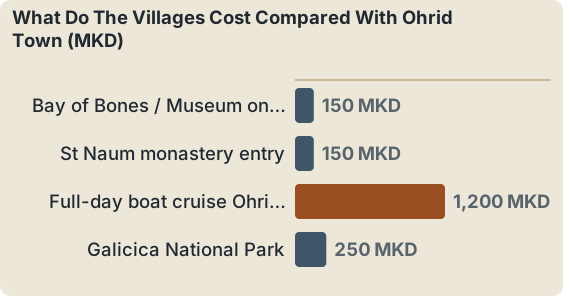
The documented costs on this coast are specific: museum-institute sites at 120 den domestic, 150 den foreign and 60 den for children and students, the Bay of Bones at 150 MKD per person, St Naum at 150 MKD, the full-day boat cruise from 1,200 den adult and 600 den child, and the springs rowboat at about 5 EUR per boat. Galicica adds 250 MKD per vehicle or 100 MKD on foot, and the denar is the local currency, euros quoted informally but not legal tender.
The currency point matters on this shore more than in town: boat operators quote in den, the monastery figure is in MKD, and the springs rowboat is quoted in euros on the cruise listing. The National Bank's middle rate on 19 October 2026 was 1 EUR to 61.6633 MKD, and the denar is pegged in practice to the euro through the central bank's exchange-rate targeting. The fuller money picture, including what the Ohrid cost and budget guide covers, belongs to town planning; on the eastern shore, the table below is what the sources price.
| Item | Price in source | Notes |
|---|---|---|
| Bay of Bones / Museum on Water entry | 150 MKD per person | Museum-institute ticket also 120 den domestic, 60 den child/student |
| St Naum monastery entry | 150 MKD per person | Per cruise operator's listing |
| Full-day boat cruise Ohrid port to St Naum | From 1,200 den adult, 600 den child | About 7 hours, stops at Bay of Bones, Trpejca, Zaum |
| Rowboat at the Crn Drim springs | About 5 EUR per boat | Per cruise operator's listing |
| Galicica National Park | 250 MKD per vehicle; 100 MKD on foot | No per-passenger fee for vehicles |
Which Books And Trips Cover This Shore Best?
Three product shapes cover the Trpejca and Ljubanista coast: a full-day boat trip linking the Bay of Bones, St Naum and a swim stop; a wine-tasting cruise for a shorter water experience; and the guided day tour from Tirana that reaches Ohrid and St Naum from an Albanian start. Prices, ratings and durations for all three render in the listings themselves rather than in prose here.
The choice between them is a choice of base and appetite. From Ohrid town, the boat products fit a lake day with swim stops at exactly the beaches this page describes. From Tirana or Durres, the day tour is the option that reaches the Ohrid region and St Naum in one booked day, and it starts where its listing says it starts. For visitors mixing the eastern shore with more of Ohrid's sightseeing, the St Naum tours from Ohrid and the wider things to do in Ohrid round out the options.
Common Questions About Trpejca And Ljubanista
Can you swim at Trpejca and Ljubaništa?
Yes. Ljubaništa is listed in Lake Ohrid's beach guides among the popular swimming beaches, with pebble and mixed shores, and Trpejca is a swim and food stop on the full-day boat cruise route to St Naum. The modelled water data puts comfortable swimming from July, with July around 22.9 C and August around 23.5 C, and the season generally July to September.
How do you get to Trpejca and Ljubanista from Ohrid?
Two ways: the coast road running south from Ohrid town past Peshtani toward St Naum, and the seasonal boats from Ohrid port, which run roughly May to October and stop at Trpejca on the full-day cruise to St Naum.
Is Trpejca or Ljubaništa close to St Naum monastery?
Both sit on the last stretch of the eastern shore before St Naum, which sits about 4 km from the Albanian border crossing at Tushemisht at the southern end of the lake. The full-day boat route stops at Trpejca on its way to the monastery.
What does a boat trip to St Naum cost?
The documented full-day cruise from Ohrid port to St Naum with Boat Armada runs from 1,200 den per adult and 600 den per child for about 7 hours, with the Bay of Bones entrance of 150 MKD per person not included. Rowboats at the Crn Drim springs cost about 5 EUR per boat.
Are the villages open in winter?
The villages remain on the road network year-round, but beach facilities reduce or close outside the main season, boats to St Naum run a reduced winter schedule after roughly October, and museum sites on the coast, like the Bay of Bones, switch to winter hours of 09:00 to 15:30 from 1 October and close on Mondays.
Is the water clean for swimming on the eastern shore?
The Institute of Public Health's 2026 May-June testing found Class I physico-chemical quality at the lake's bathing points except Grashnica beach, which rated Class III, with most microbiological samples rated Excellent, though the same reporting flagged ongoing wastewater collector problems, including on the stretch from St Naum to Radozda.