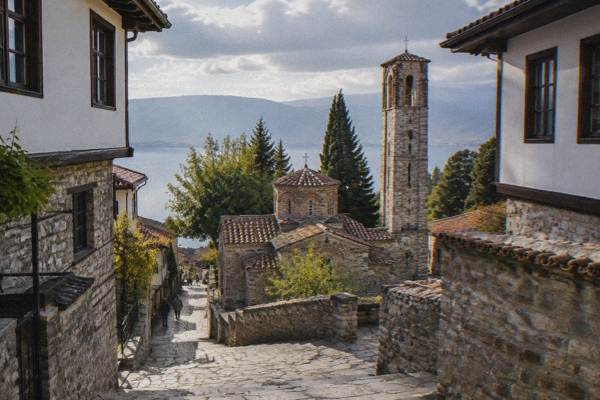
Cycling Around Lake Ohrid: Routes, Rentals And Bike Paths
Lake Ohrid sits at about 693 m above sea level, ringed by villages, churches and two countries, and a bicycle is one of the simplest ways to move between them. Riding the shore from Ohrid offers traffic-free options only so far, and a day in the saddle covers a realistic stretch of it.
Short answer
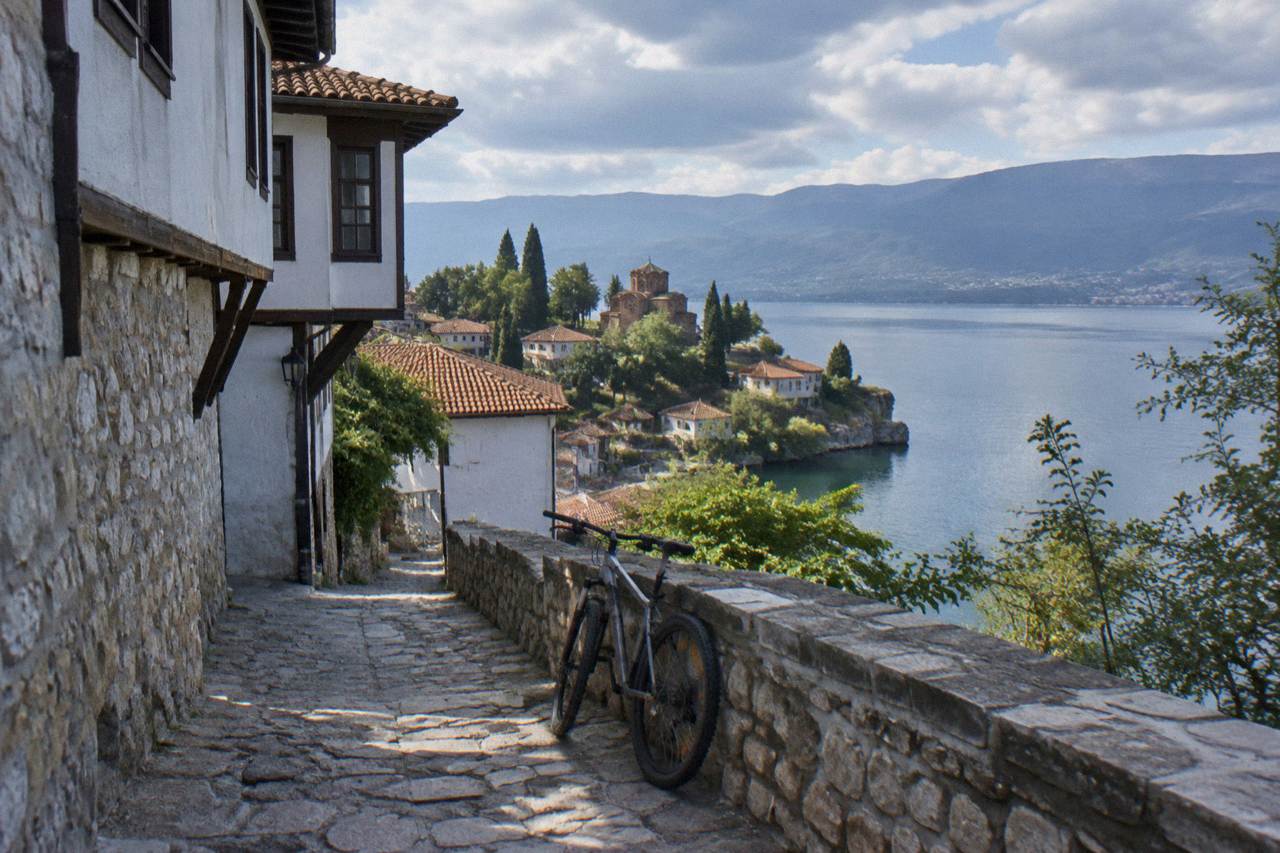
There is no bike-share scheme or marked bike lane network in Ohrid, but the lake shore road links Ohrid to Struga, Peshtani, Trpejca and St Naum on the Macedonian side, and a guided around-the-lake excursion covers the Albanian shore. Rentals exist in the summer season; prices are not published.
Lake Ohrid is a freshwater mountain lake shared between North Macedonia and Albania, and the town of Ohrid sits on its north-eastern shore at about 693 m above sea level. The Ohrid Travel Guide covers the destination end to end, and this page takes one narrow question: what does cycling around the lake actually look like, what the routes and rental options are, and where a guided trip does the work instead. The honest starting point is that Ohrid has no bike-share scheme and no marked bike-lane network, so everything here rests on the shore road, the villages along it, and the bookable products that cover the loop.
Can You Cycle Around Lake Ohrid?
Yes, in the practical sense that the lake is ringed by roads and a full circumnavigation is a recognised day-trip product, but nothing about it is car-free. No cycle path, bike lane or bike-share scheme exists around Lake Ohrid, so the ride is a road ride on the shore road shared with cars, buses and coaches, and anyone uncomfortable with traffic should treat the guided or boat alternatives as the primary plan.
The lake is the anchor of the UNESCO property "Natural and Cultural Heritage of the Ohrid Region", inscribed in 1979 and 1980 and extended to the Albanian part in 2019, which covers roughly 94,729 hectares across both countries. That single fact explains both the appeal and the constraint. The appeal: the shoreline strings together the old town of Ohrid, fishing villages such as Trpejca, Peshtani and Lagadin, the Bay of Bones museum on the water, the monastery of St Naum at the Crn Drim springs, and, across the border, the Albanian shore towards Pogradec. The constraint: the same shore road carries all summer traffic between those places.
A full loop also involves a border. The Macedonian and Albanian sides meet at two crossings relevant to cyclists: the Sveti Naum and Tushemisht crossing, which sits about 4 km from the St Naum monastery, and the main Struga-area crossing at Qafe Thane. The Sveti Naum crossing is reported to be open around the clock for passenger vehicles and pedestrians, though that figure is reported rather than independently confirmed, so check before committing a day to it.
For readers who want the loop without the logistics, the around-the-lake excursion listed below is the site's featured pick for this page, covering the Albanian side of the lake from Ohrid with transport and a guide included.
What Routes Work For Cycling Around Ohrid?
The realistic cycling geography has three tiers: the old-town lanes above the Ohrid quay, which are pedestrian in character; the western shore road towards Struga, Peshtani, Trpejca and St Naum, which is the main riding corridor; and the Galicica side, where the national-park road climbs between Lake Ohrid and Lake Prespa and snow can close it between January and March. No route lengths or gradient profiles exist for any of these, so plan by named waypoints rather than kilometres.
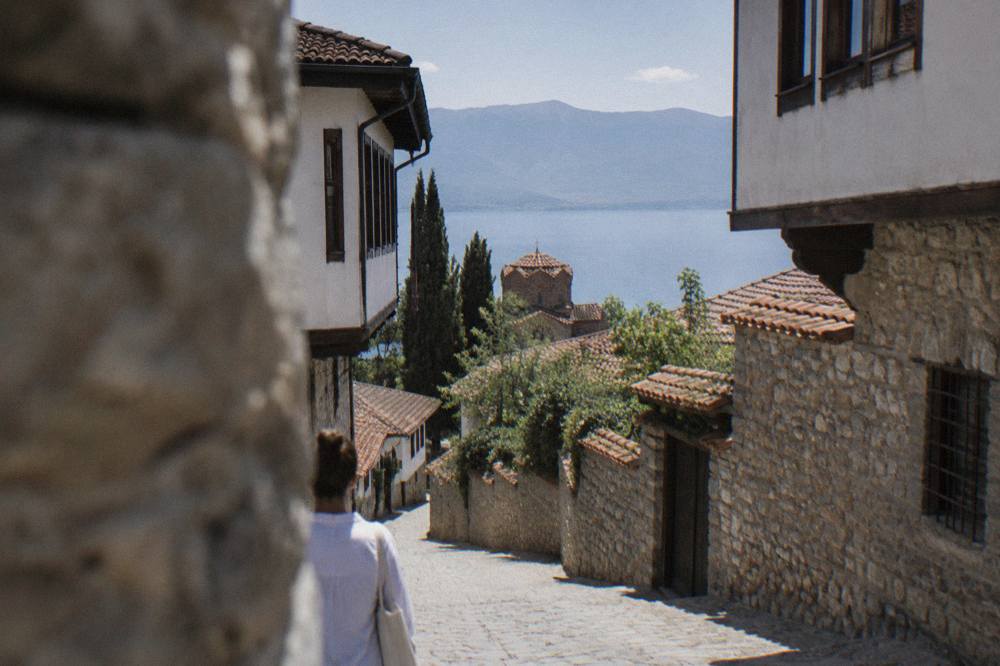
Starting from the old town, the ride naturally begins at the quay. The old town climbs from the lake towards Samuel's Fortress, and its lanes are on foot, so a cyclist leaves the bike or walks it. West of town the shore road runs along the northern edge of the lake. The first named milestone is Struga, where the Black Drim flows out of the lake and where the Struga Poetry Evenings held their 65th edition from 24 to 29 June 2026. Local buses also link Ohrid and Struga, with fares reported at 100 to 150 MKD in older guides, which makes Struga a bail-out point on a shore ride.
Continuing south on the eastern shore, the road passes Lagadin and Peshtani before reaching the Bay of Bones at Gradiste. Further on sit Trpejca and Ljubanista, and the Macedonian shore ends at St Naum, about 4 km from the Tushemisht border crossing into Albania. The monastery sits at the Crn Drim springs, and a rowboat ride through the springs is quoted by a cruise operator at about 5 EUR. That is the turnaround point of the classic day ride, or the gateway to the Albanian side for a full loop.
The third tier is different in kind. Galicica National Park, North Macedonia's second national park, established in 1958, covers 22,750 ha between Lake Ohrid and Lake Prespa, with Magaro peak at 2,254 m. The park is open year-round, but heavy snow can close the main road typically between January and March, and the park charges 250 MKD per vehicle, or 100 MKD for someone entering on foot from the Ohrid-side gate. A cyclist crossing the park by road counts as neither of those cleanly, so expect to ask at the gate. The Lake Prespa day trip page covers what waits on the other side, and the Ohrid hiking guide covers the park on foot.
No journey time is given for any of these rides, and none is offered here. What the sources do give is the rail and air picture for context: there is no passenger train to Ohrid at all, and the town's airport sits about 10 km west of the centre, so a cyclist arriving by air has a short connection before the lake riding starts. The getting around Ohrid guide lays out the non-bike options in full.
What Should You Know About Bike Rentals In Ohrid?
Bike rental exists in Ohrid as a seasonal, shop-based trade concentrated in the summer months, but no rental price list, fleet description or year-round operator survives scrutiny. The only bike products with prices, ratings and durations listed on this site are bookable tours, which render their own data below, and e-bike touring exists only through those bookable products rather than as a documented public network.
That is a deliberately thin answer, and it is the honest one. What can be said in more detail is seasonal. The tourist season around the lake runs roughly June to September, with August the busiest month, and seasonal operations, from beach facilities to boat schedules to St Naum cruises, scale back or stop outside it. Rental shops follow the same logic, which means a cyclist planning a May or October trip should not assume a bike is waiting.
The practical workaround for a visitor who wants wheels without depending on a shop is the tour product. The site's Ohrid kayak and activity tours round-up covers the active options, and the around-the-lake excursion covers the full Albanian shoreline with a vehicle. For anyone set on independent riding, the questions to ask any rental desk are the ones no published source answers: helmet included or not, repair kit, lock, and whether the bike may be taken across the border into Albania, since a loop of the lake crosses it.
Prefer four wheels over pedals for the lake loop? Book a rental car here.
Which Sights Sit Along The Lakeshore Ride?
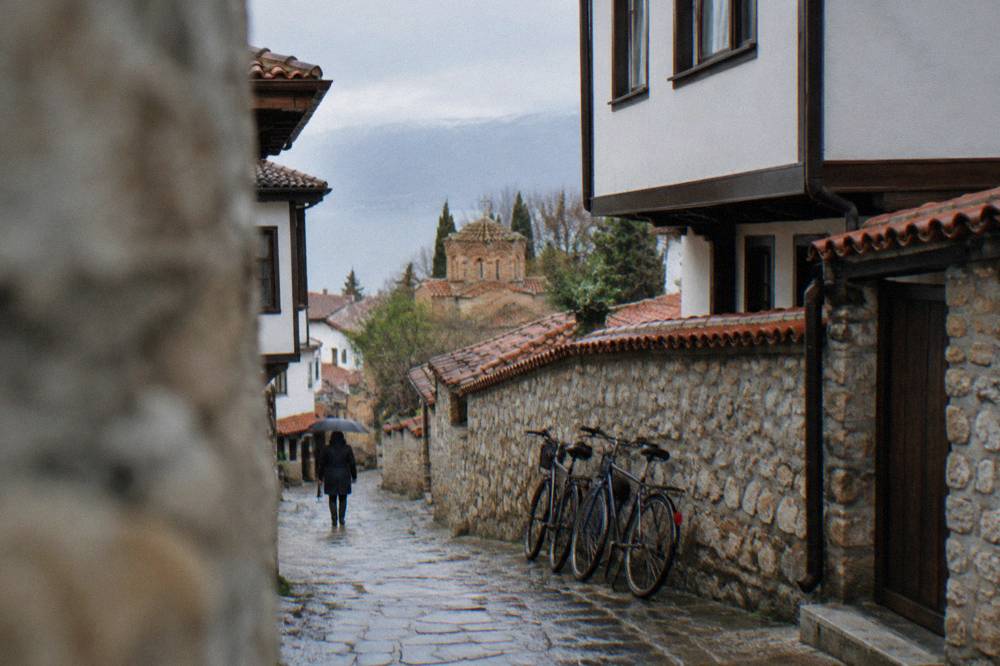
The eastern-shore ride from Ohrid to St Naum passes four museum-grade stops, and the museum institute's own pages price them uniformly: Robev Family House, the Museum on Water at the Bay of Bones and the Icon Gallery each charge 150 MKD for foreign visitors and 120 MKD for domestic visitors, with a reported 60 MKD child and student rate, and all three close on Mondays. St Naum monastery charges 150 MKD per person on the same basis, quoted by a cruise operator.
The table below gathers what the museum institute's own site states, with the winter and summer schedules spelled out. Winter runs 1 October to 30 April, summer 1 May to 30 September, and the Monday closure applies to the institute sites. This matters to a cyclist more than to a coach tourist, because a Monday shore ride reaches closed doors at every museum stop.
| Site | Foreign ticket | Domestic ticket | Winter hours (1 Oct to 30 Apr) | Summer hours (1 May to 30 Sep) | Closed |
|---|---|---|---|---|---|
| Robev Family House, Tsar Samoil St 62 | 150 MKD | 120 MKD | 09:00 to 15:30 | Two shifts, 09:00 to 15:30 and 13:30 to 20:00 | Monday |
| Bay of Bones (Museum on Water), Gradiste, Peshtani | 150 MKD | 120 MKD | 09:00 to 15:30 | 09:00 to 16:30 | Monday |
| Icon Gallery, Perivleptos complex | 150 MKD | 120 MKD | 09:00 to 14:00 | 09:00 to 17:00 | Monday |
| St Naum monastery | 150 MKD (operator-quoted) | not published | not published | not published | not published |
Beyond the ticketed stops, the shore string includes places with no entry bureaucracy at all. The Ancient Theatre in Ohrid, built at the end of the third or start of the second century BC and first excavated in 1935, hosts the Ohrid Summer Festival, whose 66th edition opened on 12 July 2026 at the theatre itself. The ride out of town also passes the Kaneo quarter, where the Church of St John at Kaneo sits above the water; an entry figure of about 150 MKD for it is only weakly reported and should be confirmed on the spot. The Bay of Bones guide covers the museum on water in detail, and the Kaneo district page covers the approach on foot.
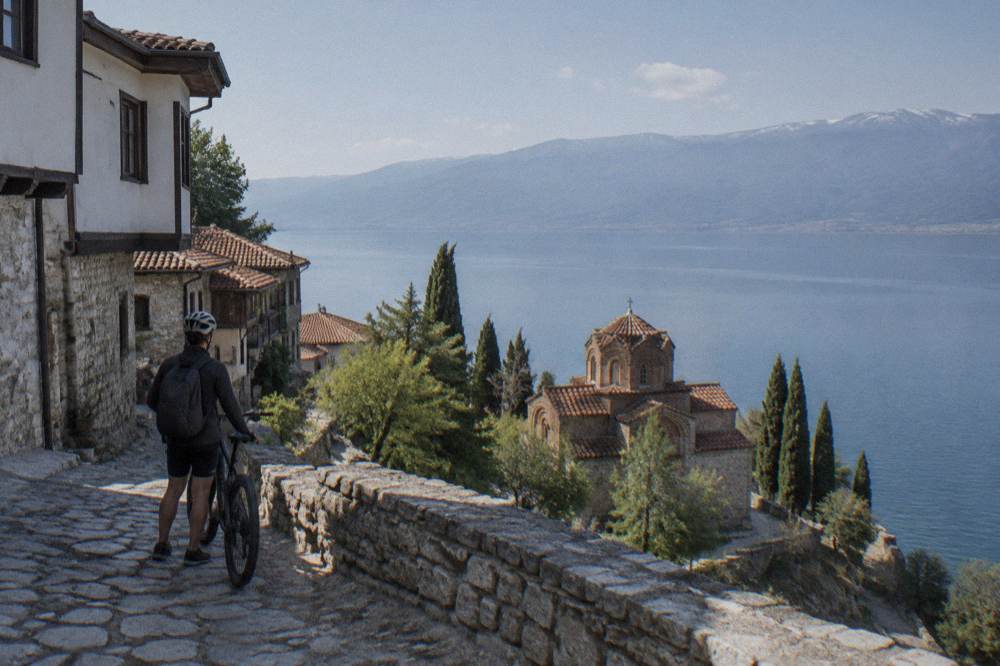
For a swim stop, the modelled lake surface temperatures give the calendar. Aggregator values model January at about 4.6 C, July at about 22.9 C and August at about 23.5 C, with a UHMR multi-year October mean of 14.3 C for the lake. In practice the comfortable swimming window runs from July, and the swimming in Lake Ohrid guide and the answer to is it possible to swim in Lake Ohrid cover the beaches along the same shore the ride follows.
When Is The Best Season For Cycling Around Ohrid?
The modelled ERA5 climate normals for 1991 to 2020 put August's mean daily high at 27.6 C and January's at 5.0 C, with August also carrying 32.9 mm of rain and December carrying 92.6 mm, so the comfortable road-riding window runs roughly May to September, with June and September offering the balance of warmth and lower traffic that August does not. Snow closes the Galicica park road in a typical winter.
These are modelled ERA5 reanalysis values for the grid cell over Ohrid, not a weather-station record, and they come with no superlatives attached: the figures are stated month by month and speak for themselves. The rest of the planning pages sit on Ohrid Travel Guide.
| Month | Mean daily high C | Mean daily low C | Rain mm |
|---|---|---|---|
| Jan | 5.0 | -0.8 | 76.5 |
| Feb | 6.3 | 0.0 | 74.3 |
| Mar | 10.0 | 2.5 | 80.5 |
| Apr | 14.6 | 6.3 | 82.4 |
| May | 19.5 | 10.8 | 70.8 |
| Jun | 24.2 | 15.2 | 43.1 |
| Jul | 27.1 | 18.3 | 34.7 |
| Aug | 27.6 | 19.0 | 32.9 |
| Sep | 22.4 | 14.9 | 62.4 |
| Oct | 17.4 | 10.3 | 76.0 |
| Nov | 11.5 | 5.3 | 90.4 |
| Dec | 6.2 | 0.9 | 92.6 |
Two seasonal mechanics matter to a cyclist beyond the raw numbers. First, August is the busiest month on the lake's roads as well as its beaches, so the same shore road that feels empty in May carries summer coach and car traffic. Second, the summer event calendar gives the ride dates worth building around: the Balkan Festival of Folk Songs and Dances held its 65th edition from 3 to 6 July 2026, and the Ohrid Water Festival ran 12 to 30 August 2026, including the 25 km St Naum to Ohrid harbour swimming marathon on 22 August. The Ohrid weather and Ohrid in summer pages extend the seasonal picture, and when is the best time to visit Lake Ohrid answers the question for the lake as a whole.
Can You Cross Into Albania By Bike?
Yes, and for a full loop of the lake you must. The Sveti Naum and Tushemisht crossing, about 4 km from the St Naum monastery, is reported open around the clock for passenger vehicles and pedestrians, with the Struga-area Qafe Thane crossing as the alternative on the northern shore; border waits of up to an hour have been reported at St Naum, and holders of recognised visas or residence permits from the UK, US, Canada or Schengen can enter for up to 15 days.
The entry rules for North Macedonia are the backbone of any cross-border ride. Visa-free nationals may stay up to 90 days in any 180-day period, per the foreign ministry's own entry page. UK visitors may stay up to 3 months without a visa, need a passport valid at least 90 days after arrival, and must register with the local police within 48 hours, a task hotels normally handle. North Macedonia is not in the EU and not in Schengen; Bulgaria and Romania became full Schengen members, land borders included, on 1 January 2025, which affects routing from those countries but not the Albanian border itself.
On the Albanian side, the ride joins the shore towards Pogradec and Lin. The Pogradec and Albania from Ohrid guide covers the destination, and the Tirana transport page covers the longer haul. For cyclists who would rather not ride the Albanian shoulder at all, the around-the-lake excursion covers the Albanian shore by vehicle, and its live listing carries the current price and terms: Check availability.
How Safe Is Cycling Around Ohrid?
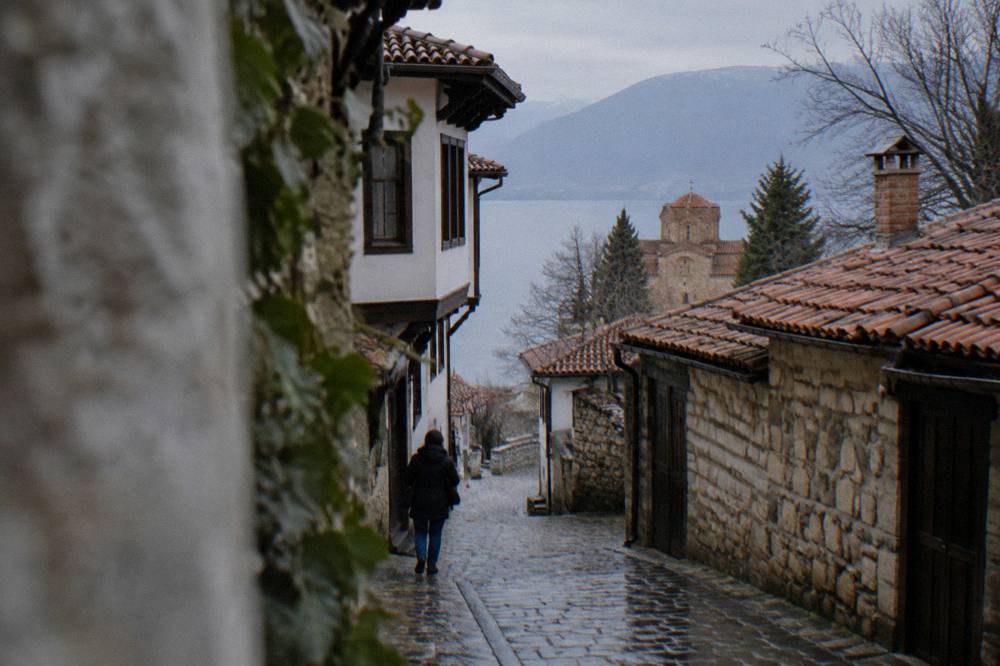
Ohrid's road-safety picture is ordinary for the region, with no bike-specific infrastructure anywhere around the lake, so safety on the ride comes down to the standard road-cycling practices: daylight riding, lights and a helmet, and caution on the summer shore road. The country-level advisory from the US State Department stands at Level 1, Exercise Normal Precautions, and the emergency numbers to carry are ambulance 194, police 192 and roadside assistance 196.
The is Ohrid safe guide covers the general question in depth. Cycling-specific factors worth planning around: headlights are required day and night for vehicles in North Macedonia, which says something about tunnel and dusk conditions a rider shares; there is no vignette system, with motorway tolls paid per plaza, and about 140 MKD of tolls apply on the Skopje to Ohrid motorway sections for a car, a route a touring cyclist arrives on by bus or transfer rather than by pedal. The resident-only parking regime introduced on old-town streets such as Ilindenska, Kosta Abrash and Car Samoil from summer 2026, with clamping for non-residents, has narrowed vehicle access to the old town itself, which works in a cyclist's favour for the town end of any route.
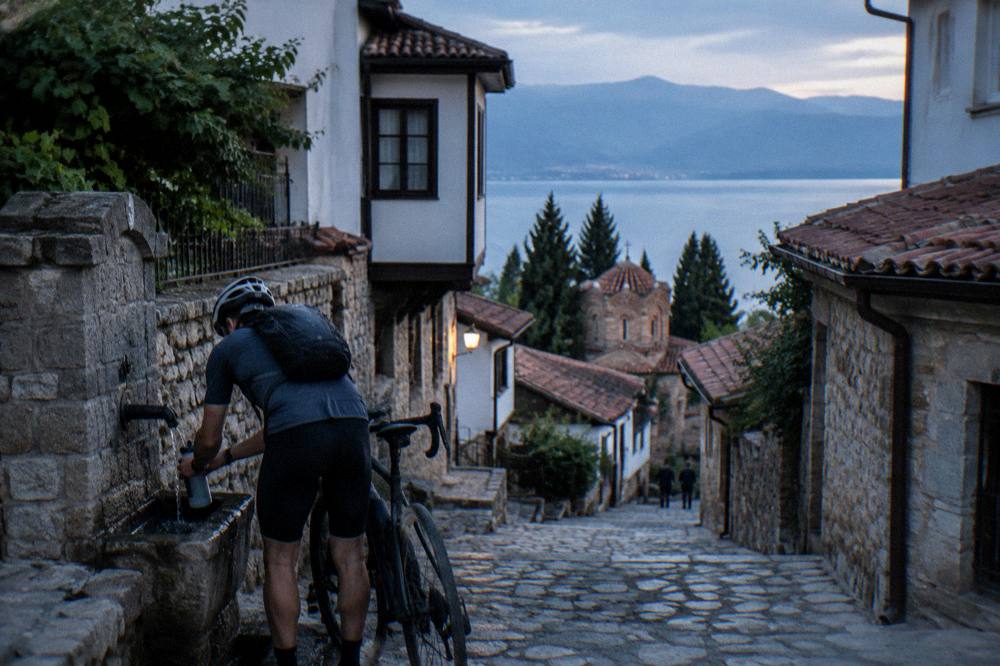
Water and provisioning matter on a high-altitude lake ride. Tap water in Ohrid is generally reported as drinkable, and the 2026 bathing-water testing found the lake Class I physico-chemically except at Grashnica beach, though untreated lake water is not recommended. Summer services thin out fast outside the June-to-September core, so a spring or autumn rider should carry more than a July one would.
What If You Would Rather Not Ride? Water And Air Alternatives
The two strongest alternatives to the lake loop are on the water and above it: full-day boat cruises from Ohrid port to St Naum, with one operator's page quoting a 7-hour cruise from 1,200 MKD for an adult and 600 MKD for a child, and tandem paragliding flights over the lake, both bookable below with live prices. A third option is the boat and cruise product family covering the shoreline from the water.
The boat option deserves the emphasis for one reason: it solves the traffic problem entirely and reaches the same headline stops. The Armada cruise page, whose figures are stated above, lists the Bay of Bones entrance at 150 MKD and the St Naum monastery entrance at 150 MKD as items not included in the fare, plus the springs rowboat at about 5 EUR, which gives a rider a like-for-like cost comparison with the cycling day. Boats to St Naum run roughly May to October with reduced winter schedules. The Lake Ohrid boats and ferries guide covers the schedules in detail.
For the airborne alternative, tandem paragliding over the lake is one of this page's featured products, alongside a private wine tasting for the recovery evening. All three picks below render their own prices, ratings and durations, and none of those figures is typed anywhere in this prose.
How Does A Bike Day Fit Into A Longer Ohrid Trip?
A shore ride or an around-the-lake excursion slots most naturally into a three-day-or-longer Ohrid itinerary: day one for the old town on foot, day two for the lake loop or the St Naum shore, and day three for Galicica, Struga or a second-country extension into Albania, with the Ohrid in one day and Ohrid in five days itineraries giving the ready-made frames.
The itinerary logic follows the geography. The old town's lanes are on foot and climb from the quay to Samuel's Fortress, so it consumes a walking day, and the things to do in Ohrid round-up is the index for it. The lake loop, by bike or by excursion, is a full-day commitment that ends at a different border from where it starts unless the loop closes. Galicica and Lake Prespa form a third, higher day, constrained by the park's snow season and the vehicle fee. The Lake Ohrid guide holds the lake-level and heritage background, and the Ohrid bus station page covers the platform end of arriving and departing.
Accessibility is the last planning filter. The old town's gradient and the lack of bike infrastructure mean the around-the-lake excursion, the boat cruise and the paragliding product are, for many travellers, not just alternatives to cycling but better fits; the Ohrid accessibility guide covers the town's steps and slopes in full.
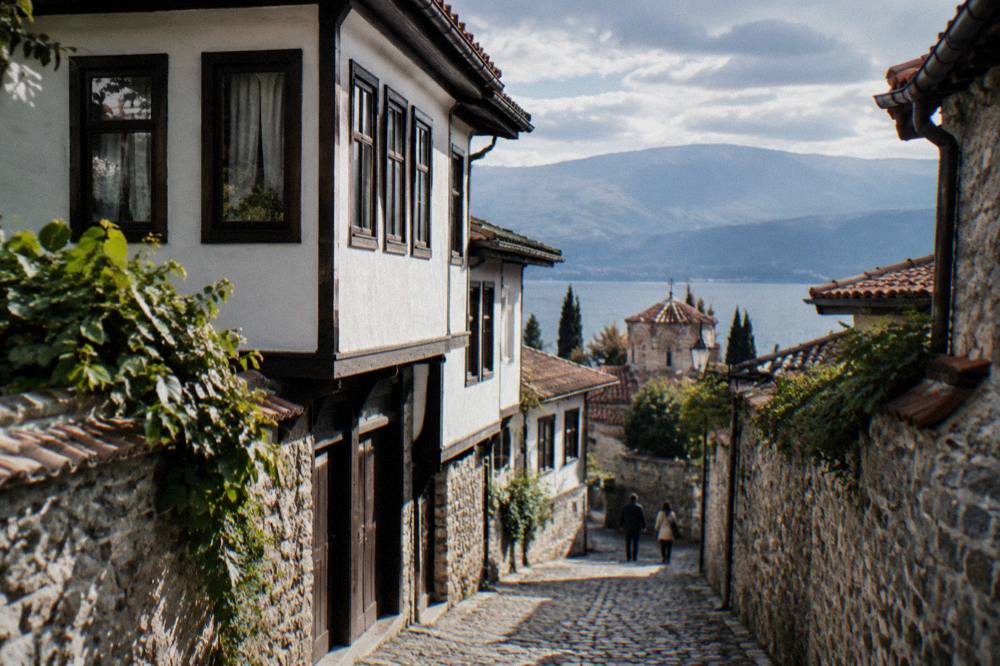
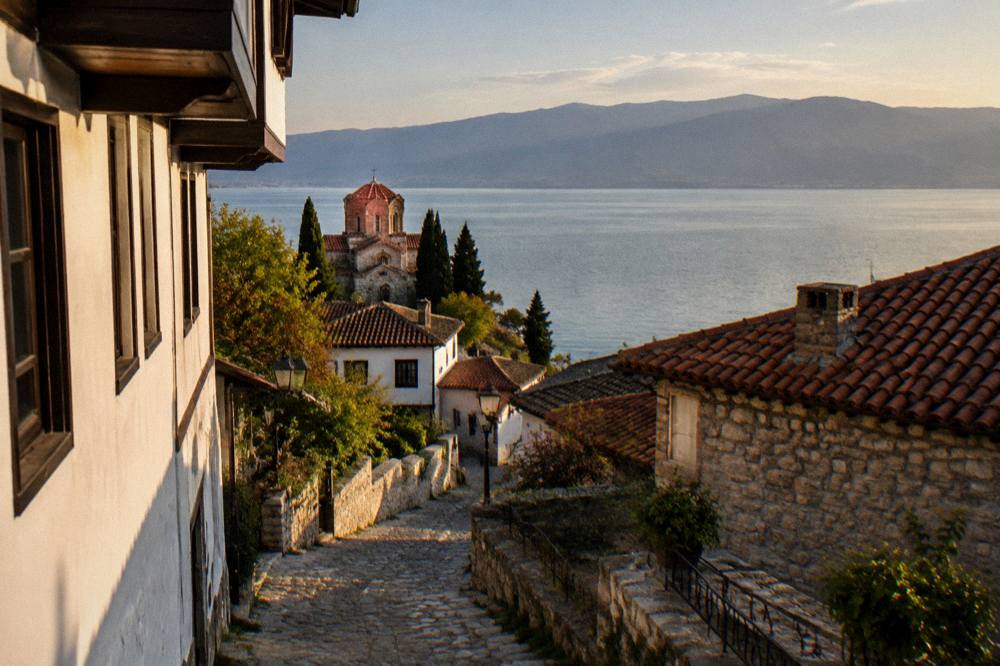
Before the questions, one last comparison table gathers the three ways of covering the lake that this page has weighed, priced where the figures exist and marked where they do not.
| Way around the lake | What it covers | local cost anchors | Main constraint |
|---|---|---|---|
| Full lake loop with Albania | Both shores, crossing at Sveti Naum/Tushemisht or Qafe Thane | Galicica vehicle fee 250 MKD if crossing the park | Border wait, two-country entry rules, no rental cross-border terms published |
| Guided around-the-lake excursion | The Albanian shore by vehicle from Ohrid | Price renders from the operator's live listing | Fixed group schedule, no riding |
Common Questions About Cycling Around Lake Ohrid
Is there a bike path around Lake Ohrid?
No bike path, bike lane or bike-share scheme exists around Lake Ohrid or in Ohrid itself. The ride from Ohrid towards Struga, Peshtani, Trpejca and St Naum uses the ordinary shore road shared with cars and coaches, and the only bike-specific products on offer are bookable tours.
How long does it take to cycle around Lake Ohrid?
No published distance or riding-time figure for the loop appears in the sources for this page, so none is stated. The lake's shore can be covered in one long day by a fit rider as part of a guided excursion by vehicle; an independent cyclist should plan by named waypoints, Ohrid, Struga or the eastern villages, St Naum, the border, and the Albanian shore, rather than by a published kilometre count.
Can you rent bikes in Ohrid?
Bike rental operates as a seasonal shop-based trade in the summer months, but no price list or operator details can be confirmed. Ask any rental desk about helmets, locks, repair kits and, for a full loop, whether the bike may cross the border into Albania.
Can you cycle from Ohrid to St Naum?
The eastern-shore road links Ohrid with the villages of Lagadin, Peshtani, Trpejca and Ljubanista and ends at St Naum, which sits about 4 km from the Tushemisht border crossing. The monastery entrance is quoted at 150 MKD per person by a cruise operator, and the springs rowboat at about 5 EUR.
Do you need a helmet to cycle in Ohrid?
No helmet rule specific to Ohrid appears in the sources for this page, but the town lacks bike infrastructure, so a helmet, lights and daylight riding are the practical standard on a road shared with summer traffic. Vehicle headlights are required day and night in North Macedonia, which signals the conditions a road cyclist shares.
When is the best month for cycling around Lake Ohrid?
The modelled ERA5 normals for 1991 to 2020 give May a mean daily high of 19.5 C, June 24.2 C, September 22.4 C and August 27.6 C, with June carrying 43.1 mm of rain and August 32.9 mm. May, June and September combine workable temperatures with less peak-season traffic than August, and the Galicica park road can be closed by snow typically between January and March.