Ohrid History: From Lychnidos To The Cyrillic School
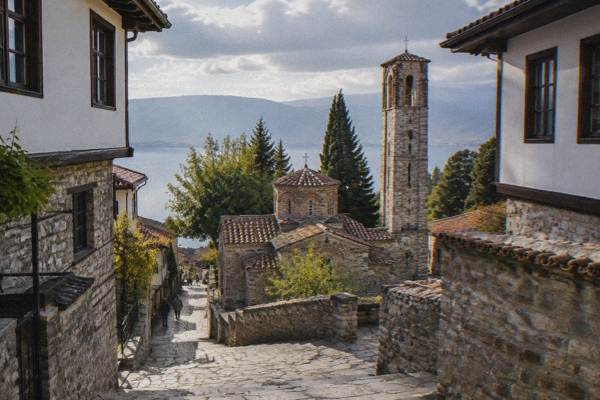
Ohrid was Lychnidos in antiquity, holds a late Hellenistic theatre cut into its hillside, carries the walls of Samuel's Fortress above the lanes, and gave the Slav world a literary school at Plaosnik. This page reads those layers in order.
Short answer
Ohrid's history runs from the ancient town of Lychnidos and its hillside theatre, through Samuel's Fortress and the Cyrillic school at Plaosnik, to the Ottoman-era old town and UNESCO listing in 1979 and 1980, and most of it can be walked in a single day.
The layers under Ohrid are unusually readable for a town of about fifty-one thousand people. The lake shore, sitting at about 693 m above sea level, has carried a settlement for a very long time: the lake itself has existed for about two to three million years, according to UNESCO's own listing text. Above the shore stand the walls of Samuel's Fortress, and between the two lie a theatre from late antiquity, churches with frescoes and icons from the eleventh to the fourteenth century, and an old town shaped by Ottoman-era building. That sequence unfolds in order, and each chapter survives in stone today.
What Was Lychnidos, The Ancient Town Under Ohrid?
Lychnidos was the ancient settlement on the same lake shore where Ohrid now stands, and its name appears in written records from antiquity onward before the Slav name Ohrid eventually replaced it in the sources for this area. The Roman world knew the lake and its towns, later Byzantine sources carried the old name forward, and excavated remains around the modern town keep confirming how deep the settlement layers go.
The practical starting point for the ancient chapter is the town's theatre, described below, and the archaeological collections of the national museum, which hold material recovered from digs around the town. The museum institute's own pages give the ticket prices: 120 denars for domestic visitors, 150 denars for foreign visitors, with a children's and students' rate reported at 60 denars. The museum's office hours are Monday to Friday, 07:30 to 15:30, at Boro Shain St 10. A full orientation to the modern town sits in the things to do in Ohrid overview, which places each period's sights on one map.
What Does The Ancient Theatre Of Ohrid Tell You?
The Ancient Theatre of Ohrid was built at the end of the third or the start of the second century BC, in the period the museum's own page calls late Hellenism, and its first excavations took place in 1935, with its capacity rising to about 5,000 after the epiteatron, an added seating tier, was built. Those three facts, all from the museum institute's page for the site, are the spine of the ancient story. The theatre's position on the slope below the fortress means it was cut into the same hillside that every later generation built on, and the stone rows now visible are the oldest built structure in the town that a visitor can stand inside. The detailed Ancient Theatre of Ohrid guide covers the site's layout and how to reach it.
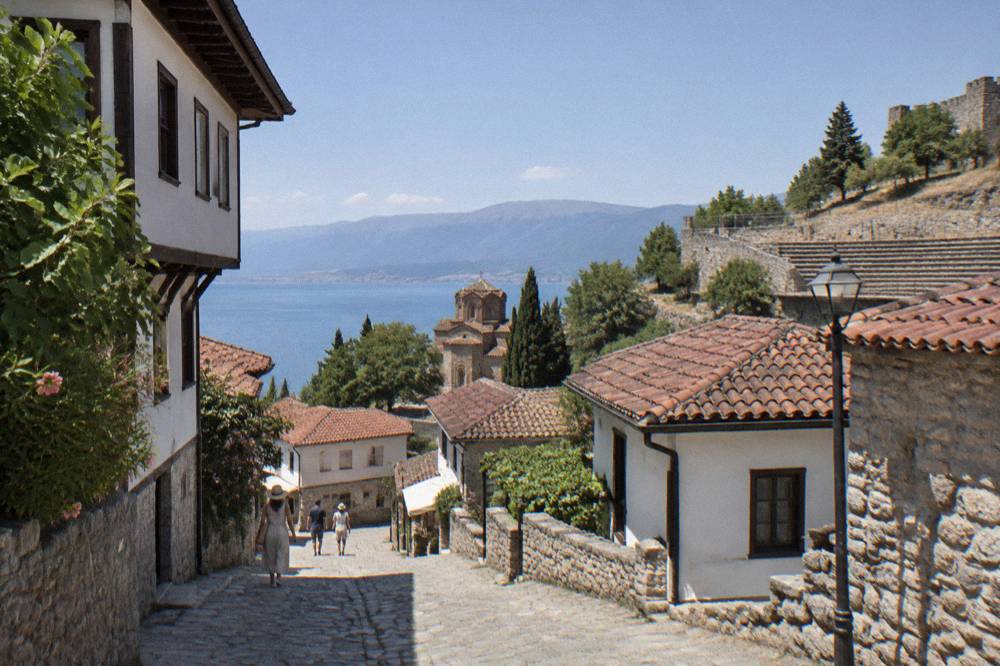
The theatre's afterlife is part of the story too. It now serves as a performance venue, and the Ohrid Summer Festival uses it: the 66th edition opened on 12 July 2026 with a gala at the Ancient Theatre, featuring Ermonela Jaho and Charles Castronovo, and the festival closed by tradition on 20 August. Sitting in a Hellenistic-era cavea listening to opera is one of the more compressed experiences of Ohrid's timescales, and it happens every summer. Tickets and programming are on the festival's own channels each year. Everything else covered here is indexed on Ohrid Travel Guide.
Where Does Samuel's Fortress Fit In Ohrid's Story?
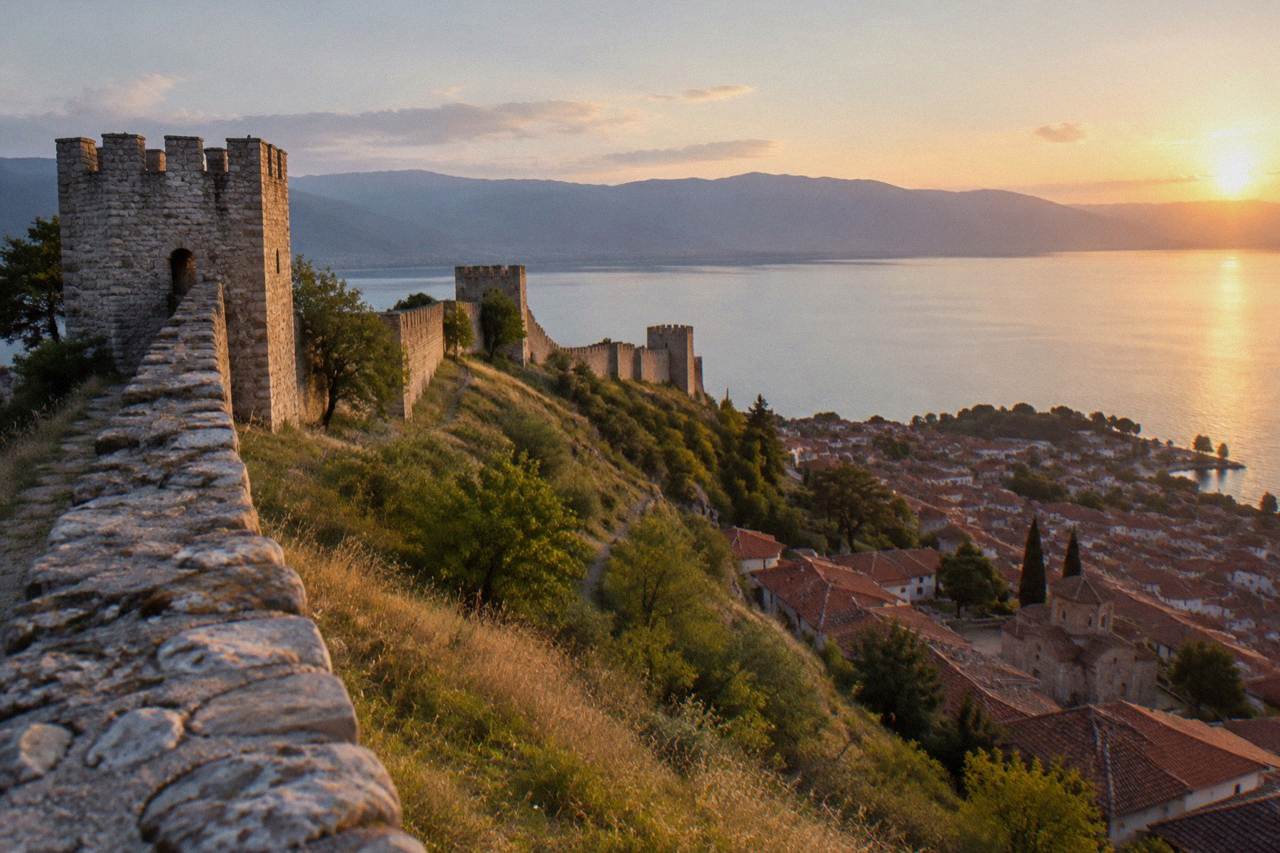
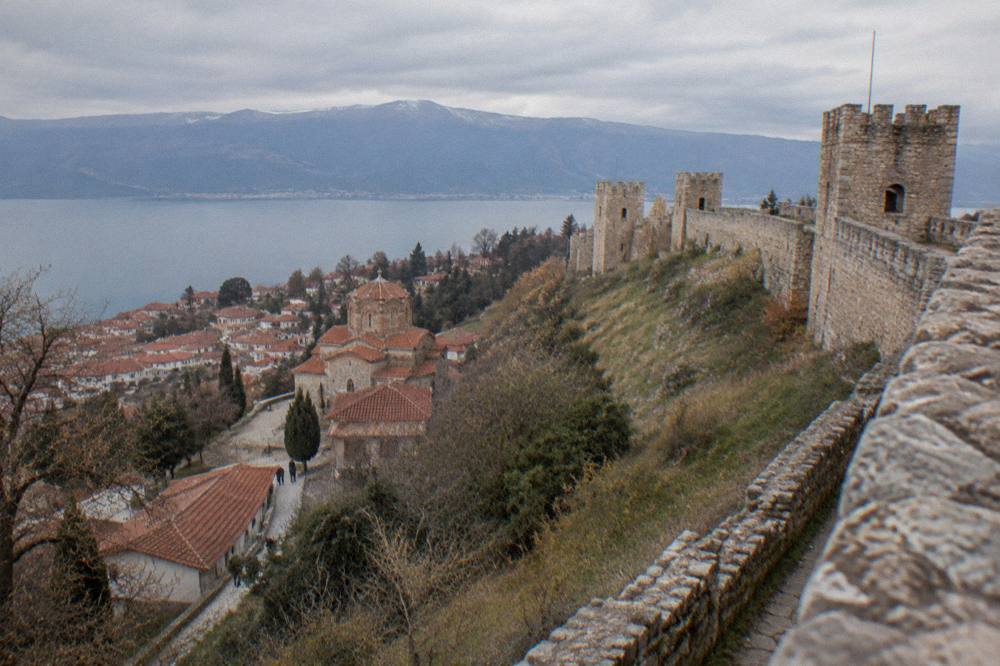
Samuel's Fortress is the medieval chapter made visible: its walls crown the hill above the old town and define its upper boundary, and the town's identity as a fortified medieval centre rests on them, while the site's own story continues into the present with a municipal revitalisation plan, budgeted at over 11 million denars, that adds a summer stage and illumination. The fortress walls are the single most dominant structure in Ohrid, and the walk around their circuit gives the classic view over the lake and the rooftops. The fortress stands at the top of the climb from the old town, and the lanes below it run down to the shore on foot, which is how the town has always been moved through.
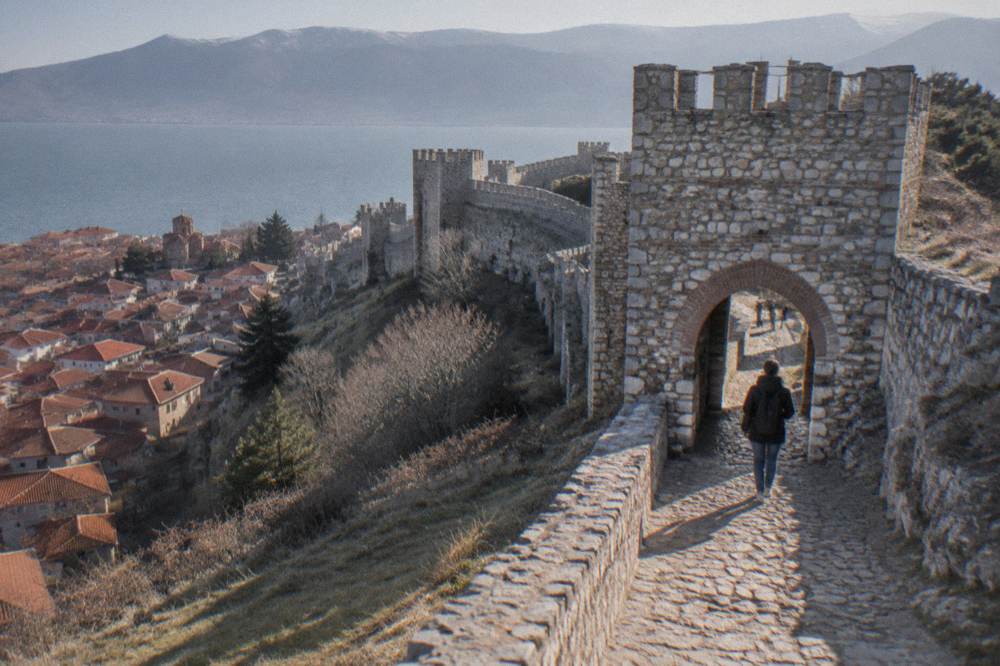
The Upper Gate area belongs to the same fortified ensemble, and the old town below spreads between the fortress and the lake in the pattern that the UNESCO listing protects. Practical details for the walls, the approach climb and what the site covers today are collected in the Samuel's Fortress guide. For travellers planning the walk, the old town guide explains the lane structure between the fortress and the shore, and the Ohrid in one day itinerary sequences the fortress as the first stop of the day.
Why Is Plaosnik Tied To The Cyrillic School?
Plaosnik, the plateau just below the fortress, is where UNESCO's listing places the monastery of St Panteleimon, which it describes as the oldest Slav monastery, and the site is inseparable from the story of the Ohrid literary school, the centre that produced and transmitted Slavonic religious literature and a tradition of icons, more than 800 of them, from the eleventh to the end of the fourteenth century. Those two facts come from the UNESCO listing text itself, and they are the reason Plaosnik carries the weight it does in the region's cultural history. The rebuilt church standing today sits over excavated early basilica floors with mosaic fragments, and the site functions as both an archaeological park and an active place of pilgrimage.
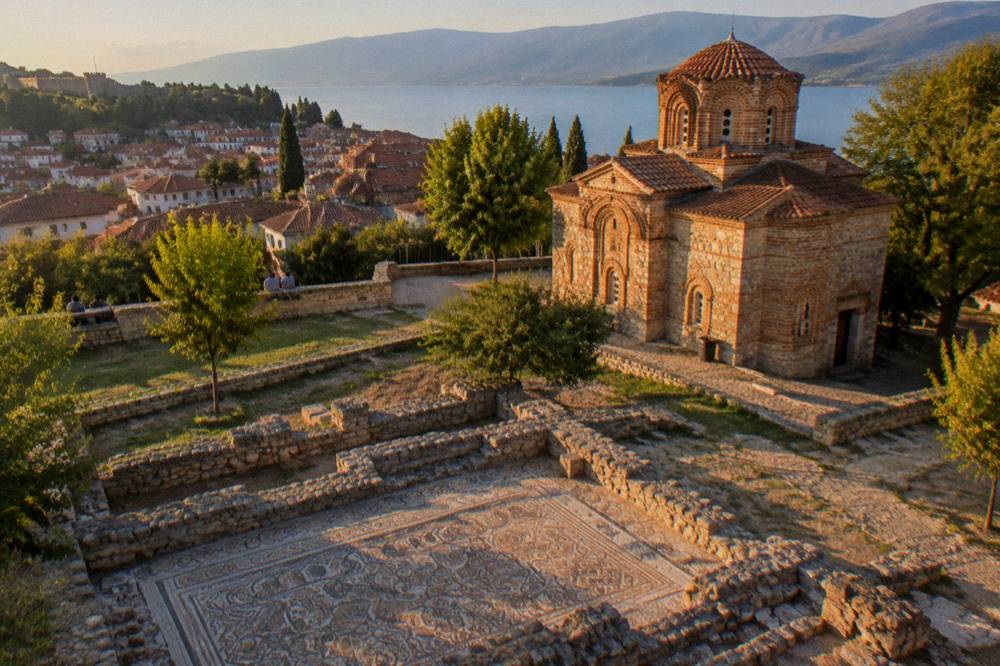
The literary school's reach is what gives Ohrid its place in alphabet history. The Slavonic script tradition associated with Cyril and Methodius and their disciples found in Ohrid a centre that trained clergy and produced translations, and the modern Cyrillic alphabet descends from that script tradition. UNESCO's listing frames it through the monastery and the icon collection: over 800 Byzantine-style icons spanning the eleventh to the fourteenth century, held in the town's churches and galleries, with the Icon Gallery at the Perivleptos complex showing a large share of them. The Plaosnik guide and the Icon Gallery guide cover both sites in detail.
The second name tied to the school is St Naum, whose monastery stands at the southern end of the lake near the springs that feed the Crn Drim. The St Naum site remains a working monastery and a pilgrimage destination, and a cruise operator's listing gives its entrance as 150 MKD per person, with a rowboat ride through the springs at about 5 EUR. The St Naum Monastery guide covers the trip south.
What Survives From Ottoman Ohrid And The Old Bazaar?
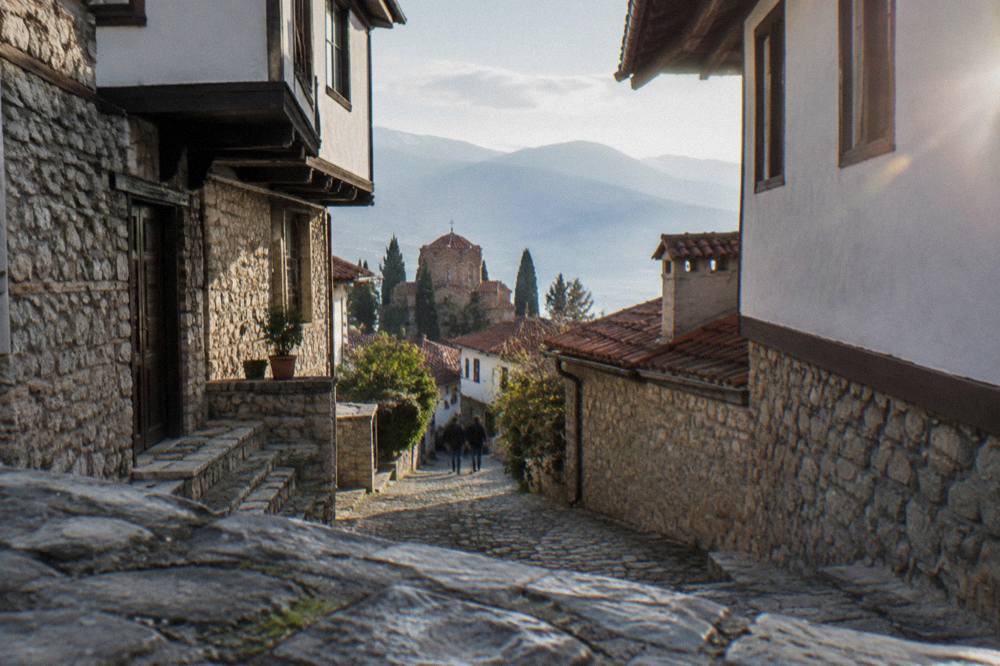
The old town's street pattern and many of its standing houses belong to the Ottoman centuries, and the most complete single building from that era open to visitors is the Robev Family House on Tsar Samoil St 62, now the national museum's main building, open winter 09:00 to 15:30 and summer in two shifts, 09:00 to 15:30 and 13:30 to 20:00, and closed on Mondays. Those hours come from the museum institute's own page for the house. The Robev house is a merchant mansion, and its survival is the reason the museum can display the town's archaeological and historical collections in a period building rather than a modern one. Tickets follow the institute's standard rates: 120 denars domestic, 150 denars foreign, with the children's and students' rate reported at 60 denars.
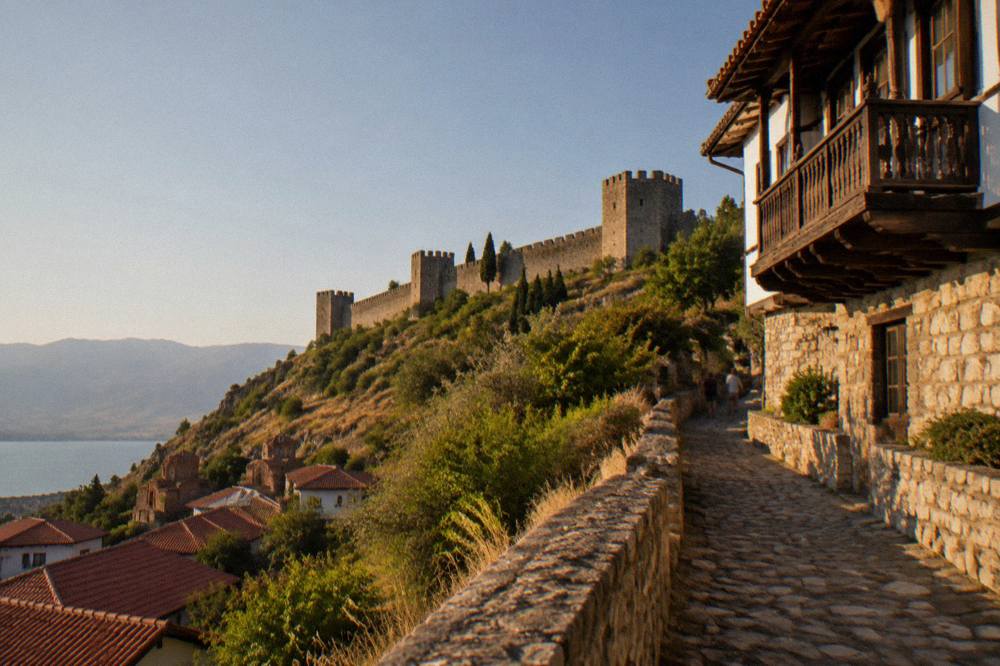
The Old Bazaar street, running through the lower old town, is the commercial survivor of the same era, and the Old Bazaar guide covers what it holds today, from workshops to food shops. Between the bazaar and the shore, the old town's lanes climb steeply, and the whole district is on foot. Two more chapters of the region's story sit within easy reach: Struga, at the lake's outflow, home of the Struga Poetry Evenings, whose 65th edition ran from 24 to 29 June 2026 with about 70 poets, and Vevcani, whose carnival traditionally falls on 13 and 14 January by the Julian calendar. Both are covered in the Struga town guide and the Vevcani guide.
Why Is Ohrid A UNESCO World Heritage Site?
The Natural and Cultural Heritage of the Ohrid Region was inscribed by UNESCO as a mixed property, natural in 1979 and cultural in 1980, and the property was extended to include the Albanian part of the lake in 2019, covering about 94,729 hectares in total, which protects the monuments, the townscape and the lake ecosystem as one unit. Those dates and figures come from UNESCO's own listing. The mixed status matters: the lake is protected for its nature, including over 200 endemic species, 17 of them endemic fish, and the town is protected for its culture, and the two protections cannot be separated, because the townscape faces the water and the water frames the townscape.
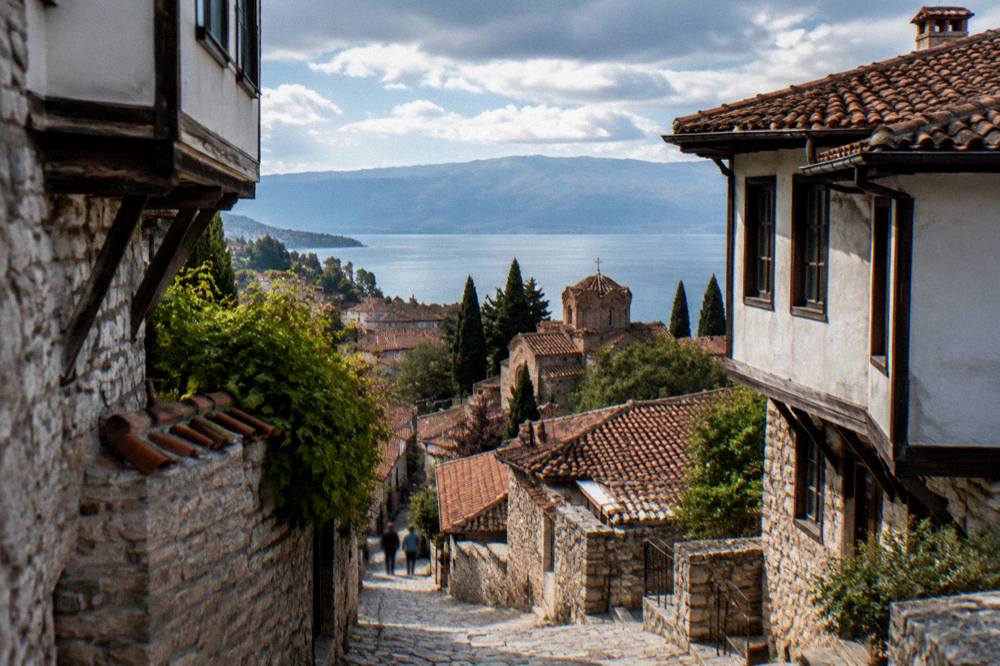
The lake's own history is measured in millions of years, about two to three million of them by UNESCO's text, which makes the human chapters on its shore recent additions. For the full picture of the lake's ecology and shoreline, see the Lake Ohrid guide, and for the heritage machinery behind the listing, the Ohrid UNESCO World Heritage guide. In July 2026 the World Heritage Committee, at its 48th session in Busan, decided not to place the property on the List of World Heritage in Danger, with 16 of 21 members supporting that outcome, and asked for a joint report by 1 February 2029.
Which Museums Hold Ohrid's Artefacts?
The NI Institute and Museum Ohrid runs the town's main museum sites, with tickets at 120 denars for domestic visitors, 150 denars for foreign visitors and a reported 60-denar rate for children and students, and its listed sites, including the Robev Family House, the Museum on Water at the Bay of Bones and the Icon Gallery, all close on Mondays and run a winter schedule from 1 October to 30 April and a summer schedule from 1 May to 30 September. The schedule split is a practical fact that goes unnoticed: a spring or autumn trip sits on the boundary between the two schedules, and the hours shift accordingly. The table below gathers what the institute's own pages publish for each site.
| Museum site | Winter hours (1 Oct to 30 Apr) | Summer hours (from 1 May) | Closed |
|---|---|---|---|
| Robev Family House, Tsar Samoil St 62 | 09:00 to 15:30 | Two shifts, 09:00 to 15:30 and 13:30 to 20:00 | Monday |
| Museum on Water (Bay of Bones), Gradishte, Peshtani | 09:00 to 15:30 | 09:00 to 16:30 | Monday |
| Icon Gallery, Klimentov Univerzitet St bb (Perivleptos complex) | 09:00 to 14:00 | 09:00 to 17:00 | Monday |
The Bay of Bones, the Museum on Water at Gradishte near Peshtani, is the museum's prehistoric chapter: a reconstructed pile-dwelling settlement on the lake, reached by road or by boat, and covered in the Bay of Bones guide. A cruise operator's listing gives its entrance as 150 MKD per person. The Icon Gallery's collection overlaps with the UNESCO icon story told above, and the national museum page collects the institute's sites in one place.
How Does The Lake Shape Ohrid's Yearly Rhythm?
Lake Ohrid sits at about 693 m above sea level, and the hydrometeorological service's October multi-year mean for the gauge is 693.31 m with the agreed minimum at 693.10 m, while the modelled monthly surface temperatures run from about 4.6 C in January to about 23.5 C in August, with the swimming season counted from July. Those figures, from the UHMR daily bulletin's multi-year data and modelled aggregator values, frame the year: a cold lake in winter, a warm one in high summer, and a town whose festival calendar and boat season follow the water. The ERA5 reanalysis normals for the town, 1991 to 2020, tell the same story from the air side.
| Month | Mean daily high (C) | Mean daily low (C) | Rain (mm) | Modelled lake surface (C) |
|---|---|---|---|---|
| January | 5.0 | -0.8 | 76.5 | 4.6 |
| February | 6.3 | 0.0 | 74.3 | 5.4 |
| March | 10.0 | 2.5 | 80.5 | 7.2 |
| April | 14.6 | 6.3 | 82.4 | 10.5 |
| May | 19.5 | 10.8 | 70.8 | 14.9 to 18.7 |
| June | 24.2 | 15.2 | 43.1 | 19.4 to 22.5 |
| July | 27.1 | 18.3 | 34.7 | 22.9 |
| August | 27.6 | 19.0 | 32.9 | 23.5 |
| September | 22.4 | 14.9 | 62.4 | 19.7 |
| October | 17.4 | 10.3 | 76.0 | 14.7 |
| November | 11.5 | 5.3 | 90.4 | 10.3 |
| December | 6.2 | 0.9 | 92.6 | 6.0 |
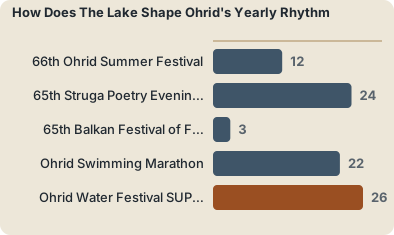
The climate figures are modelled ERA5 reanalysis values for the 1991 to 2020 period, not a weather-station record, and the lake temperatures are modelled aggregator values. Rain totals for the year sum to 816.6 mm. The seasonal rhythm matters for history travellers because the festival calendar sits on top of it: the events table below gathers the dated 2026 editions of the town's main festivals.
| Event | 2026 dates | Notes from the reports |
|---|---|---|
| 66th Ohrid Summer Festival | 12 July to 20 August | Opening gala at the Ancient Theatre, with Ermonela Jaho and Charles Castronovo |
| 65th Struga Poetry Evenings | 24 to 29 June | Theme 'Where Poetry Lives', about 70 poets |
| 65th Balkan Festival of Folk Songs and Dances | 3 to 6 July | Grigor Prlichev cultural centre, closed by Croatia's Lado ensemble |
| Ohrid Swimming Marathon | 22 August | 25 km Klime Savin route from St Naum to Ohrid harbour, 16 swimmers, prize fund USD 15,000 |
| Ohrid Water Festival SUP marathon | 26 August | 33 km stand-up paddle route around the lake |
The swimming marathon's distance is worth flagging because it is often misquoted: the St Naum to Ohrid harbour swim is 25 km, and the 33 km figure belongs to the separate SUP marathon around the lake. Season-by-season planning context, including the boat season to St Naum, which runs about May to October, sits in the best time to visit Ohrid guide and the swimming in Lake Ohrid guide.
How To Read Ohrid's Layers In One Day?
The sequence reads best from the top down: start at Samuel's Fortress for the medieval walls and the view, walk down through Plaosnik for the Cyrillic school and the basilica floors, pass the Ancient Theatre for the late Hellenistic chapter, then finish at St John at Kaneo and the lakefront, with the Robev House museum squeezed in between. That single walk covers every major period except St Naum at the southern end of the lake and the Bay of Bones, which each need a separate half-day. The Ohrid in one day itinerary gives the full sequence with timings, and longer versions sit in the two days and three days itineraries.
Want that same story told aloud as you wander? Book a self-guided audio walk here.
A private guided version of the same walk is the Full-Day Private Best of Ohrid and Lake Ohrid Tour, which covers the town and the shore in one moving narrative: Check availability on the operator's live listing. Practical planning pieces that pair well with this page are the how many days in Ohrid guide, the Ohrid weather guide and the Ohrid cost and budget guide. For the region's wider context, the North Macedonia travel guide frames Ohrid against Skopje, Bitola and the national parks.
Common Questions About Ohrid's History
How old is Ohrid?
The lake has existed for about two to three million years according to UNESCO, and the town's theatre was built at the end of the third or the start of the second century BC, so the settlement on this shore goes back well over two thousand years.
When was the Ancient Theatre of Ohrid built?
The museum institute's page dates it to the end of the third or the start of the second century BC, the period it calls late Hellenism, with first excavations in 1935 and a capacity that rose to about 5,000 after the epiteatron was added.
Why is Ohrid linked to the Cyrillic alphabet?
UNESCO's listing places the monastery of St Panteleimon at Plaosnik and describes it as the oldest Slav monastery, and the Ohrid literary school centred there produced Slavonic literature and more than 800 icons from the eleventh to the end of the fourteenth century.
When did Ohrid become a UNESCO World Heritage Site?
The property was inscribed in two steps, natural in 1979 and cultural in 1980, and it was extended to include the Albanian part of the lake in 2019, covering about 94,729 hectares.
On 24 July 2026 the World Heritage Committee decided not to inscribe it on the List of World Heritage in Danger, with 16 of 21 members supporting that outcome, and asked for a joint report by 1 February 2029.