Free Things To Do In Ohrid
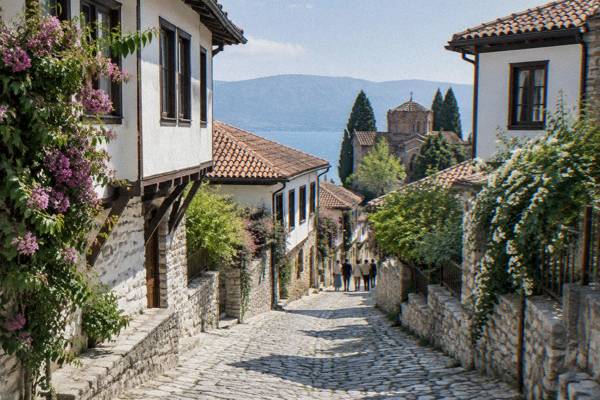
Ohrid rewards a zero-denar day better than almost any lake town in the Balkans: the lakefront is public, the Old Town lanes cost nothing, and a free walk covers the headline sights.
Short answer
The lakefront promenade, the Old Town streets, the Ancient Theatre area and the free tip-based walking walks are the core of a free day in Ohrid; paid entry at museum-institute sites is 150 MKD for foreign visitors.
Ohrid sits on Lake Ohrid, a freshwater mountain lake at about 693 m above sea level in North Macedonia, inside the UNESCO mixed site "Natural and Cultural Heritage of the Ohrid Region", inscribed in 1979 and 1980. The good news for a tight budget is structural: the lakefront and the Old Town streets are public, so the two things the town is known for, the water and the lanes climbing to the fortress, cost exactly nothing. This Ohrid Travel Guide page lays out a full day built on that, with every paid ticket, bus fare and event date taken from published figures, so the free plan and the few paid extras stay honest. For a broader sweep of the town's paid and free sights together, see things to do in Ohrid.
What Can You See In Ohrid Without Paying?
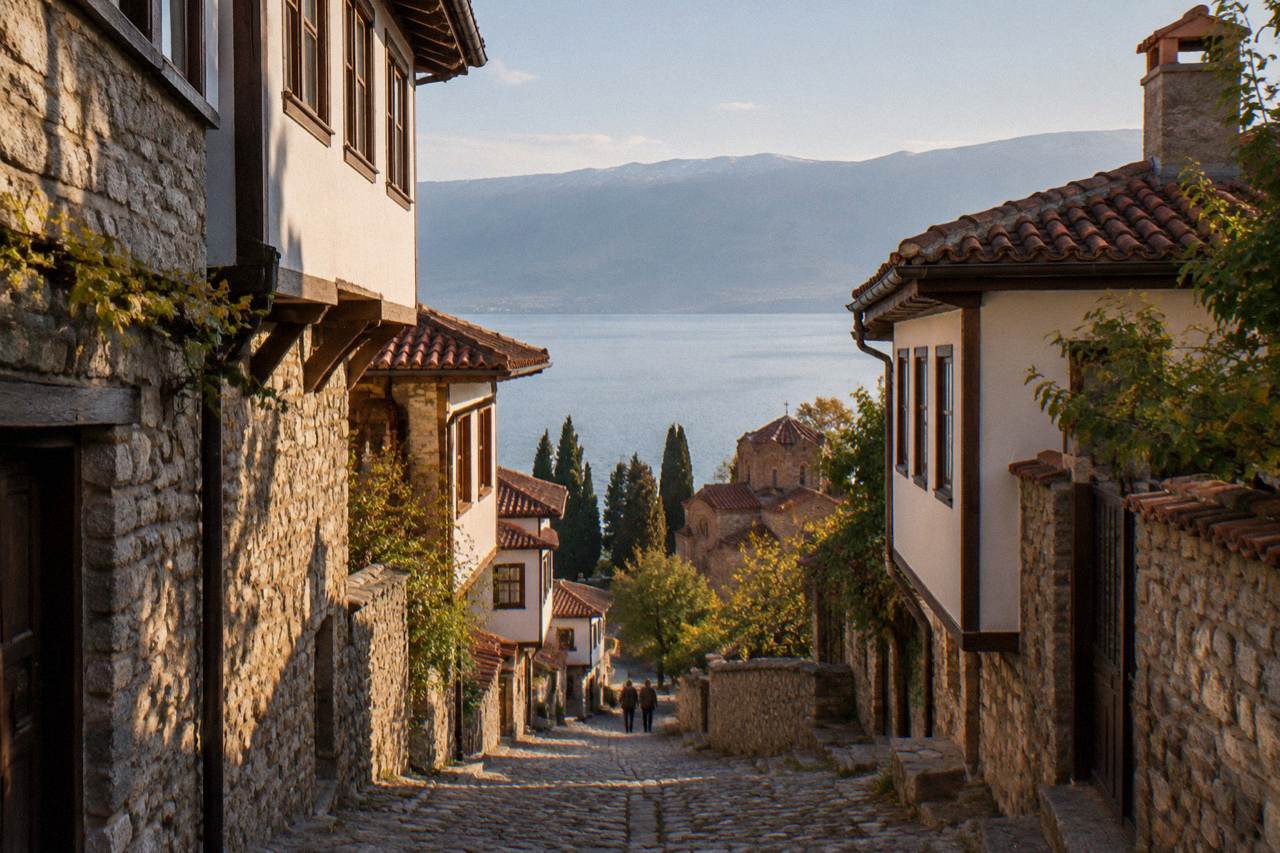
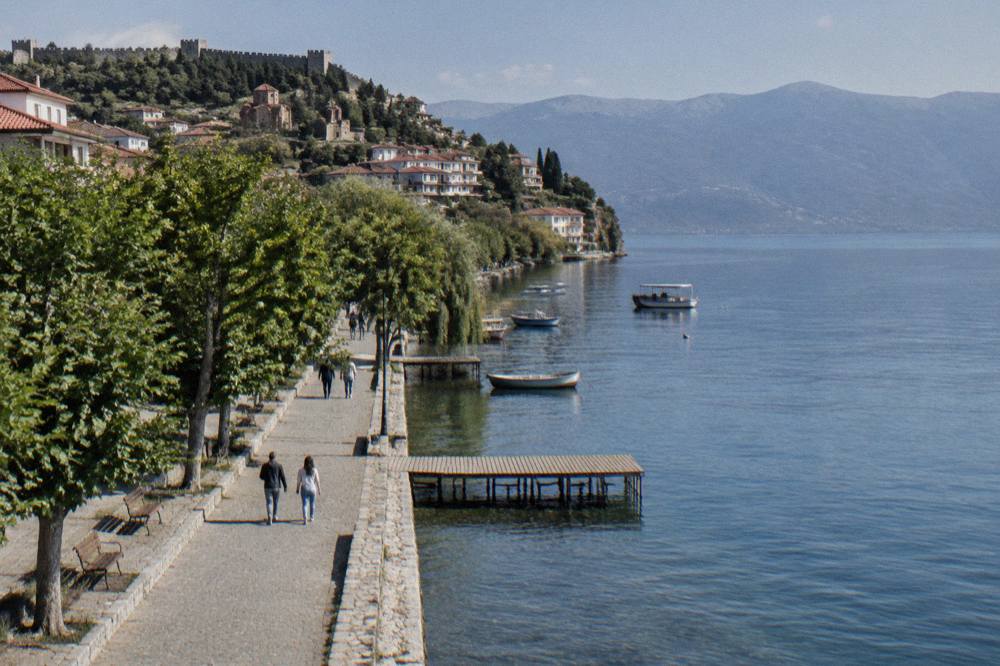
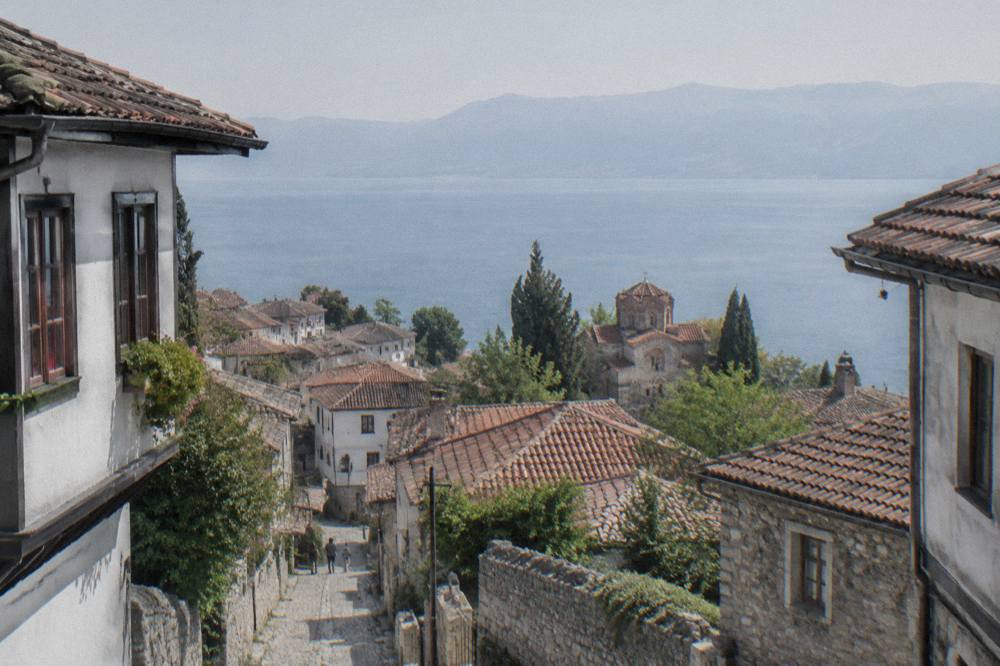
The lakefront promenade, the Old Town lanes, the port area and the public streets around the fortress walls are all free to walk, and they carry the core of Ohrid's UNESCO-listed townscape, so a visitor can spend a full day in the old core without buying a single ticket. The lake itself sits at about 693 m above sea level, and the old town climbs from the shore toward Samuel's Fortress, with the lanes closed to through traffic and everything reachable on foot. The UNESCO listing covers a mixed natural and cultural property of roughly 94,729 hectares, and its description credits Ohrid with the oldest Slav monastery, St Panteleimon, and more than 800 Byzantine-style icons from the 11th to the end of the 14th century, heritage you walk through rather than pay for on the public streets.
The distinction that matters on a free day is between the public realm and the ticketed interiors. The boardwalk along the water, the squares of the upper town and the viewpoints from the streets above the lake are all public space. The church interiors, the fortress and the museum buildings behind doors are where the ticket system starts. The National Institute and Museum Ohrid sells entry to its sites, Robev Family House, the Museum on Water at the Bay of Bones and the Icon Gallery among them, at 150 den for foreign visitors and 120 den for domestic visitors, with a reported child and student rate of 60 den.
A free day works because the paid layer is thin and optional. The Ancient Theatre, a late Hellenistic structure first excavated in 1935, whose capacity rose to 5,000 after the epiteatron was added, sits in the urban fabric of the old town, and the streets around it are public. The theatre's own access arrangements are event-dependent, since it is a venue of the Ohrid Summer Festival, but the approach to it from the old lanes costs nothing. Anyone wanting the fuller picture, paid interiors included, can extend the plan with one day in Ohrid.
Is The Ohrid Old Town Free To Walk End To End?
Yes, walking the Ohrid Old Town end to end is free. Nothing on the route itself is ticketed: the Old Bazaar, the squares and the streets around St John at Kaneo are public, and only the church interiors and the museum buildings carry entry fees. A free route from the port up through the Plaosnik plateau and down to the lake fills most of a day, and every metre of it is free.
Nothing on the route itself is ticketed: the Old Bazaar, the squares and the streets around St John at Kaneo are public, and only the church interiors and the museum buildings carry entry fees.
Two practical notes shape the walk. First, the summer 2026 resident-only parking regime on Ilindenska, Kosta Abrash and Car Samoil makes driving into the old core a poor idea even for visitors who have a car; the lanes are for people on foot, and the plan below assumes that. Second, the paid interiors are optional pauses rather than the point: the exteriors of St Sophia, Plaosnik and the Perivleptos complex, and the whole of the fortress approach, are seen from public ground. A visitor who wants the interiors too can compare the paid layer in detail on the Plaosnik and Samuel's Fortress pages.
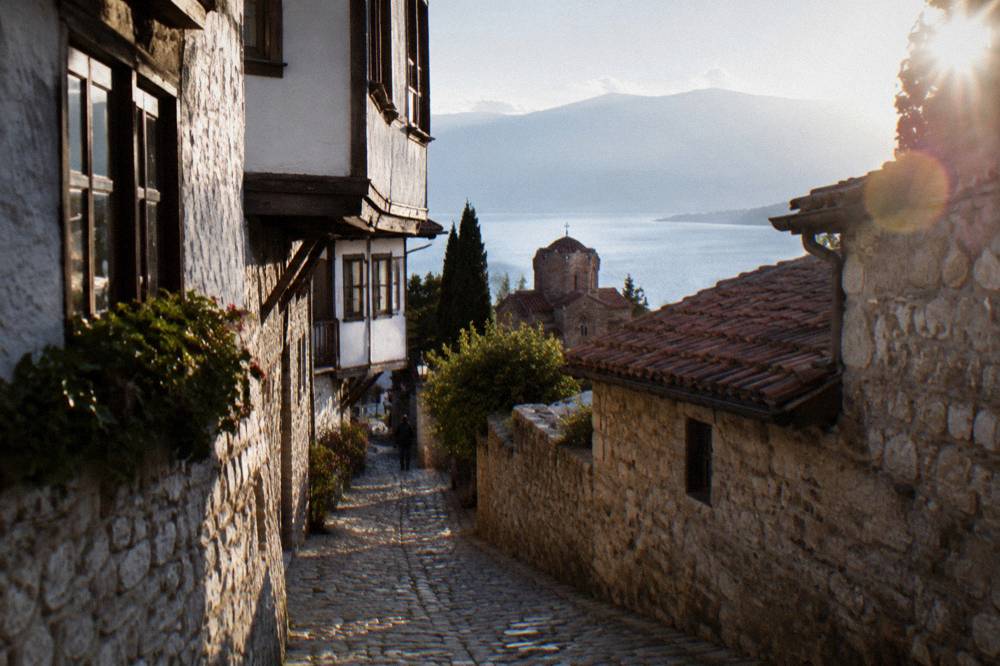
A sensible free route runs roughly like this: start at the port, walk the boardwalk east, climb through the Old Bazaar toward the Upper Gate, follow the walls above the town, descend past the Ancient Theatre and the Plaosnik plateau, and finish down at the lake. Done slowly with the views, it fills most of a day, and every metre of it is free. For a two-day version that adds ticketed interiors, see two days in Ohrid.
If a guided version of that route appeals, book an Old Town walking tour here.
Are There Free Walking Tours In Ohrid?
Three free walks run in Ohrid, offered on the GuruWalk platform, free to join with a pay-what-you-want tip at the end, and they are the cheapest structured introduction to the old town that exists, since the operator charges nothing up front and the walker decides the tip when the walk ends. One of them, Explore Ohrid, North Macedonia: A Journey Through Historical Treasures and Cultural Wonders, has its own listing on this site at the free history walk page, where the listing carries its rating and current details. The platform, GuruWalk, is where these walks are booked; the model is simple, join for free, tip what you want at the end. No meeting point, guide or price is guessed here, because the listing prints what matters.
The free walks fit a zero-budget day perfectly because they overlap with the free public realm: the old town lanes, the squares and the lakefront are the same streets a walker would explore alone, but with a guide narrating them. Anyone arriving from Tirana or Durres on a day trip has a different option, the Check availability link goes to the operator's live listing for a guided day tour of Ohrid and St Naum that starts in Tirana, not in Ohrid, and covers the monastery and the old town in one organized day. That product is a paid alternative, but it is the one this site features for travellers whose Ohrid visit is a side trip from Albania.
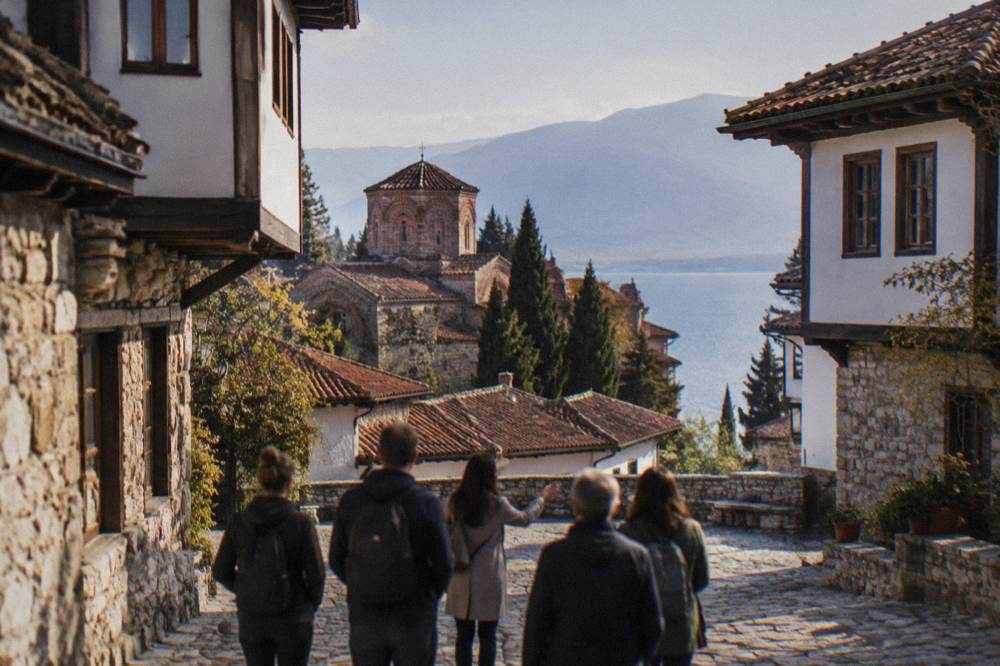
For visitors already sleeping in Ohrid, the free walk plus the public lanes is the whole plan. The paid walking products, including the small-group old town walk, add fixed-group walks with printed prices, but the free tier is real and runs in the same streets.
What Does A Day On The Ohrid Lakefront Cost?
Nothing for the walking and the swimming spots: the lakefront and the Old Town streets are public, and the modelled lake surface temperature runs from about 4.6 C in January to about 23.5 C in August, with the swimming season running from July, so the water itself is the free attraction and the shore path is a public promenade. The modelled monthly lake surface figures, aggregator estimates rather than station readings, show July at about 22.9 C, August at about 23.5 C and October at about 14.7 C, and the UHMR multi-year October mean is 14.3 C. The 2026 bathing tests found Class I physico-chemical quality at the monitored points except Grashnica beach, which was Class III, with most microbiological samples rated excellent.
The paid add-ons on the water are boats. A full-day cruise from Ohrid port to St Naum with the operator Boat Armada runs 7 hours and is priced from 1,200 den for an adult and 600 den for a child, with the Bay of Bones entrance of 150 MKD listed by the cruise operator as not included. St Naum monastery itself charges an entrance of 150 MKD, and the rowboat through the Crn Drim springs is about 5 EUR. Those are the figures the operators publish; a free day simply stays on the shore.
| Month | Modelled lake surface temp (C) | Notes |
|---|---|---|
| Jan | about 4.6 | modelled aggregator value |
| Mar | about 7.2 | modelled aggregator value |
| May | about 14.9 to 18.7 | sources differ by dataset |
| Jul | about 22.9 | swimming season under way |
| Aug | about 23.5 | modelled aggregator value |
| Oct | about 14.7 | UHMR multi-year mean 14.3 C |
The lakefront also carries the free evening: the port, the boardwalk and the lower squares after dark are public space, and the Ohrid at night itinerary builds on exactly that. No ticket is needed for any of it.
Which Ohrid Sights Charge Entry, And Which Do Not?
The National Institute and Museum Ohrid charges 150 den for foreign visitors, 120 den for domestic visitors and a reported 60 den for children and students at its sites, which include Robev Family House, the Museum on Water at the Bay of Bones and the Icon Gallery, while the lakefront, the Old Town streets and the public squares around the churches cost nothing. The institute's office hours are Monday to Friday 07:30 to 15:30, and its sites run a winter schedule from 1 October to 30 April and a summer schedule from 1 May to 30 September, closing on Mondays at the sites where the published hours say so. The three headline churches, St John at Kaneo, St Sophia and Plaosnik, are reported at about 150 MKD each, a reported figure to confirm on the spot.
The per-site detail matters because the schedules differ, and moving one sight's hours onto another is the classic mistake here. Robev Family House runs 09:00 to 15:30 in winter and two summer shifts, 09:00 to 15:30 and 13:30 to 20:00, closed Monday. The Museum on Water at the Bay of Bones, out at Gradishte near Peshtani, runs 09:00 to 15:30 in winter and 09:00 to 16:30 in summer, closed Monday. The Icon Gallery at the Perivleptos complex runs 09:00 to 14:00 in winter and 09:00 to 17:00 in summer, closed Monday.
| Museum-institute site | Foreign | Domestic | Winter hours (1 Oct to 30 Apr) | Closed |
|---|---|---|---|---|
| Robev Family House | 150 den | 120 den | 09:00 to 15:30 | Monday |
| Museum on Water, Bay of Bones | 150 den | 120 den | 09:00 to 15:30 | Monday |
| Icon Gallery, Perivleptos | 150 den | 120 den | 09:00 to 14:00 | Monday |
| Children and students, all listed sites | 60 den (reported) | 60 den (reported) | as above | as above |
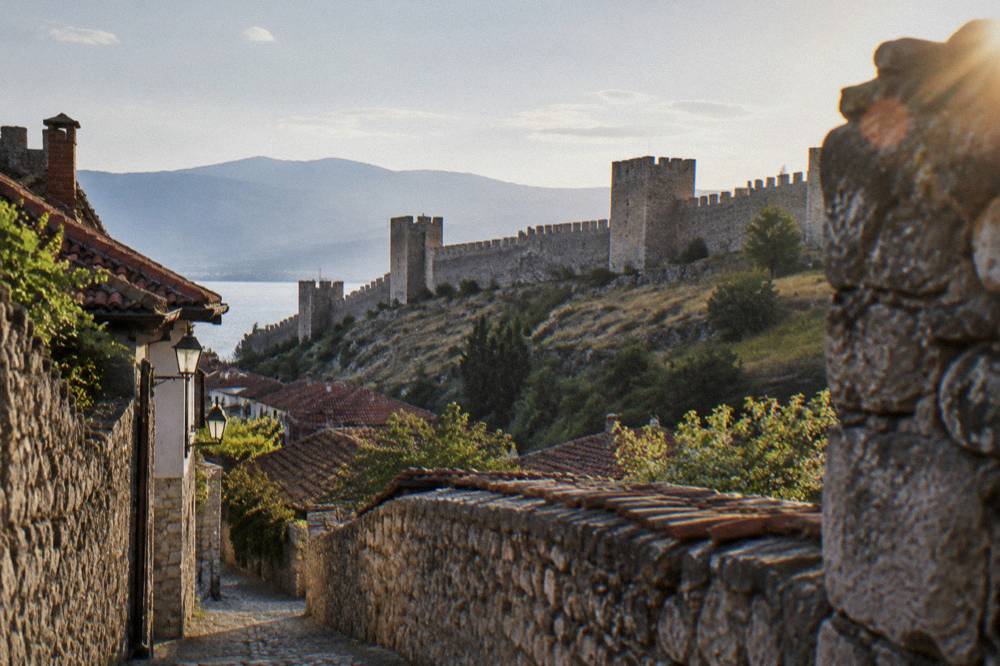
The fortress does have a municipal revitalisation plan, a summer stage and illumination budgeted at over 11 million denars, which signals investment without saying anything about access. The paid vs free split for the rest is simple: streets, shore and squares free; interiors and museum buildings ticketed at the institute's rates.
What Free Events Fill The Ohrid Calendar?
Free options include the Water Festival swimming marathon finish at Ohrid harbour, the 33 km SUP marathon watched from public shore, and the Struga Poetry Evenings public readings. Ohrid also hosts the Balkan Festival of Folk Songs and Dances and the Ohrid Summer Festival, whose opening at the Ancient Theatre can be watched from the surrounding public streets. Fixed dates add Orthodox Christmas on 7 January, Epiphany on 19 January, St Clement of Ohrid Day on 8 December, and the Vevcani Carnival on 13 to 14 January.
The Water Festival is the free-spectator highlight: the swimming marathon covers the 25 km Klime Savin route from St Naum to Ohrid harbour, 39th edition on Saturday 22 August 2026 with 16 swimmers and a USD 15,000 prize fund, and the finish at the harbour is watched from public ground. The 33 km SUP marathon around the lake on 26 August is a separate event. Earlier in the summer, the 65th Struga Poetry Evenings ran 24 to 29 June 2026 in nearby Struga with about 70 poets, a short and cheap bus ride away at 100 to 150 den per the older fare guides, to confirm locally.
| Event | 2026 dates | Free angle |
|---|---|---|
| 65th Struga Poetry Evenings | 24 to 29 June | public readings in Struga |
| 65th Balkan Festival of Folk Songs and Dances | 3 to 6 July | folk programme in Ohrid |
| 66th Ohrid Summer Festival | 12 July to 20 Aug | opening at the Ancient Theatre, streets around it public |
| Ohrid Swimming Marathon, 25 km | 22 August | finish at Ohrid harbour, public viewing |
| 33 km SUP marathon around the lake | 26 August | lakeside spectacle from public shore |
The fixed annual dates help too: Orthodox Christmas on 7 January, Epiphany with the cross thrown into the lake on 19 January, and St Clement of Ohrid Day on 8 December, all public-holiday rhythms that cost a spectator nothing. The Vevcani Carnival traditionally runs 13 to 14 January in the village above Struga.
Is A Free Day In Ohrid Also A Cheap Day?
Very nearly: the free layer is genuinely free, the local currency is the Macedonian denar with the euro quoted informally but not legal tender, and the few paid essentials on a day plan, a museum ticket at 150 den, a bus from Skopje at 850 to 950 den or a minibus from Tirana at about 15 to 20 EUR, sit in a band that makes Ohrid one of the cheaper UNESCO towns to move around. The National Bank middle rate on 19 October 2026 was 1 EUR to 61.6633 MKD, and the denar is reported as de facto pegged to the euro, so costs in denars are stable rather than volatile. Card acceptance, tipping norms and SIM prices have no sourced figure, so this page prints none.
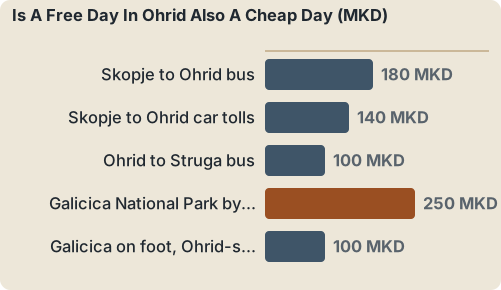
Transport in is where the savings live. Skopje to Ohrid is about 170 km by road, roughly 3 hours by bus at 850 to 950 den one way, with the car alternative about 2.5 hours plus about 140 MKD of motorway tolls and no passenger train to Ohrid at all. From Tirana, minibuses run roughly 5 to 7 a day, 3 to 3.5 hours including the border, about 15 to 20 EUR. The airport, OHD, is about 10 km from the centre via the E65, with an airport taxi reported at about 600 to 800 MKD or about 12 EUR.
| Journey | Figure | Basis |
|---|---|---|
| Skopje to Ohrid bus | 850 to 950 MKD, about 3 h | published fare range |
| Skopje to Ohrid car tolls | about 140 MKD | motorway plazas, no vignette |
| Tirana to Ohrid minibus | about 15 to 20 EUR, 3 to 3.5 h | about 5 to 7 daily |
| Ohrid to Struga bus | 100 to 150 MKD | older fare guides, confirm locally |
| Galicica National Park by car | 250 MKD per vehicle | no per-passenger fee |
| Galicica on foot, Ohrid-side gate | 100 MKD | pedestrian entry |
Galicica National Park, North Macedonia's second national park, proclaimed in 1958, spans 22,750 ha between Lake Ohrid and Lake Prespa with Magaro peak at 2,254 m, and its main road can close under snow, typically January to March. The park is open year-round and its official site runs a live camera page. A car pays 250 MKD per vehicle with no per-passenger fee; someone entering on foot from the Ohrid-side gate pays 100 MKD.
How Do You Fill A Free Day Hour By Hour?
A workable free schedule: morning on the boardwalk and port, late morning climbing the Old Bazaar lanes to the Upper Gate and fortress walls, midday in the free public streets around the Plaosnik plateau and the Ancient Theatre, afternoon along the shore east of the centre, and evening back at the harbour, with the only money spent being food and an optional museum ticket at 150 den. The whole circuit is on foot, the old town is compact, and the modelled climate normals, ERA5 reanalysis for 1991 to 2020, not a station record, give July a mean daily high of 27.1 C and January a mean daily low of minus 0.8 C, so the climbing is best done before midday from June to September.
The seasons decide the shape of the day more than the price does. June to September is the reported peak, August the busiest, with boats to St Naum running about May to October and reduced in winter. Rain in the cold half of the year, November averages 90.4 mm on the modelled normals and December 92.6 mm, pushes the plan indoors, and the Ohrid in the rain page carries that variant, with the museum interiors at 150 den as the paid fallback. Families can adapt the same route with the Ohrid with kids itinerary.
| Month | Mean high C | Mean low C | Rain mm |
|---|---|---|---|
| Jan | 5.0 | -0.8 | 76.5 |
| Mar | 10.0 | 2.5 | 80.5 |
| May | 19.5 | 10.8 | 70.8 |
| Jul | 27.1 | 18.3 | 34.7 |
| Sep | 22.4 | 14.9 | 62.4 |
| Nov | 11.5 | 5.3 | 90.4 |
The modelled normals put August's mean daily high at 27.6 C and its monthly rain at 32.9 mm, against December's 92.6 mm of rain and a mean low of 0.9 C. None of that is a station record; it is ERA5 reanalysis for the grid cell at the centre of Ohrid, and it is the honest basis for choosing when to climb to the fortress walls.
What Practical Rules Apply On A Free Day In Ohrid?
Entry to North Macedonia is visa-free for up to 90 days in any 180-day period for visa-free nationals, UK visitors can stay up to 3 months with a passport valid at least 90 days after arrival, visitors register with the local police within 48 hours and hotels do it automatically, and North Macedonia is not in the EU or Schengen, facts that shape a free day only at the edges but matter before it starts. Tap water in Ohrid is generally drinkable per the available reporting. The emergency numbers are ambulance 194, police 192 and roadside assistance 196. Euros are not legal tender; they are sometimes accepted informally at poor rates, so denars from an ATM are the better plan.
The 2026 shore rules affect a summer free day directly: under the government decision of 2 June 2026, jet skis are banned from 1 July to 31 August between 11:00 and 19:00, and boats are restricted at night from 3 June, 21:00 to 05:00 through 31 August and 20:00 to 06:00 in September. For a swimmer or a shore walker this means calmer daytime water in high summer. The resident-only parking on the old-town streets means anyone with a rental leaves it outside the core; the getting around question is covered in full on its own page.
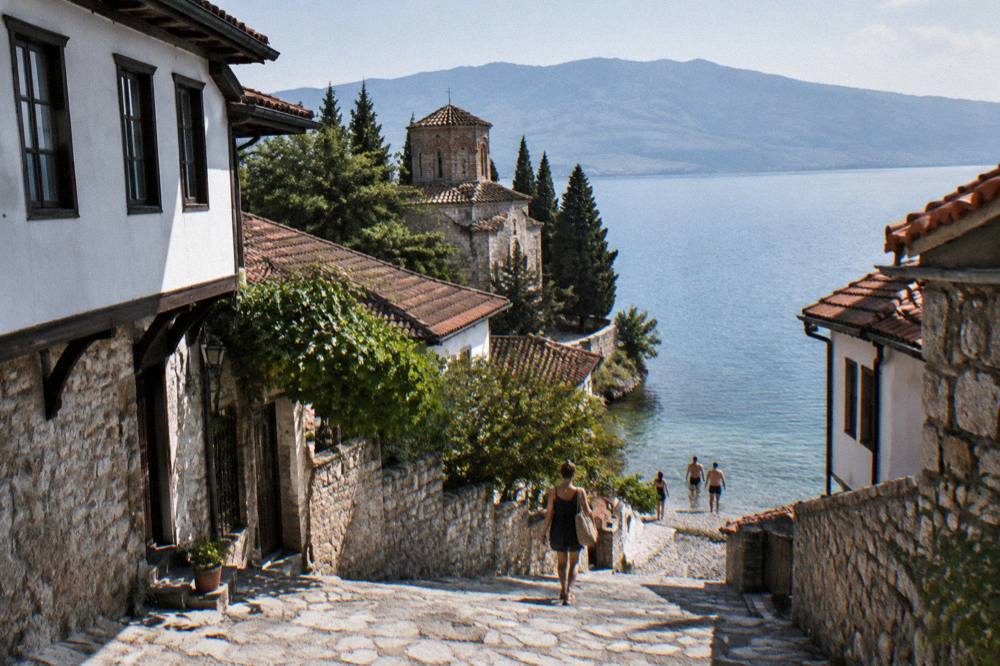
Beyond the free core, Ohrid's paid layer is modest and well defined: the institute's museum sites, the church interiors, the monastery at St Naum and the boats. Visitors with more days can stretch the plan across three days in Ohrid or the full five days in Ohrid, and the hidden gems itinerary adds the corners most free-day routes miss.
Common Questions About Free Things To Do In Ohrid
What can you do in Ohrid for free?
The lakefront promenade, the Old Town lanes, the Old Bazaar streets, the public squares around the churches and the harbour are all free to walk, and the free tip-based walking walks on the GuruWalk platform cover the old town with no charge up front.
Is the Ohrid old town free to enter?
Yes, the Old Town is a network of public streets with no gate or ticket; only specific interiors, the museum-institute sites at 150 den for foreign visitors and the church interiors, charge entry.
Are there free walking tours in Ohrid?
Three free walks run in Ohrid on the GuruWalk platform, free to join with a pay-what-you-want tip at the end; this site lists one of them on its free history walk page.
How much do Ohrid museums cost?
The National Institute and Museum Ohrid charges 150 den for foreign visitors, 120 den for domestic visitors and a reported 60 den for children and students at its sites, which run a winter schedule from 1 October to 30 April and close on Mondays at the sites that publish hours.
Can you swim in Lake Ohrid for free?
Yes, the lakefront is public and swimming costs nothing; modelled lake surface temperatures reach about 22.9 C in July and 23.5 C in August, and 2026 bathing tests found Class I physico-chemical quality except Grashnica beach at Class III.
Is Ohrid expensive for a day trip?
No: the bus from Skopje costs 850 to 950 den, a minibus from Tirana about 15 to 20 EUR, museum entry is 150 den, and the core experience, the lakefront and the Old Town, is free public space.