Ohrid In The Rain: Museums, Cafes And Covered Stops
Rain changes the rhythm of Ohrid, not the possibilities: museums, covered stops, kitchens and wineries carry the day while the lake waits for the sky to clear.

Short answer
Ohrid in the rain works because the town's strongest indoor draws, the museum institute sites, the Icon Gallery, the Old Bazaar lanes and a busy calendar of cooking classes and winery visits, sit within a compact old town on the shore of Lake Ohrid. Modelled rainfall averages 90.4 mm in November and 92.6 mm in December against 32.9 mm in August, so wet days cluster in late autumn and winter and a full plan for them follows.
Ohrid, the old town on the shore of Lake Ohrid in North Macedonia, sits at about 693 m above sea level, and rain here is a matter of season rather than luck. The Ohrid Travel Guide weather record, modelled from the ERA5 reanalysis for the old-town grid point, shows the wet months concentrated from October through December, with 76.0 mm in October, 90.4 mm in November and 92.6 mm in December. A rainy day does not strand anyone: the town packs its museum sites, covered shopping lanes, kitchens and wineries into a walkable core, and the lake itself is never more than a street away. This itinerary pairs the covered stops with the numbers that tell you when the rain is likely.
What Can You Actually Do In Ohrid When It Rains?
A rainy day in Ohrid fills easily with the NI Institute and Museum sites, the Icon Gallery at the Perivleptos complex, the covered lanes of the Old Bazaar, a cooking class, a winery tasting and cafe stops along the old-town streets, all reachable on foot in the compact centre. The town's heritage listing, the UNESCO Natural and Cultural Heritage of the Ohrid Region, inscribed in 1979 and 1980 and extended to the Albanian part of the lake in 2019, means the indoor collections are unusually dense for a town of this size. UNESCO's own listing notes more than 800 Byzantine-style icons from the 11th to the end of the 14th century held in Ohrid, which is the single strongest reason a grey afternoon in this town is not a lost afternoon.
The practical shape of a wet day follows the geography. The old town climbs from the lake shore toward Samuel's Fortress, and its lanes are entirely on foot, so the distance between one covered stop and the next is measured in minutes rather than transit. The Old Bazaar streets sit at the flat end of that climb, the museum sites sit along it, and the cafe terraces under their awnings face the water.
Two things keep the day flexible. First, the one-day Ohrid itinerary already routes past most of these stops, so a rain plan is mostly a reordering of the same map, not a new one. Second, several of the strongest wet-weather options, cooking classes and winery visits among them, are bookable products whose details and prices render on their own listings, so you can commit to one without gambling on the sky.
Which Ohrid Museums And Galleries Work On A Wet Day?
The wet-day museum circuit in Ohrid runs through three named sites of the NI Institute and Museum Ohrid: the Robev Family House on Tsar Samoil street in the old town, the Icon Gallery in the Perivleptos complex on Klimentov Univerzitet street, and the Bay of Bones, the Museum on Water at Gradishte near Peshtani down the shore. Each belongs to the same museum institute, whose offices sit at Boro Shain street 10, and each holds part of the collection UNESCO cites when it describes the region's heritage. The Bay of Bones is the outlier: it is a museum on the water itself, a walkable distance from the shore road at Peshtani, so it pairs a museum visit with a short ride out of town even in poor weather.
What makes these stops work in rain is their concentration. The Robev Family House and the Icon Gallery sit within the old-town fabric, connected by lanes rather than roads, so moving between them never requires a long exposed stretch. The Icon Gallery in particular carries the icon collection: UNESCO's listing for the Ohrid region describes more than 800 Byzantine-style icons spanning the 11th to the end of the 14th century, and the gallery at Perivleptos is where that collection is housed. The Perivleptos church complex itself, the Church of the Holy Mother of God Perivleptos, shares the site with the gallery, so one doorway covers two layers of the town's heritage.
Museum schedules shift with the seasons in Ohrid, running a winter pattern and a summer pattern, and the institute publishes its current arrangements on its own site, so check the days before you set out rather than planning around a fixed timetable. The churches of the old town, St Sophia, Plaosnik and St John at Kaneo, also open their doors to visitors, and their interiors, frescoes above all, are precisely the part of Ohrid that rain cannot touch. The Ancient Theatre, by contrast, is an open-air site, and the Samuel's Fortress walls stand in the open too, so save both for the clearing sky.
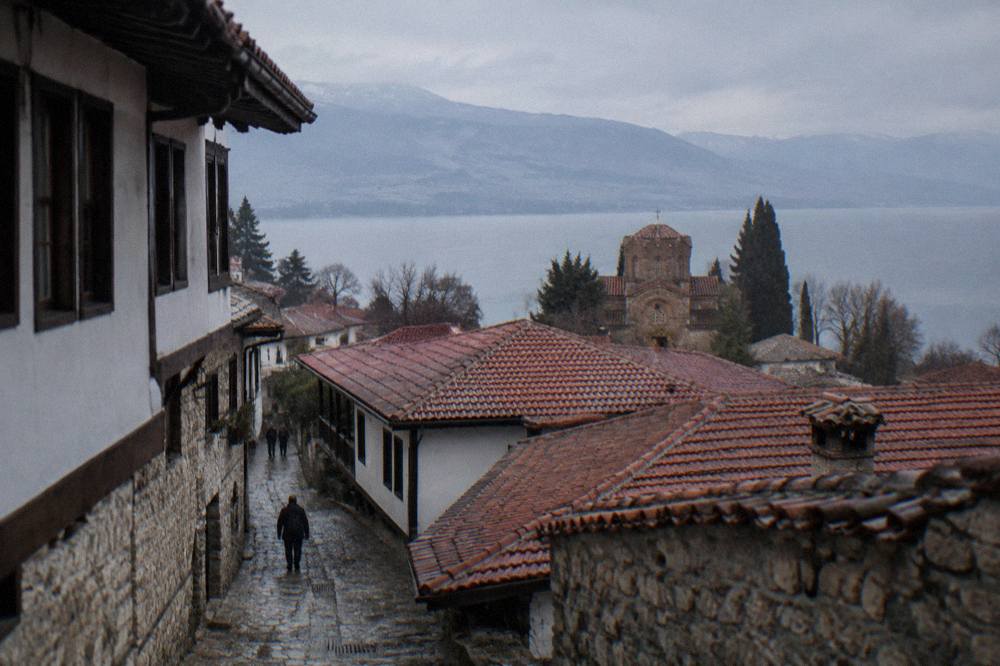
The wet-day map, at a glance:
| Covered Stop | What It Is | Where It Sits | Rain Suitability |
|---|---|---|---|
| Robev Family House | Museum site of the NI Institute and Museum Ohrid | Tsar Samoil street, old town | Fully indoors, central |
| Icon Gallery at Perivleptos | Houses part of Ohrid's icon collection | Klimentov Univerzitet street, old town | Fully indoors, central |
| Old Bazaar lanes | Historic shopping streets | Lower old town, near the shore | Mostly covered or sheltered |
| Bay of Bones, Museum on Water | Museum site on the lake at Gradishte, Peshtani | Shore road south of Ohrid | Indoors, but the approach is outdoors |
| Church of St Sophia | Church with frescoed interior | Old town edge | Indoors while inside |
| St John at Kaneo | Church above the lake at Kaneo | Kaneo district, below the old town | Indoors, exposed walk to reach it |
Where Do You Eat, Drink And Cook Indoors In Ohrid?
Ohrid's rainy-day food plan has three arms: long cafe sessions in the old town, restaurant tables serving the Macedonian classics of the region, and a bookable cooking class that turns a wet afternoon into the meal itself, with the class listed on this site's own tours pages. The cooking class is the strongest wet-weather move of the three, because it converts the hours you would spend shelter-hopping into a single warm room, a working table and a finished meal. Its price, duration and rating render from its own listing rather than from this page, and the operator's live listing carries the current availability.
The cafe culture of the old town does the rest. Ohrid's food identity is the one described across the food and drink pages of this site: lake fish, grilled meats, tavche gravche, the beans baked in clay, and the salads and meze that fill a table before a main course arrives. Rain slows none of that. A window table facing the water, a pot of coffee and the bazaar streets outside doing their best impression of a weather report is a perfectly good way to spend two hours.
What the cooking class adds is participation. Rather than choosing from a menu, a class group shops, prepares and cooks, and eats what it has made, which is the entire point on a day when the lake promenade is off the table. The class runs on the operator's own schedule, and booking carries the usual free-cancellation flexibility, so a forecast that improves overnight does not trap anyone indoors: Check availability and keep the option open. The class itself has its own page at Ohrid cooking classes.
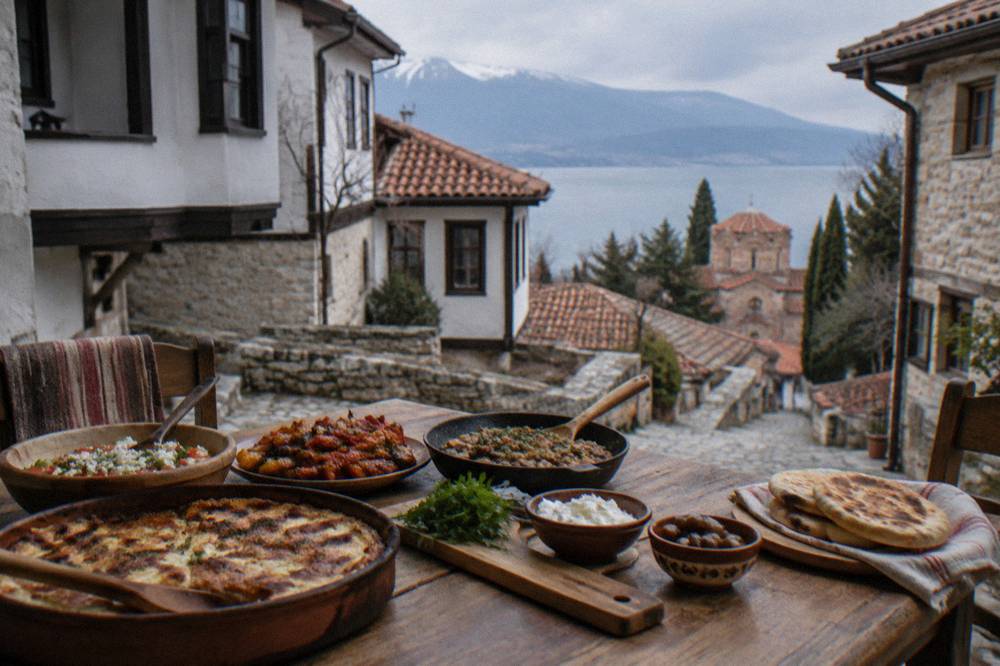
For the hours between meals, the Old Bazaar does the shelter work. Its lanes hold the shops that sell Ohrid's signature crafts, and the shopping pages of this site cover what to look for, from the famous Ohrid pearl to the hand-bound paper of the town's workshops. Browsing is the rain-day activity that needs no booking, no timetable and no umbrella once you are inside the lane.
How Much Rain Does Ohrid Actually Get, And When?
Ohrid's modelled rainfall, from the ERA5 reanalysis 1991-2020 normals for the old-town grid point, runs from 32.9 mm in August to 92.6 mm in December, with October at 76.0 mm and November at 90.4 mm marking the shift into the wet half of the year. These are modelled climate normals, not a weather-station record, so treat them as the pattern rather than a forecast. The same normals put the mean daily high at 27.6 C in August against 6.2 C in December, which matters as much as the rain: a wet December afternoon in Ohrid is also a cold one, and the covered-stop plan changes accordingly, from unhurried browsing to short dashes between warm rooms.
| Month | Mean Daily High (C) | Mean Daily Low (C) | Rainfall (mm) |
|---|---|---|---|
| Jan | 5.0 | -0.8 | 76.5 |
| Feb | 6.3 | 0.0 | 74.3 |
| Mar | 10.0 | 2.5 | 80.5 |
| Apr | 14.6 | 6.3 | 82.4 |
| May | 19.5 | 10.8 | 70.8 |
| Jun | 24.2 | 15.2 | 43.1 |
| Jul | 27.1 | 18.3 | 34.7 |
| Aug | 27.6 | 19.0 | 32.9 |
| Sep | 22.4 | 14.9 | 62.4 |
| Oct | 17.4 | 10.3 | 76.0 |
| Nov | 11.5 | 5.3 | 90.4 |
| Dec | 6.2 | 0.9 | 92.6 |
Read the table seasonally. June through August is the dry block, with rainfall between 32.9 and 43.1 mm per month, and that is the same window in which the lake's swimming season runs on the modelled water-temperature figures. From late September the totals climb back through the 60s and 70s, and October, November and December form the wet stretch. A trip planned for the shoulder months, May at 70.8 mm or September at 62.4 mm, sits between the two regimes, which is exactly when a ready-made rain plan earns its keep.
The full monthly breakdown, including what it means for crowds and lake temperatures, sits on the Ohrid weather guide. The short version for this page: rain in Ohrid is a November-and-December problem more than a summer one, but the lake climate can produce a wet afternoon in any month, and the covered stops below are the insurance.
Can You Still Enjoy The Lake And Old Town In The Rain?
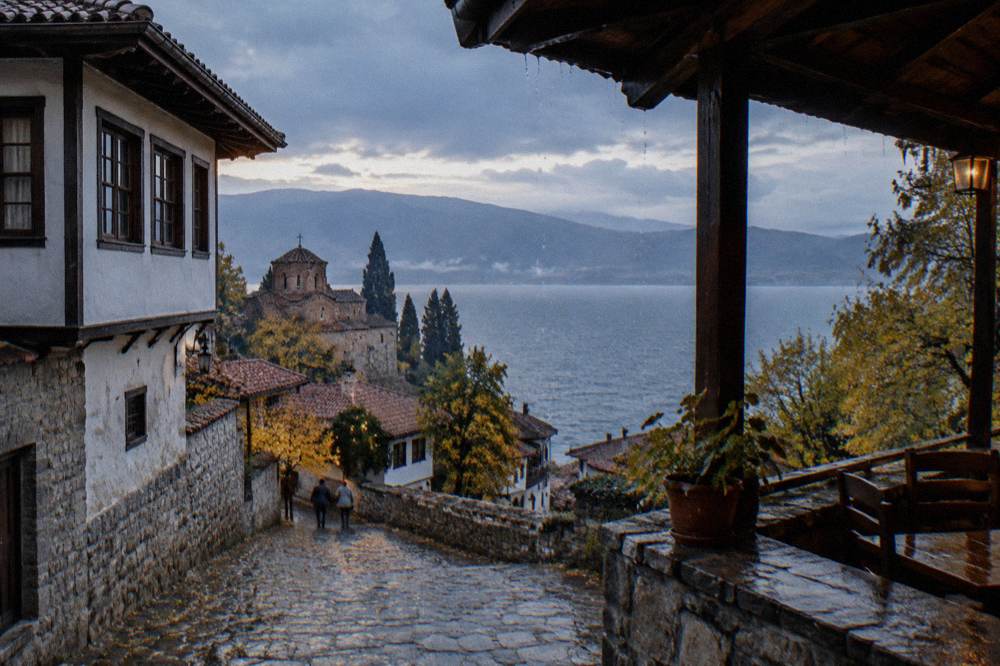
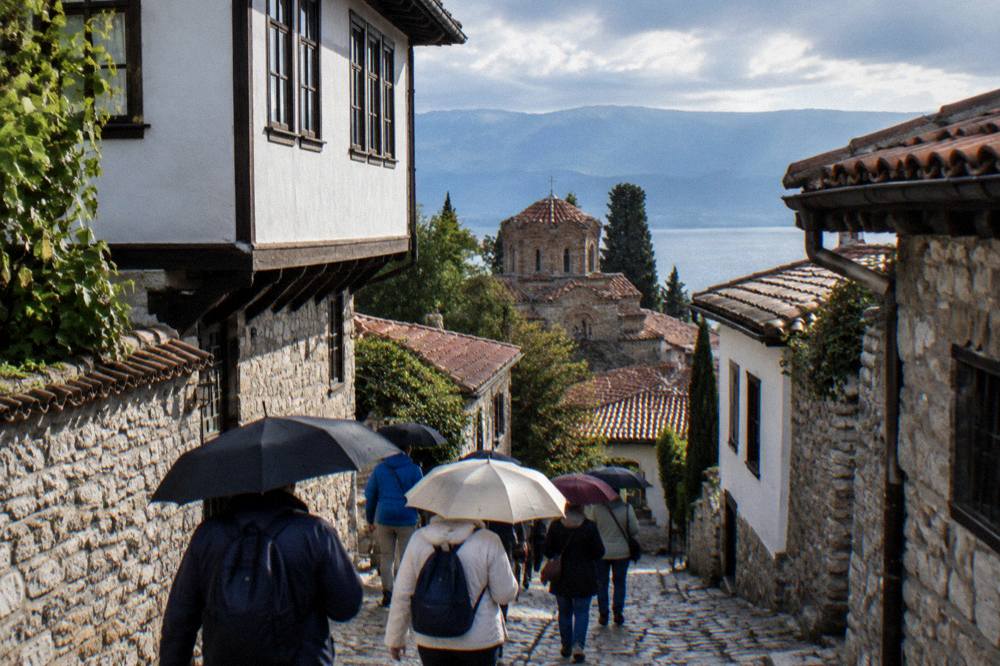
Yes, with adjustments: the old-town lanes and the shore promenade remain walkable in rain, the boat cruises still run on their operators' schedules in fair conditions, and the views across the lake from the town's terraces simply change character, but the open-air sites, the fortress walls and the Ancient Theatre, are better saved for a dry window. The old town was built for walking, its lanes climbing from the shore to the fortress, and stone streets after rain are part of the town's look rather than an obstacle to it. What changes is pacing: shorter outdoor stretches, longer indoor stays, and a cafe or museum as the anchor at each end.
The lake itself deserves a mention even on a grey day. Lake Ohrid sits at about 693 m above sea level, and the modelled surface water temperatures run from about 4.6 C in January to 23.5 C in August, so swimming belongs to the warm months regardless of the weather. A rain-dark lake from a covered terrace is still the lake UNESCO inscribed, and the mist that sometimes sits on the water in the wet months gives the shore a different character from the bright blue of July. Photography-minded visitors will find the wet-season town and its viewpoints reward a different kind of picture than the postcard light.
One caution belongs here. The 2026 navigation limits on the lake, set by the government decision of 2 June 2026, restrict jet skis in the daytime hours of July and August and boats at night through the summer and into October, and boat operations generally follow the seasonal calendar, running roughly May to October with reduced schedules outside it. A rainy off-season day may simply find fewer boats on the water, and each operator's live listing carries what it runs. When the rain eases, the walk up to Samuel's Fortress and the theatre below it repay the wait.
A Full One-Day Rain Plan For Ohrid, Hour By Hour
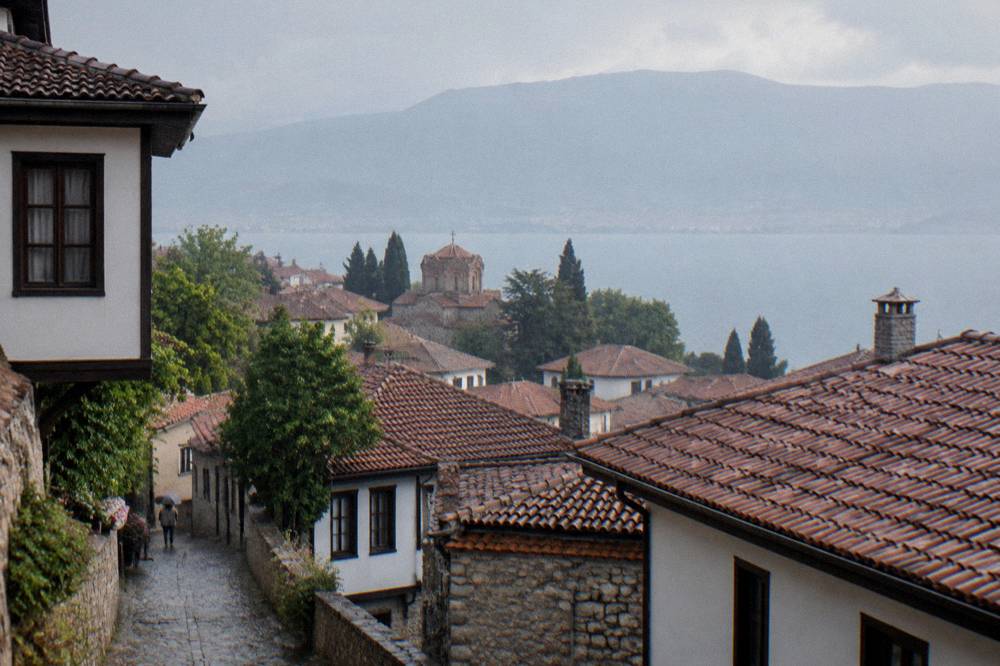
A complete rainy day in Ohrid runs like this: a bazaar-and-coffee morning, the Robev Family House and Icon Gallery through the middle hours, a long indoor lunch, a cooking class or winery visit for the afternoon, and an evening in the old town's restaurants, all without needing a car. The plan below assumes the worst kind of wet day, steady rain from morning to night, and treats any dry window as a bonus for the fortress or the Kaneo walk. It compresses into the same footprint as the three-day Ohrid itinerary, so nothing here is exotic, it is the standard map re-sequenced for weather.
| Time Block | Activity | Why It Works In Rain |
|---|---|---|
| Morning, first stop | Coffee and breakfast in the Old Bazaar lanes | Covered shopping streets, central location |
| Morning, second stop | Robev Family House, National Museum | Indoor museum site in the old town |
| Midday | Icon Gallery at Perivleptos | Indoor gallery, short walk from the museum |
| Lunch | Old-town restaurant, Macedonian classics | Indoors, unhurried |
| Early afternoon | Cooking class, or winery tasting visit | Booked indoor activity, meal included or following |
| Late afternoon | Cafe facing the lake, or souvenir browsing | Sheltered, flexible length |
| Evening | Dinner in the old town | Indoors, walkable from anywhere central |
The morning works because the bazaar sits flat and central. The middle works because the museum sites sit along the old town's spine within an easy walk of each other. The afternoon is the pivot: a cooking class swallows three or four hours productively, and a winery visit does the same with tastings instead of chopping, which is why both anchor the picks on this page. The evening needs no planning beyond a reservation, and the nightlife and evening pages cover the rest.
For travellers with more than one wet day, the sequence extends rather than repeats. The second day can take the Bay of Bones at Peshtani, an indoor museum reached by a shore-road ride, and pair it with the winery option. A third can go to the St Naum monastery at the lake's southern end, where the monastery interior and the boat ride at the Crn Drim springs give the day structure whatever the sky does. The five-day Ohrid itinerary carries the full sequence in dry weather, and every indoor stop in it survives a forecast collapse.
Do Winery Visits Work As An Ohrid Rain Plan?
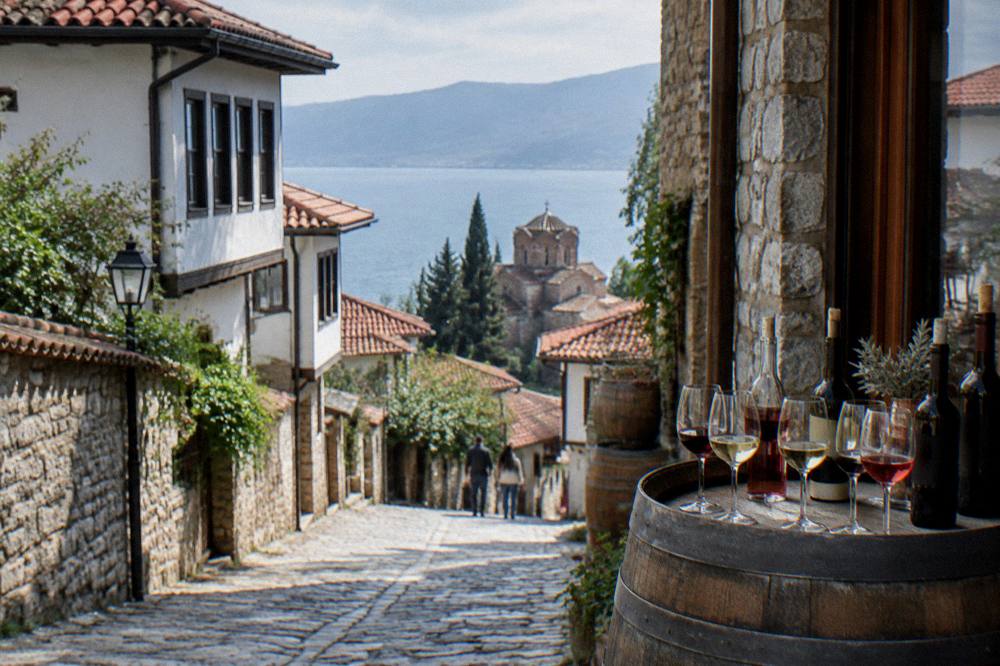
A winery visit is one of the strongest rain-day options around Ohrid, because the tasting rooms and cellars are indoors by definition, the visits are bookable products with transport handled, and the wine culture of the region, its vranac and local varieties, fills an afternoon that the lake cannot. The wine pages of this site describe the Macedonian wine tradition in full, from rakija to the reds the country is known for, and a guided tasting turns that background into a sitting-down experience. Like the cooking class, the winery products print their own prices, durations and ratings from their listings, and the operator's live listing carries current slots.
The winery option also solves the movement problem that rain creates. A tasting visit with transport included removes the need to plan the drive out of town and back, which matters on a day when you want to move between sheltered stops without standing at a bus stop. Grouped with the food options, it rounds out a wet-weather roster that is genuinely varied: cook, taste, browse, museum, gallery, eat, repeat.
The wider comparison, at a glance:
| Wet-Weather Option | Indoors Or Outdoors | Bookable As A Product | Needs Transport Out Of Town |
|---|---|---|---|
| Museum sites in the old town | Indoors | No, site visits | No |
| Old Bazaar browsing | Mostly sheltered | No | No |
| Cooking class | Indoors | Yes | No |
| Winery visit and tasting | Indoors | Yes | Handled by the product |
| Bay of Bones museum | Indoors on arrival | No, site visit | Yes, shore road |
| Hidden-gems walking tour | Outdoors, shortened in rain | Yes | No |
What Should You Pack For Rain In Ohrid?
Pack for Ohrid rain the way you pack for a mountain-lake town at 693 m: a real rain layer rather than a token one, shoes with grip for wet stone lanes, and warm layers for the wet months, because the modelled November mean daily high is 11.5 C and the December figure is 6.2 C, cold enough that the rain is the smaller problem. The old town climbs, its lanes are stone, and the shore promenade exposes you to the wind off the water, so footwear matters more than in a flat city. An umbrella works in the bazaar lanes and cafe-to-restaurant dashes, but a hood wins on the open stretches toward the fortress.
The seasonal split decides the rest of the bag. From June through August, with rainfall between 32.9 and 43.1 mm per month and mean daily highs from 24.2 to 27.6 C, a light rain shell covers the occasional storm, and the same day can still hold a swim in the lake on the modelled water temperatures. From October through December, with 76.0 to 92.6 mm per month and highs falling from 17.4 C to 6.2 C, the packing list is a proper coat, layers and the acceptance that the day will be organized around interiors. The best-time-to-visit guidance frames the same numbers from the trip-timing side.
Two practical notes close the kit. North Macedonia's currency is the denar, and the country is outside the EU and Schengen, so the practicalities, cards, cash and entry rules, are covered on the money and entry pages of this site rather than guessed at here. And the emergency numbers are printed facts worth having offline: ambulance 194, police 192, roadside assistance 196.
Can A Rain Day In Ohrid Still Include A Walk?
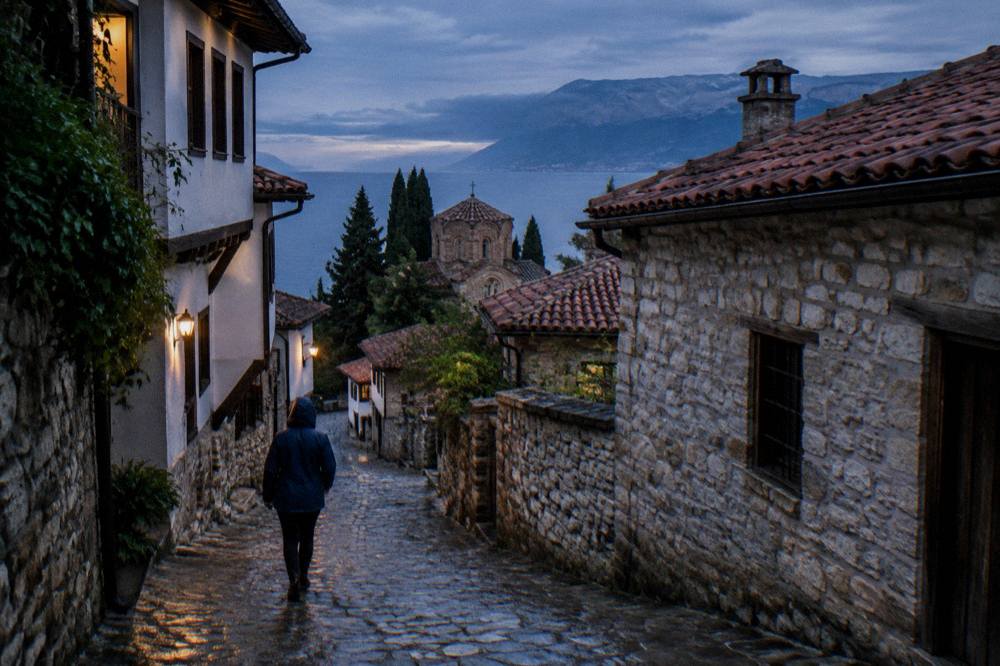
A rain day in Ohrid can still include a walk, and often should: the old town's lanes, the shore promenade and the lower slopes toward Kaneo all remain walkable in ordinary rain, and a guided walk with a small group turns the wet town into the attraction itself rather than an obstacle to be endured. The guided walking products on this site cover the old town's lanes, churches and viewpoints, and their details, prices and ratings come from their own listings. In rain, the calculus favours the shorter formats: a town walk of an hour or two fits between the museum stops, while the long fortress-and-viewpoint routes belong to the dry window.
The self-guided version works too, with the same adjustments. The promenade along the shore is flat and direct, the bazaar lanes loop tightly, and the walk out toward the Kaneo district below the old town gives the lake view that defines the town, at the price of an exposed stretch. On the modelled climate, the odds of a walkable gap are decent even in the wet months: the rainfall totals are monthly sums, not a promise of continuous rain, and the town's compactness means a break in the weather is never more than a few minutes' walk from being exploited.
Prefer to wander the lanes at your own pace? Book a self-guided audio tour here.
The hidden-gems walking option in the picks above is the structured version of this idea. It runs as a shared small-group product, it covers ground beyond the standard church trail, and like every product on this page its price and rating render from its listing. Pair it with the cooking class or the winery visit and a wet day in Ohrid has a morning, an afternoon and an evening, which is all any itinerary ever needs.
Common Questions About Ohrid In The Rain
Does it rain a lot in Ohrid?
By the modelled ERA5 1991-2020 normals, Ohrid receives about 816.6 mm of rain per year, concentrated from October to December, when monthly totals run 76.0 mm, 90.4 mm and 92.6 mm. June through August is the dry block, with 43.1 mm, 34.7 mm and 32.9 mm respectively.
What are the best indoor activities in Ohrid?
The strongest indoor options are the museum institute sites, the Robev Family House and the Icon Gallery at Perivleptos, browsing the Old Bazaar lanes, a cooking class, a winery tasting visit, and long cafe and restaurant sessions in the old town.
Is Ohrid worth visiting in winter rain?
Yes, with adjusted expectations. The modelled December mean daily high is 6.2 C and rainfall is 92.6 mm, so the day organizes around interiors: museums, food, wine and the bazaar. The summer lake activities, including swimming on the modelled water temperatures, pause until the warm months.
Do boat trips on Lake Ohrid run in the rain?
Boat operations follow the seasonal calendar, roughly May to October, with reduced schedules outside it, and individual departures depend on conditions. Each operator's live listing carries its current schedule, and the 2026 navigation limits restrict boats at night through the summer and into October.
Can you walk Ohrid old town in the rain?
Yes. The old town is entirely on foot, its lanes climb from the shore to the fortress, and the stone streets are walkable in ordinary rain with gripped footwear. The exposed stretches are the higher slopes toward Samuel's Fortress and the path down to St John at Kaneo.
What is a good rainy-day itinerary for Ohrid?
Coffee in the Old Bazaar, the Robev Family House and Icon Gallery through the morning, a long indoor lunch, a cooking class or winery tasting in the afternoon, and dinner in the old town. The hour-by-hour version sits in the table above and needs no car.