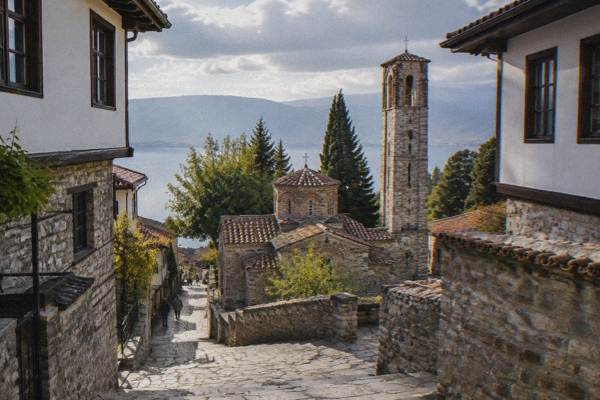
North Macedonia Travel Guide: Where Ohrid Fits
North Macedonia is a small, landlocked Balkan country outside the EU and Schengen, and Ohrid, its lakeside UNESCO town on a mountain lake at about 693 m above sea level, is where the overwhelming share of a first visit happens. This guide sets out what the primary sources actually say: bus and flight routes, museum tickets in MKD, modelled climate normals, festival dates and entry rules.
Short answer
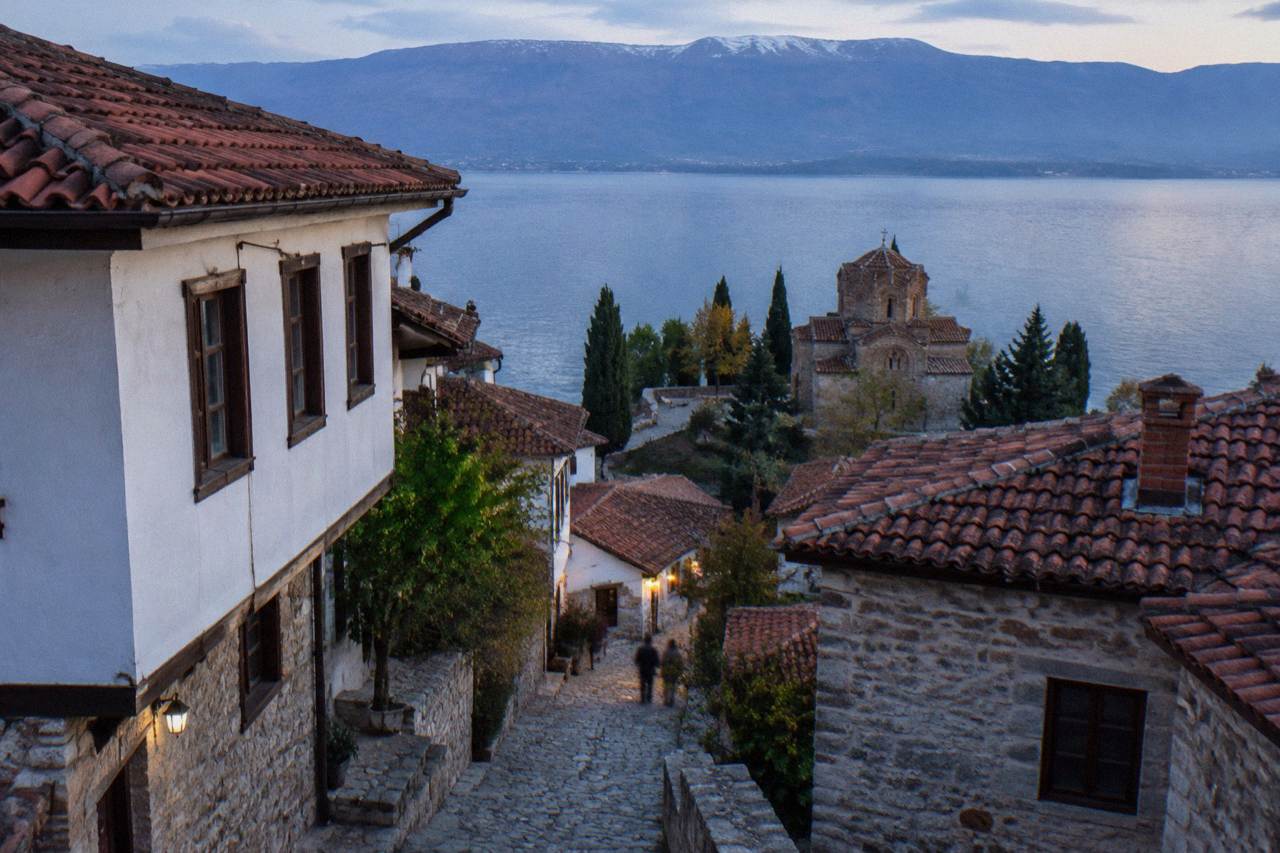
Ohrid sits on Lake Ohrid in the southwest of North Macedonia, about 170 km by road from Skopje, inside a UNESCO mixed heritage site inscribed in 1979 and 1980. The denar is the currency, the country is outside the EU and Schengen, and visa-free nationals stay up to 90 days in any 180.
Ohrid is a lakeside town in the southwest of North Macedonia, on the shore of Lake Ohrid, a freshwater mountain lake whose surface sits at about 693 m above sea level. The country around it is small, landlocked and outside both the EU and Schengen, which shapes almost every practical decision a visitor makes: the currency is the Macedonian denar, border checks are real, and the sights that matter cluster within a few kilometres of one another. This Ohrid Travel Guide page sets out how Ohrid fits into a wider North Macedonia trip, using what museums, ministries and operators publish rather than guesswork, and it links out to the deeper things to do in Ohrid overview for the full sight list.
Where Is Ohrid And What Is North Macedonia?
Ohrid lies in the southwest corner of North Macedonia, on the eastern shore of Lake Ohrid, a freshwater mountain lake shared with Albania whose surface sits at about 693 m above sea level. The town is about 170 km by road from the capital Skopje, roughly a three-hour bus ride, and the old town holds a UNESCO mixed heritage site, inscribed in 1979 for nature and 1980 for culture and extended to the Albanian part of the lake in 2019.
North Macedonia is not in the EU and not in Schengen, so border checks apply on every crossing and the euro is not legal tender, even though tour operators commonly quote prices in it. The local currency is the denar (MKD). Bulgaria and Romania became full Schengen members, land borders included, on 1 January 2025, which matters for anyone routing overland through Sofia or Bucharest, but North Macedonia itself remains outside.
The UNESCO listing, "Natural and Cultural Heritage of the Ohrid Region", is a mixed property of about 94,729 hectares, and UNESCO's own description credits Ohrid with the oldest Slav monastery, St Panteleimon at Plaosnik, and more than 800 Byzantine-style icons from the 11th to the end of the 14th century. The lake itself, per UNESCO, has existed for about two to three million years and carries over 200 endemic species, including 17 endemic fish. On 24 July 2026 the World Heritage Committee decided at its 48th session in Busan not to place the region on the List of World Heritage in Danger, asking the two states instead for a joint report by 1 February 2029.
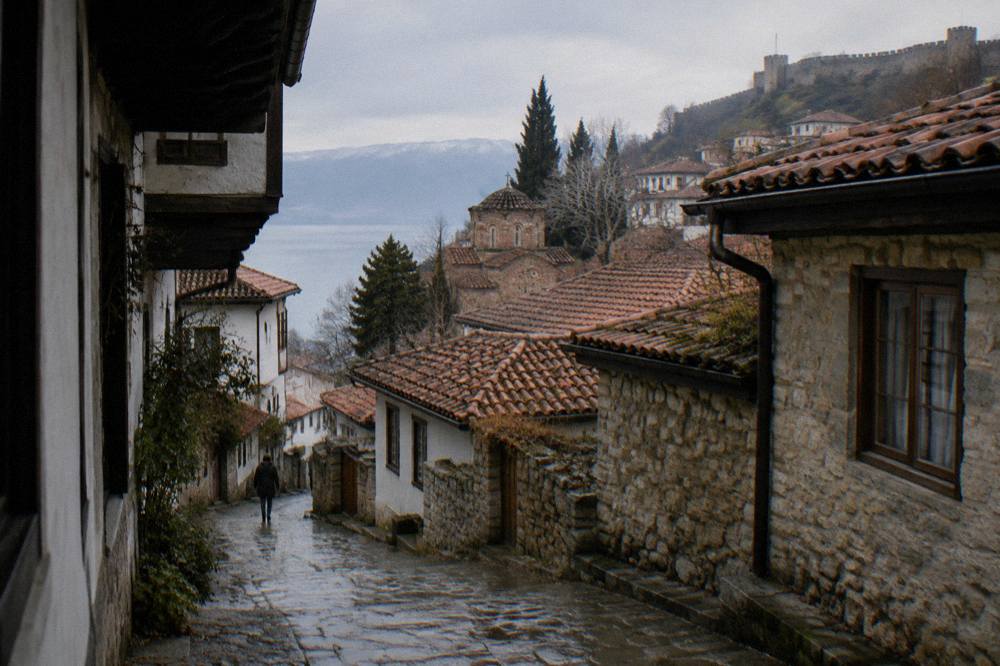
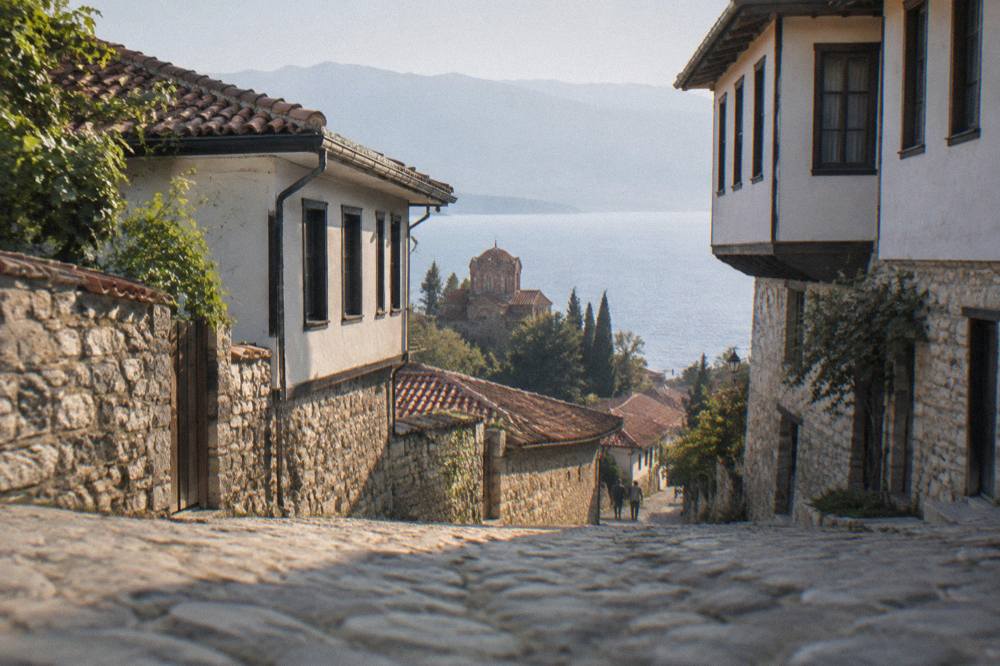
The town itself is compact. The old town climbs from the lake up to Samuel's Fortress, the lanes are on foot, and the sights that dominate a visit, St John at Kaneo, St Sophia, Plaosnik, the Ancient Theatre, the Old Bazaar, the Perivleptos and Icon Gallery complex, all sit within that slope. Beyond the town, the geography fans out: Galicica National Park fills the ridge between Lake Ohrid and Lake Prespa, Struga sits where the Crn Drim leaves the lake at the north-western corner, and St Naum monastery stands near the southern shore close to the Albanian border.
What Are The Main Places To Visit Around Ohrid?
The core sights inside Ohrid are the Church of St John at Kaneo, St Sophia, Plaosnik, the Ancient Theatre, Samuel's Fortress, the Old Bazaar and the museum institute's sites, with the Bay of Bones at Peshtani and St Naum monastery on the lake shore south of town and Galicica National Park on the ridge above it. The institute's own site lists tickets at 150 den for foreign visitors and 120 den for domestic visitors at Robev Family House, the Museum on Water and the Icon Gallery, each closed on Mondays.
Those three museum sites run on fixed seasonal schedules published by the institute. Robev Family House keeps winter hours of 09:00 to 15:30 from 1 October to 30 April and two summer shifts, 09:00 to 15:30 and 13:30 to 20:00, from 1 May, closed Mondays. The Bay of Bones, the reconstructed pile dwellings at Gradishte near Peshtani, runs 09:00 to 15:30 in winter and 09:00 to 16:30 from 1 May to 30 September, again closed Mondays. The Icon Gallery at the Perivleptos complex keeps 09:00 to 14:00 in winter and 09:00 to 17:00 in summer, closed Mondays.
| Museum institute site | Foreign ticket | Domestic ticket | Winter hours (1 Oct to 30 Apr) | Closed |
|---|---|---|---|---|
| Robev Family House | 150 MKD | 120 MKD | 09:00 to 15:30 | Monday |
| Bay of Bones / Museum on Water | 150 MKD | 120 MKD | 09:00 to 15:30 | Monday |
| Icon Gallery (Perivleptos) | 150 MKD | 120 MKD | 09:00 to 14:00 | Monday |
The Ancient Theatre, per the museum institute's page, was built at the end of the late Hellenistic period, was first excavated in 1935 and reached a capacity of 5,000 once the epiteatron was added. It still serves as an opening venue for the Ohrid Summer Festival. Further out, St Naum monastery's entrance is listed at 150 MKD per person on a cruise operator's published tariff, and a rowboat through the Crn Drim springs beside it is quoted at about 5 EUR.
Galicica National Park, North Macedonia's second national park, founded in 1958, covers 22,750 ha between the two lakes with Magaro peak at 2,254 m. The park is open year-round, though heavy snow can close the main road across it, typically from January to March. Entry by vehicle is 250 MKD per car with no per-passenger fee, while someone entering on foot at the Ohrid-side gate pays 100 MKD. More detail sits on the Galicica National Park guide pages of this site, and the Lake Ohrid guide covers the shoreline villages such as Trpejca and Ljubanista.
How Many Days Do You Need For Ohrid And North Macedonia?
Three to five days in Ohrid covers the old town churches, the fortress, the Bay of Bones and a boat or road trip to St Naum, with a spare day for Galicica or the Albanian shore, and the town rewards that pace because nearly everything sits within walking distance or a short drive. A first-time country circuit typically adds Skopje, about 170 km away by road, and possibly Bitola, both reachable as day trips or as stops on a route between Ohrid and Skopje airport.
Ready to settle on a base for those days? Book a hotel in Ohrid here.
The practical math comes from geography, not opinion. The old town is pedestrian, the museum sites keep short winter hours, and the two big out-of-town draws, St Naum and the Bay of Bones, sit along the same southern shore, so one well-planned day by boat or car absorbs both. The how many days in Ohrid breakdown works through one-day, two-day and three-day sequences in detail, and there are full itineraries from a single day up to five.
For the town itself, a guided walk compresses the orientation problem. The Ohrid Old Town Walking Tour runs through the lanes with a local guide and is one of the cheaper ways to leave with the layout fixed in your head; check dates and free cancellation on the operator's live listing, or Check availability directly.
How Do You Get To Ohrid And Around The Country?
Ohrid's own airport, St Paul the Apostle (OHD), sits about 10 km from the centre, but the common route is a bus from Skopje, about 170 km and roughly three hours for 850 to 950 MKD one way, with several departures daily; there is no passenger train to Ohrid and no domestic flight, and from Tirana minibuses run roughly five to seven times a day for 3 to 3.5 hours including the border, costing about 15 to 20 EUR.
The airport's own passenger guide gives the 10 km distance and the E65 access road, with no regular public shuttle, so arrivals land into a taxi or a pre-booked transfer; secondary guides put the taxi fare at roughly 600 to 800 MKD. Wizz Air dominates OHD's schedule, and a TAV press release confirms new routes from 2026 including Milan, Wroclaw and Katowice across the Skopje and Ohrid airports, with an aircraft base at Ohrid reported in August 2026 as expected. OHD handled 263,869 passengers in 2025, 20.0 percent up on 2024, though still below 2023 and 2019.
| Route | Distance | Time | Cost (one way) | Notes |
|---|---|---|---|---|
| Skopje to Ohrid bus | about 170 km | about 3 h | 850 to 950 MKD | Several daily, more in summer |
| Skopje to Ohrid car | about 172 km | about 2.5 h | about 140 MKD tolls | Headlights required day and night |
| Skopje airport to Ohrid transfer | about 170 km | about 3 h | from about EUR 130 | No regular airport shuttle |
| Tirana to Ohrid minibus | via Qafe Thane border | 3 to 3.5 h | about EUR 15 to 20 | Roughly 5 to 7 daily |
| OHD airport to Ohrid centre | 10 km | 10 to 15 min | about 600 to 800 MKD | Taxi or pre-booked transfer |
The Kicevo to Ohrid motorway section remains under construction, with the Izvor to Vrbjani stretch due to open in the coming months and the full opening targeted for the first half of 2027, so road timings from Skopje still include ordinary two-lane sections. Drivers must run headlights day and night, carry a green card, and pay tolls plaza by plaza, as there is no vignette. From St Naum, the Tushemisht border crossing into Albania is about 4 km away, a drive quoted at 400 den by taxi, and the crossing is reported to operate around the clock for passenger vehicles and pedestrians. Deeper route detail sits on the Skopje to Ohrid and Tirana to Ohrid pages.
What Does It Cost To Travel In Ohrid And North Macedonia?
The big fixed costs are low by European standards: museum institute sites charge 150 MKD for foreign visitors, a full-day boat cruise to St Naum starts at 1,200 den for an adult and 600 den for a child per the operator's own tariff, Galicica charges 250 MKD per vehicle, and intercity buses run 850 to 950 MKD from Skopje, so a full sightseeing day costs a fraction of a comparable day in Western Europe, with guided tours and transfers quoted in euros on top.
The denar is the only legal currency, and the National Bank's published middle rate on 19 October 2026 was 1 EUR = 61.6633 MKD, with the denar de facto pegged to the euro under the bank's exchange-rate targeting. ATMs are the practical answer for cash, and euros are accepted only informally and at poor rates. The Macedonian denar and money guide covers exchange in detail, and the Ohrid cost and budget page builds full daily budgets.
| Item | Price | Source basis |
|---|---|---|
| Museum institute ticket (foreign) | 150 MKD | Institute's own site |
| Museum institute ticket (domestic) | 120 MKD | Institute's own site |
| St Naum monastery entry | 150 MKD | Cruise operator tariff |
| Crn Drim springs rowboat | about 5 EUR | Cruise operator tariff |
| Full-day boat cruise to St Naum | from 1,200 MKD adult, 600 MKD child | Boat Armada tariff, 7 hours |
| Galicica entry by car | 250 MKD per vehicle | Park guide tariff |
Boat trips run about May to October and drop to a reduced winter schedule, which is the single biggest seasonal swing in what a day costs. The Lake Ohrid boats and ferries page tracks the operators. The 2026 season also brought new rules on the water: a government decision of 2 June 2026 bans jet skis between 11:00 and 19:00 from 1 July to 31 August, and restricts night boating from 21:00 to 05:00 through August with later limits into September and October.
What Is The Weather Like And When Should You Visit?
Modelled ERA5 climate normals for 1991 to 2020 put Ohrid's mean daily high at 27.6 C in August against 5.0 C in January, with monthly rain ranging from 32.9 mm in August up to 92.6 mm in December, so the swimming window runs July to September when modelled lake surface temperatures are at their warmest, while May, June and September offer warm days with thinner crowds and winter is quiet, cold and wet.
These figures are reanalysis values for a grid cell at 701 m, not a weather-station record, and they carry the usual uncertainty of any modelled normal. They describe a genuinely four-season continental mountain climate: snow falls in Ohrid in winter, and Galicica's higher ground holds enough snow to close the road across the park, typically January to March. The Ohrid weather page carries the full monthly table and the best time to visit Ohrid page weighs the trade-offs.
| Month | Mean high C | Mean low C | Rain mm |
|---|---|---|---|
| Jan | 5.0 | -0.8 | 76.5 |
| Feb | 6.3 | 0.0 | 74.3 |
| Mar | 10.0 | 2.5 | 80.5 |
| Apr | 14.6 | 6.3 | 82.4 |
| May | 19.5 | 10.8 | 70.8 |
| Jun | 24.2 | 15.2 | 43.1 |
| Jul | 27.1 | 18.3 | 34.7 |
| Aug | 27.6 | 19.0 | 32.9 |
| Sep | 22.4 | 14.9 | 62.4 |
| Oct | 17.4 | 10.3 | 76.0 |
| Nov | 11.5 | 5.3 | 90.4 |
| Dec | 6.2 | 0.9 | 92.6 |
Modelled lake surface temperatures follow the same curve: about 4.6 C in January, 22.9 C in July, 23.5 C in August and 14.7 C in October, with the UHMR multi-year October mean at 14.3 C. The 2026 bathing tests found Class I physico-chemical quality across the measured sites except Grashnica beach, which rated Class III, with most microbiological samples rated excellent.
What Food And Drink Is North Macedonia Known For?
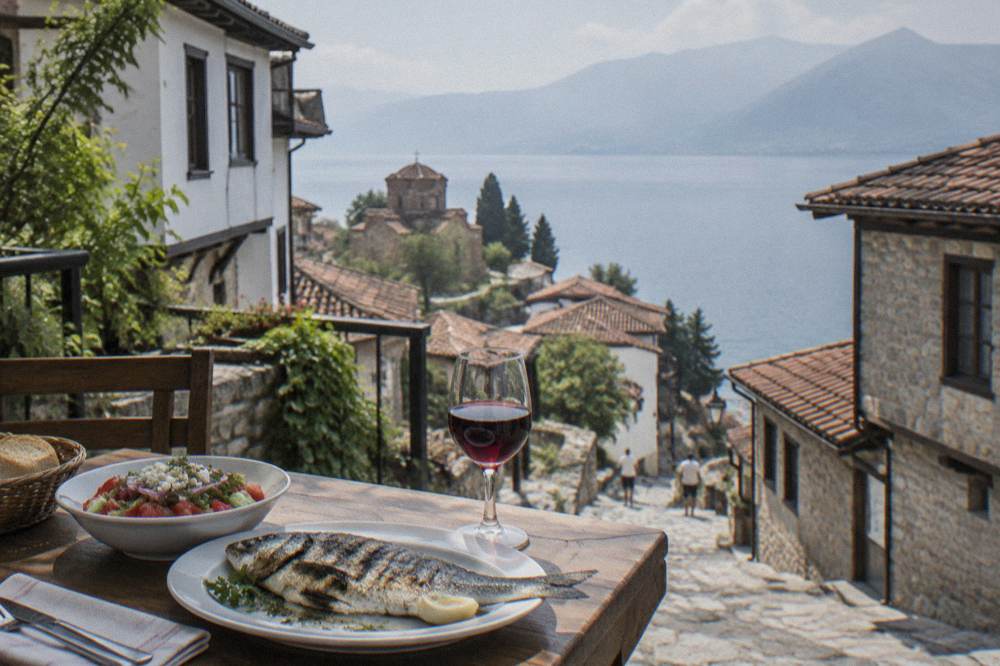
Ohrid's table centres on lake fish, grilled meat and slow-cooked beans: Ohrid trout is the local name fish (farmed today, with wild fishing restricted), tavche gravche is the national baked-bean dish, and rakija and Macedonian wine anchor the drinks, with a monastery winery tradition in the hills above the lake and tastings around town that a visitor can book as a guided experience.
The Ohrid food page works through the dishes and the Ohrid restaurants page lists where to eat them, but the short version is that the cuisine is Balkan with a lakeside accent. The Ohrid trout guide on this site explains the protected status of the wild fish and why farmed trout is what the menus actually serve. Wine here is genuinely local: Vranec and Stanushina reds and Žilavka whites come from Macedonian vineyards, and the monastery winery above the lake pours them in a historic setting.
For cooking rather than eating, hands-on classes run in Ohrid covering Macedonian home dishes, and the winery visits and tastings are covered in detail on the Ohrid food and wine tour guide. Restaurant prices are not published in any source this site uses, so nothing is quoted here; the cost and budget page deals in the figures that do have a source.
What Rules Apply To Entry, Money And Safety?
Visa-free nationals can stay up to 90 days in any 180-day period, UK visitors get up to three months with a passport valid at least 90 days beyond arrival, and everyone registers with the local police within 48 hours, a formality hotels handle for guests; North Macedonia is outside the EU and Schengen, the denar is the currency, and the emergency numbers are ambulance 194, police 192 and roadside assistance 196.
The foreign ministry's own entry page sets the 90-in-180 rule, and adds that holders of a valid multiple-entry UK, US or Canadian visa or a Schengen residence permit can enter for up to 15 days. UK guidance adds the passport rule and the 48-hour registration requirement. There is no EU roaming arrangement, so the North Macedonia visa and entry page and the SIM and connectivity guide on this site carry the practical detail. On safety, the is Ohrid safe page deals with the everyday picture, and the wider question is it safe to travel to North Macedonia right now covers the national advisory picture.
Two 2026 changes affect drivers and sailors directly. A resident-only parking regime applies on old-town streets including Ilindenska, Kosta Abrash and Car Samoil from summer 2026, with clamping reported for non-residents, so the Ohrid parking practicalities matter more than they used to. And the lake navigation limits described above run through October 2026 as dated government decisions, not permanent law.
What Events Fill The Ohrid Year?
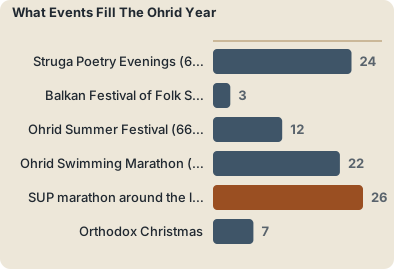
The Ohrid year centers on the Ohrid Summer Festival (12 July to 20 August), joined by the Struga Poetry Evenings, the Balkan Festival of Folk Songs and Dances, and the Ohrid Water Festival with its swimming and stand-up-paddle marathons, while winter brings Orthodox Christmas, Epiphany cross-throwing, the Vevcani Carnival, and St Clement of Ohrid Day.
The swimming marathon is the event most often mis-described: the Klime Savin route from St Naum to Ohrid harbour is 25 km, not 30, and the 39th edition on Saturday 22 August 2026 drew 16 swimmers, 11 men and 5 women, with a USD 15,000 prize fund organised by Ohrid Waves 2008. The SUP marathon around the lake is the separate 33 km event on 26 August. The Ohrid Summer Festival guide on this site covers the programme in depth.
| Event | 2026 dates | Tier of detail |
|---|---|---|
| Struga Poetry Evenings (65th) | 24 to 29 June | Reported with source |
| Balkan Festival of Folk Songs and Dances (65th) | 3 to 6 July | Reported with source |
| Ohrid Summer Festival (66th) | 12 July to 20 August | Reported with source |
| Ohrid Swimming Marathon (39th), 25 km | 22 August | Reported with source |
| SUP marathon around the lake, 33 km | 26 August | Reported with source |
| Orthodox Christmas | 7 January (annual) | Reported with source |
Beyond summer, the fixed calendar points are Orthodox Christmas on 7 January, Epiphany with the cross-throwing into the lake on 19 January, St Clement of Ohrid Day as a public holiday on 8 December, and the Vevcani Carnival in the hill village above Struga each 13 to 14 January by tradition. The 2027 dates for the major festivals had not been announced when the sources were gathered.
What Can You Do On The Lake And In Galicica?
Lake Ohrid carries the activity load in summer: boat cruises from the port to St Naum with stops at the Bay of Bones, stand-up paddleboarding and kayaking along the shore, scuba diving at the Bay of Bones, and swimming at the beaches from Gradiste to Ljubanista, while Galicica National Park above the lake adds hiking between the two lakes, jeep safaris and paragliding flights that take off from the park's slopes.
The water itself is the draw, and it is unusually warm for a mountain lake by August. Modelled surface values climb notably by late summer, and the swimming season runs July to September. The swimming in Lake Ohrid coverage collects the beaches, and the kayak and activity tours guide lists the paddle options. For the full-day lake circuit, the Bay of Bones boat trip with a swim stop is the best-established product on the water, and it pairs the museum pile dwellings with St Naum in one run.
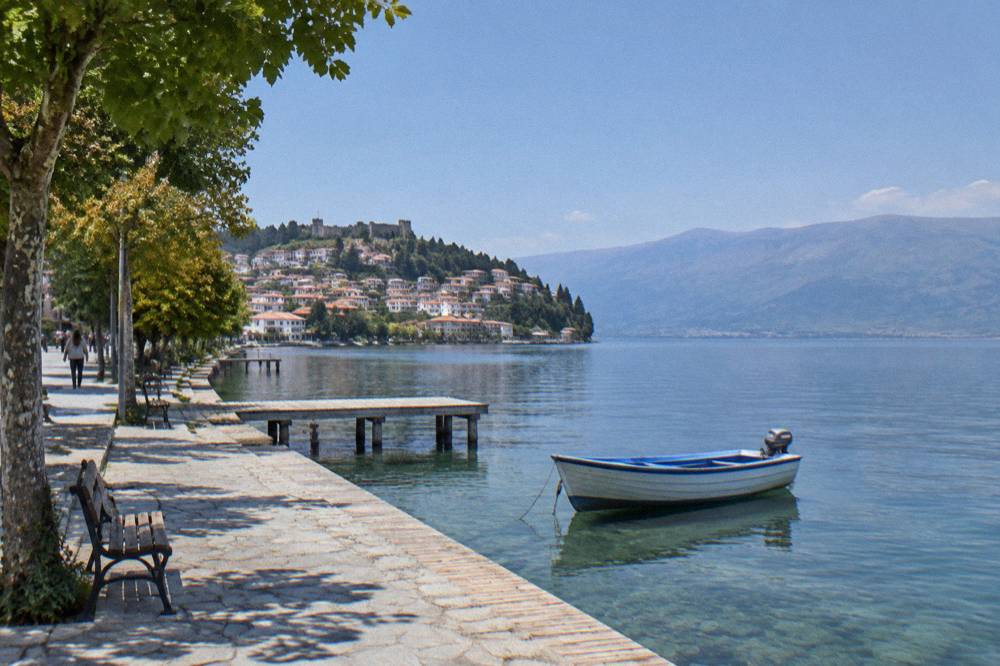
Inland, the Two Lakes hiking trail crosses Galicica between Lake Ohrid and Lake Prespa, whose surface sits about 148 m higher than Ohrid's at the Nakolec gauge reading of 841.36 m on 19 October 2026. Paragliding flights launch above the town, and jeep safaris work the park tracks. Winter shifts everything to the low town: museums on their shorter cold-season hours, the Old Bazaar, and the quiet lakeside walks on the Ohrid boardwalk.
How Does Ohrid Compare With Skopje, Struga And The Albanian Side?
Ohrid and Skopje do different jobs: Skopje is the capital, the flight hub and the administrative centre about 170 km away, while Ohrid holds essentially all of the country's headline heritage inside one walkable old town, so a typical first trip flies into Skopje, spends a night there or not, and puts the bulk of the time in Ohrid.
Struga, at the lake's outflow, is the quiet alternative on the same body of water, and the Albanian side, Pogradec and Lin across the border, extends the same lake into a second country.
The comparison pages on this site work through each pairing: Ohrid versus Struga, Ohrid versus Skopje, and the cross-border option of visiting Ohrid and Albania in one trip, which the Tushemisht crossing makes straightforward given its reported 24/7 opening and the 4 km gap between St Naum and the border. A day trip to Pogradec from Ohrid is a genuine half-plan, and tours from the Tirana side in the reverse direction are among the best-reviewed products covering this stretch of the lake.
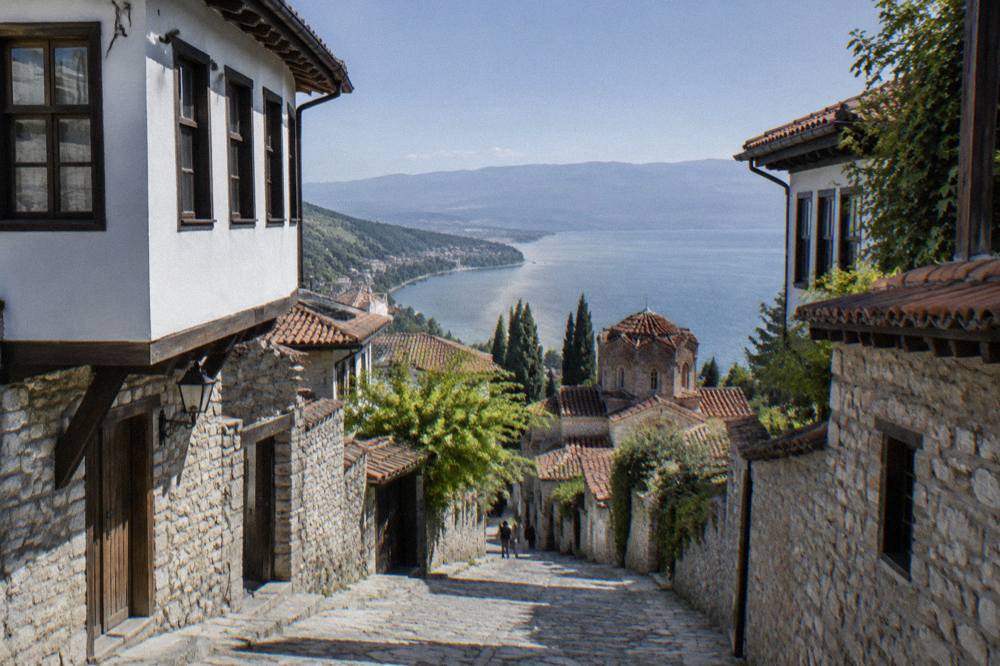
For a country circuit, the honest summary the sources support is this: Ohrid is the destination, Skopje is the gateway, and everything else, Bitola, Struga, Vevcani, Lake Prespa, is a day trip radiating out from the lake. Five days based in Ohrid with one or two outward days covers North Macedonia as thoroughly as a short first visit reasonably can.
Common Questions About North Macedonia Travel
Is North Macedonia in the EU or Schengen?
No to both. North Macedonia is outside the European Union and outside the Schengen area, so border checks apply on entry and the euro is not legal tender. Bulgaria and Romania became full Schengen members, land borders included, on 1 January 2025.
What currency is used in Ohrid?
The Macedonian denar (MKD). The National Bank's middle rate on 19 October 2026 was 1 EUR = 61.6633 MKD, and the denar is de facto pegged to the euro. ATMs are the practical way to get cash.
Do I need a visa for North Macedonia?
Visa-free nationals can stay up to 90 days in any 180-day period. UK visitors can stay up to three months with a passport valid at least 90 days beyond arrival, and everyone registers with the local police within 48 hours, which hotels do for guests.
How far is Ohrid from Skopje?
About 170 km by road. The bus takes roughly three hours and costs 850 to 950 MKD one way; a car takes about 2.5 hours plus about 140 MKD in tolls. There is no passenger train to Ohrid and no domestic flight.
What is the best time of year to visit Ohrid?
July to September for swimming, when modelled lake surface temperatures are at their warmest, with August the busiest month on the modelled normals' 27.6 C mean high and lowest rain at 32.9 mm. May, June and September bring warm air with fewer visitors, and winter is cold, with snow in town and road closures possible in Galicica.
How much do the Ohrid sights cost?
The museum institute's sites, Robev Family House, the Museum on Water at the Bay of Bones and the Icon Gallery, charge 150 MKD for foreign visitors and 120 MKD for domestic visitors, and are closed on Mondays. St Naum monastery entry is listed at 150 MKD on a cruise operator's tariff, and Galicica charges 250 MKD per vehicle.
A first North Macedonia trip almost always becomes an Ohrid trip with excursions attached, and the planning sequence that fits the sources is simple: fly or bus to the lake, give the old town its full days, then spend the spare ones on the water to St Naum, up into Galicica, or across the border to the Albanian shore.