Ohrid Accessibility: Cobbles, Steps And Wheelchair Routes
Ohrid's old town climbs from the lakeshore to Samuel's Fortress on cobbled lanes, which makes planning around steps and gradients a real part of any trip. Here is what the terrain, transport and ticket facts actually say.
Short answer
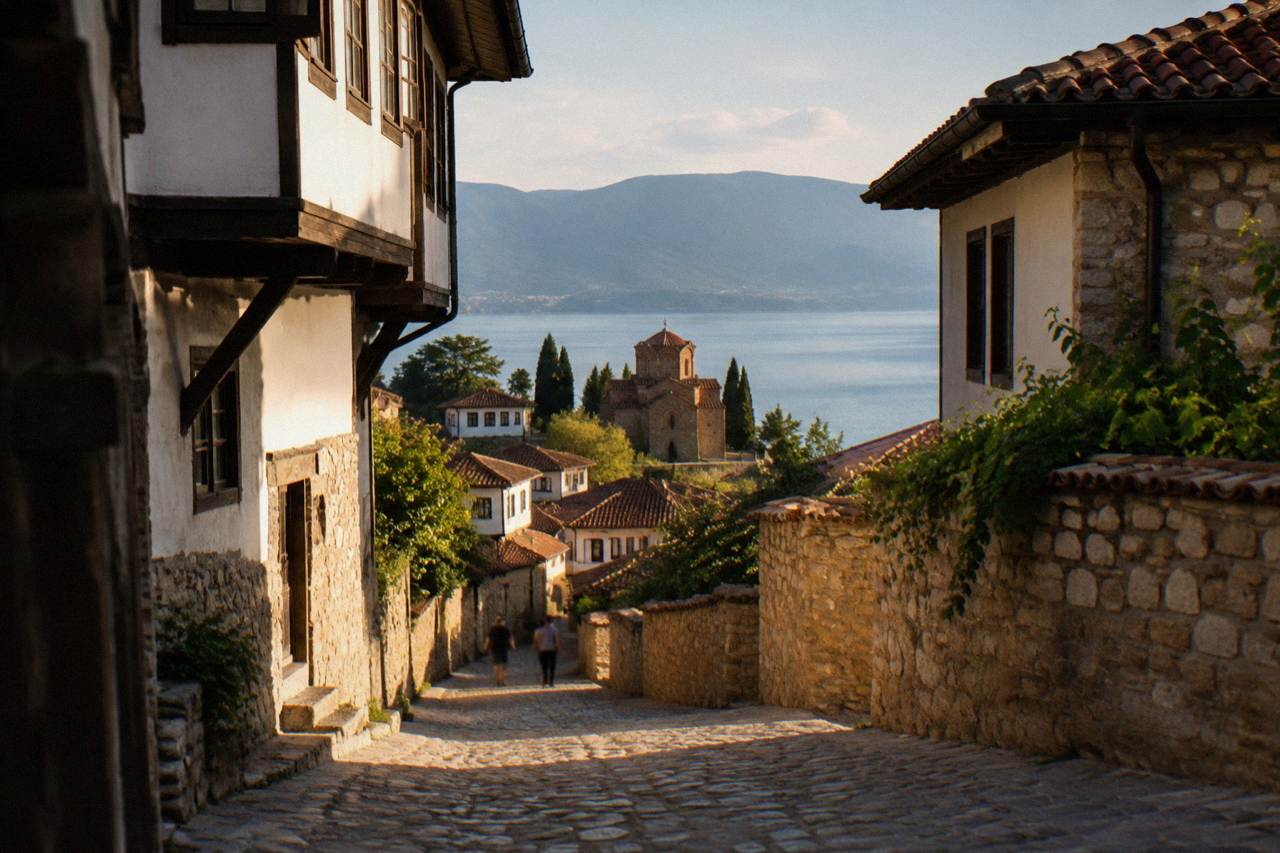
Ohrid's old town is hilly and cobbled in parts, with lanes climbing from the lake at about 693 m up to the fortress; the lakeshore, boats and several museum sites give flatter alternatives, and taxis, buses and airport transfers handle the distances.
Ohrid sits on the shore of Lake Ohrid in North Macedonia, a freshwater mountain lake whose surface sits at about 693 m above sea level, and the town's character is written into its slopes: the old town climbs from the water up toward Samuel's Fortress, and the lanes between are on foot, hilly and cobbled in parts. For anyone planning a visit around limited mobility, a stroller or simply a dislike of steep stone, the honest starting point is terrain, and this Ohrid Travel Guide page works through it with the published facts: what the ground actually does, where the flatter options are, what taxis and buses cost, and which museum sites keep which hours. Nothing here rates a single sight for wheelchair use, because no such rating exists in the published record; what it does give is the ground truth you can plan against.
What Is The Terrain Like In Ohrid's Old Town?
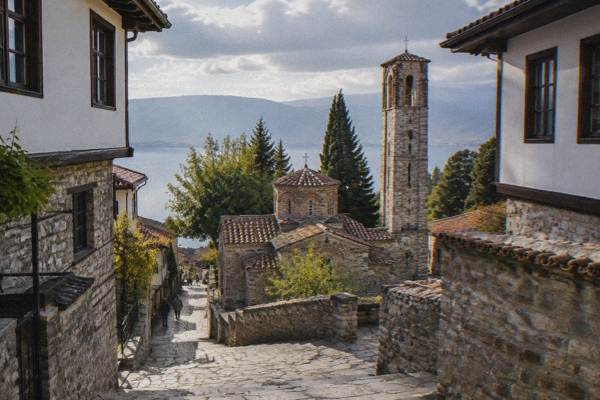
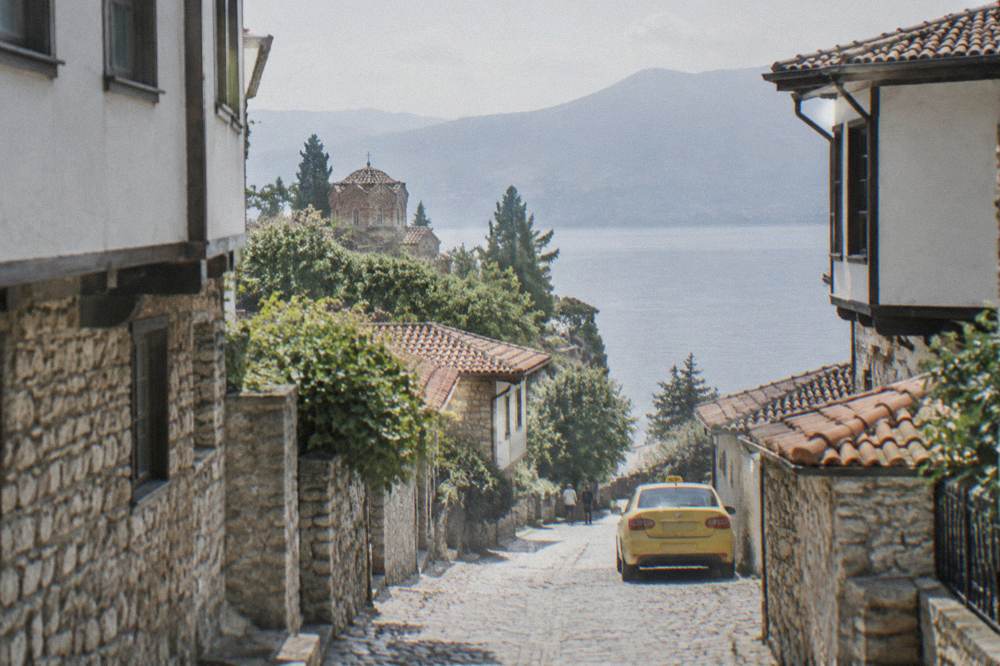
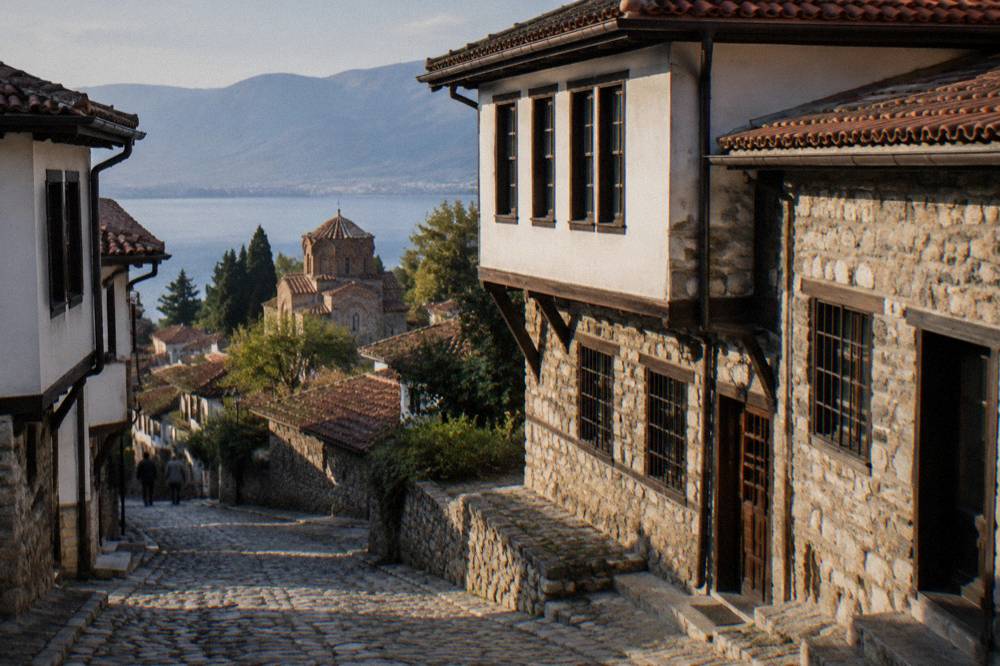
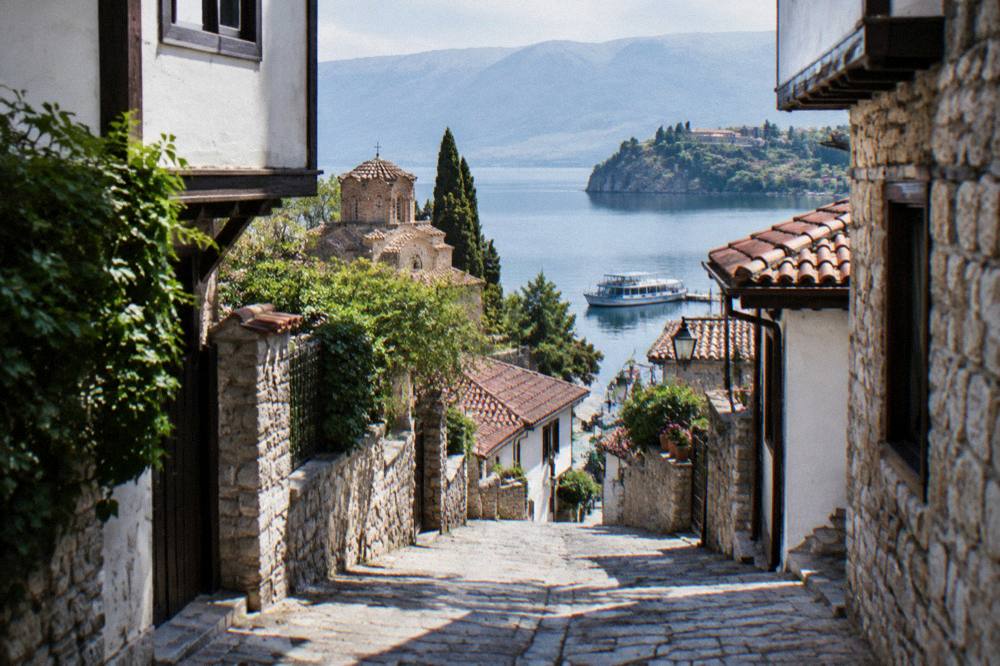
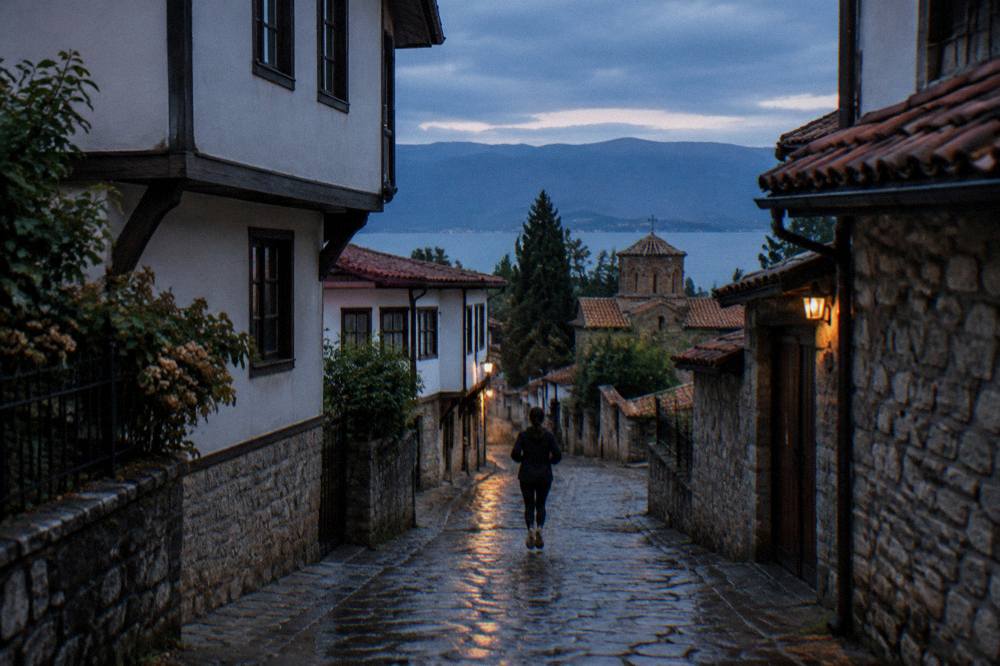
Ohrid's Old Town is hilly and cobbled in parts, built on a slope with pedestrian lanes climbing from the lakeshore up to Samuel's Fortress rather than smooth roads. The lake sits at about 693 m above sea level and the fortress sits above the town, so any route between them gains height. Horizontal distances are short but vertical ones are not, and the surfaces in between are stone, meaning footwear with grip matters more than in a flat town.
Two practical consequences follow. First, the direction of travel matters: a lane that reads as a gentle stroll going down reads as a sustained climb going back up, and many visitors plan their day downhill, from the fortress end toward the lake, for exactly that reason. Second, footwear matters more than in a flat town, because cobbles and worn stone steps reward grip. The old town guide covers how the districts fit together; this page stays on the physical questions.
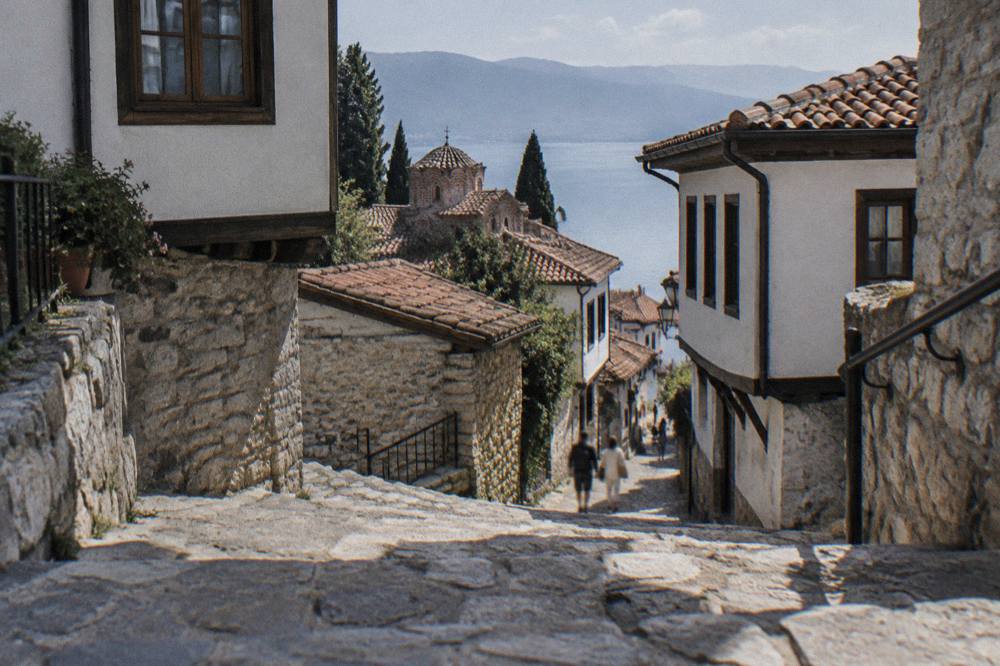
What the published record does not contain matters too. There is no published accessibility rating for individual sights, no list of which church entrances have ramps and which have steps, and no survey of dropped kerbs. Any page offering a sight-by-sight verdict is guessing. What can be stated is structural: the town is built on a slope, the old core is a network of pedestrian lanes, and the modern parts of town around the bus station and the eastern shore are ordinary streets with ordinary pavements. Planning around that divide, lakeshore and east versus hillside old core, is the reliable move.
Which Parts Of Ohrid Are Easiest To Reach Without Climbing?
The lakeshore is Ohrid's flattest corridor: the boardwalk and the town beaches sit at water level, boat cruises leave from the port area, and the eastern shore villages such as Lagadin and Peshtani sit on the lakeside road rather than on the hill. If a day's plan keeps to the water, the gradients largely disappear. This is why so many visitors structure their trip as a shore day and a hill day rather than mixing the two, and why boats carry a bigger share of sightseeing here than in most inland towns.
The shore options are real ones, with published figures behind them. Boat Armada runs a full-day cruise from Ohrid port to St Naum, seven hours, from 1,200 den for an adult and 600 den for a child, with stops along the way. The boats and ferries guide collects the lake options in one place. On land, the Bay of Bones, the Museum on Water at Gradishte near Peshtani, sits by the lakeside road, and its museum hours are published site by site, which matters when a whole day hangs on one opening time.
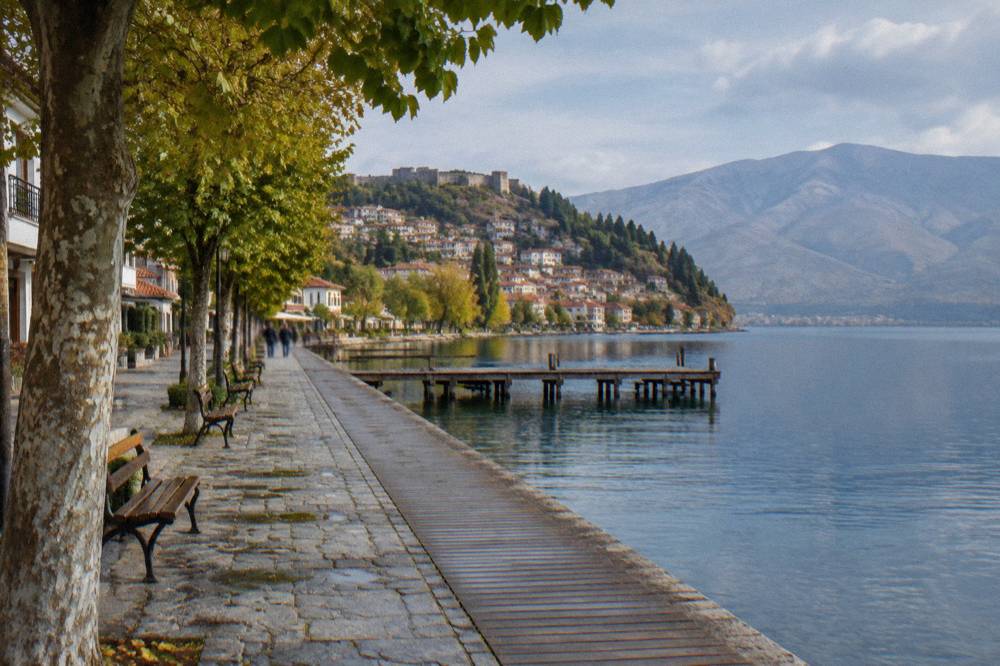
The lake itself is a constant rather than a season-long obstacle course. Modelled surface temperatures put January at about 4.6 C and August at about 23.5 C, with the swimming season running from July, so shore time is a summer plan more than a year-round one. The October mean from the national hydrometeorological service's multi-year record is 14.3 C. None of that changes the terrain, but it changes how much of the day sensibly sits by the water.
How Do You Get To Ohrid If Walking Is Difficult?
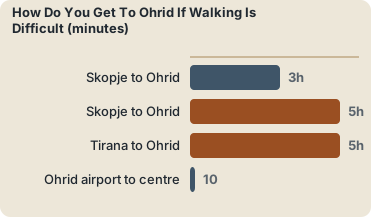
Ohrid's airport is about 10 km from the centre, a taxi from it is reported at about 600 to 800 den or about 12 euros, and intercity buses arrive at the bus station east of the centre, so the last kilometre into the old town is the part to plan. Distance is not the problem; the final approach is. The old core's lanes are pedestrian, so whichever way you arrive, car, bus or plane, the trip ends with a decision about how far to walk and where to stop.
The long-distance options carry published figures. Skopje is about 170 km away by road: buses take about three hours and cost 850 to 950 den one way, while a car covers about 172 km in about 2.5 hours plus about 140 den in motorway tolls, and a private transfer is quoted from about 130 euros. From Tirana, minibuses run several times a day, taking three to three and a half hours including the border, for about 15 to 20 euros. The how to get to Ohrid guide and the Skopje to Ohrid and Tirana to Ohrid pages carry the detail.
| Route | Mode | Time | Cost |
|---|---|---|---|
| Skopje to Ohrid | Intercity bus | About 3 hours | 850 to 950 den one way |
| Skopje to Ohrid | Car | About 2.5 hours, about 172 km | About 140 den in tolls |
| Skopje to Ohrid | Private transfer | Road time varies | From about 130 euros |
| Tirana to Ohrid | Minibus (furgon) | 3 to 3.5 hours with border | About 15 to 20 euros |
| Ohrid airport to centre | Taxi | Short drive, about 10 km | Reported 600 to 800 den, about 12 euros |
Two local facts tighten the picture. Since summer 2026 the streets Ilindenska, Kosta Abrash and Car Samoil in the old part of town are reserved for residents with a valid sticker, with clamping reported for non-residents, so driving into the old core is not a parking strategy even if the lanes allowed it. And in-town taxi rides are short and cheap by wider European standards, with a ride from the bus station reported at about 150 to 200 den; the taxis page covers how they work. Agree the fare in advance or ask for the meter, which is the standard local advice.
What Do The Museum Sites Charge And When Are They Open?
The Institute and Museum Ohrid's sites, including Robev Family House, the Bay of Bones and the Icon Gallery, charge 120 den for domestic visitors and 150 den for foreign visitors, with a reported 60 den rate for children and students, and each site keeps its own published hours with Monday closures. These are the town's main indoor sights, and their schedules are the part of an Ohrid plan most worth writing down in advance, because the winter and summer schedules differ site by site.
The institute runs a winter schedule from 1 October to 30 April and a summer schedule from 1 May to 30 September. Within that, each site has its own times, and they do not move one site's hours onto another. Robev Family House on Tsar Samoil Street runs 09:00 to 15:30 in winter and two summer shifts from 1 May, 09:00 to 15:30 and 13:30 to 20:00, closed Monday. The Bay of Bones runs 09:00 to 15:30 in winter and 09:00 to 16:30 in summer, closed Monday. The Icon Gallery in the Perivleptos complex runs 09:00 to 14:00 in winter and 09:00 to 17:00 in summer, closed Monday.
| Museum site | Winter hours (1 Oct to 30 Apr) | Summer hours (1 May to 30 Sep) | Closed |
|---|---|---|---|
| Robev Family House | 09:00 to 15:30 | Two shifts, 09:00 to 15:30 and 13:30 to 20:00 | Monday |
| Bay of Bones, Museum on Water | 09:00 to 15:30 | 09:00 to 16:30 | Monday |
| Icon Gallery, Perivleptos complex | 09:00 to 14:00 | 09:00 to 17:00 | Monday |
| Institute offices, Boro Shain St 10 | Mon to Fri 07:30 to 15:30 | Mon to Fri 07:30 to 15:30 | Weekends |
Tickets are 120 den domestic and 150 den foreign across the institute's listed sites, per the institute's own site; the 60 den child and student rate is reported only, so check it at the desk. The fortress sits at the top of the old town's slope, which is a separate planning question from its admission, and the hill itself is the thing to weigh.
Can You See St Naum And The Lake Without The Hills?
Yes, by boat and by road: the full-day cruise from Ohrid port to St Naum runs seven hours from 1,200 den for an adult and 600 den for a child, St Naum monastery's entrance is listed at 150 den per person by a cruise operator, and the Crn Drim springs rowboats cost about 5 euros. St Naum is a day trip from Ohrid, at the lake's far end, and both ways of reaching it avoid the old town's gradients entirely, because you travel by water or along the lakeside road rather than up through the lanes.
The boat is the lower-effort option by design: you board at the port and sit while the lake goes past. Boats to St Naum generally run about May to October and reduce in winter, so the water option is seasonal. The road option runs year-round, and the border is close by, with the Tushemisht crossing about 4 km from St Naum, a taxi quoted at 400 den and up to an hour allowed for the crossing. That nearness is why some visitors combine St Naum with a look across into Albania around Pogradec.
The water also has its own 2026 rulebook worth knowing before you book anything with an engine. Under a government decision dated 2 June 2026, jet skis are banned from 1 July to 31 August between 11:00 and 19:00, and boats are banned at night, 21:00 to 05:00 from 3 June to 31 August and 20:00 to 06:00 through September, with a further October limit. These are dated rules for swimmer safety, not permanent law, but they shape what runs when. The Bay of Bones boat trips, which pair the museum with a cruise, are covered on the Bay of Bones pages.
| Lake option | Published figure | Season note |
|---|---|---|
| Full-day cruise, Ohrid port to St Naum (Boat Armada) | 7 hours, from 1,200 den adult, 600 den child | Boats generally run about May to October |
| St Naum monastery entrance | Listed at 150 den per person by a cruise operator | Day-trip destination at the lake's far end |
| Rowboat at the Crn Drim springs | About 5 euros per boat | At St Naum itself |
| Bay of Bones entrance | 150 MKD per person, per a cruise operator's list | Museum hours as in the table above |
What About Weather, Money And Emergencies While Planning?
Ohrid's modelled climate normals, ERA5 reanalysis for 1991 to 2020, put July highs at 27.1 C and January highs at 5.0 C with January lows of -0.8 C, the currency is the Macedonian denar pegged in practice to the euro, and the emergency numbers are ambulance 194, police 192 and roadside assistance 196. None of these are accessibility facts in the narrow sense, yet all three decide whether a planned route is walkable, payable and safe on the day.
The climate figures deserve their label: they are modelled normals from a reanalysis grid cell, not a station record, and the year's rain totals 816.6 mm, with December at 92.6 mm and August at 32.9 mm. Rain matters on cobbles more than on asphalt, and winter precipitation in Ohrid includes snow, with heavier snow on Galicica above town. Galicica National Park, North Macedonia's second national park, proclaimed in 1958, covers 22,750 ha between Lake Ohrid and Lake Prespa with Magaro peak at 2,254 m, and heavy snow can close its main road typically from January to March. The park charges 250 den per vehicle with no per-passenger fee, and 100 den only for someone entering on foot from the Ohrid-side gate.
On money: North Macedonia is not in the EU or Schengen, the denar is the local currency, and euros are commonly quoted for tours and transfers but are not legal tender. Visa-free nationals may stay up to 90 days in any 180-day period; UK visitors may stay up to 3 months, must hold a passport with an expiry date at least 90 days after arrival, and must register with the local police within 48 hours, which hotels do for guests. The denar and money guide and the visa and entry page carry the detail, and the is Ohrid safe page covers the broader safety picture.
| Practical item | Figure | Note |
|---|---|---|
| Ambulance | 194 | Confirmed on official travel advice |
| Police | 192 | Confirmed on official travel advice |
| Roadside assistance | 196 | Confirmed on official travel advice |
| Visa-free stay | Up to 90 days in any 180 | For visa-free nationals |
| UK visitors | Up to 3 months, passport valid 90 days beyond arrival | Police registration within 48 hours, hotel does it |
| Galicica entry | 250 den per vehicle, 100 den on foot from the Ohrid gate | No per-passenger fee |
Which Tours Suit A Slower Or Self-Paced Visit To Ohrid?
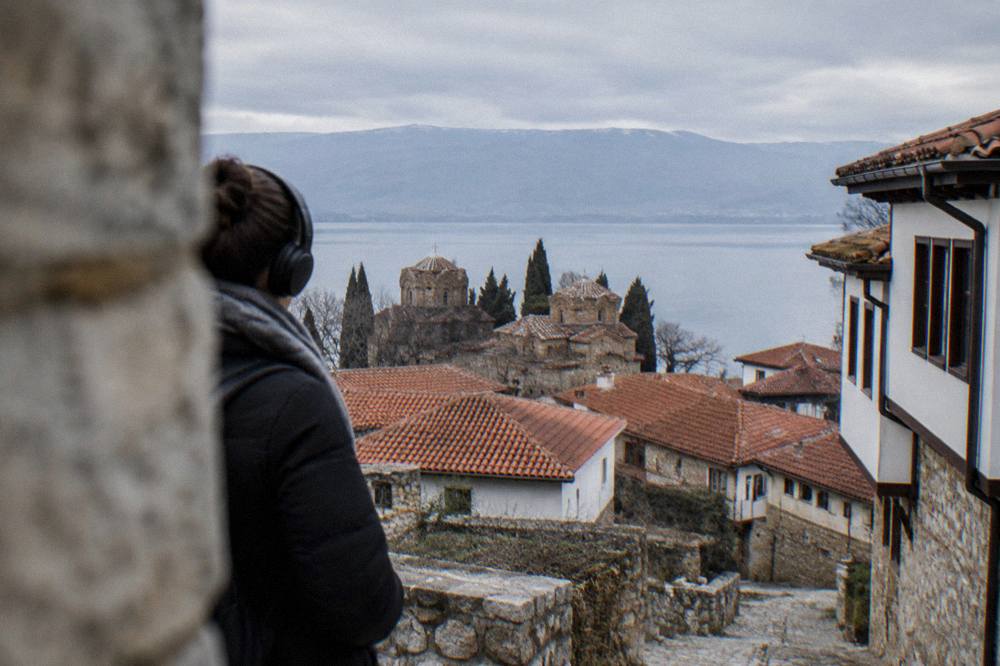
A self-guided audio tour, a private day tour and a full-day boat trip are the three formats that hand you control over pace, because each sets its own rhythm rather than following a fixed group walk, and all three are bookable products with live listings. The audio tour covers the old town's stories through headphones, which means you stop when you want and skip any lane that looks too steep on the day; its own page describes what it includes, and Check availability shows the operator's live terms.
The private format solves a different problem: a private day tour from Tirana and Durres puts the vehicle, the route and the stops in your hands, which matters when a fixed group itinerary would commit you to a walk you cannot judge in advance. The boat format solves the hill problem outright, since boarding at the port replaces climbing entirely, and the Bay of Bones cruise pairs the lakeside museum with the water. None of these is rated for accessibility by anyone, and no page should claim they are; what they offer is pace control, which is the part you can actually verify from the listing.
A longer stay spreads the slopes thinner, and the how many days in Ohrid question answers itself differently when each day holds one hill rather than three. The best time to visit page pairs the season with what runs then, and the weather guide has the monthly figures behind it. If budget shapes the plan, the cost and budget page sets out what a stay costs.
Common Questions About Accessibility In Ohrid
Is Ohrid's old town wheelchair accessible?
The old town is hilly and cobbled in parts, with pedestrian lanes climbing from the lake to the fortress, and no published accessibility rating exists for individual sights. The lakeshore, the port area and the modern streets around the bus station are the flatter parts of town.
Is Ohrid walkable for someone who struggles with hills?
Partly. The horizontal distances are short, but the vertical gain between the waterfront and the fortress is real, and the surfaces are stone. Many visitors plan downhill routes, use taxis for the climb, and spend shore days on the boardwalk and beaches.
How much is a taxi from Ohrid airport to the centre?
The airport is about 10 km from the centre, and the fare is reported at about 600 to 800 den, about 12 euros. Agree the price in advance or ask for the meter.
Are Ohrid's museums open on Mondays?
No. Robev Family House, the Bay of Bones and the Icon Gallery are all closed on Mondays, and each keeps its own published winter and summer hours.
Can you visit St Naum without walking the old town?
Yes. St Naum is a day trip from Ohrid reached by boat or by the lakeside road, and the full-day cruise from the port takes about seven hours. Boats generally run about May to October and reduce in winter.
What are the emergency numbers in Ohrid?
Ambulance 194, police 192 and roadside assistance 196, as listed on official travel advice for North Macedonia.