Ohrid Food: Trout, Tavče Gravče And What To Order
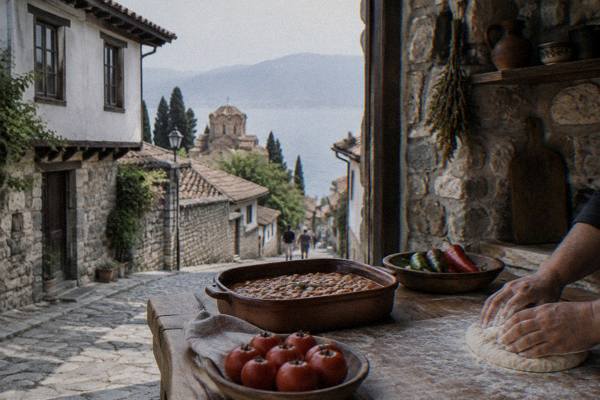
Ohrid's food comes off the lake and out of the mountains: trout, beans baked in clay, meze plates and local wine, eaten in a UNESCO-listed old town on the shore of Lake Ohrid.
Short answer
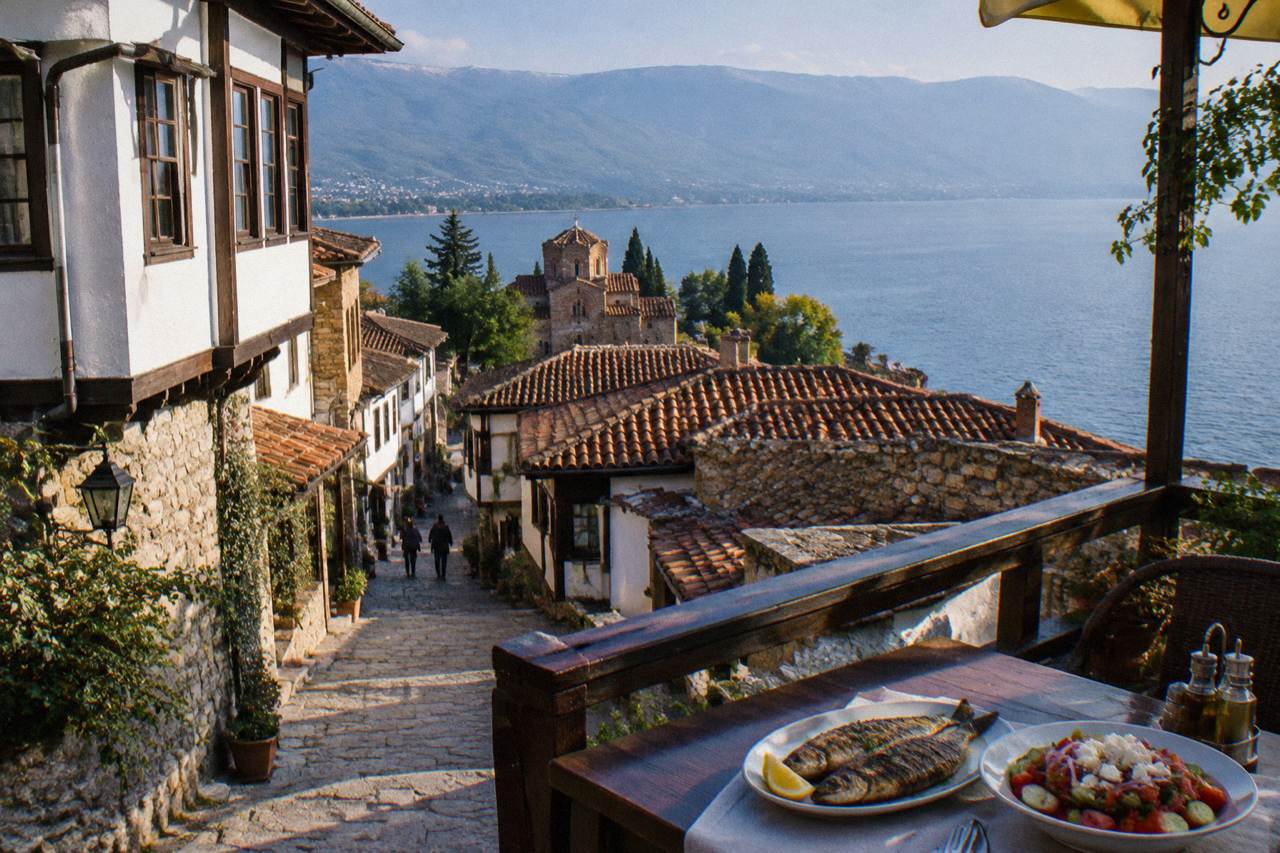
Order Ohrid trout when it is on the menu as lake fish, try tavče gravče as the national baked-bean dish, build meals around meze plates with rakija or Macedonian wine, and eat in the old town lanes or along the lakeshore in Ohrid, North Macedonia.
Ohrid sits on Lake Ohrid, a freshwater mountain lake at about 693 m above sea level in North Macedonia, and its kitchen draws on two larders at once: the lake itself and the high farmland around it. The town is the centre of a UNESCO mixed heritage site, the "Natural and Cultural Heritage of the Ohrid Region", inscribed in 1979 and 1980, and the food culture is part of what holds visitors in the old town for days rather than hours. This page from the Ohrid Travel Guide covers the dishes that define the town, what to order on a first visit, and how a food trip fits into a wider stay, with a companion piece in things to do in Ohrid.
What Food Is Ohrid Known For?
Ohrid is known for lake fish above all, led by the Ohrid trout that gives Lake Ohrid its culinary reputation, followed by tavče gravče, the national baked-bean dish, by meze spreads of cured meat, cheese and ajvar, and by local wine and rakija served in the tavernas of the old town and the villages around the lake.
The order of that list matters. Fish sits first because the lake is the reason there is a distinctive cuisine here at all. UNESCO's listing for the Ohrid region records more than 200 endemic species in the lake, including 17 endemic fish, which is why fish carries such weight on local menus. Below the fish comes the mountain pantry: beans, peppers, tomatoes, cheese cured in brine, and the clay-pot cooking that produces tavče gravče. Around everything sits the meze habit, small plates meant to stretch an evening, usually with a short glass of rakija or a carafe of local red.
A first-time visitor does not need to work hard to find any of this. The lanes between the Old Bazaar and the lakeshore hold the densest run of kitchens, and everything on this page is standard taverna territory rather than specialist dining. The deeper guide to the signature bean dish is at tavče gravče, and the fish story continues on the Ohrid trout page.
Ohrid Trout: The Lake Fish That Defines The Town
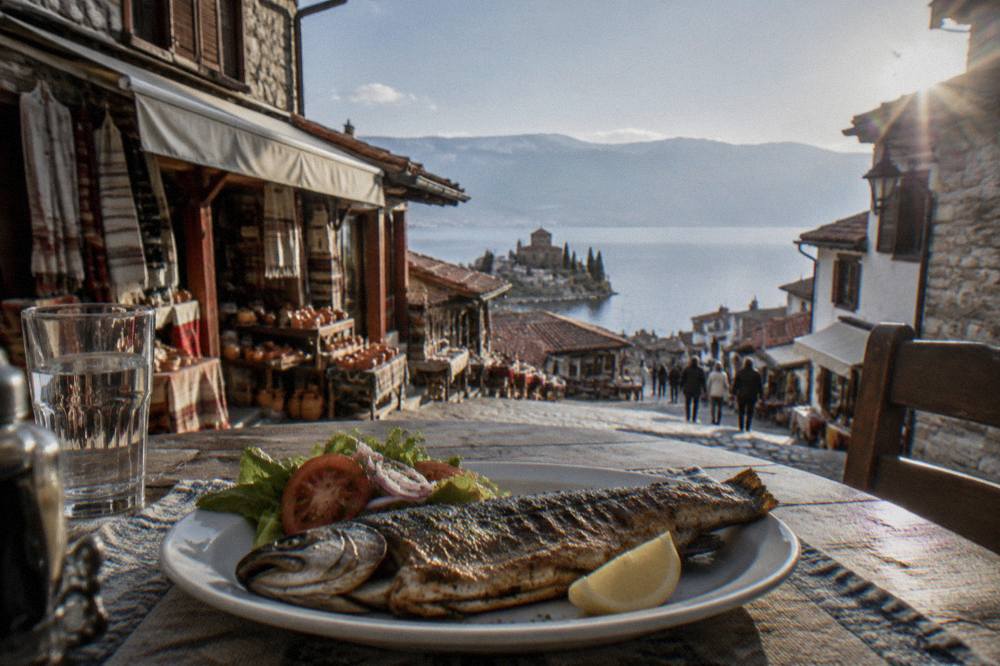
Ohrid trout is the town's signature dish, a lake fish endemic to Lake Ohrid that is traditionally served grilled or baked with lemon and simple sides, and it is the single most ordered plate in the old town's restaurants, though the wild fish is protected and much of what is served today comes from fish farms around the lake.
The UNESCO record for the lake lists 17 endemic fish species, and the Ohrid trout is the one that made it onto plates and postcards. Because wild stocks are protected, the responsible version of the dish is the farmed trout, and menus that serve it will usually say so. Grilled whole with a wedge of lemon, a green salad and a cold beer is the standard treatment, and it is a hard order to improve on anywhere along the shore.
Two practical notes shape the order. First, ask whether the trout on the menu is farmed: wild Ohrid trout should not be served, and a kitchen that is clear about its sourcing is doing the right thing by the lake. Second, trout is not the only fish worth ordering. The lake's endemic list and the daily catch mean other local fish appear too, and a mixed fish plate for two is often the better introduction to what the water actually produces. The context for all of it is the lake itself, covered in full at Lake Ohrid.
| Dish | What It Is | How It Is Usually Served |
|---|---|---|
| Ohrid trout | Lake fish endemic to Lake Ohrid, now mostly farmed | Grilled or baked whole, with lemon and salad |
| Other lake fish | Fish from the lake's daily catch, several species endemic | Grilled or fried, often as a mixed plate |
| Trout-roe starter | Cured roe, a lake-kitchen classic | As a spread or a small plate with bread |
Tavče Gravče: The National Dish You Will Eat Twice
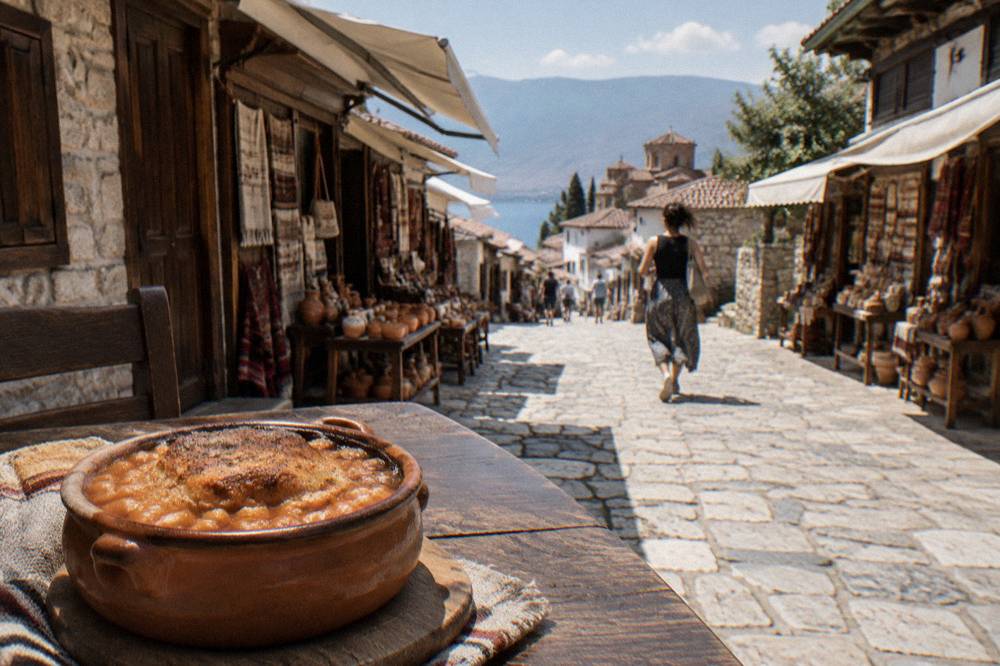
Tavče gravče is North Macedonia's national dish, white beans baked slowly in a traditional clay pot called a tavča, with onion, red pepper and oil, and in Ohrid it appears on nearly every menu as the standard main alongside the fish, thick-crusted on top and soft underneath, usually ordered with a side of shopska salad and bread.
The dish belongs to the whole country rather than to Ohrid alone, but a lakeside town at altitude is exactly the climate where baked beans became a staple, and the local version is a fixture of old-town kitchens. The clay pot is the point of the exercise: the bean and pepper base bakes until the top crusts over, and the pot arrives at the table still bubbling. It is hearty, meatless in its classic form, and cheap relative to the fish, which is why it earns its place as the everyday plate.
Order it once as a main with salad and bread, and once as part of a wider spread, because tavče gravče sits well next to grilled meat and meze. Vegetarians in particular will find it the reliable backbone of a week's eating here. The full story of the dish, its clay pot and its place in Macedonian home cooking is on the tavče gravče page.
Meze, Rakija And Macedonian Wine: The Evening Spread
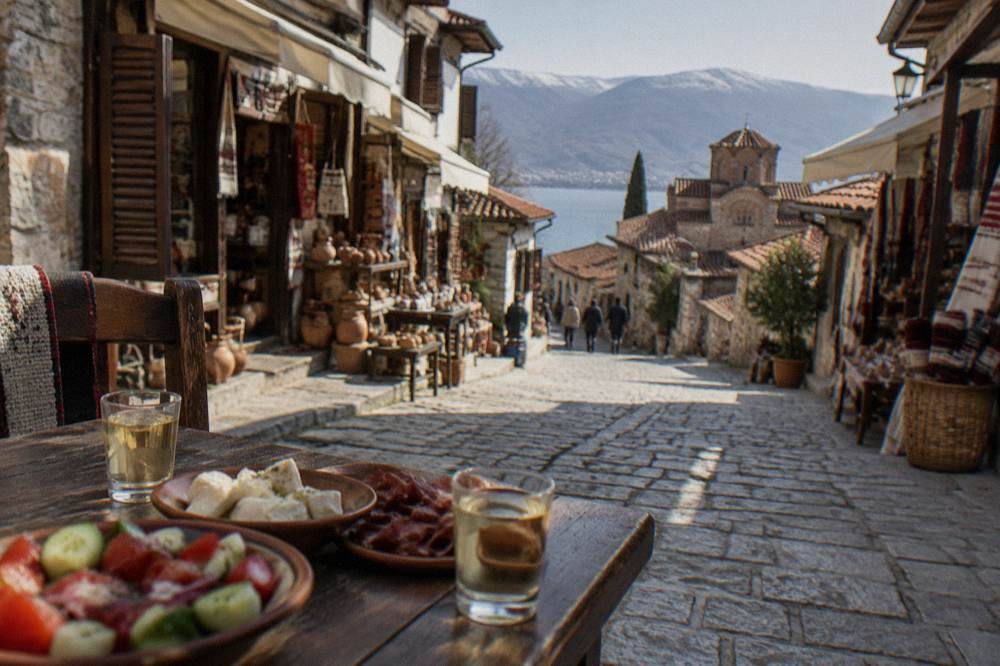
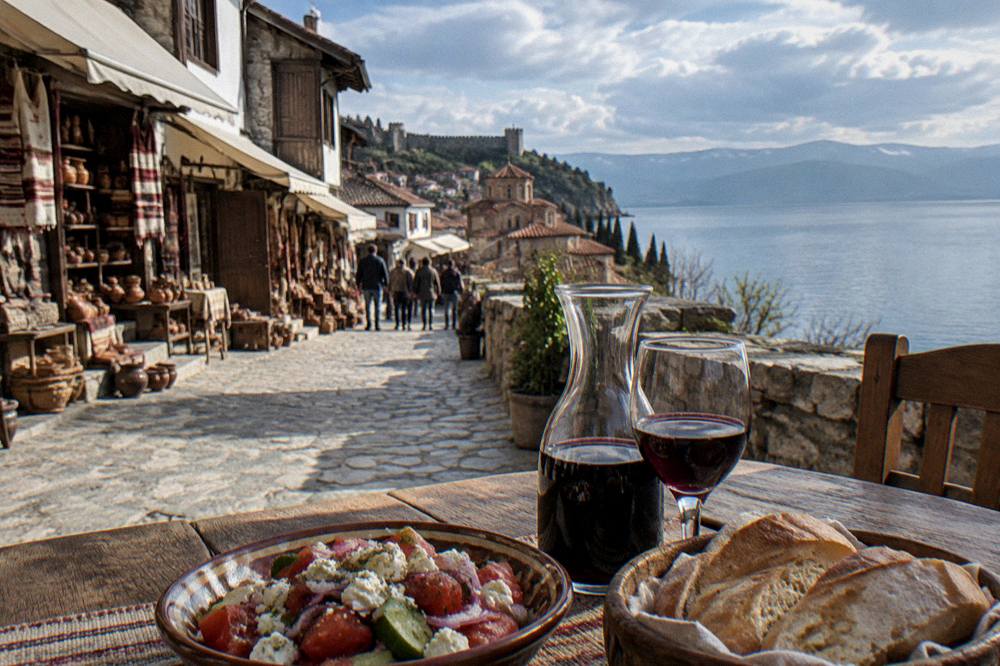
Meze is the social format of eating in Ohrid: a spread of small plates, cured meats, brined cheese, ajvar, olives and bread, opened with a small glass of rakija, the regional fruit brandy, and carried on with Macedonian wine, of which the red Vranec is the country's best-known grape, poured by the carafe in most old-town tavernas.
The mechanics are simple and worth knowing before the first order. Rakija arrives first, in small glasses, as an opener rather than a session drink; it is strong, and it exists to start the meal and the conversation. Then the plates land: shopska salad with its white cheese topping, ajvar made from roasted red peppers, cured meat, and bread. Wine follows. Macedonian winemaking has a long history on its own territory, and the local lists lean toward red, with Vranec the name to look for.
A meze evening in Ohrid is also the cheapest way to eat well late, because the format rewards slowness over volume. For visitors who want the same story told with the glass in hand, a tasting does the job, and the wine side of the region's table is walked in full on the page about Macedonian wine and rakija.
Curious to taste the local wines with the story behind them? Book a private wine tasting here.
| Element Of The Spread | What To Expect | Role At The Table |
|---|---|---|
| Rakija | Fruit brandy, served in small glasses | The opener, poured before the food |
| Shopska salad | Tomato, cucumber, pepper and grated white cheese | The standard first plate |
| Ajvar | Roasted red pepper relish, often house-made | Spread for bread, served with everything |
| Brined cheese | White cheese cured in brine, sheep or cow | Eaten with bread or salad |
| Vranec | Macedonia's best-known red grape | The usual carafe red on local lists |
What About A Cooking Class In Ohrid?
A cooking class in Ohrid puts a visitor in a home-style kitchen for an afternoon of preparing the dishes this page describes, typically the baked beans, the salads and the pastry work, with the meal eaten at the end, and it is the one food activity that turns recipes you have eaten once into something repeatable at home.
Classes in the town centre around the classics: the clay-pot bean bake, the pepper relishes, and the filo pastries that carry cheese or meat. The format suits families and small groups, since the work is hands-on but undemanding, and the payoff is lunch. For visitors staying longer, a class pairs naturally with a day of eating through the old town, and the timing questions are answered on how many days in Ohrid.
Sweets, Coffee And Breakfast In Ohrid
Breakfast in Ohrid runs to burek, the filo pastry filled with cheese, meat or spinach, bought by weight and eaten with yogurt or ayran, while the sweet end of the day belongs to Turkish-style coffee, baklava and the plain cakes served in the old-town cafés, all of it unpriced here but inexpensive by any European measure.
The burek counter is the morning institution. It is bought by the slice or by the kilo, cut from a spiral tray, and eaten standing or at a small table with a glass of ayran, the salted yogurt drink. Pastry shops sell the same filo work in sweet form, and baklava with a small coffee is the standard afternoon stop between the church climbs. Ice cream in generous scoops does the rest of the day's work along the lakeshore.
None of this needs a plan. The pastry counters open early, the cafés fill mid-morning and again in the late afternoon, and the hardest decision is cheese or spinach. Visitors building a full day around the town, food included, can lift the structure from the Ohrid in one day itinerary.
Where To Eat In Ohrid: Old Town, Shore And Villages
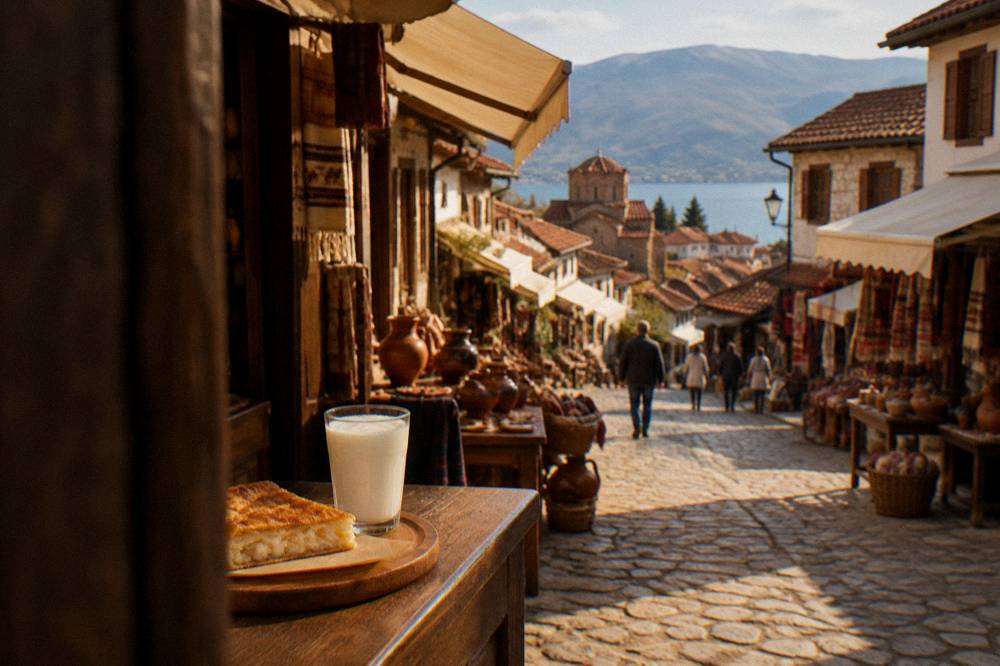
The main eating grounds in Ohrid are the old-town lanes between the Old Bazaar and the lake, the restaurant terraces along the lakeshore themselves, and the village kitchens scattered along the southern shore toward St Naum, each with a different strength: lanes for taverna classics, the shore for fish with a view, and the villages for slow, home-style mountain cooking.
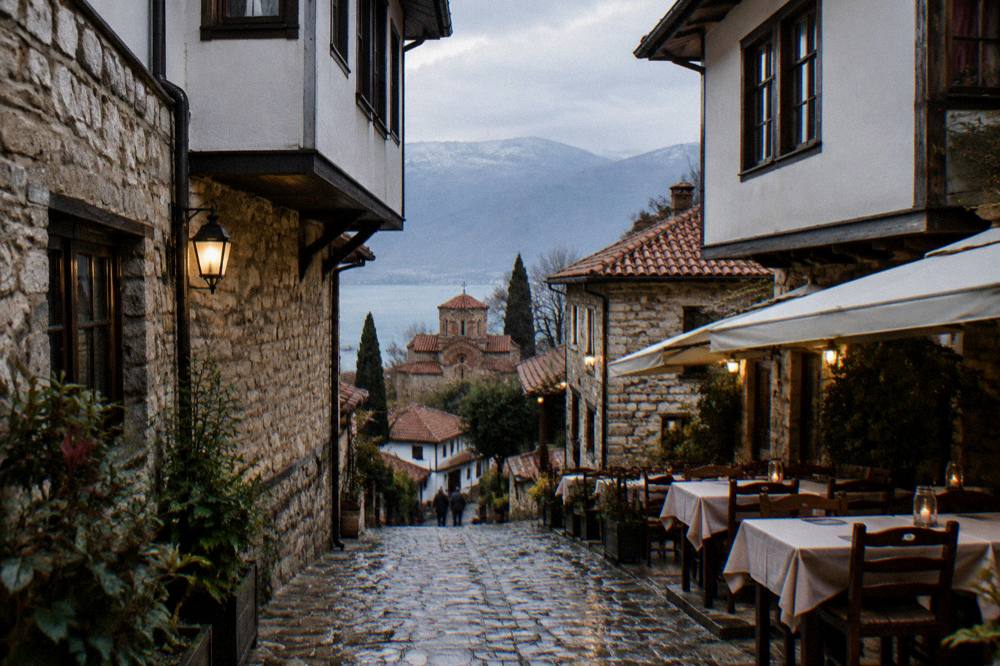
The old-town choice rewards walkers. The lanes climb from the water toward Samuel's Fortress, and kitchens sit at every level, so a day of sightseeing can be punctuated without planning. The shore terraces concentrate around the harbour and the boardwalk and specialise in the lake fish, ordered with a salad and eaten slowly. The southern shore, reached by road or by boat in the main season, holds the village tables where the mountain pantry does the talking.
One caution keeps the fish order honest: ask whether the trout is farmed rather than wild, since the wild fish is protected. Everything else on the standard menu is fair game, and the wider restaurant landscape is covered on the Ohrid restaurants page.
A guided taste of the villages does more than a menu can: the cave-church-and-villages trip that leaves from Ohrid builds a day around village cuisine in the hill country outside town, and pairs it with the painted cave churches that make that landscape famous. Check availability if the plan fits your dates.
Eating With The Seasons: What The Lake And The Year Decide
Ohrid's food follows the lake and the calendar, and the practical version is this: lake fish and shore terraces belong to the warm half of the year, bean pots and heavier clay-pot cooking to the cold half, and the shoulder months of spring and autumn are when both kitchens run side by side, with the ERA5 climate normals for Ohrid showing July and August averaging 27.1 and 27.6 C mean daily highs against 5.0 C in January.
The climate table drives the eating year more than any menu does. In the modelled ERA5 normals for 1991 to 2020 for the Ohrid grid cell, July and August are the warm months with mean daily highs of 27.1 C and 27.6 C and the lowest rain of the year at 34.7 and 32.9 mm, while November and December carry 90.4 and 92.6 mm of rain. Terrace season therefore runs through the summer, and the clay-pot season takes over as the mean daily low falls to -0.8 C in January.
The lake temperature sets the swimming-and-fish-shore rhythm. Modelled aggregator figures put the surface at about 4.6 C in January and about 23.5 C in August, with the UHMR multi-year October mean at 14.3 C, so the water is genuinely warm only from July. The full climate picture, including what it means for boats and beaches, is on Ohrid weather, and the timing trade-offs for the whole trip are on the best time to visit Ohrid.
| Month | Mean Daily High C | Mean Daily Low C | Rain Mm | Modelled Lake Surface C |
|---|---|---|---|---|
| Jan | 5.0 | -0.8 | 76.5 | 4.6 |
| Feb | 6.3 | 0.0 | 74.3 | 5.4 |
| Mar | 10.0 | 2.5 | 80.5 | 7.2 |
| Apr | 14.6 | 6.3 | 82.4 | 10.5 |
| May | 19.5 | 10.8 | 70.8 | 14.9 to 18.7 |
| Jun | 24.2 | 15.2 | 43.1 | 19.4 to 22.5 |
| Jul | 27.1 | 18.3 | 34.7 | 22.9 |
| Aug | 27.6 | 19.0 | 32.9 | 23.5 |
| Sep | 22.4 | 14.9 | 62.4 | 19.7 to 25.0 |
| Oct | 17.4 | 10.3 | 76.0 | 14.7 |
| Nov | 11.5 | 5.3 | 90.4 | 10.3 |
| Dec | 6.2 | 0.9 | 92.6 | 6.0 |
Food Shopping In Ohrid: The Old Bazaar And Markets
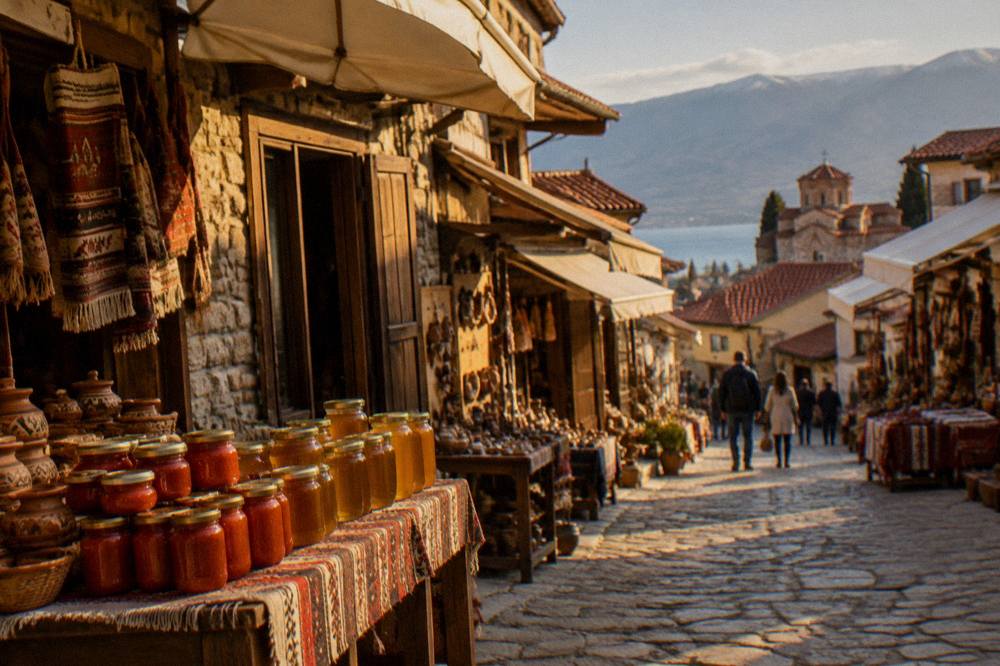
The Old Bazaar is Ohrid's food-shopping heart, a historic market street of the old town selling roasted peppers and ajvar by the jar, honey from the surrounding hills, dried herbs, raki and the famous Ohrid pearl, alongside everyday grocers selling cheese, cured meat and bread for a self-catering stay.
Shopping here is souvenir and pantry at once. The jars are the main prize: ajvar, the roasted pepper relish, plus preserved peppers and honey, all of it packed to survive a journey. Dried mountain tea and herbs, and bottles of rakija or local wine, round out the edible luggage. The Old Bazaar itself is one of the town's listed sights, covered in detail on the Old Bazaar page, and the non-edible side of the shopping, including the pearl workshops, is covered on the Ohrid souvenirs and shopping page.
| What To Buy | What It Is | How To Carry It Home |
|---|---|---|
| Ajvar | Roasted red pepper relish, sold by the jar | Sealed jar, padded in the bag |
| Mountain honey | Honey from the hills around the lake | Jar, checked for a tight seal |
| Rakija | Fruit brandy from local producers | Bottle under 1 litre in checked luggage rules |
| Dried herbs and tea | Mountain-gathered, sold loose or bagged | Light, packs flat |
| Macedonian wine | Red, with Vranec the best-known grape | A bottle or two, well wrapped |
A Food Day In Ohrid: One Workable Shape
A food day in Ohrid runs from a morning burek counter in the old town, through a market walk in the Old Bazaar, a lakeside fish lunch, an afternoon of coffee and baklava, and a meze evening with rakija and Vranec, a shape that fits inside the town's walkable core and leaves the fortress and church climbs as the exercise between meals.
The old town is compact and climbs from the lake, so the food day and the sightseeing day are the same day. The fortress, the Church of St John at Kaneo and the church interiors sit along the walking routes between meals, and the lakeshore holds the afternoon. The menu-side companion to this page is the best food in North Macedonia answer, which places Ohrid's table in the national one, and the budget that covers a week of it is laid out on Ohrid cost and budget.
Common Questions About Food In Ohrid
What food is Ohrid known for?
Ohrid is known for lake fish, above all the Ohrid trout, followed by tavče gravče baked beans, meze spreads with rakija, and Macedonian red wine led by the Vranec grape.
Can you eat Ohrid trout in Ohrid?
Yes, and it is the signature order, but ask whether the fish is farmed. The wild Ohrid trout is protected, and the lake holds 17 endemic fish species recorded by UNESCO, so a kitchen that is clear about serving farmed trout is the one to order from.
What is tavče gravče?
Tavče gravče is North Macedonia's national dish: white beans baked slowly in a clay pot with onion, red pepper and oil, served crusty on top and soft underneath, usually with salad and bread.
What do people eat for breakfast in Ohrid?
Burek, the filo pastry filled with cheese, meat or spinach, bought by weight from a bakery counter and eaten with yogurt or ayran, with coffee following.
Is food in Ohrid expensive?
Relative to Western Europe, no. Restaurant prices vary, but the general pattern is that burek and meze are the low-cost end and lakeside fish the higher end, and the full budget picture is on the Ohrid cost and budget page.
What should I bring home from Ohrid?
Jars of ajvar, mountain honey, dried herbs, rakija and a bottle or two of Macedonian red wine, all sold in and around the Old Bazaar.