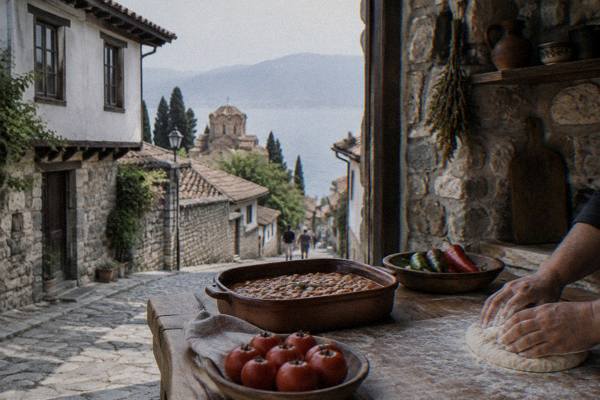
Tavče Gravče: Macedonia's Baked Bean Dish
Tavče gravče is the baked bean dish of North Macedonia, and Ohrid, the old lake town inside the UNESCO heritage region, is one of the places where it is eaten most seriously.
Short answer
Tavče gravče is beans baked slowly in a clay dish with onion, oil and red pepper, the traditional baked bean dish of North Macedonia, served across Ohrid's restaurants and taught in local cooking classes.
Tavče gravče, the baked bean dish of North Macedonia, is the one plate that follows a visitor from the Old Bazaar of Ohrid to the villages around the lake. Ohrid itself sits on Lake Ohrid, a freshwater mountain lake at about 693 m above sea level, inside the UNESCO mixed site "Natural and Cultural Heritage of the Ohrid Region", and its food tradition runs on lake fish, garden vegetables and slow oven dishes of exactly this kind. This page on the Ohrid Travel Guide explains what tavče gravče is, how the dish is built, where it fits into a day of sightseeing in the old town, and how a cooking class in Ohrid teaches it from scratch. For the wider food picture, start with the food and restaurant guide to Ohrid.
What Is Tavče Gravče And Why Does It Matter In Ohrid?
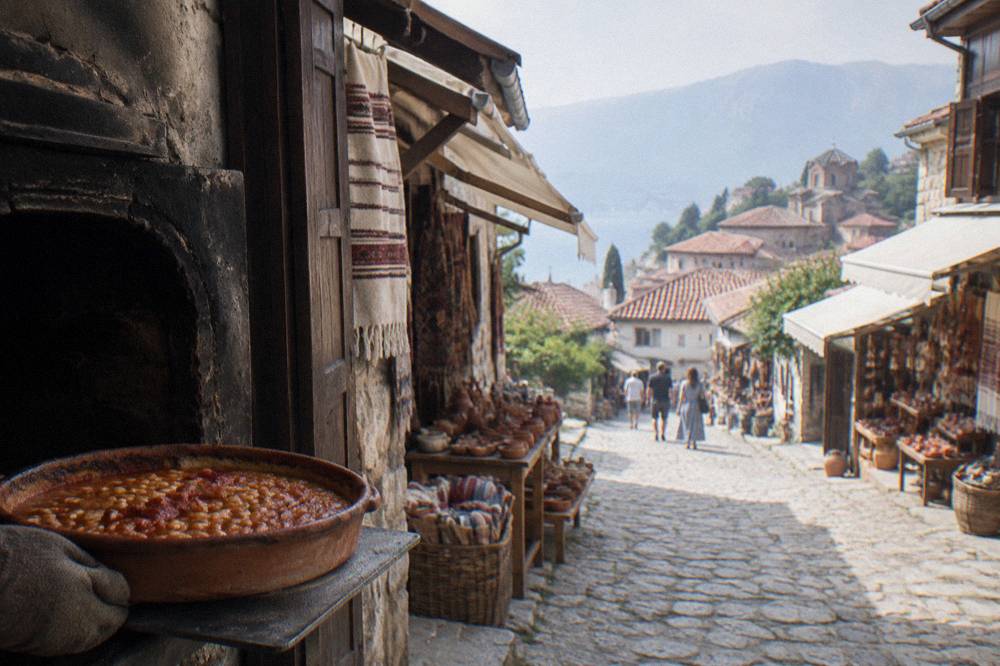
Tavče gravče is the traditional baked bean dish of North Macedonia, beans baked slowly in a clay dish called a tavče with onion, oil and red pepper, and in Ohrid it is a fixture of restaurant menus alongside the lake fish the town is known for. The name describes the method, the vessel, and the main ingredient all at once.
The dish is a slow food in the literal sense. Beans are soaked, then baked with the aromatics until the sauce thickens and the edges of the clay dish crisp. The word gravče is the Macedonian diminutive for beans, and tavče is the earthenware pan the dish is both cooked and served in. Nothing about the recipe needs expensive ingredients, which is why it traveled from village kitchens to town restaurants all over the country. In Ohrid it sits on menus beside the town's better known specialities, and the full guide to Ohrid food covers the rest of the table, from lake trout to the local rakija.
| Element | What it is | Notes for visitors |
|---|---|---|
| Tavče | The clay baking dish | The dish is named after it and often served in it |
| Gravče | Beans, the core ingredient | Soaked before baking |
| Base aromatics | Onion, oil, red pepper | The standard flavour base of Macedonian cooking |
| Serving | Baked until thickened | A main course, not a side |
Ohrid's setting shapes how the dish is eaten. The old town climbs from the lake up towards Samuel's Fortress, the lanes are on foot, and a plate of baked beans is the kind of slow lunch that fits a day of walking between churches. The town's sights, from the Ancient Theatre to the Church of St John at Kaneo, are close together, and eating well here costs less than in most of Europe, a point the Ohrid cost and budget guide breaks down month by month.
How Is Tavče Gravče Actually Cooked?
The method is a long soak followed by a slow bake: the beans are soaked, simmered until soft, then combined with onion, oil and red pepper in the clay dish and baked until the liquid reduces to a thick sauce. Time and the clay vessel do the work, not technique, which is why the dish survives so well in home kitchens and cooking classes alike.
Every version follows the same arc. The soak comes first, overnight in most home practice. The simmer comes second, until the beans are tender but intact. The bake comes last, and it is the stage that turns a pot of beans into tavče gravče, as the sauce tightens and the surface takes colour. Restaurants in Ohrid bake the dish in quantity, and home cooks make it for the same reason cooks everywhere adopt slow dishes, because it feeds a table from cheap ingredients. A cooking class in Ohrid teaches the full sequence from raw beans to finished dish, and the Ohrid food and wine tour guide shows the other guided food options in town.
| Stage | What happens | Why it matters |
|---|---|---|
| Soak | Beans rest in water, usually overnight | Softens the beans evenly |
| Simmer | Beans cook in water until tender | Sets the texture before baking |
| Combine | Onion, oil and red pepper join the beans | Builds the flavour base |
| Bake | The clay dish goes into the oven until thick | Reduces the liquid and finishes the dish |
The clay dish is not decoration. Baked and served in the same vessel, the dish arrives at the table still bubbling, and the crisp edge at the rim is part of the point. In Ohrid that theatre of serving fits the town's own style of eating, long lunches and longer dinners, with the lake a short walk from almost every terrace. After a morning at the Ancient Theatre and the old town lanes, the dish works as the anchor of a midday meal before the afternoon churches.
For visitors who want to do more than order it, Ohrid has a cooking class product that covers the local repertoire, tavče gravče included, in a small-group format.
Where Do You Eat Tavče Gravče In Ohrid?
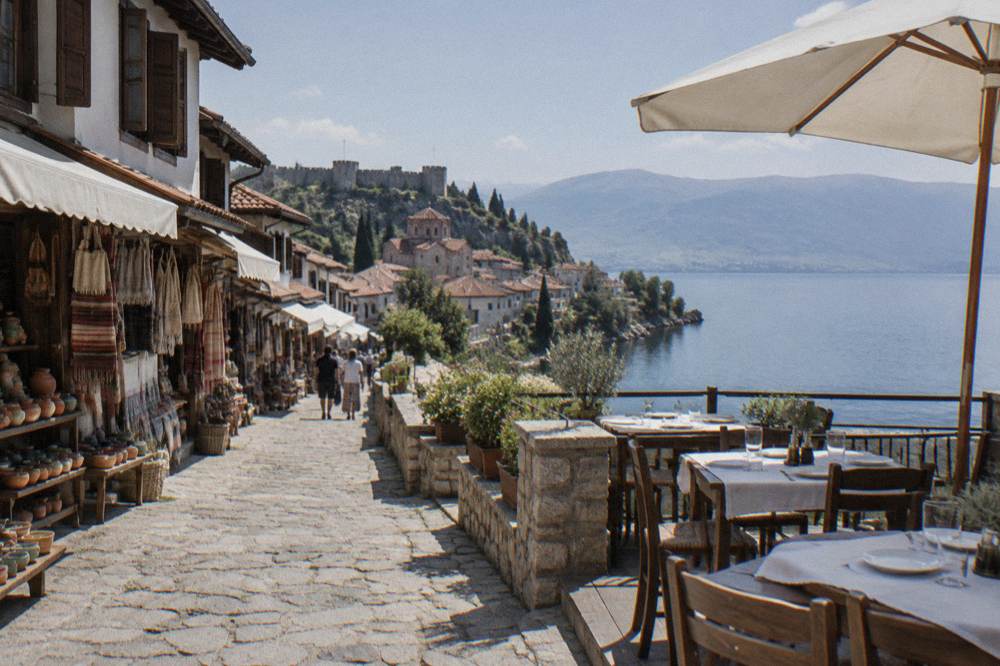
Tavče gravče is eaten in the restaurants of the old town, along the lakeside promenade and in the villages around the lake, and in Ohrid specifically the dining scene clusters in the old town lanes, the quay and the Kaneo district below St John at Kaneo. Wherever menus run to local cooking rather than tourist shorthand, the baked bean dish appears alongside the lake fish.
Ohrid's dining geography is compact. The old town holds most of the lanes worth eating in, and the walk from the Old Bazaar down towards the lake passes restaurant after restaurant inside ten minutes on foot. The Kaneo district, the neighbourhood that climbs to the Church of St John at Kaneo, holds terraces looking over the water, and the Kaneo district guide covers that quarter in detail. Further out, the eastern shore villages such as Trpejca and Ljubanista have their own tables, reached by boat or road on a slow day.
| Area | Character | How it fits a food day |
|---|---|---|
| Old Bazaar and old town lanes | Dense, walkable, close to the sights | Lunch between churches |
| Lakeside quay | Terraces along the water | Long dinners, sunset side |
| Kaneo district | Terraces below St John at Kaneo | Combine with the church walk |
| Eastern shore villages | Small tables away from town | Boat trip or a slow drive |
Ordering the dish needs no strategy beyond timing. It is baked ahead and served through the day, so it suits both a post-sightseeing lunch and a late dinner. Pair it the local way: the dish is heavy and savoury, and Macedonian tables balance it with salad, bread and a glass of rakija or local wine. The rakija and Macedonian wine guide on this site goes deeper on what to drink, and a tasting room visit pairs naturally with a food-focused day.
A guided walk is a good way to earn the lunch. The small-group hidden gems walk in the picks above covers the old town's less obvious corners, and a food and wine tour strings several tastings into one afternoon.
What Should You Drink With Tavče Gravče In Ohrid?
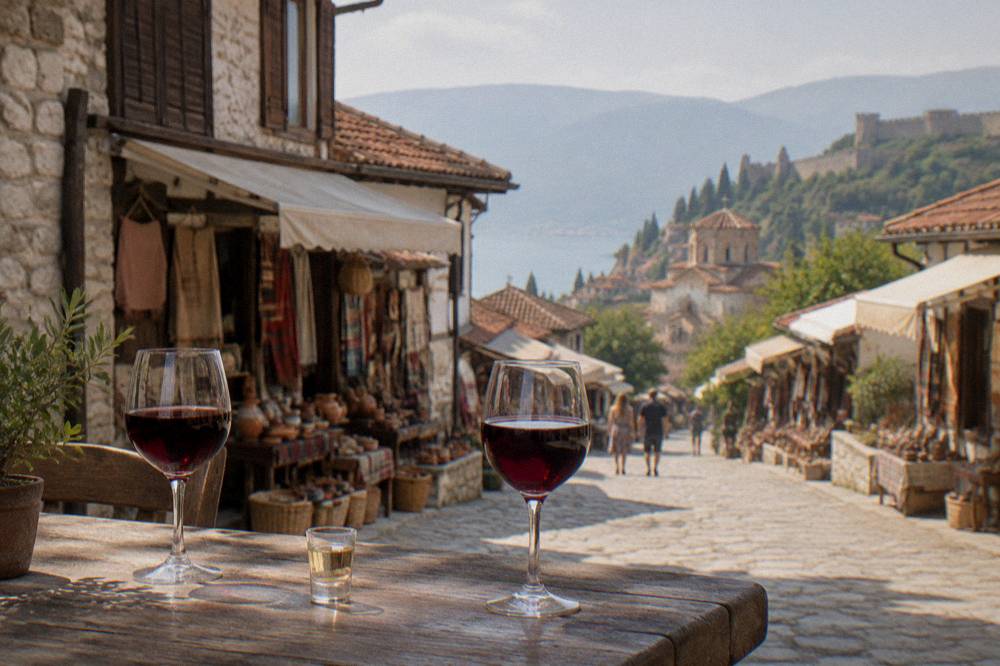
The standard pairings are Macedonian red wine, usually Vranec, and rakija, the fruit brandy poured across the Balkans, and both are made and poured around Ohrid, where winery visits and tastings sit within a short drive of the old town. The wine carries the dish's weight, and the rakija cuts it.
Vranec is the red that dominates Macedonian tables, a dark, dry wine that stands up to baked beans and red pepper. Whites from local varieties pour alongside in the same restaurants. Rakija, distilled from grapes or other fruit, arrives as an aperitif or a digestif, and refusing one politely is a small social skill worth having. Ohrid itself has tasting rooms in and near the old town, and winery tours run out into the surrounding countryside, among them the monastery winery tour and the S&S winery tasting that appear in the picks band above. The money and currency guide explains the practical side of paying: the local currency is the Macedonian denar, euros are commonly quoted for tours but are not legal tender, and the National Bank middle rate on 19 October 2026 was 1 EUR to 61.6633 MKD.
| Drink | Style | When it is poured |
|---|---|---|
| Vranec | Dry dark red wine | With the main course |
| Local whites | Dry white from Macedonian varieties | With lighter dishes and fish |
| Rakija | Fruit brandy | Before or after the meal |
| Macedonian beer | Lager style | Through the meal |
For visitors who want the drink without the dinner, a standalone tasting in Ohrid covers several local pours in a single sitting, and the winery experiences in the picks band above are the ones with the deepest review history on this site's roster.
How Does Tavče Gravče Fit Into A Day Of Sightseeing In Ohrid?
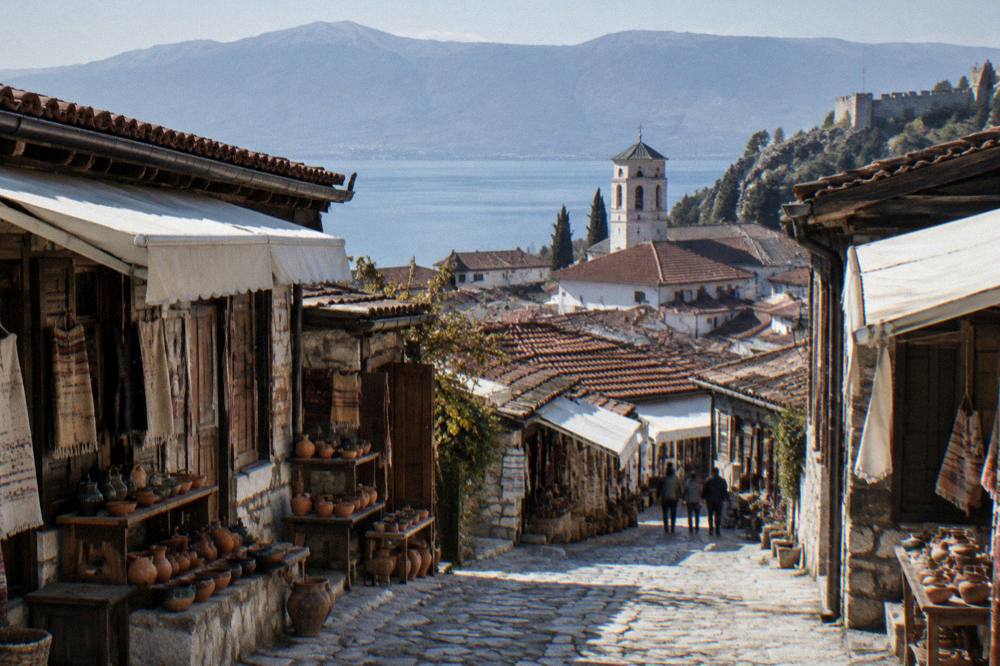
A sensible food day in Ohrid runs sightseeing in the morning, a baked bean lunch in the old town, and the lake in the afternoon, because the town's main sights, the Ancient Theatre, Samuel's Fortress, Plaosnik and St John at Kaneo, all sit within one walkable climb, and the museum sites run fixed schedules that make morning visits the safe bet.
The scheduling matters more than visitors expect. The museum institute's sites in Ohrid, including the Robev Family House, the Museum on Water at the Bay of Bones and the Icon Gallery, charge 150 den for foreign visitors and 120 den for domestic, with a reported 60 den rate for children and students, and from 1 October to 30 April they keep a winter schedule of 09:00 to 15:30, closed Mondays. From 1 May the summer schedule extends the day. Doing the paid sights before lunch leaves the afternoon free for the water.
| Sight | Ticket | Winter hours (1 Oct to 30 Apr) |
|---|---|---|
| Robev Family House | 150 MKD foreign, 120 MKD domestic | 09:00 to 15:30, closed Monday |
| Museum on Water, Bay of Bones | 150 MKD foreign, 120 MKD domestic | 09:00 to 15:30, closed Monday |
| Icon Gallery, Perivleptos complex | 150 MKD foreign, 120 MKD domestic | 09:00 to 14:00, closed Monday |
Between the morning churches and the afternoon lake, lunch is the hinge of the day, and tavče gravče is built for exactly that slot. The walk from the fortress walls down to the quay passes through the old town lanes, and a clay dish of baked beans with bread and salad resets a day of stairs. The how many days in Ohrid guide lays out full itineraries around meals like this, and the Lake Ohrid guide covers the water side, from swimming to the boat cruises that run about May to October.
The cooking class in Ohrid is another way to fold the dish into a visit. Rather than ordering it once, a visitor spends an afternoon learning the soak, the simmer and the bake, and eats the result. The class is the featured tour on this page and appears as a solo pick below, with price, rating and duration printing from the token block.
When Is The Best Season For A Food Trip To Ohrid?
The comfortable months for eating and walking in Ohrid are May through September, when modelled ERA5 climate normals for 1991 to 2020 show daytime highs from 19.5 C in May to 27.6 C in August and the lowest monthly rainfall of the year in July and August at 34.7 and 32.9 mm, while the lake reaches its modelled warmest surface temperatures in August at about 23.5 C.
The climate table below is modelled, ERA5 reanalysis for a grid cell at Ohrid, not a station record, and it is the honest basis for choosing a month. Spring and early summer give green hills and long lunch light, July and August bring the festival season and the crowds, September trades a few degrees of warmth for quieter tables. The Ohrid Summer Festival ran its 66th edition from 12 July to 20 August 2026, and the Balkan Festival of Folk Songs and Dances held its 65th edition from 3 to 6 July 2026.
| Month | Mean high C | Mean low C | Rain mm |
|---|---|---|---|
| May | 19.5 | 10.8 | 70.8 |
| June | 24.2 | 15.2 | 43.1 |
| July | 27.1 | 18.3 | 34.7 |
| August | 27.6 | 19.0 | 32.9 |
| September | 22.4 | 14.9 | 62.4 |
| October | 17.4 | 10.3 | 76.0 |
Source of the figures: ERA5 reanalysis normals, 1991 to 2020, for the Ohrid grid cell.
A baked bean dish is not seasonal in the way lake fish is, but the eating around it is. Winter Ohrid, from November's 90.4 mm of rain to January's mean low of -0.8 C, pushes meals indoors and shortens the museum day to the 09:00 to 15:30 winter schedule. The best time to visit Ohrid guide and the month-by-month Ohrid weather guide take the decision further.
What Does A Cooking Class In Ohrid Cover?
A cooking class in Ohrid covers the local repertoire hands on, with tavče gravče among the dishes taught from raw ingredients to the table, in a small-group format that runs from a town kitchen, and it is the one product on this site's roster built around learning Macedonian food rather than only eating it. Booking runs through the operator's live listing.
The class suits visitors who cook at home and want the dish to travel back with them. The sequence taught is the sequence described above, soak, simmer, combine, bake, and the small-group format leaves room for questions. It also pairs well with a market walk or a tasting, which is why this page's picks band groups the cooking class with the hidden gems walk and the winery tasting: together they cover the town on foot, the kitchen and the glass. For a visitor staying several days, the where to stay in Ohrid guide puts accommodation within walking distance of the kitchens and terraces that matter.
How Much Does A Food Day In Ohrid Cost?
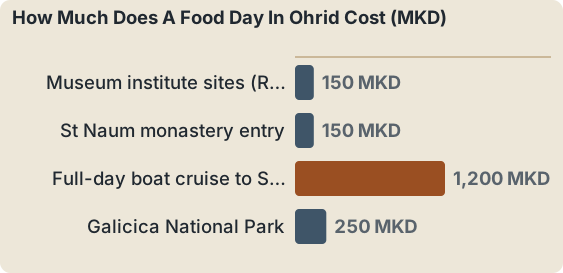
A food day in Ohrid is priced in denars at the restaurant and in the currency shown on the booking listing for tours, with museum tickets at 150 MKD for foreign visitors, a full-day boat cruise to St Naum from 1,200 den per adult with the Bay of Bones entry at 150 MKD, and Galicica National Park charging 250 MKD per vehicle, so a full eating-and-sightseeing day costs a fraction of the equivalent in western Europe.
The table gathers the fixed local costs a food-first visitor actually meets. Bookable tours are different: their prices, ratings and durations print from the token blocks on this page and on each tour's own page, and are never typed into prose.
| Item | Local cost | Notes |
|---|---|---|
| Museum institute sites (Robev House, Museum on Water, Icon Gallery) | 150 MKD foreign, 120 MKD domestic | Children and students reported at 60 MKD |
| St Naum monastery entry | 150 MKD per person | Per a cruise operator's listing |
| Rowboat at the Crn Drim springs | About 5 EUR | Per the same listing |
| Full-day boat cruise to St Naum | From 1,200 MKD adult, 600 MKD child | Boat Armada listing |
| Galicica National Park | 250 MKD per vehicle | 100 MKD only on foot from the Ohrid-side gate |
Paying for it all is straightforward. The denar is the currency, ATMs are widespread, and the denar and money guide covers the practical detail, including why the denar trades stably against the euro. North Macedonia is not in the EU and not in Schengen, so card rules and roaming from home do not follow EU patterns, and the entry basics are on the visa and entry guide.
Can You Combine Tavče Gravče With The Rest Of Ohrid's Food?
Yes, and the combination is the point: tavče gravče belongs on a table that also holds Ohrid trout, shopska salad, bread, mezze and a glass of Vranec, and the guided way to sample several of these in one afternoon is a food and wine tour, while the deeper dive into the kitchen is the cooking class that teaches the baked bean dish itself.
Ohrid's table is broader than one dish. The lake supplies fish, the gardens supply the peppers and tomatoes that fill the mezze plates, and the clay oven supplies the slow dishes. A visitor eating seriously in Ohrid for three or four days will cross the whole range, and the Ohrid food guide maps it dish by dish. The practical structure of a food trip, which sights pair with which meals and which terraces sit where, is covered across this site's itinerary pages, starting with things to do in Ohrid.
For a visitor who wants one booking to cover the kitchen, the walk and the glass, the picks below are the three this site's roster rates most consistently for a food-focused day. Availability and current pricing sit on each operator's live listing.
Visitors planning a longer stay around the lake can extend the same logic across the region: Struga sits a short bus ride away on the Black Drim, and Galicica National Park rises between Lake Ohrid and Lake Prespa with its 250 MKD per vehicle entry fee. Food, walk and water make a full week without repetition.
Common Questions About Tavče Gravče In Ohrid
What is tavče gravče?
Tavče gravče is the traditional baked bean dish of North Macedonia: beans soaked, simmered and then baked slowly in a clay dish with onion, oil and red pepper until the sauce thickens. The name comes from the clay dish, the tavče, and the beans, gravče.
Can you learn to cook tavče gravče in Ohrid?
Yes. A cooking class in Ohrid teaches the local repertoire hands on, the baked bean dish included, in a small-group format. Check availability on the operator's live listing.
Is tavče gravče expensive in Ohrid?
The dish is made from inexpensive ingredients and is generally one of the cheaper main courses on local menus. Restaurant prices vary, but the overall cost of eating in Ohrid is low, as the cost and budget guide explains.
What do you drink with tavče gravče?
Macedonian red wine, usually Vranec, or rakija, the fruit brandy poured before or after meals. Tasting rooms and winery tours around Ohrid pour both.
Where in Ohrid should you eat it?
The old town lanes, the lakeside quay and the Kaneo district hold most of the local menus. Any restaurant cooking traditional Macedonian food rather than tourist fare will serve it through the day.
Is tavče gravče available year round in Ohrid?
Yes, the dish is baked from store-cupboard ingredients and does not depend on a season. What changes by season is the rest of the day: museum sites keep shorter winter hours from 1 October to 30 April, and lake activities concentrate in the warmer months.