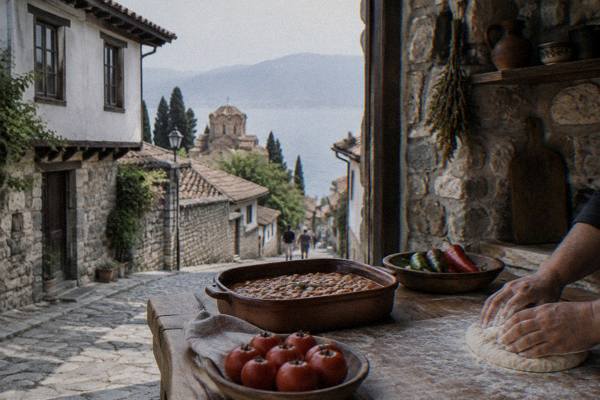
Ohrid Trout: Why It Is Protected And Where To Eat It
The Ohrid trout is the fish that gives Lake Ohrid its food reputation, and the one dish every menu in the old town leans on. Here is what the lake's protected status actually means for what lands on your plate, and how to plan a food-focused trip around it.
Short answer
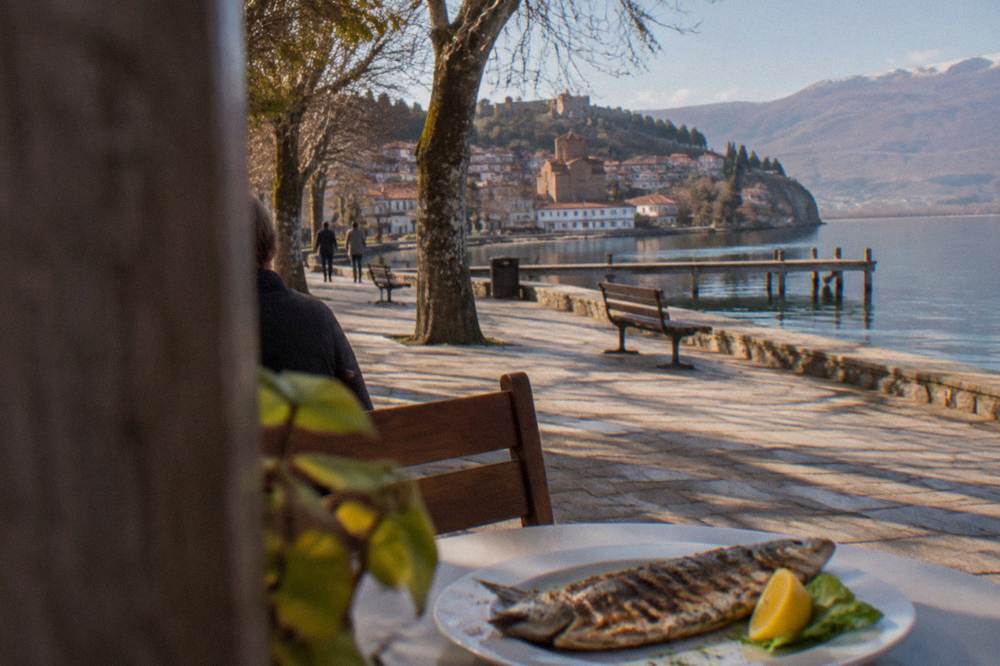
Lake Ohrid supports over 200 endemic species, including 17 endemic fish, and sits inside a UNESCO mixed World Heritage site. Protection of the lake's fish life is tied to that status, so the honest way to eat in Ohrid is to ask where any trout on a menu comes from and to treat lake fish as a regional specialty rather than a guaranteed wild catch.
The Ohrid trout is the first food Ohrid, the lakeside town in North Macedonia on Lake Ohrid, puts in front of anyone who asks what to eat. It is also the most complicated dish on any menu here, because the lake it comes from is a UNESCO mixed World Heritage site whose fish life the listing itself protects in words. The Ohrid Travel Guide approach to this dish is to start with what the lake's own record says, then work forward to the restaurant table, because the two are connected in a way few menus explain.
UNESCO's listing for the "Natural and Cultural Heritage of the Ohrid Region" records that the lake has existed for about two to three million years and holds over 200 endemic species, including 17 endemic fish. That single sentence is the backbone of everything on this page. It is why the fish is protected, why the lake is monitored, and why the question "where can I eat it" deserves a real answer rather than a restaurant name. The broader food picture, from tavche gravche to rakija, sits in the Ohrid food and drink guide, and the restaurant landscape in the Ohrid restaurants guide.
What Is Ohrid Trout?
The Ohrid trout is the lake trout of Lake Ohrid, a freshwater mountain lake sitting at about 693 metres above sea level, and it belongs to a fish community the UNESCO listing describes as exceptional: over 200 endemic species in the lake, 17 of them endemic fish, in a body of water that has existed for about two to three million years. In plain terms, this is a fish tied to one lake, in a town whose entire food identity flows from that water.
The lake is old by any measure the listing uses. UNESCO dates its existence to about two to three million years, and counts the endemic species as a central reason the Ohrid region was inscribed as a mixed natural and cultural property, in 1979 for its natural values and 1980 for its cultural ones, covering roughly 94,729 hectares. In 2019 the property was extended to include the Albanian part of the lake. The fish are not a footnote to that listing; they are part of its natural case.
For a visitor, this changes how the dish reads. A trout on a menu in Ohrid is not just lunch, it is a question about one specific lake and what that lake is allowed to give up. That is uncomfortable for a menu and useful for a traveller, because it turns ordering into a conversation worth having with whoever is serving you.
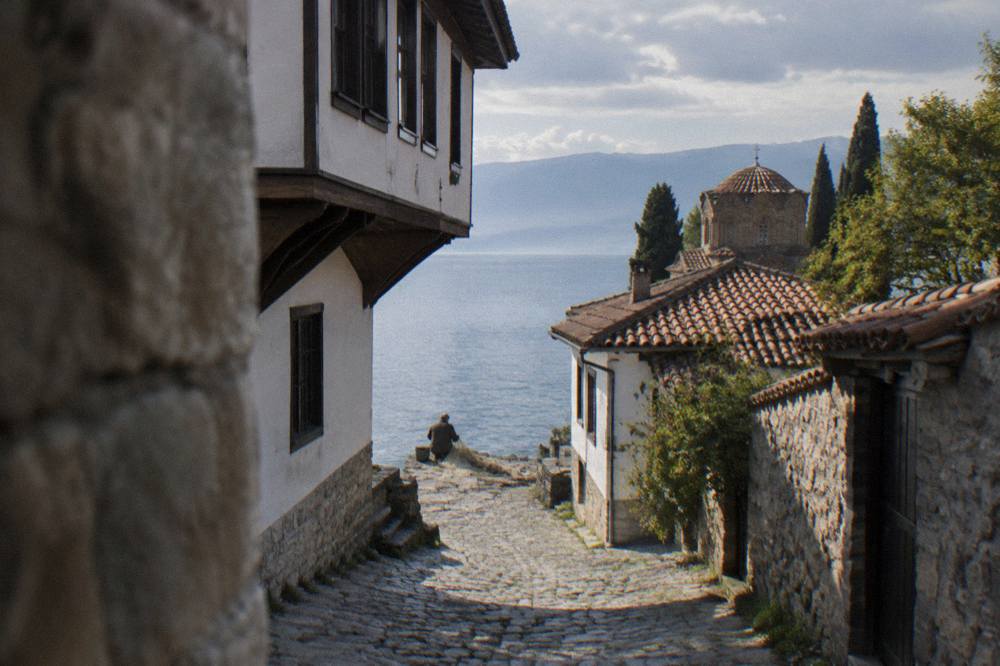
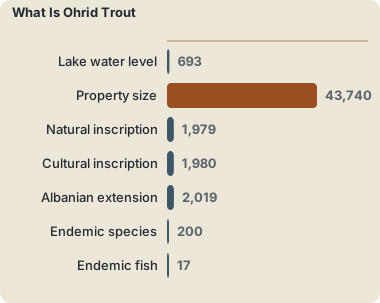
| The Lake In Figures | Value | Stated By |
|---|---|---|
| Lake water level | About 693 m above sea level | UHMR gauge, October 2026 |
| Property size | About 94,729 ha | UNESCO listing |
| Natural inscription | 1979 | UNESCO listing |
| Cultural inscription | 1980 | UNESCO listing |
| Albanian extension | 2019 | UNESCO listing |
| Endemic species | Over 200 | UNESCO listing |
| Endemic fish | 17 | UNESCO listing |
| Lake age | About two to three million years | UNESCO listing |
The table above is the factual spine of every claim on this page. Anything a menu or a tour brochure adds on top of it is marketing, and anything stricter than it is regulation you would need to check with the authorities before relying on.
Why Is Ohrid Trout Protected?
Protection flows from the lake's World Heritage status and its endemic fish life: UNESCO's listing treats the lake's species, over 200 endemics including 17 endemic fish, as part of the property's outstanding value, and the World Heritage Committee reviewed the lake's condition as recently as July 2026, deciding not to place it on the Danger List while requiring a joint report by 1 February 2029. The fish are protected, in other words, because the lake itself is a protected natural property, and because its fish community exists nowhere else in this form.
The July 2026 decision deserves a careful reading. So the lake is not on the danger list, but it is under active scrutiny, and the pressures named in that scrutiny, construction and wastewater among them, are exactly the pressures that reach fish.
Water quality is tracked too. The Institute of Public Health's 2026 bathing tests, covering May and June, found Class I physico-chemical quality across the lake's bathing sites except Grashnica beach, which rated Class III, with most microbiological samples rated Excellent. A lake whose water is tested monthly is a lake whose fish live inside an argument about pollution, sewer connections and shoreline development. When you eat a lake fish in Ohrid, you are eating the current state of that argument.
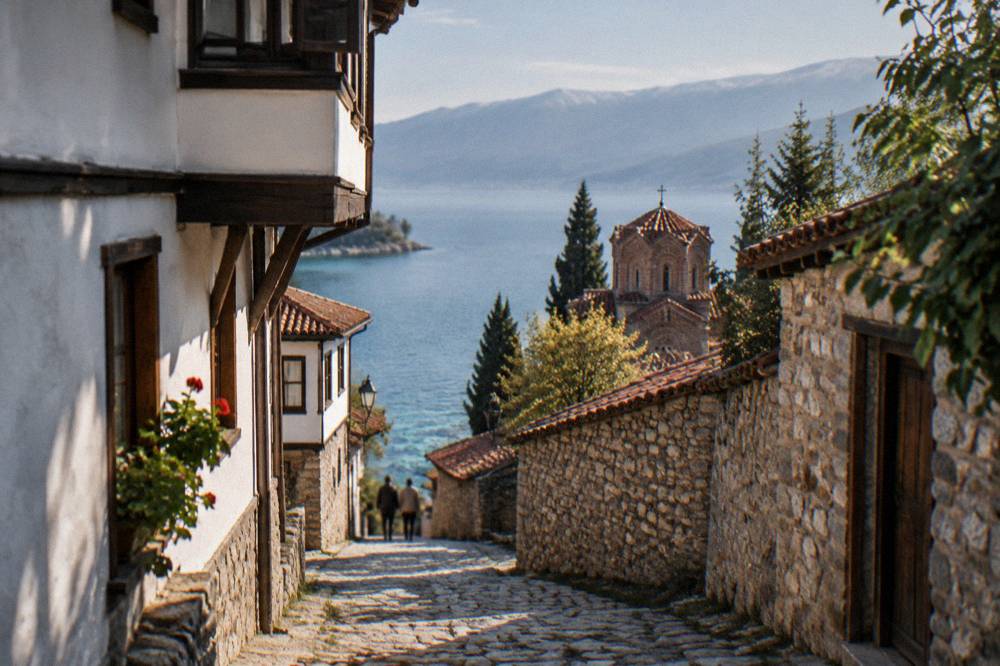
None of this translates into a simple rule a visitor can recite. What it translates into is a question: if a trout is on the menu, where did that fish come from? The lake's protected status makes that a fair question to ask anywhere in town, and the honest answers, lake-caught, farmed, or from another water entirely, tell you more about a restaurant than any review score.
The wider context of the lake, its villages, its shores and its protection regime, is covered in the Lake Ohrid guide and the Ohrid UNESCO World Heritage guide.
Can You Still Eat Ohrid Trout In Ohrid?
Yes, trout is served in Ohrid, but protection of the lake's endemic fish means the smart question is not whether you can order it, it is where the fish on your plate came from: the lake's fish community is part of a UNESCO protected property, its water is monitored, and no menu is obliged to tell you the fish's origin unless you ask. Treat the dish as a regional specialty to be asked about, not a product with a guarantee attached.
The practical advice is short and it works in every restaurant in town. Ask two things: is the trout from Lake Ohrid, and is it wild or farmed. Any restaurant proud of its answer will say so without prompting. The UNESCO listing protects the lake's fish life as part of a World Heritage property; it does not run a certification scheme for menus, and nothing in the listing obliges a kitchen to label the origin of a fillet. The diner's own question is the labelling system.
This is also why the best food experiences around Ohrid often leave the lakeshore. A guided trip into the surrounding villages, where cooking happens around home kitchens, monasteries and small producers, shows the cuisine the trout belongs to, grains, beans, cheese, rakija and wine, rather than a single celebrity fish. The Hidden Macedonia cave churches, villages and cuisine trip does exactly this, and there is Check availability on the operator's live listing.
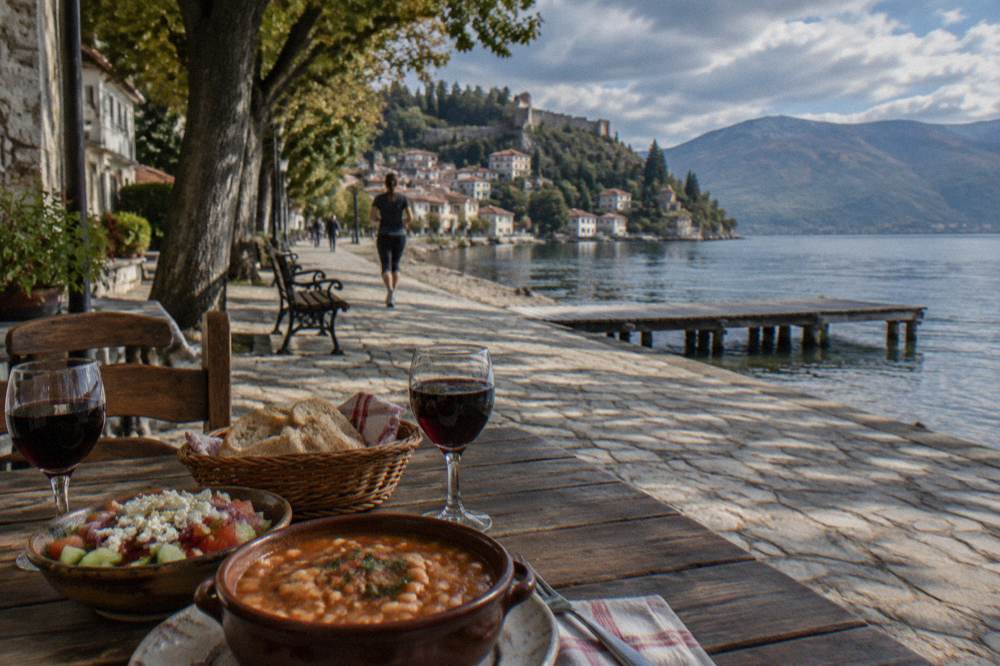
What the trout question shares with the rest of Macedonian eating is a cuisine built on simple, slow things. Tavche gravche, the baked bean dish, grilled meats, Shopska salad, cheese and bread: these are the everyday plates, and breakfast habits get their own treatment in what Macedonians eat for breakfast. The trout sits on top of that tradition as the lake's contribution, protected precisely because the lake's contribution is irreplaceable.
Where To Eat Lake Fish In Ohrid?
The honest answer is: anywhere that answers the origin question, with the old town and the lakeshore walk holding the densest concentration of kitchens, and the plate in front of you judged by the fish's source rather than the view beside it, because no public register names which restaurants serve lake-caught trout. This site does not hand out restaurant recommendations it cannot stand behind, and for this dish, no recommendation could be honest without knowing the day's supply.
What can be said is structural. Ohrid's old town climbs from the lake to Samuel's Fortress, its lanes are on foot, and the places to eat cluster along that climb and along the water. The planning question is therefore less "which restaurant" and more "which walk", and the two walks that matter are covered in depth elsewhere on this site: the old town guide and the boardwalk route in the Ohrid boardwalk guide. Build the meal into the walk, ask the origin question when you sit down, and let the answer decide.
For travellers who want the food explained rather than just served, guided options exist at three scales. A villages-and-cuisine trip reaches the countryside kitchens; an old town walking tour covers the lanes where the restaurants sit; a private wine tasting adds the Macedonian wine that belongs beside any lake fish. The trio below shows the current listings for all three.
The walk itself deserves the same standard as the plate. The old town is compact and steep in places, and a guided walk with a small group turns the climb into an explanation rather than a route. The current listing for the small-group option is here.
When Is The Best Time To Visit Ohrid For Lake Food?
July to September is the window where the facts line up: modelled lake surface temperatures run about 22.9 C in July, 23.5 C in August and 19.7 C in September, the swimming season runs from July, boats to St Naum operate about May to October, and the Ohrid Summer Festival filled the town from 12 July to 20 August in 2026, so food, water and atmosphere peak together in high summer. The trade-off is that August is also the busiest month, with full accommodations reported across the season's guides.
The numbers behind that answer come from two modelled datasets, and they are worth seeing whole. Air temperatures are ERA5 reanalysis climate normals for 1991 to 2020, computed for a grid cell over Ohrid, not a weather-station record. Lake temperatures are modelled aggregator values, except the UHMR October multi-year mean of 14.3 C. Both are planning tools, not forecasts.
| Month | Mean Daily High C | Mean Daily Low C | Rain Mm |
|---|---|---|---|
| Jan | 5.0 | -0.8 | 76.5 |
| Feb | 6.3 | 0.0 | 74.3 |
| Mar | 10.0 | 2.5 | 80.5 |
| Apr | 14.6 | 6.3 | 82.4 |
| May | 19.5 | 10.8 | 70.8 |
| Jun | 24.2 | 15.2 | 43.1 |
| Jul | 27.1 | 18.3 | 34.7 |
| Aug | 27.6 | 19.0 | 32.9 |
| Sep | 22.4 | 14.9 | 62.4 |
| Oct | 17.4 | 10.3 | 76.0 |
| Nov | 11.5 | 5.3 | 90.4 |
| Dec | 6.2 | 0.9 | 92.6 |
The rain column deserves a look before you pack. November averages 90.4 mm and December 92.6 mm, while July averages 34.7 mm and August 32.9 mm. A trout dinner tastes the same in rain, but the boat to St Naum and the lakeside table do not, and the month-by-month detail lives in the Ohrid weather guide and the best time to visit Ohrid guide.
| Month | Modelled Lake Surface Temp C |
|---|---|
| Jan | About 4.6 |
| Feb | About 5.4 |
| Mar | About 7.2 |
| Apr | About 10.5 |
| May | About 14.9 |
| Jun | About 19.4 |
| Jul | About 22.9 |
| Aug | About 23.5 |
| Sep | About 19.7 |
| Oct | About 14.7 (UHMR multi-year mean 14.3) |
| Nov | About 10.3 |
| Dec | About 6.0 |
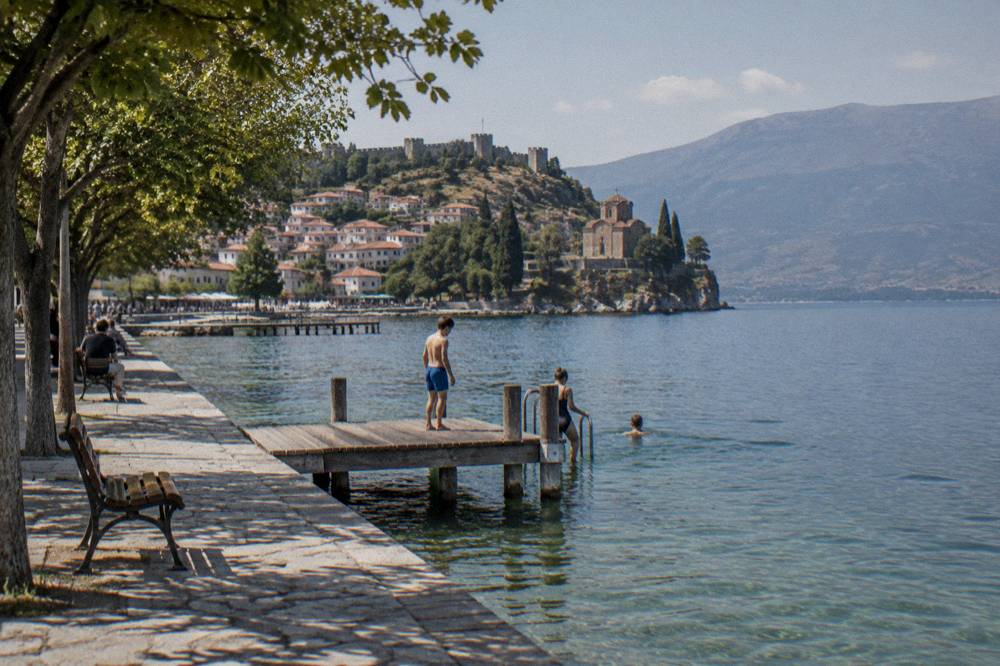
Seasonality also reaches the timetable of the lake itself. The 2026 lake navigation rules, set by government decision on 2 June 2026, banned jet skis between 1 July and 31 August from 11:00 to 19:00 and restricted boats at night through summer and into October, all in the name of swimmer safety. The 39th Ohrid Swimming Marathon, a 25 km swim from St Naum to Ohrid harbour, was held on 22 August 2026. Food trips in high summer share the lake with all of this, which is exactly what makes the season what it is.
What Else Should A Food-Focused Trip To Ohrid Include?
A trout-centred trip works best as a triangle: the old town's kitchens, the lake's boats and shores, and the wine country behind the hills, with the how-many-days question answered by how many corners of that triangle you want, and the practical sweet spot for most first trips landing at two to three days. The fish is one dish; the region around it is the meal.
The itinerary logic is laid out in full elsewhere on this site, from how many days in Ohrid to the one-day and multi-day plans, but the food-specific shape is simple. Give the old town a full day for the lanes, the churches and the evening tables. Give the lake a day for the boat to St Naum, which the Armada cruise listing prices from 1,200 den for adults and 600 den for children, with the St Naum monastery entrance at 150 MKD and a rowboat through the Crn Drim springs at about 5 EUR, per the cruise operator's own listing. Then give the hinterland a half day for wine and village cooking.
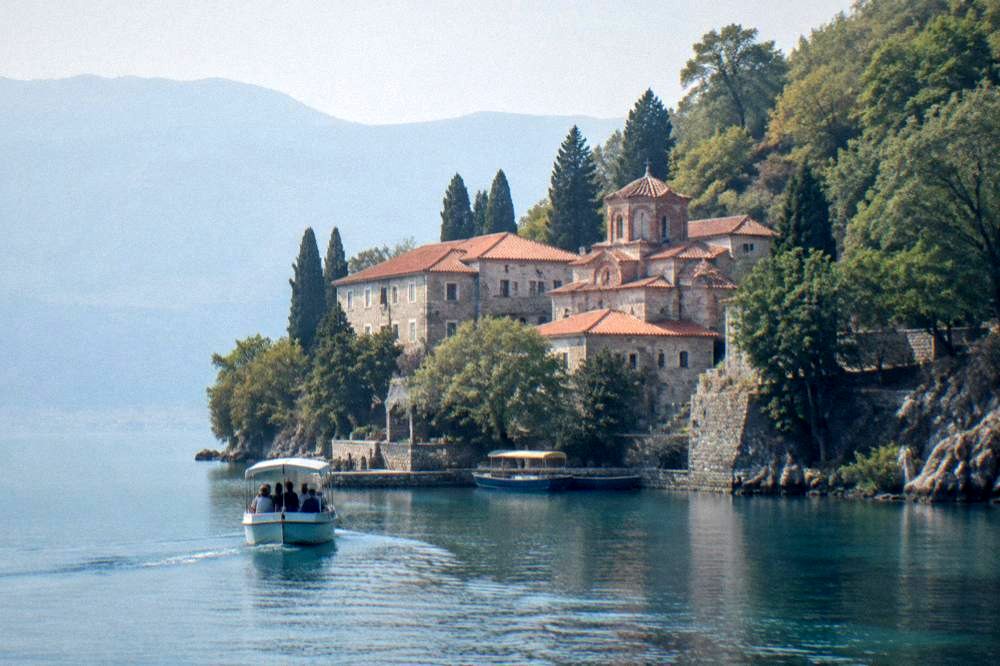
Wine belongs in this triangle for a reason: Macedonian wine and rakija are the drinks the lake fish is served with, and a tasting turns the meal from a plate into a region. The private tasting format suits couples and small groups who want the table to themselves, and the current listing is here.
The museum side of a food trip is cheap and quick, and it explains the town the fish comes from. The museum institute's ticket prices and hours are fixed and published, so they can be planned to the denar.
| Museum Institute Site | Foreign Ticket | Domestic Ticket | Hours | Closed |
|---|---|---|---|---|
| Robev Family House | 150 MKD | 120 MKD | Winter 09:00 to 15:30, summer two shifts 09:00 to 15:30 and 13:30 to 20:00 | Monday |
| Bay of Bones, Peshtani | 150 MKD | 120 MKD | Winter 09:00 to 15:30, summer 09:00 to 16:30 | Monday |
| Icon Gallery, Perivleptos | 150 MKD | 120 MKD | Winter 09:00 to 14:00, summer 09:00 to 17:00 | Monday |
Children and students pay a reduced rate at the same sites, per the institute's ticket page. The winter schedule runs 1 October to 30 April and the summer schedule 1 May to 30 September, so a shoulder-season trip sees the shorter hours. The sight-by-sight detail, from Samuel's Fortress to St John at Kaneo, sits in the things to do in Ohrid collection.
How Much Does A Food-Focused Trip To Ohrid Cost?
Getting there and eating there are two different budgets: intercity transport is cheap, with the Skopje bus at 850 to 950 MKD one way and the Tirana minibus at about EUR 15 to 20, local costs like museum entries at 150 MKD a site and the St Naum cruise from 1,200 den, while restaurant spending is not covered by any published tariff and should be planned loosely. The currency is the Macedonian denar, and euros, though widely quoted, are not legal tender.
The transport numbers are worth seeing together, because Ohrid is reached from three directions and the costs differ.
| Route | Cost | Time | Source Note |
|---|---|---|---|
| Skopje to Ohrid bus | 850 to 950 MKD | About 3 hours | Route guide figures |
| Skopje to Ohrid by car, tolls | About 140 MKD | About 2.5 hours, 172 km | Route guide figures |
| Tirana to Ohrid minibus | About EUR 15 to 20 | 3 to 3.5 hours with border | Route guide figures |
| Ohrid Airport taxi to centre | 600 to 800 MKD, reported | About 10 km | Reported figure |
| Boat cruise Ohrid to St Naum | From 1,200 den adult, 600 den child | 7 hours | Operator listing |
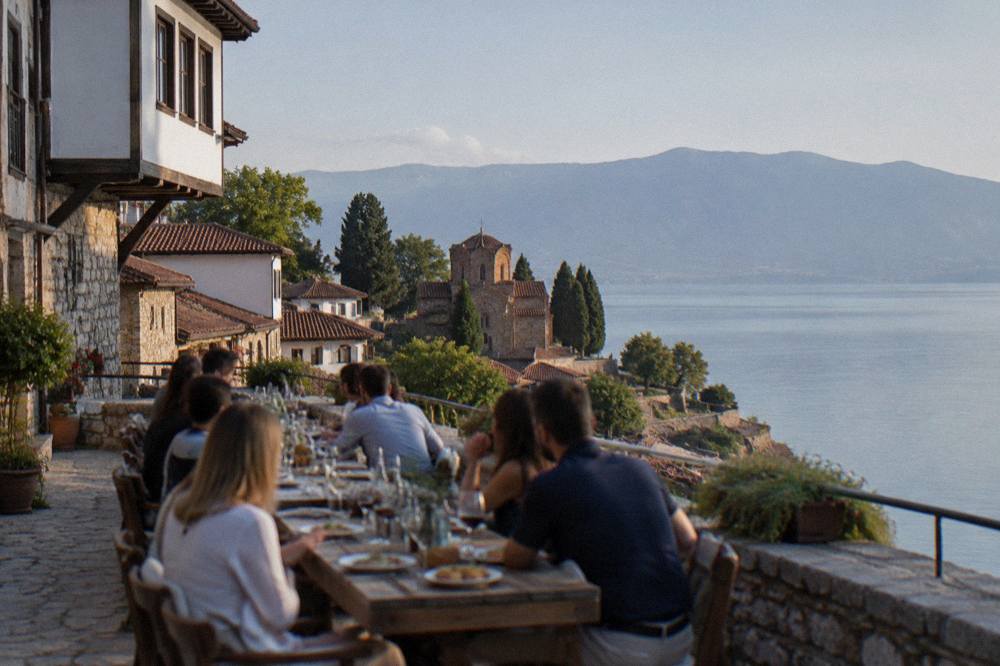
Money handling has its own quirks. The denar is pegged in practice to the euro, with the National Bank's middle rate at 61.6633 MKD to 1 EUR on 19 October 2026, and ATMs are the normal way to get denar. The Macedonian denar and money guide covers the details, and the Ohrid cost and budget guide puts the whole trip in one frame. Safety questions, for a food trip mostly about late walks home, are handled in is Ohrid safe.
What Should You Know Before Ordering Trout In Ohrid?
Three things carry the whole page: the lake's fish are part of a UNESCO protected property with 17 endemic fish among over 200 endemic species, the water they live in was tested through 2026 with strong results outside one named beach, and no menu label replaces the direct question of where a fish came from, so ask it, and let the answer pick your table. Protection here is a living process, reviewed by the World Heritage Committee in 2026 and reported on again in 2029, not a plaque on a wall.
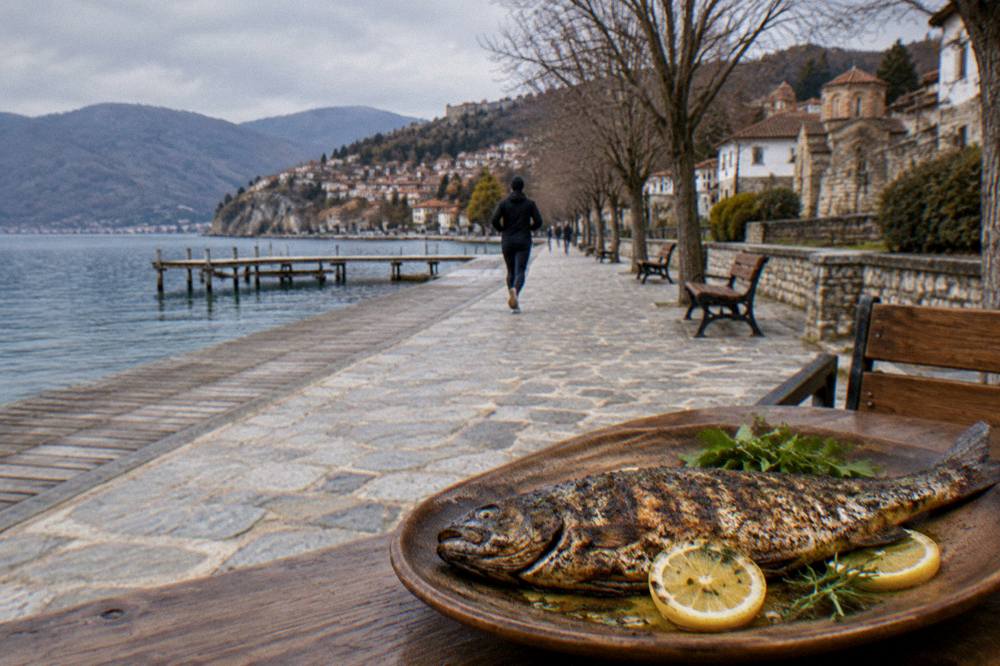
Beyond the fish, the same trip delivers the rest of the region's table, and the guided options below cover the three formats this site rates for a food-focused visit: the villages-and-cuisine trip into the hinterland, the small-group old town walk, and a private wine tasting. Each listing prints its own current price and availability, and each can anchor a different day of the itinerary.
Common Questions About Ohrid Trout
Is Ohrid trout the same as ordinary trout?
No. The Ohrid trout belongs to Lake Ohrid's endemic fish community, one of 17 endemic fish species in a lake UNESCO records as holding over 200 endemic species, so it is tied to this one water rather than being a generic farmed trout, which is exactly why the origin question at a restaurant matters.
Is it legal to eat Ohrid trout in Ohrid?
Restaurants in Ohrid serve trout, and no rule on this site's record forbids ordering it. The lake's fish life is protected as part of a UNESCO World Heritage property, which shapes fishing and supply rather than menus, so the practical step is asking where the fish on the plate was sourced.
Where can I eat Ohrid trout?
Kitchens cluster along the old town's climb from the lake and along the waterfront, and no public register names which ones serve lake-caught fish on a given day. Ask at the table whether the trout is from Lake Ohrid and whether it is wild or farmed, and treat the answer as the recommendation.
Why is Lake Ohrid's fish life protected?
Because UNESCO's 1979 and 1980 inscription of the Ohrid region treats the lake's endemic species, over 200 of them, including 17 endemic fish, as part of the property's outstanding universal value, and the World Heritage Committee reviewed the lake's condition again in July 2026, keeping it off the Danger List with a further report due in 2029.
What is the best month to visit Ohrid for lake food?
July to September, when modelled lake surface temperatures run from about 19.7 C to 23.5 C, the boats to St Naum are running on their roughly May to October season, and the Ohrid Summer Festival ran from 12 July to 20 August in 2026, though August is also the busiest month.
What else should I eat in Ohrid besides trout?
The wider Macedonian table: tavche gravche, the baked bean dish, grilled meats, salads, cheese, bread and rakija, with Macedonian wine alongside. The villages-and-cuisine trips and wine tastings listed above reach the versions of these plates that the lakeshore does not always serve.