Language In Ohrid: English, Macedonian And Useful Phrases
Ohrid speaks Macedonian, written in Cyrillic, with English widespread in the parts of town visitors actually use. Here is what the sources say, plus the phrases worth knowing.
Short answer
Macedonian is the official language of Ohrid and is written in the Cyrillic alphabet, though Latin script is also used. English is the main second language in the old town, hotels, restaurants and tour operators, so a short visit needs no Macedonian. A handful of greetings and polite words still earns a warm reception.
Macedonian is the official language of Ohrid, written in the Cyrillic alphabet, and it is what you will hear on the streets, read on the museum tickets and see on the signage of this lakeside town in North Macedonia. English, though, is the working second language of the old town: tour operators run their listings in English, the museum institute publishes its own pages in English, and hotel and restaurant staff in the visitor core switch between the two without friction. This Ohrid Travel Guide page sets out what that means in practice: how much English you can genuinely rely on, how the Cyrillic script works so that street signs stop being opaque, and which Macedonian phrases are worth carrying for churches, markets, taxis and a glass of rakija at the end of the day.
North Macedonia sits outside the EU and outside Schengen, and the country's language situation reflects its position at a Balkan crossroads. The 2021 census counted 51,428 people in Ohrid municipality, a small enough town that language is personal rather than abstract: the person selling you lake fish at the market, the taxi driver from the bus station and the caretaker of a hillside church are all part of the same compact community. A visitor who learns three words of Macedonian is not shouting into a crowd, and that is exactly why the small effort lands well here.
What Language Is Spoken In Ohrid?
Macedonian is the official and everyday language of Ohrid, spoken throughout the town and written in the Cyrillic alphabet, with Latin script also in use on signage and in informal contexts. English functions as the main visitor language in the old town, hotels, tour listings and the museum's own published materials, so a short stay does not require any Macedonian at all.
Macedonian is a South Slavic language, closely related to Bulgarian and mutually intelligible with it to a large degree, and it shares enough vocabulary and structure with Serbian, Croatian and Bosnian that speakers of those languages manage comfortably in Ohrid. The language has been written in the Cyrillic alphabet since its standardisation, and official Ohrid communication, street signage, museum tickets and shop fronts use it. Latin script appears too, especially anywhere visitors look: menus, tour brochures, price lists and accommodation listings frequently run in both scripts or in Latin-only English versions.
The practical effect for a visitor is that Ohrid reads as a two-script town. On one walk up from the lake you can pass a bakery sign in Cyrillic, a restaurant board in English, and a museum plaque in Macedonian with an English summary. The denar and money guide covers the currency side of the same question, because prices are quoted in Macedonian denar (MKD), euros circulate informally in tourist-facing quotes, and the scripts and the currencies follow the same pattern: local first, visitor-friendly alongside.
Do They Speak English In Ohrid?
English is widely spoken in the parts of Ohrid that visitors use: the old town, the lakefront, hotels, restaurants, ticket desks and every licensed tour listing, where English is the default operating language. Outside the visitor core, in residential neighbourhoods and on local buses, English becomes thinner and Macedonian, often with some Albanian or Serbian, carries the conversation.
Once you have picked up a few phrases, settle in somewhere comfortable, book a hotel in Ohrid here.
The evidence is structural rather than anecdotal. Ohrid's economy runs on visitors, the town's museum institute publishes its tickets and site pages in English, and the site's own tour roster lists dozens of Ohrid products run in English, from walking tours to wine tastings and boat cruises. The do they speak English in Ohrid answer page deals with this question directly. In the peak season, from June to September, the visitor-facing workforce is at full strength; in the winter months, when museum sites run their shorter schedule from 1 October to 30 April and close on Mondays, the town is quieter and the people you meet are more likely to be locals going about their day.
Two honest qualifications follow. First, English in Ohrid is strongest among younger people and anyone working in tourism; a retired caretaker at a small church may have none. Second, the old town's lanes climb steeply from the lake toward the fortress, and the further you get from the lakefront, the more purely Macedonian daily life becomes. Neither point is a barrier. Gestures, patience and the phrase table below solve nearly everything, and a printed address in Cyrillic solves the rest.
For travellers who want the language barrier removed entirely on day one, a guided walk is the simplest fix: the site's featured Old Town Walking Tour runs with an English-speaking guide through exactly the lanes where signage is most Cyrillic.
What Are The Useful Macedonian Phrases For Ohrid?
The phrases that matter in Ohrid are greetings and politeness formulas: dobr den (good day), blagodaram (thank you), moli (please and you're welcome), se vidime (see you), andPROSTITE (excuse me), plus numbers and a few market and restaurant words. Macedonians appreciate the effort warmly, and even two words change the tone of an interaction, though English covers the substance in the old town.
The tables below give a working set. Transliterations follow the way the words sound, since the Cyrillic originals are given for recognition rather than reading fluency. Say the transliteration roughly as written, stress the vowel marked in capital letters where shown, and do not worry about perfection: the attempt is the message.
| English | Macedonian (Cyrillic) | Say it like | When to use it |
|---|---|---|---|
| Hello / good day | Ден добар / Добар ден | DOH-bar DEN | Any daytime greeting |
| Good morning | Добро утро | DOH-bro UT-ro | Until late morning |
| Good evening | Добра вечер | DOH-bra VE-cher | After dark |
| Goodbye | Пријатно | pri-YAT-no | Leaving any shop or café |
| Thank you | Благодарам | bla-go-DARAM | The word you will use most |
| Please / you're welcome | Моли / Молам | MO-li | Offering and accepting |
| Excuse me / sorry | Извинете | iz-vi-NE-te | Getting attention, apologising |
| Yes / no | Да / Не | da / ne | Everywhere |
| Do you speak English? | Говорите ли англиски? | go-vo-RI-te li AN-glis-ki | Opening gambit |
| I don't understand | Не разбирам | ne ra-ZBI-ram | Honest and useful |
| How much is this? | Колку чини ова? | KOL-ku CHI-ni O-va | Markets, taxis |
| Good / delicious | Добро / Вкусно | DO-bro / VKUS-no | Restaurants |
The how do you say hello in Macedonian page takes the single most-searched greeting in more depth. One habit worth adopting early: Macedonian hello formulas change with the time of day, and using dobr den at noon rather than a generic hi reads as politeness rather than performance. Older speakers in particular respond to the day-part greetings as good manners.
How Does The Cyrillic Alphabet Work In Ohrid?
Macedonian Cyrillic has 31 letters, most matching one sound, so once you learn about a dozen key letters you can sound out Ohrid street signs, museum tickets and menus with reasonable accuracy. Several letters are false friends for Latin readers, including Н (N), Р (R), С (S) and В (V), and recognising those four alone decodes a surprising share of the signage in the old town.
Cyrillic was designed so that one letter equals one sound, which makes it far friendlier to decode than English spelling. You will not read fluently in a week, but you do not need to: the goal is recognition, so that Цар Самоил (Tsar Samoil) registers as the street named for the fortress, and Ресторан obviously means restaurant. The table below covers the letters that appear on the great majority of Ohrid signs you will actually encounter.
| Cyrillic letter | Sounds like | Cyrillic letter | Sounds like |
|---|---|---|---|
| А а | a in father | Н н | n |
| Б б | b | О о | o in more |
| В в | v | П п | p |
| Г г | g in go | Р р | r (rolled) |
| Д д | d | С с | s |
| Е е | e in met | Т т | t |
| З з | z | У у | oo in boot |
| И и | ee in see | Ф ф | f |
| К к | k | Х х | ch in loch |
| Л л | l | Ц ц | ts in cats |
| М м | m | Ч ч | ch in church |
| Ј ј | y in yes | Ш ш | sh |
| Љ љ | ly | Џ џ | j in jump |
| Њ њ | ny | Ѓ ѓ | gy (soft g) |
Try it on real Ohrid words. Охрид is Ohrid. Скопје is Skopje. Струга is Struga, the neighbouring town on the lake's outflow. Црква is tsrkva, a church, a word you will see on signs pointing to St John at Kaneo, St Sophia and Plaosnik. Градска плажа contains gradska plazha, city beach. Музеј is muzej, museum, and it appears above the doors of Robev Family House and the Icon Gallery. Ten minutes with the table above and a walk up the old town is a self-teaching exercise, because the same dozen words repeat on signs, menus and ticket stubs.
Numbers are the other quick win, because market stalls, boat tickets and bus fares all use them. The museums publish their own prices directly: the museum institute's sites, including Robev House, the Museum on Water at the Bay of Bones and the Icon Gallery, list 150 den for foreign visitors and 120 den for domestic visitors, with a children's and students' rate reported at 60 den. Reading those digits on a price board takes no Cyrillic at all; reading the word for open and closed takes one.
| Number | Macedonian (Cyrillic) | Say it like |
|---|---|---|
| 1 | еден | E-den |
| 2 | два | dva |
| 3 | три | tri |
| 4 | четири | CHE-ti-ri |
| 5 | пет | pet |
| 6 | шест | shest |
| 7 | седум | SE-dum |
| 8 | осум | O-sum |
| 9 | девет | DE-vet |
| 10 | десет | DE-set |
What Should You Say In Restaurants And Markets In Ohrid?
In Ohrid restaurants you need almost nothing beyond blagodaram and a pointed finger at the menu, because menus in the visitor core carry English translations and staff handle English orders routinely; at the market and in smaller konobas, kolku chini (how much) plus numbers, and vkusno (delicious) at the table, carry the whole transaction. Ordering rakija or wine by name works because the names are short and printed on the bottle.
The old town's restaurant strip and the lanes around the Old Bazaar are built for international guests: printed menus typically list dishes in Macedonian and English side by side, and the region's signature items, Ohrid trout, tavche gravche and shopska salad, appear under recognisable names. The site's Ohrid food guide and Ohrid restaurants pages cover what to order; the language point is simpler. Learn to read the Cyrillic word for the dish as well as its English gloss and you can order from either menu, in either script, anywhere in town.
At the market, the transaction is numeric. Vendors quote in denar, you hand over denar, and kolku chini plus a gesture at the peaches or the lake fish does the rest. The currency guide explains why: the denar is the legal currency, euros are informally accepted at poor rates in some tourist spots, and ATMs dispense denar, so the numbers you hear at a stall are MKD numbers. Two food words repay learning because they appear everywhere: voda (water) and leb (bread).
Rakija deserves one line of language attention because it is also a word of ritual. The fruit brandy is offered as a welcome, and the rakija and Macedonian wine page covers the custom. When a glass arrives, nazdravje (NAZ-drav-ye, cheers) is the word that goes with it, and raising the glass while saying it is the whole required performance.
Do People In Ohrid Understand Other Balkan Languages?
Ohrid's position on the Albanian border and its tourist mix mean the town regularly hears Albanian, Serbian, Bulgarian, Turkish and German alongside Macedonian and English, and speakers of Serbian, Croatian, Bosnian and Bulgarian can largely make themselves understood in Macedonian without switching languages. German has a strong presence among visitors, and Turkish is spoken by part of the population.
The structural reason is geography and history. North Macedonia borders Albania, Kosovo, Serbia, Bulgaria and Greece, and its population includes a large Albanian-speaking community; in Ohrid itself, the mix tilts Macedonian, but Albanian is present in daily life and utterly dominant a short drive away at the Albanian side of the lake around Pogradec. Bulgarian visitors need no interpreter: the two languages are close enough that a Bulgarian and a Macedonian converse each in their own tongue. Serbian and Croatian function the same way, and many older Ohrid locals grew up with Serbo-Croatian from the Yugoslav era.
German is the quiet second visitor language. State Statistical Office data for November 2025 showed Germany as the largest single foreign market for Ohrid, with 3,537 of the month's 11,686 foreign guests, ahead of Turkey, and that flow has built a small German-speaking capacity in hotels and restaurants. Turkish serves the Turkish market and part of the local population. Greek is heard less in Ohrid than the country's southern regions, and Greek visitors generally use English.
| Language | Where it helps in Ohrid | Notes |
|---|---|---|
| English | Old town, hotels, tours, ticket desks | Default visitor language |
| German | Hotels, larger restaurants | Germany is Ohrid's top foreign market (Nov 2025 data) |
| Serbian / Croatian / Bosnian | Everywhere | Widely understood, especially among older speakers |
| Bulgarian | Everywhere | Closely related to Macedonian |
| Albanian | Town and the whole Albanian lake shore | Dominant around Pogradec and Struga's west |
| Turkish | Some shops and restaurants | Spoken by part of the population |
| Russian | Limited | Not a former local lingua franca here |
The visa context matters for some of these speakers: North Macedonia is outside the EU and Schengen, and visitors from visa-free countries may stay up to 90 days in any 180-day period, with UK visitors allowed up to three months. The North Macedonia visa and entry page carries the full rules.
How Do You Handle Language With Taxis, Buses And Tours In Ohrid?
Taxis, local buses and tour meeting points in Ohrid are manageable with English plus a written address, because tour products run in English by default, taxi drivers know the landmark names in several languages, and the only genuinely local-language zone is the intercity and Ohrid-to-Struga bus network, where a printed destination and denar in hand solve everything.
Start with tours, because that is the easy case. Every Ohrid product in the site's roster, from the featured Old Town Walking Tour to the sunset cruise and the Skopje-based UNESCO day trip, is listed and operated in English, and a guide doubles as an on-demand translator for the parts of town where Cyrillic-only signage returns. Check availability for the walking tour, which doubles as the best possible first-hour language orientation in the old town.
Taxis are the second case. There is no ride-hail service in Ohrid, as the site's taxis page explains, so the transaction is curbside: agree the price before the car moves, or ask for the meter. Drivers handle "St Sophia", "Kaneo", "bus station" and hotel names in English pronunciation, and the airport run is the single most common fixed fare conversation in town. The site's Ohrid taxis and Uber page covers the fares and the no-app reality in detail.
Buses are the third case, and the most local-language. The intercity station serves the Skopje route, roughly three hours each way with several operators, and the local Ohrid to Struga minivans use Macedonian destination boards; carrying the destination in Cyrillic, Скопје or Струга, removes any ambiguity. The Ohrid bus station page covers operators and the station location, and the arrival pages for Skopje to Ohrid and Tirana to Ohrid handle the two main corridors.
One last language-adjacent number belongs in every phone: the emergency numbers are police 192, ambulance 194 and roadside assistance 196. The operators answering speak Macedonian first; saying the service name and location, policija or bolnica plus a place name, is the fastest route to help if a call ever needs to be made.
Is Macedonian Hard To Learn For A Short Visit To Ohrid?
Macedonian is a moderately easy language for a short visit: the pronunciation is regular, the Cyrillic alphabet can be decoded in an afternoon, and a phrase list of twenty items covers essentially every interaction a visitor will have in Ohrid, because English absorbs the hard conversations in the old town. Grammar, with its verb forms and case traces, is where the language gets genuinely difficult, and none of that matters on a two-day trip.
The honest division is between recognition and production. Recognition, reading street signs, decoding menus, matching a church name on a ticket to the door in front of you, is achievable before dinner on day one with the alphabet table above. Production, forming your own sentences, requires grappling with Macedonian's verb conjugation and its definite-article suffixes attached to the ends of nouns, a feature that has no English equivalent and delights linguists more than it helps tourists. A visitor does not need it. The twenty-word phrase table plus numbers plus pointing is a complete toolkit.
Context does the rest. Ohrid's visitor economy is organised around people who arrive with no Macedonian: the museum's own pages run in English, boat and tour staff work in English, and the town's two scripts mean that even the Cyrillic-only surfaces usually sit beside a Latin or English twin. If the trip is longer than a weekend, the how many days in Ohrid page helps size the stay, and each extra day passively teaches more signage vocabulary than any app session.
For travellers who enjoy the language side of a place, the deepest reward in Ohrid is not conversational fluency but historical depth: the old town's churches, including St Sophia and Plaosnik, carry inscriptions in Cyrillic scripts that connect to the alphabet's medieval history in this region, and a guide can read them aloud in a way no phrasebook arranges. That is the real argument for putting a guided walk early in the itinerary rather than late.
What Language Tips Help Most On A First Trip To Ohrid?
The five tips that pay off are: learn the four false-friend Cyrillic letters first, greet by time of day, carry destinations written in Cyrillic for buses and taxis, learn blagodaram before anything else, and put a guided English-language walk on day one so a guide can read the town for you. Every one of these survives translation failures, and none requires talent.
The false-friend letters come first because they unlock the most signage for the least effort: Н is N, Р is R, С is S and В is V. With those four plus А, О, Т, К and И, half the words on an Ohrid street become soundable, and soundable is enough to match a printed address to a sign. Time-of-day greetings come second because they cost three words and change how interactions open. Written Cyrillic destinations come third because they fix the two genuinely local-language moments, buses and taxi drop-offs. Blagodaram comes fourth because thanks is the word a visitor says most often in any language.
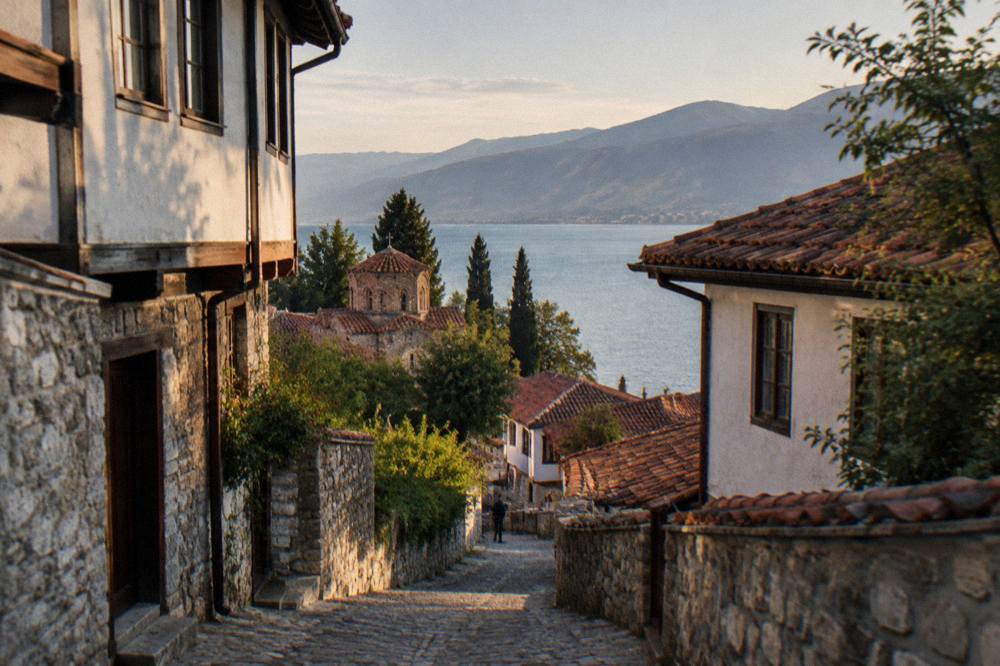
The fifth tip, the guided walk, is also the pleasant one. Language in Ohrid is inseparable from what the language describes: a fortress named for a tsar, churches whose names change between Macedonian and English, a bazaar where the word for cheese matters more than the word for museum. A guide moves through all of it in English while the town speaks Macedonian around you, and the things to do in Ohrid page lists the options for turning that first morning into a full itinerary, with the best time to visit Ohrid page handling the seasonal timing.
Practical readiness rounds it out: the is Ohrid safe page answers the safety question, the where to stay in Ohrid page covers neighbourhoods, and Lake Ohrid covers the body of water the whole town is arranged around. None of these require Macedonian to read, but each one drops a few more Cyrillic words into your working vocabulary as a side effect.
Common Questions About Language In Ohrid
Do they speak English in Ohrid?
Yes, English is the main visitor language in the old town, hotels, restaurants, tour listings and ticket desks, and every guided product in the site's Ohrid roster operates in English. Outside the visitor core English thins out and Macedonian carries daily life.
How do you say hello in Macedonian?
Dobar den (good day) is the standard daytime greeting, with dobro utro for morning and dobra vecher for evening. The greetings change with the time of day, and using the right one reads as good manners.
Is Macedonian written in Cyrillic or Latin letters?
Macedonian is written in the Cyrillic alphabet, which has 31 letters, and Latin script is also used, especially on menus, brochures and visitor-facing signage in Ohrid.
Can I get by in Ohrid without any Macedonian?
Yes. The museum institute publishes in English, tours and boats run in English, and restaurant menus in the visitor core carry English translations. A handful of polite words is welcome but not necessary.
Do people in Ohrid understand Serbian or Bulgarian?
Largely, yes. Macedonian is closely related to Bulgarian, and Serbian, Croatian and Bosnian are widely understood, especially among older speakers who grew up with Serbo-Croatian.
What is the most useful Macedonian word for a visitor?
Blagodaram, thank you. It fits every transaction, from museum tickets to market stalls to taxi rides, and it is the word Ohrid locals will hear from visitors most often.