Ohrid To Thessaloniki And Greece: Buses And Border
Ohrid to Thessaloniki means leaving North Macedonia for Greece: a border that is outside Schengen on one side and inside it on the other, a currency that changes from the denar to the euro, and a bus journey whose schedules shift with the season.
Short answer
Travel from Ohrid to Thessaloniki runs by road, with departures from the Ohrid bus station; because North Macedonia is outside the EU and Schengen, every crossing into Greece involves passport control, and Greek prices are in euros while Macedonian costs are in denar.
Ohrid, the lakeside town in North Macedonia on Lake Ohrid at about 693 m above sea level, sits closer to two international borders than to its own capital, and Greece is one of them. This Ohrid Travel Guide page covers the practical spine of the trip south: how the road journey to Thessaloniki works, what documents the border demands, what changes in your pocket when the denar gives way to the euro, and how to fit Ohrid into a route that continues into Greece. North Macedonia is outside the EU and outside Schengen, Greece is inside both, and that single fact shapes almost everything about the crossing.
How Do You Travel From Ohrid To Thessaloniki?
The journey from Ohrid to Thessaloniki is a road journey by intercity bus or car, with no passenger train into Ohrid at all and no published timetable for the direct crossing, so the first practical step is checking current schedules at the Ohrid bus station before you commit to a day. Buses on this route are seasonal in part, and the composition of the route, direct coach versus a change of bus partway, varies with the year and the season. The Ohrid bus station, covered in detail in the Ohrid bus station guide, is where every long-distance departure in the town starts, and staff there can confirm whether a same-day connection to Thessaloniki exists or whether an overnight stop fits better.
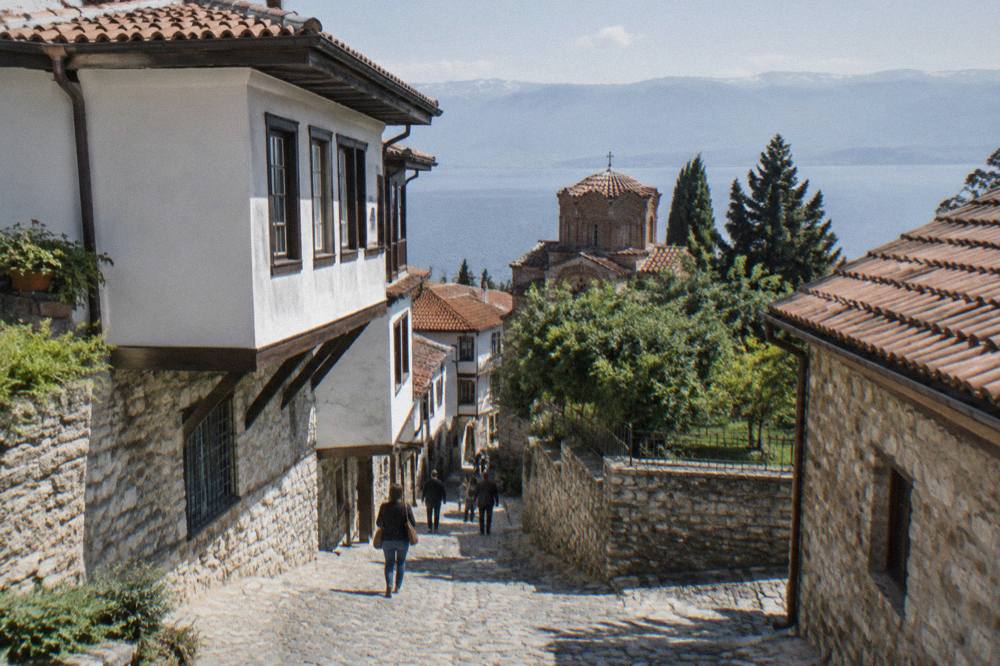
Two route shapes dominate the planning discussion. One runs the journey in stages through Skopje, which is about 170 km by road from Ohrid and is the country's main transport hub, with onward international coaches towards Greece. The other heads south and west first, towards Bitola and the southern border, a direction that shortens the distance to Greek territory but depends entirely on which operators run international lines in the season you travel. Neither shape has a fixed timetable on record here, so the honest planning position is: choose your border direction after you have seen what actually departs that week. For the wider picture of reaching the town from every direction, the how to get to Ohrid guide collects the routes.
A third option is flying, but it does not serve this corridor well. Ohrid's own airport, covered here, is about 10 km from the centre and its routes run mostly north and west into central Europe, not south into Greece, so the bus and the road remain the practical answer for Thessaloniki. If you are assembling a multi-country Balkan route rather than a simple out-and-back, the Ohrid to Kotor guide covers the western crossing towards Montenegro in the same practical style.
Considering flying instead of the long bus ride. Book a flight to Ohrid here.
Do You Need A Passport To Cross From Ohrid Into Greece?
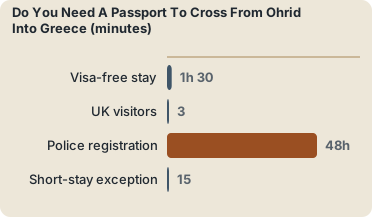
Yes, a valid passport or accepted ID document is required, because North Macedonia is not in the Schengen area even though Greece is, so every crossing from Ohrid towards Thessaloniki passes a full passport control on the way out and a Schengen entry check on the way in. The Macedonian foreign ministry's entry rules allow visa-free stays of up to 90 days in any 180-day period for most foreign nationals, and holders of a valid multiple-entry UK, US or Canadian visa, or Schengen residence, may stay up to 15 days. UK guidance adds that visitors may stay up to 3 months and should register with the local police within 48 hours of arrival, a formality hotels handle for their guests.
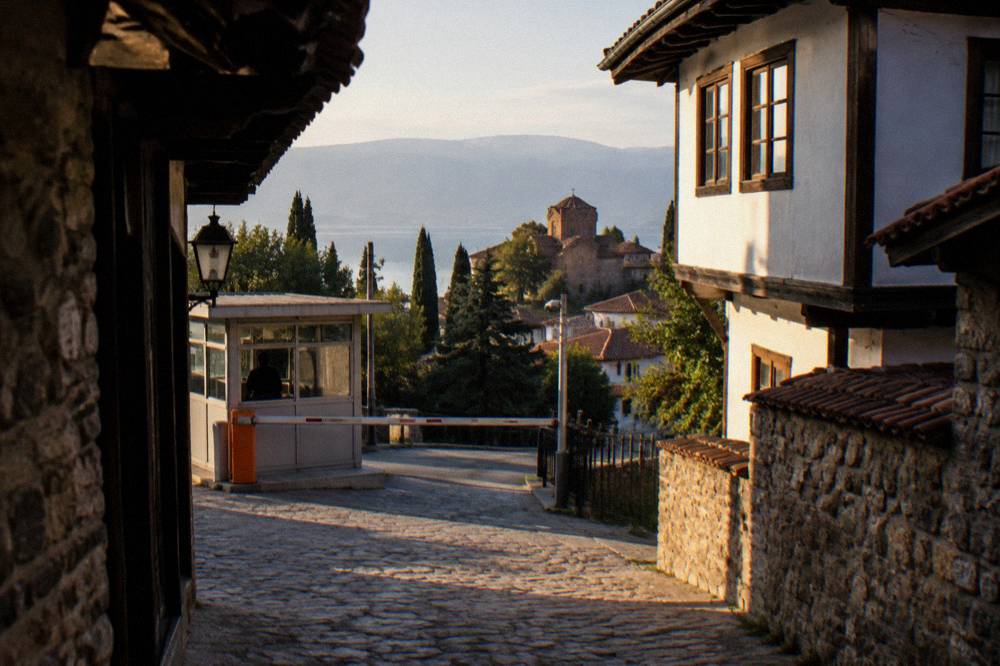
The document side is worth getting exactly right, because the rules are asymmetric between the two countries. The table below gathers the entry facts that carry a source; anything beyond them, such as expected queue times at the Greek crossing, is not a published figure and should not be planned around.
| Requirement | North Macedonia side | Greece side |
|---|---|---|
| Zone | Outside the EU and outside Schengen | EU member and Schengen member |
| Visa-free stay | Up to 90 days in any 180-day period for most nationals | Schengen rules apply on entry |
| UK visitors | Up to 3 months, passport expiry at least 90 days after arrival | Schengen entry rules apply |
| Police registration | Within 48 hours, hotels do it for guests | Not required for hotel stays |
| Short-stay exception | 15 days with a valid multiple-entry UK, US or Canadian visa or Schengen residence | Does not apply |
One clarification that matters for the rest of a Balkan route: Bulgaria and Romania became full Schengen members, land borders included, on 1 January 2025, which changed crossings north and east of North Macedonia. The southern border into Greece has always been an external Schengen border from the Macedonian side, and it stays one. The full document picture for entering the country in the first place sits in the visa and entry guide.
What Changes At The Border Between North Macedonia And Greece?
Three things change at the border: the currency switches from the Macedonian denar to the euro, the emergency numbers change, and the practical cost base of the trip changes with it, because Greek prices are quoted in euros while Ohrid's museum tickets and local costs are quoted in denar. The denar is de facto pegged to the euro through the National Bank's exchange-rate targeting, and the middle rate on 19 October 2026 was 1 EUR = 61.6633 MKD, but a peg is not a permission to spend: euros are not legal tender in North Macedonia and are only accepted informally at poor rates when they are accepted at all. ATMs are widespread for denar withdrawals.
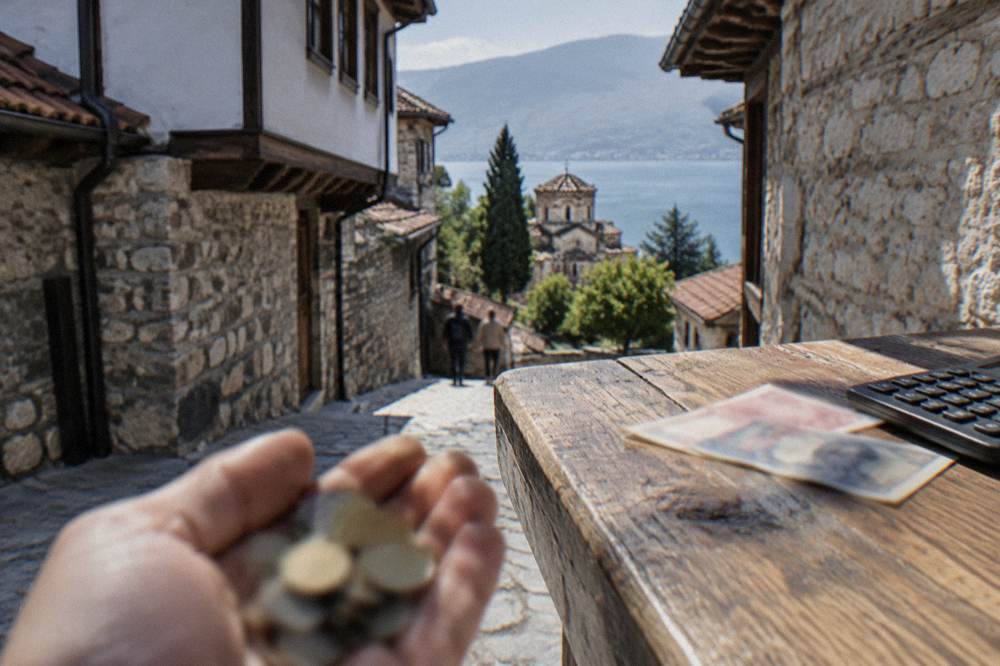
The practical sequence is simple. Spend or withdraw denars for your last Macedonian costs, cross, and withdraw euros on the Greek side rather than exchanging cash at the border. Ohrid's own sightseeing costs run in denars, and the museum institute's own pages list the tickets: 150 den for foreign visitors, 120 den for domestic, with a reported child and student rate of 60 den, across the Robev Family House, the Bay of Bones and the Icon Gallery. The denar and money guide and the cost and budget guide cover the Macedonian side in depth.
| Money fact | Figure | Where it applies |
|---|---|---|
| Denar to euro middle rate, 19 Oct 2026 | 1 EUR = 61.6633 MKD | National Bank middle rate, reference only |
| Euro status in North Macedonia | Not legal tender | Informal acceptance only, poor rates |
| Museum institute ticket, foreign adult | 150 MKD | Robev House, Bay of Bones, Icon Gallery |
| Museum institute ticket, domestic adult | 120 MKD | Same listed sites |
| Galicica National Park, vehicle | 250 MKD per vehicle, no per-passenger fee | Ohrid-side gate on foot: 100 MKD |
The peg has a quiet advantage for planning: because the denar tracks the euro, the arithmetic of your Macedonian costs does not swing week to week against the euro you will spend in Greece. What does swing is what each side charges for, and that is where a budget comparison belongs, not in the exchange rate.
Should You Break The Ohrid To Thessaloniki Trip In Skopje?
Breaking the journey in Skopje is the staging option with the most transport behind it: the capital is about 170 km by road from Ohrid, reachable by intercity bus in roughly three hours with tolls of about 140 MKD by car, and it carries the country's widest choice of onward international lines towards Greece. The alternative staging points south of Ohrid, such as Bitola, sit closer to the Greek border but have a thinner long-distance network, so the choice is between a longer road north and a better choice of onward coaches from Skopje.
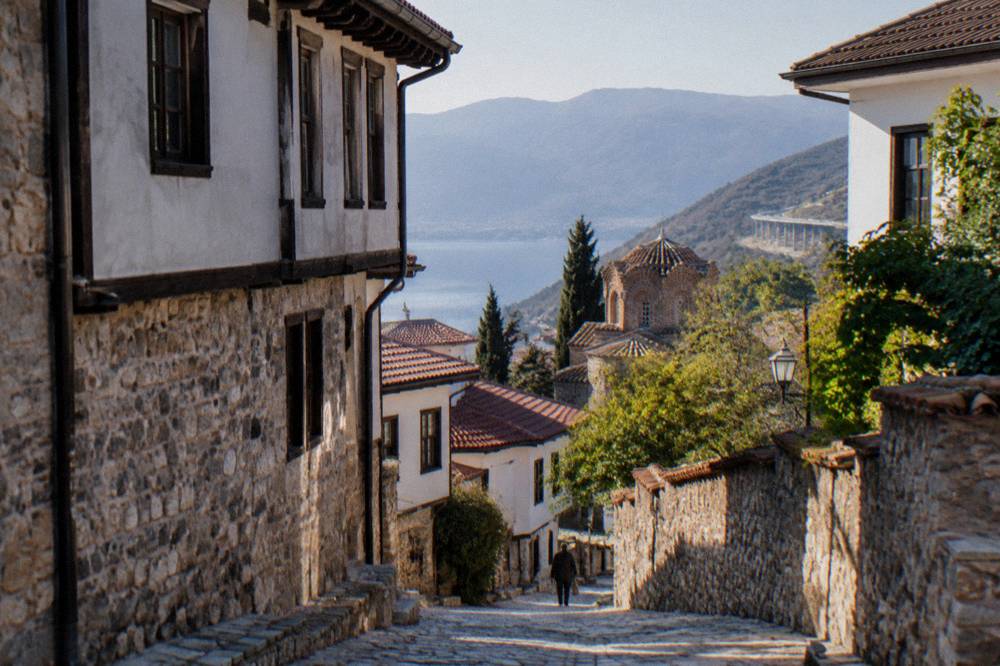
The road facts for the Skopje leg are the best documented part of the whole corridor, and they come from the transport record rather than from operator promises. A private transfer between the two cities starts from about EUR 130, there is no passenger train to Ohrid and no domestic flight on the route, and driving means headlights on day and night, a green card, and tolls paid at each plaza because there is no vignette. The Skopje to Ohrid guide covers the leg in both directions, including what to expect at the bus station end.
| Skopje leg fact | Figure |
|---|---|
| Distance by road | About 170 km |
| Intercity bus journey time | About 3 hours |
| Motorway tolls by car | About 140 MKD total |
| Private transfer | From about EUR 130 |
| Passenger rail to Ohrid | None in operation |
One road project is worth knowing about if your route north runs through Kicevo: the Kicevo to Ohrid motorway section is due to open in stages, with the full opening expected in the first half of 2027, so road times on that side of the country are still a moving target and any schedule built around them should be checked close to travel.
How Many Days Should You Give Ohrid Before Greece?
Two or three days in Ohrid before continuing to Thessaloniki is the pattern that fits the town's sightseeing, since the museum sites, the lake and the Old Bazaar fill two full days comfortably and a third day opens the day trips to St Naum and Galicica, which is what the itinerary guides on this site are built around. Rushing Ohrid into a single afternoon before a border crossing wastes the reason the town is on your route at all: a UNESCO mixed heritage site, inscribed in 1979 and 1980 and extended to the Albanian part in 2019, with more than 800 Byzantine-style icons from the 11th to the end of the 14th century held in its churches and galleries.
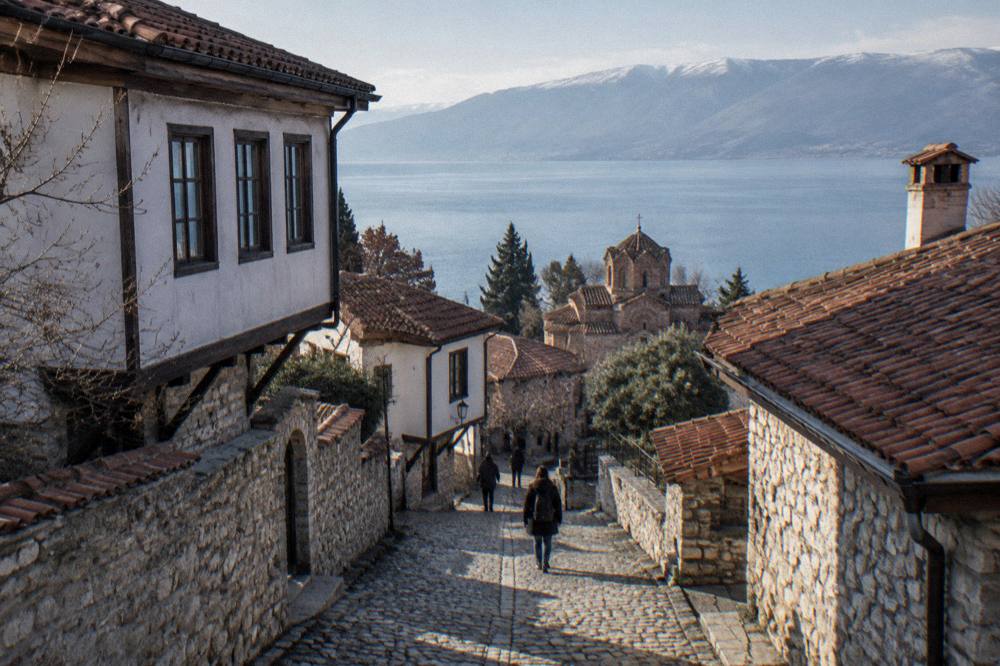
The scheduling detail that matters most for a short stay is the museum calendar. The museum institute's sites run a winter schedule from 1 October to 30 April and a summer schedule from 1 May to 30 September, and they are closed on Mondays, so a two-day visit that lands on a Monday loses the interiors it came for. The how many days in Ohrid guide and the best time to visit guide work through the seasonal trade-offs, and the weather figures below, modelled ERA5 normals for 1991-2020 rather than a station record, explain why the shoulder months suit a border-and-bus itinerary.
| Month | Mean daily high C | Mean daily low C | Rain mm |
|---|---|---|---|
| Apr | 14.6 | 6.3 | 82.4 |
| May | 19.5 | 10.8 | 70.8 |
| Jun | 24.2 | 15.2 | 43.1 |
| Jul | 27.1 | 18.3 | 34.7 |
| Aug | 27.6 | 19.0 | 32.9 |
| Sep | 22.4 | 14.9 | 62.4 |
| Oct | 17.4 | 10.3 | 76.0 |
The same months carry the town's calendar. The 66th Ohrid Summer Festival opened on 12 July 2026 at the Ancient Theatre and runs to 20 August by tradition, the Balkan Festival of Folk Songs and Dances held its 65th edition from 3 to 6 July 2026, and the Ohrid Water Festival ran from 12 to 30 August 2026 including the 25 km swimming marathon from St Naum to Ohrid harbour on 22 August.
What Should You See In Ohrid Before You Cross Into Greece?
Before crossing into Greece, see St Naum, the monastery at the Crn Drim springs about 4 km from the Tushemisht border crossing into Albania, ideally combined with a seven-hour boat cruise from Ohrid port. Also visit Galicica National Park, the country's second national park, which spans 22,750 ha between Lake Ohrid and Lake Prespa and includes Magaro peak at 2,254 m. A St Naum day trip from Tirana suits travellers on an Albania and Greece loop.
The things to do in Ohrid overview collects the full list.
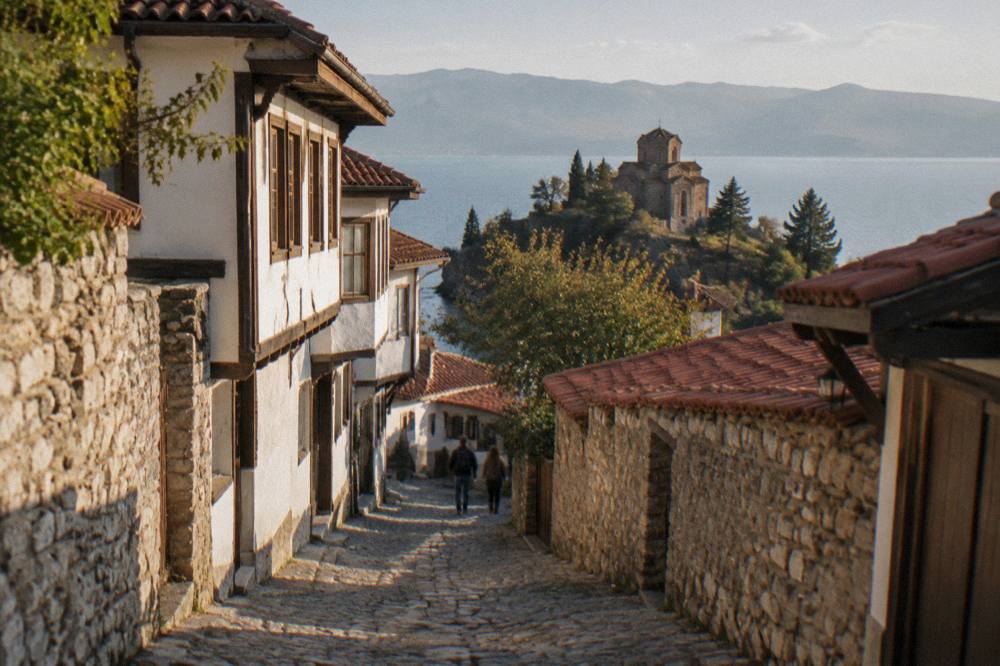
The day trips are where a Greek-bound itinerary earns its extra day. St Naum, the monastery at the Crn Drim springs about 4 km from the Tushemisht border crossing into Albania, combines with a full-day boat cruise from Ohrid port that runs seven hours and costs from 1,200 den for an adult and 600 den for a child with one operator. Galicica National Park, the country's second national park, founded in 1958, spans 22,750 ha between Lake Ohrid and Lake Prespa with the Magaro peak at 2,254 m, and charges 250 MKD per vehicle with no per-passenger fee, or 100 MKD for someone entering on foot from the Ohrid-side gate. The St Naum monastery page covers the site itself.
If your route into North Macedonia came from the south-west rather than the north, the mirror-image planning is in the Tirana to Ohrid guide, which covers the Albanian crossing and the furgon minibus network on that side. And for travellers whose Balkan loop continues beyond Greece, the Tirana from Ohrid day trip guide shows how close the third border sits to this town.
One guided option fits the pattern of a pre-departure day especially well. The St Naum day trip that starts in Tirana covers the monastery and the Ohrid side of the lake on a route that many travellers tack onto an Albania and Greece loop; you can Check availability alongside the internal St Naum day trip from Tirana write-up before committing a day to it.
What Is Different About Coming Back From Greece To Ohrid?
Coming back from Thessaloniki into Ohrid reverses the document and money sequence rather than repeating it: you leave the Schengen area at the Greek exit check, enter North Macedonia under its 90-days-in-180 visa-free rule, and need denars again for every local cost from museum tickets to the bus station kiosk. The registration rule also returns, since UK guidance asks visitors to register with the local police within 48 hours of arrival in North Macedonia, a task hotels perform for their guests. None of this is difficult, but it is asymmetric, and travellers who treat the two crossings as identical are the ones caught out.
The practical return-day checklist is short. Have your passport to hand for both checks, withdraw denars after the Macedonian side rather than accepting an informal euro rate, and keep the emergency numbers for the country you are in: ambulance 194, police 192 and roadside assistance 196 in North Macedonia, with the Greek equivalents applying before the border. Safety context for the Macedonian side is covered in the is Ohrid safe guide, and the question of where to land on the first night back is answered in the where to stay in Ohrid guide.
A final planning note on the lake itself. Ohrid sits on Lake Ohrid, a freshwater mountain lake about two to three million years old by UNESCO's description, with over 200 endemic species including 17 endemic fish, and the lake's character does not stop at any border: the UNESCO property was extended to the Albanian part in 2019. The Lake Ohrid guide carries the fuller picture.
Common Questions About Ohrid To Thessaloniki
How do you travel from Ohrid to Thessaloniki?
By road, either directly by intercity coach when a seasonal line runs, or in stages through Skopje, about 170 km from Ohrid, where the widest choice of international coaches departs. There is no passenger train to Ohrid, and no reliable timetable for the direct crossing, so check current schedules at the Ohrid bus station before you plan a same-day journey.
Do you need a passport to cross from North Macedonia into Greece?
Yes. North Macedonia is outside the EU and outside Schengen, so crossing into Greece means a passport control on exit and a Schengen entry check on arrival, in both directions. Visa-free stays in North Macedonia run up to 90 days in any 180-day period for most nationals.
Can you use euros in Ohrid before crossing into Greece?
No. The Macedonian denar is the local currency and euros are not legal tender, though they are sometimes accepted informally at poor rates. The denar is de facto pegged to the euro, with a middle rate of 1 EUR = 61.6633 MKD on 19 October 2026, and ATMs are widespread for denar withdrawals.
Is there a train from Ohrid to Thessaloniki?
No. There is no passenger rail service into Ohrid at all, so the rail question does not arise on this corridor; the journey runs by bus or by car.
Do UK visitors need a visa for the North Macedonia side of the trip?
No, UK visitors may stay up to 3 months, with a passport expiry date at least 90 days after the date of arrival, and hotels handle the police registration required within 48 hours of arrival.
How many days should you spend in Ohrid on the way to Greece?
Two days covers the old town, the churches and the museum sites, and a third day opens St Naum and Galicica. Museum sites close on Mondays and run a winter schedule from 1 October to 30 April, so the days of the week matter as much as the count.