Etiquette And Tipping In Ohrid
Ohrid is a small lakeside town whose daily rhythm runs through churches, family restaurants and the lakeshore, and a visitor who understands a few local habits, from covering shoulders in churches to paying in denar, will be welcomed everywhere from the Old Bazaar to St Naum.
Short answer
In Ohrid, cover shoulders and knees in churches, greet before asking, pay in Macedonian denar rather than assuming euros, and treat tipping as a small courtesy in denar notes rather than a fixed percentage.
Ohrid sits on the shore of Lake Ohrid in North Macedonia, a freshwater mountain lake at about 693 m above sea level, and the whole town lives inside a UNESCO mixed heritage site, the Natural and Cultural Heritage of the Ohrid Region, inscribed in 1979 and 1980. The Ohrid Travel Guide covers the destination end to end, and this page handles the part many guides skip: how to behave. Etiquette in Ohrid is not a minefield, but it is a religious town, a cash-friendly town and a town on a protected lake, and small habits matter. The museum institute's own pages, government decisions on lake use and the UK foreign travel advice for North Macedonia give the concrete rules below, and where a habit is a matter of courtesy rather than a published rule, that is what the page says.
How Should You Behave At Ohrid's Churches And Monasteries?
Churches and monasteries in Ohrid are working religious sites inside a UNESCO heritage area, and the baseline expectation is modest dress, quiet voices and no flash photography inside, with the museum-run sites charging published admission and closing on Mondays, so a respectful visit needs both a covered outfit and a little planning around the weekly closing day.
The Byzantine churches are the reason Ohrid holds UNESCO status at all. UNESCO's own listing records that Ohrid has the oldest Slav monastery, St Panteleimon at Plaosnik, and more than 800 Byzantine-style icons from the 11th to the end of the 14th century. These are not museums first. Services, weddings and feast days happen in them, and on those days a visitor waits outside or stands quietly at the back.
Practical dress etiquette is straightforward: shoulders and knees covered for men and women alike, hats off indoors, and loud conversation left on the street. Monasteries such as St Naum, about 4 km from the Tushemisht border crossing, follow the same expectation. The rowboat ride through the Crn Drim springs costs about 5 EUR per boat, per the cruise operator Armada, and the monastery entrance is listed at 150 MKD per person on that operator's page.
For the museum institute's sites, the institute's own pages give the entry prices and the weekly rhythm:
| Museum Institute Site | Foreign Adult | Domestic Adult | Hours Basis | Closed |
|---|---|---|---|---|
| Robev Family House | 150 MKD | 120 MKD | Winter 09:00-15:30, summer two shifts to 20:00 | Monday |
| Bay of Bones / Museum on Water | 150 MKD | 120 MKD | Winter 09:00-15:30, summer 09:00-16:30 | Monday |
| Icon Gallery, Perivleptos complex | 150 MKD | 120 MKD | Winter 09:00-14:00, summer 09:00-17:00 | Monday |
Winter schedules run from 1 October to 30 April and summer schedules from 1 May to 30 September, per the institute's pages, and the child and student rate is reported as 60 den. More church-by-church background sits in the Ohrid churches overview and in the pages on St John at Kaneo and St Sophia.
What Is The Tipping Approach In Ohrid?
Tipping in Ohrid works as a small, optional courtesy in Macedonian denar rather than a fixed published percentage, and because no official source sets a local rate, the sound approach is to round up modestly in restaurants and taxis, hand a few denar notes to guides and drivers who have helped you, and never feel pressed to calculate a percentage the way a service-culture city expects it.
No government or tourism-body page publishes a tipping norm for North Macedonia, so any percentage an article quotes is someone's habit, not a rule. What can be said from the money side is concrete: the currency is the denar, the National Bank's middle rate stands at 1 EUR at 61.6633 MKD, and euros are not legal tender even though tour operators quote in them. Tips given in cash should therefore be denar, because a waiter or boat hand cannot easily spend a ten-euro note at the market.
A workable pattern for a week in Ohrid: keep small denar notes for café round-ups, restaurant tables, the airport-to-town taxi and a guide at the end of a walking tour. For booked day trips and boat cruises, the tipping moment is at the end of the excursion, in cash, in the local currency. Do not tip at museum ticket desks, and do not leave money in church donation boxes as though it were a service charge, those boxes are for worshippers.
The money mechanics deserve their own reading, and the denar and money guide and the cost and budget guide cover them in depth.
How Does Money Etiquette Work With The Denar In Ohrid?
Money etiquette in Ohrid comes down to paying in Macedonian denar for everyday purchases, understanding that euros are quoted by tour operators but are not the local currency, and knowing that North Macedonia is outside both the EU and the eurozone, so a card that works in Greece is not guaranteed to be the polite default at a village taverna table.
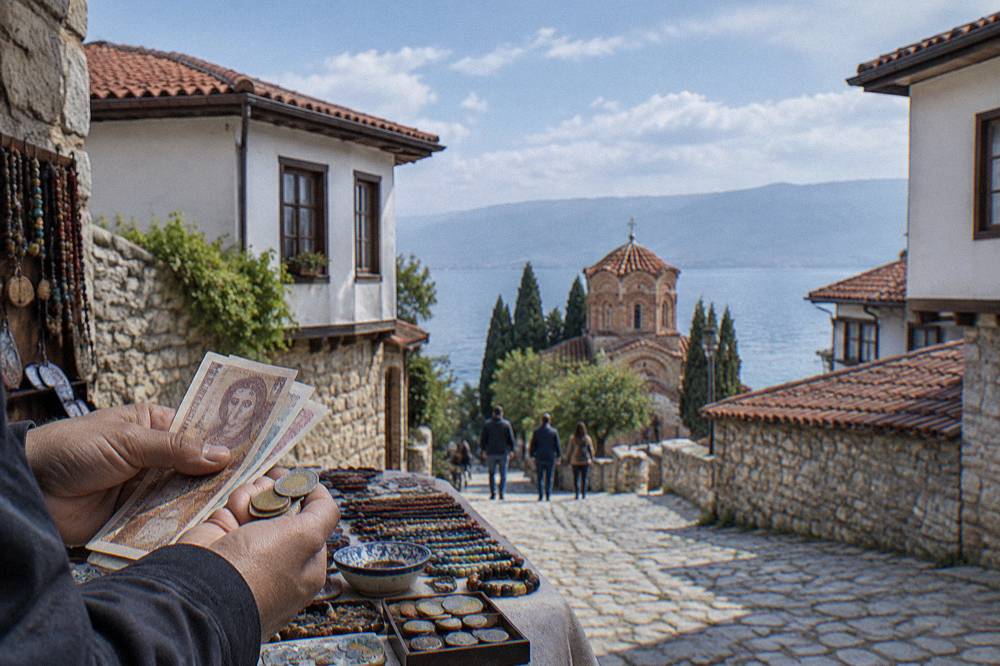
The denar is de facto pegged to the euro through the National Bank's exchange-rate targeting, reported at around 61.5 MKD to the euro, which keeps mental arithmetic stable across a trip. What this means in practice for manners: when a restaurant or a boat operator quotes a price in euros, ask for the denar price too, because paying in denar is the norm and informal euro acceptance, where it happens, is reported to come at poor rates.
| Money Fact In Ohrid | Figure Or Rule |
|---|---|
| Local currency | Macedonian denar (MKD) |
| Euro middle rate (National Bank) | 1 EUR = 61.6633 MKD |
| Euro status | Quoted by operators, not legal tender |
| EU and eurozone membership | North Macedonia is in neither |
| Schengen membership | Not a member; Bulgaria and Romania joined fully on 1 January 2025 |
Haggling is not part of Ohrid's shopping culture the way it is in some Balkan markets. The Old Bazaar's shops and the souvenir workshops that make the famous Ohrid pearl sell at asking prices, and polite conversation, not bargaining, is the local register.
What Are The Greeting And Language Habits In Ohrid?
The language of Ohrid is Macedonian, written in the Cyrillic alphabet, and the polite baseline is a spoken greeting before any request, a simple good day or thank you in Macedonian where you can manage it, and patience with English, which is common in tourism but not universal in shops and taxis, so a few words and a calm manner open more doors than fluent English does.
Macedonian uses the Cyrillic alphabet as its primary script, with Latin also in use, so street signs and menus in the old town often carry both. Learning to read a handful of Cyrillic letters pays off faster than a phrasebook of sentences: restaurant, church and hotel are all decipherable within a day.
Greetings come first. In a shop, at a market stall or at a monastery gate, a greeting before the question is the expected order, and skipping it reads as rude anywhere in North Macedonia, not just in Ohrid. Dress and demeanour at religious sites follow the rules in the first section of this page, and at family tables the customs are the same as across the country: wait to be seated, accept what is offered, and treat rakija, the fruit brandy covered in the rakija and Macedonian wine guide, as a gesture of hospitality rather than a drink to refuse casually.
How Should You Behave On The Lake And At The Beaches?
Lake Ohrid is a protected lake inside a UNESCO site, and behaviour on it is regulated, not just customary: a June 2026 government decision bans jet skis in daytime through peak summer, restricts boats at night through August and September, and asks swimmers and beachgoers to treat the water as the town's defining asset, with 2026 testing showing Class I physico-chemical quality everywhere except Grashnica beach.
The Ministry of Transport's decision of 2 June 2026 set jet-ski bans from 1 July to 31 August between 11:00 and 19:00, and night boating bans from 3 June to 31 August between 21:00 and 05:00, with a further October limit. These are dated 2026 rules for swimmer safety, and a respectful visitor does not book an operator who ignores them.
| Lake Rule Or Fact | Detail |
|---|---|
| Jet-ski daytime ban, 2026 | 1 Jul to 31 Aug, 11:00 to 19:00 |
| Night boating ban, 2026 | 3 Jun to 31 Aug, 21:00 to 05:00 |
| September night ban, 2026 | 1 to 30 Sep, 20:00 to 06:00 |
| 2026 bathing water | Class I physico-chemical, except Grashnica beach, Class III |
| Boats to St Naum season | About May to October, reduced in winter |
At the beaches, from Gradiste to Ljubanista, the etiquette is ordinary lake etiquette: take rubbish away, keep music low, and respect that the lake's water is the town's drinking-water basin as well as its swimming pool. The swimming guide and the beaches guide list the swimming spots, and the modelled lake temperature reaches about 23.5 C in August against about 6.0 C in December, which is why the shore culture is seasonal.
On the water itself, the full-day cruise from Ohrid port to St Naum with the operator Armada runs seven hours from 1,200 den for an adult and 600 den for a child, with the Bay of Bones entrance of 150 MKD not included, and the polite pattern on any cruise is to be at the port before departure and to settle with the crew in denar.
What Table Manners And Food Customs Apply In Ohrid?
Table customs in Ohrid run on hospitality: meals are unhurried, dishes arrive to be shared, the host's offer of rakija or coffee is a welcome rather than an upsell, and the bill arrives only when you ask for it, so the polite guest slows down, eats what is put forward and signals for the bill rather than waiting for it.
Ohrid's food identity is lake and mountain at once. Ohrid trout is the famous local fish, and tavche gravche, the baked-bean dish, is the national comfort food; both have their own guides on this site, along with the wider Ohrid food and restaurants pages. Customs at the table are simple: compliment the food, do not rush the cook, and understand that a meze-style spread of small dishes is an invitation, not a course structure.
Two habits worth naming. First, smoking is common on terraces and in designated indoor areas, and reacting loudly to it reads as worse manners than the smoke itself. Second, the bill comes on request; staff will not hover. When it comes, cash in denar remains the smoothest settlement, and the tipping approach is the one above: round up modestly, in notes, without a ceremony.
How Should You Behave On Tours And With Guides In Ohrid?
A good guest on an Ohrid tour arrives at the meeting point early, lets the guide set the pace through the old town's steep lanes, keeps questions for natural pauses at churches rather than mid-story, and settles tips in denar at the end, while tours that start in Skopje or Tirana genuinely start there, so confirming the departure city before booking is the single most important etiquette point of all.
The roster point matters commercially and politely. A trip labelled from Tirana, such as the Ohrid and St Naum day tour that departs Tirana and Durres, is an Albanian departure, and turning up in Ohrid expecting a pickup is a planning failure, not a service failure. The same applies to the full-day Ohrid tours that depart Skopje. Inside the town itself, the private full-day tour of Ohrid and the lake, this site's featured pick, links the old town's churches with the shoreline, and its page at Full-Day Private Best of Ohrid and Lake Ohrid carries the details, with live pricing and dates at the operator's listing: Check availability.
Guides in Ohrid routinely cover religion, history and politics in one walk, from the Ancient Theatre, built at the end of the 3rd or start of the 2nd century BC, to Samuel's Fortress above. Let them. Interruption etiquette is the same everywhere: listen, then ask.
What Should You Know About Respecting The Old Town Itself?
Ohrid's old town is a lived-in UNESCO site where about 51,428 people in the wider municipality go about ordinary lives, and from summer 2026 several old-town streets, including Ilindenska, Kosta Abrash and Car Samoil, became resident-only for parking, so the respectful visitor walks, keeps noise down at night in the lanes above the lake and never treats the stone streets or the fortress walls as furniture to climb.
The parking regime, introduced from around July 2026, clamps non-resident cars on those streets, which is as good a reason as any to arrive on foot. The old town climbs from the lake to Samuel's Fortress, and the lanes are pedestrian in character. The town's historic core holds the Old Bazaar, the Ancient Theatre and dozens of churches, and the old town guide maps it.
Litter, graffiti and climbing on walls are the obvious offences. A subtler one is drone flying over the heritage area and over the lake's protected shoreline, which sits badly with both residents and the site's protected status. The UNESCO story behind all of this, including the July 2026 decision that kept the region off the Danger List while asking both countries for progress, is in the UNESCO heritage guide.
How Should You Dress For Ohrid's Seasons?
Dressing for Ohrid means dressing for a mountain lake at about 693 m: ERA5 modelled normals for 1991-2020 put July daytime highs at 27.1 C and January highs at 5.0 C with nights below freezing, so church-appropriate coverage and swimwear coexist in a summer bag, and a warm layer is not optional outside June to September.
| Month | Mean Daily High | Mean Daily Low | Rainfall | What It Means For Dress |
|---|---|---|---|---|
| January | 5.0 C | -0.8 C | 76.5 mm | Winter coat, layers, possible snow |
| April | 14.6 C | 6.3 C | 82.4 mm | Light jacket plus rain layer |
| July | 27.1 C | 18.3 C | 34.7 mm | Heat gear plus a scarf or shawl for churches |
| October | 17.4 C | 10.3 C | 76.0 mm | Layers, warm evenings by the lake |
| December | 6.2 C | 0.9 C | 92.6 mm | Full winter kit, waterproof |
These are modelled ERA5 reanalysis normals for 1991-2020, not a station record, and the weather guide and the best time to visit guide build on them. The etiquette angle is the shawl or scarf: it is the single most useful item in Ohrid, because it turns any summer outfit into church-appropriate dress at the door of St Sophia or Plaosnik.
What Everyday Safety And Courtesy Numbers Should You Know?
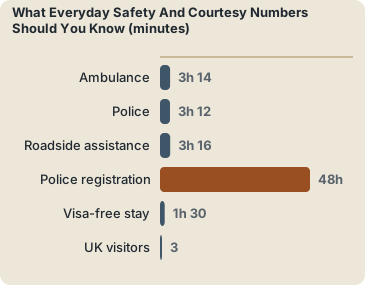
Courtesy in Ohrid includes knowing where help comes from: the UK foreign travel advice page for North Macedonia lists ambulance at 194, police at 192 and roadside assistance at 196, hotels handle the legal requirement to register guests with the local police within 48 hours of arrival, and the US advisory level for the country stands at Level 1, Exercise Normal Precautions, so the practical register is ordinary care rather than caution.
| Service | Number Or Rule |
|---|---|
| Ambulance | 194 |
| Police | 192 |
| Roadside assistance | 196 |
| Police registration | Within 48 hours of arrival; hotels do it |
| Visa-free stay | Up to 90 days in any 180-day period |
| UK visitors | Up to 3 months; passport expiry at least 90 days after arrival |
North Macedonia is outside the EU and Schengen, so border formalities at the Albanian crossing at Sveti Naum and Tushemisht, reported open 24/7 for passengers and pedestrians, are real border checks. The safety guide and the visa and entry guide carry the detail, and the walk across the no-man's-land between the two posts takes about 45 minutes on foot, a route where a greeting to the border officers and passports ready is the whole etiquette.
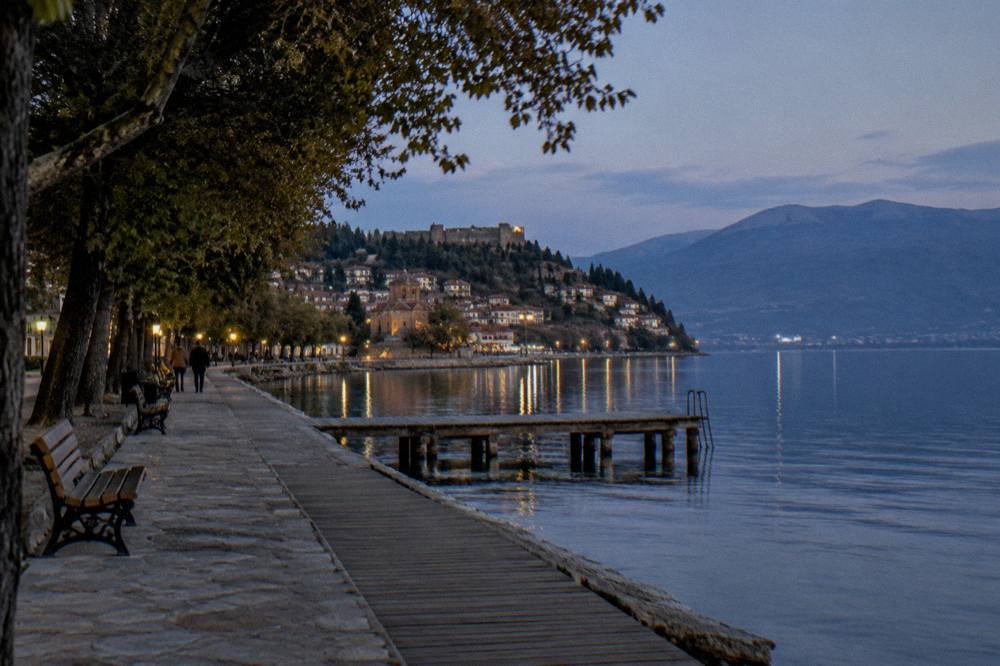
How Do You Behave As A Guest At Ohrid's Festivals?
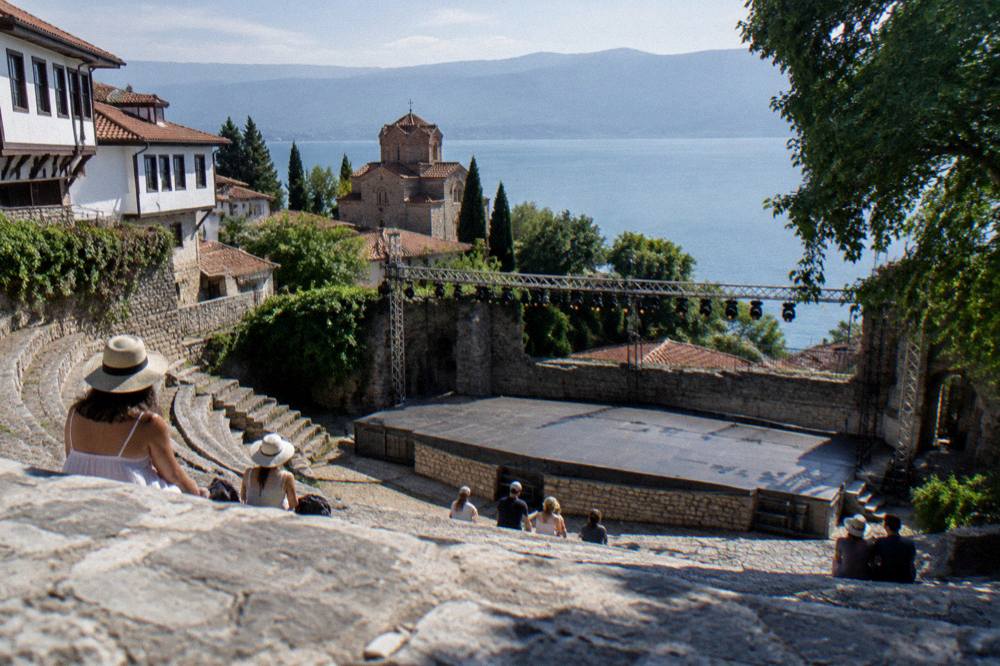
Ohrid's festival calendar is public and sacred at once: the 66th Ohrid Summer Festival ran 12 July to 20 August 2026 with its opening gala at the Ancient Theatre, the Balkan Festival of Folk Songs and Dances held its 65th edition from 3 to 6 July, and the etiquette at all of them is concert etiquette, quiet during performances, no flash at the Ancient Theatre's stone tiers and respect for the fact that St Sophia hosts performances as a church venue.
The Ohrid Water Festival in August 2026 included the 25 km swimming marathon from St Naum to Ohrid harbour on 22 August and a separate 33 km stand-up-paddle marathon around the lake on 26 August. Watching from the harbour is a civic event, and the swim is a serious race, sixteen swimmers took part in the 39th edition, so cheering, not swimming alongside, is the visitor's role.
Common Questions About Etiquette And Tipping In Ohrid
Is tipping expected in Ohrid?
Tipping in Ohrid is an optional courtesy in Macedonian denar, not a published percentage. Rounding up a restaurant bill or a taxi fare modestly, and handing a few denar notes to a guide or driver at the end of a tour, matches local practice, and no official source sets a fixed rate.
Can I pay with euros in Ohrid?
Euros are commonly quoted by tour and transfer operators but are not legal tender in North Macedonia. The local currency is the denar, with the National Bank's middle rate at 61.6633 MKD per euro, and informal euro acceptance, where it happens, is reported to come at poor rates.
What should I wear to visit churches in Ohrid?
Shoulders and knees covered for men and women, hats off indoors, and quiet behaviour, especially during services. The museum-run sites such as Robev Family House, the Bay of Bones and the Icon Gallery charge 150 MKD for foreign adults and 120 MKD for domestic adults, and close on Mondays.
Is Ohrid a safe place for respectful travel?
The UK foreign travel advice lists ambulance at 194, police at 192 and roadside assistance at 196, and the US advisory for North Macedonia stands at Level 1, Exercise Normal Precautions. Ordinary care around belongings and the lake shoreline covers the practical side.
Are there rules for using Lake Ohrid?
Yes, dated 2026 rules: jet skis are banned from 1 July to 31 August between 11:00 and 19:00, and boats are restricted at night through the summer and early autumn under the government decision of 2 June 2026. Swimmers should note that 2026 testing found Class I physico-chemical water quality everywhere except Grashnica beach.
How do I greet people politely in Ohrid?
Greet before you ask. Macedonian, written in Cyrillic, is the local language, and a spoken good day or thank you in Macedonian before a request is the expected order in shops, at market stalls and at monastery gates.
Etiquette in Ohrid is mostly attentiveness: covered shoulders at church doors, denar at the table, a greeting before a question, and care for the lake that gives the town its name and its UNESCO status, and every visitor who manages those four habits will find the rest of the welcome takes care of itself.