Ohrid Hostels And Budget Stays
The neighbourhoods that suit cheap stays, the fixed local costs that are on the record, and a sample day that keeps spending flat are covered below.
Short answer
Budget travellers to Ohrid should base themselves in or near the old town, use the museum institute's fixed 120 to 150 MKD tickets, eat from bakers and the Old Bazaar rather than the quay, and swim at public lake access points, which cost nothing.
Ohrid, a lakeside town in North Macedonia on Lake Ohrid at about 693 m above sea level, has long been a destination where the lake, the churches and the lanes cost nothing to enjoy and only the doors charge. A budget trip here is less about hunting discounts and more about knowing which figures are fixed, which neighbourhoods suit a thin wallet, and how the town's free layer, from the shoreline to the Old Bazaar, holds up a whole visit. The Ohrid Travel Guide covers the town in depth; this page concentrates on staying and spending little.
Which Areas Of Ohrid Suit A Budget Stay Best?
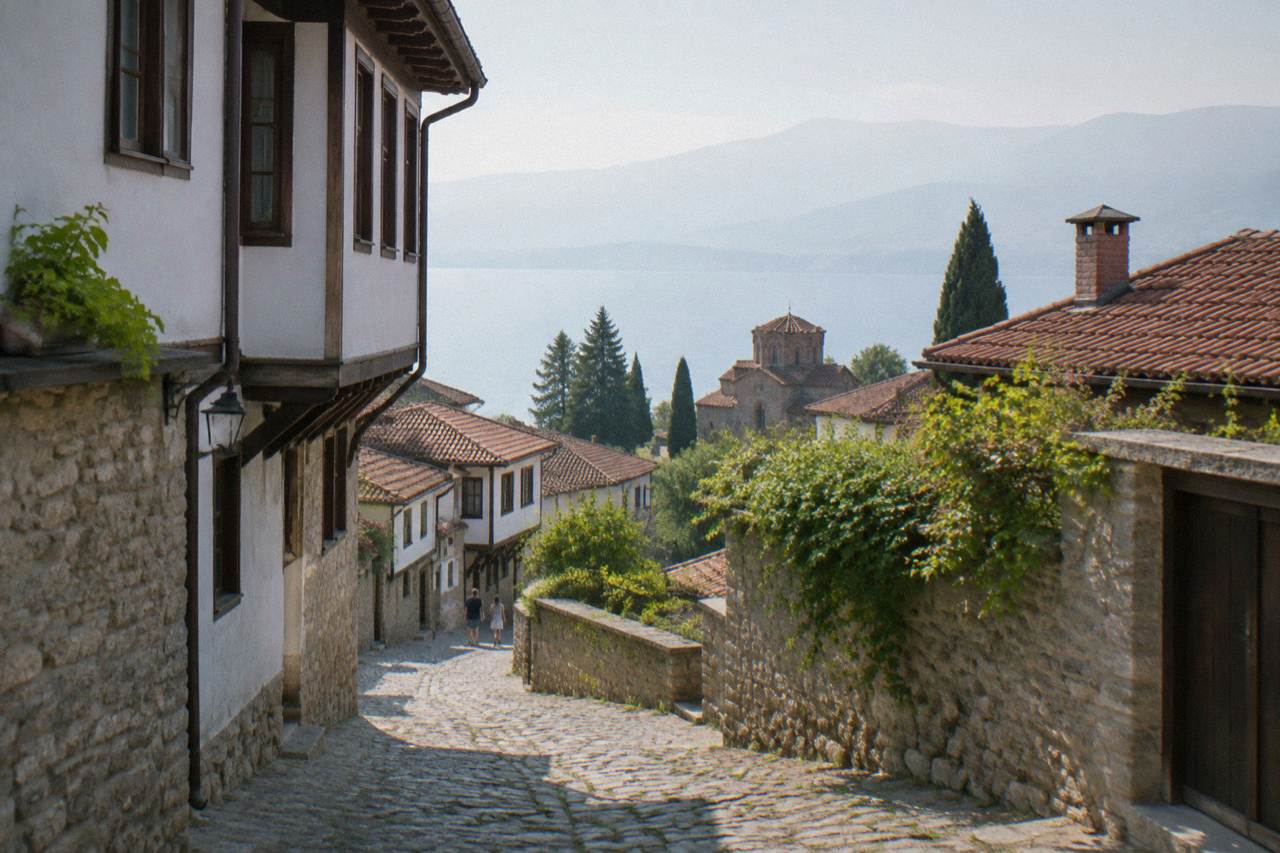
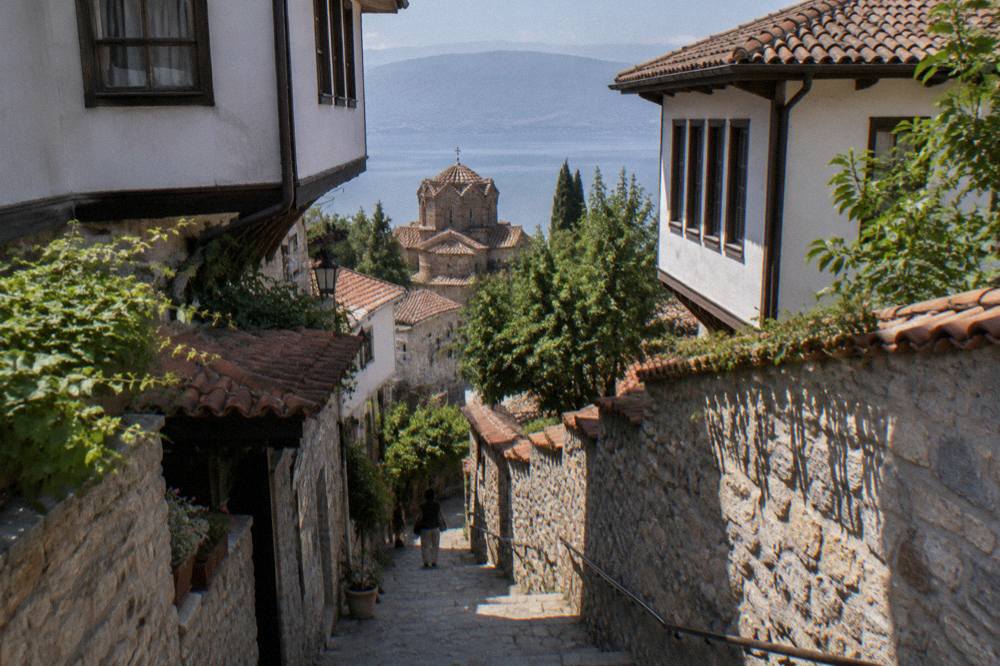
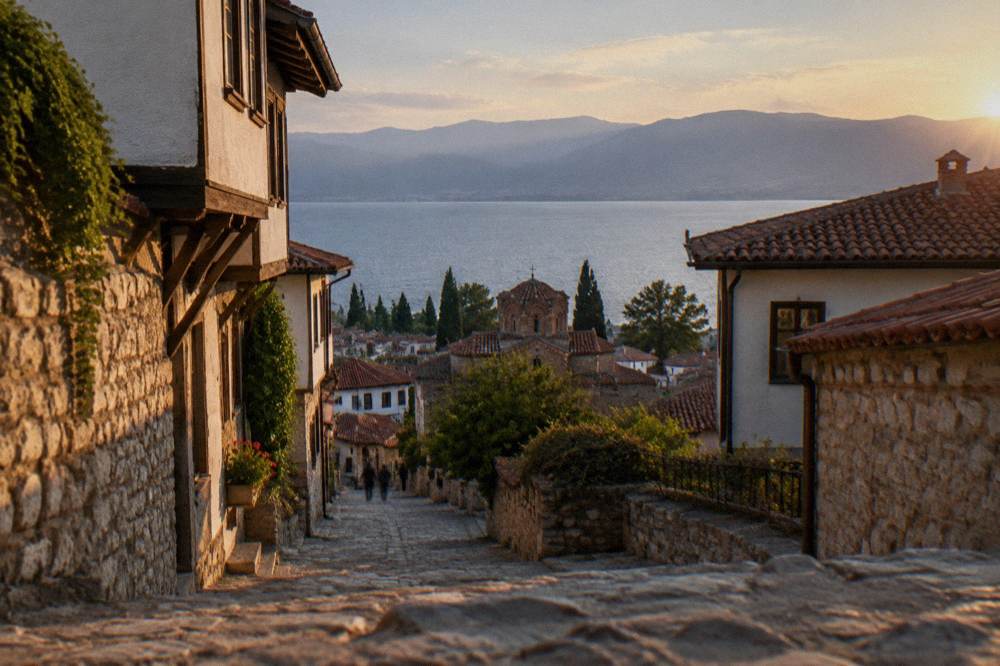
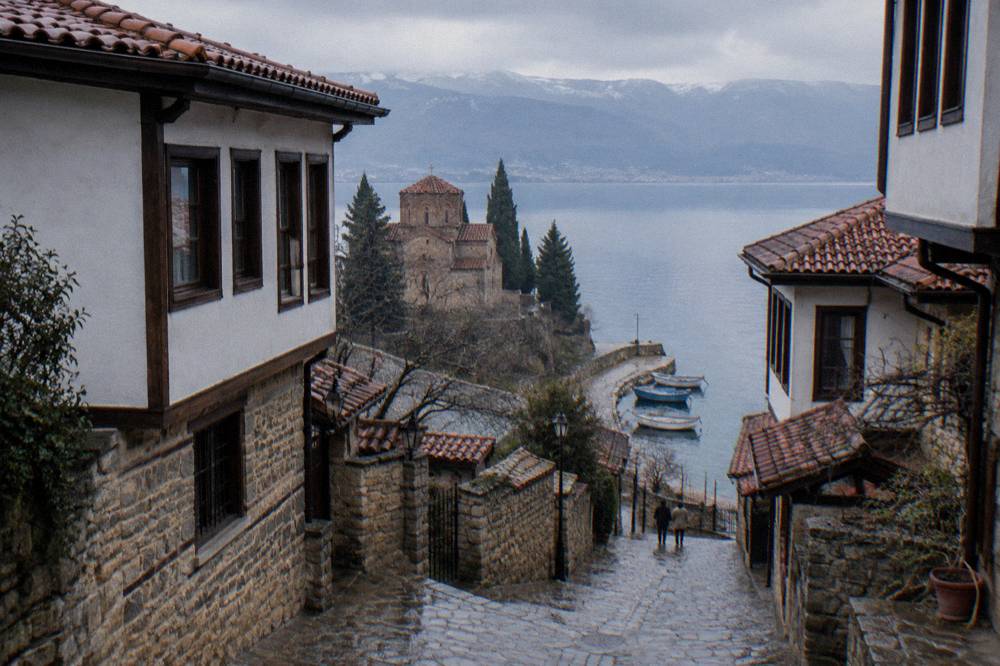
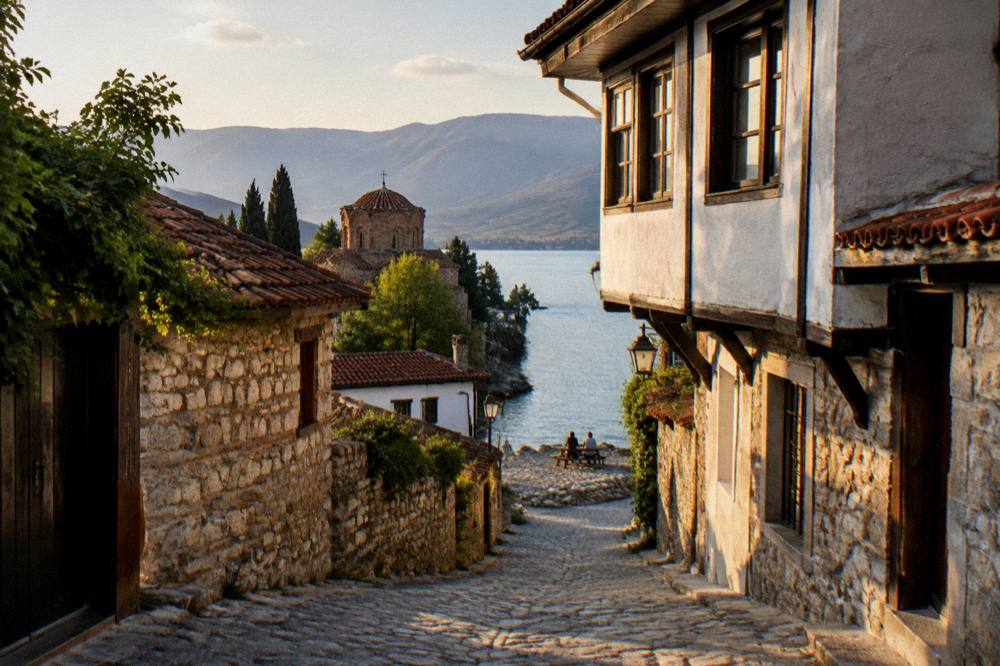
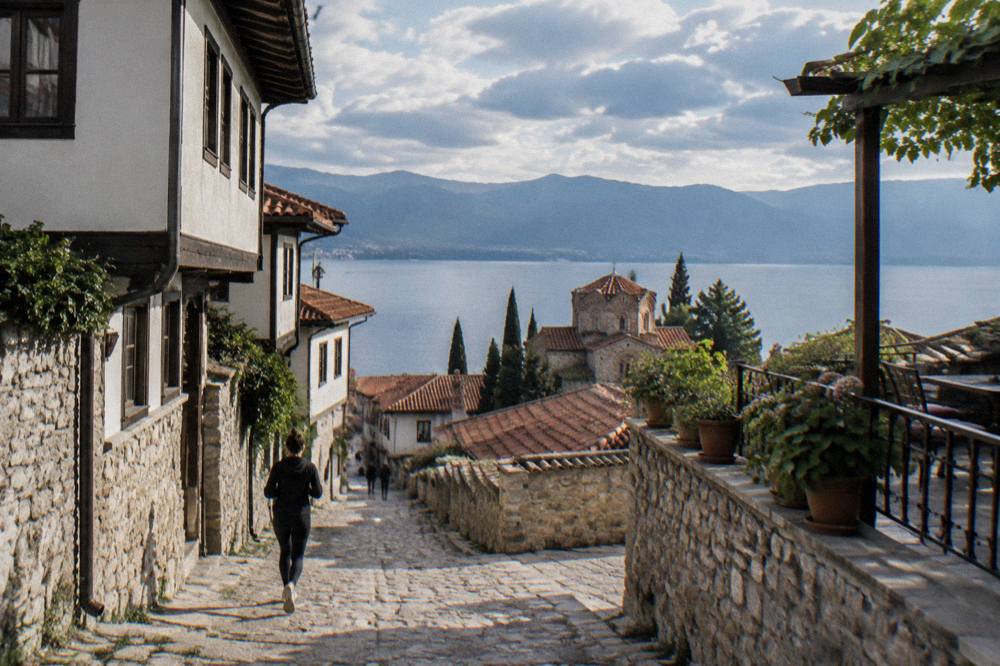
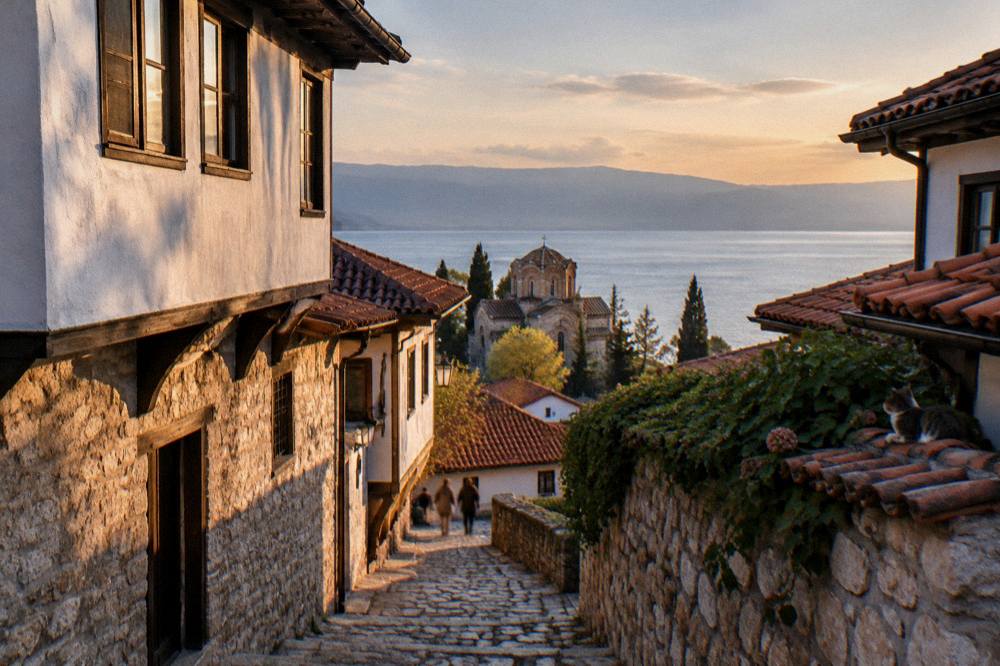
The old town is the practical base for a cheap trip to Ohrid, because its lanes are entirely on foot, the main sights sit inside a short walk of each other, and the climb from the lake up to Samuel's Fortress means a bus or taxi is rarely needed for a day of sightseeing. The old town climbs from the lake to the fortress, and the lanes are on foot. Staying inside it removes local transport from the daily budget almost entirely.
That walking geography is the single biggest saver in Ohrid. A guesthouse or hostel in the old town puts the Old Bazaar, St Sophia, Plaosnik, the Ancient Theatre site and the Church of St John at Kaneo district within one pedestrian circuit, so the day's only fixed costs become museum tickets and food. The trade-off is that the old town sits on a hill: bags go up and down slopes, and a room low near the water means a longer climb home.
Outside the old core, the lakeshore villages each carry a different logic for a cheap stay. Peshtani, on the road toward St Naum, holds the Bay of Bones museum site, so a room there pairs a swim with one ticketed sight. Lagadin and Trpejca sit further along the same shore. Struga, the neighbouring town on the Black Drim, is a separate place reached by local bus and is covered in its own guide to Struga. For a fuller comparison of districts, see where to stay in Ohrid.
One 2026 change matters if you plan to rent anything with wheels or drive in: from summer 2026 the streets of the old town's core, including Ilindenska, Kosta Abrash and Car Samoil, run a resident-only parking regime, with clamping reported for non-residents, per the municipal reporting on the new rules. A budget stay inside the old town means you never have to think about that regime at all. Parking more broadly is covered in the Ohrid parking guide.
What Does A Cheap Day In Ohrid Actually Cost?
A realistic cheap day in Ohrid costs as little as one museum ticket, 150 MKD for foreign visitors or 120 MKD domestic, at any of the museum institute's sites such as Robev Family House, the Museum on Water at the Bay of Bones, or the Icon Gallery, since the shoreline, the Old Bazaar lanes, and the town's outdoor spaces are free, with food from bakers and market stalls keeping eating costs to a handful of coins.
The museum institute's own website lists its tickets plainly: 120 den domestic, 150 den foreign, with a children and student rate reported at 60 den. Those rates apply across the institute's listed sites, including Robev Family House, the Museum on Water at the Bay of Bones and the Icon Gallery at the Perivleptos complex. The sites run a winter schedule from 1 October to 30 April and a summer schedule from 1 May to 30 September, and the listed sites are closed on Mondays. Plan a Monday around the outdoors.
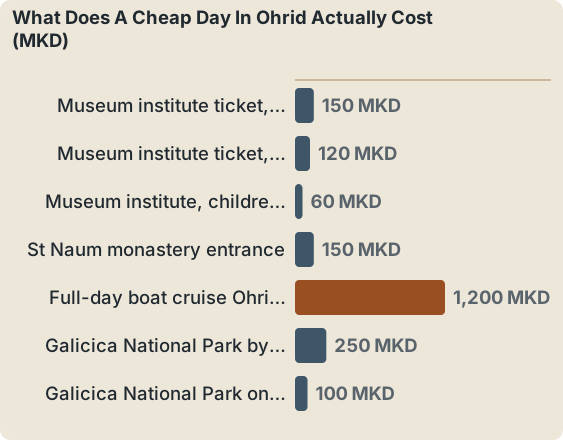
| Fixed local cost | Figure | Notes |
|---|---|---|
| Museum institute ticket, foreign adult | 150 MKD | Robev Family House, Museum on Water, Icon Gallery |
| Museum institute ticket, domestic adult | 120 MKD | Same ticket system |
| Museum institute, children and students | 60 MKD (reported) | Rate reported, not on the institute's own price line |
| St Naum monastery entrance | 150 MKD | Per the cruise operator's listed exclusions |
| Rowboat at the Crn Drim springs | about 5 EUR | Per the same operator listing |
| Full-day boat cruise Ohrid to St Naum (Boat Armada) | from 1,200 MKD adult, 600 MKD child | 7 hours, per the operator's page |
| Galicica National Park by car | 250 MKD per vehicle | No per-passenger fee |
| Galicica National Park on foot (Ohrid-side gate) | 100 MKD | Applies only to those entering on foot |
Food is where a budget flexes. The Ohrid food guide covers what the town eats, from tavche gravche to lake trout, and the restaurant guide covers where; the cheap version of both is the bakery-plus-market pattern that keeps a day's eating to a handful of coins, with one proper sit-down meal at the end of it. Cooking for yourself, in a hostel kitchen or an apartment, is covered below.
For orientation on a first day, the small-group city walk of the old town from the site's tour roster is the natural pairing with a budget stay, and there is a longer walking tour guide for planning the route yourself. The tour's own listing carries its current price and availability: Check availability.
Happy to tip what the walk was worth at the end. Book a free Old Town walking tour here.
Which Ohrid Sights Cost Nothing To See?
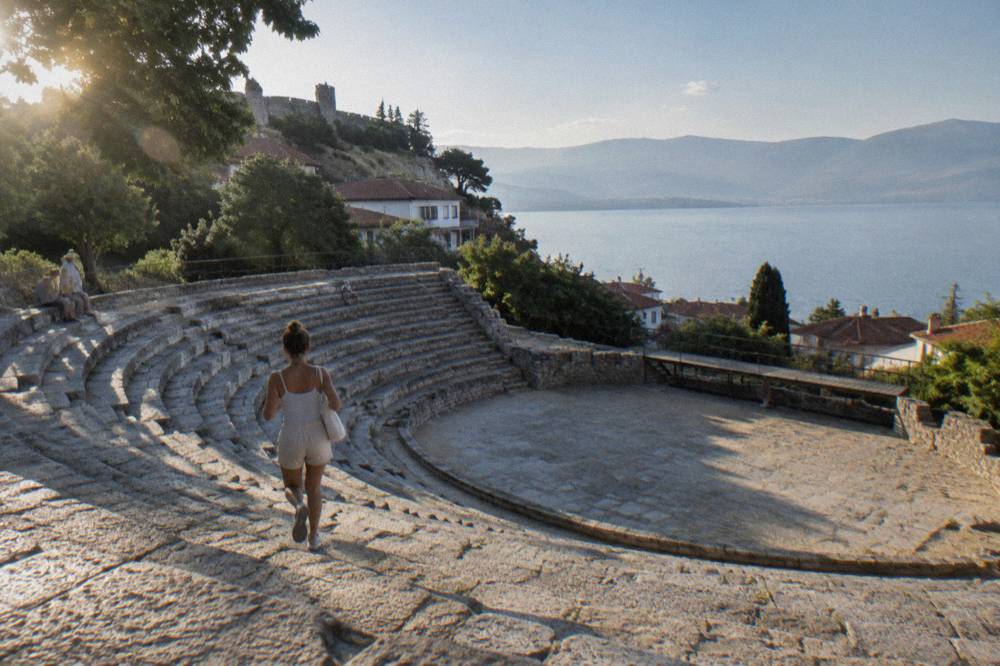
The free layer in Ohrid is unusually deep for a UNESCO town: the lakeshore and public water access, the Old Bazaar, the lanes of the old town and the walk up toward the fortress all cost nothing, and the Ancient Theatre site, managed by the museum institute with no fee listed on its page, has long served as an open performance space during the Ohrid Summer Festival rather than a ticketed room.
The lake itself is the town's largest free asset. Public swimming, the water temperature through the year and the beaches are covered in the swimming in Lake Ohrid guide and the beaches guide; modelled lake surface temperatures run from about 4.6 C in January to about 23.5 C in August, with the swimming season typically from July. The 2026 bathing tests found the water Class I physico-chemically except Grashnica beach at Class III, per the Institute of Public Health reporting, so a budget swimmer has current information to work with.
| Free or near-free in Ohrid | What it is |
|---|---|
| Old Bazaar | The historic market streets, open public space |
| Old town lanes and the climb toward the fortress | Pedestrian network, no charge |
| Lakeshore and public water access | Swimming and shoreline, no charge |
| Lake Ohrid itself | A freshwater mountain lake at about 693 m above sea level |
| Ohrid Summer Festival performances at open venues | The 66th edition opened 12 July 2026 at the Ancient Theatre |
The festival point deserves its own sentence. The 66th Ohrid Summer Festival ran from 12 July to 20 August 2026, with the opening gala at the Ancient Theatre, per the festival programme reporting, and the theatre's own museum page records its late-Hellenistic construction and its excavations from 1935. The full event picture, including the Balkan Festival and the Water Festival, is in the events overview.
How Do You Eat Cheaply In Ohrid Without Missing The Food?
Eating cheaply in Ohrid means building each day around bakery bread, burek-style pastries and market produce, then spending the saved money on one proper meal of Macedonian cooking, ideally one you can also learn to cook yourself, since the town's cooking classes cover exactly the dishes the cheap restaurants charge for, and tavche gravche, the national baked bean dish, is inexpensive by nature.
The logic is simple and the Macedonian food background supports it: the cuisine's staples are beans, bread, cheese, peppers and lake fish, and the first four are market-aisle cheap anywhere in North Macedonia. Lake trout, the famous exception, sits at the other end, and its story is covered in the Ohrid trout guide. Rakija and Macedonian wine have their own page, and a glass at a market-adjacent bar rather than a quay restaurant keeps the evening inside budget.
Hostel and apartment kitchens change the arithmetic entirely. A self-catering budget traveller in Ohrid buys from the bakers early, the market through the day, and cooks the protein at home. The cooking class option in the tour roster above turns that same instinct into an activity: a class ends with a meal included, which makes it a food spend and an entertainment spend at once.
| Eating approach in Ohrid | Budget effect |
|---|---|
| Bakery breakfast (bread, pastry) | Lowest fixed food cost of the day |
| Market produce for lunch | Cheap, self-catering friendly |
| One sit-down Macedonian meal daily | The single planned spend |
| Cooking class with meal included | Combines activity and dinner |
| Quay-front restaurants | The expensive tier, easiest to skip |
For the timing of a food-centred visit, the best time to visit Ohrid guide pairs the calendar with what is open.
Is Ohrid Safe For Budget Travellers?
Ohrid is considered safe for budget travellers, with the US State Department advisory for North Macedonia at Level 1, Exercise Normal Precautions, per its country page, and the town posing the ordinary risks of a small lakeside place rather than any specific threat to visitors; emergency numbers are ambulance 194, police 192 and roadside assistance 196, per the UK foreign office's help page for the country.
The is Ohrid safe guide covers this in full. For the budget traveller specifically, the practical notes are few. The old town's lanes are pedestrian and steep, so sensible shoes matter more than caution. The lake is a freshwater mountain lake and swimming areas are tested; the 2026 results are noted above. Tap water in Ohrid is generally drinkable, per the secondary reporting on the municipal supply, which removes bottled water from the daily budget; the question has its own page in can I drink the water in Ohrid.
Entry rules matter to anyone stretching a trip. Visa-free nationals may stay up to 90 days in any 180-day period, per the foreign ministry's entry page, and UK visitors may stay up to 3 months with a passport valid at least 90 days after arrival. Visitors register with the local police within 48 hours, and hotels do it as part of check-in, which is one quiet argument for staying in licensed hostels and guesthouses rather than informal arrangements. North Macedonia is not in the EU or Schengen, so EU rules on roaming, payments and movement do not apply; the visa and entry guide carries the details.
How Do You Handle Money On A Budget Trip To Ohrid?
The currency is the Macedonian denar (MKD), euros are commonly quoted by operators but are not legal tender, and the practical budget routine in Ohrid is to withdraw or exchange denars and pay local costs in MKD exactly as they are priced, from the 150 MKD museum ticket to the 250 MKD Galicica vehicle fee, never converting a local price in your head.
The denar is de facto pegged to the euro through the National Bank's exchange-rate targeting, per the central bank's own framework, which is why euro-denominated tour quotes and denar-denominated local costs sit side by side without chaos. Bookable products priced in dollars or euros render their own prices from their listings and are never converted by hand. The Macedonian denar and money guide covers the whole system, and the cost and budget guide frames the overall spend.
Flights into Ohrid arrive at St Paul the Apostle Airport, about 10 km from the centre, per the airport's own passenger page; the Ohrid airport guide covers arrivals. Overland, Skopje is about 170 km away by road and the Skopje to Ohrid and Tirana to Ohrid guides cover the two main approaches, both of which are covered in how to get to Ohrid.
Can You See Ohrid Without Spending On Transport Inside The Town?
Yes, and this is Ohrid's quiet budget advantage: the town has no trams or rail, the old town is fully walkable, the classic climb from the lake to the fortress can be done on foot, and the only transport a budget traveller usually pays for is the occasional taxi or the local bus toward Struga or the lakeshore villages, both of which are cheap by the standards of Western Europe.
Taxis in Ohrid are covered in the taxis guide, and the general advice in the secondary reporting is to agree the price in advance where there is no meter. Car rental has its own page at Ohrid car rental, but a budget stay inside the old town rarely needs one: Galicica National Park trips and the drive to St Naum are the two cases where wheels help, and both are also served by boat from the port in season. The lake boats, including the full-day cruise to St Naum with its Bay of Bones stop, are covered in the lake boats and ferries guide.
| Getting around Ohrid | Budget relevance |
|---|---|
| Walking the old town | Free, and the main mode |
| Taxi for bags or airport runs | Occasional, agree the fare in advance |
| Local bus toward Struga and shore villages | Cheap link out of town |
| Boat from the port toward St Naum | Seasonal, doubles as the sightseeing |
| Car for Galicica and Lake Prespa | Optional; the park charges 250 MKD per vehicle |
Day trips from a budget base work the same way. St Naum from Ohrid, Galicica National Park, Lake Prespa and Struga from Ohrid are all covered separately, and each can be done as a cheap day with one fixed cost at most.
What Does A Sample Low-Cost Day In Ohrid Look Like?
A sample cheap day in Ohrid runs like this: a bakery breakfast in the old town, a morning walk through the Old Bazaar and up past St Sophia and Plaosnik toward the fortress hill, one museum ticket at 150 MKD at Robev Family House or the Icon Gallery, a swim or shoreline afternoon instead of a paid activity, and a self-catered or simple restaurant dinner, keeping the day's fixed costs to one ticket plus food.
Timing matters more than spending. The museum sites close on Mondays and run their winter schedule from 1 October to 30 April, with Robev Family House at 09:00 to 15:30 in winter and the Icon Gallery at 09:00 to 14:00, per each site's own page. In summer, from 1 May, the schedules lengthen. A budget day that puts the ticketed sight first and the free afternoon second survives any season.
| Time | Cheap-day plan | Fixed cost |
|---|---|---|
| Morning | Bakery breakfast, Old Bazaar walk | Food only |
| Late morning | Plaosnik, fortress hill lanes, one museum site | 150 MKD ticket |
| Midday | Market lunch or picnic by the lake | Food only |
| Afternoon | Swim or shoreline walk | None |
| Evening | Self-catered or simple Macedonian dinner | Food only |
For a fuller version, the Ohrid in one day and Ohrid in two days itineraries build on the same spine, and the how many days in Ohrid guide answers the length question. Weather shapes the day more than the wallet does: modelled ERA5 climate normals for 1991 to 2020 put July's mean daily high at 27.1 C and January's mean daily low at minus 0.8 C, with August rain averaging 32.9 mm and December 92.6 mm, so the free afternoon swims best in summer and the free walks best outside the deepest winter. The Ohrid weather guide has the monthly detail.
Which Season Gives A Budget Trip The Best Value In Ohrid?
The shoulder months give a budget Ohrid trip its best value, because the lake is swimmable at the edges of summer, the modelled water temperature runs about 14.9 C in May and about 19.7 C in September, the August peak crowds thin out, and the museum summer schedule, which runs from 1 May to 30 September, is still in force, so nothing a visitor wants to see is on its shortened winter hours.
The seasonal guide set covers each window in turn: Ohrid in spring, Ohrid in summer, Ohrid in autumn and Ohrid in winter. The budget angle in each is the same trade: winter means fewer boat options, since boats toward St Naum generally run about May to October with a reduced winter schedule, but also a town where the free layer, the lanes, the lake shore and the churches seen from outside, carries the visit. The is Ohrid worth visiting in winter page answers that question directly.
One seasonal cost trap deserves a flag. The 2026 lake navigation decision bans jet skis from 1 July to 31 August between 11:00 and 19:00 and restricts night boating from early June through September, per the Ministry of Transport's June 2026 statement, so boat-based days in high summer run inside those windows. A budget traveller booking any lake activity should read the listing's own times rather than assume an evening cruise exists in August.
Common Questions About Ohrid Budget Stays
Accommodation rates vary by season and are best checked directly.
What currency do budget travellers need in Ohrid?
The Macedonian denar (MKD). Euros are commonly quoted by tour and transfer operators but are not legal tender, and local costs such as museum tickets are priced in denars. The money guide covers the full system.
Are the main sights in Ohrid free?
The outdoor layer is free: the lanes, the shore, the Old Bazaar and the walk toward the fortress. The museum institute's sites, Robev Family House, the Museum on Water and the Icon Gallery, charge 150 MKD foreign and 120 MKD domestic, and they are closed on Mondays.
Can you swim in Lake Ohrid for free?
Yes. Public lake access costs nothing, the modelled surface water runs about 23.5 C in August, and the 2026 bathing tests found Class I physico-chemical quality except Grashnica beach at Class III. The swimming guide has the detail.
Do budget visitors need a car in Ohrid?
Usually not. The old town is entirely walkable, the lakeshore villages are linked by local bus, and the full-day boat cruise toward St Naum doubles as transport and sightseeing in season. A car mainly helps for Galicica National Park and Lake Prespa day trips.
When is the cheapest time to visit Ohrid?
The shoulder months around the edges of the summer season pair lower demand with the museum summer schedule, which runs from 1 May to 30 September. Boats toward St Naum generally run about May to October. The best time to visit guide compares the seasons.
A budget stay in Ohrid comes down to three decisions: sleep inside or beside the walkable old town, spend on the one or two museum tickets that matter and let the free lake and lanes carry the rest, and eat from the market layer with one proper Macedonian meal a day. Everything else in this things to do in Ohrid roundup layers on top of that frame without changing its arithmetic.